Threshold FlipThem: When the winner does not need to
take all
David Leslie1, Chris Sherfield2, and Nigel P. Smart2
1
Department Mathematics and Statistics, University of Lancaster,
Department of Computer Science, University of Bristol, UK,
[email protected], [email protected].
Abstract. We examine a FlipIt game in which there are multiple resources which a monolithic attacker is trying to compromise. This extension to FlipIt was con-sidered in a paper in GameSec 2014, and was there called FlipThem. Our analysis of such a situation is focused on the situation where the attacker’s goal is to com-promise a threshold of the resources. We use our game theoretic model to enable a defender to choose the correct configuration of resources (number of resources and the threshold) so as to ensure that it makes no sense for a rational adversary to try to attack the system. This selection is made on the basis of the relative costs of the attacker and the defender.
1
Introduction
At its heart security is a game played between an attacker and a defender; thus it is not surprising that there have been many works which look at computer security from the point of view of game theory [1, 9, 12, 15]. One particularly interesting example is the FlipIt game developed by van Dijk et al [16]. In FlipIt the attacker and defender are competing to control a resource. Both players are given just a single button each. The attacker gets control of the resource by pressing her button, whilst the defender can regain control by pressing his button. Pressing the button has a cost for each player, and owning the resource has a gain.
In this work we examine the FlipIt game in the situation where the defender has mul-tiple resources, and the attacker is trying to obtain control of as many of these resources as possible. This was partially considered before in the paper [7], who introduced a vari-ant of FlipIt called FlipThem in which the defender has control of multiple resources. Instead of flipping the state of a single resource from good to bad, the attacker is trying to flip the states of multiple resources. In [7] the authors examine the simplest situations in which an attacker “wins” if he has control of all resources, and a defender “wins” if she has control of at least one resource. Thus using the terminology of secret sharing schemes the paper [7] considers only thefull thresholdsituation.
In this paper we study non-full threshold cases. This is motivated by a number of potential application scenarios which we now outline:
try to knock out a proportion of the servers so as to reduce the owners quality of service below an acceptable level.
– Large networks contain multiple paths between different nodes; again to protect against attacks. An attacker will not usually be successful if he knocks out a sin-gle path, however knocking out all paths is overkill. There will be a proportion of the paths which will result in a degradation of the network connectivity which the attacker may want to achieve.
– In many computer systems multiple credentials are needed to access a main re-source. Thus an attacker only needs to obtain enough credentials to compromise a main resource. Thus modelling attacks on credentials (e.g. passwords, certificates, etc) should really examine the case of multiple credentials in the non-full threshold case.
– Multi-Party Computation (MPC) has always used threshold adversaries; an external attacker trying to compromise a system protected with MPC technology will only be interested in obtaining a threshold break above the tolerance limit of the MPC system. In such a situation however one is interested in proactively secure MPC systems, since when modelled by FlipThem a defender may regain control of a compromised party.
– Related to the last point is that of fault tolerance. It is well known that Byzantine agreement is not possible if more thann/3of the parties are compromised. Thus an adversary who simply wants to inject errors into a network protected by some Byzantine agreement protocol only needs to compromise more than n/3 of the servers.
Thus we examine variants of the FlipThem game of [7] in which an attacker is trying to obtain control of at leasttof the resources. We call this the(n, t)-FlipThem game.
defender to maximise his benefit decreases. For single reset, the analysis is harder by hand. However, using numerical methods, one can find analogous results.
1.1 Prior Work
The FlipIt game has attracted attention as it focuses on the situation where the attacker always gets in; building on the modern appreciation that perimeter defence on its own is no longer enough. For example the paper [2] examines the FlipIt game as applied to various different situations in computer security; for example password reset strategies, key management, cloud auditing and virtual machine refresh methodologies.
Despite its simplicity the FlipIt game is rather complex in terms of the possible different attacker and defender strategies, and can be modified in various ways. In the original FlipIt game both the attacker and the defender are ‘stealthy’ in the sense that neither knows if the other controls the resource before they execute a button press. In [13] the authors introduce a new mechanism where by a player can test who controls the resource. The idea being to model the situation whereby investigating whether a breach has occured is less costly than clearing up after a breach. Thus a ‘peek’/‘probe’ at the resource state costs less than taking control of the resource. The paper [13] then moves onto discuss situations where a resource becomes hardened over time; meaning that every time a player moves on a resource he already controls, part of the move consists of making it harder for the opponent to regain control of the resource. An example would be a system administrator resetting the system to regain control and then patching the system so the attacker can not use the same method of infiltration.
One can think of the ‘peek’/‘probe’ at the resource state from [13] as a way of removing the stealthiness from the FlipIt game. In [8] a different approach is proposed in whichdefendermoves are not stealthy, i.e. an attacker knows if the defender controls the resource. This is introduced to model situations such as password resetting, in which an attacker knows when the password is reset (as he is no longer able to login), but the defender may not notice that their password is compromised. As well as this non-stealthy mode of operation the paper also introduces the idea of a defender trying to defend against multiple (independent) attackers.
The main prior work related to the current paper is that of Laszka et al [7]. They consider the same situation as us of multiple resources being attacked by a single mono-lithic adversary. However, their work has a number of distinct differences. Firstly, and most importantly, they focus on the case where an attacker wins if he controls all re-sources, and the defender wins when he controls one resource. We on the other hand examine a general threshold structure. Secondly, the paper of Laszka et al considers two types of strategies defined by periodic and non-arithmetic renewal processes1. The paper establishes some basis facts on these strategies, but does not consider construct-ing full benefit functions for either of these strategies and nor does it find analytic Nash equilibria for the strategies. This is due to the analytic difficulty in obtaining such for-mulae.
1
Given this (relatively) negative result the paper moves onto considering strategies arising from Markov processes. They develop a model for two resources, considering discrete time steps and set up a linear programming solution that becomes more com-plicated as the finite time horizon extends. We on the other hand are able to obtain simpler analytic formulae by considering a continous Markov process. This is because in [7] when constructing the Markov chain, they consider the state space to be the inter-arrival times of each resource with respect to the attacker.
In our paper we set up the state space to be the number of resources compromised at a specific (continuous) time. Thus moving from discrete to continuous time, and Markov to Stochastic processes simplifies the analysis somewhat. Without this simpli-fication the paper [7] looks at two specific examples; trying to find the optimal strategy of the attacker given the strategy of the defender, and then the optimal flip rates that maximise the benefit at the defender side given that the attacker plays optimally. Fi-nally they briefly mention how to find a Nash equilibrium, stating there is a simple iterative algorithm to find one but they state that algorithm will not converge for the majority of cases.
The paper [17] also considers a number of extensions of the FlipIt paper, and much like that of Laszka et al comments on the difficulty of obtaining analytic solutions to the Nash equilibrium. Therefore, they adopt a simulation based method. The attackers prob-ability of compromising increases progressively with probing, while the defender uses a moving-target technique to erase attacker progress. The paper extends the model to multiple resources and considers a time dependent ‘reimage’ initiated by the defender, much like our full reset play of the defender described above. In addition [17], much like our own work, sets up a situation of asymmetric stealth in that the attacker can always tell when the defender has moved however the defender does not know when the attacker has compromised the resource but finds this out when he has probes the resource.
Having multiple resources which an attacker needs to compromise also models the situation of a moving target defence and a number of game theoretic works are devoted to other aspects of moving target defence including [3, 18]. Since these works are not directly related to our own work we do not discuss them here.
2
The Multi-Party FlipIt Model
Our basic multi-party FlipIt game, or FlipThem game, consists of a defender who is trying to protect against an attacker getting control ofndifferent resources. It may help the reader to notice how at each point our game degenerates to the FlipIt game when
n= 1.
threshold tolerated by the MPC protocol; e.g.t = n/3,t = n/2 or t = n. Note, in the case of MPC protocols, the ability of the defender to reset all resources is a common defence against mobile adversaries, and is thus related to what is called pro-active security in the MPC community [11].
The variableDB is the multiplicative factor of the defender’s benefit (i.e. the
ben-efit obtained per unit time), the same for the attacker’sAB. The values are potentially
distinct, since the defender could gain more (or less) than the attacker for being in con-trol of the system for an amount of time. The valuesDc andAc are respectively the
defender and attacker’s cost per action they perform. We setd= Dc
DB to be the ratio of the defender’s cost and benefit. Similarly for the attacker,a = Ac
AB. We then consider the ratioρ= ad = Ac·DB
AB·DC. Much of our analysis will depend on whetherρis large or small; which itself depends on the relative ratios of the benefit/costs of the attacker and defender. With each application scenario being different. A game where the costs are normalized in this way we shall call a “normalized game”.
For each time period for which the attacker obtains control oft or more of the resources it obtains a given benefit, whereas for each time period that he does not have such control the defender obtains a benefit. In the normalized game we assume the attacker’s benefit lies in[0,1]and is the proportion of time that he controls the resource; whilst the defenders benefit is the proportion of time in which they control the resource. Thus in the normalized game the benefits always sum to one.
In all games the utility for the attacker is their benefit minus their cost of playing (i.e. the cost of pushing the buttons), with the utility for the defender obtained in the same manner. Therefore, the game is non-zero sum. The attacker (resp. defenders) goal is to derive a strategy which maximises their respective utility.
In one basic normalised “Single Reset” game the defender has a set ofnbuttons; there is one button on each resource which when pressed will return that resource to the defenders control, or do nothing if the resource is already under the defenders control. Pressing the resource’s button costs the defender a given value, which in the normalized game is the valued. In another normalised “Full Reset” game addition there is a “master button” which simultaneously returns all resources to the defenders control. Pressing the master button costs the defender a value which we shall denote byDn, the value of
which depends onn, the number of resources. The reason for having a master button is to capture the case when resetting the entire system in one go is simpler than resetting each resource individually. In particular we assume thatd≤Dn. To simplify our games
we assume that the defender does not have access to the master button and the individual resource buttons in a single game. This property could be relaxed which would result in a much more complex analysis than that given here.
The attacker has a set ofnbuttons, one for each resource. When the attacker presses a resources button it will allow the adversary control of that resource, or again do noth-ing if the resource is already under the attackers control. The cost to the attacker of pressing one of its buttons isain the normalized game.
situation, if we assume a defender is not stealthy (but the attacker is) we are said to be in a one-way stealthy situation.
Throughout the paper we model a number of games. We denote FlipThemR (n, t, d, ρ)
to be the game of partial threshold FlipThem. By abuse of notation we also think of FlipThemR (n, t, d, ρ)as a function which returns all the rates of play strategy pairs for the defender and attacker that are Nash Equilibria whereR ∈ {F,S}. Here we denote byF the full reset game andSthe single reset game, both to be described in detail in later sections. The variablesn,t,d ρanddenote the number of resources, the thresh-old, the defender’s cost of play, the ratio between the attacker’s and defender’s cost and the lowest rate of play in the defender’s strategy space(,∞]respectively. Having
> 0 recognises the fact that the defender will never actually set the reset rate to 0. It also ensures that the benefit functions are well defined for all valid attacker-defender strategy pairs. We will not treat the choice of ourto be strategic, it will be a very small number, close to zero to represent that even when the attacker has given up (plays a rate of zero) the defender will not.
We also use a function OptRN,(d,T, ρ)to answer the following question: Given the ratioρof costs of play between the attacker and defender and a limit N for the number of resources the defender can own, what is the best set up for the defender in order to maximise their benefit function? The function OptRN,(d,T, ρ)plays the first
game FlipThemR (n, t, d, ρ)for allnand alltsubject to some constraint spaceT2. The function OptRN,(d,T, ρ)then finds the values ofnandtwhich produce the greatest possible benefit for the defender.
3
Obtaining Nash Equilibria in Continuous Time for a Stochastic
Process
In this section we analyse various different cases of our basic game FlipThemR (n, t, d, ρ). To explain the basic analysis techniques in a simple example; we first examine the game FlipThemF0(n, n, d, ρ). In this game the defender can perform a full reset and the at-tacker is trying to compromise allnservers (i.e. the full threshold case). We also, again for initial simplicity and exposition purposes, assume that the defender could decide not to play, i.e.= 0. A moments thought will reveal in practice that such a strategy is not realistic. In the later sub-sections we remove these two simplifying assumptions and examine other cases. In particular in Section 3.3 when we consider defender performing single resets, the analysis becomes more complex.
3.1 Simple Example, FlipThemF0(n, n, d, ρ): Full Threshold, Full Reset
We first consider a simple example of our framework in which the time an attacker takes to successfully compromise an individual resource follows an exponential distri-bution with rateλ, and the defender performs a full reset, and thus regains control of all resources, at intervals with lengths given by an exponential distribution with rateµ. An alternative description is that individual resources are compromised on at the arrival
times of a Poisson process with rateλ, and the state is reset at the arrival times of a Poisson process with rateµ.
In this context we think of the attacker as being stealthy, i.e. the defender does not know how many resources are compromised when he does a full reset. A moment’s thought will also reveal that in this situation it makes no difference if the defender is stealthy or not; if the defender is not stealthy then the attacker will always pick an uncompromised resource to attack, whereas if the defender is stealthy then the attacker is more likely to compromise an uncompromised resource by picking one which he knows he controlled the longest time ago. Thus an attacker simply attacks each resource in turn, given some specific ordering.
We model the number of resources compromised by the attacker at timeτas a fam-ily of random variablesX ={X(τ) :τ≥0}in the finite spaceS={0, . . . , n}. Since both the defender and attacker follow memoryless strategies (with memoryless expo-nential random variables determining the times between changes of state) the processX
is a continuous time Markov chain. Following the analysis of continuous time Markov chains in Grimmet et al. [5], for such a process there exists an|S|×|S|generator matrix
Gwith entries{gij :i, j∈S}such that
Pr[X(τ+h) =j|X(τ) =i] =
(
1 +gii·h+o(h), ifj=i,
gij·h+o(h), ifj6=i.
The generator matrixGfor continuous time Markov chains replaces the transition ma-trixP for discrete time Markov chains; entrygij fori 6= j is the “rate” of transition
from stateito statej. Summing equation (3.1) overjimplies thatP
j∈Sgij = 0, so
thatgii =−Pj6=igij≤0. Basic theory [5] tells us that when the chain arrives in state
iit remains there for an amount of time following a Exponential(−gii) distribution, then
jumps to statej6=iwith probability−gij/gii.
Considering our specific example with the defender using full reset, we can consider our model as a “birth-reset process” (by analogy with a “birth–death process”) in which
Pr[X(τ+h) =j|X(τ) =i] =
λ·h+o(h), ifj=i+ 1, µ·h+o(h), ifj= 0,
1−(λ+µ)·h+o(h), ifj=i,
o(h), otherwise.
Thus,gi0 = µ,gi,i+1 = λ,gii = −(µ+λ)andgij = 0otherwise. From this the
generator matrix can be constructed:
G=
−λ λ 0 0. . . 0 0
µ −(µ+λ) λ 0. . . 0 0
µ 0 −(µ+λ)λ . . . 0 0 ..
. ... ... ... . .. ... ...
µ 0 0 0. . .−(µ+λ) λ
µ 0 0 0. . . 0 −µ
.
occurs) or to state0with probabilityµ/(λ+µ)(when the reset occurs before another resource is compromised). Clearly the chain is never going to settle in one state; it will continue to randomly fluctuate between various states depending on the rates of playµandλ. However further theory [5] indicates that the long run proportion of time the system spends in each state is given by the stationary distribution, a row vector
π= (π0, . . . , πn)such thatπG= 0andPni=0πi= 1.
Using our specific generator matrixGit can be shown that
π=
µ
µ+λ, µ·λ
(µ+λ)2, . . . ,
µ·λn−1
(µ+λ)n,
λn
(µ+λ)n
. (1)
This tells us the proportion of time spent in each state. We therefore obtain the benefit functions of
βD0 (µ, λ) =DB·(1−πn)−Dc·µ
and
βA0 (µ, λ) =AB·πn−Ac·λ
whereβ0Dis the benefit function of the defender andβ0Ais the benefit function of the attacker. We can then normaliseβD0 andβ0Asuch that
βD(µ, λ) =
βD0 DB
= 1−πn−d·µ= 1−
λn
(µ+λ)n −d·µ
and
βA(µ, λ) =
βA0 AB
=πn−a·λ=
λn
(µ+λ)n −a·λ,
whereβDis the normalized benefit function of the defender andβAis the normalized
benefit function of the attacker.
Recall that in this model, when the defender plays he is resetting all resources at once. Therefore, the normalized cost of the defenders movedis likely to depend onn, the number of resources. We represent this by settingd=Dn.
Using the stationary distribution described above the benefit functions for the nor-malized game are
βD(µ, λ) = 1−
λn
(µ+λ)n −Dn·µ and βA(µ, λ) =
λn
(µ+λ)n −a·λ. (2)
We are assuming that both players are rational, in that they are both interested in max-imising their benefit functions, and will therefore choose a rate (λor µ) to maximise their benefit given the behaviour of their opponent. A pair of rates at which each player is playing optimally against the other is called a Nash equilibrium [10]. At such a point neither player can increase their benefit by changing their rate; we are looking for pairs (λ∗, µ∗)such that
βD(µ∗, λ∗) = max µ∈R+
βD(µ, λ∗) and βA(µ∗, λ∗) = max λ∈R+
βA(µ∗, λ).
whenλ =µ = 0the Markov chain never makes any transitions. In later sections we will boundµbelow to remove this solution and for now we will search for non-trivial solutions.
Differentiating the defender’s benefit functionβDwith respect toµand solving for
µgives at most one non-negative real solution, given by
ˆ
µ(λ) = n+1 r
nλn
Dn
−λ
Ifλ < Dn
n then this is positive, and checking the second derivative confirms this corre-sponds to a maximum. Ifλ≥ n
Dn then
∂βD
∂µ <0for allµ≥0and so the optimal rate
for the defender isµ= 0. Hence the best response of the defender is given by
ˆ
µ(λ) =
(
n+1 q
nλn
Dn −λ ifλ <
n Dn 0 ifλ≥ n
Dn.
We now calculate
∂βA
∂λ =
n·µ·λn−1 (µ+λ)n+1 −a.
A closed form solution forλwhich equates this to 0 is not easy to calculate directly. However, plugging inµˆ(λ∗)we see thatλ∗must be either 0 or satisfy
n·µˆ(λ∗)·(λ∗)n−1
(ˆµ(λ∗) +λ∗)n+1 −a= 0. (3)
If it were the case that λ∗ ≥ n
Dn thenµˆ(λ
∗) = 0and there are no solutions to this equation. Note that this indicates that no equilibrium exists when the attacker’s rate is too high — the intuition for this is if the attacker’s rate is sufficiently high, the defender ceases to defend, and thus the attacker can do just as well by reducing their rate. Thus
at any equilibrium we must haveλ∗ < n
Dn,and thereforeµ
∗ = ˆµ(λ∗) = n+1qn(λ∗)n Dn . Plugging this back into equation (3) we see that either
λ∗ = n·D
n n
(Dn+a)n+1
, µ∗= ˆµ(λ∗) = n·a·D
n−1
n
(Dn+a)n+1
, (4)
or µ∗ = λ∗ = 0. The non-zero solution will only correspond to a Nash equilibrium ifβA(µ∗, λ∗)≥βA(µ∗,0) = 0, since otherwiseλ∗is not a best response againstµ∗.
Note that this is the case if
0< (λ
∗)n
(µ∗+λ∗)n −a·λ
∗= (Dn)n
(Dn+a)n+1
(Dn+a·(1−n))
i.e. ifa/DN <1/(n−1).
In the game FlipThemF0(n, n, Dn, ρ)we have definedρto be the ratio between the
returns the list{(0,0)}for allρ >1/(n−1). Ifρ <1/(n−1)we have a further equi-librium(µ∗, λ∗)such that the game returns the list{(0,0),(µ∗, λ∗)}where
µ∗= n·ρ
Dn·(1 +ρ)n+1
, λ∗= n
Dn·(1 +ρ)n+1
=µ∗/ρ.
The attacker’s cost per move is independent ofn, which implies that the defender will be successful, assuming Dn
n−1 is a decreasing function ofn, as long asnis large enough. Thus for the defender to always win we require the cost of a full reset to be a sublinear function of the number of resources.
In the case of resetting a cloud or web service this might be a reasonable assumption, but in the case of requiring nusers to reset their passwords it is likely that the cost is a superlinear function as opposed to sublinear due to the social cost in needing to implement such a password policy.
3.2 FlipThemF(n, t, d, ρ): (n,t)-Threshold, Full Reset
We now generalize the previous easy case to the threshold case FlipThemF(n, t, d, ρ), i.e. we treat the number of servers which the attacker has to compromise as a parameter
t, and in addition we bound the defenders strategy away from zero. Thus the defender not playing at all is not considered a valid strategy3. Much of the prior analysis carries through, since we are still assuming the defender performs a full reset on his turn. Thus the stationary distribution is once more,
π=
µ
µ+λ, . . . ,
µ·λk−1 (µ+λ)k, . . . ,
µ·λn−1 (µ+λ)n,
λn
(µ+λ)n
.
The (normalized) benefit functions are now derived from the ratio of times which the attacker has compromised at leasttresources, which simplifies due to the formula for geometric series:
βD(µ, λ) = 1−
λn
(µ+λ)n − n−1
X
i=t
µ·λi
(µ+λ)i+1 −Dn·µ
= 1− λ
t
(µ+λ)t−Dn·µ.
Using the same analysis, the attacker’s benefit isβA(µ, λ) = λ
t
(µ+λ)t −a·λ. Note that these benefit functions are identical to those in the full threshold case of the previous section, but withnreplaced byt. If we were still considering the lower bound for the defender’s rate of playto be zero the conclusions would be as before, but with the modification that we usetinstead ofn. Since we are now considering the more realistic assumption that > 0the analysis gets slightly more involved, but remains similar to that above. In particular
βD(µ, λ) = 1−
λ
λ+µ
t
−Dn·µ, and
∂βD
∂µ =
t·λt
(λ+µ)t+1 −Dn.
This derivative is decreasing inµ, and 0 atλ·
t λ·Dn
t+11
−1
. It follows immediately
thatβDis a unimodal function ofµ, so that the maximisingµvalue in[,∞)is given
by
ˆ
µ(λ) = min
(
, λ·
"
t λ·Dn
t+11
−1
#)
. (5)
As above, we have that
βA(µ, λ) =
λ
µ+λ
t
−a·λ and ∂βA
∂λ =
t·µ·λt−1
(λ+µ)t+1 −a. (6)
Thus for a particular value ofµthe maximisingλmust either be 0 or be a root of the derivative. However, explicitly solving forλdoes not appear to be possible, but we note that
∂2β
A
∂λ2 =
t·µ·λt−2
(λ+µ)t+2 ·[µ·(t−1)−2·λ]
so that the first derivative, ∂βA
∂λ , is increasing whenλ < µ·(t−1)/2then decreasing.
Since ∂βA
∂λ is equal to−awhenλ= 0and asymptotes to−aasλ→ ∞we have the
derivative increasing from−ato a maximum whenλ=µ·(t−1)/2then decreasing back to−a. The maximal value of∂βA
∂λ is given by
4·t·(t−1)t−1
µ·(t+ 1)t+1 −a, (7)
which is positive only ifµis sufficiently small. As a function ofλ,βAtherefore initially
decreases (from 0), has a period of increase only ifµis sufficiently small, then decreases again. It follows thatβAhas at most one non-zero maximum, which occurs in the region
(µ·(t−1)/2,∞)once the derivative is decreasing, and this fixed point maximises
βA(µ, λ)onλ∈[0,∞)if and only ifβA(µ, λ)>0; otherwise the best response must
beλ= 0. We use these insights to explore Nash equilibria directly. First consider the existence of a Nash equilibrium(µ∗, λ∗)withµ∗ > . Note that ifλ∗were equal to 0 then this would forceµ∗=, so it must be the case thatµ∗= ˆµ(λ∗)and∂βA
∂λ (µ
∗, λ∗) = 0. It follows from (5) and (6) that
a= t·µ
∗·λ∗t−1
(λ∗+µ∗)t+1 =Dn·
"
t λ∗·D
n
t+11
−1
#
and hence
λ∗= t
Dn·(1 +ρ)t+1
, µ∗= t·ρ
Dn·(1 +ρ)t+1
. (8)
We have checked necessary conditions so far, but have still not verified that thisλ∗
does correspond to a maximum ofβA. As observed above, the necessary and sufficient
condition is that
0< βA(µ∗, λ∗) =
1 +ρ−ρ·t
Thus an equilibrium of this form exists when
ρ < 1
t−1 and µ
∗= t·ρ
Dn·(1 +ρ)t+1
> .
Therefore, if the ratioρof the attacker’s cost and defender’s cost is less than t−11 then the game FlipThemF (n, t, d, ρ)returns the list consisting of two pairs, the trivial equi-librium of no play (from the attacker, the defender plays at minimal rate ) and an equilibrium at
µ∗= t·ρ
Dn·(1 +ρ)t+1
, λ∗= t
Dn·(1 +ρ)t+1
=µ∗/ρ.
Note that if the maximal value of the derivative ofβAis non-positive then no stationary
point ofβAexists, and soλwill be 0. By removing all local maxima of the attacker’s
payoff function we really would expect the attacker to just stop playing; i.e. this would be the perfect defenders strategy. From (7) we see that by taking
≥ 4·t·(t−1)
t−1
a·(t+ 1)t+1 (9)
we can ensure there is only the trivial equilibrium. Note that a simpler lower bound on
, which trivially implies the one above, is to take ≥ 4
a·(t+1). Note that choosing a sufficiently highin this way is very conservative. The rate of decrease ofβAis−aat
λ= 0and asλ→ ∞, so by insisting there is no local maximum at all we ensureβA
stays well away from0.
Picking to force out the attacker only makes sense if the defender’s benefit is actually maximised. It might be the case that stopping the attacker completely is not economically viable. Therefore, in such a caseshould be chosen to be very small, close to zero and the other equilibria in equation (8) should be used; implying thatµ∗ is less than the right hand side of equation (9). Thus an expected amount of attacker success may be tolerated if completely eliminating such success comes at too much of a price. Recall our function OptFN,T,(d, ρ). If we fix= 0.01/dand setT ={t≤n},
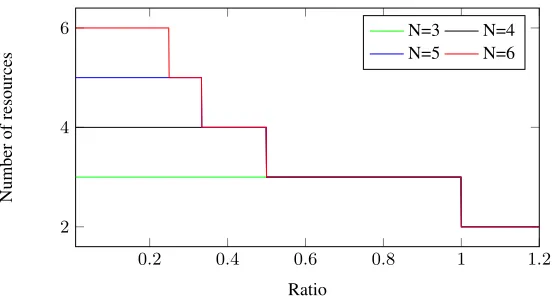
and run this programmatically forρfrom0to1, Fig. 1 shows the smallestn≤Nthat maximises the defenders benefit for variousN. Recall that the attacker will not play if
ρ >1/t−1, meaning that asρincreases the level of threshold decreases and therefore the number of servers required decrease. The optimum defender’s benefit occurring whent=n. This explains the step down in Fig. 1.
We end this section by examining the classic case of a threshold situation in which the required threshold is a constant fraction of the total number of resources. Suppose we have t = γ·n for some constant γ ∈ (0,1]. We have shown that the attacker will not play if Da·ρ
n ≥
1
t−1 = 1
0.2 0.4 0.6 0.8 1 1.2 2
4 6
Ratio
Number
of
resources
N=3 N=4
N=5 N=6
Fig. 1.Number of resources used by the defender to maximise his benefit given a specificρ
3.3 FlipThemS(n, t, d, ρ): (n,t)-Threshold, Single Reset
So far we have set up the model such that the defender can reset the whole system re-gaining full control whereas the attacker compromises each resource individually. We now consider the game FlipThemS(n, t, d, ρ). The defender can reset a single machine at any specific time. Consider the situation at any time point where the number of re-sources compromised iskout ofn. Assume the defender is going to reset a resource. There are multiple strategies they could employ, they could pick a resource which they have not reset recently, or pick a random resource, or pick a resource in a given se-cret sequence. Here we will assume the players pick resources uniformly at random. Thus the probability of resetting a compromised resource is nk, and that of wastefully resetting a non-compromised resource1−k
n. Letting the defender’s and attacker’s rate
of play beµandλrespectively, it is not hard to see that our generating matrix now becomes
G=
−λ λ 0 0 . . . 0 0 0
µ n −
(µ+(n−1)·λ)
n
(n−1)·λ
n 0 . . . 0 0 0
0 2·nµ −(2·µ+(nn−2)·λ) (n−2)·n λ . . . 0 0 0 ..
. ... ... ... . .. ... ... ...
0 0 0 0 . . . (n−1)·n µ −((n−1)·nµ+λ) λ n
0 0 0 0 . . . 0 µ −µ
We then solve for the stationary distributionπ = (π0, π1, . . . , πn−1, πn), by solving
πG= 0, and it can be shown by induction that
πk=
n!·λk·π
0 (n−k)!·k!·µk =
n k
·λk·π
0
Recall, that we also need to utilize the constraintPn
i=0πi = 1, which implies that we
haveπ0= µ n
(µ+λ)n so that we obtain the stationary distribution
π= 1 (µ+λ)n
µn, n·λ·µn−1, . . . ,
n
k
·µn−k·λk, . . . , n·µ·λn−1, λn
.
Once again, this gives us the proportion of time spent in each state. We assume here that the costs and benefits have already been normalised and do not depend onnthe number of resouces. Constructing these benefit functions gives
βD(µ, λ) = 1− n
X
i=t
πi−d·µ= 1−
1 (µ+λ)n ·
n
X
i=t
n
i
·µn−i·λi−d·µ,
βA(µ, λ) = n
X
i=t
πi−a·λ=
1 (µ+λ)n ·
n
X
i=t
n
i
·µn−i·λi−a·λ
We want to find the Nash Equilibria for these benefit functions. A point at which neither player can increase their benefit by changing their rate. We want to find pairs(µ∗, λ∗) such that
βD(µ∗, λ∗) = max
µ∈(,∞)βD(µ, λ
∗) and β
A(µ∗, λ∗) = max λ∈R+
βA(µ∗, λ),
whereis the lowest rate we can expect the defender to play in order to ensure the stationary distributions and hence benefit functions are well defined for all valid(µ, λ). Differentiating the defender’s and attacker’s functions with respect toµandλ respec-tively gives,
∂βD
∂µ =
n!·µn−t·λt
(t−1)!·(n−t)!·(µ+λ)n+1 −d, (10)
∂βA
∂λ =
n!·µn−t+1·λt−1
(t−1)!·(n−t)!·(µ+λ)n+1 −a. (11) Closed form solutions forµandλwhich equate to 0 are not easy to calculate directly. The second derivative of the attackers benefit with respect toλis
n!·µn−t+1·λt−2
(t−1)!·(n−t)!·(µ+λ)n+2 ·[µ·(t−1)−λ·(n+ 2−t)].
Thus,∂βA
∂λ is increasing when
λ < µ·(t−1) n+ 2−t,
then decreasing. Since ∂βA
∂λ is−aatλ= 0and asymptotes to−aasλ→ ∞we have
the derivative increasing from−ato a maximum whenλ= µn·(+2−t−1)t and then decreasing back to−a. The maximal value of∂βA
∂λ is given by
n!·(t−1)t−1
which is positive only ifµis sufficiently small. As a function ofλ,βAtherefore initially
decreases (from0), has a period of increase only ifµis sufficiently small, then decreases again. It follows thatβAhas at most one non-zero maximum which occurs in the region
µ(t−1)
n+ 2−t,∞
once the derivative is decreasing, and this fixed point maximises βA(µ, λ) on λ ∈
[0,∞)if and only ifβA(µ, λ)>0; otherwise the best response must beλ= 0. First,
like the full reset case, we consider the existence of a Nash Equilibrium(µ, λ)with
µ > . Since both derivatives (10) and (11) are hard to solve analytically for generaln, we used a numerical method utilizing the Maple algebra system to solve for a specific
n. The method for solving starts with defining the benefit functions in terms ofµand
λ, we then differentiate the derivatives as above and solve forµandλfor the defender and attacker, respectively. This provides 2 generic solutions of the form
ˆ
µ(λ) =RootOf(f(λ)) and ˆλ(µ) =RootOf(g(µ))
wheref andgare polynomials. We then put these solutions back into the derivatives to give
∂βD(µ,ˆλ(µ))
∂µ and
∂βA(ˆµ(λ), λ)
∂λ
Solving these with respect toµandλrespectively gives solutions forµ∗andλ∗with respect to the costsdanda. From this we can consider the ratioρ = ad between the attacker’s and defender’s costs of play. A table can be constructed to show the ratios at which both the defender and attacker will and won’t play for variousρ. Recall that even if the attacker is not playing, the defender must still play at some ratein order to ensure control of the system. In order to calculate the defender’s benefit given a specific
ρwe must calculate the lowest rate of play for the defender when the attacker is not playing. From equation (12), ∂βA
∂λ is never positive if
µ > n!·(t−1)
t−1
tn+1·(n+ 2−t)t−2·a
Meaning no stationary point exists for the attackers benefit. From this we can see that by taking
≥ n!·(t−1)
t−1
tn+1·(n+ 2−t)t−2·a
we can ensure there is no equilibrium withµ∗ =andλ6= 0. Recall thatρ= a d, so
that
≥ n!·(t−1)
t−1
tn+1·(n+ 2−t)t−2·ρ·d
This shows that ifρis large enough,will be small meaning the likely strategy for the attacker will be no play,λ= 0. So the benefit for the defender will be
βD(,0) = 1−·d= 1−
n!·(t−1)t−1
However, havingρlarge enough to ensureis small enough is an unrealistic assumption and choosinglike this becomes a strategic choice. As it was for the full reset case, it is also very conservative and could be expensive for the defender. We therefore fix our
>0to be very small, close to zero before the game. We now want to ask the following question: Given the costs of play for both defender and attacker and a limitN for the number of resources the defender can own, what is the best set up for the defender in order to maximise their benefit function? i.e. givenρandNwe are looking for the pairs such that
βD∗(n∗, t∗) = max
n≤N,t≤nβ
∗
D(n, t)
whereβ∗
D(n, t) =βD(µ∗, λ∗)is the Nash equilibrium for the specific number of
re-sourcesnand thresholdt. Recall we defined this game to be OptSN,(d,T, ρ). We turn
to the method of numerical programming for this problem. Obviously, since the lowest rate of playfor the defender is chosen arbitrarily before the game is played, if the equi-librium played is the trivial equiequi-librium then the defenders benefit isβD(,0) = 1−·d.
0.2 0.4 0.6 0.8 1 1.2
2 4 6
Ratioρ
Number
of
resources
n
Minimum number of resources
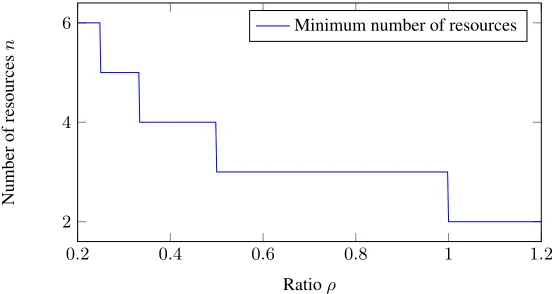
Fig. 2.Number of resources used by the defender to maximise his benefit given a specificρ, for
T ={t≤n}andN = 7.
When running OptSN,(d,T, ρ), each round of FlipThem
S
(n, t, d, ρ)played has three
possible outcomes.
– Ifρis so small the defender will not even play at the minimal rate.
– Ifρis “mid-size” the defender and attacker both play the non-trivial equilibrium (µ∗, λ∗).
– Ifρis large the attacker does not play and the trivial equilibrium(,0)is played.
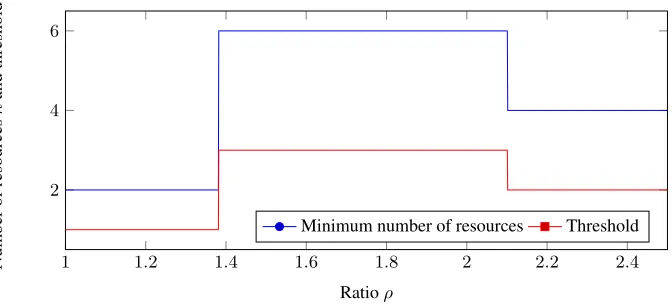
in Fig. 3. In this case small values ofρresult in games for which the defender will not play, for larger values ofρwe end up requiring more servers.
1 1.2 1.4 1.6 1.8 2 2.2 2.4
2 4 6
Ratioρ
Number
of
resources
n
and
threshold
t
Minimum number of resources Threshold
Fig. 3.Number of resources used by the defender to maximise his benefit given a specificρ, for
T ={t < n/2}andN= 7.
Acknowledgements
The second author was supported by a studentship from GCHQ. This work has been supported in part by ERC Advanced Grant ERC-2010-AdG-267188-CRIPTO and by EPSRC via grant EP/I03126X.
References
1. H. S. Bedi, S. G. Shiva, and S. Roy. A game inspired defense mechanism against distributed denial of service attacks.Security and Communication Networks, 7(12):2389–2404, 2014. 2. K. D. Bowers, M. van Dijk, R. Griffin, A. Juels, A. Oprea, R. L. Rivest, and N.
Triandopou-los. Defending against the unknown enemy: Applying flipit to system security. In Grossklags and Walrand [6], pages 248–263.
3. M. P. Collins. A cost-based mechanism for evaluating the effectiveness of moving target defenses. In Grossklags and Walrand [6], pages 221–233.
4. S. K. Das, C. Nita-Rotaru, and M. Kantarcioglu, editors. Decision and Game Theory for Security - 4th International Conference, GameSec 2013, Fort Worth, TX, USA, November 11-12, 2013. Proceedings, volume 8252 ofLecture Notes in Computer Science. Springer, 2013.
5. G. Grimmett and D. Stirzaker.Probability and Random Processes. Oxford University Press, 3rd edition edition, 2001.
7. A. Laszka, G. Horvath, M. Felegyhazi, and L. Buttyan. Flipthem: Modeling targeted attacks with flipit for multiple resources. In Poovendran and Saad [14], pages 175–194.
8. A. Laszka, B. Johnson, and J. Grossklags. Mitigation of targeted and non-targeted covert attacks as a timing game. In Das et al. [4], pages 175–191.
9. B. Z. Moayedi and M. A. Azgomi. A game theoretic framework for evaluation of the impacts of hackers diversity on security measures.Rel. Eng. & Sys. Safety, 99:45–54, 2012. 10. J. Nash. Non-cooperative games.The Annals of Mathematics, 54:286–295, 1951.
11. R. Ostrovsky and M. Yung. How to withstand mobile virus attacks (extended abstract). In L. Logrippo, editor, Proceedings of the Tenth Annual ACM Symposium on Principles of Distributed Computing, Montreal, Quebec, Canada, August 19-21, 1991, pages 51–59. ACM, 1991.
12. E. Panaousis, A. Fielder, P. Malacaria, C. Hankin, and F. Smeraldi. Cybersecurity games and investments: A decision support approach. In Poovendran and Saad [14], pages 266–286. 13. V. Pham and C. Cid. Are we compromised? modelling security assessment games. In
Grossklags and Walrand [6], pages 234–247.
14. R. Poovendran and W. Saad, editors.Decision and Game Theory for Security - 5th Interna-tional Conference, GameSec 2014, Los Angeles, CA, USA, November 6-7, 2014. Proceed-ings, volume 8840 ofLecture Notes in Computer Science. Springer, 2014.
15. S. Roy, C. Ellis, S. G. Shiva, D. Dasgupta, V. Shandilya, and Q. Wu. A survey of game theory as applied to network security. In43rd Hawaii International International Conference on Systems Science (HICSS-43 2010), Proceedings, 5-8 January 2010, Koloa, Kauai, HI, USA, pages 1–10. IEEE Computer Society, 2010.
16. M. van Dijk, A. Juels, A. Oprea, and R. L. Rivest. Flipit: The game of ”stealthy takeover”.
J. Cryptology, 26(4):655–713, 2013.
17. M. P. Wellman and A. Prakash. Empirical game-theoretic analysis of an adaptive cyber-defense scenario (preliminary report). In Poovendran and Saad [14], pages 43–58.