arXiv:astro-ph/0203053v1 5 Mar 2002
Mon. Not. R. Astron. Soc.000, 000–000 (0000) Printed 1 February 2008 (MN LATEX style file v1.4)
RX J0806+15: the shortest period binary?
Gavin Ramsay
1, Pasi Hakala
2, Mark Cropper
11Mullard Space Science Lab, University College London, Holmbury St. Mary, Dorking, Surrey, RH5 6NT, UK 2Tuorla Observatory, University of Turku, V¨ais¨al¨antie 20, 21500 Piikki¨o, Finland
Received: 2002 Jan 25, Accepted: 2002 Mar 5
ABSTRACT
The X-ray source RX J0806+15 was discovered usingROSAT, and shows an X-ray
light curve with a prominent modulation on a period of 321.5 sec. We present optical observations in which we report the detection of its optical counterpart. We find an optical period consistent with the X-ray period. We do not find convincing evidence for a second period in the data: this implies the 321.5 sec period is the orbital period. As such it would be the shortest period stellar binary system yet known. We discuss the nature of this system. We conclude that an isolated neutron star and an intermediate polar interpretation is unlikely and that a double degenerate interpretation is the most likely.
Key words: Stars: individual: RX J086+15 – Stars: binaries – Stars: neutron stars, cataclysmic variables
1 INTRODUCTION
Using data taken using the ROSAT satellite, Israel et al (1999) and Burwitz & Reinsch (2001) found that RX J0806.3+1527 (hereafter RX J0806+15) was modulated on a period of 321.5 sec. Further, the amplitude was 100 per cent with zero X-ray flux for half of the 321.5 sec period. Bur-witz & Reinsch (2001) found a V ∼21 mag object within the X-ray error-box and considered it the most likely opti-cal counterpart (star ‘A’ in their Figure 3). Using the Digital Palomar Survey, Israel et al (1999) did not find an optical counterpart in theRband down to∼20, although they did find a blue object close to the X-ray position in the Auto-matic Plate Measuring machine catalogue (Irwin, Maddox & McMahon 1994).
Israel et al (1999) suggested that RX J0806+15 was a relatively distant intermediate polar (IP: a weakly magnetic cataclysmic variable) or a nearby isolated neutron star. Bur-witz & Reinsch (2001) ruled out the isolated neutron star option based on its soft X-ray spectrum. For all known IPs, none show an X-ray light curve which shows zero flux for half the X-ray period. Indeed, it is difficult (although not impossible) to envisage a IP geometry which would produce this type of X-ray light curve (Cropper et al 1998). For this reason Burwitz & Reinsch (2001) suggested that this option was not likely.
They did however, notice the resemblance of the X-ray folded light curve with that of another ROSATdiscovered source RX J1914+24 which has a period of 569 sec. Cropper et al (1998) proposed that this object was a double degen-erate polar – an interacting binary consisting of two white
dwarfs, one of which is magnetic. In this interpretation, the 569 sec period was the binary orbital period and also the spin period of the magnetic white dwarf. Recently, Wu et al (2002) have proposed that RX J1914+24 is driven by electri-cal power, while Marsh & Steeghs (2002) and Ramsay et al (2002) have proposed it is a double degenerate Algol system. We have made optical observations of the field of RX J0806+15 with the goal of identifying the optical counter-part of RX J0806+15 and thereby making progress in un-derstanding the nature of this system.
2 OBSERVATIONS
Optical observations were carried out using the 2.5m Nordic Optical Telescope on La Palma on the nights of 14/15 and 15/16 Jan 2002. The instrument was the Andalucia Faint Object Spectrograph and Camera (ALFOSC), the detec-tor being a Loral 2048x2048 CCD. Conditions were pho-tometric. The seeing on the first night was moderate (∼1.1– 1.8”), but better on the second (∼0.9–1.2”). The images were bias-subtracted and flat-fielded in the usual way. On the first night 600 sec exposures were made of the field of RX J0806+15 inBV RI bands. A series of shorter (windowed) exposures were also made of the immediate field in V I
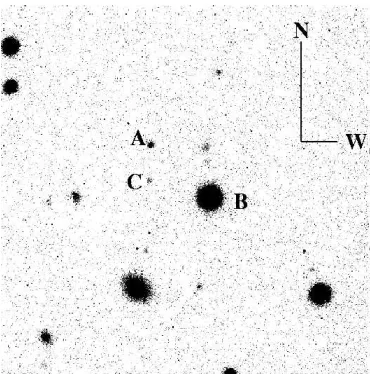
Figure 1.AV band image of the field of RX J0806+15. Stars A
and B refer to stars mentioned in Burwitz & Reinsch 2001). Stars A and C are separated by 11 arc sec.
3 THE OPTICAL COUNTERPART
We show in Figure 1 the immediate field of RX J0806+15. The analysis of our white light observations (§4) show that the optical counterpart of RX J0806+15 is indeed star ‘A’ as suggested by Burwitz & Reinsch (2001). The magnitude of star A is:B = 20.9±0.1, V = 21.1±0.1, R = 21.4±0.1
and I = 21.2±0.1. It is clearly a blue object. The
Hydro-gen column density to the edge of the galaxy in the direc-tion of RX J0806+15 is relatively low: NH = 2.7×10²⁰
cm−2
corresponding toAV=0.15.
4 THE LIGHT CURVE
On the night 15/16 Jan we made a series of short exposures in white light: this was a continuous series of observations spanning over 9 hours. The images contained stars ‘A’ and ‘B’ in the chart of Burwitz & Reinsch (2001) and also a star∼11” to the south of star A - star ‘C’ in Figure 1. Our photometry showed that star B was V=15.52 (consistent
with that found by Burwitz & Reinsch) and I=14.64. We performed differential aperture photometry between stars A and B and also between stars B and C. There was no significant variation in the differential magnitude between stars B and C. There was, however, a significant variation between star A and star B. We show the resulting light curve in Figure 2. We also obtained light curves for star A in V I
bands on the first night.
Using the white light data we obtained a power spec-trum using the Lomb-Scargle algorithm: a prominent peak is seen at 321.4 sec. We conclude that star A is the optical counterpart of RX J0806+15. To refine the period we use an inversion technique based on Bayesian statistics (Karttunen & Muinonen 1991). This searches a range of periods and as-sumes that the pulse shape can be modelled using a Fourier expansion of n degrees (we assume n=2). Using this tech-nique we find a period of 321.404±0.044 sec. If we include theV band data (covering nearly 8 hours of data taken on
Jan 14/15) we determine a period of 321.544±0.014 sec. The power spectra of this combined dataset is shown in Figure 3.
0 2000 4000 6000 8000 10000
Time (sec) 6.5
6.0 5.5 5.0 4.5 4.0
Differential Mag
0 2000 4000 6000 8000 10000
6.5 6.0 5.5 5.0 4.5 4.0
0 2000 4000 6000 8000 10000
6.5 6.0 5.5 5.0 4.5 4.0
Figure 2.The unfolded white light light curve obtained on the night 15/16 Jan 2002. The time advances left to right and is then shifted up by 0.9 mag.
Figure 3.The power spectrum of the combined white light and
V band data. The peak at 160 sec is the second harmonic of the
main peak at 321.5 sec.
This is consistent with the X-ray period of 321.5393±0.0004 sec (or its alias period of 321.5465±0.0004 sec) (Burwitz & Reinsch 2001). Unfortunately, because of the uncertainty in the periods, we cannot co-phase the optical and X-ray data (the X-ray data were taken in 1994 and 1995). We also show in Figure 3 a close-up of the power spectrum between 300 and 360 sec. The spectrum is remarkably clean and free from peaks other than those which can be attributed to the window function.
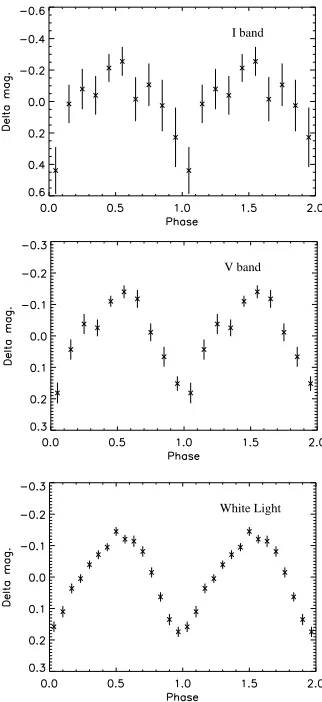
We folded the white light, V and I band data on the 321.544 sec period and show them in Figure 4. The white light folded light curve shows an amplitude of 0.30±0.01 mag (using a second order Fourier fit to the folded light curve) and shows an asymmetric light curve with the descent from maximum being more rapid than the rise to maximum. The
V band folded light curve is similar to the white light curve
(amplitude 0.31±0.03 mag). The signal to noise of the I
band light curve is lower since RX J0806+15 is a relatively blue object. However, there is some evidence that the am-plitude of the modulation is larger inIthan inV: 0.54±0.12 mag.
3
White Light V band
I band
Figure 4.From the bottom: The white light data folded on the 321.528 sec period, middle: theV band data and top: theIband
data.
(=2.8hrs) for the white light plusV band data. (For periods
longer than 10000 sec the power is negligible). This shows a number of peaks, the most prominent being near 4700sec. To make an assessment of significance of these peaks, we show in the middle panel of Figure 5 the power spectrum of the same data set if we randomly reassign the times of the data points using 500 trials. In the lower panel of Figure 5 we show the power of the highest peak lying in the range 4000-6000 sec for each of these trials. We find that in∼10 of these 500 trials the maximum peaks exceeds or is very close to the actual power determined in the combined white light plusV band light curve. Based on this test we find the
peak at 4700 sec has a significance of only between 2 and 3σ. We also investigated this further by creating a random light curve by assigning Gaussian random numbers to the time points of the combined white light and V band light curve and determining its power spectrum. Again we con-clude that although a period close to 4700 sec maybe present in the data, we cannot be certain.
Figure 5.Top panel: the power spectra of the combined white light plusV band data in the range 1200–10000 sec. Middle panel:
the resulting power series where we have randomly assigned the data points to the time points. This has been carried out for 500 trials. Bottom panel: the power of the highest peak lying in the range 4000–6000 sec for each of these 500 trials.
5 THE LOCATION OF THE OPTICAL EMISSION SITE
From the colours determined in§3, RX J0806+15 is clearly a blue object. However, it is more difficult to reconcile a blue object with having a modulation amplitude greater in the
I band compared to theV band. This contrasts with the
double degenerate polar RX J1914+24 which shows a larger variation in V compared to I. There are several possible solutions. In the first, we assume that the optical emission originates on the secondary star and is due to irradiation from X-rays from the primary. If RX J0806+15 was an ac-creting double degenerate polar, the primary white dwarf would be more massive, and hence smaller in size than the secondary white dwarf. If the heated face of the secondary covered a small fraction of the area, then the variation in the cooler area (larger fraction) of the secondary could be greater than the hotter component.
It is also possible that the X-ray and optical data orig-inate from the same site on the primary. In this case the higher amplitude of the I band data could be due to the
primary having a magnetic field of sufficient strength to pro-duce cyclotron radiation. A field strength of∼10MG would emit most strongly at red wavelengths and imply that the spin period of the primary white dwarf was closely syn-chronised with the binary orbital period. Since we cannot co-phase the optical and X-ray data we cannot distinguish between these scenarios.
6 DISCUSSION
We have detected the optical counterpart of RX J0806+15. It has a period (321.5 sec) consistent with that detected in X-rays. There is marginal evidence for a second period at ∼4700 sec: this needs to be tested by a longer series of observations. We now consider the nature of this object.
Date RA (2000) Dec (2000) Reference 2002.0 08 06 22.98 +15 27 31.5 1 1998.3 08 06 22.9 +15 27 30.2 2 1951.1 08 06 22.94 +15 27 31.1 3
Table 1. The reported positions of RX J0806+15. References: (1) this paper, (2) Burwitz & Reinsch (2001), (3) APM catalogue Irwin, Maddox & McMahon (1994).
that its X-ray spectrum is very soft. However, they do not show the spectrum, or details of any fits to that spectrum. The softness ratio of RX J0806+15, HR1=–0.67±0.1, is very similar to that of the isolated neutron star RX J0720–31
(ROSATpublic archive). We cannot exclude RX J0806+15
being an isolated neutron star based on its X-ray softness ratio. Israel et al (1999) conclude that were RX J0806+15 to be an isolated neutron star then it would have to be∼10pc distant, based on a blue magnitude of∼20.5.
If RX J0806+15 was indeed a neutron star at a dis-tance of 10 pc, then we may expect to detect a significant proper motion. To test this, we determined the position of RX J0806+15 using our 600 secV band image usingASTROM
(Wallace 1998) (and determining the positions of stars in the immediate field from the USNO A2 catalogue and the APM catalogue) and compared it to the position reported by Burwitz & Reinsch (2001) and the position of the blue star recorded in the APM catalogue (Irwin, Maddox & McMahon 1994) (Table 1). We find that the position determined by us and the APM catalogue agree to within 0.5 arc sec over a time interval of 50 years. In contrast, the isolated neutron star RX J1856-37 has been observed to show a proper mo-tion of 0.33 arc/yr at a distance of 61pc (Walter 2001). At a distance of 10pc it would be expected to show a proper motion of 11.9 arc sec/yr. If RX J0806+15 were an isolated neutron star it would have to have a proper motion very much smaller than that of RX J1856-37. We consider it un-likely that RX J0806+15 is an isolated neutron star.
In the intermediate polar (IP) model, the 321.5 sec pe-riod would be associated with the spin pepe-riod of the accret-ing white dwarf and the 4700 sec period the binary orbital period. The X-ray softness ratio (which implies a soft X-ray spectrum) would associate it with the soft IPs (like PQ Gem and UU Col) which have similar ratios. However, its X-ray light curve is very atypical for that of an IP. Indeed, Cropper et al (1998) discussed the possibility that RX J1914+24 was an IP. They concluded that an IP interpretation was possible if the binary inclination was close to 90◦ and heavy (phase
dependent) absorption was present, or the soft X-rays were strongly beamed by some (as yet unknown) mechanism. Fur-ther, the light curve (Figure 2) shows no sign of flickering or flaring activity as is seen in other IPs. In the PQ Gem the amplitude on the spin period is∼0.1 and 0.2 mag inV andI
bands respectively. This contrasts with 0.3 and 0.5–0.6 mag in RX J0806+15. We also note the very clean power spectra (Figure 3): IPs show complex power spectra, typically show-ing a beat period which is not seen in RX J0806+15. For a spin period of 321.5 sec and an orbital period of 4700 sec, we would expect to observe a beat period around 345 sec: this is not seen (Figure 3). Further, no ellipsoidal
modula-tion due to a main sequence secondary is seen and its colour is too blue. We consider the IP model unlikely.
Burwitz & Reinsch (2001) made the suggestion that RX J0806+15 is a double degenerate polar: a close binary system consisting of a magnetic white dwarf which is accreting ma-terial from a secondary white dwarf. Indeed, the similarities between RX J0806+15 and RX J1914+24 (which was pro-posed as the first double degenerate polar by Cropper et al 1998) is striking. The X-ray light curves are very similar: RX J0806+15 has an X-ray period of 321.5 sec, RX J1914+24 569 sec. Both show folded X-ray light curves which have zero flux for approximately half their period and are asymmetric with the rise to maximum being more rapid than their de-scent. The optical and X-ray light curves of RX J1914+24 are anti-phased, but the uncertainty in the period of RX J0806+15 prevents us from co-phasing these light curves. Although there have been several other suggestions as to the nature of RX J1914+24 (the electric star model of Wu et al (2002) and a double degenerate Algol system (Marsh & Steeghs 2002 and Ramsay et al 2002) they all assume a double degenerate system. Such a system would not show a second period lasting several 1000 sec. In the absence of a convincing second period, we consider the double degenerate model the most likely scenario.
7 SUMMARY
In summary, we consider the isolated neutron star scenario to be unlikely. We cannot rule out an IP model if the geom-etry and the accretion stream absorption was very specific. Since we cannot be certain that there is a second period on a timescale of 4000-5000 sec we cannot at this stage rule out a double degenerate model. The nature of RX J0806+15 therefore, remains open. However, we conclude that the 321.5 sec period marks the rotation period of a white dwarf. If accretion onto the white dwarf is taking place, then the accretion flow appears to show little variation.
8 ACKNOWLEDGMENTS
The data presented here have been taken using ALFOSC, which is owned by the Instituto de Astrofisica de Andalucia (IAA) and operated at the Nordic Optical Telescope (NOT) under agreement between IAA and the NBIfAFG of the As-tronomical Observatory of Copenhagen. We also thank the staff of the NOT for their support. PJH is an Academy of Finland research fellow.
Footnote: After this paper was submitted, Israel et al (2002) published a report in an IAU Circular announcing the discovery of optical modulation in star A of Burwitz & Reinsch (2001).
REFERENCES
Burwitz, V., Reinsch, K., 2001, AIP Con Proc, Eds White, N., Malaguti, G., Palumbo, G., Vol 599, p522
5
Israel, G. L., Panzera, M. R., Campana, S., Lazati, D., Covino, S., Tagliaferri, G., Stella, L., 1999, A&A, 349, L1
Israel, G. L., Stella, L., Hummel, W., Covino, S., Campana, S., 2002, IAUC 7835
Karttunen, H., Muinonen, K., 1991, A&A, 242, 513 Landolt, A. U., 1992, AJ, 104, 340
Marsh, T. R., Steeghs, D., accepted MNRAS, (astro-ph/0201309) Ramsay, G., Wu, K., Cropper, M., Schmidt, G., Sekiguchi, K.,
Iwamuro, F., Maihara, T., submitted, MNRAS Wallace, P. T., 1998, Starline User Note No.5 Walter, F. M., 2001, ApJ, 549, 433