ISSN Online: 2164-5175 ISSN Print: 2164-5167
DOI: 10.4236/ajibm.2018.89132 Sep. 27, 2018 1972 American Journal of Industrial and Business Management
Conceptual Model Fit for Career Planning and
Development of Employees with Special
Reference to Private Sector Banks by Using
Structural Equation Model
V. Suresh Kumar
1, A. Manonmani
2, V. Ramesh Kumar
31Research Department of Business Administration, Rajah Serfoji Government College (Autonomous), Thanjavur, India 2Department of Business Administration, Annai Vailankanni Arts and Science College, Thanjavur, India
3Department of Management, Adaikalamatha College, Thanjavur, India
Abstract
Powerful career planning of employees is reliant on viable execution admin-istration, where administration considers correspondence and reconciliation as a wellspring of keeping employees relentlessly on their approach to objec-tives accomplishment. The focal point of this investigation, hence, was to survey whether there was career planning and development has its impact on worker inspiration, having a tendency to lose its performing employees work fulfillment and devotion. The present research is a survey on limited scale. It is on the other a descriptive-cum-analytical effort on the selected variables of the study. It is studied how and to what extent the independent variables make changes in the dependent variables. The researcher collected the data from 1000 employees and the sample size is adjusted and determined as 860 respondents to obtain more and clear information. The survey concludes that findings confirm that the model fit is absolutely suitable for this analysis.
Keywords
Career Planning, Career Development, Private Sector Banks
1. Introduction
Employees are the profitable resources of the firm and they cannot be squan-dered futile and they ought not to be left without anyone else purposefully. Each employee in the firm or association is not all around outfitted with a wide range of qualities and capacities of completing each errand up to stamp. Letting them
How to cite this paper: Kumar, V.S., Ma-nonmani, A. and Kumar, V.R. (2018) Con-ceptual Model Fit for Career Planning and Development of Employees with Special Reference to Private Sector Banks by Using Structural Equation Model. American Journal of Industrial and Business Man-agement, 8, 1972-1990.
https://doi.org/10.4236/ajibm.2018.89132
Received: August 23, 2018 Accepted: September 24, 2018 Published: September 27, 2018
Copyright © 2018 by authors and Scientific Research Publishing Inc. This work is licensed under the Creative Commons Attribution International License (CC BY 4.0).
DOI: 10.4236/ajibm.2018.89132 1973 American Journal of Industrial and Business Management to manage on for each endeavor is to put their work being referred to which is harming and ruthless for the employees himself and in addition for the earth in which they work [1]. Some new or junior employees who are slightest mindful of the procedures of playing out their activity and settling themselves in their workplace, they require care, bolster and legitimate arranging toward the begin-ning of their profession to give solid sustenance to their on-going employment [2]. Each employees ought to be made mindful of significance of their reality among any group or gathering of the firm and if, their acknowledgment of such sense does not way to deal with the administration at that point level of their ap-titudes and capacities can’t be enhanced through legitimate administration reac-tion. The better a firm can render to its workers is the earth of learning, partici-pation among individuals, conferred supervision, convenient satisfying prepar-ing needs, employer stability, gratefulness on better exhibitions and proficient and compelling making arrangements for their vocation. Employees profession arranging goes about as a device of reinforcing the work connection amongst boss and worker showing the productive sensation for every one of the levels and gatherings of employees. It likewise guarantees the employability of a work-er when they are reliably learning and applying educated and more created apti-tudes [3].
Powerful career planning of employees is reliant on viable execution adminis-tration, where administration considers correspondence and reconciliation as a wellspring of keeping employees relentlessly on their approach to objectives ac-complishment. The intercession of genuine administration bolster in the em-ployees’ normal exercises raises their bravery and shines their capacities to bring down the boundaries in the route to their career and hierarchical achievement [4]. Consequently, they guide their endeavors to approach and accomplish the objectives. In result of meeting the characterized targets they can pick up grate-fulness and significance according to administration and, administration at-tempts to draw out their stay with them through better planning and suggestions for their career. Same thought is reflected [5] [6]. Some HR supervisors ac-knowledge and comprehend the significance of career planning exceptionally for people who perform uncommon.
Although the business environment has been endlessly experiencing negative changes such as economic downsizing and restructuring resulting in fewer hie-rarchical positions but at the same time the need for improving productivity while keeping a pace with continuously changing technology has also increased. Organizations, therefore, instead of hiring a new individual from the market prefer to promote their already existing employee to a specific position as he or she is already aware of the organizational culture and does not need to be trained. This requires a careful succession planning of employees and devel-oping and preparing them continuously for filling topmost designations in fu-ture.
DOI: 10.4236/ajibm.2018.89132 1974 American Journal of Industrial and Business Management as well as consequences that can change the entire scenario. In such a situation both employees and employers must be ready to keep with the changing envi-ronment and act accordingly. Employees continuously need to upgrade their skills and competencies to meet the current demands whereas organizations must be ready with those employees who can handle the pressure efficiently and cease the risk of falling prey to the changed scenario. Therefore, understanding the importance of career development is very necessary for both the parties.
2. Review of Related Studies
Training is very important for employee’s performance in acquiring competen-cies and help organization to retain its employees through satisfaction and mo-tivation. Globally day by day the world is modernizing and moving rapidly which is creating many challenges for the organizations. Training can overcome and make an employee’s capabilities more efficient which also contributes in the efficiency of the company. Training becomes an essential element to an em-ployee for the development of the companies because some of the emem-ployees have lack of knowledge skills and competencies and failed to accomplish task on timely basis. The sample has been taken from both males and female employees of National Bank of Pakistan. The research is descriptive study and it’s quantita-tive in nature. Primary data was collected and although secondary data also used to classify the work done. Study provides an empirical evidence of factors that effects employees training and performance of organization [7].
In order to improve the efficiency of employee in the present job and prepare himself for the higher level job, the effective training programmes are necessary. It is also needed to banking policies, new technology and the changing environ-ments. Training and development is now considered as more of retention tool than a cost. The training system in banking industry has been changed to create a smarter workforce and yield the best results. Training and development pro-grammes help remove performance deficiencies in employees and also they are esteemed resource of the bank and success or failure of the bank operation relay on the performance of employees. Timely evaluation of the success of employ-ees’ training and development programmes are most important for the banks [8].
The result of this research have shown that the factors of “Training have posi-tive impact on employee performance of Banks of Karachi. Despite of that, this research has provided precious information and knowledge to banks about the importance of training in increasing employee performance. As a result, it can be conclude that the banks which provide training to their employees in a proper way can gain substantial improvement in performance and productivity and can deal more number of customers with satisfaction. Training is compulsory for employees to enhance knowledge, skills and abilities that provide extensive sup-port to increase the performance of banks of Karachi” [9].
DOI: 10.4236/ajibm.2018.89132 1975 American Journal of Industrial and Business Management present competitive world, the banking sector, especially of the developing economies like India, is facing lot of tough competition, talent crunch, and skill shortage. All these have made the banks feel that the internal customer is also more important equally with external customers, so every bank is trying to de-vise innovative HR practices to attract best talent and give them comfortable en-vironment to work with, that enables the banks to retain talents [10].
It is presumed that there is no difference in the HR practices being followed by private sector and public sector banks. The analysis reveals in contrary to the hypothesis that two groups of respondents belonging to different sectors differ in their HR practices. On general observation also it is evidentially clear from the observations of work environment in different banks [11].
It was helps to this conclusion as “Human resources are the main component of any organization or it can be said that they are the backbone of the organiza-tion without which accomplishment of objectives is rarely possible. Better train-ing programs, proper compensation schemes, evaluation of employee perform-ance are the important element of HR practices which are to be focused by the organization to satisfy its employees and customers. HR practices like compen-sation management, performance appraisal and promotion influence the per-formance level of employees. The results have revealed that as banking is an emerging sector necessary changes are required to be made. Better HR policies will enhance the employee to perform better” [12].
The study recommends that KPS should improve on the existing and incor-porate other on-the-job training methods as they were found to have great im-pact on performance of KPS. This could be done by reviewing the influence each approach had on performance. The study also recommends that combating crime be a joint effort by all the stakeholders. On-the-job training was found to have a positive but insignificant effect on performance of the Kenya Police Ser-vice. Future researchers should focus on other factors affecting performance of police officers in the KPS such as motivation and level of education of police of-ficers among others [13].
The HDFC Bank focuses on training of its employees on a continuous basis, both on the job and through training programmes conducted by internal and external faculty. The Bank has consistently believed that broader employee own-ership of its share has a positive impact on its performance and employee moti-vation. Prioritizing seniority over performance is not a good practice for at-tracting the best talent in a competitive environment. However, recruitment practices as well as on-the job training and redeployment are considered as one of those many improvements of HR in the Indian banks. In nutshell, it can be said that T & D policies and practices of the selected bank in the above back-ground concentrated on training and developing, and motivating employees to work for ensuring that these policies are properly designed and implemented, thereby helping the workers to set and achieve individual and organizational goals [14].
ful-DOI: 10.4236/ajibm.2018.89132 1976 American Journal of Industrial and Business Management filled workforce. Employees who are fulfilled, they have a tendency to perform productively and adequately as they understand the significance of solid infor-mation they surrender to achieving their assignments. It therefore can bring gratefulness and reward for them. They will at last be propelled through it and they will work with more industriousness and duty [15], additionally featured this sense and they contend that most association concentrate just on their ob-jectives accomplishment yet they think less about the methods through which their accomplishment is being conceived (e.g. employees). Employee career planning and development are the devices, which can form the futile employees into valuable shape for any organization. It shows that employee career planning is particularly vital and must be rehearsed on proficient premise by each workplace.
In the later talk we might want examine the significance of career planning for the basic places of any working environment. Progression planning through keeping an eye over the need of that position and making accessibility of that before the occupant takes the charge. It won’t just keep up their energy of past execution however it will urge them to build up their own particular aptitudes as well as to exchange them to their youngsters [16].
This review brings forth various findings relating to career development and its effects on job performance of the employees in various organizations. Career planning and development practices among the organizations are studied so as to understand the complexities involved in undertaking the job and performing effectively. It is observed that the researchers have come across certain factors such as employee motivation, commitment and job satisfaction that differs based on the efficacious policies of career planning. The researchers have individually studied the various determinants of the career planning and development and its effect on job performance. Though the reviews are discussing the career devel-opment and planning activities and job satisfaction of the employees, there were only few reviews of their impact on job performance and loyalty. No studies were identified with the implications of the career planning and development and motivation over job performance of the employees. The present paper was quite helpful to identify the gap and it provides an insight to carry out the re-search in the right perspective. Therefore, the study attempts to fulfil the identi-fied gap with the factors ascertained from the reviews.
3. Statement of the Problem
DOI: 10.4236/ajibm.2018.89132 1977 American Journal of Industrial and Business Management to distinguish the worker gifts, capacities, values, needs, mentalities and objec-tives with respect to their career will push them far from the association. More-over, the preventions to career development are not known and the answers for these impediments are not known either. On the off chance that this issue proceeds and inspiration gets truly influenced, the execution of the employees is probably going to diminish and this could genuinely influence the accomplish-ment of the objectives and goals of the Managing an account associations. Be-sides, it may not be faultless for the bank to keep spending a lot of cash on pre-paring, which may not prompt career development and enhanced hierarchical execution. The focal point of this investigation, hence, was to survey whether there was career planning and development has its impact on worker inspira-tion, having a tendency to lose its performing employees work fulfillment and devotion.
4. Objectives of the Study
Following are the objectives of the study:1) To find out the inter relationship between organizational commitment of the employees and career development system of the organization;
2) To analyze the effects of career planning and development and its influence over job satisfaction and employee loyalty.
5. Proposed Research Model
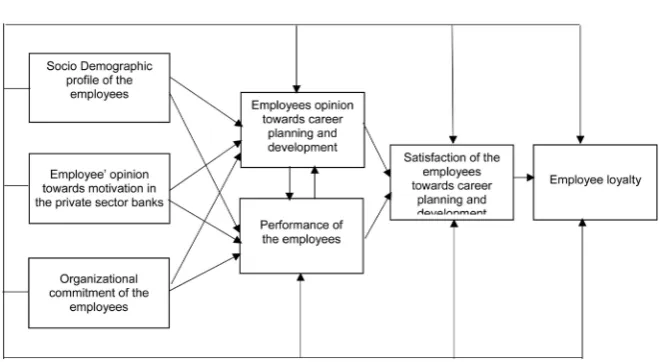
The research takes the socio demographic factors of the employees in the se-lected private sector banks. Employee’ opinion towards motivation in the private sector banks, Organizational commitment of the employees, Employees’ opinion towards career planning and development and Performance of the employees are taken as the major independent variables and Satisfaction of the employees towards career planning and development and Employee loyaltyare taken as the dependent variables. It is studied how and to what extent the independent va-riables make changes in the dependent vava-riables. The proposed conceptual re-search model (Figure 1) shows the process of research as follows.
6. Research Methodology
The present research is a survey on limited scale. It is on the other a descrip-tive-cum-analytical effort on the selected variables of the study.
6.1. Method of Data Collection
DOI: 10.4236/ajibm.2018.89132 1978 American Journal of Industrial and Business Management Figure 1. Proposed conceptual research model.
6.2. Population and Sampling Procedure
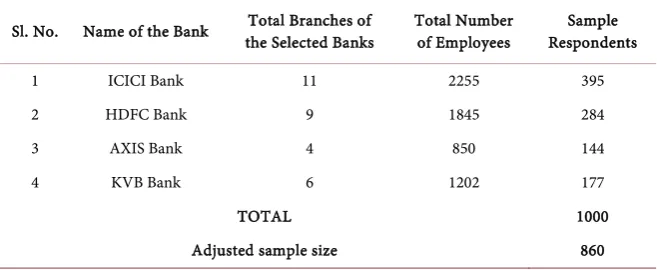
The private sector banks considered for the study include ICICI, HDFC, AXIS, and KVB Banks. 30 branches all over the district of Thanjavur were included for the study. The population of the employees from the selected branches accounts to 6152 who are in service from 2014; Table 1 shows the total population of the employees and the sample considered for the study. Form the finite population of 6152 employees working under different cadres in the selected branches of the selected Private Sector Banks in Thanjavur district, the study includes a sample of 1000 employees as respondents. The sample is obtained with the help of pur-posive sampling based on the condition that the employees of the selected four private sector banks are considered purposively. Since the population is finite, sample size provides proportionately more information for a small population. Therefore, the sample size is corrected with the equation
(
0 0)
1 1
n n
n N
=
+ −
N is the population (N = 6150) and n is the sample size considered (n = 800). But the researcher collected the data from 1000 employees and the sample size is adjusted and determined as 860 respondents to obtain more and clear informa-tion.
The sample size of the respondents was corrected to 860 for a better precision. The questionnaires were distributed in person by the researcher to the sample employees. The response rate on the questionnaire was 86%.
7. Reliability and Validity of Data
DOI: 10.4236/ajibm.2018.89132 1979 American Journal of Industrial and Business Management Table 1. Sample size across the study units.
Sl. No. Name of the Bank the Selected Banks Total Branches of Total Number of Employees Respondents Sample
1 ICICI Bank 11 2255 395
2 HDFC Bank 9 1845 284
3 AXIS Bank 4 850 144
4 KVB Bank 6 1202 177
TOTAL 1000
Adjusted sample size 860
Source: researcher’s own calculations.
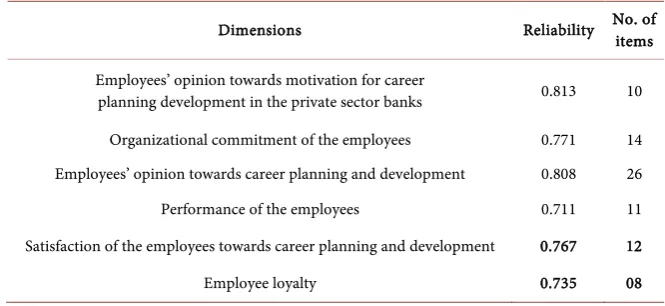
Therefore, it is confirmed that the data are highly reliable and valid for analysis. The following (Table 2) shows that, the Cronbach’s alpha value for every di-mension of career planning and development of employees with special refer-ence to private sector banks in Thanjavur district.
8. Limitations of the Study
The following are the limitations of the study:
1) The study is conducted in selected Taluks of the Thanjavur district due to time constraints.
2) The study limits with only the employees of the selected banks for its analy-sis.
3) Findings of the study may vary due to the future environmental changes. 4) The survey questions were not clearly interpreted by the respondents and the answers were the personal opinion of the respondents. Hence t it may not be generalized.
9. Conceptual Model Fit for Career Planning and
DOI: 10.4236/ajibm.2018.89132 1980 American Journal of Industrial and Business Management Table 2. Reliability and validity of the data.
Dimensions Reliability No. of items
Employees’ opinion towards motivation for career
planning development in the private sector banks 0.813 10 Organizational commitment of the employees 0.771 14 Employees’ opinion towards career planning and development 0.808 26 Performance of the employees 0.711 11 Satisfaction of the employees towards career planning and development 0.767 12 Employee loyalty 0.735 08
Source: output generated from SPSS 20.
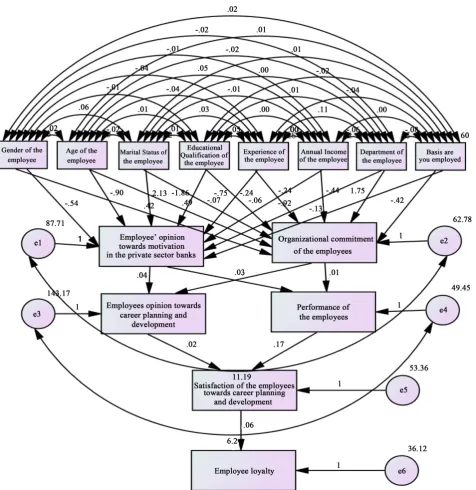
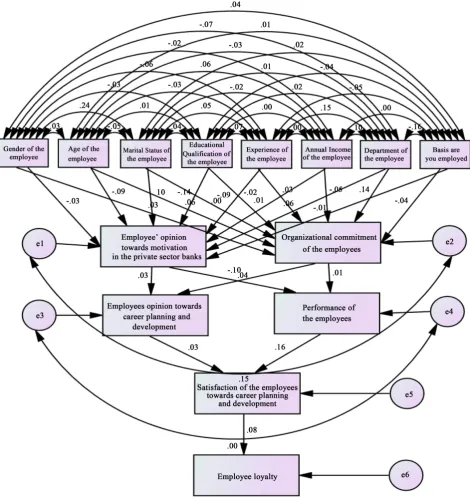
a single latent construct. A structural equation model implies a structure of the covariance matrix of the measures. Hence an alternative name for this field, "analysis of covariance structures. Once the model’s parameters have been esti-mated, the resulting model-implied covariance matrix can then be compared to an empirical or data-based covariance matrix. If the two matrices are consistent with one another, then the structural equation model can be considered a plau-sible explanation for relations between the measures. Table 3 shows the vari-ables used in the research. Figure 2 and Figure 3 show the unstandardized and standardized estimate for Structural Equation Model of the career planning and development of employees with special reference to private sector banks.
The variables used in the structural equation model are: Observed, endogenousvariables
1) Employee’ opinion towards motivation in the private sector banks; 2) Organizational commitment of the employees;
3) Employees’ opinion towards career planning and development; 4) Performance of the employees;
5) Satisfaction of the employees towards career planning and development; 6) Employee loyalty.
Observed, exogenousvariables 1) Gender of the employee; 2) Age of the employee;
3) Marital Status of the employee;
4) Educational qualification of the employee; 5) Experience of the employee;
6) Annual Income of the employee; 7) Department of the employee; 8) Basis of the employment. Unobserved, exogenousvariables
DOI: 10.4236/ajibm.2018.89132 1981 American Journal of Industrial and Business Management Table 3. Summary of the variables used for the analysis.
Number of variables in your model 20 Number of observed variables 14 Number of unobserved variables 6
Number of exogenous variables 14 Number of endogenous variables 6
Source: output generated from Amos 20.
[image:10.595.64.541.201.692.2]DOI: 10.4236/ajibm.2018.89132 1982 American Journal of Industrial and Business Management Figure 3. Standardized estimate for structural equation model of the career planning and development of employees with special reference to private sector banks.
2) Error 2 for Organizational commitment of the employees;
3) Error 3 for Employees’ opinion towards career planning and development; 4) Error 4 for Performance of the employees;
5) Error 5 for Satisfaction of the employees towards career planning and de-velopment;
6) Error 6 for Employee loyalty.
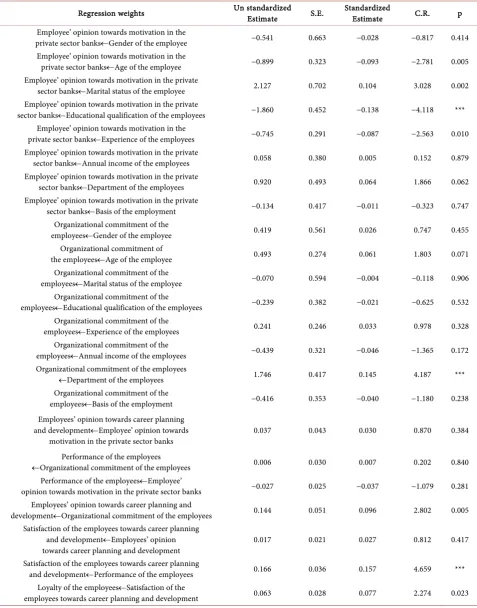
DOI: 10.4236/ajibm.2018.89132 1983 American Journal of Industrial and Business Management towards motivation in the private segment banks goes around 0.541. At the point when gender of the employee goes up by 1 standard deviation, employee' supposition towards motivation in the private area banks goes around 0.028 standard deviations. The regression weight appraise, −0.899, has a standard blunder of around 0.323. The likelihood of getting a critical ratio is as substantial as 0.817 in total esteem seems to be 0.414 (Table 4).
At the point when age of the employee goes up by 1, employee’ supposition towards motivation in the private division banks goes around 0.899. At the point when age of the employee goes up by 1 standard deviation, employee’ feeling towards motivation in the private segment banks goes around 0.093 standard deviations. The regression weight assess, −0.899, has a standard blunder of around 0.323. The likelihood of getting a critical ratio is as extensive as 2.781 in outright esteem may be 0.005. As it were, the regression weight for age of the employee in the forecast of employee’ sentiment towards motivation in the pri-vate segment banks is altogether not quite the same as zero at the 0.01 level (two-Tailed) (Table 4).
At the point when marital status of the employee goes up by 1, employee’ conclusion towards motivation in the private area banks goes up by 2.127. At the point when marital status of the employee goes up by 1 standard deviation, em-ployee’ supposition towards motivation in the private segment banks goes up by 0.104 standard deviations. The regression weight gauge, 2.127, has a standard mistake of around 0.702. The likelihood of getting a critical ratio as expansive is as 3.028 in total the esteem seems to be 0.002 (Table 4).
At the point when educational qualification of the employees goes up by 1, employee’ supposition towards motivation in the private segment banks goes around 1.86. At the point when educational qualification of the employees goes up by 1 standard deviation, employee’ supposition towards motivation in the private part banks goes around 0.138 standard deviations. The regression weight gauge, −1.860, has a standard mistake of around 0.452. The likelihood of getting a critical ratio as huge as 4.118 in outright esteem is under 0.001. As such, the regression weight for educational qualification of the employees in the expecta-tion of employee’ feeling towards motivaexpecta-tion in the private division banks is al-together unique in relation to zero at the 0.001 level (two-Tailed) (Table 4).
At the point when experience of the employees goes up by 1, employee’ con-clusion towards motivation in the private part banks goes around 0.745. At the point when experience of the employees goes up by 1 standard deviation, em-ployee’ conclusion towards motivation in the private segment banks goes around 0.087 standard deviations. The regression weight gauge, −0.745, has a standard error of around 0.291. The likelihood of getting a critical ratio is as substantial as 2.563 in outright esteem may be 0.010 (Table 4).
DOI: 10.4236/ajibm.2018.89132 1984 American Journal of Industrial and Business Management Table 4. Regression weights for structural equation model for the career planning and development of employees with special reference to private sector banks.
Regression weights Un standardized Estimate S.E. Standardized Estimate C.R. p
Employee’ opinion towards motivation in the
private sector banks←Gender of the employee −0.541 0.663 −0.028 −0.817 0.414 Employee’ opinion towards motivation in the
private sector banks←Age of the employee −0.899 0.323 −0.093 −2.781 0.005 Employee’ opinion towards motivation in the private
sector banks←Marital status of the employee 2.127 0.702 0.104 3.028 0.002 Employee’ opinion towards motivation in the private
sector banks←Educational qualification of the employees −1.860 0.452 −0.138 −4.118 *** Employee’ opinion towards motivation in the
private sector banks←Experience of the employees −0.745 0.291 −0.087 −2.563 0.010 Employee’ opinion towards motivation in the private
sector banks←Annual income of the employees 0.058 0.380 0.005 0.152 0.879 Employee’ opinion towards motivation in the private
sector banks←Department of the employees 0.920 0.493 0.064 1.866 0.062 Employee’ opinion towards motivation in the private
sector banks←Basis of the employment −0.134 0.417 −0.011 −0.323 0.747 Organizational commitment of the
employees←Gender of the employee 0.419 0.561 0.026 0.747 0.455 Organizational commitment of
the employees←Age of the employee 0.493 0.274 0.061 1.803 0.071 Organizational commitment of the
employees←Marital status of the employee −0.070 0.594 −0.004 −0.118 0.906 Organizational commitment of the
employees←Educational qualification of the employees −0.239 0.382 −0.021 −0.625 0.532 Organizational commitment of the
employees←Experience of the employees 0.241 0.246 0.033 0.978 0.328 Organizational commitment of the
employees←Annual income of the employees −0.439 0.321 −0.046 −1.365 0.172 Organizational commitment of the employees
←Department of the employees 1.746 0.417 0.145 4.187 *** Organizational commitment of the
employees←Basis of the employment −0.416 0.353 −0.040 −1.180 0.238 Employees’ opinion towards career planning
and development←Employee’ opinion towards
motivation in the private sector banks 0.037 0.043 0.030 0.870 0.384 Performance of the employees
←Organizational commitment of the employees 0.006 0.030 0.007 0.202 0.840 Performance of the employees←Employee’
opinion towards motivation in the private sector banks −0.027 0.025 −0.037 −1.079 0.281 Employees’ opinion towards career planning and
development←Organizational commitment of the employees 0.144 0.051 0.096 2.802 0.005 Satisfaction of the employees towards career planning
and development←Employees’ opinion
towards career planning and development 0.017 0.021 0.027 0.812 0.417 Satisfaction of the employees towards career planning
and development←Performance of the employees 0.166 0.036 0.157 4.659 *** Loyalty of the employees←Satisfaction of the
employees towards career planning and development 0.063 0.028 0.077 2.274 0.023
DOI: 10.4236/ajibm.2018.89132 1985 American Journal of Industrial and Business Management 0.005 standard deviations. The relapse weight appraise, 0.058, has a standard blunder of around 0.380. The likelihood of getting a basic proportion is as ex-pansive as 0.152 in outright esteem seems to be 0.879 (Table 4).
At the point when department of the employees goes up by 1, employee’ con-clusion towards inspiration in the private area banks goes up by 0.92. At the point when department of the employees goes up by 1 standard deviation, em-ployee’ feeling towards inspiration in the private division banks goes up by 0.064 standard deviations. The relapse weight gauge, 0.920, has a standard error of around 0.493. The likelihood of getting a basic proportion is as huge as 1.866 in total esteem seems to be 0.062 (Table 4).
At the point when basis of the employment goes up by 1, employee’ conclu-sion towards inspiration in the private segment banks goes around 0.134. At the point when basis of the employment goes up by 1 standard deviation, employee’ supposition towards inspiration in the private division banks goes around 0.011 standard deviations. The relapse weight evaluate, −0.134, has a standard error of around 0.417. The likelihood of getting a basic proportion as is expansive as 0.323 in outright esteem seems to be 0.747. As it were, the relapse weight for ba-sis of the employment in the forecast of employee’ conclusion towards inspira-tion in the private division banks is not essentially unique in relainspira-tion to zero at the 0.05 level (two-Tailed) (Table 4).
At the point when gender of the employee goes up by 1, organizational com-mitment of the employees goes up by 0.419. At the point when gender of the employee goes up by 1 standard deviation, organizational commitment of the employees goes up by 0.026 standard deviations. The relapse weight assess, 0.419, has a standard error of around 0.561 (Table 4).
At the point when age of the employee goes up by 1, organizational commit-ment of the employees goes up by 0.493. At the point when age of the employee goes up by 1 standard deviation, organizational commitment of the employees goes up by 0.061 standard deviations. The relapse weight appraise, 0.493, has a standard error of around 0.274. The likelihood of getting a basic proportion is as vast as 1.803 in supreme esteem seems to be 0.071 (Table 4).
At the point when marital status of the employee goes up by 1, organizational commitment of the employees goes around 0.07. At the point when marital sta-tus of the employee goes up by 1 standard deviation, organizational commitment of the employees goes around 0.004 standard deviations. The relapse weight gauge, −0.070, has a standard error of around 0.594.
DOI: 10.4236/ajibm.2018.89132 1986 American Journal of Industrial and Business Management At the point when experience of the employees goes up by 1, organizational commitment of the employees goes up by 0.241. At the point when experience of the employees goes up by 1 standard deviation, organizational commitment of the employees goes up by 0.033 standard deviations. The regression weight esti-mate, 0.241, has a standard error of around 0.246. The likelihood of getting a critical ratio is as huge as 0.978 in supreme esteem seems to be 0.328. At the end of the day, the regression weight for experience of the employees in the forecast of organizational commitment of the employees is not fundamentally quite the same as zero at the 0.05 level (two-Tailed) (Table 4).
At the point when annual income of the employees goes up by 1, organiza-tional commitment of the employees goes around 0.439. At the point when an-nual income of the employees goes up by 1 standard deviation, organizational commitment of the employees goes around 0.046 standard deviations. The re-gression weight estimate, −0.439, has a standard error of around 0.321. The like-lihood of getting a critical ratio is as substantial as 1.365 in outright esteem seems to be 0.172 (Table 4).
At the point when department of the employees goes up by 1, organizational commitment of the employees goes up by 1.746. At the point when department of the employees goes up by 1 standard deviation, organizational commitment of the employees goes up by 0.145 standard deviations. The regression weight esti-mate, 1.746, has a standard error of around 0.417. The likelihood of getting a critical ratio as substantial as 4.187 in total esteem is under 0.001. As it were, the regression weight for department of the employees in the forecast of organiza-tional commitment of the employees is essentially not quite the same as zero at the 0.001 level (two-Tailed) (Table 4).
When basis of the employment goes up by 1, organizational commitment of the employees goes down by 0.416. When basis of the employment goes up by 1 standard deviation, organizational commitment of the employees goes down by 0.04 standard deviations. The regression weight estimate, −0.416, has a standard error of about 0.353. The probability of getting a critical ratio as large as 1.18 in absolute value is 0.238 (Table 4).
Whenever employee’ sentiment towards motivation in the private division banks goes up by 1, employees conclusion towards career planning and devel-opment goes up by 0.037. Whenever employee’ assessment towards motivation in the private division banks goes up by 1 standard deviation, employees feeling towards career planning and development goes up by 0.03 standard deviations. The regression weight gauge, 0.037, has a standard mistake of around 0.043. The likelihood of getting a critical ratio is as huge as 0.87 in total esteem seems to be 0.384. As such, the regression weight for employee’ sentiment towards motiva-tion in the private area banks in the expectamotiva-tion of employees feeling towards career planning and development isn’t essentially not the same as zero at the 0.05 level (two-Tailed) (Table 4).
DOI: 10.4236/ajibm.2018.89132 1987 American Journal of Industrial and Business Management the employees goes up by 1 standard deviation, performance of the employees goes up by 0.007 standard deviations. The regression weight estimate, 0.006, has a standard error of about 0.030. Here the coefficient of organizational commit-ment of the employees is 0.006 represents the partial effect of organizational commitment of the employees on performance of the employees, holding the other variables as constant. The estimated positive sign implies that such effect is positive that performance of the employees would increase by 0.006 for every unit increase organizational commitment of the employees and this coefficient value is significant at 5% level (Table 4).
When employee’ opinion towards motivation in the private sector banks goes up by 1, performance of the employees goes down by 0.027. When employee’ opinion towards motivation in the private sector banks goes up by 1 standard deviation, performance of the employees goes down by 0.037 standard devia-tions. The regression weight estimate, −0.027, has a standard error of about 0.025. Here the coefficient of employee’ opinion towards motivation in the pri-vate sector banks is 0.027 represents the partial effect of employee’ opinion to-wards motivation in the private sector banks on performance of the employees, holding the other variables as constant. The estimated negative sign implies that such effect is negative that performance of the employees would decrease by 0.027 for every unit increase employee’ opinion towards motivation in the pri-vate sector banks and this coefficient value is significant at 5% level (Table 4).
When organizational commitment of the employees goes up by 1, employees’ opinion towards career planning and development goes up by 0.144. When or-ganizational commitment of the employees goes up by 1 standard deviation, employees’ opinion towards career planning and development goes up by 0.096 standard deviations. The regression weight estimate, 0.144, has a standard error of about 0.051. Here the coefficient of organizational commitment of the em-ployees is 0.144 represents the partial effect of organizational commitment of the employees on employees’ opinion towards career planning and development, holding the other variables as constant. The estimated positive sign implies that such effect is positive that employees’ opinion towards career planning and de-velopment would increase by 0.144 for every unit increase organizational com-mitment of the employees and this coefficient value is significant at 1% level (Table 4).
DOI: 10.4236/ajibm.2018.89132 1988 American Journal of Industrial and Business Management and development, holding the other variables as constant. The estimated positive sign implies that such effect is positive that satisfaction of the employees towards career planning and development would increase by 0.017 for every unit increase employees’ opinion towards career planning and development and this coeffi-cient value is significant at 5% level (Table 4).
When performance of the employees goes up by 1, satisfaction of the em-ployees towards career planning and development goes up by 0.166. When per-formance of the employees goes up by 1 standard deviation, satisfaction of the employees towards career planning and development goes up by 0.157 standard deviations. The regression weight estimate, 0.166, has a standard error of about 0.036. The probability of getting a critical ratio as large as 4.659 in absolute value is less than 0.001. Here the coefficient of performance of the employees is 0.166 represents the partial effect of performance of the employees on satisfaction of the employees towards career planning and development, holding the other variables as constant. The estimated positive sign implies that such effect is posi-tive that satisfaction of the employees towards career planning and development would increase by 0.166 for every unit increase performance of the employees and this coefficient value is significant at 1% level (Table 4).
When satisfaction of the employees towards career planning and development goes up by 1, loyalty of the employees goes up by 0.063. When satisfaction of the employees towards career planning and development goes up by 1 standard deviation, loyalty of the employees goes up by 0.077 standard deviations. The regression weight estimate, 0.063, has a standard error of about 0.028. Here the coefficient of satisfaction of the employees towards career planning and devel-opment is 0.063 represents the partial effect of satisfaction of the employees to-wards career planning and development on loyalty of the employees, holding the other variables as constant. The estimated positive sign implies that such effect is positive thatloyalty of the employees would increase by 0.063 for every unit in-crease satisfaction of the employees towards career planning and development and this coefficient value is significant at 5% level (Table 4).
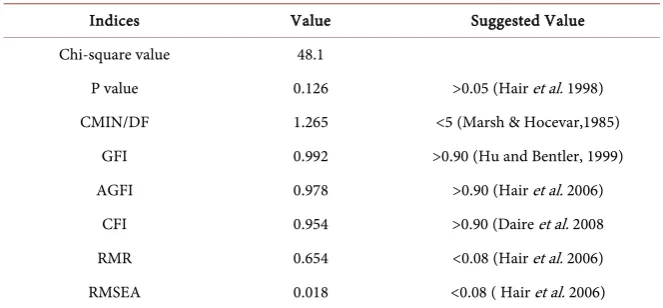
From Table 5 it is found that the calculated p value is 0.126, which is greater than 0.05 which indicates the model is fit. And also CMIN/DF value is 1.265 which is less than 5 which indicates the model is fit. Here GFI (Goodness of Fit Index) value and AGFI (Adjusted Goodness of Fit Index) value is greater than 0.9 which represent it is a good fit. The calculated CFI (Comparative Fit Index) value is 0.954, which means that it is a perfectly fit and also it is found that RMR (Root Mean Square Residuals) value is 0.654 and RMSEA (Root Mean Square Error of Approximation) value is 0.018 which is less than 0.10 which indicated it is perfectly fit.
10. Managers Opinion towards Career Planning and
Development
DOI: 10.4236/ajibm.2018.89132 1989 American Journal of Industrial and Business Management Table 5. Model fit summary for the career planning and development of employees with special reference to private sector banks in Tamilnadu.
Indices Value Suggested Value Chi-square value 48.1
P value 0.126 >0.05 (Hair et al. 1998) CMIN/DF 1.265 <5 (Marsh & Hocevar,1985)
GFI 0.992 >0.90 (Hu and Bentler, 1999) AGFI 0.978 >0.90 (Hair et al. 2006)
CFI 0.954 >0.90 (Daire et al. 2008 RMR 0.654 <0.08 (Hair et al. 2006) RMSEA 0.018 <0.08 ( Hair et al. 2006)
Source: output generated from Amos 20.
supervisor and his or her sponsorship and tutoring into the photo will guarantee that you have an inside guide who will enable you to deal with your career. A few organizations have formal projects to enable employees to build up their ca-reers. In others, you should casually seek after your career development. Or-ganizations with programs for the most part concentrate vitality on helping em-ployees create and take after a career way. The career way is talked about at a few gatherings bi-every year with the employee’s supervisor. Career ways are sug-gested for a similar reason that objectives are prescribed. They are the composed arrangement that can enable every employee to assume responsibility of what is most essential to his or her satisfaction and achievement. Without an arrange-ment, you can feel rudderless and you have no benchmark against which you can quantify your advancement.
11. Conclusion
The survey concludes that the partial effect of employees’ opinion towards career planning and development on satisfaction of the employees towards career planning and development, holds the other variables as constant. The estimated positive sign implies that such effect is positive that satisfaction of the employees towards career planning and development would increase for every unit increase about employee’s opinion towards career planning and development and this is significant. In addition, the findings confirm that the model fit is absolutely suitable for this analysis.
Conflicts of Interest
The authors declare no conflicts of interest regarding the publication of this pa-per.
References
Synthe-DOI: 10.4236/ajibm.2018.89132 1990 American Journal of Industrial and Business Management sis of the Literature. Institute on Education and the Economy, Columbia University, New York.
[2] Witko, K., Bernes, K.B., Magnusson, K. and Bardick, A.D. (2009) Senior High School Career Planning: What Students Want. The Journal of Educational Enquiry, 6, 34-49.
[3] Watts, A.G. (2006) Career Development Learning and Employability. Learning and Employability (Series 2), the Higher Education Academy, Islington.
[4] Thessaloniki (2007) Career Development in Employing Organization: Practices and Challenges from a UK Perspective. Guidance for Workforce Development Confer-ence, Held by CEDEFOP.
[5] Strandberg, C. (2009) The Role of Human resource Management in Corporate So-cial Responsibility Issue Brief and Roadmap. Report for Industry Canada, Strand-berg Consulting, Burnaby.
[6] Marwat, Z.A., Qureshi, T.M. and Ramay, M.I. (2006) Impact of Human Resource Management (HRM) Practices on Employee’s Performance. Muhammad Ali Jinnah University, Islamabad.
[7] Abbas, Z. (2014) Identification of Factors and Their Impact on Employees’ Training and Organizational Performance in Pakistan. Khadim Ali Shah Bukhari Institute of Technology (KASBIT), KASBIT Business Journals, 7, 93-109.
[8] Rajinikanth, J. (2014) A Conceptual Study on Training and Development Programs of Bank Employees. International Journal of Advance Research in Computer Sci-ence and Management Studies, 2. http://www.ijarcsms.com/
[9] Athar, R. and Maqbool, F. (2015) Shah Impact of Training on Employee Perform-ance. Banking Sector Karachi, IOSR Journal of Business and Management (IOSR-JBM), 17, 58-67. http://www.iosrjournals.org/
[10] Tejukujur and ShahInnovative, M.A. (2016) Human Resource Practices in Indian Banks: A Study from Hr Manager’s Perspective. International Journal of Engineer-ing Research and Applications, 6, 40-48. http://www.ijera.com/
[11] Kalidoss, K. and Vijayalakshmi, P. (2016) A Comparative Study on Impact of Hu-man Resources Management Practices between Public and Private Sector Banks with Reference to Mayiladuthurai Town. International Journal of Advanced Scien-tific Research & Development (IJASRD), 3, 72-77. http://www.ijasrd.org/in [12] Bajwa, J.K. (2016) Human Resource Management Practices and Their Impact on
the Job Performance of Employees with Special Reference to Banking Sector. Inter-national Journal of Engineering Technology, Management and Applied Sciences, 4.
http://www.ijetmas.com/
[13] Maina, P.M. and Waithaka, P. (2017), Effect of On-the-Job Training on Perfor-mance of the Kenya, Police Service. IOSR Journal of Business and Management (IOSR-JBM), 19, 64-71. http://www.iosrjournals.org/
[14] Jyoti (2017) Training and Development Scenario at HDFC Bank. International Journal of Business Administration and Management, 7.
http://www.ripublication.com
[15] Hameed, A. and Waheed, A. (2011) Employee Development and Its Affect on Em-ployee Performance a Conceptual Framework. International Journal of Business and Social Science, 2, 224-229.