Shape based Object Classification using
Knowledge Vector Code
Dr G D Jasmin
Assistant Professor, Dept. of CSE, Loyola Academy Degree & PG College, Hyderabad, Telangana, India
ABSTRACT: As more information is digitized more and more digital images have been generated around the world. Efficient way of description and classification of objects is a well needed application to identify the objects that are present in images. Various methods have been developed for the representation aiming to effective classification of objects.
In this paper the knowledge vector code also called Direction-Length Code is used to represent the shape of the objects. It compresses the bi-level image, preserves the information at the same time allows a considerable amount of data reduction.
KEYWORDS: Pre-processing, Computer Vision, Object Description, Object Recognition.
I. INTRODUCTION
Object recognition in computer vision is the identification of objects present in the image via extraction of significant features or attributes. Various methods such as colour based representation, texture based representation, shape based representation and appearance based representation have been developed to represent objects. More studies on these methods are being carried out and advanced techniques are being developed. Shape is an important visual feature of objects in an image. Shape based representation of objects gives more clarity about the shape of the objects that acts as a more unique and important feature of objects for the further identification of objects. The encoding efficiency to represent shapes of objects is also very important for image storage and transmission [1].
The input image to the system may be a colour image, a gray scale image or a binary image. These images have to be converted to binary images for further processing. Segmentation is an important process in our object recognition system as it highlights the objects present in the image from its back ground. The contours are extracted from the image, the initial point is identified, the outline tracing algorithm is applied and the vector code is generated.
II. RELATED WORK
Various contour based shape description techniques such as simple shape descriptors, correspondence based shape matching, boundary moments, stochastic method, spectral transform and other structural methods such as chain code representation, polygon decomposition and shape invariants have been developed in the past [2-5]. A number of new techniques have been proposed in recent years [6,7].
Global contour shape techniques take the whole shape contour for the shape representation. The shape should be described as accurately as possible; on the other hand, a shape description should be as compact as possible to simplify indexing and retrieval. Simple global shape descriptors are compact, however, they are very inaccurate shape descriptors. They need to be combined with other shape descriptors to create accurate shape descriptors.
From a historical perspective there have been quite a few principled structural theories for shape perception. Chain-code techniques are widely used because they preserve information and allow considerable data reduction. Chain codes are used as the standard input format for numerous shape-analysis algorithms. The chain code usually has high dimensions and is sensitive to noise [9]. Iivarinen and Visa derived a chain code histogram (CCH) for object recognition [10]. The CCH reflects the probabilities of different directions present in a contour. The CHH is translation and scale invariant, however, it is only invariant to a rotation of 90◦. Therefore, the normalized CHH (NCHH) is proposed. The NCHH reduces the dimensions of chain code representation, but does not solve the noise sensitivity problem.
Syntactic pattern recognition is inspired by the phenomenon that composition of a natural scene is an analogue to the composition of a language, that is, sentences are built up from phrases, phrases are built up from words and words are built up from alphabets, etc. The matching between shapes can use string matching by finding the minimal number of edit operations to convert one string into another. A more general method is to formulate the representation as a string grammar. Each primitive is interpreted as a alphabet of some grammar, where a grammar is a set of rules of syntax that govern the generation of sentences formed from symbols of the alphabet. The set of sentences generated by a grammar G is called its language and is denoted as L(G). Here, sentences are strings of symbols (which in turn represent patterns), and languages correspond to pattern class. After grammars have been established, the matching is straightforward. For a sentence representing an unknown shape, the task is to decide in which language the shape represents a valid sentence. Syntactic shape analysis is based on the theory of formal language [11]. It attempts to simulate the structural and hierarchical nature of the human vision system.
III. KNOWLEDGE VECTOR CODE OF OBJECTS
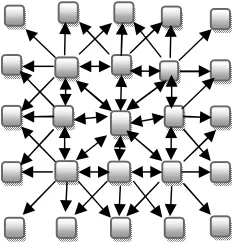
The notion of ‘Picture Description Languages’ refers to the language of digital images defined over a regular array of vertices. Having extracted the contour of an image this process involves running through the contour pixel by pixel and finding the length of the contour in every possible direction. The symbols used to represent the 8 possible directions - 2 horizontal, 2 vertical and 4 diagonal are R, DR, D, DL, L, UL, U and UR. Symbols R, D, L and U are elementary symbols and DR, DL, UL and UR are composite symbols of the alphabet. The directions denoted by these symbols are shown in Figure 1
.
Figure 1: Direction Codes
Let us consider an object S present in an image f(x,y). A pixel p at coordinates (x,y) has 4 horizontal and vertical neighbours and 4 diagonal neighbours whose coordinates are given by (x+1,y), (x-1,y), (x,y+1), (x,y-1), (x+1,y+1), (x+1,y-1), (x-1,y+1), (x-1,y-1).
The connectivity between the pixels is an important concept used in the field of object recognition. If pixel p with coordinates (x,y) and pixel q with coordinates (s,t) are pixels of object S, a path from p to q is a sequence of distinct pixels with coordinates (x0, y0), (x1, y1),……….., (xn, yn), where (x0, y0) = (x,y) and (xn, yn) = (s,t), (xi, yi) is adjacent to
(xi-1, yi-1), 1 ≤ i ≤ n, and n is the length of the path. If there a path exists from p to q consisting of pixels in S, then p is
(a) Image of a square (b) contour map
<104,109>/R81*D81*L81*U80*/<105,109># (c ) Vector code
Figure 2: The vector code of a square
To reduce the complexity of the problem a gap filling algorithm is introduced to fill the small gaps present as noise in the image. A higher order pixel representation is considered as shown in figure 3.
Figure 3: Higher order pixel representation
When the immediate neighbour of a pixel is not present, the algorithm looks for the pixels in the next level in the order of preferential directions. If pixels found in the next level, the algorithm connects the present pixel position to that in the next level to form connectivity thus filling the gap between pixels.
IV. GENERATION OF NORMALIZED KNOWLEDGE VECTOR
It is important to note that, when the diagonal lines appear in the image, they do not appear as the combination of only diagonal sides. The direction codes D and R appear with DR lines, D and L appear with DL, U and L appear with UL and U and R direction codes appear with UR. Consier the image of a triangle and the corresponding vector code shown below.
The code generated is <75,121>/D1*DR2*D1*DR3*R1*DR1*D1*DR3*D1*DR3*D1*R7*D1*DR5*D1*DR2*D1*DR3*R1*DR2*D1*DR 1*D1*DR2*DR4*D2*DR2*R1*DR4*D2*DR7*D2*DR1*R1*DR5*D1*DR1*D1*DR8*D1*DR4*D1*DR3*D1*DR3 *R1*DR1*D1*DR3*D1*DR2*L175*UR3*U1*UR2*U1*UR2*R1*UR3*U1*UR2*U1*UR7*U1*UR7*U2*UR5*R1 *UR1*U1*UR2*U1*UR4*U1*UR7*U1*UR5*U1*UR1*U1*UR4*R1*UR3*U2*UR7*U2*UR1*R1*UR5*U1*UR2* U1*UR4*U1*UR1*R1*UR2*U1*UR2*/<77,120>#
This is then reduced to single occurrence of eight directions as <75,121>/R10*DR82*D23*L175*U21*UR82*/<77,120>#
An approximate measure taken such that when the amount of pixels in a particular direction is less than 10% of its total amount of pixels it need to be added to their corresponding major directions. This reduces the memory space needed as well as gives a clear idea about the shape of the object.
Thus the vector code obtained is
<75,121>/DR110*L175*UR108*/<77,120># and then normalized to 100 pixels as
DR28*L45*UR27
So, the final vector is a normalized vector called knowledge vector as it consists of more information of the object in its simpler form.
V. OBJECT CLASSIFICATION
1. Regular shaped objects
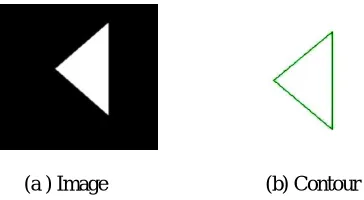
The task of identifying regular shaped objects is simple. From the vector code generated it is observed that square consists of 4 basic directions with all lengths equal. Shapes with all the basic directions but with equal alternate length can be identified as a rectangle. Shapes with 4 sides consisting of only diagonal directions can be considered as rhombus. Let us now consider the triangle that is rotated by 90o to the left,
(a ) Image (b) Contour
Figure 5: Image of a rotated triangle and its contour
The knowledge vector limited to 8 directions is <34,170>/R15*D184*L16*UL84*U15*UR84*/<35,169># and, the normalized vector is D47*UL27*UR27
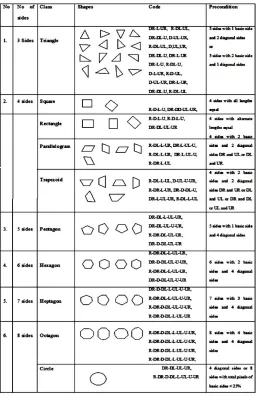
It is observed that this vector code has 1 basic direction and 2 diagonal directions and can be classified as triangle.
Table 2: The classes of basic transformed shapes with their vector codes
2. Irregular shaped objects
(a) Image (b) Contour
Figure 6: Image of a flower and its contour
The vector code for the image of a flower shown above is
<64,184>/R4*DR2*R2*D1*DR1*R2*DR4*R2*DR1*R1*DR1*D1*DR1*R2*DR1*D1*DR4*R1*DR2*D1*DR4*R1 *DR1*D2*DR3*D1*DR2*R1*DL1*DR1*D1*DR1*R2*UR1*R3*UR1*R5*UR1*R5*UR1*R4*UR1*R32*DR1*UR 1*R2*DR1*R6*D6*DR1*DL1*DR1*D23*DL1*D5*L1*DL1*D3*DL1*D4*DL3*DR4*R2*DR1*R2*DR1*R2*DR1 *R2*DR2*R2*DR1*R1*DR1*D1*DR1*R1*DR1*R2*DR2*R1*DR6*R1*DR2*R1*DR1*D1*DR1*R2*D1*DR1*D 1*DR1*R1*DR1*D1*DR1*R1*DR1*DL6*D1*DL1*L2*D1*DL4*L1*DL2*L1*DL1*D1*DL2*L1*DL2*L2*DL1* L1*DL4*L2*DL2*L2*DL1*L2*DL2*L2*DL1*L3*D1*DL2*DR1*D2*DR1*D3*DR1*D3*R1*DR1*D4*DR1*D19 *R1*DR1*DL2*D10*DL1*D3*L5*DL1*L13*DL1*UL1*L23*UL1*L4*UL1*L5*UL1*L4*UL1*L3*UL1*L1*DL2 *D2*L1*DL1*D1*DL3*D1*DL4*D1*DL4*L1*DL1*D1*DL1*L1*DL3*DL3*L1*DL2*L1*DL1*L2*DL1*D2*DL1 *L2*DL1*L1*DL1*L1*DL1*L1*DL1*UL2*L2*UL1*L1*UL1*L2*UL1*U2*UL1*L2*UL2*L1*UL2*L1*UL5*L1* UL2*U1*UL1*L1*UL1*U1*UL1*L1*UL1*U1*UL1*L1*UL1*U1*UL2*U1*UL1*U1*UL1*U1*UL4*DL2*L2*DL 1*L5*DL1*L5*DL1*L6*DL1*L29*UL1*L1*DL1*UL1*L8*U5*UL1*U1*UR1*UL1*U24*UR1*U4*UR2*D1*U3* UR1*U4*UR3*U2*UL2*L2*UL1*L2*UL1*L2*UL2*L4*UL2*L1*UL1*U1*UL1*L2*UL2*L1*UL2*L2*UL1*L1* UL1*U2*UL1*L2*UL1*L1*UL1*U1*UL4*U1*UL1*L2*U1*UL1*L1*UL1*U3*UR5*R1*UR1*U1*UR1*R1*UR1 *U1*UR2*R1*UR5*R1*UR1*R2*UR2*R1*UR3*R1*UR2*R1*UR1*R2*UR1*R2*UR2*R2*UR1*R2*UR2*R1*U R1*U1*UL1*U2*UL2*U3*UL1*U3*UL2*U5*UL1*U20*UR1*U8*UR1*R11*UR1*R26*DR1*R7*DR1*R5*DR1* R5*DR1*R3*DR1*R2*UR3*D1*U2*UR2*U1*UR3*U1*UR4*R1*UR1*U2*UR1*R1*UR2*U1*UR1*R1*UR1*U1 *UR1*R1*UR2*R1*UR2*R2*UR1*R1*UR1*U1*UR2*R1*UR1*R2*UR1*/<65,183>#
Code with the single occurrence of 8 directions is
<64,184>/R26+160*DR74*D19+91*DL82*L29+153*UL74*U20+94*UR77*/<65,183># And the normalized vector code is
R3*DR22*D2*DL23*L3*UL22*U2*UR23
Is identified as a member of the basic shape class circle.
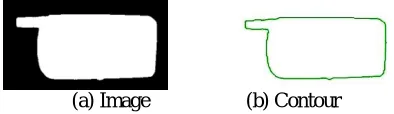
Consider another example of an image (Figure 7) of a cell phone with rounded edges.
(a) Image (b) Contour
Figure 7 : Image of a cell phone and its contour
The knowledge vector obtained is
13*UR2*R17*UR2*R16*D1*DR1*UR2*R1*D1*DR1*UR2*R6*UR1*R6*UR1*R5*DR1*R3*UR1*R3*UR1*R2*U R1*R1*/<104,109>#
This vector can be limited to single occurrence of 8 directions as
<103,109>/R223+68*DR16*D102+17*DL20*L189+77*UL39*U36+61*UR18*/<104,109># Then normalized to 100 pixels as
R26*DR7*D12*DL8*L22*UL13*U4*UR9
This normalized vector code fits into the shape category of 8 sided shape known as octagon.
Such irregular shaped objects are classified to fit into one of the classes of the basic shapes and then later detailed classification can be done.
VI. CONCLUSION
In this paper I have reviewed various techniques available in the literature for the recognition of objects. The knowledge vector code called Direction Length Code is generated for the description of objects and is used to identify the shape of the objects. The performance of the system is analysed and it is noted that in some situations the system can perform object recognition very well even in the presence of noise. It also minimizes the need of storage at the same time preserving the information. The technique is effective, computationally inexpensive and can be applied to shapes with several variations. These codes also can act as a standard input format for numerous shape-analysis algorithms.
REFERENCES
1. H. Freeman, “On the Encoding of Arbitrary Geometric Configurations,” in Proceedings of IRE Translation Electron Computer, New York, pp. 260-268, 1961.
2. Zhang D, Lu G, “Evaluation of mpeg-7 shape descriptors against other shape descriptors”, Multimedia Systems, 9(1), 2003.
3. Biederman, I., “Recognition-by-components: A theory of human image understanding”, Psychological Review, 94, pp. 115-147, 1987. 4. J.W. Mckee, J.K. Aggarwal, “Computer recognition of partial views of curved objects”, IEEE Trans. Comput.-pp. 26 790–800, 1977. 5. R. Chellappa, R. Bagdazian, “Fourier coding of image boundaries”, IEEE Trans. Pattern Anal. Mach. Intell. 6 (1), pp. 102–105, 1984.
6. Torralba, A., Oliva, A., Freeman, W. T., Object recognition by scene alignment [Abstract]. Journal of Vision, 3( 9), pp. 196- 196a, 2003.
7. Leordeanu et al., “Beyond local appearance: Category recognition from pair wise interactions of simple features”, IEEE Computer Society Conference on Computer Vision and Pattern Recognition, 2007.
8. C.W. Richard, H. Hemami, “Identi1cation of three dimensional objects using Fourier descriptors of the boundary curve”, IEEE Trans. System Man Cybernet, SMC-4 (4), pp. 371–378, 1974.
9. D. Zhang, G. Lu , “Review of shape representation and description techniques”, Pattern Recognition 37 : pp. 1–19, 2004.
10. J. Iivarinen, A. Visa, “Shape recognition of irregular objects”, Intelligent Robots and Computer Vision XV: Algorithms, Techniques, Active Vision, and Materials Handling, Proc. SPIE 2904, pp. 25–32, 1996.