ISSN(Online): 2320-9801
ISSN (Print): 2320-9798
International Journal of Innovative Research in Computer
and Communication Engineering
(A High Impact Factor, Monthly, Peer Reviewed Journal) Website: www.ijircce.com
Vol. 5, Issue 11, November 2017
Reduction of Peak to Average Power Ratio
Using Weighted OFDM
Bushra Zareen I. A. Khan1, Shirish L. Kotgire2
P.G Student, Department of Electronics and Telecommunication, M.G.M’s College of Engineering, Nanded, India1
Professor, Department of Electronics and Telecommunication, M.G.M’s College of Engineering, Nanded, India2
ABSTRACT: Besides many advantages of Orthogonal Frequency Division Multiplexing (OFDM), Peak to Average Power Ratio (PAPR) is the major problem of this system. To overcome this drawback many different techniques are used, some are distortion-less techniques and, some are distortion techniques. In this paper, PAPR reduction technique based on weighted OFDM signal is proposed to reduce PAPR without distortion. In the proposed scheme a weight is imposed on the discrete OFDM signal at the transmitter, whereas original signal can be recovered at the receiver by removing the weights. According to the numerical results, the PAPR of weighted OFDM signal is smaller than that of Clipping and Filtering (C&F) method also Bit Error Rate (BER) performance is improved. The proposed method is simpler than C&F method. Also for a better perspective weighted OFDM scheme is compared with the conventional method of Partial Transmit Sequences (PTS). Numerical computation of all the methods and comparisons are done by MATLAB simulations.
KEYWORDS: Orthogonal Frequency Division Multiplexing (OFDM), Weighted OFDM, Clipping and Filtering (C&F), Partial Transmit Sequences (PTS), Peak to Average Power Ratio (PAPR), Bit Error Rate (BER).
I. INTRODUCTION
Orthogonal Frequency Division Multiplexing or OFDM is a modulation technique that is being used for many of the latest wireless and telecommunication standards. OFDM has been adopted for a number of broadcast standards like 802.11a, 802.11g, 802.11n, 802.11ac, 808.11ad. It is also used in cellular telecommunications standards LTE/LTE-Advanced 4g, and in addition to this it has been adopted by other standards such as WIMAX and many more. It has also been adopted for a number of broadcast standards like Digital Audio Broadcast (DAB), Digital Video Broadcast like DVB-T(Terrestrial) and DVB-H (Handheld).
However, one of the major problem of the OFDM based systems is the high Peak to Average Power Ratio (PAPR) of a transmitted signal. The transmit signals in an OFDM system can have high peak values in the time domain since many subcarriers are added via an Inverse Fast Fourier Transform (IFFT) operation. As a result, OFDM systems are known to have high peak to average power ratio (PAPR) when compared to single carrier systems. Also it causes a distortion of a signal at the nonlinear high-power amplifier (HPA) of a transmitter. Thus, the power efficiency of the HPA is limited to avoid nonlinear distortion; otherwise, the high PAPR results in significant performance degradation. Because, this problem is having a practical importance, a number of algorithms for reducing the high PAPR have been developed, such as clipping and filtering (C&F) [1]-[3]; coding [4]; adaptive symbol selection, such as selected mapping[5]; partial transmit sequence and interleaving [6][7]; tone reservation/injection [8]; active signal constellation extension [9], companding [10]; and others.
In this paper, a PAPR reduction scheme based on a weighted OFDM signal is proposed to reduce the PAPR without distortion in removing the weight at the receiver side [11]. This method is motivated by a circular convolution method, i.e., the modulated OFDM signal is circularly convoluted with a signal Φ for smoothing the peak of the OFDM signal before the HPA. Here, the signal Φ is chosen such that it satisfies that the Fourier transform φof Φ has no zero on the real line.
ISSN(Online): 2320-9801
ISSN (Print): 2320-9798
International Journal of Innovative Research in Computer
and Communication Engineering
(A High Impact Factor, Monthly, Peer Reviewed Journal) Website: www.ijircce.com
Vol. 5, Issue 11, November 2017
a suitable positive constant to the original weight. The PAPR of the weighted OFDM signal with the modified weight is smaller than that of the C&F method, and the BER performance is improved compared with the C&F method.
Also the comparison of weighted OFDM method is done with the Partial Transmit Sequences (PTS) technique along with C&F method to get a better understanding of the proposed method.
II. SYSTEMDESCRIPTION
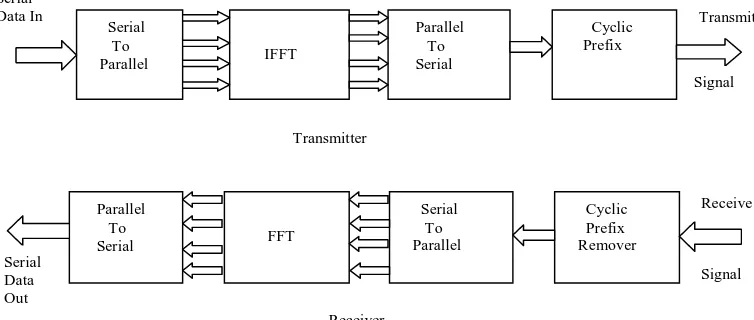
Simplified block diagram for OFDM system is shown in Fig.1. The IFFT operation is performed on the modulated data and then cyclic prefix is added to the signal and then the signal is passed through the HPA and then transmitted. At the receiver cyclic prefix is removed first then fast Fourier transform (FFT) is carried out and later the signal is demodulated. For discrete data { } , multicarrier modulated signal ( ) is represented by,
( ) =
√ ∑ (1)
For OFDM systems peak to average power ratio can be calculated as, the ratio of maximum power to the average power of the signal. It is represented as,
( ) = | ( )|
(| ( )| ) (2)
The transmit signals in an orthogonal frequency-division multiplexing (OFDM) system can have high peak values in the time domain since many subcarrier components are added via an inverse fast Fourier transformation (IFFT) operation. As a result, OFDM systems are known to have a high peak-to-average power ratio (PAPR) when compared to single-carrier systems. In fact, the high PAPR is one of the most detrimental aspects in an OFDM system as it decreases the signal-to-quantization noise ratio (SQNR) of the analog-digital convertor (ADC) and digital-analog convertor (DAC) while degrading the efficiency of the power amplifier in the transmitter. In order to reduce the effect of high PAPR different techniques are used, we will evaluate some of them.
Fig. 1. OFDM Block Diagram
Serial To
Parallel IFFT
Parallel To Serial
Cyclic Prefix
Transmitter
Parallel To
Serial FFT
Serial To Parallel
Cyclic Prefix Remover Serial
Data In
Serial Data Out
Receiver
Transmit
Signal
Receive
ISSN(Online): 2320-9801
ISSN (Print): 2320-9798
International Journal of Innovative Research in Computer
and Communication Engineering
(A High Impact Factor, Monthly, Peer Reviewed Journal) Website: www.ijircce.com
Vol. 5, Issue 11, November 2017
III.CLIPPINGANDFILTERING
Clipping is one of the most simple and effective methods of PAPR reduction. Fig.2. shows the block diagram for OFDM system with clipping and filtering method. In this method the large peak that exceeds a certain threshold level and occurs infrequently is clipped deliberately.
Fig. 2. Clipping and Filtering Block Diagram
( ) =
− , ( ) <−
( ), − ≤ ( )≤
, ( ) >
(3)
In Eq(3), ( ) is the data to be transmitted, ( ) is the modulated data and is the clipping level or the threshold. The value of the threshold is chosen in such a way that it provides good PAPR reduction with less BER. Clipping is a non-linear process and may cause significant in-band and out-of-band radiation which degrades the system performance. In-band radiation degrades BER performance and out-of-band radiation causes degradation in spectral efficiency. Filtering can remove the out-of-band radiation.
The simplest and widely used method for PAPR reduction is amplitude clipping. some other clipping techniques are, repeated clipping, iterative clipping, recursive clipping and filtering
IV.PARTIALTRANSMITSEQUENCES
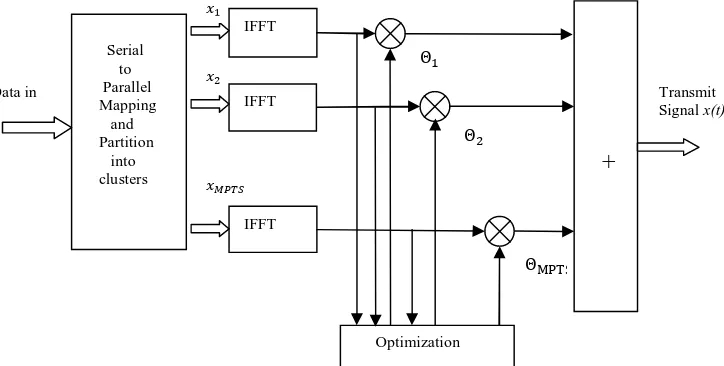
Partial Transmit Sequences or PTS is mainly motivated by the idea that an individual scaling and phase rotation of appropriately defined ‘partial transmit signals’ should be a powerful means to avoid the constructive addition of the components to high peak values. Fig.3. shows the block diagram of OFDM system with PTS technique for reduction of PAPR [12].
Fig. 3. Block Diagram for Partial transmit sequence (PTS) scheme of PAPR reduction
Serial to Parallel Mapping and Partition into clusters
IFFT
IFFT
IFFT
Optimization
+
Θ
Θ
Θ
Transmit Signal x(t)
Data in Modulated
Data
IFFT Clipping Filtering Amplifier Input
ISSN(Online): 2320-9801
ISSN (Print): 2320-9798
International Journal of Innovative Research in Computer
and Communication Engineering
(A High Impact Factor, Monthly, Peer Reviewed Journal) Website: www.ijircce.com
Vol. 5, Issue 11, November 2017
The OFDM signal is partitioned into disjoint sets of sub-channels
( ) =∑ ( ) (4) with
( ) =∑ . ∆
∈ (5)
The components ( ) are called the ‘Partial Transmit Sequences’ (PTS) or ‘group signals’. Set consist of adjacent sub-channels. Each group signal is transformed in time domain by conventional modulation. In time-domain, all group signals are weighted with an individual factor and added to results in transmit signal ( ) . are complex factors that usually have unit modulus allows for a phase rotation of each group signal. They are chosen so that the peak power of ( ) is minimal.
With an increasing number of groups as well as with an increasing number of possible phase values, the achievable PAPR reduction increases. A disadvantage of this method is that the number of possible time-domain signals ( ) rapidly increases with the number of group signals and phase value.
V. WEIGHTEDOFDMMETHODOLOGY
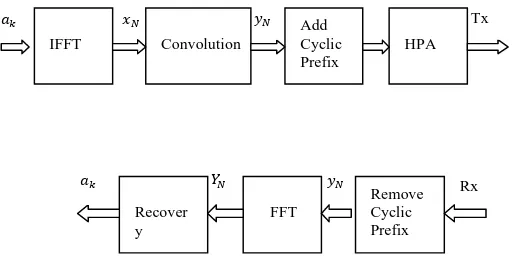
In this paper we are going to examine the weighted OFDM signal scheme for PAPR reduction, where the weight is obtained from a suitable band-limited signal having no zero on the real line. This method is motivated by a circular convolution process, i.e., the modulated OFDM signal is convoluted with a certain kind of signal Φ for smoothing the peak of the OFDM signal before the HPA.
Fig. 4 Block diagram for smoothing peaks of OFDM signal
Fig. 5. PAPR reduction using weighted OFDM
Apply
Weight IFFT
Add Cyclic Prefix
Remove Weight
HPA
FFT
Remove Cyclic Prefix
Tx
Rx IFFT Convolution
Add Cyclic Prefix
Recover y
HPA
FFT
Remove Cyclic Prefix
Tx
ISSN(Online): 2320-9801
ISSN (Print): 2320-9798
International Journal of Innovative Research in Computer
and Communication Engineering
(A High Impact Factor, Monthly, Peer Reviewed Journal) Website: www.ijircce.com
Vol. 5, Issue 11, November 2017
First, we will see the convolution method and then obtain the weighted OFDM signal respectively.
A. Convolution Method:
We consider signal φ as
( ) = ( ) (6) Where,
( ) = , ≠0
1, = 0 (7)
By direct computation, the Fourier transform Φ=Ƒ[φ]of φ is given by
Φ(ξ) = 1− | |
, |ξ|≤ π
0, otherwise (8)
The signal φ is a band-limited signal with bandwidth π, has no zero on the real line.
Consider the circular convoluted signal as follows:
( ) = ∗ Φ(t) = ∫ ( − ξ)Φ(ξ)dξ (9)
Taking the Fourier transform in above equation,
Ƒ[ ] = 1
2 Ƒ[ ]Ƒ[Φ] =Ƒ[ ]
Where Ƒ[ ] and Ƒ[ ] are the Fourier transforms. We can recover discrete data so that, for = 0, … … . , −1, we have ,
=√ Ƒ[ ]( )=√ Ƒ[ ]( )
( ) (10)
B. Weighted OFDM
We show that the convoluted signal in (9) can be written as simple weighted OFDM signal as follows;
( ) =
√ ∑ (2 ) (11)
C. Modified Weighted OFDM
The drawback of the weighted OFDM signal in (11) is the degradation of BER performance since the weight φis nonuniform. To overcome this obstacle, we consider the modified weight with a positive constant αas follows:
( ) = ( ) + (12)
ISSN(Online): 2320-9801
ISSN (Print): 2320-9798
International Journal of Innovative Research in Computer
and Communication Engineering
(A High Impact Factor, Monthly, Peer Reviewed Journal) Website: www.ijircce.com
Vol. 5, Issue 11, November 2017
( ) =
√ ∑ (2 ) (13)
as a transmitted signal instead of in (1).
In system (13) weight (2 ) is imposed on discrete data , = 0, … … . , −1, and we form an OFDM signal with the weighted discrete data { (2 ) } to get weighted OFDM signal for the same time duration as the original OFDM signal.
We note that weight φis positive on the real line; therefore, the modified weight is positive on the real line. Since
(2 )≠0 for any = 0, … … . , −1, the discrete data { } can be completely recovered. The PAPR of weighted OFDM signal is given by,
( ) = | ( )|
(| ( )| ) (14)
In the following section, we provide the simulation results showing that the PAPR of the weighted OFDM signal with modified weight is smaller than that of the C&F method, and the BER performance of the weighted OFDM system with modified weight is improved compared with the C&F method. We note that as α increases, due to the modification of weight, the BER performance is improved, whereas the complementary cumulative distribution function (CCDF) grows slightly.
In (14), we can recover discrete data { (2 ) } by the conventional method of the OFDM system. By dividing the discrete data by (2 ) we can obtain the original discrete data, the weighted OFDM system is not expected to cause any computational complexity in recovering the original discrete data. In fact, 2 complex multiplications are additionally needed compared with the original OFDM method.
VI.SIMULATIONRESULTS
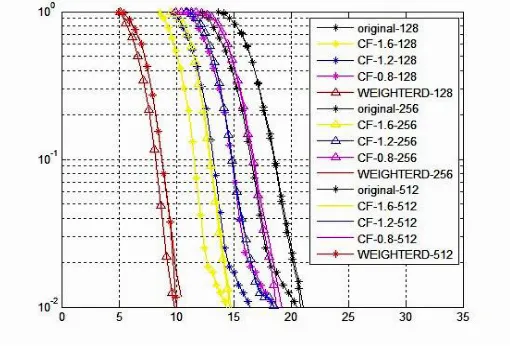
The analysis of all the systems is carried out using MATLAB simulations. Simulations for CCDF and BER of C&F , PTS, and Weighted OFDM methods are done for different number of symbols and subcarrier’s. Using QAM modulation on 128,256,512, and 1024 number of symbols and clipping ratios for clipping is considered to be
0.8,1.2,and 1.6. The value of shift parameter α=0.15and 0.75.
Fig. 6. CCDF of C&F and proposed method
ISSN(Online): 2320-9801
ISSN (Print): 2320-9798
International Journal of Innovative Research in Computer
and Communication Engineering
(A High Impact Factor, Monthly, Peer Reviewed Journal) Website: www.ijircce.com
Vol. 5, Issue 11, November 2017
Fig.7. CCDF and BER of C&F and proposed method
Fig. 6. compares the C&F method with the proposed method of modified weighted OFDM for CCDFs and BER performance over the additive White Gaussian noise channel together. As shown in the figure, the BER performance and the CCDF of the proposed method with α= 0.15 are superior to those of the C&F method for CR = 0.8, 1.2, 1.6 when N= 128 is fixed.
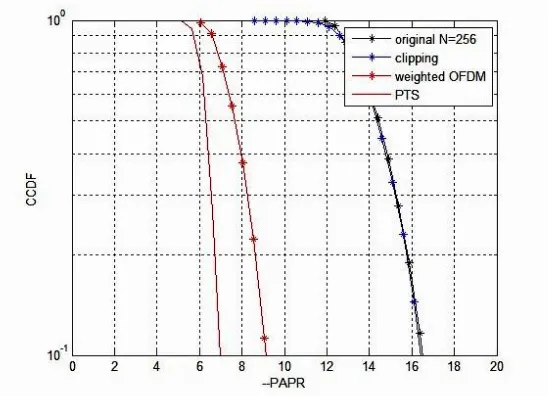
Fig. 8. Comparison of C&F, PTS and proposed method
ISSN(Online): 2320-9801
ISSN (Print): 2320-9798
International Journal of Innovative Research in Computer
and Communication Engineering
(A High Impact Factor, Monthly, Peer Reviewed Journal) Website: www.ijircce.com
Vol. 5, Issue 11, November 2017
VII. CONCLUSION
In this paper , PAPR reduction based on weighted OFDM is proposed which does not cause distortion when removing weight at the receiver side. We consider a weighted discrete data to form a weighted OFDM signal, which is defined on the same time interval as the original OFDM signal. It can be observed that the PAPR of weighted OFDM method is less than that of the C&F method, and the BER performance is improved when compared with the C&F method. The graph obtained by MATLAB simulation shows weighted OFDM has better BER performance when compared to conventional method like PTS. Also the time duration needed to transmit the weighted OFDM signal is the same as the time duration required for the transmission of original OFDM signal.
REFERENCES
[1] X. Li and L. J. Cimini, Jr., “Effects of clipping and filtering on the performance of OFDM,” IEEE Commun. Lett., vol. 2, no. 5, pp. 131–133, May 1998.
[2] J. Armstrong," Peak-to-Average Power Reduction for OFDM by Repeated Clipping and Frequency Domain Filtering" Electronics Letters, vol.38, no. 5, 28th February 2002.
[3] Y.-C. Wang and Z.-Q. Luo, “Optimized iterative clipping and filtering for PAPR reduction of OFDM signals,” IEEE Trans. Commun., vol. 59, no. 1, pp. 33–37, Jan. 2011.
[4] V. Tarokh and H. Jafarkhani, “On the computation and reduction of the peak-to-average power ratio in multicarrier communications,” IEEE
Trans. Commun., vol. 48, no. 1, pp. 37–44, Jan. 2000.
[5] S. Yoo, S. Yoon, S. Y. Kim, and I. Song, “A novel PAPR reduction scheme for OFDM systems: Selective mapping of partial tones (SMOPT),” IEEE Trans. Consum. Electron., vol. 52, no. 1, pp. 40–43, Feb. 2006.
[6] S. H. Muller and H. B. Huber, “OFDM with reduced peak-to-mean power ratio by optimum combination of partial transmit sequences,”
Electron.Lett., vol. 33, no. 5, pp. 368–369, Feb. 1997.
[7] Jun Huo, Jianhua Ge, and Jing li, “Peak to Average Power Ratio of OFDM signals Using PTS scheme with low computational complexity, ”
IEEE Transaction on Broadcasting, vol. 57, pp. 143-148, March 2011.
[8] J. Tellado, “Peak to average power reduction for multicarrier modulation,” Ph.D. dissertation, Stanford Univ., Stanford, CA, Sep. 1999. [9] B. S. Krongold and D. L. Jones, “PAR reduction in OFDM via active constellation extension,” IEEE Trans. Broadcast., vol. 49, no. 3, pp.
258– 268, Sep. 2003.
[10] X. Huang, J. Lu, J. Zheng, K. B. Letaief, and J. Gu, “Companding transform for reduction in peak-to-average power ratio of OFDM signals,” IEEE Trans. Wireless Comuun., vol. 3, no. 6, pp. 2030–2039, Nov. 2004.
[11] Chang Eon Shin, Kyung Soo Rim, and Youngok Kim, “A Weighted OFDM Signal Scheme for Peak-to-Average
Power Ratio Reduction of OFDM Signals,” IEEE Transaction on Vehicular Technology, vol. 62, pp. 1406-1409, March2013.