ISSN(Online): 2320-9801
ISSN (Print): 2320-9798
I
nternational
J
ournal of
I
nnovative
R
esearch in
C
omputer
and
C
ommunication
E
ngineering
(A High Impact Factor, Monthly, Peer Reviewed Journal) Website: www.ijircce.com
Vol. 7, Issue 5, May 2019
A Practical Framework for Energy-Efficient
Node Activation in Heterogeneous LTE
Networks
Alok Kumar Bairwa, Gajendra Sujediya
Research Scholar, RIET Jaipur , Rajasthna, India
Assistant Professor, RIET Jaipur , Rajasthna, India
ABSTRACT: Wireless cellular networks have seen dramatic growth in number of mobile users. As a result, data requirements and hence the base-station (BS) power consumption has increased significantly. It in turn adds to the operational expenditures (OPEX) and also causes global warming. The base stations power consumption in Long Term Evolution (LTE) has therefore, become a major challenge for vendors to stay green and profitable in competitive cellular industry. It necessitates novel methods to devise energy efficient communication in LTE. Importance of the topic has attracted huge research interests worldwide. Energy saving (ES) approaches proposed in the literature can be broadly classified in categories of energy efficient resource allocation, load balancing, carrier aggregation and bandwidth expansion. Each of these methods has its own pros and cons leading to a trade-off between ES and other performance metrics resulting into open research questions. This paper discusses various ES techniques for the LTE systems and critically analyses their usability through a comprehensive comparative study.
I. INTRODUCTION
Wireless communication has become one of the basic pro-visions of the modern world. Since the inception of first radio communication system by Marconi, wireless communication systems have seen a massive growth in the last few decades from having a couple of individuals to the majority of the world as their users . The concept of frequency reuse was first introduced in cellular radio communication systems by AT &T . Further developments in radio communication introduced digital cellular systems, which pass through a long chain of evolution known as the Generations (G). We have seen usage of 1G, 2G, 3G and now4G as the communication standard with each resulting into enhanced performance of cellular systems . Aiming towards the key achievements such as short transmission time, high throughput, low latency and security, these systems generally consist of Base Stations (BS) connected to core network. Each BS has designated cover-age area, called cell and communicates directly with User Equipment (UE) within its coverage . Whenever UE moves from serving cell to neighbor cell, its transfer of control is initiated through handover process.LTE is a 4G technology, which transmits Digital Broadband Packets over Internet Protocol (IP) while offering peak data rate of 100 – 300 Mbps . This increased data rate in LTE is achieved by employing Orthogonal Frequency Division Multiple Access (OFDMA) based technology which promises low latency, high data rate and packet optimized radio access. This enhanced performance of services compared to previous generations of the cellular networks has helped LTE systems to gain rapid popularity both commercially and academically
3GPP and LTE Standardization
ISSN(Online): 2320-9801
ISSN (Print): 2320-9798
I
nternational
J
ournal of
I
nnovative
R
esearch in
C
omputer
and
C
ommunication
E
ngineering
(A High Impact Factor, Monthly, Peer Reviewed Journal) Website: www.ijircce.com
Vol. 7, Issue 5, May 2019
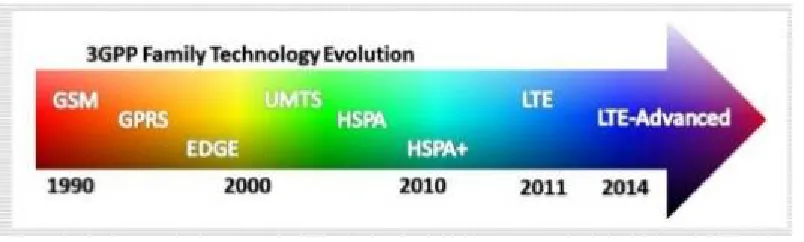
After four years of deliberation, and with contributions from telecommunications companies and Internet standardization bodies all across the globe, the standardization process of LTE(3GPP Release 8) was completed in 2008. The Release 8 LTE standard later evolved to LTE Release 9 with minor modifications and then to Release 10, also known as the LTE-Advanced standard. The LTE-Advanced features improvements in spectral efficiency, peak data rates, and user experience relative to the LTE. With a maximum peak data rate of 1 Gbps, LTE-Advanced has also been approved by the ITU as an IMT-Advanced technology.
II. OBJECTIVES OF LTE AND LTE-ADVANCED
The overall objective for LTE is to offer an extremely high performance radio access technology which offers complete vehicular speed mobility and that can readily coexist with HSPA and earlier networks. LTE is referred as Universal Terrestrial Radio Access Network (E-UTRAN). LTE supports Downlink peak data rates up to 326 Mbps with 20 MHz bandwidth and Uplink peak data rates up to 86.4 Mbps with 20 MHz bandwidth. LTE also supports scalable bandwidth such as 1.4 MHz, 3 MHz, 5 MHz, 10 MHz, 15 MHz, and 20 MHz .Besides, LTE supports reduced latency up to 10 milliseconds (ms) round-trip times between user equipment and the base station, and to less than 100 ms transition time from inactive to active.
Table 1.1: Technical specifications published by the 3GPP group
Release Specification Date Downlink
Data Rate
Uplink Data Rate
Round Trip Time
Release 99 WCDMA March,
2000
384 kbps 128 kbps 150 ms
Release 4 TDSCDMA March,
2001
384 kbps 128 kbps 150 ms
Release 5 HSDPA March to
June, 2002
14 Mbps 5.7 Mbps <100ms
Release 6 HSUPA December,
2004 to March, 2005
14 Mbps 5.7 Mbps <100ms
Release 7 HSPA December,
2007
28 Mbps 11 Mbps <50ms
Release 8 LTE December,
2008
100 Mbps 50 Mbps 10 ms
Release 10 LTE-Advanced Published
2012
1 Gbps in a low mobility
ISSN(Online): 2320-9801
ISSN (Print): 2320-9798
I
nternational
J
ournal of
I
nnovative
R
esearch in
C
omputer
and
C
ommunication
E
ngineering
(A High Impact Factor, Monthly, Peer Reviewed Journal) Website: www.ijircce.com
Vol. 7, Issue 5, May 2019
III. PROPOSED METHODOLOGY
Long Term Evolution (LTE) is an upcoming standard for very high-speed wireless communication for mobile devices and data terminals. LTE is based on the GSM/EDGE and UMTS/HSPA technologies. By using different radio interface together with core network improvements, LTE increases the capacity and speed.LTE is a 4G wireless communications standard developed by the 3rd Generation Partnership Project (3GPP) that's designed to provide up to 10x the speeds of 3G networks for mobile devices such as smart phones, tablets, notebooks, notebooks and wireless hotspots. 3GPP engineers named the technology "Long Term Evolution" because it represents the next step (4G) in a progression from GSM, a 2G standard, to UMTS, the 3G technologies based upon GSM. LTE provides significantly increased peak data rates, with the potential for 100 Mbps downstream and 30 Mbps upstream, reduced latency, scalable bandwidth capacity, and backwards compatibility with existing GSM and UMTS technology. Future developments to could yield peak throughput on the order of 300 Mbps. The upper layers of LTE are based upon TCP/IP, which will likely result in an all-IP network similar to the current state of wired communications. LTE will support mixed data, voice, video and messaging traffic. LTE uses OFDM (Orthogonal Frequency Division Multiplexing) and, in later releases, MIMO (Multiple Input Multiple Output) antenna technology similar to that used in the IEEE 802.11n wireless local area network (WLAN) standard. The higher signal to noise ratio (SNR) at the receiver enabled by MIMO, along with OFDM, provides improved coverage and throughput, especially in dense urban areas.
ETU:
Extended typical urban model (ETU) is used to generate channel models for wireless applications like EPA and EVA. This is based on the GSM Typical Urban Model. It has maximum Doppler frequency of 300 Hz. This model has number of nine channel taps and the maximum delay is 5000ns. This channel model has limited bandwidth of 20 MHz. The UE of this channel model has a speed of 120Km/hour or 350 Km/hour. This model is applicable for typical urban areas.
Propagation channel modelling function is to impair transmitted signal with environmental disturbances.Multi-path fading channel is defined by a combination of multi--path delay profiles and a maximum of Doppler frequency which can be 5 hz, 70hz and 300 hz. When a wireless signal travels from a transmitter to receiver it follows multiple paths. The signal may travel directly following line of sight between Tx and Rx. It may bounces off the ground and reaches the receiver or it may be reflected by multiple buildings on the way to receiver. When these copies of same signal arrives at the receiver they are delayed and attenuated based upon the path length, they have followed and on various other factors.
ISSN(Online): 2320-9801
ISSN (Print): 2320-9798
I
nternational
J
ournal of
I
nnovative
R
esearch in
C
omputer
and
C
ommunication
E
ngineering
(A High Impact Factor, Monthly, Peer Reviewed Journal) Website: www.ijircce.com
Vol. 7, Issue 5, May 2019
Figure 1: The concept ETU ETU Delay Profile:
Excess tap delay (ns) Relative power (dB)
0 -1.0
50 -1.0
120 -1.0
200 0.0
230 0.0
500 0.0
1600 -3.0
2300 -5.0
5000 -7.0
IV. SIMULATION RESULTS
4.1. Result
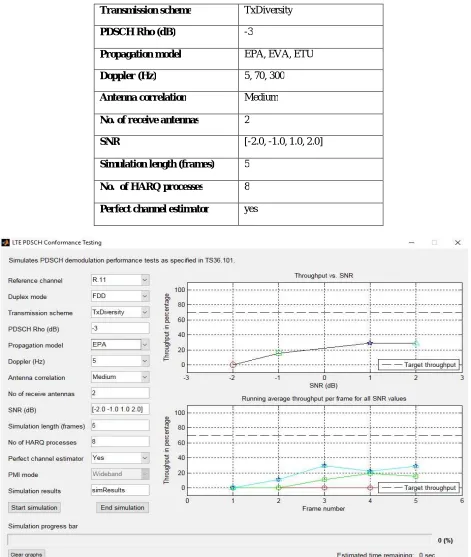
This section will discuss the results obtained after the simulation in Matlab 2014a with variousparameters that have been discussed in the previous section. In all the simulations, throughput ratio has been considered as the target throughput.
The parameters used here to simulate the LTE PDSCH have been given below
Parameters Value
Reference channel R.11
ISSN(Online): 2320-9801
ISSN (Print): 2320-9798
I
nternational
J
ournal of
I
nnovative
R
esearch in
C
omputer
and
C
ommunication
E
ngineering
(A High Impact Factor, Monthly, Peer Reviewed Journal) Website: www.ijircce.com
Vol. 7, Issue 5, May 2019
Transmission scheme TxDiversity
PDSCH Rho (dB) -3
Propagation model EPA, EVA, ETU
Doppler (Hz) 5, 70, 300
Antenna correlation Medium
No. of receive antennas 2
SNR [-2.0, -1.0, 1.0, 2.0]
Simulation length (frames) 5
No. of HARQ processes 8
Perfect channel estimator yes
ISSN(Online): 2320-9801
ISSN (Print): 2320-9798
I
nternational
J
ournal of
I
nnovative
R
esearch in
C
omputer
and
C
ommunication
E
ngineering
(A High Impact Factor, Monthly, Peer Reviewed Journal) Website: www.ijircce.com
Vol. 7, Issue 5, May 2019
In Fig. 2, throughput vs SNR for EPA with 5 Hz Doppler Effect has been plotted. Here, it has been observed that when the value of SNR is -2dB then the throughput is 0%, for -1dB it is 15.56%, for 1dB it crosses the target throughput which is 28.89%. Same result has been obtained for 2dB SNR. In 5Hz doppler values, % of throughput for various SNR values are changing as per the no.of frames transmitted.
V. CONCLUSION
Simulation results show the impact of % throughput depending on SNR & no. of frames transmission for EPA, EVA and ETU model in LTE PDSCH channel. For the different doppler values, % of throughput for various SNR values are changing as per the no.of frames transmitted. Best throughput performance is estimated above the targeted throughput for both cases i.e. SNR & Frame number.In this proposed work, the performances of three propagation models of LTE (EPA, EVA & ETU) have been analyzed. In the analysis, throughputs for various SNR’s value in several Doppler effects have been considered. It has been found that for 5 Hz Doppler Effect, ETU shows the best performance and EVA shows the worst. In case of 70 Hz, ETU is the best and EPA is the worst. But in case of 300 Hz, all the models are identical. It has been also found that increasing the value of SNR increases the value of throughput.
REFERENCES
[1]. Astély, D. et al. (2009) ‘LTE : The Evolution of Mobile Broadband’, (April), pp. 44–51.
[2]. Das, R. N. (2015) ‘Environment’.
[3]. Hosein, P. (2014) ‘Resource Allocation for the LTE Physical Downlink Control Channel’, (July). doi:
10.1109/GLOCOMW.2009.5360730.
[4]. Ikuno, J. C., Wrulich, M. and Rupp, M. (2010) ‘System level simulation of LTE networks’, (June). doi: 10.1109/VETECS.2010.5494007.
[5]. Kadhim, M. (2018) ‘Analysis and Simulation of LTE Downlink : EPA and ETU model’, 2018 International Conference on Advanced
Science and Engineering (ICOASE). IEEE, pp. 185–188.
[6]. Kanwal, K. et al. (2017) ‘Energy Management in LTE Networks’, 5.
[7]. Kaushik, A. and Khurana, S. (2016) ‘International Journal of Advanced Research in Throughput Analysis of LTE PDSCH Channel for
ETU Model’, 6(10), pp. 289–292.
[8]. Mohamed, M. A., Abdel-atty, H. M. and Raslan, W. (2014) ‘Performance Analysis of LTE-Advanced Physical Layer Performance
Analysis of LTE-Advanced Physical Layer’, (January).
[9]. Padaganur, S. K. (2018) ‘Performance Analysis of PDSCH Downlink & Inter-Cell Interferece Parameters in LTE Network .’, 2018 2nd
International Conference on Inventive Systems and Control (ICISC). IEEE, (January), pp. 791–795. doi: 10.1109/ICISC.2018.8398907.
[10]. S, P. A. (2018) ‘PERFORMANCE ANALYSIS OF LTE NETWORK USING RUNTIME PRE- CODING ALGORITHM’, (2581), pp.
220–223.
[11]. Sindal, R. (2018) ‘LTE channel throughput assessment and comparison under different terrain’, (March), pp. 1–9. doi: 10.1002/dac.3586.