EXPECTED SAFETY ISSUES OF THE SEISMICALLY ISOLATED
NUCLEAR POWER PLANT STRUCTURES
Sanghyun Choi1, Juyoung Lee2, Kee-Jeung Hong3, Sinzeon Park4, Hohyun Cho5, Chang-Hun Hyun6, Moon-Soo Kim6, and Yong-Lak Paek6
1
Associate Professor, Dept. of Railroad Facility Eng., Univ. of Trans., Uiwang, Korea ([email protected]) 2
Graduate Research Assistant, Dept. of Railroad Facility Eng., Univ. of Trans., Uiwang, Korea 3
Associate Professor, School of Civil Engineering, Kookmin University, Seoul, Korea 4
Graduate Research Assistant, School of Civil Engineering, Kookmin University, Seoul, Korea 5
Senior Researcher, Korea Institute of Nuclear Safety, Daejeon, Korea 6
Principal Researcher, Korea Institute of Nuclear Safety, Daejeon, Korea
ABSTRACT
After the Fukushima nuclear accident last year, the efforts have actively been made to enhance the safety of the nuclear power plant (NPP). As a part of these efforts, applying the seismic isolation system to NPP structures is being considered and researched seriously in several countries. In Korea, the related research is also on the way by the public utilities for the recently developed Korean NPP. Accordingly, Korea Institute of Nuclear Safety (KINS) is conducting an independent research project to provide regulatory rules on the seismic isolation system for NPP structures.
In this paper, identified regulatory safety issues relating to approval of the seismic isolation system and the isolated NPP structure are summarized. The possible safety issues include the design, analysis, manufacture, performance evaluation, installation, maintenance, and replacement of the seismic isolation system itself and the isolated NPP structure. The issues have been identified based upon experience, research information and documentation available to date.
INTRODUCTION
In these years, as global interests in green energy rises, the construction of nuclear power plant tends to increase. IAEA once predicted more than 300 NPPs would be newly constructed by 2030 and the market could be inflated up to 830 billion US dollars (IAEA, 2008). To date, most of primary NPP structures have been designed and built based on the seismic resistance design. However, for high seismic region such as non-bedrock regions, adopting seismic isolation design has been seriously considered due to high cost of conventional seismic design.
To date, only a few NPPs including 4 units in France and 2 units in Republic of South Africa has adopted the seismic isolation system (Forni, 2011). However, advanced countries such as Japan and US are pushing forward to develop a seismic isolation system for commercial NPPs (Stojadinovic, 2011). In response to this movement, regulatory committees and institutes in US and Japan such as US NRC and JNES have been performing research on seismic isolation systems and preparing regulatory guides. Using research results, JNES recently distributed the regulatory guide for a seismic system (JNES, 2010).
In Korea, the joint research team including public utilities and related institutes has initiated a research on a seismic isolation system for the APR 1400 system, a recently developed commercial NPP system. Accordingly, KINS, a regulatory institute for nuclear facilities and materials in Korea, is conducting an independent research project to provide regulatory rules on the seismic isolation system for NPP structures.
summarized. The issues have been identified based upon experience, research information and documentation available to date.
SAFETY ISSUES
Seismic isolation design has not been widely applied to NPP structures, and thus much review on various aspects in design, analysis, and maintenance of the isolator, the isolation system and the isolated structure should be conducted before application. In this paper, the possible safety issues extracted from currently available documental, experimental and empirical knowledge of the seismic isolation are provided.
Design and Analysis Methods
Most of design codes and guides developed recently (ASCE, 2005; ASCE, 2010; US NRC, 2007) are based on the performance and probability based design concepts, and it is expected that new NPP’s to be built will be designed using the probabilistic design procedure. Therefore, the regulatory rules should be prepared for reviewing the rationality of the performance goal and the design procedure to achieve it.
The probability based performance design procedure requires performing the analysis using the site-specific seismic ground motion (US NRC, 2007). The acceptable methods and procedures for estimating the site-specific seismic ground motion should be identified. Also the acceptable methods and procedures for analyzing the seismically isolated structures should also be specified.
Vertical Motion and Isolation
Even though the vertical ground motion can have significant magnitude, installing vertical isolation system to a structure should be applied with great care. The vertical isolation system can cause rocking and/or torsional action which can cause serious adverse effect especially on a massive structure with wide dimension. Combination of horizontal structural isolation and vertical equipment isolation can be considered for a site where significant vertical seismic movement is expected.
The behavior of horizontal isolator units caused by ground motion does not directly amplify vertical accelerations. However, in a large isolated structure having wide spaces between the isolators, the horizontal behavior of the isolators can cause the amplification in vertical acceleration, and thus it should be considered to prevent this phenomenon in design.
Large Displacement
The seismic isolation can significantly decrease earthquake induced force, but cause large displacement. The design spectrum in Figure 1 illustrates the trade-off between horizontal displacements and horizontal accelerations of a structure subjected to typical seismic excitation (Stojadinovic, 2011).
Therefore, the design of the seismically isolated structure should include moats, expansion joints, horizontal failure preventing systems, umbilical lines so that larger displacements can be accommodated, and these systems should be designed and maintained as safety related systems. The moats can be defined as a seismic gap along the perimeter of an isolated structure to accommodate large horizontal displacements (Stojadinovic, 2011). The umbilical lines are nonstructural systems that cross the isolation interface such as pipes and cables.
Types of Isolation Units
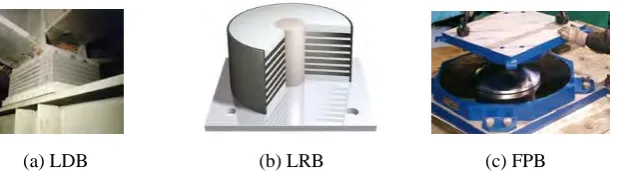
To date, many types of isolation unit, i.e., a bearing system, an isolation device or an isolator, have been developed based on various principles (Naeim and Kelly, 1999), and, in general, most bearing system types can be classified into rubber, sliding and hybrid systems. For an NPP structure, however, acceptable types of isolators considering application history and verification records should be specified or some specific requirements should be provided. For example, Huang et al. (2009) suggests that two types of elastomeric bearings and one type of sliding bearings are appropriate for the NPP structure (Stojadinovic, 2011): low damping bearings (LDB), lead rubber bearings (LRB), and friction pendulum bearings (FPB) (Figure 2).
(a) LDB (b) LRB (c) FPB
Figure 2. Types of seismic isolators
It should be noted that, based on past earthquake experience (JPWRI, 2011) and research results (Hibino et al., 2012), even the isolators classified as acceptable types can show abrupt performance decrease in unpredictable state.
Mechanical Characteristics of Isolation Units
The isolation unit utilized in the NPP structure should have predictable mechanical properties such as load-displacement relationship, long term stability and durability in service environment. Acceptable environmental conditions (e.g., humidity, temperature) for a specific isolation unit should be provided considering service environment and acceptable mechanical property change. Equipment that actively maintains the environmental service condition is not recommended in general for its possible malfunction.
The requirements for materials utilized in an isolation device should be provided for every possible ultimate state. Materials with unpredictable or unstable mechanical property are not permitted.
Analytical Procedure
For certain types of isolation units which cannot be analyzed linearly, definite analytical procedure and program should be established in modeling physical characteristics and estimating behavior. The procedure should reflect at least the following characteristics:
- interaction between the horizontal and vertical load-displacement relationship; and - energy dissipation effect.
Performance Requirements for Isolation Units
The performance of isolation units subjected to the site-specific design bases seismic motion should be reviewed via prototype and product test. Also, a full scale test for the isolation system may have to be conducted for a specific instance. The test types and corresponding procedures should be determined based on related codes and standards.
Long Period and Long Duration Earthquake
Other than enormous human and property damage, the April 2011 Fukushima earthquake caused serious damage to numbers of seismic isolation devices (Figure 3). The investigation report (JPWRI, 2011) and research documents revealed that the long period and long duration characteristics of the earthquake (Figure 4) led to damage to seismic isolators. Consequently, for a site where a long period and duration earthquake is expected, special requirements should be provided considering the site specific seismic motion.
Figure 3. Isolator damage by the Fukushima earthquake (JPWRI, 2011)
Quality Control and Assurance
Quality control and assurance procedures in constructing seismic isolators and systems should be developed. Possible items for controlling and assuring the quality are as follows:
- inspection of the quality of isolators; - anchoring system for isolators; - allowable tolerance;
- shrinkage of concrete; - curing of superstructure; - replacement of isolators;
In-service Inspection and Monitoring
Appropriate in-service inspection plan should be established to make sure that the isolation system and isolated structure behave as designed (US NRC, 1994; JNES, 2010). The inspection plan should include method and criteria for evaluation of an individual isolator and the isolation system. Also, the isolated structure should be designed to enable in-service inspection, monitoring and replacement of isolators. The monitoring system should be independent from other systems and provide continuous information on isolators.
CONCLUSIONS
As noticed, while the concept of seismic isolation is not new and the technique has been applied to thousands of civil engineering structures worldwide, a full scale application to an NPP structure is rare and technical guides for ensuring the safety is needed.
In this paper, possible safety issues in applying seismic isolation system to a NPP structure are summarized. From the review on related codes, standards, and research documents, to assure the safety of isolators, isolation system and isolated structure, it is required that the physical and material characteristics, allowable types, analysis technique, a long period and long duration earthquake, service environment, performance verification, in-service inspection and replacement plan, monitoring system, and quality control should be reviewed.
Acknowledgements. This research was supported by the Korea Institute of Nuclear Safety (Contract
Number 12-03). The authors also thank KEPCO E&C, KHNP (Korea Hydro & Nuclear Power) Co., EESK (Earthquake Engineering Society of Korea), and KAERI(Korea Atomic Energy Research Institute) for their supports and cooperation.
REFERENCES
AASHTO (2010a). AASHTO Guide Specifications for Seismic Isolation Design. ASCE (2000). Seismic Analysis of Safety-Related Nuclear Structures. ASCE 4-98
ASCE (2005). Seismic Design Criteria for Structures, Systems, and Components in Nuclear Facilities. ASCE/SEI 43-05.
ASCE (2010). Minimum Design Loads for Building and Other Structures. ASCE/SEI 7-10. Forni, M. (2011). "Seismic Isolation of Nuclear Power Plants." ENEA in Japan 2011.
Hibino, H., Maseki, R., Nii, A., Minewaki, S., Yamamoto, M., Yoneda, H., Takayama, M., Kikuchi, M., Iiba, M. (2012). “Safety verification of seismic isolation system using sliding bearings against long period earthquake motions.” Proceeding of 15WCEE, Sep 2012, Lisbon, Portugal.
Huang, Y.-N., Whittaker, A.S., Kennedy, R.P. and Mayes, R.L. (2009). “Assessment of base-isolated nuclear structures for design- and beyond-design basis earthquake shaking.” MCEER-09-0008,
IAEA (2008). Nuclear Technology Review 2008. GC(52)/INF/3.
Japanese Public Works Research Institute (JPWRI) (2011) “Quick Report on Damage to Infrastructures by the 2011 off the Pacific coast of Tohoku Earthquake.” Technical Note of National Institute for
Land and Infrastructure Management, No. 646, Technical Note of Public Works Research Institute,
No.4202.
JNES (2010). Regulatory Guideline for Reviewing Seismic Isolation Structures. JNES-SS-1001. Naeim, F., Kelly, J.M. (1999). Design of Seismic isolated Structures. John Wiley and Sons.
Stojadinovic, B. (2011). Technical Considerations for Seismic Isolation of Nuclear Facility Structures. US DOE - US NRC.
US NRC (1994). Preapplication Safety Evaluation Report for the Power Reactor Innovative Small
Module (PRISM) Liquid-Metal Reactor. NUREG-1368.