Interference Mitigation in IEEE 802.15.4
Based MBSN
Pankaj Mule
M.E Student, Department of Electronics and Telecom Engineering, Dhole Patile College of Engineering, Pune, India
ABSTRACT: In resent time mobile body sensor network known as a capable technology having a number of applications in health and well-being. For low power sensor network, main problem in wireless body network is that it disturbs the reliable transmission in WBSN is interference , but we can deal with this problem by allowing a body sensor network by changing its working frequency and its conduct power in response to changes in the observed interference . In this paper we study the influence of the variant of transmit power in the presence and absence of frequency adaptation and to improve the overall energy consumption and success rate of devices.
KEYWORDS: MBSN, wifi , frequency, overall energy consumption, success rate.
I. INTRODUCTION
Mobile Ad Hoc Networks (MANETs) consists of a collection of mobile nodes which are not bounded in any infrastructure. Nodes in MANET can communicate with each other and can move anywhere without restriction. This non-restricted mobility and easy deployment characteristics of MANETs make them very popular and highly suitable for emergencies, natural disaster and military operations.
In the whole world there is an vast use of mobile body sensor network. In recent times Mobile Body Sensor Networks (MBSNs) known as a capable technology having a number of applications in health and well-being. MBSN is used in many areas like hospitals, sports, in military and also having environment application. In MBSN there is lot of problems due to interference in the network which reduces packet success rate, reliable transmission and timely data transfer, possible approach to deal with this problem is frequency adaptation schemes.
We are using here a IEEE 802.15.4 standard a wireless standard. It is a developed by IEEE for wireless LAN technology. It uses 2.4 Ghz band using either direct sequence spread spectrum or frequency hopping spread spectrum. 802.15.4 specifies an over the air interference between a nodes and base station.
A wireless sensor network can be called as a whole network of sensor nodes and wide area is as under and offers environmental information such as humidity and temperature about the tested area by wireless communication protocols[3]. The Wireless Sensor Network (WSN) has a wide range of potential applications and is an developing technology Just as mobile ad hoc networks, a WSN usually contain of a huge number of circulated nodes that organize themselves into a multi-hop wireless network [4].
II.RELATED WORK
The exhausted literature study has been carried out on wireless data transfer problems and study of wireless sensor network system .
Pangun Park, Piergiuseppe Di Marco, Carlo Fischione, and Karl Henrik Johansson[1] was focused on reliable and timely data transfer in IEEE 802.15.4 wireless network. The IEEE 802.15.4 for wireless sensor networks which can support reliable, energy efficient, and timely packet transmission by a parallel and distributed fine-tuning of the medium access control parameters. Such a tuning is hard, because exact and simple models of the effect of these parameters on the probability of successful energy consumption, packet transmission, packet delay, and are not available.
mitigating the total use of energy of the end devices in WBSN, number of coordinator discovery schemes are present in this paper. The main attention of this paper is to progress the overall success rate and energy consumption of end devices.
Wenqi (Wendy) Guo, William M. Healy, and Mengchu Zhou[3] published the paper on “An Experimental Study of Interference Impacts on ZigBee-based Wireless Communication Inside Buildings” having purpose to focus the problems which disturbing co-existence of ZigBee systems in the existence of different interferences. They proposed an experimental study of ZigBee-based wireless communication up to a period of time .with the use of microwave oven and bluetuth. Results are presented for several different link configurations, they present the interference prediction algorithms to discover the impacts of WiFi/microwave oven on ZigBee communication Based on opinions of the Packet Error Rate.
Qian Hu and Zhenzhou Tang[4] published the paper on “An adaptive transmit power scheme for wireless sensor networks” in this paper they uses the MAC protocol, The MAC protocol for wireless sensor networks is dissimilar from traditional wireless MACs such as IEEE 802.11.This paper introduces an adaptive transmit power scheme built on S-MAC named of S-MAC is Adaptive Transmit Power MAC. In S-MAC, all the nodes transfer data with a permanent power level, no problem how near the involved nodes are. The planned ATPM can identified the distance in between the transmitter and the receiver by calculating the received power, and then adaptively choose the appropriate transmit power level agreeing with the propagation model and distance..
Flavia Martelli, Roberto Verdone and Chiara Buratti[5]focused on a novel Link Adaptation (LA) strategy, in
which nodes choice the modulation scheme according to the channel quality and interference level. The novelty sets in the fact that in case of big Signal-to-Noise Ratio and low Signal-to-Interference Ratio due to which instead of falling it, nodes rise the bit rate, as mostly done in the works exist in the literature. The decrease of the bit rate, in fact, permits to reduce the time the channel is working and, for this reason the collision probability. Performance is weighed in terms of packet error rate and results achieved with and without LA are matched. Results show that the proposed strategy improves performance.
III. PROBLEM STATMENTS
There is a lot of internal and outer interference in MBSN network which affects the reliable transmission of the data from sensor nodes to coordinator and vice versa. Due to this effect there is problem in reliable transmission causing reduction in packet success rate .
Due to the interference and time require for searching the beacons, increases the time of data transmission. During Transferring of data nodes require more energy to transfer data due to which more energy is consumed in the network. During transmission of data each node transfer the data to their layer coordinator and layer coordinator transfer data to the base station for this reason data transfer is not secure .
IV. PROJECT OBJECTIVE
1) Successful packet transmission.
2) To Reduce the Energy Consumption.
3) Co-ordinator will communicate with every node to perform secure data transfer. 4) To reduce orphan time for timely data transfer.
1.No Adaptation Scheme
Here the initial channel is randomly picks by its coordinator and stay on these channel it never changes. This scheme does not requires any measurement. At the time when a device become orphaned, it does not scan all the channels but stay on these channel and when it finds the next beacon it resumes its operation.
2.Lazy Scheme
The second scheme is the lazy scheme.
The common idea is that the MBSN stops on the similar channel as long as it is good enough. Channel swapping happens only when the measured channel energy (outside own transmissions) exceeds a threshold. In this measurement scheme the coordinator takes RSSI measurements on all channels during the inactive periods of each super frame. The coordinator collects the last ten RSSI readings for each channel and reports the channel quality of every channel by the maximum from those readings. However, a channel switch is only carried out if the maximum RSSI value of the existing channel surpasses a threshold of -90 dBm, and if there is another channel with a lower maximum RSSI value.
B) Successful Packet Transmission
For successful Packet Transmission we have to apply Frequency Adaptation in network. For applying frequency adaptation we have to apply frequency adaptation schemes which we have discuss earlier. BSN uses either the no-adaptation or lazy scheme and All nodes Use low transmit power of -25 dBm and high transmit power of 0 dBm. By this way we can obtained the successful packet transmission. we can get best result either from lazy scheme or from no adaptation scheme this can be prove from the Result.
c) Energy Consumption Model
The use of power in MBSN is considered to be only related to its transceiver, and the power used by other hardware components is ignored.
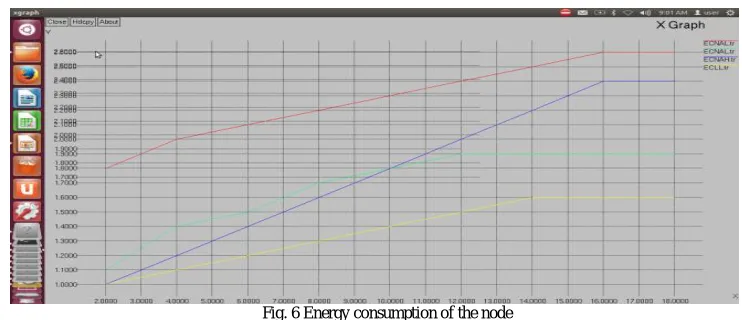
In MBSN sensor node consume more energy and co-ordinator requires less energy. And the nodes numbers are more than the coordinator hence power consumption is more. For sensor node use High transmit power during both frequency adaptation scheme. Due to the use of high transmit power we can reduce the use of power. Also to Reduce the Energy Consumption have to transfer data having nearest one Node.
D) Timely Data Transfer
Orphan time is responsible for late data transfer. If the coordinator obtains a data packet successfully, it replies with an acknowledgement, If the device does not obtain the acknowledgement, it tries up to nine times. The devices have to see to the coordinators beacons to preserve synchronization. If four successive beacons has not obtained by the device, depending on the frequency adaptation scheme, it scans all list of channels to search the beacons. This spend of time for searching beacons is called orphan time.
VI. FLOW CHART
Give Annotation
Ending the nam and simulation
Installation of ns2 is very easy first step of project is the installation of ns2 in ubuntu in Implementation steps chapter there is an detail about the installation of NS2 ,we have use here NS 2.1 version and installed in Ubuntu. After that second step is the creation of Tcl file is generated by writing code in C++ coding in geditor which generate the file which can run the nam editor. After that the third step is the provide colour to each node colouring is for identifying the each node .
Creating the sink node in the network sink node in project sink node is the 0TH node. Generation of moments of nodes
is for showing the moments of nodes in the network because this nodes we are using are mobile body sensor network. After this step creation of CBR file for the network this is required for constant or continues bit rate in the network. Next step is used in the network is the the coding for error file error file is for creating errors in the networks like interference in the networks , last is the coding for ending the nam and code for x graphs for each X graphs we have to write separate code and end the simulation.
VII. IMPLIMENTATION DETAIL Installation of NS2
TCL program for network
Provide color to each node
Generation of moments of nodes
Create CBR file for network
Create the error file in the network
Fig 1 shows network formation for MBSN. In MBSN we have to create 49 nodes of size 15 and 1coordinator of size 15 this is the first step to create network.
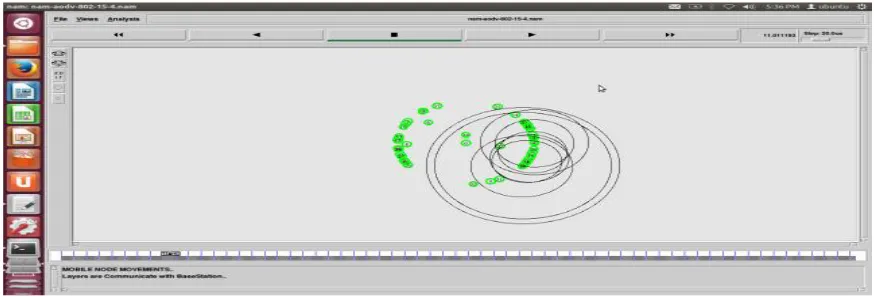
Fig. 2Annotation & Sensor Node Movement.
Figure 2 shows the annotation and sensor node moments. Annotation means notification of what happening now in the network simulation we can put notification of what activities are going on time to time. And second one is the moment of nodes from initial position to their mobile position.
Fig.3 Communication of sensor nodes with coordinator
Figure 3 shows the communication of sensor nodes with coordinator. communication means connection of coordinator with all layers and with each nodes. Communication is required for transferring data from coordinator to nodes and vice versa and all other communications.
VIII. RESULT AND DISCUSSION
A) Success Rate
Fig.5 Success Rate
In Figure 5 we display results for the success rate (or percentage of successful transmissions) defined as the average (taken over all sensors) percentage of uplink packets that the coordinator has successfully received (possibly after some retransmissions) and for this reason the sending device has received an acknowledgement. It can be seen that overall the lazy scheme has a substantial advantage over the no adaptation scheme. The lazy-high scheme has great effect over the lazy-low scheme, similarly the no-adaptation-high scheme has an great effect over the no adaptation- low scheme.
B) Energy Consumption of the Node
Fig. 6 Energy consumption of the node
C) Orphan Time
Fig.7 Orphan time
In Figure 7 we show for all four frequency adaptation schemes and the percentage of spending time in the orphan state by sensor nodes , during that time they cannot transmit any data. Due to which packet transfer time is increased. It can be seen here that for the lazy scheme has a Astonishing effect by using the high transmit power which has a ability of almost eliminating orphan time, which is still useful for the lazy scheme with low transmit power.
IX. CONCLUSION
In MBSN, Orphan time is reduces due to the astonishing effect and which is possible by lazy high scheme. In MBSN, we introduce and use four frequency adaptation scheme such as lazy high, lazy low , no adaptation high and no adaptation low to reduce interference from which lazy high scheme is more effective in MBSN for successive packet transmission , reducing orphan time and less energy consumption.
REFERENCES
1. Pangun Park, Piergiuseppe Di Marco, Carlo Fischione, and Karl Henrik Johansson, “Modeling and Optimization of the IEEE 802.15.4 Protocol for Reliable and Timely Communications” IEEE Transaction on Parallel and Distributed Systems, VOL. 24, NO. 3, pp. 550-564,March 2013.
2. Ehsan Tabatabaei Yazdi, Andreas Willig and Krzyszt of Pawlikowski , “Shortening Orphan Time in IEEE 802.15.4: What can be Gained?” IEEE international conference , 2013
3. Wenqi (Wendy) Guo, William M. Healy, and Mengchu Zhou” An Experimental Study of Interference Impacts on ZigBee-based Wireless Communication Inside Buildings”,International Conference on Mechatronics and Automation, pp 1982-1987,Aug 2010.
4. Q. Hu and Z. Tang, “An adaptive transmit power scheme for wireless sensor networks,” in Ubi-media Computing (U-Media), 2010 3rd IEEE International Conference on, , pp. 12–16.2010.
5. Flavia Martelli, Roberto Verdone and Chiara Buratti, “Link Adaptation in IEEE 802.15.4-Based Wireless Body Area Networks” in WiLAB, DEIS University of Bologna, Italy, 2010 21st international symposium` on personal, indoor and mobile radio communications
workshops,pp.117-121, 2010.
6. Mauro De Sanctis, Marco Monti, Marina Ruggieri and Ramjee Prasad, “A Collaborative Coexistence Mechanism for IEEE 802.15.3 and 802.15.4 WPANs”, pp.395-399, 2009.
7. Hongliang Ren and Max Q.-H. Meng, “Power Adaptive Localization Algorithm for Wireless Sensor Networks Using Particle Filter”, IEEE transations on vehicular technology, VOL. 58, NO. 5, pp. 2498-2508, JUNE 2009.
8. Michael Timmers, Sofie Pollin, Antoine Dejonghe, Liesbet Van der Perre and Francky Catthoor, “Exploring vs Exploiting: Enhanced Distributed Cognitive Coexistence of 802.15.4 with 802.11”, pp.613-616,2008.
9. Bart Braem, Benoˆıt Latr´e, Chris Blondia, Ingrid Moerman, Piet Demeester, “Improving Reliability in Multi-hop Body Sensor Networks”, The Second International Conference on Sensor Technologies and Applications, , pp. 342-34, 2008.
10. M. Bertocco, G. Gamba, A. Sona, “Assessment of Out-of-Channel Interference Effects on IEEE 802.15.4 Wireless Sensor Networks”, IEEE International Instrumentation and Measurement Technology Conference, may 2008 .