15
Urdu Named Entity Recognition System using Hidden
Markov Model
Muhammad Kamran Malik, Syed Mansoor Sarwar
1. Punjab College of Information Technology, University of the Punjab Lahore, Pakistan
* Corresponding Author: E-mail: [email protected]
Abstract
Named Entity Recognition (NER) is the process of identifying names of Persons, Organizations, Locations and other miscellaneous information like number, date, and measure in a given text. In this paper, we describe the development of a NER system for Urdu Language using Hidden Markov Model (HMM). First, we show a comparison of IOB2 and IOE2 tagging schemes. Second, we show the preprocessing of Urdu before feeding data to the HMM model for training using the IOE2 tagging scheme. Finally, we use the Part of Speech (POS) information, gazetteers, and rules to improve the accuracy of the system. Our system yields 66.71%, 71.70%, and 69.12% as the values for precision, recall, and f-measure, respectively. This system will help us improve the results of Urdu Information Retrieval, Machine Translation, and Questing and Answering systems.
Key Words:
Statistical NER, Indian language NER, Resource poor language, Language independent NER, Urdu NER, Urdu HMM1.
Introduction
Urdu is the national language of Pakistan and written from right to left using the Arabic script, and 69.1 million people worldwide speak Urdu [19]. The task of a Named Entity Recognition and Classification (NERC) system is to identify proper names from the given text and then classify them into person, organization, and location names. Sometimes the process of identifying time, date, money, and percent expression can also be considered as part of the NERC system. A NERC
system has many applications, including
intelligent Information Retrieval (IR), Machine Translation (MT), and Questioning and Answering (Q&A) systems.
We face the following challenges in Urdu for the development of Urdu NER system [3]:
1. There is no concept of capitalization in Urdu,
which is a major clue for NEs in English.
2. Urdu is free word-order language.
3. Urdu is Agglutinative in nature.
4. In Urdu, sometimes words are written with
diacritic and sometimes without diacritic, which causes multiple variations of a single word.
5. Urdu contains words of different languages,
including Arabic, Persian, Sanskrit, and English.
6. In Urdu, very less work has been done from computational perspective.
7. In Urdu, there is an issue of word
segmentation.
8. There is also the problem of lack of
standardization and spelling variations in Urdu.
9. In Urdu, many words, depending on their
context, can be considered as common nouns as well as proper nouns (i.e., candidate for NE). For example, Shan, Kamran, Fazal, Kiran, Aftab, Manzoor, etc can be NEs, i.e., Person can be considered as common noun. The context may help in identifying proper nouns against common nouns but due to no
concept of capitalization in Urdu,
disambiguation becomes harder than English. 10. There is serious lack of labeled data in Urdu
for machine learning.
11. There is a huge variation in writing numbers in Urdu.
In our Urdu NERC system, we first perform experiments using two different types of tagging schemes, i.e., Inside-Outside-Begin (IOB2) and Inside-Outside-End (IOE2). The main purpose of
using these two tagging schemes for
experimentation is that IOB2 is considered suitable for prepositional languages like English and IOE2 is considered suitable for postpositional languages like Japanese. Urdu is also a postpositional language; that’s why we compare the results of the two tagging schemes and results show that IOE2 produces better results than IOB2. We use character level, word level normalization, Part of Speech, and Regular expressions to improve accuracies.
16
2.
Literature Review
The NERC system has been developed for different languages including Chinese, Dutch, English, French, German, Hindi, and Italian using supervised learning algorithms, semi-supervised learning algorithms, unsupervised algorithms, and hand crafted rules as discussed in [5]. Little work has been done on Urdu NER compared to other languages. Focused work on Urdu NER started after International Joint Conference on Natural Language Processing (IJCNLP)-08 [20] where five Indian languages were targeted for study: Bengali, Hindi, Oriya, Telugu, and Urdu.
[10] describes development of NER systems for the Urdu, Hindi, Bengali, Telugu, and Oriya languages using IJCNLP workshop NER data. Language specific rules and Maximum Entropy (ME) approach along with gazetteers are used to develop NER systems for these languages. Experiment was conducted on 12 types of NEs and the overall accuracy for the Hindi, Bengali, Oriya, Telugu, and Urdu NER systems in terms of f-measure were 65.13%, 65.96%, 44.65%, 18.74%, and 35.47% respectively.
[15] used Beaker-Riaz corpus for the development of a rule based NER system for Urdu. Hand crafted rules were developed due to the availability of a limited amount of annotated corpus for training and testing. They used 200 documents for the construction of rules for the identification of NEs like Person, Designation, Location, Date, Number, and Organization. These rules were tested on 2262 documents that contained 206 unique NEs. By using this approach, 187 NEs were extracted out of which 171 were true NEs with 90.7% recall, 91.5%
precision and 91.1% f-measure. The same
approach was also used in the IJCNLP 2008 NER workshop to achieve 72.5% f-measure without tuning and 81.6% f-measure with tuning.
[16] also used a rule for the extraction of numbers, non-numeral numbers, date, and time. For the identification of Person, Location, and terms, it used suffix matching along with gazetteer. Two datasets were used with 12032 and 150243 tokens. 12 NEs were used and accuracy in terms of f-measure for dataset 1 and dataset 2 were 60.09% and 88.1%, respectively.
[6] proposes a bootstrapped model for Urdu. This model has four levels of text processing. Conditional Random Field (CRF) is used for POS tagging and NE tagging. It uses three NEs for experimentation, i.e., Person, Organization, and Location. The f-measure of the two-stage model
and four-stage model were 55.3% and 68.9%, respectively. The paper also describes these two-stage and four-two-stage models.
[9] used the n-gram models, i.e., Unigram and
Bigram models, with different smoothing
techniques for the development of an Urdu NERC system. Five NEs were used for experimentation, i.e., Person, Organization, Location, Date, and Time. The highest accuracy was achieved using the bigram model along with Backoff smoothing technique with 66.2% precision, 88.18% recall,
and 75.83% f-measure.
[13] highlights the challenges in the development of an Urdu NER system. Urdu and other South Asian languages are discussed in detail in this regard.
Several experiments have been conducted on the IJCNLP workshop Urdu NE data. [7] used the ME approach to build an Urdu NERC system with 37.58% precision, 33.58% recall, and 25.47% f-measure. [12] applied CRF for the development of an Urdu NERC system with 48.96% precision, 39.07% recall, and 43.46% f-measure. [8] used HMM and rules to build an Urdu NERC system with 56.21% precision, 37.15% recall, and 44.73% f-measure. [14] used CRF for the training and testing of an Urdu NERC system. The system yields 54.45% precision, 26.36% recall, and 35.52% f-measure. [17] used CRF on an Urdu language on only three NEs, i.e., person, organization, and location. The reported results are 64.11% precision, 66.98% recall, and 65.51% f-measure.
3.
Tagging Problem
NER can be considered as a sequence labeling problems where we want to determine a vector of random variables given an
observed vector . Each variable
can be NE of the word at position s, and is the word at positions.
Now we define the tagging problem for finding the
most probable NE sequence for the word
sequence . More formally,
(1)
3.1 Hidden Markov Model (HMM)
In HMM [4] we have two set of states and a triple (π, A, B). First is a set of observable states that is the input sentence or word sequencesuch that with be the ith word in X.
17
represented by NE for the word sequence
with be the ith NE in the sequence. Each NE
represents one of the hidden states in HMM. The observable states (the word sequence) are probabilistically related (emission probabilities) to the hidden states (NE sequence) such that the sum of probabilities of all links outgoing from a single hidden state to all observable states is 1. In triple (π, A, B), we define π as the initialization vector containing the initial probabilities of all NEs starting an NE sequence. We define A as a matrix of probabilities (transition or Prior Probabilities) when the underlying Markov Process transitions from one state (NE) to another. We define B as a matrix of probabilities (emission or Likelihood probabilities) of generating the word sequence
from the underlying NE sequence , i.e.,
the probability of generating or emitting a word once the underlying Markov Process enters a state . The triple (π, A, B) is learnt from our Urdu NE training data.
HMM defines the joint probability distribution over a word sequence paired with an NE sequence as
(2)
The output of HMM is a tag sequence that maximizes this joint probability distribution
(3) To model this joint probability we consider our basic NE problem from Equation (1) as
(4) Bayes Rule of probability dictates us that we can
calculate the probability of if we know
the probability of and it says
(5) By applying Bayes Rule to Equation 3 we get
(6) We drop the denominator for being a constant for all NEs and hence Equation 6 becomes
(7) This means that for each NE sequence we need to calculate the product of likelihood
and prior probability . We make two
simplifying assumptions to estimate the
probability of the NE sequence. First assumption
says that the probability of a word is dependent only on its own underlying NE.
(8) Since we have used both the Bigram and Trigram HMM to formulate our results, therefore, for Bigram HMM we assume that the probability of NE is dependent only on the previous NE (First
Order Markov Assumption). Thus, is
expressed as shown below.
(9) For Trigram HMM we assume that the probability of NE is dependent only on previous two NEs (Second Order Markov Assumption). Thus, Equation (9) may be expressed as given below.
(10)
After these two assumptions, we can rewrite Equation (2) as
(11)
Where and are called
the Bigram and Trigram parameters, respectively,
and is called the emission parameter of
HMM. Some of the details are also mentioned in [3].
4.
Hybrid Approach For Urdu NER
System
For our experiments, we have used training and testing data from IJCNLP workshop. The training data consisted of 2584 NEs, 35447 tokens, and 1508 sentences, and the testing data consisted of 1027 NEs, 12805 tokens, and 498 sentences. Details of the training and testing data are given in Table 1.
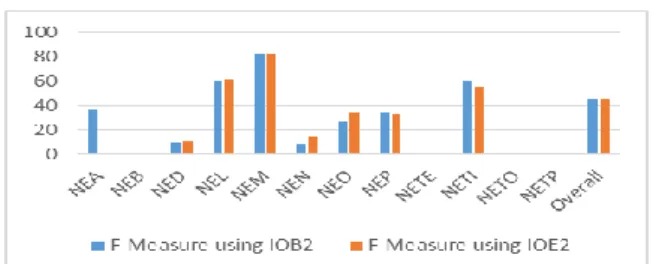
Figure 1: Comparison of IOB2 and IOE2 tagging
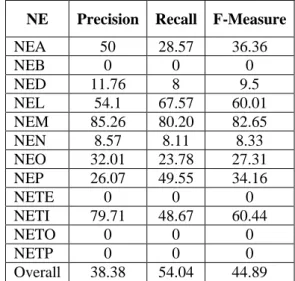
18 We used two tagging schemes, i.e., IOB2 and IOE2, on 12 NEs for experimentation. First, we converted the Urdu NE data from the SSF format to the IOB2 and IOE2 formats. We used HMM for training and testing of Urdu NER. The precision, recall, and f-measure values using IOB2 are 38.38%, 54.04%, and 44.89%, respectively. Using IOB2 no entry for NEB, NETE, NETO, and NETP is found, whereas the highest f-measure value of NEM is found. Similarly, the precision, recall, and f-measure using IOE2 are 39.00%, 54.65%, and 45.52%, respectively. No word is correctly classified against NEA, NEB, NETE, NETO, and NETP. Detailed results of IOB2, IOE2, and comparison of each NE against IOB2 and IOE2 is shown in Table 2, Table 3, and Figure 1, respectively.
Table 1: Details of Urdu Corpus
Named Entity Training
Data (tokens)
Testing Data (tokens)
NEP (Person) 365 145
NED
(Designation) 98 41
NEO
(Organization) 155 40
NEA
(Abbreviation) 39 3
NEB (Brand) 9 18
NETP
(Title-Person) 36 15
NETO
(Title-Object) 4 147
NEL (Location) 1118 468
NETI (Time) 279 59
NEN (Number) 310 47
NEM (Measure) 140 40
NETE (Terms) 30 4
Total NEs 2584 1027
Total Words 35447 12805
Total Sentences 1508 498
We used IOE2 for further experimentation. We normalized the whole input and then trained it using HMM. We performed two types of normalization:
1. Character level normalization
2. Word level normalization
In the character level normalization we convert different equivalent forms of a character to a standard form of character. In Urdu some of the characters that are visually the same can be written in different ways. For example آ can be written using 0622 Unicode or it can be written using two Unicode (0627+0653) ا+ ٓ. We need to standardize such characters for correct matching and for better learning the parameters of the supervised learning algorithm. If we do not standardize such characters then there is the possibility that the same location name, organization name, or person name may be assigned different NEs. For example, ہرگآ (Agrah), ہرگآ (Agrah) may be assigned different NEs. For the purpose of Normalization, we use the Center for Language Engineering (CLE) [20] utility for Urdu character level normalization using the NFC implementation.
Table 2: Results of using IOB2 tagging scheme
NE Precision Recall F-Measure
NEA 50 28.57 36.36
NEB 0 0 0
NED 11.76 8 9.5
NEL 54.1 67.57 60.01
NEM 85.26 80.20 82.65
NEN 8.57 8.11 8.33
NEO 32.01 23.78 27.31
NEP 26.07 49.55 34.16
NETE 0 0 0
NETI 79.71 48.67 60.44
NETO 0 0 0
NETP 0 0 0
Overall 38.38 54.04 44.89
Table 3: Results of Using IOE2 tagging scheme
NE Precision Recall F-Measure
NEA 0.00 0.00 0.00
NEB 0.00 0.00 0.00
NED 11.76 9.09 10.26
NEL 54.77 68.84 61.01
NEM 87.37 78.30 82.59
NEN 14.29 14.71 14.49
NEO 42.45 28.13 33.83
NEP 24.64 48.15 32.60
NETE 0.00 0.00 0.00
NETI 72.46 45.05 55.56
NETO 0.00 0.00 0.00
NETP 0.00 0.00 0.00
Total 39.00 54.65 45.52
In Urdu users may write a single word with different sequence of characters like Lahore can be
19 written as روھلا or روہلا. This is an example of word normalization where we need to standardize such words into a single form for correct learning of HMM. We perform word level normalization by using four steps, as described below:
4.1 Assignment of Part of Speech
(POS) Tags
The POS information for each word is useful to improve the results of a NER system. For this purpose, we assign the POS tags to the training and testing data by using an online POS tool available at http://cle.org.pk/index.htm, which uses the POS tagset of [11]. The output of this tool is not up to the mark with respect to identifying Proper Noun (NNP) because the location name Lahore can be written using two ways روھلا and روہلا, as stated above, but this tool assigns the NN tag to the first word and NNP tag to second word.
4.2 Transliteration of Each Word
The transliteration task is carried out using the tool mentioned in [18]. This tool converts Urdu in Arabic script into Roman Urdu. For example, Roman Urdu of روھلا and روہلا is Lahore and, similarly, Roman Urdu of ہلمش and لامش are Shimlah and Shimla, respectively. We take all Nouns and Proper Nouns as input and generate their transliteration.4.3 SOUNDEX Code Generation
This module takes Roman Urdu form of all Nouns and Proper Nouns as input and generates their SOUNDEX codes. For example, the SOUNDEX code generated for Shimla and Shamila is S540.4.4 Conversion into a Standard
Word
In this module words with different spelling variations are converted into one form on the basis of highest frequency.
Figure 2: Comparison of IOB2, IOE2 and IOE2
after normalization
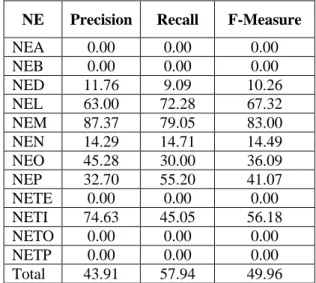
After performing character level and word level normalizations, the results improved significantly with precision, recall, and f-measure as 43.91%, 57.94%, and 49.96%, respectively. However, our model is unable to recognize NEA, NEB, NETE, NETO and NETP. Details of the results are given in Table 4 and a comparison with other two approaches is show in Figure 2.
Table 4: Results of Using IOE2 tagging scheme
after normalization
NE Precision Recall F-Measure
NEA 0.00 0.00 0.00
NEB 0.00 0.00 0.00
NED 11.76 9.09 10.26
NEL 63.00 72.28 67.32
NEM 87.37 79.05 83.00
NEN 14.29 14.71 14.49
NEO 45.28 30.00 36.09
NEP 32.70 55.20 41.07
NETE 0.00 0.00 0.00
NETI 74.63 45.05 56.18
NETO 0.00 0.00 0.00
NETP 0.00 0.00 0.00
Total 43.91 57.94 49.96
The last experiment is performed using some rules, i.e., regular expressions of NEN, NETI, NEM and NEA. Also, a small Gazetteer of person name, location name, organization name, Terms, Title Persons, and Title object is prepared using the Internet. The partial details of these rules are given below.
For NEN (number) we define regular expressions like Urdu_Digit = کیا (aik) (one) | ود (do) (two)| نیت (theen) (three) | راچ (char) (four)| چناپ (panch) (five) | ھچ (chey) (six) | تاس (saat) (seven) | ھٹآ (aath) (eight) | ون (nao) (nine)| سد (das) (ten)| ہرایگ (giarah) (eleven) | ہراب (barah) (twelve) | ہریت (terah) (thirteen) | ہدوچ (chodah) (forteen) | ہردنپ (pandrah) (fifteen) | ہلوس (solah) (sixteen) | ہرتس (satrah) (seventeen) | ہراھٹا (atharah) (eighteen) | سینا (unees) (nineteen) | سیب (bees) (twenty) | سیککا (akees) (twenty one) | سیااب (baees) (twenty two) | سیاےت (tayees) (twenty three) | سیبوچ (chobees) (twenty four) | سیچپ (bachees) (twenty five) | سیببھچ (chabees) (twenty six) | سیااتس (sataees) (twenty seven) | سیاٹا (athaees) (twenty eight) | سیتنا (unatees) (twenty nine) | سیت (tees) (thirty) | سیتکا (aikatees) (thirty one) | سیتب (bates) (thirty two) | سیتنیت| (tantees) (thirty three) | سیتوچ (chontees) (thirty four) | سیتنیپ (pantees) (thirty five) | سیتھچ (chatees) (thirty six) | سیتنس (santees) (thirty seven) | سیتھٹا (athatees) (thirty eight) |
20 سیلاتنا (untalees) (thirty nine) | سیلاچ (chalees) (forty) | سیلاتکا (aktalees) (forty one) | سیلایب (bialees) (forty two) | سیلاتنیت (tartalees) (forty three) | سیلاوچ (chowalees) (forty four) | سیلاتنیپ (pantalees) (forty five) | سیلایھچ (chialees) (forty six) | سیلاتنیس (santalees) (forty seven) | سیلاتھٹا (artalees) (forty eight) | ساچنا (unchas) (forty nine) | ساچپ (pachas)
(fifty) | نواکا (akwan) (fifty one) | نواب (bawan) (fifty two) | نپیرت (trapen) (fifty three) | نوچ (chawan) (fifty four) | نپچپ (pachpan) (fifty five) | نپھچ (chapan) (fifty six) | نواتس (satawan) (fifty seven) | نواھٹا (athwan) (fifty eight) | ھٹسنا (unsath) (fifty nine) | ھٹاس (saath) (sixty) | ھٹسکا (eksat) (sixty one) | ھٹساب (basath) (sixty two) | ھٹسرت (treseth) (sixty three) | ھٹسوچ (chonsath) (sixty four) | ھٹسنیپ (panseth) (sixty five) | ھٹسایھچ (chaysiat) (sixty six) | ھٹاسڑس (sarsath) (sixty seven) | ھٹسھٹا (arsath) (sixty eight) | رتھنا (unhather) (sixty nine) | رتس (sather) (seventy) | رتھکا (ekhather) (seventy one) | رتھب (bather) (seventy two) | رتھت (theather) (seventy three) | رتھوچ (choather) (seventy four) | رتھچپ (pachater) (seventy five) | رتہھچ (chather) (seventy six) | رتتس (satater) (seventy seven) | رتھٹا (athter) (seventy eight) | يسانا (unasi) (seventy nine) | یسا (asy) (eighty) | يساکا (ekasi) (eighty one) | يسایب (biayasi) (eighty two) | يسارت (tarasi) (eighty three) | يساروچ (chorasi) (eighty four) | يساھچپ (pchasi) (eighty five) | يسایھچ (chiasi) (eighty six) | يساتس (satasi) (eighty seven) | يساھٹا (athasi) (eighty eight) | يساون (nawasi) (eighty nine) | ےون (navay) (ninty) | ےوناکا (akanway) (ninty one) | ےوناب (banway) (ninty two) | ےونارت (taranway) (ninty three) | ےوناروچ (churanway) (ninty four) | ےوناچپ (pachanway) (ninty five) | ےونایھچ (chianway) (ninty six) | ےوناتس (satianway) (ninty seven) | ےوناھٹا (ethanway) (ninty eight) | ےونانن (ninway) (ninty nine) | وس (so) (hundred)| رازھ (hazar) (thousand) | ھکلا (laakh) (lack) | ڑورک (crore) | برا (erab) | برھک (kharab) | نیلم )million( | نیلب (billion)
NEN = Urdu_Digit + (to handle one or more occurrences of a digit)
For NETI (Time), we define regular expressions like U_Digit = " کیا (aik) (one) | ود (do) (two) | نیت (theen) (three) | راچ (char) (four) | چناپ (panch) (five) | ھچ (chey) (six) | تاس (saat) (seven) | ھٹآ (aath) (eight) | ون (nao) (nine) | سد (das) (ten) | ہرایگ (giarah) (eleven) | ہراب (barah) (twelve) | ہریت (terah) (thirteen) | ہدوچ (chodah) (forteen) | ہردنپ (pandrah) (fifteen) | ہلوس (solah) (sixteen) | ہرتس (satrah) (seventeen) | ہراھٹا (atharah) (eighteen) | سینا (unees) (nineteen) | سیب (bees) (twenty) | سیککا (akees) (twenty one) | سیااب (baees) (twenty two) | سیاےت (tayees) (twenty three) | سیبوچ (chobees)
(twenty four) | سیچپ (bachees) (twenty five) | سیببھچ (chabees) (twenty six) | سیااتس (sataees) (twenty seven) | سیاٹا (athaees) (twenty eight) | سیتنا (unatees) (twenty nine) | سیت (tees) (thirty) | سیتکا (aikatees) (thirty one)";
M_Digit = [1-31]
Urdu_Month = یئلاوج (July) | چرام (March) | ربوتک ا (October)| یرورف (February) | ربمون (November) | یئم (May)| ربمسد (December) | لیرپا (April) | تسگا (August) | ربمتس (September) | نوج (June) | یرونج (January) | عیبر لولاا (Rabi-ul-Awal) | نابعش (Shaban) | لاوش (Shawal) |دعقلاوذ (Zulqad) | ہجحلاوذ (Zulhaj) | بجر (Rajab) | یدامج یناثلا (Jamad-ul-Alsani) | یدامج لولاا (Jamad-ul-Awal) | عیبر یناثلا (Rabi-ul-Sani) | مرحم (Muharam) | رفص (Safar) Year_Number = (single digit | double digit | three digit | four digit)
Year = Year_Number | ء
NETI = M_digit Urdu_Month Year_Number | U_digit Urdu_Month Year_Number | M_digit Urdu_Month Year | U_digit Urdu_Month Year | M_digit Urdu_Month | U_digit Urdu_Month | Year | Urdu_Month Year | Urdu_Month Year_Number
Examples are 14 تسگا (August) 1947, ہدوچ (chodah) (forteen) تسگا (August) 1947, 14 تسگا (August), ہدوچ (chodah) (forteen) تسگا (August), 1971ء, ء۱۸۸۶, 73ء, ۱۸۸۶, and نوج (June) ء 2000 etc.
The following rule is used for disambiguation between NETI and NEN. For example, in the sentence “Main nay yeh cheez 2000 main lee” (I bought this thing in 2000). Here 2000 could be NETI or NEN. We used the rule that if a digit is greater than 3000 and less than 100 then it will be most like a NEN, not NETI.
if digit < 3000 and digit > 100 then NETI
Else NEN endif
For NEM (measure), we define regular
expressions like Units = رٹیمولک (kilometer), یف رٹیمولک ہٹنھگ (kilometer per hour), ولک (kilo), لاس (saal) (year), ٹف (feet), لیم (mile), رٹکیہ (hector), نٹ (ton), ٹاواگیم (mega watt), چنا (inch) etc.
CC = ےس (say) | ای (ya) | ات (ta)
NEM = Urdu_Digit+ Units | Digit + Units | Urdu_Digit+ CC Urdu_Digit+ Units | Digit + CC Digit+ Units
21 Some of examples are لاس 9 ےس 4 (4 say 9 saal) (4 to 9 years), ہٹنھگ یف رٹیمولک 50 ےس 40 (40 say 50 kilometer fi ghunta) (40 to 50 kilometer per hour), لیم کیا (aik meel) (one mile), لیم ود ای کیا (aik ye do meel) (one or two mile), ٹف 100 ات 60 (60 ta 100 foot) (60 to 100 feet), چنا کیا کیا (aik aik inch) (one one inch)
For NEA (abbreviation) we define regular expression like Abb = | ےآ (A) | یب (B) | یس (C) | یڈ (D) | یئ (E) | فیا (F) | یج (G) | چی (H) ا | یئآ (I) | ےج (J)| ےک (K) | لیا (L) | میا (M) | نیا (N) | وا (O) | یپ (P) || ویک (Q) | رآ (R) | سیا (S) | یٹ (T) | وی (U) | یو (V) | | ویلبڈ(W) | سکیا (X) | ےاو (Y) | یز(Z)
NEA = Abb Abb+
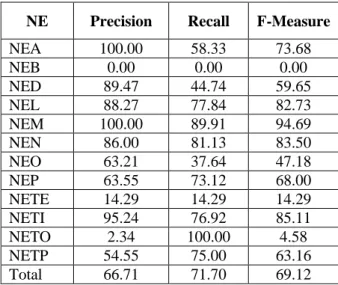
Table 5: Results of Using IOE2 tagging scheme
after executing normalization step, Regular expression, names list and POS
NE Precision Recall F-Measure
NEA 100.00 58.33 73.68
NEB 0.00 0.00 0.00
NED 89.47 44.74 59.65
NEL 88.27 77.84 82.73
NEM 100.00 89.91 94.69
NEN 86.00 81.13 83.50
NEO 63.21 37.64 47.18
NEP 63.55 73.12 68.00
NETE 14.29 14.29 14.29
NETI 95.24 76.92 85.11
NETO 2.34 100.00 4.58
NETP 54.55 75.00 63.16
Total 66.71 71.70 69.12
By using the above rules, names list, and the POS information, the improved precision, recall, and f-measure are achieved as 66.71%, 71.70%, and 69.12%, respectively. The detailed results are given in Table 5. For example, ود (do) can represent digit 2 or it can represent word “give” that is a verb. We use the POS information to correctly assign an NE to the word ود (do). Similarly, وس (so) can represent the number 100 or it can represent word “sleep” that is a verb. Thus, we use the POS information to correctly assign the NE to the word وس (so). Likewise, رفص (safar) can represent digit 0 or it can represent a month in the Islamic calendar. Hence, we use the POS information to correctly assign an NE to the word رفص (safar). The same is the case with the word ھدب (budh) that could be a day of the week, i.e., Wednesday or it could be the name of person, i.e., Mahatma Budh (Buddah). Again, we distinguish between the two with the help of the POS information.
5.
Conclusion and Future Work
We are not aware of any research in which experimentation on Urdu NER has been performed using the character and word level normalizations, POS information, gazetteers, and rules. Literature review shows that our system has produced the best-known results using 12 NEs of IJCNLP workshop data. To the best of our knowledge, no one has previously carried out experimentation on Urdu data with IOE2 tagging scheme. In future, we can use Urdu NP chunker by [1, 2], another tagging scheme mentioned in [3], CRF, and deep learning approaches to show how these techniques affect results.References
[1] Siddiq, S., Hussain, S., Ali, A., Malik, K., & Ali, W. (2010, December). Urdu Noun
Phrase Chunking-Hybrid Approach.
In Asian Language Processing (IALP), 2010 International Conference on (pp. 69-72). IEEE.
[2] Ali, W., Malik, M. K., Hussain, S., Siddiq, S., & Ali, A. (2010, September). Urdu noun phrase chunking: HMM based approach. In Educational and Information Technology (ICEIT), 2010 International Conference on (Vol. 2, pp. V2-494). IEEE.
[3] Malik, M. K., & Sarwar, S. M. (2016). Named Entity Recognition System for Postpositional Languages: Urdu as a Case Study. International Journal of Advanced Computer Science and Applications, 7(10), 141-147.
[4] Baum, L. E., & Petrie, T. (1966). Statistical inference for probabilistic functions of finite
state Markov chains. The annals of
mathematical statistics, 37(6), 1554-1563. [5] Nadeau, D., & Sekine, S. (2007). A survey
of named entity recognition and
classification. Lingvisticae Investigationes, 30(1), 3-26.
[6] Mukund, S., & Srihari, R. K. (2009, June). NE tagging for Urdu based on bootstrap POS learning. In Proceedings of the Third International Workshop on Cross Lingual
Information Access: Addressing the
Information Need of Multilingual
Societies (pp. 61-69). Association for
Computational Linguistics.
[7] Saha, S. K., Sarkar, S., & Mitra, P. (2008, January). A Hybrid Feature Set based
22 Maximum Entropy Hindi Named Entity Recognition. In IJCNLP (pp. 343-349).
[8] Kumar, P., & Kiran, V. R. (2008, January).
A hybrid named entity recognition system for south Asian languages. In proceedings of the IJCNLP-08 Workshop on NER for South and South East Asian Languages (pp. 83-88).
[9] Jahangir, F., Anwar, W., Bajwa, U. I., & Wang, X. (2012, December). N-gram and gazetteer list based named entity recognition for urdu: A scarce resourced language.
In 24th International Conference on
Computational Linguistics (p. 95).
[10] Saha, S. K., Chatterji, S., Dandapat, S., Sarkar, S., & Mitra, P. (2008, January). A
hybrid approach for named entity
recognition in indian languages.
In Proceedings of the IJCNLP-08 Workshop on NER for South and South East Asian languages (pp. 17-24).
[11] Tafseer, A., Urooj, S., Hussain, S., Mustafa,
A., Parveen, R., Adeeba, F., & Butt, M. (2015). The CLE Urdu POS Tagset.
In LREC 2014, Ninth International
Conference on Language Resources and Evaluation (pp. 2920-2925).
[12] Gali, K., Surana, H., Vaidya, A., Shishtla, P., & Sharma, D. M. (2008, January). Aggregating Machine Learning and Rule
Based Heuristics for Named Entity
Recognition. In IJCNLP (pp. 25-32).
[13] Naz, S., Umar, A. I., Shirazi, S. H., Khan, S.
A., Ahmed, I., & Khan, A. A. (2014).
Challenges of Urdu Named Entity
Recognition: A Scarce Resourced
Language. Research Journal of Applied
Sciences, Engineering and
Technology, 8(10), 1272-1278.
[14] Ekbal, A., Haque, R., Das, A., Poka, V., &
Bandyopadhyay, S. (2008, January).
Language Independent Named Entity
Recognition in Indian Languages.
In IJCNLP (pp. 33-40).
[15] Riaz, K. (2010, July). Rule-based named
entity recognition in Urdu. In Proceedings of the 2010 named entities workshop (pp. 126-135). Association for Computational Linguistics.
[16] Singh, U., Goyal, V., & Lehal, G. S. (2012). Named Entity Recognition System for Urdu. In COLING (pp. 2507-2518).
[17] Malik, M. K., & Sarwar, S. M. (2015) "Urdu Named Entity Recognition and Classification System Using Conditional Random Field” Sci-int. 27(5), pp (4473-4477).
[18] Kamran Malik, M., Ahmed, T., Sulger, S.,
Bögel, T., Gulzar, A., Raza, G., & Butt, M. (2010). Transliterating Urdu for a Broad-Coverage Urdu/Hindi LFG Grammar.
In LREC 2010, Seventh International
Conference on Language Resources and Evaluation (pp. 2921-2927).
[19] https://www.ethnologue.com/statistics/size
[20] http://ltrc.iiit.ac.in/ner-ssea-08/