ABSTRACT
YAVUZ, ATTILA ALTAY. Efficient, Compromise Resilient and Compact Cryptographic Constructions for Digital Forensics. (Under the direction of Dr. Peng Ning.)
Audit logs are a fundamental digital forensic mechanism for providing security in computer sys-tems; they are used to keep track of important events regarding the system activities. In current large distributed systems, protecting audit logs is a challenging task, especially in the presence of active at-tackers. It is critical for such a system to be compromise-resilient (i.e., having forward security and append-only integrity properties) such that when an attacker compromises a logging machine, she can-not forge or selectively delete the log entries accumulated before the compromise. Unfortunately, exist-ing secure audit loggexist-ing schemes have limitations that make them impractical for real-life applications: On the one hand, the symmetric schemes are not publicly verifiable, demand high storage, require on-line Trusted Third Party (TTP) support, and are also vulnerable to certain attacks. On the other hand, Public Key Cryptography (PKC)-based schemes require several Expensive Operations (ExpOps) (e.g., pairing), and thus are impractical for task-intensive and/or resource-constrained systems.
In this dissertation, we address the above problems by developing a series of novel cryptographic constructions that achieve the most desirable properties of both symmetric and PKC-based schemes simultaneously.
First, we propose a new class of signature schemes for Unattended Wireless Sensor Networks (UWSN) called Hash-Based Sequential Aggregate and Forward-Secure Signature (HaSAFSS). Using existing verification delays as an opportunity to introduce asymmetry, HaSAFSS schemes achieve high efficiency, while still preserving public verifiability, forward security and compactness. The HaSAFSS schemes are the only schemes in which both signers and verifiers get equal benefits of computational efficiency. Symmetric HaSAFSS (Sym-HaSAFSS) and Elliptic Curve Cryptography-based HaSAFSS (ECC-HaSAFSS) achieve the optimal (constant) signer and optimal verifier storage efficiency, respec-tively. Self-SUstaining HaSAFSS (SU-HaSAFSS) achieves an optimal storage at both the signer and the verifier sides by introducing a little more computation overhead.
Second, we develop a novel forward-secure and aggregate signature scheme called Blind-Aggregate-Forward (BAF) to address the secure audit logging needs of resource-constrained devices. BAF can address both real-time and non-real-time applications by achieving the public verifiability without re-quiring any online TTP support or time factor. BAF is the only scheme that can produce a publicly verifiable signature with very low computational, storage, and communication costs for the loggers. Moreover, a variant of BAF (i.e., Fast-Immutable BAF) enables fine-grained log verification by preserv-ing the optimal logger efficiency and security.
loggers. LogFAS is the only secure audit logging scheme that can verifyLlog entries with always a small and constant number of ExpOps regardless of the value ofL. It is also the only alternative in which each verifier stores only a small and constant size public key independent from the number of loggers and the number of log entries to be verified. In addition, a variation of LogFAS can identify the corrupted log entries with a sub-linear number of ExpOps when most entries are intact.
c
⃝Copyright 2011 by Attila Altay Yavuz
Efficient, Compromise Resilient and Compact Cryptographic Constructions for Digital Forensics
by
Attila Altay Yavuz
A dissertation submitted to the Graduate Faculty of North Carolina State University
in partial fulfillment of the requirements for the Degree of
Doctor of Philosophy
Computer Science
Raleigh, North Carolina 2011
APPROVED BY:
Dr. Huaiyu Dai Dr. Douglas S. Reeves
Dr. Ting Yu Dr. Peng Ning
DEDICATION
Gratefully devoted to my mother Ayse Yavuz by heart, who left her family and country behind to help me recover my health problems in US. She always gives her best to me in each aspect, and even her
existence here is an invaluable support for me. I am also grateful to my father Dr. Ilhami Yavuz for always supporting me in any mean. His supports are invaluable. I also would to like to thank my elder
BIOGRAPHY
ACKNOWLEDGEMENTS
First, I am grateful to my PhD advisor Dr. Peng Ning, who devotes a significant effort and time to help me for improving my research and presentation skills. I have a special thank to Dr. Michael Reiter, who provided me an invaluable training in the theoretical cryptography. I thank my committee members, alphabetically, Dr. Huaiyu Dai, Dr. Douglas Reeves and Dr. Ting Yu for their valuable suggestions to improve my dissertation.
I would like to thank my officemates Sangwon Hyun, Jung Ki So, Young-Hyun Oh, Dr. An liu, Dr. Young Hee Park and Yao Liu for their supports.
I would like to thank to all of my friends at North Carolina State University. I am only able to list a few here: Mustafa Berke Yelten, Can Babaoglu, Namik Temizer, Dr. Nurcan Tezcan, Harun Demirci, Hicran Koc, Elif Karayaka...
TABLE OF CONTENTS
List of Tables . . . vii
List of Figures . . . viii
Chapter 1 Introduction . . . 1
1.1 Motivation . . . 1
1.1.1 The Limitations of Naive (Non-Cryptographic) Approaches . . . 1
1.1.2 Desirable Properties of an Ideal Cryptographic Secure Audit Logging Scheme . 2 1.1.3 The Limitations of Symmetric Cryptography based Secure Audit Logging Schemes 3 1.1.4 The Limitations of PKC-based Secure Audit Logging Schemes . . . 4
1.2 Our Contributions . . . 5
1.3 Organization of Dissertation . . . 8
Chapter 2 Background and Related Work . . . 9
2.1 Forward Secure and/or Aggregate Signature Schemes . . . 9
2.1.1 Forward-Secure Signature Schemes . . . 9
2.1.2 Aggregate Signature Schemes . . . 12
2.1.3 Forward-Secure and Aggregate Signature Schemes . . . 13
2.2 Time-Related Cryptographic Primitives and Self-Healing Techniques . . . 14
2.2.1 Timed-Release Encryption (TRE) . . . 14
2.2.2 TESLA . . . 15
2.2.3 Self-Healing Techniques . . . 15
2.3 Secure Audit Logging Schemes . . . 16
2.3.1 Forward-secure Stream Integrity and Digital Signature based Solutions . . . . 16
2.3.2 Audit Logging Schemes Aiming with Different Properties to Our Own . . . . 17
2.4 Elliptic Curve Cryptography (ECC) . . . 17
2.5 Conclusion . . . 18
Chapter 3 Efficient, Compromise Resilient and Compact Cryptographic Constructions for UWSNs . . . 19
3.1 Preliminaries . . . 22
3.2 Models . . . 23
3.2.1 Threat Model and Security Model . . . 23
3.2.2 Data Model . . . 25
3.3 Proposed Schemes . . . 26
3.3.1 Overview . . . 26
3.3.2 Sym-HaSAFSS . . . 28
3.3.3 ECC-HaSAFSS . . . 29
3.3.4 SU-HaSAFSS . . . 30
3.4 Security Analysis . . . 33
3.4.1 Discussion . . . 35
3.5.1 Computational Overhead . . . 36
3.5.2 Storage and Communication Overheads . . . 39
3.5.3 Sustainability, Applicability and Flexibility . . . 39
3.6 Conclusion . . . 40
Chapter 4 Efficient, Compact and Compromise Resilient Cryptographic Constructions for Resource-Constrained Devices . . . 42
4.1 Preliminaries . . . 44
4.2 Models . . . 45
4.2.1 System Model . . . 45
4.2.2 Model of Forward-Secure and Aggregate Signature (FAS) Schemes . . . 46
4.2.3 Threat and Security Model . . . 47
4.2.4 Discussion on Our Security Model . . . 49
4.3 Blind-Aggregate-Forward (BAF) Schemes . . . 50
4.3.1 Overview . . . 50
4.3.2 Description of BAF . . . 51
4.3.3 Fast-Immutable BAF (FI-BAF) . . . 53
4.4 Security Analysis . . . 55
4.5 Performance Analysis and Comparison . . . 63
4.5.1 Computational Overhead . . . 63
4.5.2 Storage and Communication Overheads . . . 66
4.5.3 Scalability and Security . . . 68
4.5.4 Limitation . . . 69
4.6 Conclusion . . . 69
Chapter 5 Efficient, Compromise Resilient and Append-Only Cryptographic Construc-tions with Verifier Efficiency . . . 71
5.1 Preliminaries . . . 73
5.2 Syntax and Models . . . 75
5.2.1 System Model . . . 76
5.2.2 Security Model . . . 76
5.3 LogFAS Schemes . . . 77
5.3.1 LogFAS Scheme . . . 77
5.3.2 Selective Verification with LogFAS . . . 79
5.4 Security Analysis . . . 80
5.5 Performance Analysis and Comparison . . . 83
5.6 Conclusion . . . 86
Chapter 6 Conclusion and Future Work . . . 87
6.1 Conclusion . . . 87
6.2 Future Work . . . 90
6.2.1 Improvements on LogFAS . . . 90
6.2.2 Encrypted Searches on Audit Logs . . . 91
LIST OF TABLES
Table 3.1 Notation used in the performance analysis and comparison of HaSAFSS and Fs-sAgg schemes . . . 36 Table 3.2 Analytical comparison of HaSAFSS and FssAgg schemes in terms of dominant
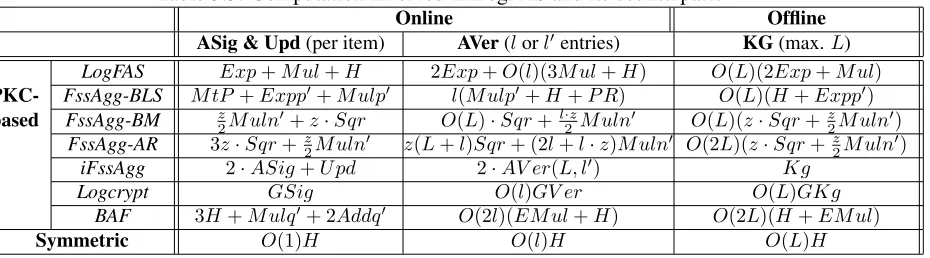
cryptographic operations . . . 36 Table 3.3 Execution time (in ms) comparison of HaSAFSS and FssAgg schemes . . . 37 Table 3.4 Asymptotic comparison of HaSAFSS and FssAgg schemes in terms of their
stor-age overheads . . . 38 Table 3.5 Comparison of HaSAFSS and FssAgg schemes in terms of some important
qual-itative properties . . . 38 Table 4.1 Comparison of BAF schemes with their counterparts in terms of asymptotic
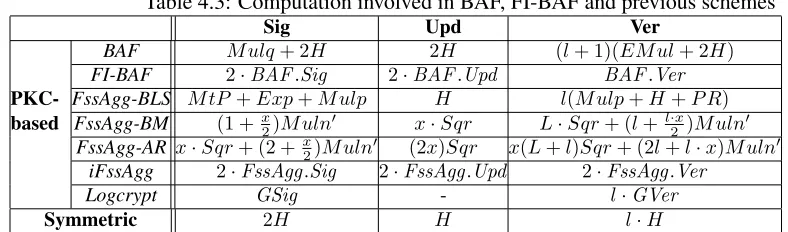
com-putational/storage/communication overheads and some qualitative properties . . 44 Table 4.2 Notation for performance analysis and comparison . . . 64 Table 4.3 Computation involved in BAF, FI-BAF and previous schemes . . . 65 Table 4.4 Execution times (in ms) of BAF, FI-BAF and previous schemes for a single log
entry . . . 65 Table 4.5 Signature/key storage and communication overheads of BAF, FI-BAF and
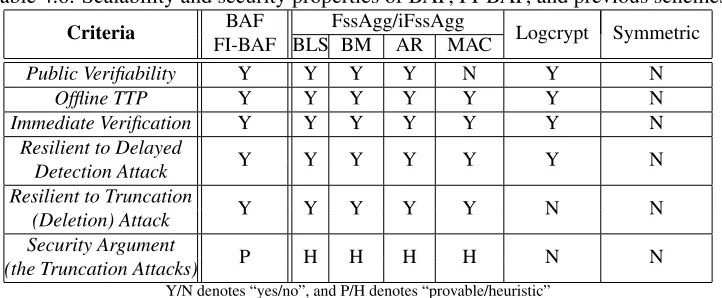
previ-ous schemes . . . 67 Table 4.6 Scalability and security properties of BAF, FI-BAF, and previous schemes . . . 68 Table 5.1 Comparison of LogFAS schemes and their counterparts for performance,
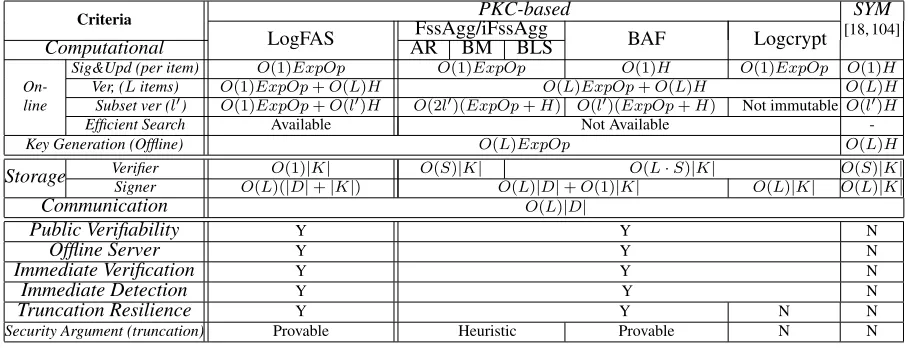
appli-cability, availability and security parameters . . . 72 Table 5.2 Notation used in performance analysis and comparison of LogFAS and its
LIST OF FIGURES
Figure 3.1 Signing time comparison of HaSAFSS schemes and their counterparts (in ms) . . . . 37
Figure 3.2 Verification time comparison of HaSAFSS schemes and their counterparts (in ms) . . 37
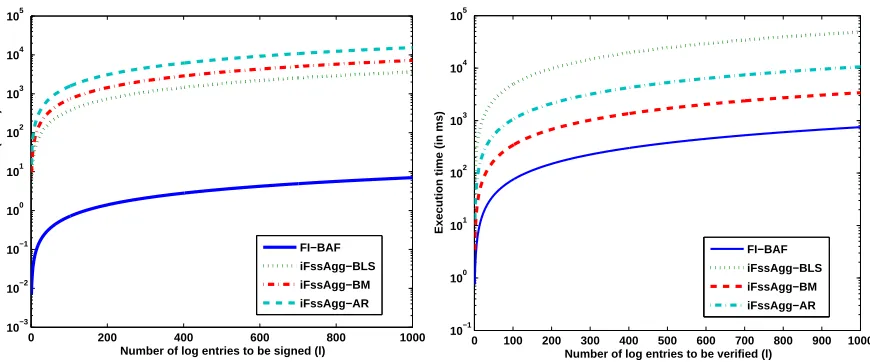
Figure 4.1 Signing time comparison of BAF and its counterparts (in ms) . . . 66
Figure 4.2 Verification time comparison BAF and its counterparts (in ms) . . . 66
Figure 4.3 Signing time comparison of FI-BAF and iFssAgg schemes (in ms) . . . 67
Figure 4.4 Verification time comparison FI-BAF and iFssAgg schemes (in ms) . . . 67
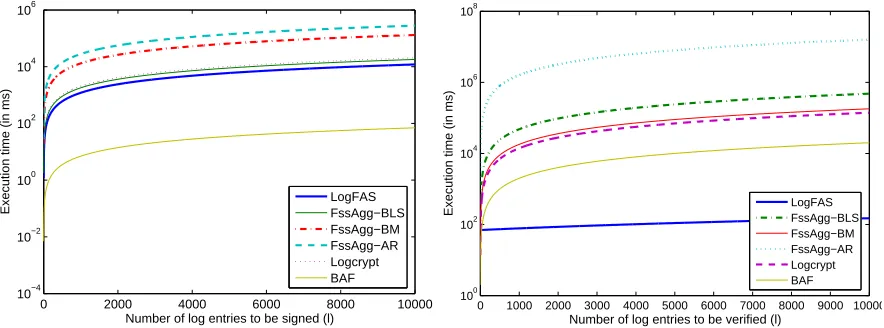
Figure 5.1 Signing time comparison of LogFAS and its counterparts (in ms) . . . 85
Chapter 1
Introduction
Audit logs are used to track important events such as user activities and program executions in modern computer systems, providing invaluable information about the state of the systems (e.g., intrusions, crashes). Due to their forensic value, audit logs are an attractive target for attackers. For instance, an experienced attacker may erase traces of her malicious activities from the logs, or modify the log entries to implicate other users after compromising the system. Therefore, ensuring the integrity, authenticity and accountability of audit logs is critical for any modern computer system [38, 57, 79, 104].
In current large and ubiquitous computer systems (e.g., Wireless Sensor Networks (WSN) [121]), protecting audit logs is a difficult task, especially in the presence of active adversaries. In particular, secure audit logging in task-intensive [79] and/or resource-constrained applications (e.g., WSNs [76], RFID tags [9]) is even more challenging. Unfortunately, existing secure audit logging solutions have significant limitations, and therefore cannot meet the requirements of such applications.
In this chapter, we first identify the limitations of naive (non-cryptographic) secure audit logging approaches and then enumerate the desirable properties of an ideal cryptographic secure audit logging scheme. We then identify the limitations of existing cryptographic secure audit logging schemes. Last, we present our solutions that address all these limitations.
1.1
Motivation
The central role of audit logs in computer forensics lead to the proposal of numerous log protection tech-niques. However, none of the previous solutions can address the requirements of secure audit logging in task-intensive and/or resource-constrained applications.
1.1.1 The Limitations of Naive (Non-Cryptographic) Approaches
in [18, 43, 78, 79, 94, 103, 120] as follows:
• One approach is to rely on an omni-reliable and secure end-to-end real-time communication chan-nel between each logging machine and a remote Trusted Third Party (TTP) to transmit log entries before the adversary compromises the logging machine. However, in modern IT systems, it is impractical to assume an omni-reliable and secure end-to-end real-time connection between each logging machine and a TTP [79, 104]. For instance, many real-life application driven by the Internet based services are considered Delay Tolerant Networks (DTNs) [50, 51, 53], which are characterized by the lack of such a continuous end-to-end communication channel. Similarly, various ubiquitous systems such as Unattended WSN (UWSN) [46, 76, 121] cannot guarantee the presence of such a communication channel.
• A straightforward approach is to back up log entries to a write-only medium (e.g., CD/DVD) assuming that the backup occurs before the logging machine is compromised. However, even for a moderate volume of logging activity, relying on a write-only medium such as CD/DVD for log protection is impractical.
• Another approach is to assume both the presence and “bug-freeness” of a tamper resistant hard-ware in each logging machine that prevents the adversary from reaching audit logs. However, in heterogeneous systems (e.g., compute clouds), it is impractical to assume both the presence and “bug-freeness” of a tamper resistant hardware on all types of platforms (e.g., wireless sensors [76], commercial off-the-shelf systems [18]). For instance, the recently introduced Write-Once-Read-Many (WORM) drives [34] were rapidly adopted for secure audit purposes [115]. However, sev-eral vulnerabilities of WORM drives were later identified (e.g., [58, 94]). This further confirms the danger in simply relying on a tamper-resistant hardware.
1.1.2 Desirable Properties of an Ideal Cryptographic Secure Audit Logging Scheme The above limitations highlight the need for developing cryptographic mechanisms that can protect audit logs on physically unprotected machines without assuming continuous end-to-end real-time communi-cation. There has been extensive research invested in this direction (e.g., [18, 43, 47, 57, 75, 78, 79, 103, 104, 120]). It is desirable for such schemes to have the following properties:
• Forward Security and Append-only (aggregate) Properties:Since the log verifiers are not neces-sarily available to verify the log entries once they are generated, a logger may have to accumulate log entries over a period of time. If the adversary takes full control of the logging machine in this duration, no cryptographic mechanism can prevent her from modifying the post-attack log entries (due to her control over the system)1. However, the integrity of log entries accumulated 1
before the attack should be protected [18, 43, 57, 75, 78, 79, 120] (i.e., forward security [2]). Note that this protection should not only guarantee the integrity of individual log entries but also the integrity of log stream as a whole. That is, no selective deletion or truncation of log entries should be possible. This is achieved with signature aggregation (i.e., append-only property) [75, 76, 79] in addition to forward security.
• Efficiency: Computational overhead introduced by the secure audit logging scheme must be low at both the logger and the log verifier sides.
• Public Verifiability: Unlike schemes that enable only a few privileged entities who share secrets with loggers to verify the integrity of log entries, a scheme supporting public verifiability permits any entity to do so. Public verifiability is a desirable property for some critical applications, such as electronic voting, where logs need to be audited and verified by the public [20], and financial applications, where financial books of publicly held companies need to be verified by current and potential future share holders [57, 79].
• Provable Security:It is necessary for a scheme to have formal security assessments for its security properties, including attacks specific to audit logging systems such as truncation and delayed detection attacks.2(The details of these attacks are given in Chapter 4.)
• Independence of Continuous Trusted Server Support: Ideally, a secure audit logging scheme should not rely on a continuous online trusted server, though an offline server or a passive server may be used from time to time. This is desirable since any dependence on the continuous com-munication with a trusted server could be exploited by an adversary to defeat the scheme (e.g., delayed detection attacks [78, 79, 120]).
1.1.3 The Limitations of Symmetric Cryptography based Secure Audit Logging Schemes The first cryptographic schemes (e.g., [17,18,103,104]) addressing the forward-secure audit logging rely on the symmetric cryptography to achieve the computational efficiency. These schemes adopted various symmetric primitives such as secure Message Authentication Code (MAC) [69], forward-secure Pseudo Random Number Generators (PRNGs) and cryptographic hash chains [19, 70]. Despite their computational efficiency, these symmetric schemes have critical drawbacks:
• The symmetric nature of these schemes does not allow public verifiability, and therefore they cannot address applications requiring public auditing [57, 75, 76, 120] (e.g., financial auditing for cooperations [4] and secure auditing for electronic voting [20]).
2
• They either need full symmetric key distribution (e.g., FssAgg-MAC in [76]), which incurs high storage overhead, or they require continuous remote trusted server support [103], which entails costly maintenance and attracts potential single-point of failures.
• They are vulnerable to certain attacks such as truncation and delayed detection attacks [75, 79].
1.1.4 The Limitations of PKC-based Secure Audit Logging Schemes
To address the limitations of symmetric cryptography based secure audit logging solutions, several PKC-based secure audit logging schemes have been proposed. Logcrypt extends the forward-secure MAC strategy to the PKC domain; it is publicly verifiable and secure against the delayed detection attack without requiring online TTP support [57]. However, Logcrypt incurs high storage/communication overheads and it is also still vulnerable to the truncation attack. Ma and Tsudik proposed FssAgg schemes ( [75,76,78,79]), which use forward-secure signatures and aggregate signatures in an integrated way. These schemes require only a single-final aggregate signature for all the accumulated log entries (due to the ability to aggregate individual signatures into a single compact signature), and therefore are signature storage/transmission efficient. This approach also provides security against the truncation attack (i.e., “all-or-nothing” property) [75].
However, despite their advantages, all existing PKC-based secure audit logging schemes share draw-backs that make them impractical for certain applications:
• These schemes require several Expensive Operations (ExpOps)3 to compute and verify the sig-natures of accumulated log entries. Therefore, they are impractical for secure audit logging in task-intensive and/or resource-constrained applications.
• To verify a particular log entry, all these schemes (e.g., [75, 76, 78]) force log verifiers to verify the entire set of log entries, which entails a linear number of ExpOps. A failure in this verification does not give any information about which log entry(ies) is (are) responsible for the failure. The iFssAgg schemes [79] mitigated these problems by allowing a more fine-grained verification. However, iFssAgg schemes double the signature computation and verification costs of their base FssAgg schemes to prevent the truncation attack. Moreover, the verification of a subset of given log entries still requires linear ExpOps in terms of the size of the given subset. Also, even if a small fraction of log entries are damaged, detecting damaged entry(ies) requires a linear number of ExpOps.
• All these schemes rely on only heuristic security arguments to justify their security against the truncation attack. However, security-critic applications demand provable security.
3
1.2
Our Contributions
The above discussion indicates that existing secure audit logging schemes cannot meet the requirements of task-intensive and/or resource-constrained applications.
In this dissertation, we developed a series of efficient, compromise resilient and compact cryp-tographic constructions to meet these requirements. We summarize our proposed schemes and their properties as follows:
1. Hash-Based Sequential Aggregate and Forward-Secure Signature (HaSAFSS) for Unattended Wireless Sensor Networks (UWSNs) [121, 122]: Resource-constraints [84] and the lack of real-time communication [50] make secure audit logging a challenging task in UWNSs, especially in the presence of active adversaries [76]. To address this problem, we propose a new class of signature schemes, which we refer to asHash-Based Sequential Aggregate and Forward-Secure Signature (HaSAFSS).
HaSAFSS schemes utilize existing verification delays in UWSNs to introduce asymmetry be-tween signers and verifiers. In this way, they integrate the efficiency of MAC-based aggregate signatures and the public verifiability of bilinear map based signatures by preserving the forward security via Timed-Release Encryption (TRE) [36].
We develop three specific HaSAFSS schemes, Symmetric HaSAFSS (Sym-HaSAFSS), Elliptic Curve Cryptography (ECC) based HaSAFSS (ECC-HaSAFSS) and self-SUstaining HaSAFSS (SU-HaSAFSS).
The desirable properties of HaSAFSS schemes are summarized below:
(a) HaSAFSS schemes achieve public verifiability and computational efficiency simultaneously. (b) HaSAFSS schemes are the only schemes that allow both signers and verifiers to get equal
benefits of the optimal (i.e., ExpOp-free) computational efficiency.
(c) HaSAFSS schemes allow a signer to sequentially generate a compact and fixed-size signa-ture.
(d) Sym-HaSAFSS and ECC-HaSAFSS complement each other in terms of their storage re-quirements by offering different alternatives for different applications. SU-HaSAFSS achieves the optimal (i.e., constant key/signature sizes) storage efficiency for both signers and veri-fiers by introducing a little more computation. However, it still remains more efficient than all the previous publicly verifiable alternatives.
2. BAF and FI-BAF: Efficient, Compact and Compromise Resilient Cryptographic Schemes for Se-cure Audit Logging in Resource-Constrained Devices [120, 123]: Publicly verifiable secure log-ging in resource-constrained devices is a hard task due to the computation and storage limitations of such devices. Unfortunately, all previous forward-secure and/or compact (aggregate) crypto-graphic tools are computationally costly (e.g., BM [12], BLS [26], FssAgg [75, 79]).
Despite being computationally efficient, the HaSAFSS schemes cannot achieve immediate verifi-cation, which restricts their use for real-time applications. Moreover, the HaSAFSS schemes need a passive TTP support, which might not be available in certain applications.
To fulfill the need of an optimal signer efficient secure logging scheme with the immediate ver-ification property, we developed a new forward-secure and aggregate cryptographic construction calledBlind Aggregate Forward (BAF)along with its extension Fast-Immutable BAF (FI-BAF). The main idea is to use simple but efficient algebraic blinding operations to compute individual signatures of log entries, which can be aggregated with just a modular addition operation. The blinding and aggregation operations preserve forward security, verifiability and indistinguisha-bility without requiring any ExpOp at the logging device. This approach offers the following desirable properties:
(a) BAF does not require a time factor to be publicly verifiable. Therefore, it can address real-time applications by achieving the immediate verification property.
(b) BAF does not need online TTP support to enable the signature verification. This eliminates the potential single point of failure risks stemming from TTP dependence, and also makes BAF more scalable than the symmetric schemes (e.g., [18, 76, 103, 104]) and the HaSAFSS schemes.
(c) In BAF, signing a single log entry requires only a few cryptographic hash operations. Hence, it is significantly more computationally efficient than all PKC-based schemes at the signer side.
(d) BAF can produce publicly verifiable forward-secure and aggregate signatures with near-zero storage and communication costs for the loggers, even if the signing procedure is ExpOp-free.
(e) BAF is proven to be ForWard-secure Aggregate Existentially Unforgeable against Chosen Message Attack (FAEU-CMA) in the Random Oracle Model (ROM) [13] based on the in-tractability of Discrete Logarithm Problem (DLP) [109]. Moreover, BAF provides a formal proof against the truncation attack without the help of an external signature scheme (the details are given in Chapter 4).
computational efficiency. FI-BAF is also more efficient than its immutable counterparts (i.e., iFssAgg schemes [75]) at the signer side.
All the above properties make BAF an ideal alternative for secure logging on resource-constrained devices.
3. LogFAS: Efficient, Compromise Resilient and Append-only Cryptographic Schemes with Verifier Efficiency: In various applications, system auditors (i.e., verifiers) are required to monitor a large numbers of logging machines in real time. This requirement forces verifiers to process a large numbers of audit logs simultaneously, and also incurs heavy public key/certificate storage over-head. All previous publicly verifiable secure audit logging schemes are costly at the verifier side. Despite being signer efficient, BAF also requires an ExpOp per-item at the verifier side, which might be costly for some applications. As discussed before, HaSAFSS schemes are not suitable for real-time log verification.
To address these problems, we propose a new forward-secure and append-only signature scheme calledLog Forward-secure and Append-only Signature (LogFAS). LogFAS utilizes various cryp-tographic primitives including incremental hashing [11], DSA tokens [92] and Schnorr signa-ture [105] in novel ways, which offers the following unique properties:
(a) LogFAS is the only PKC-based forward-secure and append-only construction that can verify Litems with a small and constant number of ExpOp(s) regardless of the value ofL. All the previous PKC-based alternatives require a linear number of ExpOps with respect to the number of log entriesL. Hence, LogFAS is significantly more computational-efficient than all previous PKC-based schemes at the verifier side.
(b) LogFAS requires each verifier to store only a small and constant size public key. This makes LogFAS the most verifier-storage-efficient among the publicly verifiable secure audit logging schemes.
(c) Similar to BAF, LogFAS achieves the public verifiabilitywithoutrequiring any online TTP support or a time factor.
(d) LogFAS is proven to be secure in ROM [13] based on the existential unforgeability [16] of the Schnorr signature [105] and the Target Collision Resistance (TCR) property of incre-mental hashingIH [11].
(e) A variant of LogFAS can identify the corrupted log entries with a sub-linear number of ExpOps when most log entries are intact. In contrast, the other schemes always require a linear number of ExpOps.
1.3
Organization of Dissertation
Chapter 2
Background and Related Work
In this chapter, we provide background information and related works. We first give a review of forward-secure and/or aggregate signatures, which constitute the basis of our schemes. We then discuss works related to the HaSAFSS schemes [121, 122] including time-related cryptographic primitives and self-healing techniques in UWSNs. We review the previous cryptographic secure audit logging schemes, which are then compared with our schemes in detail in their own chapters. Lastly, we briefly dis-cuss Elliptic Curve Cryptography (ECC), on which ECC-HaSAFSS in [121] and the implementation of BAF [120] are constructed.
2.1
Forward Secure and/or Aggregate Signature Schemes
We briefly investigate the previous forward-secure and/or aggregate signature schemes below.
2.1.1 Forward-Secure Signature Schemes
A forward-secure signature aims to minimize the effect of key compromises. This goal is achieved via thesign-evolve-deletestrategy, which can be exemplified by the first forward-secure signature scheme proposed by Anderson in [8]. Anderson’s scheme can be constructed from any standard signature schemeSGN (e.g, [93]) generically. The intuition is as follows:
The signer first generatesLprivate/public key pairs assk ←(sk0, . . . ,skL)andPK ←(PK0, . . . , PKL), respectively, whereLdenotes the maximum number of time periods that a signer can use. Each
{skj,PKj}Lj=0is associated with a time periodtj.
For each time periodtj,0 ≤ j ≤ L, the signer computes the signature on data itemsDj received
in the duration oftj as σj ← SGN.Sigskj(Dj). The signer then updates the private key by simply deletingskj. Assume that the signer computed (σ0, . . . , σl) on data items(D0, . . . , Dl) until she is
since their associated private keys were deleted. That is, forging data items accumulated before the compromise is as difficult as breakingSGN.
The limitation of this construction is that all performance characteristics grow linearly with the value ofL. That is, the storage overhead is linear with respect to the value ofLat both the signer and the verifier sides. Moreover, the signature generation and signature verification require a SGN.Sig and aSGN.Ver operation for per-item, respectively (i.e., O(L)ExpOpat both the signer and the verifier sides).
Several new schemes were later proposed to address these limitations. We can classify these schemes in two categories: Schemes based on a specific number theoretic assumption, and generic schemes that can be constructed from any standard signature scheme. We give a brief overview of these approaches below.
Non-generic Forward-Secure Signature Schemes
Bellare and Miner (BM) proposed the first formalized forward-secure signature scheme in [12] by fol-lowing Anderson’s scheme [8]. The BM scheme relies on the intractability of factoring a Blum-Williams integer. Most notably, in this scheme, the number of private and public keys as well as the length of signature do not grow linearly withL. However, the sizes of these individual private and public keys are large. Abdalla and Reyzin (AR) improved the performance of BM [12] in [2] by shortening the lengths of private and public keys. However, the signature generation and signature verification of AR are more costly than that of BM.
Kozlov and Reyzin (KR) developed a forward-secure signature in [67] that achieves a computation-efficient key update (i.e., one modular exponentiation for each key update). This property is useful for the scenarios, in which time intervals are evolved frequently. Itkis and Reyzin (IR) developed a forward-secure signature scheme in [63], which is based on Guillou-Quisquater signature [54]. In AR, the computational cost of the signature generation and verification is only two modular exponentiations with short exponents. However, the key update operation of IR is computationally expensive.
Boyen et al. proposed a forward-secure signature scheme in [28], where key update can be per-formed on encrypted keys as a second layer of security. Later, other schemes with similar properties were also proposed (e.g., [71]).
The main advantage of these non-generic signature schemes is that, they show a better performance for certain scenarios than a generic scheme (e.g., frequent key evolve [67] and constructions specifically designed for secure audit logging [76, 121] and WNSs [84]).
Generic Forward-Secure Signature Schemes
construction), which utilizes a binary tree approach to achieve constant public key and signature sizes. However, its private key size and signing/verifying operations are all logarithmic with respect to the value of L (instead of a single ExpOp per-item). Later, Malkin et al. developed a highly efficient generic construction referred to as the MMM scheme [80]. The MMM scheme utilizes Merkle tree [88] based certification chains combined with the binary tree scheme of BM [12]. This enables the MMM scheme to achieve a practically unbounded number of time periods. We briefly discuss MMM scheme later in Section 3.1.
Krawczyk proposed another generic construction in [68], which utilizes Forward-secure Pseudo Random Number Generators (FWPRNGs) and a standard signature schemeSGN. In this scheme, the signer generates an initial private key sk0, and then generates L public keys and their corresponding
certificates. These public keys and certificates are given to the verifiers before the deployment. In signature generation, for each time periodtj,0≤j ≤L, the signer computesσj ← SGN.Sigskj(Dj) on Dj, and then updates the private keyskj asskj+1 ← F(skj), where F is a FWPRNG function
(such a function can be obtained from a standard cryptographic hash function such as SHA-1 [109]). The signer then deletesskj from the memory permanently. The verification is done as in Anderson’s
scheme [8]. Our schemes the HaSAFSS [121, 122] and the BAF [120] also follow a similar key update strategy.
The generic forward-secure signature schemes have two main advantages. First, they achieve prov-able security just by assuming a secure standard signature scheme exists [5]. In contrast, non-generic schemes can be proven to be secure in the Random Oracle Model (ROM) [13]. Second, they can be constructed from any standard signature scheme. Hence, they can trade-off computational and storage efficiencies by using different base standard signature schemes with different performance characteris-tics [5].
Key Update Strategies for Forward-secure Signatures
A forward-secure signature scheme may operate in one of the following two key update models: 1. Per-item model: Sign each individual entryDjas soon as it is received.
2. Per-period model: Sign a group of entryD′j for each time periodtj, whereD′j denotes all
indi-vidual data items received intj.
2.1.2 Aggregate Signature Schemes
Another important digital signature primitive is the aggregate signature, which aggregatesnindividual signatures associated with n different data items into a single, compact signature. That is, assume that each userj,0 ≤ j ≤ L possesses a private/public key pair (skj,PKj), and wants to attest to a
message Dj. Each user first signs Dj by obtainingσj, and these signatures can be combined into a
single aggregate signature σ0,L by any party. The aggregate signature verification algorithm verifies
σ0,Lon all messages(D0, . . . , DL)for all public keys(PK0, . . . ,PKL). Therefore,σ0,L provides the
non-repudiation of all messages(D0, . . . , DL)simultaneously [73].
Aggregate digital signatures are useful primitives for various real-life applications including certifi-cate chains and secure routing. For instance, consider a Public Key Infrastructure (PKI) of depth L. Here, the certificateCertIDi onPKiassociated with userIDi is comprised of a certificate chain, which
is issued by a hierarchy of Certification Authorities (CAs). This certificate chain is long in complex CA hierarchies, and the userIDi is required to includeCertIDi in his all (new) signature/public key
trans-missions. It is therefore desirable to keep the length of authentication tags inCertIDi constant-size [73].
The first aggregate signature scheme was proposed in [26], which utilizes the BLS (Boneh-Lynn-Shacham) signatures [27]. This scheme is proven to be secure in ROM under the Bilinear Diffie-Hellman (BDH) problem [66]. It uses a full domain hash function and a single modular exponentiation under large primep to compute an individual signature for a given data item. The aggregation of two such individual signatures is just a modular multiplication operation under modp. Moreover, the sizes of pri-vate key and aggregate signature are small, especially when the scheme is implemented in elliptic curves (see Section 2.4). However, the signature verification requires a pairing operation (see Section 3.1) for each item to be verified, which makes it computationally costly.
ef-ficient secure routing, since identity-based primitives do not require to transmit large public keys and certificates. Boldyreva et al. claimed that IBSAS is secure based on an assumption called as M-LRWS (the modified version of LRWS introduced in [74]). However, Hwang et al. [59] showed that IBSAS is universally forgeable due to the fact that the intractability assumption of M-LRWS does not hold.
2.1.3 Forward-Secure and Aggregate Signature Schemes
Ma et al. proposed two forward-secure and aggregate signature schemes in [76]: FssAgg-BLS and FssAgg-MAC. These schemes are integrated signature schemes, which achieve signature aggregation and forward security simultaneously. FssAgg-BLS uses forward-secure hash chains and BLS signa-tures [26] to compute and verify aggregate signasigna-tures. However, similar to the traditional BLS-based aggregate signature schemes, FssAgg-BLS is also computationally costly.
In FssAgg-MAC, a TTP distributes a secret chain rootsk0 to the signer and the verifier before the
system deployment. In the signature generation phase, assume that the signer has accumulatedidata items(D0, D1, ..., Di−1)and computed their aggregate signatureσ0,i−1at a time periodtw. When the
signer collects data itemDi, she first computes the individual signature ofDi asσi ← M ACski(Di)
and aggregatesσiintoσ0,i−1 by simply computingσ0,i ← H(σ0,i−1||σi). The signer then updates the
chain key asski+1 ← H(ski)and deletesskiwhen she advances to the next time periodtw+1, where
Hdenotes a cryptographic hash function (e.g., SHA-1 [109]). Since the verifier knows the secret chain root, she can verifyσ0,i by following the same procedure as in the signature generation. Despite its
effectiveness and simplicity, FssAgg-MAC does not allow signatures to be publicly verifiable.
2.2
Time-Related Cryptographic Primitives and Self-Healing Techniques
Our proposed HaSAFSS schemes [121,122] rely on a time factor to achieve their intended goals. Specif-ically, HaSAFSS schemes utilize the Timed-Release Encryption (TRE) concept to introduce the desired asymmetry between the signers and verifiers to achieve public verifiability and forward security simul-taneously. Therefore, we first briefly discuss the TRE concept. We then summarize TESLA, which also uses a time factor to introduce an asymmetry between the signers and verifiers.
We finally discuss the self-healing techniques in UWSNs that are distantly related to HaSAFSS schemes.
2.2.1 Timed-Release Encryption (TRE)
The purpose of TRE [85] is to encrypt a message in such a way that no entity including the intended receivers can decrypt it until a pre-defined future time. TRE has several applications in real-life [41]:
• Confidential Commitments: In various applications such as sealed-bid auctions, electronic lot-teries and legal wills, the ciphertext can be considered as a commitment of the sender. This commitment should be available to its intended recipients no earlier than a designed future time. The properties of TRE satisfies these requirements. That is, after the sender provides the cipher-text (i.e., the commitment) to the recipients, she cannot change the original message anymore. At the same time, receivers cannot obtain any information about the message content before its in-tended time. Once the time trapdoor information is released, the receivers can recover the original message from the ciphertext.
• Bulk Information Pre-distribution: TRE enables a sender to send a bulk ciphertext beforehand without the risk of an information leakage. Since the trapdoor information is significantly smaller than the ciphertext (and even than the original message), this allows a rapid dissemination (i.e., the recovery) of the encrypted content at its desired availability time. In this way, the sender can avoid several problems that may stem from the burst transmission of bulk data (e.g., network/server bottlenecks). Such applications include the distribution of entertainment media, software license and scheduled payments.
One approach to obtain a TRE scheme is to force recipients to perform intensive computations on a given challenge (i.e., the ciphertext). For instance, the sender can encrypt the message with a short symmetric key. However, this approach imposes an intolerable computational overhead to the recipients, and also the release-time cannot be controlled precisely, since the computation power may change from one recipient to another.
can decrypt the ciphertext when its related trapdoor information is released by the TA. Some preliminary TA-based schemes require a multi-round interaction with the TA (e.g., [45]). Blake et al. developed the first TRE scheme in [36] that does not require an interaction with the TA. However, they did not provide a formal security analysis of their construction. Later, non-interactive TRE schemes with formal security assessments were proposed (e.g., [33, 37]).
In some applications, recipients might need to decrypt the ciphertext before its intended time (with the permission of the sender). To address this need, TRE schemes with a pre-open capability were developed [41, 60]. That is, the sender helps recipients to decrypt the ciphertext by publishing a pre-open key that enables the decryption without interacting with the TA. In these schemes, it is important to prevent the sender from manipulating the ciphertext in a predictable way via this auxiliary key, and the security model should capture this threat as well. Later, generic TRE schemes, which can be constructed from any traditional public key encryption scheme or an IBE scheme [25], were proposed (e.g., [83]).
Our schemes Sym-HaSAFSS and ECC-HaSAFSS only use the basic TRE concept [85] to fulfill the optimal computational efficiency goal. Our other scheme SU-HaSAFSS inspires from the time trapdoor mechanism used in [113] to achieve the self-sustainability and optimal storage efficiency, but it is more computationally costly than Sym-HaSAFSS and ECC-HaSAFSS.
2.2.2 TESLA
Another cryptographic scheme that utilizes the time factor is TESLA [96]. TESLA is an efficient broad-cast authentication protocol that also uses delayed disclosure of the keying material, assuming that senders and receivers are loosely synchronized. However, TESLA cannot address the cryptographic secure logging problem properly due to the following limitations:
• TESLA cannot achieve forward security, since an active adversary compromising a sender can forge MACs valid for the given time interval.
• TESLA does not use a signature aggregation strategy, and therefore its communication overhead is linear with respect to the number of data items to be signed.
• TESLA cannot be used for some UWSN applications, in which a loose time synchronization cannot be guaranteed for the network entities.
2.2.3 Self-Healing Techniques
compromised sensor [77, 99] by introducing local randomness (with a PRNG) to their neighborhood. DISH [77] assumes a read-only adversary and targets data secrecy. POSH [99] allows for constrained write-only adversaries and targets data survival. Pietro et. al. [98] elaborated the adversary models given in [77, 99] and provided experimental/analytical results for them.
Note that the adversary models and security goals in [77, 98, 99] are different from our schemes. In HaSAFSS schemes (similar to FssAgg [76]), the goal of the adversary is to forge the data. However, the goal of the adversary in [77, 98, 99] is to prevent the data from reaching the sink (not modifying or forging it).
2.3
Secure Audit Logging Schemes
We first survey the schemes that are based on forward-secure stream integrity and digital signatures. We then briefly discuss secure auditing approaches with different properties than those of our own schemes.
2.3.1 Forward-secure Stream Integrity and Digital Signature based Solutions
The pioneering studies addressing the forward-secure stream integrity for audit logging were presented in [17, 18]. The main focus of these schemes is to formally define and analyze forward-secure MACs and PRNGs. Based on their forward-secure MAC construction, they also presented a secure logging scheme, in which log entries are tagged and indexed according to evolving time periods.
Schneier et al. [103, 104] proposed secure logging schemes that use one-way hash chains together with forward-secure MACs to avoid using tags and indexes. In these schemes, a trusted server provides auxiliary keying materials to the verifiers to enable log verification. While reducing the need for trust in the verifiers, this approach introduces a trusted server that has to be online for each verification. This brings architectural difficulties as well as making the system open to a single point of failure.
Logcrypt [57] extended the idea given in [18, 103] to the PKC domain by replacing MACs with digital signatures and ID-based cryptography. Logcrypt can also be considered as an extension of An-derson’s scheme [8] with the addition of a confidentiality service. In this scheme, each signer generates a private/public key pair for a digital signature and/or PKC-based encryption scheme (traditional or Identity-Based Encryption (IBE)). For each log entry, the signer computes a signature and also (option-ally) encrypts this log entry. The private keys are evolved as in Anderson’s scheme.
2.3.2 Audit Logging Schemes Aiming with Different Properties to Our Own
Itkis proposed cryptographic tamper resistance techniques in [62] that can detect tampering even if all the keying material is compromised. Our schemes can be combined with the Itkis model as any forward-secure signature [62].
Davis et al. proposed time-scoped search techniques on encrypted audit logs [47]. Waters et al. proposed an audit logging scheme [116] relying on IBE, which enables an encrypted search on logs without relying on a time factor. There are several other encrypted search schemes (e.g., [24, 44, 107]) that can be used for the same purpose. All these schemes can be coupled with our schemes to provide confidentiality and effective log utilization.
There is a line of work that relies on authenticated data structures to protect audit logs in distributed systems [7, 81, 95]. While being computationally efficient, these approaches do not provide forward security. Furthermore, any authenticated data structure can be strengthened with a forward-secure sig-nature [43]. Therefore, our schemes can serve these authenticated data structures as a forward-secure and aggregate digital signature primitive.
Apart from the above schemes, there is another line of work that utilizes a trusted hardware to enhance the security of audit logs. Chong et al. proposed an extension to the scheme in [103] by using tamper-resistant hardware [39]. Xu et al. proposed SAWS [118], which relies on a Trusted Computing Base (TCB) to protect private keys used for PKC operations.
Accorsi gave surveys on existing secure audit logging schemes in [3, 4].
2.4
Elliptic Curve Cryptography (ECC)
Elliptic curve cryptography (ECC) is an approach to public-key cryptography based on the algebraic structure of elliptic curves over finite fields [56, 109, 117]. Elliptic curves used in cryptography are typically defined over two types of finite fields: prime fieldsFp, wherepis a large prime number, and
binary extension fieldsF2m. In our schemes, we only use elliptic curves overFp.
An elliptic curve overFp is defined by a cubic equationy2 = x3 +ax+b, wherea, b ∈ Fp are
constants such that4a3+ 27b3 ̸= 0[56]. The points on the elliptic curvey2 =x3+ax+bconsist of all pairs of affine coordinates(x, y)forx, y∈Fpthat satisfy the equationy2 =x3+ax+band a point
O(x,∞)at infinity. These points form an abelian group with respect to a special addition operation, whereOis the additive identity of this group. The formulas defining point addition, point doubling, and other details can be found in [56, 109].
order) [56]. The hardness of ECDLP allows several cryptographic schemes based on elliptic curves, such as ECDH and ECDSA [87].
2.5
Conclusion
In summary, forward-secure and aggregate signatures are ideal cryptographic tools to achieve compact and compromise-resilient authentication and integrity for audit logs. However, all previous PKC-based forward-secure and aggregate secure logging schemes are highly costly, and their symmetric counter-parts are not publicly verifiable as well as being open to certain attacks.
Chapter 3
Efficient, Compromise Resilient and
Compact Cryptographic Constructions
for UWSNs
An Unattended Wireless Sensor Network (UWSN) [76, 77, 86, 98, 99] is a Wireless Sensor Network (WSN) in which continuous end-to-end real-time communication is not possible for sensors (senders) and their receivers (e.g., mobile collectors, static sinks). In other words, receivers might not be available for sensors from time to time, sometimes for long time periods. Sensors accumulate the sensed data in these time periods, and transmit it to the receivers whenever they become available (e.g., visits of mobile collectors [76, 77]).
Examples of UWSNs can be found in military WSN applications (e.g., [98, 111]), where sensors are deployed to an adversarial and unattended environment to gather information about enemy activities. One illustrative example is LANdroids [46], a recent U.S. Defense Advanced Research Projects Agency (DARPA) research project, which designs smart robotic radio relay nodes for the battlefield deployment. These nodes are expected to be deployed in hostile environments to gather military information and upload to ally vehicles (e.g., UAV, soldier) upon their arrivals.
Forward-secure and aggregate signatures are ideal cryptographic tools for achieving data integrity and authentication for UWSN applications in the presence of active adversaries [76] (motivations and properties of forward-secure and aggregate signatures were discussed in Chapter 1 and Chapter 2, re-spectively). However, all existing PKC-based forward-secure and aggregate signature schemes (e.g., [26, 75, 76]) impose extreme computational overheads on the network entities, which are intolerable for resource-constrained UWSN applications. Another alternative is to rely on symmetric key cryptography via hash chains and Message Authentication Codes (MAC) as in FssAgg-MAC [76]. However, such an approach requires full symmetric key distribution and does not allow signatures to be publicly verifiable. This makes it unscalable and impractical for large distributed UWSN applications. Thus, it is necessary to seek highly efficient and flexible forward secure and aggregate signatures for UWSN applications.
To address this problem, we propose a new class of cryptographic schemes for UWSN applica-tions, which we callHash-Based Sequential Aggregate and Forward Secure Signatures (HaSAFSS, pro-nounced as “Hasafass”). We develop three specific HaSAFSS schemes, aSymmetric HaSAFSSscheme (calledSym-HaSAFSS),ECC-based HaSAFSSscheme (calledECC-HaSAFSS), and aself-SUstaining HaSAFSSscheme (calledSU-HaSAFSS).
A nice property of these schemes is that they achieve several seemingly conflicting goals, computa-tional efficiency, public verifiability, forward security, flexibility and sustainability at the same time. To achieve this, HaSAFSS schemes introduce asymmetry between the senders and receivers using the time factor via Timed-Release Encryption (TRE) [101]. Using this asymmetry, our schemes achieve high efficiency by minimizing costly Expensive Operations (ExpOps), while still remaining publicly verifi-able and forward-secure. In addition to these common properties, each HaSAFSS scheme also achieves unique properties specific to it.
We summarize the properties of HaSAFSS schemes as follows:
1. Our schemes achieve near-optimal computational efficiency and public verifiability at the same time. They achieve the computational efficiency by adopting cryptographic hash functions to compute aggregate and forward-secure signatures, and thus are much more efficient than all the existing schemes (e.g., [26], FssAgg-BLS in [76], FssAgg-AR/BM [75]), with the exception of FssAgg-MAC in [76]. When compared with FssAgg-MAC [76], our schemes further achieve public verifiability by eliminating symmetric key distribution.
2. In our schemes, both signers (senders) and verifiers (receivers) get equal benefits of computational efficiency, while most existing schemes incur heavy computational overhead on either the signer or verifier side. This property is especially useful for UWSN applications in which both the signers and verifiers need to process large amounts of data efficiently.
4. Sym-HaSAFSS relies on an omni-symmetric design even if it is public verifiable. Hence, it is the most computationally efficient scheme among of all its counterparts. It is also the most verifier storage friendly scheme by requiring only a small and constant storage for the verifiers. However, it requires a linear storage at the signer side.
5. ECC-HaSAFSS requires storing one key for each signer by offering a signer storage friendly scheme. However, it requires an ExpOp to initialize each time interval (but still requires only three hash operations to sign/verify per-item), and also demands quadratic storage overhead at the verifier side.
6. Despite their simplicity and efficiency, Sym-HaSAFSS and ECC-HaSAFSS put a linear bound on the maximum number of time periods that a signer can use. Moreover, they require a pre-determined and fixed data delivery schedule that all signers have to agree upon before deployment. SU-HaSAFSS addresses these limitations by offering following properties:
- SU-HaSAFSS enables a signer to use (practically) unbounded number of time periods (this implies the ability of generating unbounded number of signatures) without requiring any re-keying after the deployment. This allows a signer to operate in a hostile environment for a long time without requiring re-deployment/re-keying support. This also offers only a constant key storage at the signer side and a linear key storage at the verifier side.
- SU-HaSAFSS enables each sender to decide her own data delivery schedule dynamically (after the deployment) without requiring any (online) communication with other signers or a trusted third party. Therefore, SU-HaSAFSS can support applications in which a pre-determined data delivery schedule cannot be determined.
To achieve these properties, SU-HaSAFSS requires a few ExpOps for per interval (for the ini-tialization purpose), and therefore is more computationally costly than Sym-HaSAFSS and ECC-HaSAFSS. However, SU-HaSAFSS is significantly more efficient than all other PKC-based schemes (e.g., FssAgg) that require an ExpOp per data item (SU-HasAFSS requires only three hash oper-ations per data item to sign or verify in given time interval).
HaSAFSS schemes utilize already existing verification delays in the envisioned UWSN applications as an opportunity to achieve the aforementioned properties. Thus, they are ideal solutions for UWSN applications in which high computational, storage, or bandwidth efficiency is more important than im-mediate verification.
3.1
Preliminaries
G1is a cyclic additive group generated by generatorGon an Elliptic Curve(EC)over a prime fieldFp,
wherepis a large prime number andq is the order ofGandG1. kG, wherekis an integer, denotes a
scalar multiplication.G2is a cyclic multiplicative group with the same orderq.
E,D,||, and|x|denote symmetric encryption function, symmetric decryption function, concatena-tion operaconcatena-tion, and the bit length of variablex, respectively.
H1 and H2 are two distinct cryptographic hash functions, which are both defined as H1/H2 : {0,1}n → {0,1}|H|, wherendenotes the bit length of randomly generated input key and|H|denotes the output bit length of the selected hash function. H3 is used to compute aggregate signatures and
is defined as H3 : {0,1}∗ → {0,1}|H|. H4 is used to map an input key to a point on the EC, i.e.,
H4 : {0,1}n → αG. H5 : {0,1}|t| → Zq∗ is used to hash at-bit time instanceT ∈ {0,1}|t| (e.g.,
T=“22:43, June 21 2011”). H6 is defined asH6 : G2 → Zq∗. We also use a secure MAC to compute
individual signatures of data items, defined asM ACsk :{0,1}n× {0,1}∗ → {0,1}|H|.
twdenotes a single time interval, which is formed from two consecutive pre-determined time points
Tw−1 andTw > Tw−1. tw,w′ denotes a unified time interval, which starts at the beginning oftw and
ends at the end oftw′,w′ ≥w.
SGN denotes a standard digital signature scheme (e.g., Schnorr [105], DSA [87]) andMMM de-notes a Malkin Micciancio Miner (MMM) generic forward-secure signature construction [80] instanti-ated from an appropriate base scheme (e.g, [6,63]).(sk, pk) =SGN.Kg(1κ),σ=SGN.Sigsk(m)and
{success,failure}=SGN.V erpk(σ, m)denote the key generation for security parameterκ, signature generation on messagemwith privateskand verification ofσonmwith public keypk, respectively.
MMM signature scheme, in addition to the above standard algorithms, also has a key update algo-rithm, denotedMMM.Upd(skw,w). That is, given the current private keyskw, the update algorithm
generates one or several new key instances to be used in the future. This is done by using a sum compo-sition and a product compocompo-sition iteratively based on a special tree structure. The details of this update procedure can be found in [80].
Definition 3.1 beis a bilinear pairingeb: G1×G1 → G2, i.e., an admissible map with the following
properties:
1. Bilinearity: be(aP, bQ) = eb(bP, aQ) = be(abP, Q) = be(P, abQ) = be(P, Q)ab, ∀P, Q ∈ G1 and ∀a, b∈Zq∗.
2. Non-degeneracy: ∃P, Q∈G1such thatbe(P, Q) ̸= 1. In our settings, we select prime order groups
in which∀P, Q∈G1,be(P, Q)= 1̸ , and thereforebe(G, G)(Gis the generator ofG1) is a generator
ofG2.
Definition 3.2 Elliptic Curve Discrete Logarithm Problem (ECDLP) [56] is defined as follows: Given a primep, a generatorG∈G, and a random pointQ∈E(Fp), find the integerk,0≤k≤p−2, such
thatQ≡kG. ECDLP is(τ, ϵ)-hard, if no algorithm running in time less thanτ can solve the ECDLP with a probability more thanϵ. whereϵis computed over the random choices of(G, k).
Definition 3.3 q-Bilinear Diffie-Hellman Inversion (q-BDHI) problem [35] is defined as follows: Given
(q+ 1)-tuple(G, aG, a2G, . . . , aqG)∈Gq1+1for somea, q∈Zp∗, computebe(G, G)a−1 ∈G2. q-BDHI
is(τ, ϵ)-hard, if no algorithm running in time less thanτ can solve the q-BDHI with a probability more thanϵ, whereϵis computed over the random choices ofG.
3.2
Models
We first give our threat model and security model including the HaSAFSS security definition and com-plexity/system assumptions. We then present our data model.
3.2.1 Threat Model and Security Model
Our treat model is based on a resourceful but Probabilistic Polynomial Time (PPT) bounded adversary
Awith the following abilities: (i) passive attacks against output of cryptographic operations, (ii) active attacks including packet interception/modification, and (iii) physically compromising senders/receivers (called as”break-in”) and extracting the cryptographic keys from the compromised nodes.
Aaims to produce an existential forgery against the forward-secure and aggregate signature of the accumulated data that he obtained after the break-in. A may use any cryptographic key and data that she extracted from the compromised signers and verifiers.
Before giving the HaSAFSS security model, we review the Quality of Forward Security (QoF) concept [75]:
Definition 3.4 QoFis a performance-forward security quality trade-off, which is decided according to the following two key update methods:
• Per-item QoF: Each individual data itemDjis signed as soon as it is collected.
• Per-interval QoF: A group of data itemDj′ is signed as a single data item for each time periodtj,
whereD′j denotes all individual data items collected intj.
verifiers. In contrast,per-interval QoFprovides alowquality of forward security (i.e., only for across time periods), but it also incurslesscomputational and storage overhead to the the signers and verifiers. HaSAFSS Security Objectives:The goal of HaSAFSS schemes is to achieve secure signature ag-gregation and forward security simultaneously. We follow the example of previous forward-secure and aggregate signature schemes (i.e., [75, 76]), which focus on forward-security, existential unforgeability and authentication properties, to analyze our schemes in Section 3.4.
Remark that HaSAFSS schemes exploit the already existing delays (i.e., time factor) in UWSNs to achieve its desirable properties. Thus, the forward-security objective of HaSAFSS schemes is slightly different than that of previous forward-secure and aggregate schemes (i.e., [75,76,79]). That is, HaSAFSS aims to achieve atime-valid forward-securityinstead of apermanentforward-security.
Based on our threat model and security goals, the security of HaSAFSS schemes is defined as follows:
Definition 3.5 The security of a HaSAFSS scheme is defined as the non-existence of a PPT bounded adversaryAwho produces an existential forgery against HaSAFSS even under the exposure of current keying material in the duration of a designated time intervaltw,w′. This is called asTime-valid
Forward-secure Existential Unforgeability (TFEU)property.
Note that HaSAFSS schemes mainly rely on symmetric cryptography to achieve the above goal1. Indeed, in Section 5.5, we show that they achieve the highest QoF (i.e., per-item QoF) in a given time interval, and still remain much more computationally efficient than previous PKC-based schemes.
Remark: The time validity requirement in Definition 3.5 implies that a signer should transmit the forward-secure and aggregate signature computed intw,w′ to the verifiers, before the TTP releases the
time trapdoor key associated withtw′. Such a requirement is compatible with the periodic data collection
characteristic of the envisioned UWSN applications [46, 76, 111]. Details of how our schemes handle data/time trapdoor information are given in data models and Section 3.3.
HaSAFSS schemes integrate various cryptographic primitives in a novel and efficient way to achieve their security and efficiency goals. In Section 3.4, we prove that breaking a HaSAFSS scheme is as difficult as breaking its underling primitive(s). Therefore, HaSAFSS schemes achieveTFEUas long as the below assumptions hold:
Assumption 3.1 We assume that cryptographic primitives used in our schemes have all the semantic security properties [52] as follows:
(i)H1,H2, ...,H6 are secure and collision-free hash functions producing indistinguishable outputs
from the random uniform distribution [13]. (ii)M AC is Existential Unforgeable Under Chosen Mes-sage Attacks (EU-CMA) [112]. (iii) Symmetric encryption functionEis Indistinguishable under Chosen
1Sym-HaSAFSS relies on an omni-symmetric construction, but ECC-HaSAFSS and SU-HaSAFSS consult a few ExpOp
Ciphertext Attacks (IND-CCA secure) [65]. (iv)ECDLP[56] andq-BDHI problem[22] are(τ, ϵ)-hard with appropriate parameters.
Assumption 3.2 We assume a Trusted Third Party (TTP), which is trusted by all network entities. (i) The adversary Acannot compromise the TTP; (ii) A may jam the TTP, but if an entity continuously tries, its messages can eventually reach the TTP; (iii) The TTP releasestime trapdoor keys(secret cryp-tographic keys) with which the receivers verify the forward-secure and aggregate signatures generated by the senders (the TTP acts as a Trusted Agent (TA) as in TRE schemes [41]). We assume that time trapdoor keys released by the TTP reach the receivers eventually. Details of the time trapdoor key delivery are given in the data models.
3.2.2 Data Model
We consider three data delivery models for the envisioned UWSN applications:
(a)Pre-determined Data Delivery Model: This model addresses applications in which signers/verifiers and the TTP can agree on a prospective data delivery schedule so that data/trapdoor delivery can be per-formed based on this schedule. In this model, the TTPpassively broadcaststime trapdoor keys based on apre-determined schedule. The verifiers are assumed to be (e.g., mobile collectors) available for their signers based on this schedule.
(b)On-demand Data Delivery Model: This model addresses applications where the nature of appli-cation does not allow a prospective delivery schedule. In this case, the TTP provides the time trapdoor information to the verifiers on demand. A representative scenario would be a military UWSN applica-tion, in which soldiers gather information from sensors from time to time and then request time trapdoor keys from the TTP (e.g., UAV/satellite). Note that in the worst case, verifiers can obtain time trapdoor keys from a mobile TTP directly (e.g., MTC (Mobile Tactical Center) [119]). Thus, Assumption 3.2-(iii) is realistic.
(c)Self-Decisive Data Delivery Model: This model offers a flexible data delivery schedule for the signers. It requires neither a prospective data delivery schedule nor a collaborative request mechanism for the time trapdoor release (no interaction with the TTP). Instead, the TTP passively broadcasts time trapdoor keysperiodicallywith a unit timeµ(e.g., per-minute). Each signerherself decideshow long (e.g., a time duration µ·x for any desired x ∈ N) she needs to accumulate, sign and seal the data (independent from the TTP and other signers). Verifiers decrypt and verify the data when its associated time trapdoor key is released.
time duration, even if it is captured by the enemy.
Remark: (i) Signers do not need to communicate with the TTP. Verifiers communicate with the TTP only in on-demand data delivery model, only once for each time period (the TTP can be offline most of the time). (ii) In HaSAFSS, similar to the previous forward-secure and aggregate schemes (e.g., [75, 76, 79, 120]), the signer computes aggregate signatures of distinct data items accumulated-so-far (i.e., similar to the condensed signatures notion in [91]). Cross-signer signature aggregation (e.g., [21, 26, 90]) is out of our scope.
3.3
Proposed Schemes
We now present the proposed Sym-HaSAFSS, ECC-HaSAFSS and SU-HaSAFSS schemes. Before giving the detailed description, we first present an overview of these schemes, providing instruments and strategies that are common to all HaSAFSS schemes.
3.3.1 Overview
The main goal of the HaSAFSS schemes is to create a forward-secure and aggregate signature scheme, which is as efficient as a MAC-based signature scheme and is publicly verifiable at the same time. Our schemes achieve this goal based on the following observations:
Delay is already intrinsic to the envisioned UWNS applications; such delays can be used to introduce asymmetry naturally between the signer (sender) and the verifiers (receivers) in order to bring both public verifiability and efficiency to the envisioned UWSN applications. HaSAFSS introduces this asymmetry with the aid of TRE concept, instead of offloading this task simply to the signers. Hence, even when the signers are compromised, such asymmetry can still guarantee the forward security and signature aggregation in a publicly verifiable way during the desired time interval.
The HaSAFSS schemes consist of four algorithms: Key generation, forward-secure and aggregate signature generation, time trapdoor release, and forward-secure aggregate signature verification.
HaSAFSS Instruments and Strategies: The HaSAFSS schemes rely on four main types of crypto-graphic keys; they use these keys in different ways to achieve different properties. There are also other types of cryptographic keys that are specific to a particular HaSAFSS scheme (e.g., public tokens in SU-HaSAFSS), whose details will be given in corresponding schemes.
• Per-data item key: Per-data item key is used with a MAC to generate or verify forward-secure and aggregate signatures during a given time interval (a single interval tw in
Sym-HaSAFSS/ECC-HaSAFSS and a unified intervaltw,w′ in SU-HaSAFSS). We take the unified interval as a basis in this
overview. The first per-data item key of a giventw,w′, called thechain rootof the per-data item keys
(i.e.,k0) intw,w′, is either derived from an auxiliary key (Sym-HaSAFSS) or randomly generated