Instant E-Learning: Private Learning Web
Application
Prof.Neelima Pathak1, Nihal Pai2, Preeti Morde3, Shweta Vaidya4& Meghana Tare5
Head of Department, Dept. of Information Technology, Mumbai University, Atharva College of Engineering,
Mumbai, Maharashtra, India1
Student, Dept. of Information Technology, Mumbai University, Atharva College of Engineering,
Mumbai, Maharashtra, India2
Student, Dept. of Information Technology, Mumbai University, Atharva College of Engineering,
Mumbai, Maharashtra, India3
Student, Dept. of Information Technology, Mumbai University, Atharva College of Engineering,
Mumbai, Maharashtra, India4
Student, Dept. of Information Technology, Mumbai University, Atharva College of Engineering,
Mumbai, Maharashtra, India5
ABSTRACT: Instant e-Learning is a new concept that provides a full and comprehensive modern education styles. The instant Learning provides one to one chat between a teacher and a student. The word instant enhances the e-Learning with the concept of real time teaching. The challenge to exercise online and instant teaching is not just merely relying on the technologies and system efficiency, but it needs to satisfy the usability and friendliness of the system as to replicate the traditional class environment during the deliveries of the class. For this purpose, an instant e-Learning framework is been developed that will emulate a dedicated virtual classroom, and primarily designed for synchronous and live sharing of current teaching notes. Education can take advantage of e-infrastructures and chat room to provide professors with new opportunities to increase student’s motivation and engagement while they learn. In the recorded e-learning student cannot clear their doubts instantly, whereas with the chat room concept we can clearly get all the concepts.
KEYWORDS: Instant, Real Time, Live, Chat Room.
I. INTRODUCTION
Within a decade, the Internet has become a pervasive medium that has changed completely, and perhaps irreversibly, the way information and knowledge are transmitted and shared throughout the world. The education community has not limited itself to the role of passive actor in this unfolding story, but it has been at the forefront of most of the changes. Indeed, the Internet and the advance of telecommunication technologies allow us to share and manipulate information in nearly real time. This reality is determining the next generation of distance education tools. Distance education arose from traditional education in order to cover the necessities of remote students and/or help the teaching-learning process, reinforcing or replacing traditional education. The Internet takes this process of delocalization of the educative experience to a new realm, where the lack of presential intercourse is, at least partially, replaced by an increased level of technology-mediated interaction. Furthermore, telecommunications allow this interaction to take forms that were not available to traditional presential and distance learning teachers and learners.
II. RELATED WORK
Sr. No. Author Description 1 Ali Turker, et al [Ali Turker and
IlhamiGorgun]
“The challenge of content creation to facilitate personalized e-learning Experiences” International Journal on E-Learning (IJeL), Special Issue: Learning Objects in Context, Volume 5, Issue 1, pp: 11-17, Chesapeake, VA: AACE. 2006.] addressed the challenges to create the pedagogically coherent learning content for an individual learner’s preferences. This paper introduces iClass project which addresses number of key aspects to perform personalization such as modeling of the learner’s needs and preferences, representation of pedagogical strategies,
representation of learning assets and the runtime reconciliation of these elements to produce effective and coherent learning experiences.”
2 Judy C.R. , et al [Judy C.R. Tseng, Hui-Chun Chu, Gwo-Jen Hwang and Chin-Chung Tsai]
“Development of an adaptive learning system with two sources of personalization information”, Computers & Education Volume 51, Issue 2, September 2008, Pages 776-786, Elsevier, 2008.]
developed an adaptive learning system on the basis of learning behavior and personal learning style of the learner. The initial learning style of the learners is determined by questionnaires. The interactions and learning results are also considered for adjusting the subject material.”
3 Silvia Schiaffino, et al [Silvia Schiaffino, Patricio Garcia, and AnaliaAmandi]
“e-Teacher: Providing personalized assistance to e-learning students”, Computers & Education, Volume 51, Issue 4, December 2008, Pages 1744-1754, Elsevier, 2008.] presented an eTeacher, an intelligent agent, to provide personalized assistance to e-learning students. This agent observes the student’s behavior and builds the student’ profile containing the student’s learning style and
performance using Bayesian networks. E-Teacher proactively assists the student by suggesting personalized courses to help learner during the learning process.”
4 Tzouveli P., et al Shows how to realize personalized learning support in distributed learning environment based on semantic web technologies. Web services are used to provide personalization functionality to the e-learning systems. The developed personal e-learning assistant files the existing gap between the adaptive educational systems with well-established personalized functionality and open, dynamic learning and information networks.
5 Martin Balík, and Ivan Jelinek [Martin Balík, and Ivan Jelinek]
"Towards Semantic Web-based Adaptive Hypermedia Model", 5th Annual European Semantic Web Conference (ESWC 2008), Tenerife, Spain, 2008.] introduced general ontological model for adaptive web environments for adaptive personalization. This approach utilizes semantic web technologies to enable data reuse and system interoperability by developing a general model for adaptive hypermedia to provide a formal description.”
Traditionally, e-learning was based on recorded lectures. In recorded e-learning, student cannot clear their doubts instantly. Within a decade, the Internet has become a pervasive medium that has changed completely, and perhaps irreversibly, the way information and knowledge are transmitted and shared throughout the world. The education community has not limited itself to the role of passive actor in this unfolding story, but it has been at the forefront of most of the changes. The existing e-learning systems have time limitation that is the students have to attend the lectures on the specified time. If they fail to do so, they may miss their lecture. Traditional e-learning systems do not have various features like ratings or feedback which we would provide in our application. Some of the disadvantages were no doubt clearance at the moment, no sharing of resources, no live communication and social interactivity.
III.PROPOSED SYSTEM
A. System Design:
Fig: ER diagram
Instant e-learning is a generic e-learning process which makes use of a platform to connect two groups of people namely teachers and students, giving teachers independent access to learn without time restrictions and at the same time giving students to get solutions to their problems 24x7.Instant e-learning will be a live one-to-one video lecture or chat between a teacher and a student.In the recorded e-learning student cannot clear their doubts instantly, whereas with the chat room concept we can clearly get all the concepts in detail.
SIMULATION RESULTS
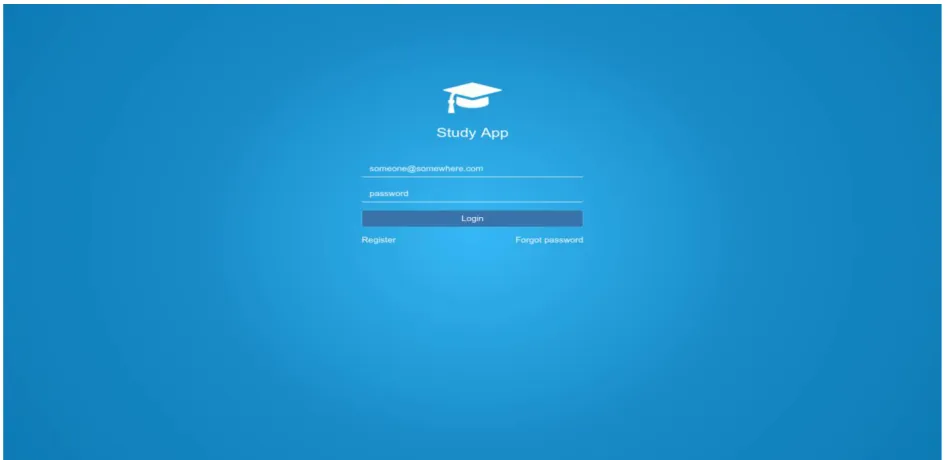
In figure 1, it shows the login with registration option. This is the registration or login page where the student/teacher can register or login if already registered. If they are unable to recollect the password then they should answer the question given by the user at the time of registration. Teacher can login or register according to their related domains.
Fig. 2 Registration page for student
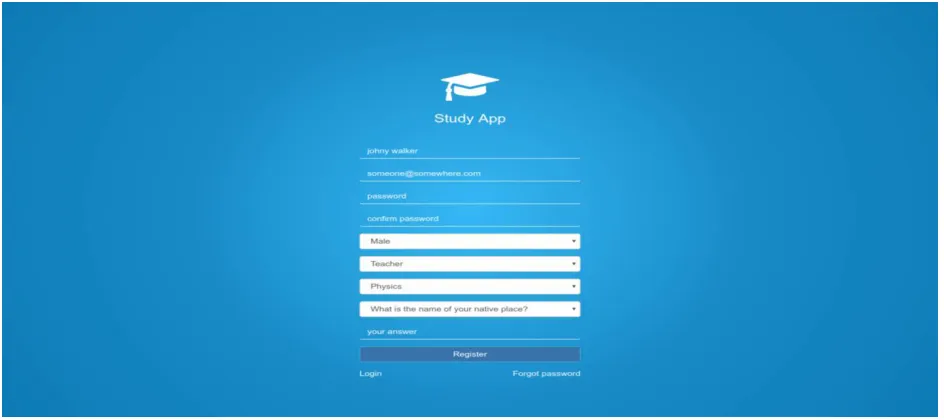
In figure 2, it shows the registration page for the student asking for his/her details. It asks for the name and password confirmation. It verifies the question asked here at the time of forgot password.
Fig.3 Registration page for teacher
F
IG.
4
A
UTHENTICATIONIn figure 4, it shows how the user can recover his/her password and authenticate successfully.
Fig. 5 Homepage
Fig.6 Messages
In figure 6, it shows the messages received by the users. It is used for teacher student communication.
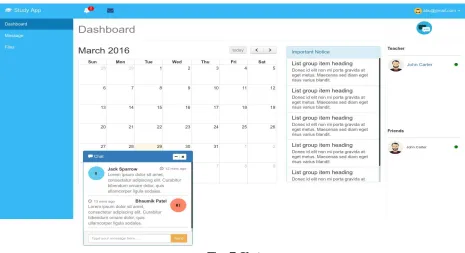
In figure 7, it shows how the user can communicate via chat messages. It is the chat box for communication between the teacher and the student.
Fig. 8 Video call lectures
In figure 8, it shows how the teacher and student can communicate live with the help of video call and clear the doubts face to face.
IV.CONCLUSION AND FUTURE WORK
Thus, Instant E-Learning is an agent-based personalized e-learning environment to reduce the effort required for learning the courses especially the interdisciplinary studies. This work is a first attempt from the different perspective of personalization and to best of our knowledge this attempt will lead a new direction in the field of e-learning environment.J2ME concept can be used in order to achieve an application anytime and anywhere.Accessible anytime and anywhere.
REFERENCES
1. Ali Turker and Ilhami Gorgun,”The challenge of content creation to facilitate Personalized e- learning Experiences” International Journal on E-Learning (IJeL), Special Issue: E-Learning Objects in Context, Volume 5, Issue 1, pp: 11-17, Chesapeake, VA: AACE. 2006.
2. Charalampos Karagiannidis, Demetrios Sampson and Fabrizio Cardinali, “Integrating Adaptive Educational Content into Different Courses and Curricula”, Educational Technology & Society Journal (ISSN 1436-4522), Special Issue on Curriculum, Instruction, Learning and theInternet, vol. 4(3), pp: 37-44, 2001.
3. Chih-Ming Chen, “Intelligent web-based learning system with personalized learning path guidance”, Computers & Education 51 (2008) 787– 814, Elsevier, 2008.
4. Chih-Ming Chen, Hahn-Ming Lee, and Ya-Hui Chen, “Personalized e-learning system using Item Response Theory”, Computers & Education 44 (2005) 237–255, Elsevier, 2008.
5. Chih-Ming Chen, Ling-Jiun Duh, “Personalized web-based tutoring system based on fuzzy item response theory”, Expert Systems with Applications 34 (2008) 2298–2315, Elsevier, 2008.
7. Judy C.R. Tseng, Hui-Chun Chu, Gwo-Jen Hwang and Chin-Chung Tsai, “Development of an adaptive learning system with two sources of personalization information”, Computers & Education Volume 51, Issue 2, September 2008, Pages 776-786, Elsevier, 2008.
8. Silvia Schiaffino, Patricio Garcia, and Analia Amandi, “eTeacher: Providing personalized assistance to e-learning students”, Computers & Education, Volume 51, Issue 4, December 2008, Pages 1744-1754,Elsevier, 2008.
BIOGRAPHY
Prof. Nileema Pathakis the Head of Department of Information Technology, Atharva College Of Engineering, Mumbai, India.
Nihal Pai is a student in the final yearof Information Technology, Atharva college of Engineering, Mumbai, India.
Preeti Morde is a student in the final year of Information Technology, Atharva college of Engineering, Mumbai, India.
Shweta Vaidya is a student in the final year of Information Technology, Atharva college of Engineering, Mumbai, India.