
Investigation on the effect of cold drawing process on mechanical
properties and structure of seamless steel (Ck60) tube
Professor Dr. Sorush Niknamian
Board Member of Weston A Price Foundation, Washington Dc, USA
E-mail: [email protected]
Abstract
The cold drawing process is one of the precise metal forming techniques which have attracted attention by many researchers with respect to the given properties such as potential for improvement of mechanical properties of the material, achieving of accurate dimensional tolerances and rise of quality at final surface so that different studies are conducted on properties of various materials in the course of analysis of its effect. Using cold drawing and also exertion of special heat treatment cycle in this investigation, initially the seamless steel tube Ck60 has been produced and then effect of cold drawing has been assessed on the mechanical properties and structure of steel. The production process of seamless steel tube includes two phases of cold drawing which was followed by surface reduction levels 15.1% and 13.7% respectively. In order to analyze mechanical properties, tensile test and hardness-testing was used and metallography test was also employed to observe the structure. The given results indicate that the seamless steel tube Ck60 produced by means of this production process has ultimate tensile strength (1021 MPa), yield strength (950 MPa) and elongation (9%). Moreover, the value of hardness mean was 312 for the final tube in Vickers Hardness Test. The images taken from optical microscopy also show that the final structure of tube is uniform and as perlite ferrite.
Keywords: Cold drawing- Seamless tube- Mechanical properties- Hardness- Structure- Heat treatment
1. Introduction
The history of using of various tubes dated back to several thousand years ago while over the years and following to scientific development and noticeable increase in recognition of materials by human, the kind and method of production of tubes has been changed and improved with respect to the existing requirement. Today, there are several techniques for production of types of tubes but tube production process can be divided into two groups of welded seam tubes produced by welding techniques and those tubes which are manufactured in seamless forms. Inter alia, due to lack of welding seam and having continuous structure, the seamless tubes have greater strength than seamed tubes. Therefore, their unique structure and mechanical properties as well as high speed production has caused this type of tubes to become especially important and to use them widely on various industrial fields such as fluids transition lines at high pressure and operational temperatures, hydraulic circuits, pressured tanks, boilers, automotive industry, various mechanical parts and many other cases [1,2,3,4].
Since time of invention and manufacturing of seamless tubes at the end of nineteenth century, several techniques have been developed for manufacturing of these tubes in parallel with each other among of which there are techniques of centrifugal foundry, rolling by different methods, rotary piercing and cold drawing. Among various techniques and particularly warm forming methods, cold drawing process has some advantages which have caused to attract more attention and to be utilized in different industrial fields. Some of these advantages are the potential to access more precise dimensional tolerances, higher quality of final surface, improvement in some of mechanical properties and potential for production of tube with thinner wall thickness that makes the cold-drawing as distinct from other processes [2,3,5,6,7,8].
The die and related plug are usually made of tungsten carbide or chromate-coated tool steel [2-11].
Drawing of tube and change in its dimensions by cold drawing process is followed by deformation and subsequently hardening. Therefore, during this process structure of material is changed and affects mechanical and physical properties of material and thus the manufactured end product. On the other hand, with respect to the given end-product, various heat treatment cycles may be exerted during production process or after the end of drawing on tube. As a result, heat treatment is deemed as a complementary process for cold-drawing. Thus, various studies have been so far conducted on final property and quality of produce tubes with different materials under various parameters of drawing and in different cycles of heat treatment and also now under process of execution.
micro-structure and mechanical properties of trip seamless steel tubes by Zhang et al. (2012) and they done tested in order to achieve a suitable composition of strength and ductility, by using different cycles of heat treatment including intercritical annealing and isothermal bainite. By optimization of heat treatment conditions, these persons succeeded in producing of trip seamless steel tube with ultimate tensile strength (542 MPa), yield strength (355 MPa) and elongation percent (35%) [15]. Raji et al. (2012) have tested effect of various times of annealing heat treatment at 900° C on mechanical properties of cold-drawn low-carbon steel. Observation of results showed that tensile properties of material were reduced including yield strength and ultimate tensile strength by rising of annealing soaking time. The hardness of material was firstly increased at slow rate during first 30 min but it was remarkably reduced afterwards and among various times (30-40 min) [16]. Similarly, in another study (2013) the same researchers executed annealing heat treatment under various temperatures and soaking times. They showed that accumulated dislocations in structure of low-carbon steel might remove after cold-drawing process by annealing of them at 650° C and soaking time (5-10 min) [17]. Whereas the used heating furnace system in tube production process includes multivariate and nonlinear characteristics thus Xiao et al. (2013) proposed a model to have potential for prediction of final temperature in output tube of furnace [18].
Steel Ck60 (DIN 1.1221) is one of the heat treatable steels which are widely used in manufacturing of different parts such as tubes, wellhead connections, mechanical parts and shafts but no study has been so far conducted on mechanical properties of it after execution of cold-drawing process. The cold-drawing process has been employed along with heat treatment for production in this study to achieve high dimensional precision, improvement of mechanical properties and also creation of a stable and uniform structure in the seamless steel tube. For this purpose, the seamless steel tube is initially produced during two drawing paces and through exertion of unique heat treatment and then the effect of these drawing operations is assessed on the mechanical properties and structure of it by means of metallography, tensile and hardness tests.
2. Method of test
1-1 Materials and drawing die
of USA) and the given results from this experiment have been shown in Table 1. These results suggest compliance of chemical composition with steel Ck60.
Table 1: Chemical composition of used steel based on weight percent
Element C Si Mn Cr
Weight
percent 0.61 0.25 0.80
0.18
Element Mo Ni P S
Weight
percent 0.08 0.20 0.016 0.005
* Element Al Co Cu Fe
Weight
percent 0.19 0.01 0.16 Base
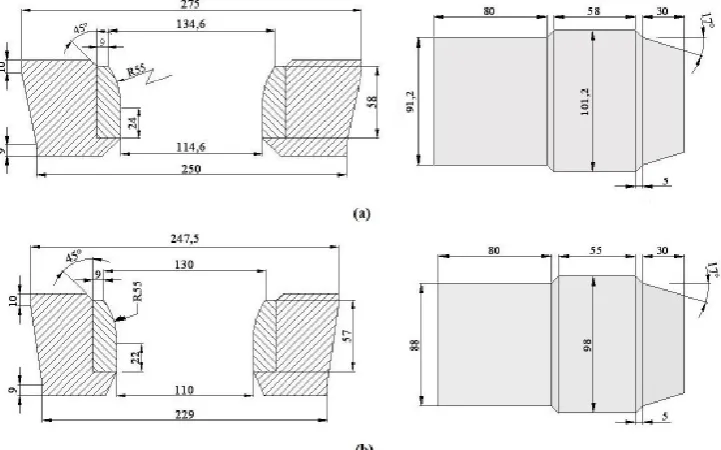
Fig 1: (a) view of a part of die and plug used at the first drawing phase; (b) View of a part of die and plug used at the second drawing phase
2-2- Cold drawing process of tube
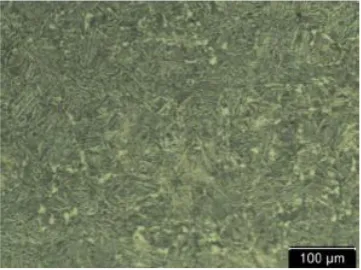
Fig 2: Optical microscopy image from structure of initial tube before heat treatment
2-2-1- Initial heat treatment
The annealing heat treatment is done on the tube to create uniformity and also to generate a stable perlite structure in the material that is softer than bainite as well before starting of cold-drawing process. After analysis of various backgrounds, cycle of heat treatment has been utilized for the designing test and from continuous furnace R-Feco (made in South Korea) with potential to control atmosphere [19-22]. This furnace includes a thermal part with 12 m length and a coolant unit (length: 18 m). Thermal unit of furnace comprises of five regions per se where in this operation temperature of two first regions is 950° C for preheating and temperature in three subsequent regions which includes main temperature has been regulated at 930° C. The tube moves at fix velocity of 240 mm/min and it exits from thermal unit after 50 minutes. Following to passage of water through the designated tubes in body of furnace in coolant unit, the cooling operation is done. The velocity of moving of tube is 550 mm/min at this unit and it exits from furnace after 33 minutes.
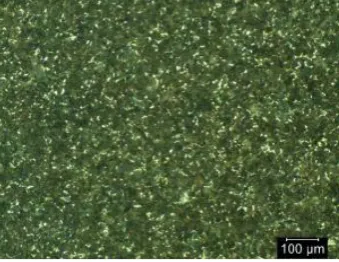
Fig 3: Optical microscopy image from structure of initial tube after heat treatment
2-2-2- Preparation of tube for drawing
Before starting of drawing process, diameter of initial tube should be reduced at one direction so that the tube can be placed inside drawing die and jaw of drawing device to be locked on it. For this purpose, swaging machine (World Eng made in south Korea) has been used which has execute cold pressing at 30 cm from the start point of tube by exertion of force (350 tons) to reduce the diameter.
To remove pollution and greases which have been so far deposited on the surface of tube, at the next step, the tube is initially degreased and treated by acid-washing. Degreaser (Schiller model) with alkaline compounds has been utilized to remove grease and the tube is passed through a bath with this solution for 20 minutes. Then, the tube is placed again in floating form in a bath with contents of hydrochloric acid (HCl) for acid-washing for 20 minutes. In order to reduce friction between surfaces of the tube and die and for prevention from occurrence of some problems e.g. rupture and tearing before starting of drawing, at the last phase, the tube is initially treated by phosphate and then it is floated in a bath with content of drawing soap at 75° C to deposit drawing soap fully on its surface. The tube is treated by phosphate so that drawing soap to be attached well to the surface of it.
2-2-3- Cold drawing
and 0.1 mm negative. At the end, eddy-current test has been employed for inspection of defects in the tube and after apparent control.
2-3- Tensile test, hardness testing and metallography
In order to analyze mechanical properties under various conditions, primarily the initial tube was tested before and after heat treatment and then once-drawn tube and also the final tube was put under tensile test at last. These tests were carried out based on ASTM A370 (2017) and DIN 50125 (2016) and by means of Universal Testing Machine AI-7000LA (made by Gotech Company by Taiwan) with load cell capacity up to 1000 kN and repeated for any sample three times as well. The macro hardness testing was conducted on the initial tube and the final tube by means of Vickers technique and according to ISO 6507-1 (2005) standard and Wolpert device (Germany). In this experiment, the indenter is of diamond pyramid type and force of 10 kg-energy (HV10) was exerted on the sample for 10-15 seconds. Hardness testing was executed in twelve different points of sample and their mean value was expressed as hardness number. Also initial metallographic test was done on the tube that was drawn for once and the final tube.
3- Results and discussion 3-1- Structure of tube
Fig 4: Optical microscopy image from structure of tube after one drawing process
Fig 5: Optical microscopy image from structure of tube after two drawing processes
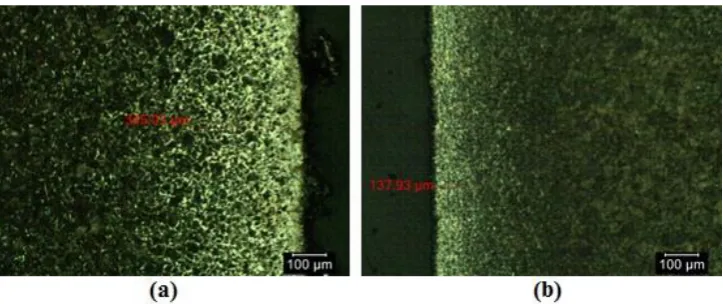
Fig 6: (a) Decarburization at external surface of the final tube; (b) Decarburization
at internal surface of the final tube
3-2- Mechanical properties
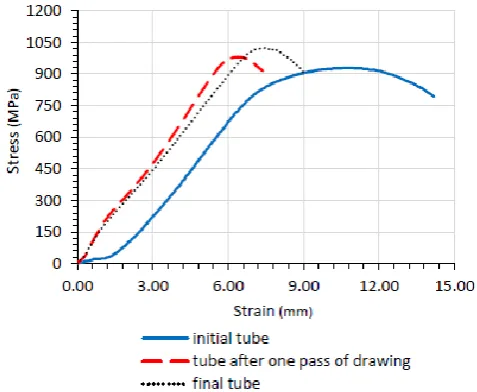
The results derived from the test of tube after first phase of cold drawing suggest rising of strength in the tube and reduction of correspondent strain to ultimate tensile strength so that the ultimate tensile strength is increased up to 977 MPa and yield strength at level of 866 MPa and on the other hand elongation is reduced and reach to 8%. Strength is increased because of cold-working done on the tube that is led to hardening phenomenon and it increases density of dislocations. Therefore, as the piece work is treated under stress and by the increase in density of dislocations, these dislocations act as barriers against way of moving of grains and reduce the potential for their motion. As a result, following to rising of strength, strain is reduced correspondently to the exerted stress and elongation of the tube is decreased. After the second phase of tube cold-drawing, the conducted tensile test on the final tube indicates ultimate tensile strength and yield strength as 1021 and 950 MPa respectively. Thus, it is seen that following to redrawing of the tube, ultimate tensile strength is increased about 4.5% and also yield strength is increased 7.2% compared to the once-drawn tube. On the other hand, however the correspondent strain to ultimate tensile strength point is increased so that by 1% growth, the percent of elongation of the tube reaches to about 9%. Toughness of material, which is also related to the surface area under strain-stress curve, increased as well. The reason for rise of quantity of correspondent strain to exerted stress is latent in the heat treatment between two processes of drawing. Before the first drawing step, heat treatment is done on the initial tube that has mainly Bainite structure, while the tube which is under heat treatment operation before the second process of drawing, has perlite-ferritic structure. Therefore, growth trend of the grains in the second cycle is led to increase percent of elongation or pre-failure strain potential for the twice-drawn tube. Finally, it can be expressed during the second step of cold-drawing process, percent of elongation is also slightly increased in addition to the strength of tube and this is positive point.
Table 2: The given results from the tensile tests
Elongation (%)
Ultimate tensile strength (MPa) Yield
strength (MPa) Tested piece work
18 926
772 Initial tube before heat treatment
24 835
734 Initial tube after heat treatment
8 977
886 Once-drawn tube
9 1021
950 Final tube (twice-drawn)
Fig 8: Variance of yield strength in the various testing processes
Fig 9: Comparison of strain-stress curve for the initial tube, once-drawn tube and final tube
4- Conclusion
Execution of the given heat treatment in this test has caused changing of heterogeneous and non-equilibrant structure of the initial tube which included bainite, ferrite and perlite so that the final tube possesses a uniform and stable perlite-ferritic structure with relatively regular grain orientation. The created decarburization is also partial on the surface of tube and depth of its layer is 345 and 138 microns at the external and internal surfaces of final tube respectively.
The cold-drawing increased ultimate tensile strength, yield strength and surficial hardness of the tube and on the other hand correspondent strain with the point of ultimate tensile strength and elongation is reduced in it. The given results indicate that at the first phase of cold-drawing process, the amounts of ultimate tensile strength and yield strength of the tube are increased 17 and 20.7% respectively and elongation is also reduced 16%. In addition, it was characterized that after the second process of tube drawing, following to the repeated rising in ultimate tensile strength and yield strength of the tube for about 4.5 and 7.2% respectively, the quantity of elongation was also increased about 1%. The surficial hardness of final tube was also measured 312 Vickers.
According to the designated production process in this study, the seamless steel (Ck60) tube was achieved successfully with ultimate tensile strength (1021 MPa), yield strength (950 MPa) and elongation of 9%.
References
[1] K. Kuroda, T. Kawakami, T. Okui, M. Akiyama, M. Kiuchi, Influential factor to dimensional precision of cold-drawn tubes, Pros IMechE Part B: Journal of Engineering Manufacture, Vol. 229, Issue 1, pp. 100-109, 2015.
[2] K. H. Brensing, B. Sommer, Steel tube and pipe manufacturing processes (http://allaboutmetallurgy.com/wp/wp-content/uploads/2016/12/steel_tube_and_pipe.pdf). [3] P. K. Loharkar, M. K. Pradhan, Handbook of research on manufacturing process modeling and optimization strategies, Vol. 1, pp. 40-53, Hershey: IGI Global Publications, 2017.
[4] K. Kondo, Y. Okada, S. Tanimoto, Method and facility for manufacturing seamless steel pipe, U.S. Patent 5873960A, 1999.
[5] B. S. Rajput, R. Victor, Study of Different Parameters in Seamless Cold Drawing Process Using Finite Element Simulation, International Journal of Engineering Sciences & Research Technology (IJESRT), Vol. 3, No. 10, pp. 437-446, 2014.
[6] P. Karnezis, D. C. J. Farrugia, Study of cold tube drawing by finite-element modeling, Journal of Materials Processing Technology, Vol. 80-81, pp. 690-694, 1998.
[8] F. O. Neves, S. T. Button, C. Caminaga, F. C. Gentile, Numerical and experimental analysis of tube drawing with fixed plug, Journal of the Brazilian Society of Mechanical Sciences and Engineering, Vol. 27, No. 4, pp. 426-431, 2005.
[9] M. Siddique, I. M. Cole, Development of tube drawing schedules in a cold drawing plant using expert system technique, Journal of Materials Processing Technology, Vol. 24, pp. 485-494, 1990.
[10] L. Shaheen, Cold drawing principles, The Tube and Pipe Journal, June 2010.
[11] H. Palkowski, S. Bruck, T. Pirling, A. Carrado, Investigation on the residual stress state of drawn tubes by numerical simulation and neutron diffraction analysis, Materials Journal, Vol. 6, No. 11, pp. 5118-5130, 2013.
[12] Q. H. Bui, R. Bihamta, M. Guillot, A. Rahem, M. Fafard, Effect of cross section reduction on the mechanical properties of aluminium tubes drawn with variable wall thickness, Journal of Manufacturing Science and Engineering, Vol. 133, No. 6, 2011.
[13] J. Gattmah, F. Ozturk, S. Orhan, Experimental and finite element analysis of residual stresses in cold tube drawing process with a fixed mandrel for AISI 1010 steel tube, The International Journal of Advanced Manufacturing Technology, Vol. 93, Issue 1-4, pp. 1229-1241, 2017.
[14] A. L. R. de Castro, H. B. Campos, P. R. Cetlin, Influence of die semi-angle on mechanical properties of single and multiple pass drawn copper, Journal of Materials Processing Technology, Vol. 60, Issue 1-4, pp. 179-182, 1996.
[15] Z. Zhang, Y. Li, K. Manabe, F. Zhu, Effect of heat treatment on microstructure and mechanical properties of TRIP seamless steel tube, Materials Transactions Journal, Vol. 53, Issue 5, pp. 833-837, 2012.
[16] N. A. Raji, O. O. Oluwole, Effect of soaking time on the mechanical properties of annealed cold-drawn low carbon steel, Materials Sciences and Applications Journal, Vol. 3, No. 8, pp. 513-518, 2012.
[17] N. A. Raji, O. O. Oluwole, Recrystallization kinetics and microstructure evolution of annealed cold-drawn low-carbon steel, Journal of Crystallization Process and Technology, Vol. 3, No. 4, pp. 163-169, 2013.
[18] D. Xiao, S. Shi, Z. Mao, J. Wang, Modeling and control for the tube blank heating quality of seamless tube, in 9th Asian Control Conference (ASCC), Istanbul, Turkey, pp. 1-5,
2013.
[19] G. E. Totten, Steel heat treatment handbook: Metallurgy and Technologies, Second Edition, Boca Raton: CRC Press, 2006.
[20] Heat treating data E-Book, Tenth Edition, Meadville: Published by SECO/Warwick Corporation, 2011.
[21] A. Kamyabi-Gol, M. Sheikh-Amiri, Spheroidizing kinetics and optimization of heat treatment parameters in CK60 steel using taguchi robust design, Journal of Iron and Steel Research, Vol. 17, Issue 4, pp. 45-52, 2010.
[22] B. S. Motagi, R. Bhosle, Effect of heat treatment on microstructure and mechanical properties of medium carbon steel, International Journal of Engineering Research and Development, Vol. 2, Issue 1, pp. 7-13, 2012.


![Bis[μ N′ (5 bromo 3 methoxy 2 oxidobenzylidene) 2 hydroxybenzohydrazidato]bis[(N,N dimethylformamide)copper(II)]](data:image/gif;base64,R0lGODlhAQABAIAAAP///wAAACH5BAEAAAAALAAAAAABAAEAAAICRAEAOw==)