SCIENCEDOMAINinternational www.sciencedomain.org
Genetic Polymorphisms of CYP2C8 in A
Healthy Iranian Population
Ali Ramazani
1*, Mahsa Ghaffari
1and Amir Fakhri
2 1Zanjan Pharmaceutical Biotechnology Research Center, Zanjan University of Medical Sciences, Zanjan, Iran. 2Department of Pharmacology and Toxicology, School of Pharmacy, Shahid BeheshtiUniversity of Medical Science, Tehran, Iran.
Authors’ contributions
This work was carried out in collaboration between all authors. Author AR directed the implementation of the study and data analysis. Author MG carried out the experiments and drafted the manuscript. Author AF made statistical analysis. All authors read and approved the final manuscript.
Received 22ndOctober 2013 Accepted 27thDecember 2013
Published 18thJanuary 2014
ABSTRACT
Aim: The aims of this study were to genotype CYP2C8 in an Iranian population and compare their allelic frequencies with other ethnic groups.
Study Site and Duration: Biotechnology Department, School of Pharmacy, Zanjan University of Medical Sciences, Zanjan, Iranfrom June 2012 through May 2013.
Methodology: CYP2C8 (*1/*2/*3) allelic variants were determined in 200 unrelated healthy Iranian volunteers by real time-polymerase chain reaction (PCR).
Results:A total 156 subjects (78%) were homozygous for CYP2C8*1, six subjects (3%) were homozygous for CYP2C8*2 and 38 subjects (19%) were heterozygous
CYP2C8*1/*2.CYP2C8*3was not detected.
Discussion and Conclusion: Genotyping indicated no significant (P>0.05) difference between CYP2C8 allelic variant frequencies in an Iranian compared with Burkina Faso population. The Iranian population’s CYP2C8 allelic variation was significantly (P<0.05) different when compared with populations in Portugal, African-American race to
Keywords: CYP2C8; real-time PCR; allele frequency; Iran.
1. INTRODUCTION
Cytochrome P450s (CYPs) are a group of microsomal heme-thiolate monooxygenases that are involved in an NADPH-dependent electron transport pathway. CYPs also oxidize a variety of structurally unrelated compounds including steroids, fatty acids, and xenobiotics. CYPs also said the metabolism and elimination of a wide range of medications as well as other xenobiotics. CYPs mediate the biotransformation of lipophilic compounds into polar metabolites that are eliminated by urinary or biliary excretion [1]. The human hepatic CYP system consists of over 30 related isoenzymes. Genetic polymorphisms in the CYP2C8 isoform cause variability in drug response. Specifically, genetic variation in a gene encoding a drug-metabolizing enzyme leads to high, low, or no enzyme activity [2]. Therefore, populations are divided into poor metabolizer (PM), intermediate metabolizer (IM), extensive metabolizer (EM) and ultra-rapid metabolizer (UM) phenotypes [3-4].
The human CYP2C subfamily consists of four known isoforms (2C8, 2C9, 2C18 and 2C19) that have closely linked genic loci located on chromosome 10 [5]. CYP2C enzymes account for ~20% of all microsomal drug metabolizing CYPs [6-7]. CYP2C8 is the principal enzyme that metabolizes the anti-cancer drug paclitaxel (taxol), the antimalarial drug amodiaquine, the hypoglycaemic drug troglitazone, amiodarone, verapamil, and ibuprofen. CYP2C8 also metabolizes fluvastatin, amitriptyline, perphenazine, diclofenac, gallopamil, omeprazole, and carbamazepine [8-9]. At least 16 different CYP2C8 alleles have been reported [10]. Four nonsynonymous variant alleles designated as CYP2C8*2-*5 (wild-type, CYP2C8*1) decrease enzymatic activity [11].
CYP2C8*2 is widespread [13] with an allele frequency of 0.18 in African-American populations, whereas CYP2C8*3 and CYP2C8*4 (allele frequencies of 0.13 and 0.075, respectively) are found primarily in Caucasian populations [12]. This allele occurs at different frequencies in West and East African populations [13]. Similar to Caucasians, theCYP2C8*2
is virtually absent in other non-African populations [11]. CYP2C8*3, an allele with the PM phenotype is absent or found at very low frequencies in Africans [11].
There are significant ethnic differences in the distribution ofCYP2C8 alleles [15-16]. Nearly 10%–20% of Caucasians carry theCYP2C8*3variant, whereas this allele is rare in African Americans [14]. Patients homozygous for CYP2C8*2 or CYP2C8*3 have lower intrinsic clearance of CYP2C8 substrates thanCYP2C8*1/*2or CYP2C8*1/*3heterozygote’s [13,17-18]. CYP2C8*2 results from a single base pair trans version (805A>T) that creates an aberrant splice site resulting in an enzyme with low activity. CYP2C8*3 results from a transition (416G>A) and creates a weak enzyme and PM phenotype [11,19].
2. MATERIALS AND METHODS
2.1 Sample Collection
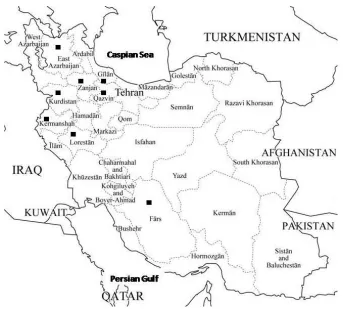
The blood samples were taken from two hundred unrelated healthy Iranian volunteers, 92 (46%) males and 108 (54%) females, aged between 19-57 years, mean age 28.72 from different Provinces of Iran between 2011 to 2012 years. The ethnicity of voluntaries was as follow: Persians (Tehran and Fars), Kurds (Kermanshah and Kurdistan), Gilakis (Gilan), Turks (Zanjan and Azerbaijan), Tats (Qazvin) and Lurs (Lorestan) Fig. 1. The study was done atZanjan University of Medical Sciences, Zanjan, Iranduring June, 2012 to May, 2013. The study protocol was approved by the ethics committee of the Zanjan University of Medical Sciences and written informed consent to participate in the study was obtained from the volunteers.
2.2 Genotyping of the
CYP2C8
Variant Alleles
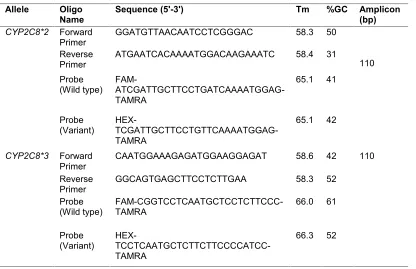
TaqMan® conventional probes and primers were designed by Primer Express® Software v3.0.1 (Applied Biosystems, USA) and synthesized by Bioneer Company (South Korea). Dual-labeled, TaqMan® probes labeled with both a fluorophore and a quencher dye are used in real-time PCR assays to detect amplification of specific SNP targets. The fluorophore FAM (6-carboxyfluorescein) was used at 5' end of wild type probes and HEX (hexachloro-6-carboxyfluorescein) for variant one. The fluorophore TAMRA (tetramethylrhodamine) was used as quencher dye at 3' end of both wild type and variant probes. Allelic discrimination was performed using TaqMan® SNP Genotyping Assays on the Rotor-Gene 6000 (Corbett, Australia).
Real-time PCR was performed in a 20 μL reaction mixtures containing 10 μL qPCR prob Master Mix (Jena Bioscience, Germany), 20 nM of each probe (wild type and variant allele), 10 pM of each specific forward and reverse primers and 5 ng of extracted DNA. These concentrations were applied for two allelic variants. The amplification condition was as follows: First, initial heat activation at 95ºC for 10 min, followed by 45 cycles of 95ºC for 10s and 60ºC for 1 min. For allelic variants genotyping quality control, 5% of samples were genotyped in duplicate and confirmed by sequencing (Bioneer, South Korea). The nucleotide sequence of all PCR primers and probes are listed in Table 1.
Differences in allele frequency between different populations were determined using chi square test. Deviations from Hardy Weinberg Equilibrium were also assessed using a chi square test. All analyses were performed using SPSS 16.0 for windows.
Table 1. The nucleotide sequence of all PCR primers and probes for CYP2C8*2 and CYP2C8*3 detection
Allele Oligo
Name Sequence (5'-3') Tm %GC Amplicon(bp) Size (bp) CYP2C8*2 Forward
Primer GGATGTTAACAATCCTCGGGAC 58.3 50
110 Reverse
Primer ATGAATCACAAAATGGACAAGAAATC 58.4 31
Probe
(Wild type) FAM- ATCGATTGCTTCCTGATCAAAATGGAG-TAMRA
65.1 41
Probe
(Variant) HEX-
TCGATTGCTTCCTGTTCAAAATGGAG-TAMRA
65.1 42
CYP2C8*3 Forward
Primer CAATGGAAAGAGATGGAAGGAGAT 58.6 42 110
Reverse
Primer GGCAGTGAGCTTCCTCTTGAA 58.3 52
Probe
(Wild type) FAM-CGGTCCTCAATGCTCCTCTTCCC-TAMRA 66.0 61
Probe
(Variant) HEX- TCCTCAATGCTCTTCTTCCCCATCC-TAMRA
3. RESULTS
Iranian CYP2C8 allelic variation and genotypic frequencies are summarized in Table 2.
CYP2C8*1, CYP2C8*2 and CYP2C8*3 allele frequencies were 82%, 18%, and 0% respectively. There were 156 subjects (78%) with theCYP2C8*1/*1genotype (wild-type), 38 subjects (19%) with the CYP2C8*1/*2 genotype, and six subjects (3%) with the
CYP2C8*2/*2 genotype. No significant (P>0.05) difference in allele frequencies between males and females was detected. CYP2C8 allele frequencies were consistent with Hardy Weinberg equilibrium (P value≥0.05) among the studied population (χ2= 6.9093,P= 0.2).
Table 2. Allele and Genotype frequencies ofCYP2C8among Iranian volunteers
Alleles/Genotype Number Frequency
CYP2C8*1 164 0.82
CYP2C8*2 36 0.18
CYP2C8*3 0 0
*1/*1 156 0.78
*1/*2 38 0.19
*2/*2 6 0.03
*1/*3 0 0
*3/*3 0 0
*2/*3 0 0
4. DISCUSSION
Advances in medical and human genetics have enabled a more detailed understanding of genetics in disease. Furthermore, large collaborative research projects (such as, the human genome project) have established a foundation for understanding gene function with respect to human development and physiology, revealed single nucleotide polymorphisms (SNPs) that underlie inter-individual genetic variability, and made genome-wide association studies (GWAS) that are used to examine genetic variation and risk for many common diseases possible [21].
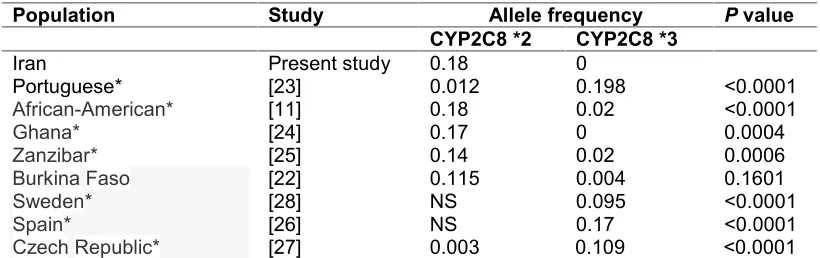
The discovery of functional variability between drug metabolizing enzymes has significantly contributed to understanding inter-individual variability in dose -concentration and -response relationships. Polymorphism ofCYP2C8has to date been less well characterized than other CYP families. CYP2C8*3 allele was not detected in our population. Our results demonstrated that the CYP2C8*2 allele is widespread in Iran and suggest that some Iranians may have decreased CYP2C8 activity and a PM phenotype. We also identified similarities (P>0.05) betweenCYP2C8allelic variation and genotypic distribution patterns in Iranians and Burkina Faso populations [22] Table 3. The Iranian population’s CYP2C8
Table 3. Distribution ofCYP2C8variant alleles among different ethnic groups
Population Study Allele frequency Pvalue
CYP2C8 *2 CYP2C8 *3
Iran Present study 0.18 0
Portuguese* [23] 0.012 0.198 <0.0001
African-American* [11] 0.18 0.02 <0.0001
Ghana* [24] 0.17 0 0.0004
Zanzibar* [25]
[22] 0.14 0.02 0.0006
Burkina Faso 0.115 0.004 0.1601
Sweden* [28] NS 0.095 <0.0001
Spain* [26] NS 0.17 <0.0001
Czech Republic* [27] 0.003 0.109 <0.0001
*: shows significant difference from our population
5. CONCLUSION
We identified significant differences inCYP2C8allelic variation between Iranian populations and other ethnic groups. Future work will include identifying clinical challenges these variants may pose by evaluating the functional roles of CYP2C8 polymorphisms. Specifically, the clinical and toxicological significance of altered CYP2C8 expression and activity caused by genetic, epigenetic, and environmental factors requires further investigation.
CONSENT
Not applicable.
ETHICAL APPROVAL
All authors hereby declare that all experiments have been examined and approved by the appropriate ethics committee and have therefore been performed in accordance with the ethical standards laid down in the 1964 Declaration of Helsinki.
ACKNOWLEDGEMENTS
We thank the research deputy of Zanjan University of Medical Sciences for financial support of this project (PharmD thesis, grant number A-10-349-6).
COMPETING INTERESTS
The authors have declared that no competing interests exist.
REFERENCES
1. Nagata K, Yamazoe Y. Genetic polymorphism of human cytochrome p450 involved in drug metabolism. Drug Metab Pharmacokinet. 2002;17(3):167-89.
3. Brosen K, De Morais SM, Meyer UA, Goldstein JA. A multifamily study on the relationship between CYP2C19 genotype and s-mephenytoin oxidation phenotype. Pharmacogenetics. 1995;5(5):312-7.
4. Gardiner SJ, Begg EJ. Pharmacogenetics, drug-metabolizing enzymes and clinical practice. Pharmacol Rev. 2006;58(3):521-90.
5. Yasar U, Bennet AM, Eliasson E, Lundgren S, Wiman B, De Faire U, et al. Allelic variants of cytochromes P450 2C modify the risk for acute myocardial infarction. Pharmacogenetics. 2003;13(12):715-20.
6. Goldstein JA. Clinical relevance of genetic polymorphisms in the human CYP2C subfamily. Br J Clin Pharmacol. 2001;52(4):349-55.
7. Garcia-Martin E, Martinez C, Ladero JM, Agundez JA. Interethnic and intraethnic variability of CYP2C8 and CYP2C9 polymorphisms in healthy individuals. Mol Diagn Ther. 2006;10(1):29-40.
8. Mancy A, Antignac M, Minoletti C, Dijols S, Mouries V, Duong NT, et al. Diclofenac and its derivatives as tools for studying human cytochromes P450 active sites particular efficiency and regioselectivity of P450 2Cs. Biochemistry. 1999;38(43):14264-70.
9. Suzuki A, Iida I, Tanaka F, Akimoto M, Fukushima K, Tani M, et al. Identification of human cytochrome P-450 isoforms involved in metabolism of R(+)- and S(-)-gallopamil utility of in vitro disappearance rate. Drug Metab Dispos. 1999;27(11):1254-9.
10. Daily EB, Aquilante CL. Cytochrome P450 2C8 pharmacogenetics a review of clinical studies. Pharmacogenomics. 2009;10(9):1489-510.
11. Dai D, Zeldin DC, Blaisdell JA, Chanas B, Coulter SJ, Ghanayem BI, et al. Polymorphisms in human CYP2C8 decrease metabolism of the anticancer drug paclitaxel and arachidonic acid. Pharmacogenetics. 2001;11(7):597-607.
12. Muthiah YD, Lee WL, Teh LK, Ong CE, Ismail R. Genetic polymorphism of CYP2C8 in three Malaysian ethnics CYP2C8*2 and CYP2C8*3 are found in Malaysian Indians. J Clin Pharm Ther. 2005;30(5):487-90.
13. Niemi M, Backman JT, Neuvonen M, Neuvonen PJ. Effects of gemfibrozil, itraconazole, and their combination on the pharmacokinetics and pharmacodynamics of repaglinide potentially hazardous interaction between gemfibrozil and repaglinide. Diabetologia. 2003;46(3):347-51.
14. Tornio A, Niemi M, Neuvonen PJ, Backman JT. Trimethoprim and the CYP2C8*3 allele have opposite effects on the pharmacokinetics of pioglitazone. Drug Metab Dispos. 2008;36(1):73-80.
15. Wu X, Zuo J, Guo T, Yuan L. CYP2C8 polymorphism frequencies among Han, Uighur, Hui and Mongolian Chinese populations. Genet Test Mol Biomarkers. 2013;17(2):104-8.
16. Arnaldo P, Thompson RE, Lopes MQ, Suffys PN, Santos AR. Frequencies of Cytochrome P450 2B6 and 2C8 Allelic Variants in the Mozambican Population. Malays J Med Sci. 2013;20(4):13-23.
17. Rendic S, Di Carlo FJ. Human cytochrome P450 enzymes a status report summarizing their reactions, substrates, inducers and inhibitors. Drug Metab Rev. 1997;29(1-2):413-580.
18. Totah RA, Rettie AE. Cytochrome P450 2C8 substrates, inhibitors, pharmacogenetics and clinical relevance. Clin Pharmacol Ther. 2005;77(5):341-52.
20. Miller SA, Dykes DD, Polesky HF. A simple salting out procedure for extracting DNA from human nucleated cells. Nucleic Acids Res. 1988;16(3):1215.
21. Sawicki MP, Samara G, Hurwitz M, Passaro E. Human genome project. The American journal of surgery. 1993;165(2):258-64.
22. Parikh S, Ouedraogo JB, Goldstein JA, Rosenthal PJ, Kroetz DL. Amodiaquine metabolism is impaired by common polymorphisms in CYP2C8 implications for malaria treatment in Africa. Clin Pharmacol Ther. 2007;82(2):197-203.
23. Cavaco I, Piedade R, Gil JP, Ribeiro V. CYP2C8 polymorphism among the Portuguese. Clin Chem Lab Med. 2006;44(2):168-70.
24. Rower S, Bienzle U, Weise A, Lambertz U, Forst T, Otchwemah RN, et al. Short communication: high prevalence of the cytochrome P450 2C8*2 mutation in Northern Ghana. Trop Med Int Health. 2005;10(12):1271-3.
25. Kudzi W, Dodoo AN, Mills JJ. Characterisation of CYP2C8, CYP2C9 and CYP2C19 polymorphisms in a Ghanaian population. BMC Med Genet. 2009;10:124.
26. Martinez C, Garcia-Martin E, Blanco G, Gamito FJ, Ladero JM, Agundez JA. The effect of the cytochrome P450 CYP2C8 polymorphism on the disposition of (R)-ibuprofen enantiomer in healthy subjects. Br J Clin Pharmacol. 2005;59(1):62-9. 27. Pechandova K, Buzkova H, Matouskova O, Perlik F, Slanar O. Genetic
polymorphisms of CYP2C8 in the Czech Republic. Genet Test Mol Biomarkers. 2012;16(7):812-6.
28. Yasar U, Lundgren S, Eliasson E, Bennet A, Wiman B, de Faire U, et al. Linkage between the CYP2C8 and CYP2C9 genetic polymorphisms. Biochem Biophys Res Commun. 2002;299(1):25-8.
© 2014 Ramazani et al.; This is an Open Access article distributed under the terms of the Creative Commons Attribution License (http://creativecommons.org/licenses/by/3.0), which permits unrestricted use, distribution, and reproduction in any medium, provided the original work is properly cited.
Peer-review history:
The peer review history for this paper can be accessed here: