Improved side channel attack on the block cipher NOEKEON
Changyong Penga Chuangying Zhub Yuefei Zhua Fei Kanga
aZhengzhou Information Science and Technology Institute,Zhengzhou, China, Email: [email protected],[email protected],[email protected],k [email protected]
bSchool of Computer and Control, Guillin University of Electronic Technology, Guilin, China
Abstract
NOEKEON is a block cipher having key-size 128 and block size 128,proposed by Daemen, J et al.Shekh Faisal Abdul-Latip et al. give a side channel attack(under the single bit leakage model) on the cipher at ISPEC 2010.Their analysis shows that one can recover the 128-bit key of the cipher, by considering a one-bit information leakage from the internal state after the second round, with time complexity ofO(268) evaluations of the cipher, and data complexity of about 210chosen plaintexts.Our side channel attack improves upon the previous work of Shekh Faisal Abdul-Latip et al. from two aspects. First, we use the Hamming weight leakage model(Suppose the Hamming weight of the lower 64 bits and the higher 64 bits of the output of the first round can be obtained without error) which is a more relaxed leakage assumption, supported by many previously known practical results on side channel attacks, compared to the more challenging leakage assumption that the adversary has access to the ”exact” value of the internal state bits as used by Shekh Faisal Abdul-Latip et al. Second, our attack has also a reduced complexity compared to that of Shekh Faisal Abdul-Latip et al. Namely, our attack of recovering the 128-bit key of NOEKEON has a time complexity 20.1 seconds on a PC with 2.6 GHZ CPU and 8G RAM and data complexity of 99 known plaintexts; whereas, that of Shekh Faisal Abdul-Latip et al. has time complexity ofO(268) and needs about 210chosen plaintexts.
Keywords: NOEKEON, symbolic computation, Gr¨obner Basis, side channel attack, algebraic-side channel attack, method of formal coding-side channel attack
1. Introduction
Classical cryptanalysis generally considers adver-saries getting black box access to the cryptographic primitives they target, e.g. the inputs and outputs of a block cipher. However,considering the practical im-plementations of a block cipher, especially in resource limited systems such as smart cards, there is a stronger attack model, namely the side channel attack model, where the adversary is given more power by having ac-cess to somelimited information leaked about the in-ternal state of the cipher. This information leakage can be via physical side channels, such as timing, electrical power consumption, electromagnetic radiation, prob-ing, etc.
One of a recent trend is to combine the classi-cal cryptanalysis such as algebraic cryptanalysis with side channel attacks, e.g. the work of Bogdanov, Kizhvatov and Pyshkin at INDOCRYPT 2008 [1], the side channel cube attack introduced by Dinur
and Shamir in [2] which was used to attack the block cipher PRESENT[5,6,7], NOEKEON [9],and the ASCA(Algebraic-Side Channel Attack) proposed by Renauld et al. in [3,4].
ex-pressions of the leaked information,with the plaintext bits and master key bits as variables.These algebraic expressions can be obtained by modern symbolic com-putation software such as Mathematica[16].If the alge-braic expressions are not very complex,the correspond-ing equation system can be solved by Gr¨obner basis-based method [15] or using a SAT solver as in [14].We selected Gr¨obner basis-based method in this paper.
As an application, we exhibit an MFCSCA attack against the block cipher NOEKEON.
Comparing Side Channel Cube attack of [9] with Our attack. The leakage model used by Shekh Faisal Abdul-Latip et al. [9] assumes that adversary has access to the exact value of some of the internal state bits after each round. We note that obtaining the exact value of the in-ternal state bits in practice will require a probe station that allows the attacker to monitor the value of a specific bit position in the internal state during the encryption or decryption process. This implies an intrusive physi-cal measurement and is known to involve a wide range of difficulties such as penetrating the device to access its internals and guessing which bit position is being recorded. To relax the leakage model, in contrast, we assume the Hamming weight leakage as a more com-mon side channel leakage model, e.g. see [18-22].In this paper,we suppose that the Hamming weight of the lower 64 bits and the higher 64 bits of the output of the first round can be obtained without error. In this paper we do not consider these specific issues and counter-measures about the actual physical aspects of the im-plementation attacks and how information leakage can be measured. Rather, we assume the Hamming weight leakage side channel model as an abstract attack model, and concentrate on investigating the security of ciphers against MFCSCA attacks in this attack model.
Our side channel attack improves upon the previ-ous work of Shekh Faisal Abdul-Latip et al. from two aspects. First, we use the Hamming weight leakage model which is a more relaxed leakage assumption, sup-ported by many previously known practical results on side channel attacks, compared to the more challenging leakage assumption that the adversary has access to the ”exact” value of the internal state bits as used by Shekh Faisal Abdul-Latip et al. Second, our attack has also a reduced complexity compared to that of Shekh Faisal Abdul-Latip et al. Namely, our attack of recovering the 128-bit key of NOEKEON has a time complexity 10 seconds on a PC with 2.6 GHZ CPU and 8G RAM and data complexity of 99 known plaintexts; whereas, that of Shekh Faisal Abdul-Latip et al. has time complexity ofO(268) and needs about 210chosen plaintexts.
2. Description of the Method of Formal Coding-Side Channel Attack(MFCSCA)
MFCSCA can also be thought of an extended version of algebraic-side channel[3,4].Algebraic side-channel attacks are made of three separate steps.
(1)Offline phase 1: algebraic description of the cryp-tosystem.
(2)Online measurement phase to obtain leaked infor-mation.
(3)Offine phase 2: equation system solving by SAT method.
MFCSCA has also the above 3 steps.Howerver,the step 1 and 2 of MFCSCA is different from that of ASCA.
In step (1) of ASCA,the algebraic description of a block cipher consists of two parts:one is the equation system following the idea of algebraic attack[13].This is an implicitequation system by setting the interme-diate state as variables.The other is the equation system generated from the leaked Hamming weight.In MFC-SCA,we first give thedirect explicitrepresentation of the outputs of earlier rounds of a block cipher in terms of the bits of plaintext and master key.This is just the idea of the method of formal coding.This can be done with the help of symbolic computation software such as Mathematica [16].Then the Hamming weight(mod 2) of the outputs can be explicitly represented by the bits of plaintext and master key.
In step (3) of ASCA,SAT solving technique [14] is used to find the solution of the equation system.In step (3) of MFCSCA,we choose Gr¨obner basis-based [15] methods to find the solution.
3. Experimental results–Method of formal coding-side channel attack on NOEKEON
3.1. Description of NOEKEON
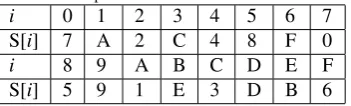
Table 1: Specification of the S-box in the function Gamma.
i 0 1 2 3 4 5 6 7
S[i] 7 A 2 C 4 8 F 0
i 8 9 A B C D E F
S[i] 5 9 1 E 3 D B 6
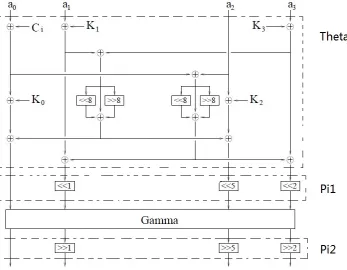
and decryption routines. Figure 1 illustrates the round function in NOEKEON, whereCiis a round dependent constant and K0, ...,K3 are the 32-bit subkeys.The least significant byte of C0 to C16 are(in hexideci-mal):80,1b,36,6c,d8,ab,4d,9a,2f,5e,bc,63,c6,97,35,6a,d4. (We refer to [8] for a complete description of the ci-pher).
Let Ar = ar
0a
r
1a
r
2a
r
3 denote the 128-bit internal state after round r; where ar
i’s are 32-bit words, and A0 contains the input plaintext P to the cipher.Then NOEKEON encryption algorithm can be described as follows:
Forr=0;r<16;r+ +
Ar+1=Pi2(Gamma(Pi1(T heta(Ar,K))));
A17 =T heta(A16,K)
The specification of NOEKEON [8], provides a key schedule which converts the 128-bit Master Key (i.e. the original key) into a 128-bit Working Key, which is used in the round function. However, the use of the key schedule is optional. If related-key attack scenar-ios [23] are not of a concern, then the key schedule is not applied (i.e. the Master Key is used directly as the Working Key), and the cipher is called to be used in the direct- key mode. Otherwise, it operates in the indirect-key mode, where the Master Key is processed by the key schedule algorithm to produce the Working Key.
3.2. Algebraic expressions of the bits of the output of the 1st round of NOEKEON
In this section,we give the algebraic expressions of the bits of the output of the 1st round of NOEKEON with the plaintext bits and master key bits as variables.
Notation:
K=k0k1...k127: master key of NOEKEON,
P=p0p1...p127: plaintext of NOEKEON,
B=b0b1...b127: output of the 1st round of NOEKEON.
Note:In this paper we number bits from zero with bit zero(the most significant bit) on the left of a block or word.
Theta@key_, a_D:=Module@
8K0, K1, K2, K3, a0, a1, a2, a3, temp<, a0=a@@1 ;; 32DD; a1=a@@33 ;; 64DD;
a2=a@@65 ;; 96DD; a3=a@@97 ;; 128DD;
K0=key@@1 ;; 32DD; K1=key@@33 ;; 64DD;
K2=key@@65 ;; 96DD; K3=key@@97 ;; 128DD;
temp=a0+a2;
temp=temp+RotateLeft@temp, 8D
+RotateRight@temp, 8D; a1=a1+temp; a3 =a3+temp;
a0=a0+K0; a1=a1+K1; a2=a2+K2;
a3=a3+K3; temp =a1+a3;
temp=temp+RotateLeft@temp, 8D
+RotateRight@temp, 8D; a0=a0+temp; a2 =a2+temp;
Return@8a0, a1, a2, a3< FlattenDD;
Figure 2: Mathematica code of the subfunction Theta of NOEKEON
We use the powerful symbolic computation soft-ware Mathematica [16] to obtain the result.To ob-tain the algebraic expressions of each bit of B = b0b1...b127, output of the 1st round of NOEKEON,we need only give the symbolic encryption code for NOEKEON.This can easily be done with Mathematica in just the same way we write a C encryption code for NOEKEON.First,we give the Mathematica code of each of the subfunctions(Theta,Pi1,Pi2 and Gamma,see fig-ure 1).The Mathematica code of each of the subfunc-tions are very simple.We give only the source code of Theta here(see figure 2).
The whole symbolic encryption code(in direct-key mode) is given in appendix A.We test the correctness of the symbolic encryption code using the test vector given in [24](see Table 2).
we use the following Mathematica code to test the correctness of the symbolic encryption code(see ap-pendix A).
m=Table[0,{128}]; k=Table[0,{128}]; c=encryption[m, k];
BaseForm[FromDigits[c, 2], 16] m=Table[1,{128}];
k=Table[1,{128}]; c=encryption[m, k];
BaseForm[FromDigits[c, 2], 16]
k=IntegerDigits[16ˆˆb1656851699e29fa24b70148503d2dfc, 2, 128];
Figure 1: Round function of NOEKEON
2, 128];
c=encryption[m, k];
BaseForm[FromDigits[c, 2], 16]
Obtaining the algebraic expressions of the output of the 1st round:
LetK = k0k1...k127(pure symbol) be the master key andP = p0p1...p127(pure symbol) be the plaintext of NOEKEON.Then we run the symbolic encryption of NOEKEON and output the stateB = b0b1...b127 after the 1st round.
The followings(see appendix A for details) are the Mathematica code for obtaining the algebraic expres-sions of each bit ofB=b0b1...b127.
K=Table[ToExpression[StringJoin[”k”,ToString[i]]],
{i,0,127}];
P=Table[ToExpression[StringJoin[”p”,ToString[i]]],
{i,0,127}];
c=encryption[P,K,1]
Here, encryption[P,K,1] means the output B = b0b1...b127 of round 1. In this way can obtain the al-gebraic expressions of each bit ofB=b0b1...b127.
Table 2: Correctness test result of our symbolic encryption code(in direct-key mode) for NOEKEON.
key1 00000000000000000000000000000000
plaintext1 00000000000000000000000000000000 ciphertext1 b1656851699e29fa24b70148503d2dfc
our
ci-phertext1
b1656851699e29fa24b70148503d2dfc
key2 ffffffffffffffffffffffffffffffff plaintext2 ffffffffffffffffffffffffffffffff
ciphertext2 2a78421b87c7d0924f26113f1d1349b2
our
ci-phertext2
2a78421b87c7d0924f26113f1d1349b2
key3 b1656851699e29fa24b70148503d2dfc
plaintext3 2a78421b87c7d0924f26113f1d1349b2 ciphertext3 e2f687e07b75660ffc372233bc47532c
our
ci-phertext3
We list only three of them,b0,b63,b127:
b0=k98+p2+p10+p26+p66+p74+p90+p98+
k0+
k32+k33+k37+k40+k45+k56+k61+k69+k96+k98+k101+
k104+k109+k120+k125+p0+p1+p2+p9+p10+p25+p26+
p32+p33+p37+p40+p45+p56+p61+p65+p66+p69+p73+
p74+p89+p90+p96+p98+p101+p104+p109+p120+p125+
k98+p2+p10+p26+p66+p74+p90+p98+1
k37+k45+
k61+k69+k101+k109+k125+p37+p45+p61+p69+p101+
p109+p125+1
+
k37+k45+k61+k69+k101+k109+k125+
p37+p45+p61+p69+p101+p109+p125
k33+p1+p9+p25+
p33+p65+p73+p89+
k98+p2+p10+p26+p66+p74+p90+
p98+1
k37+k45+k61+k69+k101+k109+k125+p37+p45+
p61+p69+p101+p109+p125+1
k33+p1+p9+p25+p33+
p65+p73+p89+
k98+p2+p10+p26+p66+p74+p90+p98+
1k37+k45+k61+k69+k101+k109+k125+p37+p45+p61+
p69+p101+p109+p125+1
+
k0+k32+k40+k56+k96+k104+
k120+p0+p32+p40+p56+p96+p104+p120+
k37+k45+k61+
k69+k101+k109+k125+p37+p45+p61+p69+p101+p109+
p125
k33+p1+p9+p25+p33+p65+p73+p89+
k98+p2+
p10+p26+p66+p74+p90+p98+1
k37+k45+k61+k69+
k101+k109+k125+p37+p45+p61+p69+p101+p109+p125+ 1+1k0+k32+k33+k37+k40+k45+k56+k61+k69+k96+
k98+k101+k104+k109+k120+k125+p0+p1+p2+p9+p10+
p25+p26+p32+p33+p37+p40+p45+p56+p61+p65+p66+
p69+p73+p74+p89+p90+p96+p98+p101+p104+p109+
p120+p125+
k98+p2+p10+p26+p66+p74+p90+p98+
1k37+k45+k61+k69+k101+k109+k125+p37+p45+p61+
p69+p101+p109+p125+1
+
k37+k45+k61+k69+k101+
k109+k125+p37+p45+p61+p69+p101+p109+p125
k33+
p1+p9+p25+p33+p65+p73+p89+
k98+p2+p10+p26+
p66+p74+p90+p98+1
k37+k45+k61+k69+k101+k109+
k125+p37+p45+p61+p69+p101+p109+p125+1
+1.
b63 =
k96+p0+p8+p24+p64+p72+p88+p96
k35+
k43+k59+k67+k99+k107+k123+p35+p43+p59+p67+p99+
p107+p123+1
+
k35+k43+k59+k67+k99+k107+k123+
p35+p43+p59+p67+p99+p107+p123
k96+p0+p8+p24+
p64+p72+p88+p96
k35+k43+k59+k67+k99+k107+k123+
p35+p43+p59+p67+p99+p107+p123+1
+k63+p7+p23+
p31+p63+p71+p87+p95
+k30+k38+k54+k62+k102+k118+
k126+p30+p38+p54+p62+p102+p118+p126+1
k96+
p0+p8+p24+p64+p72+p88+p96
k35+k43+k59+k67+
k99+k107+k123+p35+p43+p59+p67+p99+p107+p123+ 1+k35+k43+k59+k67+k99+k107+k123+p35+p43+p59+
p67+p99+p107+p123
k96+p0+p8+p24+p64+p72+p88+
p96
k35+k43+k59+k67+k99+k107+k123+p35+p43+p59+
p67+p99+p107+p123+1
+k63+p7+p23+p31+p63+p71+
p87+p95
+k30+k35+k38+k43+k54+k59+k62+k63+k67+
k96+k99+k102+k107+k118+k123+k126+p0+p7+p8+p23+
p24+p30+p31+p35+p38+p43+p54+p59+p62+p63+p64+
p67+p71+p72+p87+p88+p95+p96+p99+p102+p107+
p118+p123+p126
+k63+p7+p23+p31+p63+p71+p87+p95.
b127=
k34+k42+k58+k66+k98+k106+k122+p34+
p42+p58+p66+p98+p106+p122
k34+k42+k58+k66+
k98+k106+k122+p34+p42+p58+p66+p98+p106+p122+ 1k127+p7+p23+p31+p71+p87+p95+p127+1
+k62+
p6+p22+p30+p62+p70+p86+p94
+k29+k37+k53+k61+
k101+k117+k125+p29+p37+p53+p61+p101+p117+p125.
Note:The correctness of these expressions are guaranteed by the correctness of the symbolic en-cryption code on which we have made a correctness test using the test vector in [24] and the encryption code for digital encryption and symbolic encryption are the same.
3.3. Algebraic expressions of the Hamming weight mod2 of the lower half and higher half of the out-put of the 1st round of NOEKEON
Based on the algebraic expressions of the outputB= b0b1...b127of the 1st round,we can obtain the algebraic expressions of Hamming weight mod2 of the lower half and higher half ofB=b0b1...b127.
Let hl = b64 ⊕b65 ⊕... ⊕b127,which is the Ham-ming weight mod2 of the lower 64 bits of the output of round 1,then by summing the expressions ofbi,64≤ i≤127,we have
hl=hl(k32,k33, ...,k126,k127,p0,p1, ...,p127)=
k64+k65+k66+k67+k68+k69+k70+k71+k72+k73+k74+
k75+k76+k77+k78+k79+k80+k81+k82+k83+k84+k85+
k86+k87+k88+k89+k90+k91+k92+k93+k94+k95+p64+
p65+p66+p67+p68+p69+p70+p71+p72+p73+p74+p75+
p76+p77+p78+p79+p80+p81+p82+p83+p84+p85+p86+
p87+p88+p89+p90+p91+p92+p93+p94+p95+
k101+p5+
p13+p29+p69+p77+p93+p101+1
k32+k40+k48+k72+
k96+k104+k112+p32+p40+p48+p72+p96+p104+p112+ 1+k102+p6+p14+p30+p70+p78+p94+p102+1
k33+
k41+k49+k73+k97+k105+k113+p33+p41+p49+p73+p97+
p105+p113+1
+
k103+p7+p15+p31+p71+p79+p95+
p103+1
k34+k42+k50+k74+k98+k106+k114+p34+p42+
p50+p74+p98+p106+p114+1
+
k104+p0+p8+p16+p64+
p72+p80+p104+1
k35+k43+k51+k75+k99+k107+k115+
p35+p43+p51+p75+p99+p107+p115+1
+
k105+p1+p9+
p17+p65+p73+p81+p105+1
k108+k116+p36+p44+p52+p76+p100+p108+p116+1
+
k106+p2+p10+p18+p66+p74+p82+p106+1
k37+k45+
k53+k77+k101+k109+k117+p37+p45+p53+p77+p101+
p109+p117+1
+
k107+p3+p11+p19+p67+p75+p83+
p107+1
k38+k46+k54+k78+k102+k110+k118+p38+p46+
p54+p78+p102+p110+p118+1
+
k108+p4+p12+p20+
p68+p76+p84+p108+1
k39+k47+k55+k79+k103+k111+
k119+p39+p47+p55+p79+p103+p111+p119+1
+
k117+
p13+p21+p29+p77+p85+p93+p117+1
k32+k48+k56+
k88+k96+k112+k120+p32+p48+p56+p88+p96+p112+
p120+1
+
k109+p5+p13+p21+p69+p77+p85+p109+
1k40+k48+k56+k80+k104+k112+k120+p40+p48+p56+
p80+p104+p112+p120+1
+
k118+p14+p22+p30+p78+
p86+p94+p118+1
k33+k49+k57+k89+k97+k113+k121+
p33+p49+p57+p89+p97+p113+p121+1
+
k110+p6+
p14+p22+p70+p78+p86+p110+1
k41+k49+k57+k81+
k105+k113+k121+p41+p49+p57+p81+p105+p113+p121+ 1+k119+p15+p23+p31+p79+p87+p95+p119+1
k34+
k50+k58+k90+k98+k114+k122+p34+p50+p58+p90+p98+
p114+p122+1
+
k111+p7+p15+p23+p71+p79+p87+
p111+1
k42+k50+k58+k82+k106+k114+k122+p42+p50+
p58+p82+p106+p114+p122+1
+
k96+p0+p8+p24+p64+
p72+p88+p96
k35+k43+k59+k67+k99+k107+k123+p35+
p43+p59+p67+p99+p107+p123+1
+
k120+p0+p16+
p24+p64+p80+p88+p120
k35+k51+k59+k91+k99+k115+
k123+p35+p51+p59+p91+p99+p115+p123+1
+
k112+
p8+p16+p24+p72+p80+p88+p112
k43+k51+k59+k83+
k107+k115+k123+p43+p51+p59+p83+p107+p115+p123+ 1+k97+p1+p9+p25+p65+p73+p89+p97+1
k36+k44+
k60+k68+k100+k108+k124+p36+p44+p60+p68+p100+
p108+p124+1
+
k121+p1+p17+p25+p65+p81+p89+
p121+1
k36+k52+k60+k92+k100+k116+k124+p36+p52+
p60+p92+p100+p116+p124+1
+
k113+p9+p17+p25+
p73+p81+p89+p113+1
k44+k52+k60+k84+k108+k116+
k124+p44+p52+p60+p84+p108+p116+p124+1
+
k32+
k40+k56+k64+k96+k104+k120+p32+p40+p56+p64+p96+
p104+p120+1
k125+p5+p21+p29+p69+p85+p93+p125+
1+k98+p2+p10+p26+p66+p74+p90+p98+1
k37+k45+
k61+k69+k101+k109+k125+p37+p45+p61+p69+p101+
p109+p125+1
+
k122+p2+p18+p26+p66+p82+p90+
p122+1
k37+k53+k61+k93+k101+k117+k125+p37+p53+
p61+p93+p101+p117+p125+1
+
k114+p10+p18+p26+
p74+p82+p90+p114+1
k45+k53+k61+k85+k109+k117+
k125+p45+p53+p61+p85+p109+p117+p125+1
+
k33+
k41+k57+k65+k97+k105+k121+p33+p41+p57+p65+p97+
p105+p121+1
k126+p6+p22+p30+p70+p86+p94+p126+
1+k99+p3+p11+p27+p67+p75+p91+p99+1
k38+k46+
k62+k70+k102+k110+k126+p38+p46+p62+p70+p102+
p110+p126+1
+
k123+p3+p19+p27+p67+p83+p91+
p123+1
k38+k54+k62+k94+k102+k118+k126+p38+p54+
p62+p94+p102+p118+p126+1
+
k115+p11+p19+p27+
p75+p83+p91+p115+1
k46+k54+k62+k86+k110+k118+
k126+p46+p54+p62+p86+p110+p118+p126+1
+
k34+
k42+k58+k66+k98+k106+k122+p34+p42+p58+p66+p98+
p106+p122+1
k127+p7+p23+p31+p71+p87+p95+p127+
1+k100+p4+p12+p28+p68+p76+p92+p100+1
k39+
k47+k63+k71+k103+k111+k127+p39+p47+p63+p71+
p103+p111+p127+1
+
k124+p4+p20+p28+p68+p84+
p92+p124+1
k39+k55+k63+k95+k103+k119+k127+p39+
p55+p63+p95+p103+p119+p127+1
+
k116+p12+p20+
p28+p76+p84+p92+p116+1
k47+k55+k63+k87+k111+
k119+k127+p47+p55+p63+p87+p111+p119+p127+1
.
Lethh = b0 ⊕b1⊕...⊕b63,which is the Hamming weight mod2 of the higher 64 bits of the output of round 1.Similarly,we can also obtain its expression,which is too complex to be given here.Each plaintext variable and key variable appears in the expression.i.e. we have
hh=hh(k0,k1, ...,k126,k127,p0,p1, ...,p127).
3.4. Improved side channel attack on NOEKEON by MFCSCA
In this section,we give our MFCSCA attack on NOEKEON,which improves the work of Shekh Faisal Abdul-Latip et al in [9]. We use the Hamming weight leakage model.We suppose that the Hamming weight of the lower 64 bits b64b65...b127 and the higher 64 bits
b0b1...b63 of the output of the first round can be ob-tained without error.We give a simulation MFCSCA at-tack on NOEKEON,which shows that the 128-bit key of NOEKEON can be recovered in 10 seconds on a PC with 2.6GHZ cpu and 8G RAM,with 99 known plain-texts.
The simulation attack contains two parts.
1.Recovering k96,k97, ...,k127 with n ≥ 64
known plaintexs,using the expressions of hl = hl(k32,k33, ...,k126,k127,p0,p1, ...,p127) in
sec-tion 3.3.The simulation steps are as follows: (1)Random choose a keyK=k0k1...k127.
(3)Using the n Hamming weights(mod
2) and the expressions of hl =
hl(k32,k33, ...,k126,k127,p0,p1, ...,p127) in section 3.3,we can obtainnequations withk32,k33, ...,k126,k127 as variables.
(4)Output these equations to a text file mg.txt,of which Magma v2.12-16 can find the Gr¨obner basis.Here we use the lexicographical order for finding the Gr¨obner basis in Magma.
(5)Use the Magma command ”load mg.txt” to find the Gr¨obner basis of the equation system.
The steps (1)-(4) are simulated in Mathematica and step (5) in Magma.
We have made 100 simulations of (1)-(5) withn =
70.Each time Magma can find 64 bits key,of which the exact value ofk96,k97, ...,k127can be obtained.The av-erage running time of step (1)-(4) in Mathematica is 3.5 seconds and the average running time of step (5) in Magma is less than 1 second on a PC with 2.6GHZ CPU and 8G RAM.Hence the average time of recover-ingk96,k97, ...,k127is 4.5 seconds.
2.Recoveringk0,k1, ...,k95with anotherm(i.e. total
m+n,denoted by u) known plaintexs,using the ex-pressions ofhh=hh(k0,k1, ...,k126,k127,p0,p1, ...,p127)
in section 3.3.Now the variablesk96,k97, ...,k127are re-placed by the value obtained in 1. The simulation steps are as follows:
(1)Random choose a keyK=k0k1...k127.
(2)Random chooseuknown plaintexts.Encrypt each plaintext with the key in (1) and output the Hamming weight(mod 2) of thehigher64 bits of the output of the 1st round.
(3)Using theuHamming weights(mod 2) and the ex-pressions ofhh =hh(k0,k1, ...,k126,k127,p0,p1, ...,p127) in section 3.3,we can obtain u equations with
k0,k1, ...,k94,k95 as variables(The variables
k96,k97, ...,k127 are replaced by the actual digital value in (1)).
(4)Output these equations to a text file mg.txt,of which Magma v2.12-16 can find the Gr¨obner basis.Here we use the lexicographical order for finding the Gr¨obner basis in Magma.
(5)Use the Magma command ”load mg.txt” to find the Gr¨obner basis of the equation system.
The steps (1)-(4) are simulated in Mathematica and step (5) in Magma.
We have made 100 simulations of (1)-(5) withu =
99.Each time Magma can find the Gr¨obner basis of the equation system in (3).One running instance of the ob-tained Gr¨obner basis by Magma is:
[k0+1,k1,k2,k3,k4,k5+1, ...,k92,k93+1,k94+1,k95+1],
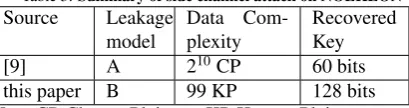
Table 3:Summary of side channel attack on NOEKEON
Source Leakage
model
Data
Com-plexity
Recovered Key
[9] A 210CP 60 bits
this paper B 99 KP 128 bits
Note:CP:Chosen Plaintext;KP:Known Plaintext; A:single bit leakage of the output of the second round; B:Hamming weight leakage of the lower 64 bits and higher 64 bits of the output of the 1st round;
which means thatk0 =1,k1 =0,k2 =0,k3 =0,k4 = 0,k5 = 1, ...,k92 = 0,k93 = 1,k94 = 1,k95 = 1.The average running time of step (1)-(4) in Mathematica is 4.8 seconds and the average running time of step (5) in Magma is 10.8 seconds on a PC with 2.6GHZ CPU and 8G RAM.Hence the average time of recover-ing k0,k1, ...,k95 is 15.6 seconds and the total time of recovering the 128-bit key is 15.6+4.5=20.1 seconds.
We summarize our work and the known side channel attack on NOEKEON in Table 3. Our side channel at-tack improves upon the previous work of Shekh Faisal Abdul-Latip et al. from two aspects. First, we use the Hamming weight leakage model(we suppose the Ham-ming weight of the lower 64 bits and the higher 64 bits of the output of the first round can be obtained without error) which is a more relaxed leakage assumption, sup-ported by many previously known practical results on side channel attacks, compared to the more challenging leakage assumption that the adversary has access to the ”exact” value of the internal state bits as used by Shekh Faisal Abdul-Latip et al. Second, our attack has also a reduced complexity compared to that of Shekh Faisal Abdul-Latip et al. Namely, our attack of recovering the 128-bit key of NOEKEON has a time complexity 20.1 seconds on a PC and data complexity of 99 known plaintexts; whereas, that of Shekh Faisal Abdul-Latip et al. has time complexity ofO(268) and needs about 210 chosen plaintexts.
4. Conclusion
may contain all the information concerning the mas-ter key.If enough Hamming weights are leaked,than the master key can easily be recovered by equation solving technique.The following work is to use MFCSCA to at-tack other block ciphers.
Appendix A. Symbolic encryption code of NOEKEON in Mathematica plat-form
[1] Bogdanov, A., Kizhvatov, I., Pyshkin, A.: Algebraic Methods in Side-Channel Collision Attcks and Practical Collision De-tection. In: Chowdhury, D.R., Rijmen, V., Das, A. (Eds.) IN-DOCRYPT 2008. LNCS, vol. 5365, pp. 251-265. Springer, Hei-delberg (2008)
[2] Dinur, I., Shamir, A.: Side Channel Cube Attacks on Block Ciphers. Cryptology ePrint Archive, Report 2009/127 (2009), http://eprint.iacr.org/2009/127
[3] Mathieu Renauld and Frano¸is-Xavier Standaert. Algebraic Side-Channel Attacks. In Feng Bao, Moti Yung, Dongdai Lin, and Jiwu Jing, editors, Inscrypt, volume 6151 of Lecture Notes in Computer Science, pages 393-410. Springer, 2009.
[4] Mathieu Renauld, Frano¸is-Xavier Standaert, and Nicolas Veyrat-Charvillon. Algebraic Side-Channel Attacks on the AES: Why Time also Matters in DPA. In Christophe Clavier and Kris Gaj, editors, CHES, volume 5747 of Lecture Notes in Computer Science, pages 97-111. Springer, 2009.
[5] Yang, L., Wang, M., Qiao, S.: Side Channel Cube Attack on PRESENT. In: Garay, J.A., Miyaji, A., Otsuka, A. (Eds.) CANS 2009. LNCS, vol. 5888, pp. 379-391. Springer, Heidel-berg (2009)
[6] Shekh Faisal Abdul-Latip, Mohammad Reza Reyhanitabar, Willy Susilo and Jennifer Seberry.Extended Cubes: Enhancing the cube attack by Extracting Low-Degree Non-linear Equa-tions. In Bruce Cheung, Lucas Chi Kwong Hui, Ravi Sandhu, Duncan S.Wong (Eds.): ASIACCS 2011, pp.296-305,2011. [7] XinJie Zhao, Tao Wang and ShiZe Guo: Improved Side Channel
Cube Attacks on PRESENT. Cryptology ePrint Archive, Report 2011/165 (2011), http://eprint.iacr.org/2011/165
[8] Daemen, J., Peeters, M., Van Assche, G.,Rijmen, V.: Nessie Proposal: NOEKEON. First Open NESSIE Workshop (2000), http://gro.noekeon.org
[9] Shekh Faisal Abdul-Latip, Mohammad Reza Reyhanitabar, Willy Susilo, and Jennifer Seberry. On the Security of NOEKEON against Side Channel Cube Attacks. ISPEC 2010, LNCS 6047, 2010, pp. 45-55,2010.
[10] M. E. Hellman, R. Merkle, R. Schroppel, L. Washington, W. Diffe, S. Pohlig and P. Schweitzer, Results of an Initial Attempt to Cryptanalyze the NBS Data Encryption Standard, Technical Report, SEL 76-042, Stanford university, September 1976. [11] Ingrid Schaumuller-Bichl, Zur Analyse des Data Encryption
Standard und Synthese Verwandter Chiffriersysteme, Ph.D. Thesis, Linz university, May 1981.
[12] Ingrid Schaumuller-Bichl, Cryptanalysis of the Data Encryption Standard by the Method of Formal Coding, Lecture Notes in Computer Science, Cryptography, proceedings of the Workshop on Cryptography, Burg Feuerstein, Germany, March 29,April 2, pp. 235-255, 1982.
[13] Nicolas Courtois and Josef Pieprzyk: Cryptanalysis of Block Ci-phers with Overdefined Systems of Equations, Asiacrypt 2002, LNCS 2501, pp.267-287, Springer.
[14] G. Bard, N. Courtois, C. Jefferson, Efficient Methods for Con-version and Solution of Sparse Systems of Low-Degree
Mul-tivariate Polynomials over GF(2) via SAT-Solvers, Cryptology ePrint Archive, Report 2007/024.
[15] G. Ars, J.-C. Faugre, H. Imai, M. Kawazoe, M. Sugita, Com-parison Between XL and Gr¨obner Basis Algorithms, in the pro-ceedings of ASIACRYPT 2004, LNCS, vol 3329, pp 338-353, Jeju Island, Korea, December 2004.
[16] http://www.wolfram.com/mathematica/ [17] http://magma.maths.usyd.edu.au/magma/
[18] Bevan, R., Knudsen, R.: Ways to Enhance Differential Power Analysis. In: Lee, P.J, Lim, C.H. (Eds.) ICISC 2002. LNCS, vol. 2587, pp. 327-342. Springer, Heidleberg (2003)
[19] Clavier, C., Coron, J.S., Dabbous, N.: Differential Power Anal-ysis in the Presence of Hardware Countermeasures. In: Koc, C.K., Paar, C. (Eds.) CHES 2000. LNCS, vol. 1965, pp. 252-263. Springer, Heidelberg (2000)
[20] Coron, J.S., Kocher, P., Naccache, D.: Statistics and Secret Leakage. In: Frankel, Y. (Ed.) FC 2000. LNCS, vol. 1962, pp. 157-173. Springer, Heidelberg (2001)
[21] Akkar, M.L., Bevan, R., Dischamp, P., Moyart, D.: Power analysis, what is now possible... In: Okamoto, T. (Ed.) ASI-ACRYPT 2000. LNCS, vol. 1976, pp. 489-502. Springer, Hei-delberg (2000)
[22] Mayer-Sommer, R.: Smartly Analysis the Simplicity and the Power of Simple Power Analysis on Smartcards. In: Koc, C.K., Paar, C. (Eds.) CHES 2000. LNCS, vol. 1965, pp. 78-92. Springer, Heidelberg (2000)
[23] Biham, E.: New Types of Cryptanalytic Attacks Using Related Keys. In: Tor Helleseth (Ed.) EUROCRYPT 1993. LNCS, vol. 7, pp. 229-246. Springer, Heidel- berg (1994)
theta@key_, a_D:=Module@8K0, K1, K2, K3, a0, a1, a2, a3, temp<,
a0=a@@1 ;; 32DD; a1=a@@33 ;; 64DD; a2=a@@65 ;; 96DD; a3=a@@97 ;; 128DD;
K0=key@@1 ;; 32DD; K1=key@@33 ;; 64DD; K2=key@@65 ;; 96DD; K3=key@@97 ;; 128DD;
temp=a0+a2; temp=temp+RotateLeft@temp, 8D+RotateRight@temp, 8D;
a1=a1+temp; a3=a3+temp; a0=a0+K0; a1=a1+K1; a2=a2+K2;
a3=a3+K3; temp=a1+a3; temp=temp+RotateLeft@temp, 8D+RotateRight@temp, 8D;
a0=a0+temp; a2=a2+temp; Return@8a0, a1, a2, a3< FlattenDD;
pai1@x_D:=8x@@1 ;; 32DD, RotateLeft@x@@33 ;; 64DD, 1D,
RotateLeft@x@@65 ;; 96DD, 5D, RotateLeft@x@@97 ;; 128DD, 2D< Flatten;
gamma@a_D:=Module@8A0, A1, A2, A3, tmp<, A0=a@@1 ;; 32DD;
A1=a@@33 ;; 64DD; A2=a@@65 ;; 96DD; A3=a@@97 ;; 128DD;
A1=A1+HA2+1L*HA3+1L; A0=A0+A1*A2; tmp=A3; A3=A0; A0=tmp;
A2=A2+A0+A1+A3; A1=A1+HA2+1L*HA3+1L;
A0=A0+A2*A1; Return@8A0, A1, A2, A3< FlattenDD;
pai2@x_D:=8x@@1 ;; 32DD, RotateRight@x@@33 ;; 64DD, 1D,
RotateRight@x@@65 ;; 96DD, 5D, RotateRight@x@@97 ;; 128DD, 2D< Flatten; H*round constant of NOEKEON*L
rc1=8128, 27, 54, 108, 216, 171, 77, 154, 47, 94, 188, 99, 198, 151, 53, 106, 212<;
rc=Table@Table@0,832<D,817<D;
For@r=1, r£17, r++, rc@@rDD@@25 ;; 32DD=IntegerDigits@rc1@@rDD, 2, 8DD;
encryption@m_, key_, s_: 0D:=ModuleA8c, r<,
c=m;
ForAr=1, r£16, r++,
c@@1 ;; 32DD=c@@1 ;; 32DD+rc@@rDD;
c=theta@key, cD; c=pai1@cD; c=gamma@cD;
c=Ic. Power@aaa_, cc_IntegerD®aaaM . aa_Integer®Mod@aa, 2D;
c=pai2@cD;
c=Ic. Power@aaa_, cc_IntegerD®aaaM . aa_Integer®Mod@aa, 2D;
If@sr, Return@cDDE;
c@@1 ;; 32DD=c@@1 ;; 32DD+rc@@17DD; c=theta@key, cD;
c=Ic. Power@aaa_, cc_IntegerD®aaaM . aa_Integer ®Mod@aa, 2D;
Return@cDE;
H*correcness test of noekeonEncryption ,the test vectors are taken from @24D*L m=Table@0,8128<D; k=Table@0,8128<D;
c=encryption@m, kD; BaseForm@FromDigits@c, 2D, 16D
m=Table@1,8128<D; k=Table@1,8128<D;
c=encryption@m, kD; BaseForm@FromDigits@c, 2D, 16D
k=IntegerDigits@16^^b1656851699e29fa24b70148503d2dfc , 2, 128D;
m=IntegerDigits@16^^2a78421b87c7d0924f26113f1d1349b2 , 2, 128D;
c=encryption@m, kD; BaseForm@FromDigits@c, 2D, 16D H*obtain the algebraic expressions of round 1*L
m=Table@ToExpression@"p"<>ToString@iDD,8i, 0, 127<D;
k=Table@ToExpression@"k"<>ToString@iDD,8i, 0, 127<D;
c=encryption@m, k, 1D;
Print@c@@1DD, ",", c@@64DD, ",", c@@128DDD