Adaptively Secure Garbling with Applications to
One-Time Programs and Secure Outsourcing
Mihir Bellare1 Viet Tung Hoang2 Phillip Rogaway2
1 Dept. of Computer Science and Engineering,University of California, San Diego, USA 2 Dept. of Computer Science, University of California, Davis, USA
October 2, 2012
Abstract. Standard constructions of garbled circuits provide onlystaticsecurity, meaning the inputx is not allowed to depend on the garbled circuitF. But some applications—notablyone-time programs
(Goldwasser, Kalai, and Rothblum 2008) and secure outsourcing (Gennaro, Gentry, Parno 2010)— needadaptive security, wherexmay depend onF. We identify gaps in proofs from these papers with regard to adaptive security and suggest the need of a better abstraction boundary. To this end we investigate the adaptive security ofgarbling schemes, an abstraction of Yao’s garbled-circuit technique that we recently introduced (Bellare, Hoang, Rogaway 2012). Building on that framework, we give definitions encompassingprivacy,authenticity, and obliviousness, with either coarse-grained or fine-grained adaptivity. We show how adaptively secure garbling schemes support simple solutions for one-time programs and secure outsourcing, with privacy being the goal in the first case and obliviousness and authenticity the goal in the second. We give transforms that promote static-secure garbling schemes to adaptive-secure ones. Our work advances the thesis that conceptualizing garbling schemes as a first-class cryptographic primitive can simplify, unify, or improve treatments for higher-level protocols.
1 Introduction . . . 1
2 Framework . . . 5
3 Adaptive Privacy and One-Time Programs . . . 6
3.1 Definitions for adaptive privacy . . . 6
3.2 The OMSS transform . . . 7
3.3 Achieving prv1 security . . . 11
3.4 Achieving prv2 security . . . 11
3.5 Efficient ROM transforms . . . 12
3.6 “Standard” schemes are not prv2 secure . . . 13
3.7 One-time programs . . . 15
4 Obliviousness, Authenticity and Secure Outsourcing . . . 18
4.1 Definitions for adaptive obliviousness and authenticity . . . 18
4.2 Achieving obv1 and aut1 security . . . 19
4.3 Achieving obv2 and aut2 security . . . 20
4.4 Efficient ROM transforms . . . 20
4.5 Application to secure outsourcing . . . 21
References . . . 24
Appendices . . . 24
A Preliminaries . . . 24
A.1 Notation and conventions . . . 24
A.2 Code-based games . . . 25
A.3 Circuits . . . 25
B Indistinguishability-Based Definitions . . . 26
C Separations . . . 32
D Postponed proofs . . . 37
D.1 Proof of Theorem 2 . . . 37
D.2 Proof of Theorem 3 . . . 39
D.3 Proof of Theorem 4 . . . 39
D.4 Proof of Theorem 5 . . . 41
D.5 Proof of Theorem 8 . . . 41
D.6 Proof of Theorem 9 . . . 43
D.7 Proof of Theorem 10 . . . 44
D.8 Proof of Theorem 11 . . . 46
D.9 Proof of Theorem 7 . . . 47
1 Introduction
Overview. Yao’s garbled-circuit technique [13, 15, 22, 24, 25] has been extremely influential, en-gendering an enormous number of applications. Yet, at least in its conventional form, the technique provides only static security.3 Some applications, notably one-time programs [17] and secure
out-sourcing [12], require adaptive security.4 In such cases Yao’s technique can be enhanced in ad hoc
ways, the resulting protocol then incorporated into the higher-level application.
This paper provides a different approach. We create an abstraction for the goal of adaptively secure garbling. Via a single abstraction, we support a variety of applications in a simple and modular way. Let’s look at two of the applications that motivate our work.
Two applications. One-time programs are due to Goldwasser, Kalai, and Rothblum (GKR) [17]. The authors aim to compile a program into one that can be executed just once, on an input of the user’s choice. Unachievable in any “standard” model of computation, GKR assume a model providing what they callone-time memory. Their solution makes crucial use of Yao’s garbled-circuit technique. Recognizing that this does not support adaptive queries, GKR embellish the method by a technique involving output-masking and n-out-of-nsecret sharing.
In a different direction,secure outsourcing was formalized and investigated by Gennaro, Gentry, and Parno (GGP) [12]. Here aclient transforms a functionf into a functionF that is handed to a
worker. When, later, the client would like to evaluatef atx (and various such inputs may arise), he should be able to quickly map x to a garbled input X and give this to the worker, who will compute and returnY =F(X). The client must be able to quickly reconstruct from thisy=f(x). He should be sure that the correct value was computed—the computation is verifiable—while the server shouldn’t learn anything significant aboutx, includingf(x).5 GGP again make use of circuit garbling, and they again realize that they need something from it—its authenticity—that is anovum
for this domain.
Issues. Assuming the existence of a one-way function, GKR [17] claim that their construction turns a (statically-secure) garbled circuit into a secure one-time program. We point to a gap in their proof, namely, the absence of a reduction showing that their simulator works based on the one-way function assumption. By presenting an example of a statically-secure garbled circuit that, under their transform, yields a program that is not one-time, we also show that the gap cannot be filled without changing either the construction or the assumption. The problem is that the GKR transform fails to ensure adaptive security of garbled circuits under the stated assumption.
Lindell and Pinkas (LP) [21] prove static security of a version of Yao’s protocol assuming a semantically secure encryption scheme satisfying some extra properties (an elusive and efficiently verifiable range). GGP [12] build a one-time outsourcing scheme from the LP protocol, claiming to prove its security based on the same assumption as used in LP. Again, there is a gap in this proof arising from an implicit assumption of adaptive security of the LP construction.
3Of course conventional garbled circuits certainly can be used to build schemes, say for multiparty computation, meeting adaptive security notion; we are only asserting that the standard and well-known methods fail, by them-selves, to provably achieve adaptive definitions of garbling-scheme security.
4In speaking of adversaries or security, non-adaptive and dynamic are common synonyms for what we are here callingstatic andadaptive.
We do not believe these are major problems for either work. In both cases, alternative ways to establish the the authors’ main results already existed. Goyal, Ishai, Sahai, Venkatesan and Wadia [18] present an unconditional one-time compiler (no complexity-theoretic assumption is used at all), while Chung, Kalai and Vadhan [10] present secure outsourcing schemes based solely on FHE (garbled circuits are not employed). Our interpretation of the stated gaps is that they are symptoms of something else—a missing abstraction boundary. As recently argued by Bellare, Hoang and Rogaway (BHR) [5], it is useful and simplifying to see garbling not just as a technique, but as a first-class primitive. To do so, our earlier work defines syntax and security notions for garbling schemes, provides proven-correct solutions, then solves some example higher-level problems by employing a garbling scheme that satisfies the appropriate definition. But the security notions of BHR do not go far enough to handle what GKR or GGP need, since BHR deals only with static notions of security. The applications we point to motivate the study of adaptive security for garbling schemes, while the gaps indicate that the issues may be more subtle than recognized.
Of course we communicated our findings to the GKR and GGP authors. GKR responded after a few weeks with an updated manuscript [16]. It modifies the claim from their original paper [17] to now claim that their transform works under the stronger assumption of a sub-exponentially hard one-way function. (This allows “complexity-leveraging,” where a static adversary can guess the input that will be used by an adaptive adversary with a probability that, although exponentially-small, is enough under the stronger assumption.) GGP responded to acknowledge the gap and suggest that they would address it by assuming the LP construction, or some related realization of Yao’s idea, already provides adaptive security.
Definitions. We now discuss our contributions in more depth. We start from the abstraction of a garbling scheme—the raw syntax—introduced by BHR [5]. That work gave multiple definitions sitting on top of this syntax, but all were for static adversaries, in the sense that the functionf to garble and its input x are selected at the same time. We extend the definitions to adaptive ones, considering two flavors of adaptive security. Withcoarse-grained adaptive security the inputxcan depend on the garbled function F but x itself is atomic, provided all at once. With fine-grained
adaptive security not only may x depend on the garbled function F, but individual bits of x can depend on the “tokens” the adversary has so-far learned.6 We will see that coarse-grained adaptive security is what’s needed for GGP’s approach to secure outsourcing, while fine-grained adaptive security is what’s needed for GKR’s approach to one-time programs.
Orthogonal to adaptive security’s granularity are the security aims themselves. Following BHR, we consider three different notions: privacy, obliviousness, and authenticity. This gives rise to nine different security notions: {prv, obv, aut} × {static, coarse, fine}. We compactly denote these prv, prv1, prv2, obv, obv1, obv2, aut, aut1, aut2. Informally, when a functionf gets transformed into a garbled functionF, an encoding function e, and a decoding functiond, privacy ensures thatF,d, and X = e(x) don’t reveal anything beyond y = f(x) that shouldn’t be revealed; obliviousness ensures that F and X don’t reveal even y; and authenticity ensures that F and X don’t enable the computation of a validY 6=F(X). Privacy is the classical requirement, while obliviousness and authenticity are motivated by the application to secure outsourcing.
6Fine-grained adaptive security requires the garbling scheme beprojective: the garbled version of eachx=x1· · ·xn∈
{0,1}nmust be (Xx1
Our primary definitions for adaptive secrecy (prv1, prv2, obv1, obv2) are simulation-based. In Appendix B we give indistinguishability-based counterparts as well. For static security this was already done by BHR, but it was not clear how to lift those definitions to the adaptive setting.
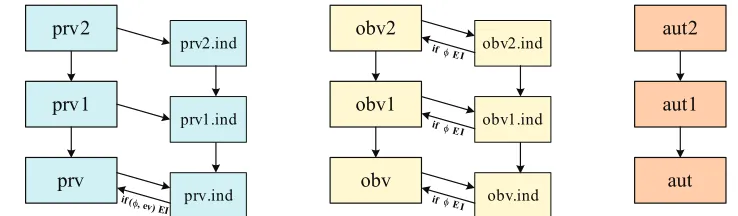
Relations. We explore the provable-security relationships among our definitions. As expected, the simulation-based definitions imply indistinguishability-based ones (namely, prv1 ⇒ prv1.ind, prv2 ⇒ prv2.ind, obv1 ⇒ obv1.ind, and obv2 ⇒ obv2.ind). But none of the converse statements hold. BHR had earlier shown that, for the static setting, the converse statements do hold as long as the associated side-information function7 is efficiently invertible.8 In contrast, we show
that, for adaptive privacy, this condition still won’t guarantee equivalence of simulation-based and indistinguishability-based notions. (For obliviousness, it is true that obv1.ind ⇒ obv1 and obv2.ind⇒obv2 ifΦis efficiently invertible.) The results are our main reason to focus on simulation-based definitions for adaptive privacy. Appendix C paints a complete picture of the relations among our basic definitions. Apart from the trivial relations (prv2 ⇒ prv1 ⇒ prv, obv2⇒ obv1⇒ obv, and aut2⇒aut1 ⇒aut) nothing implies anything else.
Achieving adaptive security. Basic garbling-scheme constructions [5, 13, 15, 22] either do not achieve adaptive security or present difficulties in proving adaptive security that we do not know how to overcome. One could give new constructions and directly prove them xxx1 or xxx2 secure, for xxx ∈ {prv,obv,aut}. An alternative is to provide generic ways to transform statically secure garbling schemes to adaptively secure ones. Combined with results in BHR [5], this would yield adaptively-secure garbling schemes.
The aim of the GKR construction was to add adaptive security to statically-secure garbled cir-cuit constructions. We reformulate it as a transform,OMSS(Output Masking and Secret Sharing), aiming to turn a prv secure garbling scheme to a prv2 secure one. We show, by counterexample, thatOMSSdoes not achieve this goal.
To give transforms that work we make two steps, first passing from static security to coarse-grained adaptive security, and thence to fine-coarse-grained adaptive security. We design these transfor-mations first for privacy (prv-to-prv1, prv1-to-prv2) and then for simultaneously achieving all three goals (all-to-all1 and all1-to-all2). Our prv-to-prv1 transform uses a one-time-padding technique from [18], while our prv1-to-prv2 transform uses the secret-sharing component of OMSS.
Applications. We treat the two applications that motivated this work, one-time programs and secure outsourcing. We show that adaptive garbling schemes yield these applications easily and directly. Specifically, we show that a prv2 projective garbling scheme can be turned into a secure one-time program by simply putting the garbled inputs into the one-time memory. We also show how to easily turn an obv1+aut1 secure garbling scheme into a secure one-time outsourcing scheme. (GGP [12] show how to lift one-time outsourcing schemes to many-time ones using FHE.) The simplicity of these transformations underscores our tenet that abstracting garbling schemes and treating adaptive security for them enables modular and rigorous applications of the
garbled-7The side-information function Φ captures that about f one allows to be revealed in its garbled counterpartF.
Whenfencodes a circuit, the side-information might be its size (gate count), input length, and output length. 8Side-information functionΦis efficiently invertible if there is a PT algorithmM that, on inputφ=Φ(f) for somef,
Transform Model Cost See
prv-to-prv1 standard model |F|+|d|+|X| Theorem 2
prv1-to-prv2 standard model (n+ 1)|X| Theorem 3
all-to-all1 standard model |F|+|d|+|X|+k Theorem 8
all1-to-all2 standard model (n+ 1)|X| Theorem 9
rom-prv-to-prv1 random-oracle model |X|+k Theorem 4
rom-prv1-to-prv2 random-oracle model |X|+nk Theorem 5
rom-all-to-all1 random-oracle model |X|+ 2k Theorem 10
rom-all1-to-all2 random-oracle model |X|+nk Theorem 11
Fig. 1. Achieving adaptive security. The name of each transform specifies its relevant property. The word all
means that prv, obv, and aut are all upgraded. Column “Cost” specifies the length of the garbled input in the constructed scheme in terms of the lengths of the input scheme’s garbled functionF, decoding functiond, garbled inputX, the number of input bitsn, and security parameterk.
circuit technique. Basing the applications on garbling schemes also allows instantiations to inherit efficiency features of future schemes.
Applying our prv-to-prv1 and then prv1-to-prv2 transforms to the prv-secure garbling scheme of BHR [5] yields a prv2-secure scheme based on any one-way function. Combining this with the above yields one-time programs based on one-way functions, recovering the claim of GKR [17]. Similarly, applying our all-to-all1 transform to the obv+aut secure scheme of BHR yields an obv1+aut1 secure garbling scheme based on a one-way function, and combining this with the above yields a secure one-time outsourcing scheme based on one-way functions.
Efficiency. Let us say a garbling scheme has short garbled inputs if their length depends only on the security parameterk, the length noff’s input, and the lengthm off’s output. It does not depend on the length off. The statically-secure schemes of BHR, as with all classical garbled-circuit constructions, have short garbled inputs. But our prv-to-prv1 and all-to-all1 transforms result in long garbled inputs. In the ROM (random-oracle model) we are able to provide schemes producing short garbled inputs, as illustrated in Fig. 1. Constructing an adaptively secure garbling scheme with short garbled inputs under standard assumptions remains open.9
Short garbled inputs are particularly important for the application to secure outsourcing, for in their absence the outsourcing scheme may fail to be non-trivial. (Non-trivial means that the client effort is less than the effort needed to directly compute the function [12].) In particular, the one-time outsourcing scheme we noted above, derived by applying all-to-all1 to BHR, fails to be non-trivial. ROM schemes do not fill the gap because of the use of FHE in upgrading one-time schemes to many-time ones [12]. Thus, a secure and non-trivial instantiation of the GGP method is still lacking. (However, as we have noted before, non-trivial secure outsourcing may be achieved by entirely different means [10].)
Further related work. Applebaum, Ishai, and Kushilevitz [1] investigate ideas similar to obliviousness and authenticity. Their approach to obtaining these ends from privacy can be lifted and formalized in our settings; one could specify transformsprv1-to-all1andprv2-to-all2, effectively handling the constructive story “horizontally” instead of “vertically.” The line of work on
ized encodings that the same authors have been at the center of provides an alternative to garbling schemes [19] but lacks the granularity to speak of adaptive security.
Independent and concurrent work by Kamara and Wei (KW) investigates the garbling what they call structured circuits [20] and, in the process, give definitions somewhat resembling prv1,obv1, and aut1, although circuit-based, not function-hiding, and not allowing the adversary to specify the initial function. KW likewise draw motivation from GKR and GGP, indicating that, in these two settings, the adversary can choose the inputs to the computation as a function of the garbled circuit, motivating adaptive notions of privacy and unforgeability.
Independent and concurrent work by Applebaum, Ishai, Kushilevitz and Waters [2] provides a definition of adaptive security for randomized encodings of functions that corresponds to our coarse-grained privacy. They provide a ROM construction with short keys achieving this notion. They also provide negative results on the length of keys for adaptive security in the standard model.
2 Framework
We now review the syntactic framework of garbling schemes from our earlier work [5]. See Ap-pendix A for basic notation, including conventions for randomized algorithms, code-based games, and circuits.
Garbling schemes. A garbling scheme [5] is a five-tuple of algorithms G= (Gb,En,De,Ev,ev). The first of these is probabilistic; the rest are deterministic. A string f, the original function, describes the function ev(f,·) :{0,1}n → {0,1}m that we want to garble. The values n = f.n
and m = f.m are efficiently computable from f. On input f and a security parameter k ∈ N, algorithmGbreturns a triple of strings (F, e, d)←Gb(1k, f). Stringedescribes anencoding function,
En(e,·), that maps aninitial input x∈ {0,1}nto agarbled input X=En(e, x). StringF describes a
garbled function,Ev(F,·), that maps a garbled inputX to agarbled output Y =Ev(F, X). Stringd describes adecoding function,De(d,·), that maps a garbled outputY to afinal outputy=De(d, Y). The correctness requirement is that if f ∈ {0,1}∗,k∈N,x∈ {0,1}f.n, and (F, e, d)∈[Gb(1k, f)],
then De(d,Ev(F,En(e, x))) = ev(f, x). We also require that eand ddepend only on k, f.n, f.m, |f|and the random coinsr ofGb. This non-degeneracy requirement excludes trivial solutions.
A common design in existing garbling schemes is for e to encode a list of tokens, one pair for each bit in x ∈ {0,1}n. Encoding function En(e,·) then uses the bits of x = x
1· · ·xn to
select from e = (X0
1, X11, . . . , Xn0, Xn1) the subvector X = (X1x1, . . . , Xnxn). Formally, we say that
garbling scheme G = (Gb,En,De,Ev,ev) is projective if for all f, x, x′ ∈ {0,1}f.n, k ∈ N, and
i ∈ [1..n], when (F, e, d) ∈ [Gb(1k, f)], X = En(e, x) and X′ = En(e, x′), then X = (X
1, . . . , Xn)
and X′ = (X′
1, . . . , Xn′) are n vectors, |Xi| = |Xi′|, and Xi = Xi′ if x and x′ have the same ith
bit. LetGS(proj) denote the set of all projective garbling schemes, and let GS(ev) be the set of all garbling schemes whose evaluation function is ev.
Boolean circuits arise often in this work. We recall in Appendix A.3 a formalization for them following [5], including the definition of the canonical circuit-evaluation function. We say that G= (Gb,En,De,Ev,ev) is a circuit-garbling scheme ifevis the canonical circuit-evaluation function.
procGarble(f, x) PrvG,Φ,S
ifx6∈ {0,1}f.n then return⊥
ifb= 1then
(F, e, d)←Gb(1k, f) X←En(e, x)
else
y←ev(f, x)
(F, X, d)← S(1k, y, Φ(f))
return(F, X, d)
procGarble(f) Prv1G,Φ,S
ifb= 1then
(F, e, d)←Gb(1k, f)
else
(F, d)← S(1k, Φ(f),0)
return(F, d)
procInput(x)
ifx6∈ {0,1}f.n then return
⊥
ifb= 1thenX ←En(e, x)
else
y←ev(f, x),X← S(y,1)
returnX
procGarble(f) Prv2G,Φ,S n←f.n; Q← ∅; τ ←ε
ifb= 1then
(F,(X0
1, X11, . . . , Xn0, Xn1), d)←Gb(1 k, f)
else
(F, d)← S(1k, Φ(f),0)
return(F, d)
procInput(i, c)
ifi6∈ {1, . . . , n} \Qthen return⊥
xi←c; Q←Q∪ {i}
if|Q|=nthen
x←x1· · ·xn; y←ev(f, x); τ←y
ifb= 1thenXi←Xxi
i
elseXi← S(τ, i,|Q|)
returnXi
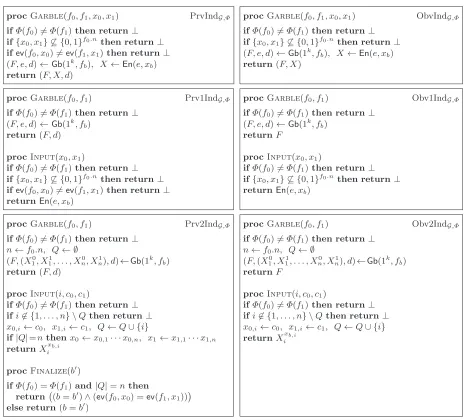
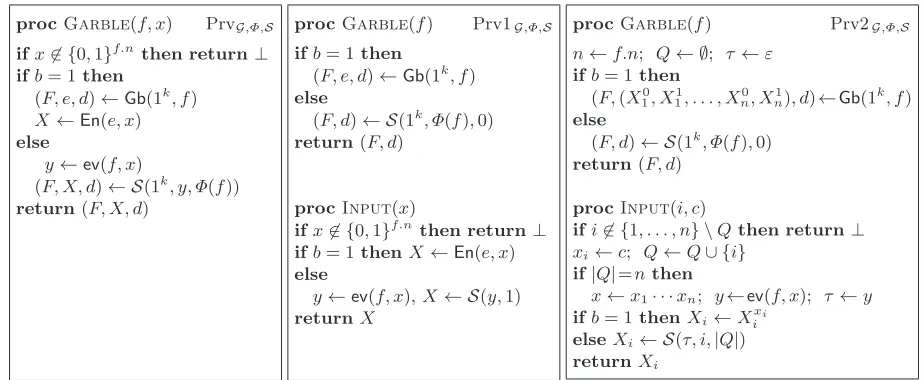
Fig. 2. Three kinds of privacy: prv, prv1, prv2.Games to define the static, coarse-grained, and fine-grained pri-vacy ofG= (Gb,En,De,Ev,ev). Each game starts withInitialize() that samples a bitbև{0,1}, and itsFinalize(b′) returns the predicate (b=b′). Notations
ևS denotes uniform sampling from a finite set.
determined from φ = Φ(f). Side-information function Φsize maps a circuit f = (n, m, q, A, B, G)
to (n, m, q), while Φtopo maps f to f− = Topo(f) = (n, m, q, A, B) and Φcirc is the identity,
Φcirc(f) =f.
Sizes. A cost metric of interest is the length of the garbled input. We say that garbling scheme G = (Gb,En,De,Ev,ev) has short garbled inputs if there is a polynomial s such that |En(e, x)| ≤ s(k, f.n, f.m) for all k ∈ N, f ∈ {0,1}∗, (F, e, d) ∈ [Gb(1k, f)], and x ∈ {0,1}f.n. Let T be a transform that maps a garbling schemeGto a garbling schemeT[G]. We say thatTpreservesshort garbled inputs ifT[G] has short garbled inputs whenG does.
Typical Yao-style constructions, including Garble1 and Garble2 [5], have short garbled inputs. But they are only statically-secure. Keeping garbled inputs short seems challenging for adaptive security in the standard model.
3 Adaptive Privacy and One-Time Programs
In this section we define coarse and fine-grained adaptive privacy for garbling schemes. We show that some natural approaches to achieve these aims fail. We provide alternatives that work, and more efficient ones in the ROM. We apply this to get secure one-time programs.
3.1 Definitions for adaptive privacy
The notion in the right panel, denoted by prv2, is fine-grained adaptive security. This notion is only applicable for projective garbling schemes.
In detail, let G = (Gb,En,De,Ev,ev) be a garbling scheme and let Φ be a side-information function. We define three simulation-based notions of privacy via the games PrvG,Φ,S, Prv1G,Φ,S,
and Prv2G,Φ,S of Fig. 2. HereS, the simulator, is an always-terminating algorithm that maintains
state across invocations. An adversary A interacting with any of these games must make exactly one Garble query. For game Prv1 it is followed by a single Input query. For game Prv2 it is followed by multipleInputqueries. There, the garbling scheme must be projective. The advantage the adversary gets is defined by
AdvprvG , Φ,S(A, k) = 2 Pr[PrvAG,Φ,S(k)]−1
Advprv1G , Φ,S(A, k) = 2 Pr[Prv1AG,Φ,S(k)]−1
Advprv2G , Φ,S(A, k) = 2 Pr[Prv2AG,Φ,S(k)]−1.
For xxx ∈ {prv,prv1,prv2} we say that G is xxx secure with respect to (or over) Φ if for every PT adversary A there exists a PT simulator S such that AdvxxxG , Φ,S(A,·) is negligible. We let GS(xxx, Φ) be the set of all garbling schemes that are xxx secure over Φ.
Let us now explain the three games, beginning with static privacy. Here we let the adversary select f and x and we do one of two things: garble f to make (F, e, d) and encode x to make X, giving the adversary (F, X, d); or, alternatively, we ask the simulator produce a “fake” (F, X, d) based only on the security parameter k, the partial information Φ(f) about f, and the output y=ev(f, x). The adversary will have to guess if the garbling was real or fake.
For coarse-grained adaptive privacy, we begin by letting the adversary pickf. Either we garble it to (F, e, d) ← Gb(1k, f) and give the adversary (F, d); or else we ask the simulator to devise a
fake (F, d) based solely onk and φ=Φ(f). Only after the adversary has received (F, d) do we ask it to provide an input x. Corresponding to the two choices we either encodex to X =En(e, x) or ask the simulator to produce a fakeX, assisting it only by providing ev(f, x).
Coarse-grained adaptive privacy is arguably not all that adaptive, as the adversary specifies its input x all in one shot. This is unavoidable as long as the encoding function e operates on x atomically, using (all of)xto generate (all of)X. But if the encoding functioneis projective, then we can dole out the garbled input component-by-component. In a garbling scheme that enjoys fine-grained adaptive privacy, the adversary may, for example, specify the second bitx2 of the inputx,
receive the corresponding token Xx2
2 , then specify the first bit x1 of x, and so on. Only after the
adversary specifies allnbits, one by one, is the input fully determined. At that point the simulator is handed y, which might be needed for constructing the final token Xxi
i .
3.2 The OMSS transform
In the process of constructing one-time programs from garbled circuits, GKR [17] recognize the need for adaptive privacy of the garbled circuits. Their construction incorporates a technique to provide it. This technique is easily abstracted to provide, in our terminology, a transform that aims to convert a projective, prv garbling scheme into a projective, prv2 garbling scheme. Instead of garbling f we pick rև{0,1}m and garble the circuit g defined by g(x) = f(x)⊕r for every
x∈ {0,1}n wheren=f.n andm=f.m. Then we secret sharer asr=r
1⊕ · · · ⊕rnand include ri
procGb2(1k, f)
n←f.n,r1, . . . , rnև{0,1}f.m r←r1⊕ · · · ⊕rn,g(·)←f(·)⊕r (G,(X0
1, X11, . . . , Xn0, Xn1), ε)ևGb(1k, g)
fori∈ {1, . . . , n}doTi0←(Xi0, ri),Ti1←(Xi1, ri)
return(G,(T0
1, T11, . . . , Tn, T0 n), ε)1
procEn2((T10, T11, . . . , Tn0, Tn), x)1 x1· · ·xn←x
return(Tx1 1 , . . . , T
xn
n )
procEv2(G,(T1, . . . , Tn))
fori∈ {1, . . . , n}do(Xi, ri)←Ti
Y ←Ev(G,(X1, . . . , Xn)),r←r1⊕ · · · ⊕rn
return(Y, r)
procDe2(ε,(Y, r))
returnDe(ε, Y)⊕r
procGb(1k, g)
(n, m)←(g.n, g.m), (G′,(Z10, Z11, . . . , Zn, Z0 n), ε)1 ևGb′(1k, g)
fori∈ {1, . . . , n}doV0
i, Vi1և{0,1}m v1· · ·vn←vև{0,1}n, V և{0,1}m
ifn≥kthenV ←ev(g, v)⊕Vv1
1 ⊕ · · · ⊕Vnvn
fori∈ {1, . . . , n}do
X0
i ←(Zi0, Vi0), Xi1←(Zi1, Vi1) G←(G′, v, V)
return(G,(X0
1, X11, . . . , Xn0, Xn1), ε)
procEv(G,(X1, . . . , Xn))
fori∈ {1, . . . , n}do(Zi, Vi)←Xi (G′, v, V)←G
returnEv′(G′,(Z1, . . . , Zn))
procEn((X0
1, X11, . . . , Xn, X0 n), x)1 x1· · ·xn←x
return(Xx1
1 , . . . , Xnxn)
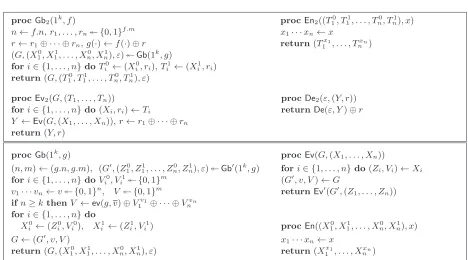
Fig. 3. OMSS definition (top).SchemeOMSS[G] = (Gb2,En2,De2,Ev2,ev) whereG= (Gb,En,De,Ev,ev).OMSS
counterexample (bottom).The garbling schemeG= (Gb,En,De,Ev,ev) obtained fromG′= (Gb′,En′,De,Ev′,ev) is prv secure whenG′ is, butOMSS[G] is not prv2 secure. We assume the decoding rule ofG′ is vacuous, a feature inherited byG. We are lettingvdenote the bitwise complement of a stringv.
recover ev(f, x) as ev(g, x)⊕r. Intuitively, this should work because the simulator can garble a dummy constant function with random outputsand does not have to commit toruntil it gets the target output valuey off and needs to provide the last token, at which point it can pickr=s⊕y so that the final output is y as desired [17]. Just the same, we show by counterexample that the OMSSdoes not work, in general, to convert a prv secure scheme to a prv2 secure one: we present a prv secure G such thatOMSS[G] is not prv2 secure.10
Now proceeding formally, we associate to circuit-garbling scheme G = (Gb,En,De,Ev,ev) ∈ GS(proj) the circuit-garbling schemeOMSS[G] = (Gb2,En2,De2,Ev2,ev) ∈GS(proj) defined at the
top of Fig. 3. For simplicity we are assuming that the decoding rule d in G is always vacuous, meaningd=ε. (We do not need non-trivial dto achieve privacy [5], and this lets us stay closer to GKR [17], whose garbled circuits have no analogue of our decoding rule.) In the code,g(·)←f(·)⊕r means that we construct fromf, r a circuitg such thatev(g, x) =ev(f, x)⊕r for allx∈ {0,1}f.n.
(Note we can do this in such a way that Φtopo(g) =Φtopo(f).)
The claim under consideration is that if G is prv secure relative to Φ =Φtopo then G2 is prv2
secure relative toΦ=Φtopo. To prove this, we would need to letA2 be an arbitrary PT adversary
and build a PT simulatorS2 such that Advprv2G2 , Φ,S2(A2,·) is negligible. GKR suggest a plausible strategy for the simulator that, in particular, explains the intuition for the transform. We present here our understanding of this strategy adapted to our setting. In its first phase the simulator S2
has input 1k, φ,0 where φ = Φ(f), with f being the query made by the adversary to Garble.
Simulator S2 picks sև{0,1}n and lets fs be the circuit that has output s on all inputs and
Φtopo(fs) = φ. It also picks random m-bit strings s1, . . . , sn and a random input wև{0,1}n. It
lets (G,(X0
1, X11, . . . , Xn0, Xn1), ε)ևGb(1k, fs) and returns Gto the adversary. In the second phase,
when given input τ, i, j, for j ≤ n−1, the simulator lets Ti ← (Xiwi, si) and returns Ti to the
adversary as the token for bitiof the input. In the case thatj=n, the simulator obtains (from τ as per our game) the output y = ev(f, x) of the function on input x, the latter defined by the adversary’s queries toInput. It now resetssi=y⊕s⊕si⊕s1⊕ · · · ⊕snand returns (Xiwi, si), so
that evaluation of the garbled function indeed results in output y.
This simulation strategy is intuitive, but trying to prove it correct runs into problems. We have to show that Advprv2, Φ,S2
G2 (A2,·) is negligible. We must utilize the assumption of prv security to do this, which means we must perform a reduction. The only plausible path towards this is to construct fromA2 an adversaryAagainst the prv security ofG and then exploit the existence of a
simulator S such that AdvprvG , Φ,S(A,·) is negligible. However, it is not clear how to constructA, let alone how its simulator comes into play.
The problem turns out to be more than technical, for we will see that the transform itself does not work in general. By this we mean that we can exhibit a (projective) circuit-garbling schemeG = (Gb,En,De,Ev,ev) that is prv secure relative toΦ=Φtopo but the transformed scheme
G2=OMSS[G] is subject to an attack showing that it is not prv2 secure. This means, in particular,
that the above simulation strategy does not in general work.
To carry this out, we start with an arbitrary projective circuit-garbling scheme G′= (Gb′,En′,
De,Ev′,ev) assumed to be prv secure relative toΦ=Φtopo. We then transform it into the projective
circuit-garbling schemeG= (Gb,En,De,Ev,ev) shown at the bottom of Fig. 3. The idea is as follows. We choose m-bit random shares V0
i , Vi1 for every i≤n, and distribute them to the tokens. Next,
choose a “poisoned” pointv =v1· · ·vn at random, and append it to the garbled function, making
it trivial for an adaptive adversary to queryx=v. Sincevis random, a static adversary can guessv with probability only 2−n. To make sure this probability is negligible in terms of k, we only do the
following trick ifn≥k. LetV be the encryption ofev(g, v) by using the one-time pad constructed from the shares corresponding tov, namely, the pad is the checksum ofVv1
1 , . . . , Vnvn. AppendV to
the garble function as well. So if the adversary queriesx=v then it will learnev(g, v) in addition toev(g, v); while if x6=v then the shares the adversary receives won’t allow it to decryptV. The following proposition says that G continues to be prv secure but an attack shows thatOMSS[G] is not prv2 secure. (The proof shows it is in fact not even prv1 secure.)
Proposition 1 Let ev be the canonical circuit-evaluation function. Assume G′ = (Gb′,En′,De,
Ev′,ev) ∈ GS(prv, Φtopo)∩GS(proj) and let G = (Gb,En,De,Ev,ev) ∈ GS(proj) be the garbling
scheme shown at the bottom of Fig. 3. Then (1)G ∈GS(prv, Φtopo)∩GS(proj), but (2)OMSS[G]6∈
GS(prv2, Φtopo).
Proof (Proposition 1). First let us justify (1). Consider an adversary A that attacks G. Assume that the circuitf inA’s query satisfies f.n≥k; otherwiseG will inherit the prv security from G′,
as it only appends to garbled function and each token a random string independent of anything else. Let the garbled function be (G′, v, V). Unless A manages to queryx=v, the same argument applies and G will again inherit the prv security of G′. Since v
և{0,1}n, the chance that x = v
procGb1(1k, f)
(F, e, d)←Gb(1k, f), F′
և{0,1}|F|, d′և{0,1}|d| F1←F⊕F′, d1←d⊕d′, e1←(e, d′, F′)
return(F1, e1, d1)
procEn1(e1, x)
(e, d′, F′)←e1, X←En(e, x)
return(X, d′, F′)
procEv1(F1, X1)
(X, d′, F′)←X1, F ←F1⊕F′, Y ←Ev(F, X)
return(Y, d′)
procDe1(d1, Y1)
(Y, d′)←Y1, d←d1⊕d′
returnDe(d, Y)
procGb2(1k, f) (F, e, d)←Gb1(1k, f) (X0
1, X11, . . . , Xn0, Xn1)←e, N ← |En1(e,0 n)
|
fori∈ {1, . . . , n}doZiև{0,1}|X 0
i|, Siև{0,1}N
Z←(Z1, . . . , Zn), Sn←Z⊕S1⊕ · · · ⊕Sn−1
fori∈ {1, . . . , n}do
Ti0←(Xi0⊕Zi, Si), Ti1 ←(Xi1⊕Zi, Si)
return(F,(T10, T11, . . . , Tn, T0 n), d)1
procEv2(F, X2) (U1, S1), . . . ,(Un, Sn)
←X2, Z ←S1⊕ · · · ⊕Sn (Z1, . . . , Zn)←Z, X←(U1⊕Z1, . . . , Un⊕Zn)
returnEv1(F, X)
procEn2(e2, x) (T0
1, X11, . . . , Tn, X0 n)1 ←e2, x1· · ·xn←x
return(Tx1
1 , . . . , Tnxn)
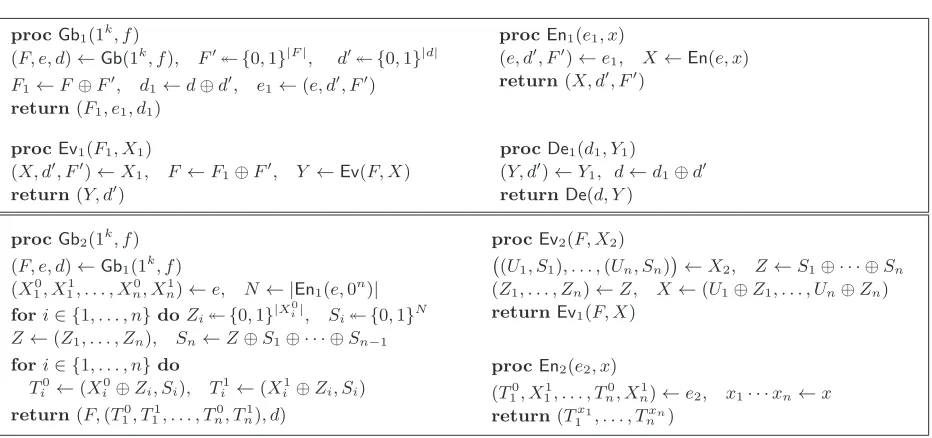
Fig. 4. Transform prv-to-prv1 (top): SchemeG1 = (Gb1,En1,De1,Ev1,ev) ∈GS(prv1, Φ) obtained by applying theprv-to-prv1transform toG= (Gb,En,De,Ev,ev)∈GS(prv, Φ).Transform prv1-to-prv2 (bottom):Projective garbling scheme G2 = (Gb2,En2,De1,Ev2,ev) ∈ GS(prv2, Φ) obtained by applying the prv1-to-prv2 transform to projective garbling schemeG1 = (Gb1,En1,De1,Ev1,ev)∈GS(prv1, Φ).
Now, we justify (2) via the following attack. Adversary A2(1k) picks R0, R1և{0,1}, and lets
fR0,R1 denote a circuit such that fR0,R1.n = k, fR0,R1.m = 1 and ev(fR0,R1, x) = Rx1 where x1 is the first bit of x. (We note that we construct the circuit in such a way that the topology is independent of R0, R1 and depends only on k.) It queries fR0,R1 to Garble to get back (G, ε). It parses (G′, v, V) ← G and v1· · ·vn ← v. Next for i = 1, . . . , n it queries (i, vi) to Input to
get back Ti and lets (Xi, ri)← Ti and (Zi, Vi) ← Xi. It lets y ←De2 ε,Ev2(G,(T1, . . . , Tn))
and y′ ← V ⊕V
1 ⊕ · · · ⊕Vn and r ← r1 ⊕ · · · ⊕rn. If y⊕y′ ⊕r = R0 ⊕R1 then it returns 1 else it
returns 0.
Let S2 be any PT simulator and consider game Prv2G2,Φ,S2. We claim that A2(1
k) returns 1
with probability 1 if the challenge bit b in the game is 1. This is because in this case we have y=ev(fR0,R1, v) andy
′ =r⊕ev(f
R0,R1, v) so by definition offR0,R1 we havey⊕y
′⊕r=R
0⊕R1.
Next we claim that A2(1k) returns 1 with probability at most 1/2 if the challenge bit bis 0. (We
emphasize that this claim is made regardless of the strategy of the simulator, showing that no simulator could possibly do well.) In the first phase, the simulator S2 is given 1k, Φtopo(f),0 as
input and can obtain no information on R0 or R1 beyond their length because the topology of
fR0,R1 is by construction independent ofR0, R1. In the second phase, the only useful information that the sender gets isy =ev(fR0,R1, v). It thus learns Rv1 but it has no information aboutR1−v1 and thus the probability that the y′ ⊕r computed by the adversary equals y ⊕R
0 ⊕R1 is at
most 1/2. ⊓⊔
3.3 Achieving prv1 security
We now describe a transformprv-to-prv1that successfully turns a prv secure circuit garbling scheme into a prv1 secure one. Combined with established results [5], this yields prv1 secure schemes based on standard assumptions. The idea (cf. [18]) is to use one-time pads to mask F and d, and then append the pads toX. This will ensure that the adversary learns nothing aboutF andduntil it fully specifies functionf andx. Given a (not necessarily projective) garbling schemeG= (Gb,En,De,Ev, ev), the prv-to-prv1 transform returns the garbling scheme prv-to-prv1[G] = (Gb1,En1,De1,Ev1,ev)
at the top of Fig. 4. We claim:
Theorem 2. For anyΦ, ifG ∈GS(prv, Φ) thenprv-to-prv1[G]∈GS(prv1, Φ).
The proof sketch is as follows. Given any PT adversaryA1against the prv1 security ofG1, we build
a PT adversary A against the prv security ofG. Now the assumption of prv security yields a PT simulatorS forAsuch thatAdvGprv, Φ,S(A,·) is negligible. Now we build fromS a PT simulatorS1
such that for all k∈Nwe have Advprv1, Φ,S1
G1 (A1, k)≤Adv
prv, Φ,S
G (A, k). This yields the theorem.
In Appendix D.1 we provide a full proof that shows how to buildAandS1. The idea for the latter
is that in its first stage,S1, given (1k, φ,0), returns randomF1 andd1. In the second phase, giveny,
it lets (F, X, d)ևS(1k, φ, y),F′ ←F1⊕F,and d′ ←d1⊕d. It returns (X, d′, F′). The formal proof
must attend to some pesky issues connected with the need for the simulator to know what length it must pick for F1 andd1.
Transform prv-to-prv1 does not require the starting scheme G to be projective. However, it is important that if G is projective, so isprv-to-prv1[G]. Seeing this requires a slight re-interpretation of certain quantities in the algorithms at the top of Fig. 4. Specifically, ewill now have the form (X10, X11, . . . , Xn0, Xn1) and Gb1 will lete1 = ((X10, d′, F′),(X11, d′, F′), X20, X21, . . . , Xn0, Xn1). Also X
inEn1 will have the form (X1, . . . , Xn) andEn1 will return ((X1, d′, F′), X2, . . . , Xn).
A potentially simpler transform of a prv secure garbling scheme G = (Gb,En,De,Ev,ev) into a prv1 secure garbling scheme G1 = (Gb1,En1,De1,Ev1,ev) is as follows. Algorithm Gb1(1k, f)
lets (F, e, d)ևGb(1k, f) and returns (ε,(e, F, d), ε). Let En
1((e, F, d), x) = (En(e, x), F, d). Let
Ev1(ε,(X, F, d)) = (Ev(F, X), d). Let De1(ε,(Y, d)) = De(d, Y). This works, but the scheme does
not meet the non-degeneracy requirement we have imposed in Section 2. Theprv-to-prv1transform can be seen as a way to effectively implement this trivial transform while avoiding degeneracy.
3.4 Achieving prv2 security
Next we show how to transform a prv1 scheme into a prv2 one. Formally, given a projective garbling schemeG= (Gb1,En1,De1,Ev1,ev)∈GS(prv1, Φ), theprv1-to-prv2transform returns the projective
garbling scheme prv1-to-prv2[G] = (Gb2,En2,De1,Ev2,ev) shown at the bottom of Fig. 4. The idea
is to mask the garbled input and then use the second part of GKR’s idea as represented byOMSS, namely secret-share the mask, putting a piece in each token, so that unless one has all tokens, one learns nothing about the garbled input. The formal proof of the following is in Appendix D.2.
Theorem 3. For any Φ, if G1 ∈ GS(prv1, Φ)∩GS(proj) then prv1-to-prv2[G1] ∈ GS(prv2, Φ)∩
GS(proj).
The proof sketch is as follows. We first build, from a given prv2 adversaryA2, a prv1 adversaryA1,
procGb1(1k, f)
(F, e, d)←Gb(1k, f), R
և{0,1}k
F1←F⊕Hash(|F|,0kR), d1 ←d⊕Hash(|d|,1kR)
return(F1,(e, R), d1)
procEn1(e1, x) (e, R)←e1
return(En(e, x), R)
procEv1(F1, X1)
(X, R)←X1, F ←F1⊕Hash(|F1|,0kR), Y ←Ev(F, X)
return(Y, R)
procDe1(d1, Y1)
(Y, R)←Y1, d←d1⊕Hash(|d1|,1kR)
returnDe(d, Y)
procGb2(1k, f) (F, e, d)←Gb1(1k, f)
fori∈ {1, . . . , n}doSiև{0,1}k
(X10, X11, . . . , Xn, X0 n)1 ←e, S←S1⊕ · · · ⊕Sn
fori∈ {1, . . . , n}do
T0
i ←(Xi0⊕Hash(|Xi0|,1kikS), Si) T1
i ←(Xi1⊕Hash(|Xi1|,1kikS), Si)
return(F,(T10, T11, . . . , Tn, T0 n), d)1
procEv2(F, T)
((U1, S1), . . . ,(Un, Sn))←T S←S1⊕ · · · ⊕Sn
fori∈ {1, . . . , n}do
Xi←Ui⊕Hash(|Ui|,1kikS)
returnEv1(F,(X1, . . . , Xn))
procEn2(e2, x) (T0
1, T11, . . . , Tn, T0 n)1 ←e2, x1· · ·xn←x
return(Tx1 1 , . . . , T
xn
n )
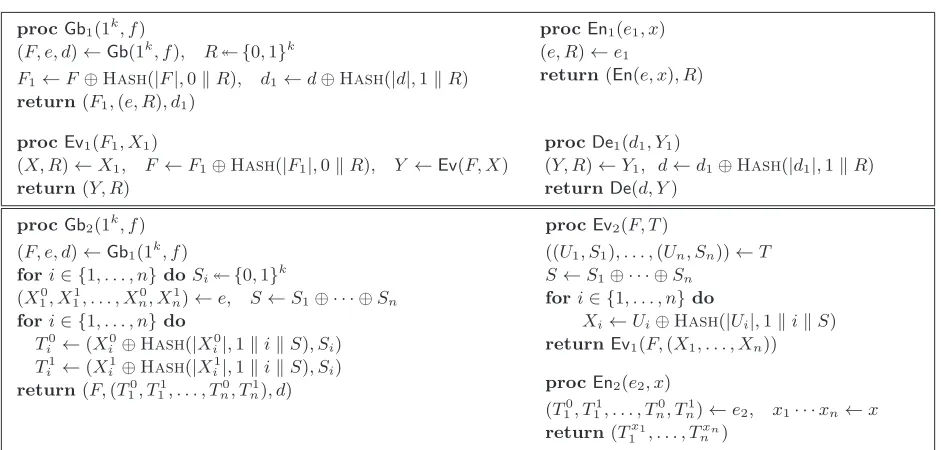
Fig. 5. Transform rom-prv-to-prv1 (top): Garbling scheme G1 = (Gb1,En1,De1,Ev1,ev) ∈ GSrom(prv1, Φ) ob-tained by applying the ROM rom-prv-to-prv1 transform to garbling scheme G = (Gb,En,De,Ev,ev) ∈ GS(prv, Φ).
Transformrom-prv1-to-prv2 (bottom):Projective garbling schemeG2 = (Gb2,En2,De1,Ev2,ev)∈GSrom(prv2, Φ) obtained by applying the ROMrom-prv1-to-prv2transform to projective garbling scheme G1 = (Gb1,En1,De1,Ev1,
ev) ∈ GS(prv1, Φ). The advantage of these transforms over the ones of Fig. 4 is that they preserve short garbled inputs.
return random tokens for the first n−1 bits of the input. Just before it must provide a token for the very last input bit, it gets the final output y. Now, it can run the prv1 simulator on y to get the real tokens and create the last piece of the secret mask and thence its last token so that the shares unmask the real tokens.
3.5 Efficient ROM transforms
The prv-to-prv1 transform does not preserve short garbled inputs, meaning even if G has short garbled inputs,prv-to-prv1[G] may not. Theprv1-to-prv2 transform preserves short garbled inputs, but we usually want to apply the two transforms in sequence. We do not know how to fill this gap in the standard model under standard assumptions. We will now provide a simple way to do it in the ROM (random-oracle model).
To extend our definitions of garbling-scheme privacy to ROM [6], we follow BHR’s treatment [5]. An ROM garbling scheme is a garbling scheme whose first four algorithms have access to an oracle
Hash called the random oracle (RO). The model is obtained by adding the following procedure
Hashto the games of Fig. 2. proc Hash(ℓ, w)
if H[ℓ, w] =⊥then
ifb= 1 thenH[ℓ, w]և{0,1}ℓ
elseH[ℓ, w]ևS(ℓ, w,ro)
TheHashprocedure can be called by a garbling scheme’s algorithms (Gb,En,De,Ev,ev), or by the adversary. If the challenge bit b is 0 then the simulator will itself answer queries made to Hash
by the adversary. In the code, ro is a formal symbol indicating to the simulator that it is being
asked to answer a query to Hash. For xxx ∈ {prv,prv1,prv2} we let GSrom(xxx, Φ) be the set of all garbling schemes that are xxx secure overΦ in the ROM.
The rom-prv-to-prv1transform at the top of Fig. 5 generates the mask of theprv-to-prv1 trans-form by applying the RO to a random k-bit seed R, and includesR in the encoding function and garbled input and output in place of the full mask, thereby saving space. As a consequence, it preserves short garbled inputs. We claim:
Theorem 4. For anyΦ, ifG ∈GS(prv, Φ) thenrom-prv-to-prv1[G]∈GSrom(prv1, Φ).
The proof is in Appendix D.3. The idea is standard. The simulator can pickF1, d1 at random just
as in the proof of Theorem 2. Then, once it has F, d, it will pick R at random and program the RO so thatF1=F⊕Hash(|F|,0kR) andd1 =d⊕Hash(|d|,1kR). Security relies on the fact that
the probability that the adversary queries (ℓ, w) to Hash, with R being the suffix of w, prior to receiving R in the garbled input, is negligible.
As with prv-to-prv1, we note that the starting scheme is not assumed projective, but a suitable re-interpretation of the notation is enough to ensure that if the starting scheme is projective, so is the constructed one.
Ourprv1-to-prv2already preserves short garbled inputs, but the size of a token in the constructed scheme is ntimes the size of a token in the original scheme. Therom-prv-to-prv1 transform at the bottom of Fig. 5 does a little better, increasing the size of each token by an additive nk bits regardless of the length of the tokens of the starting scheme. The idea is again to generate the masks of the prv1-to-prv2 transform by applying the RO to a seed and then secret-sharing the latter instead of the entire mask. The proof of the following, in Appendix D.4, is again standard:
Theorem 5. For anyΦ, ifG1 ∈GS(prv1, Φ)∩GS(proj) thenrom-prv1-to-prv2[G1]∈GSrom(prv2, Φ)∩
GS(proj).
As the statements of Theorems 4 and 5 indicate, we are assuming in both cases that the starting scheme is a standard-model one. This is for simplicity. One can apply the transform to a ROM scheme. (And, in the case of rom-prv1-to-prv2, are likely to, since the starting scheme is likely an output of rom-prv-to-prv1.) This can be handled by suitable “domain separation” of all ROs involved.
For conceptual simplicity we have presented two separate transforms but we note that one can gain efficiency by going directly from prv to prv2. We would not pickS as inrom-prv1-to-prv2but instead apply the secret-sharing directly to theR chosen byrom-prv-to-prv1.
3.6 “Standard” schemes are not prv2 secure
what we call partial evaluation: if certain output bits depend only on certain input bits, having the tokens for these input bits (and having the decoding rule, but not the tokens, for other input bits) allows one to compute the corresponding output bits. We will show that any scheme with this property is prv2 insecure. But the partial-evaluation property is possessed by all schemes that use the token-based, gate-encryption paradigm of Yao, in particular the ones mentioned above, and thus our results will imply that these schemes are not prv2 secure. We now proceed to formalize and prove this claim, defining what it means for a garbling scheme to permit partial evaluation and then showing that any scheme with this property fails to be prv2 secure.
Let G = (Gb,En,De,Ev,ev) be a projective circuit-garbling scheme, so that evis the canonical circuit-evaluation algorithm, taking as input a circuit f = (n, m, q, A, B, G) and x ∈ {0,1}f.n to
return ev(f, x) ∈ {0,1}f.m. We extend ev to a partial circuit evaluation algorithm ev that takes f
and x∈ {0,1,⊥}f.n and returns ev(f, x)∈ {0,1,⊥}f.m as follows:
proc ev(f, x)
(n, m, q, A, B, G)←f for g←n+ 1ton+q do
a←A(g),b←B(g)
if(xa=⊥ orxb=⊥) thenxg ← ⊥
elsexg←Gg(xa, xb)
return xn+q−m+1· · ·xn+q
Note that ev(f, x) =ev(f, x) if x ∈ {0,1}f.n. Partial evaluation captures an inherent property of
circuit evaluation, namely the ability to compute a part of the output given only the inputs on which it depends. For example if the first bit of ev(f, x) depends only on the first two bits of x, then this first output bit can be computed as the first bit of ev(f, x1x2⊥ · · · ⊥).
We say thatGpermits partial evaluation of the garbled function if the above property is inherited by the garbled-evaluation process. Thus if, as in the above example, the first bit ofev(f, x) depends only on the first two bits of x, then this first output bit can be computed given the garbled function F, the tokens Xx1
1 , X
x2
2 and the decoding rule d, meaning tokens corresponding to the
other bits of the input are not necessary. Formally we say that Ev is a partial garbled-evaluation algorithm for G if for any f ∈ {0,1}∗, any (F,(X0
1, X11, . . . , Xf.n0 , Xf.n1 ), d) ∈ [Gb(1k, f)], and any
x∈ {0,1,⊥}f.n, if we let X⊥
i =⊥for 1≤i≤f.n, then
De d,Ev(F,(Xx1
1 , . . . , Xnxn))
=ev(f, x).
In other words, tokens may now take value⊥, and evaluation of the garbled circuit is still possible, the result being the corresponding partial evaluation of the circuit. We say that G permits partial evaluation if it has a PT partial garbled-evaluation algorithm. The following says this condition implies thatG is not prv2 secure:
Proposition 6 Let G = (Gb,En,De,Ev,ev) be a projective circuit-garbling scheme that permits partial evaluation. Then G 6∈GS(prv2, Φ) for all Φ.
The result is quite strong with regard to side-information, saying the scheme is insecure for all
Proof (Proposition 6).Fork∈NletIDk:{0,1}k+1 → {0,1}k+1denote the identity function and let
idkdenote a circuit such thatidk.n=k+1,ev(idk,·) =IDk(·), andev(idk, x1· · ·xk⊥) =x1· · ·xk⊥
for every x1, . . . , xk ∈ {0,1}. Let Ev be the partial garbled-evaluation algorithm associated to G.
Consider the following adversary:
adversaryA2(1k)
(F, d)←Garble(idk)
xև{0,1}k+1, x1· · ·xk+1 ←x
for i∈ {1, . . . , k} doXi←Input(i, xi)
z←De(d,Ev(F,(X1, . . . , Xk,⊥)))
if z=x1· · ·xk⊥then return1else return 0
LetS2 be any (even computationally unbounded) simulator. Then for everyk∈N, lettingbbe the
challenge bit in game Prv2G2,Φ,S2, we have
PrhPrv2A2
G,Φ,S2(k) | b= 1
i
= 1 and Prh¬Prv2A2
G,Φ,S2(k) | b= 0
i
≤2−k.
The first equation uses the assumption that Ev is a partial garbled-evaluation algorithm. The second equation is true because S has no information about the input x until the very last token is requested, and the adversary stops just short of that. Subtracting we have
Advprv2, Φ,S2
G (A2, k)≥1−2−k ,
which proves the theorem. ⊓⊔
3.7 One-time programs
Security definition for a one-time compiler. The notion of a one-time program was put forward by Goldwasser, Kalai, and Rothblum (GKR [17]). The intent is that possession of a one-time program P for a function f should enable one to evaluate f at any single value x; but, beyond that, the one-time program should be useless. Unachievable in any standard model of computation (where possession of P would enable its repeated evaluation at multiple point), GKR suggest achieving one-time programs in a model of computation that providesone-time memory— tamper-resistant hardware whose read-once i-th location returns, on query (i, b) ∈N× {0,1}, the stringTb
i, immediately thereafter expungingTi1−b. Aone-time compiler probabilistically transforms
the description of a functionf into a one-time programP and its associated one-time memoryT. For a formal treatment, we begin by specifying two stateful oracles; see Fig. 6. The first,OTPf,
formalizes the desired behavior of a one-time program for f. Here f will now be regarded as a string, not a function, but this string represents a circuit computing a functionev(f) :{0,1}f.n →
{0,1}f.m; we write ev for the canonical circuit-evaluation function [5]. The agent calling out to
OTPf provides x and, on the first query, it gets ev(f, x). Subsequent queries return nothing. On
the right-hand side of Fig. 6 we similarly define an oracle OTMT, this to model possession of a
one-time-memory system. Given a list ofℓpairs of strings (establish some convention so that every string T is regarded as denoting a list of ℓ pairs of strings, for some ℓ∈N), the oracle returns at most one string from each pair satisfying each request.
Elaborating on GKR, we now define a one-time compiler as a pair of probabilistic algorithms Π = (Co,Ex) (for compile and execute). Algorithm Co, on input 1k and a string f, produces a
pair (P, T)←Co(1k, f) whereP (the one-time program) is a string and T (the one-time-memory)
procOTPf(x) procOTMT(i, b)
ifx6∈ {0,1}f.n then return
⊥ (T0
1, T11, . . . , Tℓ0, Tℓ1)←T
ifcalledthen return⊥ ifi6∈[1..ℓ]orusediorb6∈ {0,1}then return⊥ called←true usedi←true
returnev(f, x) returnTb i
Fig. 6. Oracles model one-time programs and one-time memory.OracleOTPdepends on a stringf repre-senting a boolean circuit. Oracle OTM depends on a list of stringsT.
to an oracle O, returns a string y ← ExO(P, x). We require the following correctness condition of Π= (Co,Ex): if (P, T)←Co(1k, f) andx∈ {0,1}f.n thenExOTMT(·,·)(P, x) =ev(f, x).
The security of Π = (Co,Ex) will be relative to a side-information function Φ; the value φ= Φ(f) captures the information about f that P is allowed to reveal.11 So fix a one-time
com-piler Π = (Co,Ex), an adversary A, a security parameter k, and a string f. (1) Consider the distributionRealΠ,A,f(k) determined by the following experiment: first, sample (P, T)←Co(1k, f);
then, runAOTMT(·)(1k, P) and output whatever Aoutputs. (2) Alternatively, fix a one-time com-piler Π = (Co,Ex), a side-information function Φ, a simulator S, a security parameter k, and a string f. Consider the distribution FakeΠ,Φ,S,f(k) determined by the following experiment: run
SOTPf(·)(1k, Φ(f)) and output whateverS outputs. ForD an algorithm andΠ,Φ,A, S, and kas above, let
AdvotcΠ,Φ,A,S,D(k) = Pr[(f, σ)← D(1k);v←RealΠ,A,f(k) : D(σ, v)⇒1]−
Pr[(f, σ)← D(1k);v←FakeΠ,Φ,S,f(k) : D(σ, v)⇒1]
One-time compilerΠ is said to be (OTC-)secure with respect to side-information functionΦif for any PPT adversaryAthere is a PPT simulatorS such that for all PPT distinguishers D, function AdvotcΠ,Φ,A,S,D(k) is negligible.
Discussion. Let us briefly talk through the definition. The distinguisher D selects f and is presented with a string drawn from one of two worlds. In the first world, the distinguisher is given the output (equivalently, the view) of an adversary A who has the garbled program P for f and its associated one-time memory. Using the execution procedure Ex the adversary could compute ev(f, x), if it so wishes, but it is not compelled to do so. In the second world, the distinguisher is given output produced by a simulatorS. That simulator has no one-time memory; it has only the side-informationΦ(f) aboutf and an ideal one-time program for f. In a protocol we deem secure, no matter what the adversary does, there will be a simulator such that the two views described will be computationally close.
To arrive at an achievable notion of security, one must allow that information beyond the function’s value atx to be leaked; minimally, information on the size of the circuit will be revealed. Indeed the construction of GKR leaks more—it divulges thetopology of a circuit computingf. We follow BHR’s approach for handling side-information, one whereΦacts as a “knob” controlling just what may be learned of f.
Constructing an OTC from a garbling scheme.A projective circuit-garbling scheme G = (Gb,En,De,Ev,ev) can be turned into a one-time compiler Π = (Co,Ex) in a natural way: let
11For example, we might have Φ(f) = Φsize(f) = (f.n, f.m, f.q), the number of inputs, outputs, and gates; or
OTC[G] = (Co,Ex) be defined as follows. (1) Co(1k, f): let (F, e, d) ← Gb(f) and return (P, T)
where P = (F, d) and T =e. (2) ExO(P, x): Let (F, d)← P, let x1· · ·xn ← x, query oracle O on
(1, x1), . . . ,(n, xn) to obtain X1, . . . , Xn, respectively, and return De(d,Ev(F, X)) with X = (X1,
. . . , Xn). The proof of the following is in Appendix D.9. The straightforwardness of the construction
and its trivial proof are, we believe, points in our favor, evidence of our claim that the garbling-scheme abstraction and appropriate security notions for it engender applications in direct, simple and less error-prone ways.
Theorem 7. IfGis a prv2-secure projective garbling scheme over side-information functionΦthen
OTC[G] is OTC-secure with respect to side-informationΦ.
A concrete one-time compiler may be obtained from any prv-secure (projective) garbling scheme by (1) using ourprv-to-prv1 transform to go from the prv garbling scheme to a prv1 one (2) using ourprv1-to-prv2transform to go from the prv1 scheme to a prv2 one, and (3) applying Theorem 7. BHR [5] provide prv-secure garbling schemes based on PRFs and thence on one-way functions, yielding a one-way function based one-time compiler to recover the original claim of GKR [17].
Analysis of OTC[OMSS[G]]. The claim of GKR [17], in our language, is that if G is a prv-secure (projective) garbling scheme thenOTC[OMSS[G]] is otc-secure. Proposition 1, showing that OMSS[G] need not be prv2-secure, does not refute this claim, for the prv2 security of OMSS[G], while sufficient to establish the claim, may not be necessary. Here we accordingly refute the claim by extending the counter-example of Proposition 1 to give a projective, prv-secure garbling scheme G for which OTC[OMSS[G]] is shown by attack to not be otc-secure. (That is, we show that this transform will yield programs that are not one-time.)
This example does not contradict the updated claim of [16], made in response to our work, of a OTC based on exponentially-hard one-way functions. The latter would correspond, in our language, to the claim thatOTC[OMSS[G]] is a secure OTC if G has exponential prv-security.
Proceeding to the counter-example, recall that in the proof of Proposition 1, we gave a garbling schemeG= (Gb,En,De,Ev,ev) such that G ∈GS(prv, Φtopo) but G2 =OMSS[G]6∈GS(prv2, Φtopo).
Now we show that OTC[G2] is otc-insecure, by demonstrating an attack. Distinguisher D(1k)
picks R0, R1և{0,1}, and lets fR0,R1 denote a circuit such that fR0,R1.n = k, fR0,R1.m = 1 and ev(fR0,R1, x) =Rx1 wherex1 is the first bit of x. (We construct the circuit in such a way that the topology is independent of R0, R1 and depends only on k.) It queries fR0,R1, and then outputs 1 only if the oracle’s answer isR0⊕R1.
The adversary A(1k) is given (G, ε), and parses (G′, v, V) ← G and v
1· · ·vn ← v. Next for
every i≤n, it queries (i, vi) toInput to get back Ti and lets (Xi, ri)← Ti and (Zi, Vi) ← Xi. It
lets y ← De2(ε,Ev2(G,(T1, . . . , Tn))) and y′ ← V ⊕V1⊕ · · · ⊕Vn and r ← r1 ⊕ · · · ⊕rn. It then
returns y⊕y′⊕r. Note that y=ev(f
R0,R1, v) andy′ =r⊕ev(fR0,R1, v) so by definition offR0,R1 we have y⊕y′⊕r =R
0⊕R1. Hence givenRealΠ,A,f(k), the distinguisher always outputs 1.
Let S be any (even computationally unbounded) simulator. It is given only 1k, Φ
topo(f) as
input and can obtain no information on R0 or R1 beyond their length because the topology of
fR0,R1 is by construction independent ofR0, R1. The simulator is given oracle access toOTPfR0,R1 and can obtain either R0 or R1 but not both. SinceR0 is independent of R0 ⊕R1, and so is R1,
the probability that the simulator can output R0 ⊕R1 is 1/2. Hence, given FakeΠ,Φ,S,f(k), the
procGarble(f, x) ObvG,Φ,S
ifx6∈ {0,1}f.n then return⊥
ifb= 1then
(F, e, d)←Gb(1k, f) X←En(e, x)
else
(F, X)← S(1k, Φ(f))
return(F, X)
procGarble(f) Obv1G,Φ,S
ifb= 1then
(F, e, d)←Gb(1k, f)
else
F← S(1k, Φ(f),0)
returnF
procInput(x)
ifx6∈ {0,1}f.n then return
⊥
ifb= 1thenX ←En(e, x)
elseX← S(1)
returnX
procGarble(f) Obv2G,Φ,S n←f.n; Q← ∅; σ←ε
ifb= 1then
(F,(X0
1, X11, . . . , Xn0, Xn1), d)←Gb(1 k, f)
else
F ← S(1k, Φ(f),0)
returnF
procInput(i, c)
ifi6∈ {1, . . . , n} \Qthen return⊥
xi←c; Q←Q∪ {i}
ifb= 1thenXi←Xxi
i
elseXi← S(i,|Q|)
returnXi
procGarble(f, x) AutG
ifx6∈ {0,1}f.nthen return
⊥
(F, e, d)←Gb(1k, f) X ←En(e, x)
return(F, X)
procGarble(f) Aut1G (F, e, d)←Gb(1k, f)
returnF
procInput(x)
ifx6∈ {0,1}f.nthen return⊥ X←En(e, x)
returnX
procGarble(f) Aut2G n←f.n; Q← ∅; σ←ε
(F,(X0
1, X11, . . . , Xn, X0 n), d)1 ←Gb(1k, f)
returnF
procInput(i, c)
ifi6∈ {1, . . . , n} \Qthen return⊥
xi←c; Q←Q∪ {i}, Xi←Xxi
i
if|Q|=nthenX ←(X1, . . . , Xn)
returnXi
Fig. 7. Obliviousness (top).Games for defining the obv, obv1, and obv2 security ofG = (Gb,En,De,Ev,ev). For each game,Initialize() samplesbև{0,1}andFinalize(b′) returns (b=b′).Authenticity (bottom).Games for defining the aut, aut1, and aut2 security ofG = (Gb,En,De,Ev,ev). ProcedureFinalize(Y) of each game returns 0 ifx6∈ {0,1}f.n, otherwise it returns (
De(d, Y)6=⊥andY 6=Ev(F, X)).
4 Obliviousness, Authenticity and Secure Outsourcing
We define obliviousness and authenticity, both with either the coarse-grained or fine-grained adap-tivity. We show how to achieve these goals, in combination with adaptive privacy, via generic transforms and in the standard model. We then give more efficient transforms for the ROM model. Finally we apply this to obtain extremely simple and modular designs, and security proofs, for verifiable outsourcing schemes based on the paradigm of GGP [12].
4.1 Definitions for adaptive obliviousness and authenticity
Obliviousness. Intuitively, a garbling scheme is oblivious if garbled function F and garbled input X, these corresponding to f and x, reveal nothing of f orx beyond side-information Φ(f). In particular, possession ofF andX will not allow the calculation ofy =ev(f, x).
privacy counterparts. The first important difference is that the adversary does not get the decoding functiond. The second important difference is that the simulator must do withouty=ev(f, x). For a garbling schemeG, side-informationΦ, simulatorS, adversaryA, and security parameter k∈N, we letAdvobvG , Φ,S(A, k) = 2 Pr[ObvAG,Φ,S(k)]−1,Advobv1G , Φ,S(A, k) = 2 Pr[Obv1A
G,Φ,S(k)]−1, and
finally Advobv2G , Φ,S(A, k) = 2 Pr[Obv2AG,Φ,S(k)]−1. Garbling scheme G is obv secure with respect to Φ if for every PPT A there exists a simulator S such that AdvobvG , Φ,S(A, k) is negligible. We similarly define obv1 and obv2 security. For xxx∈ {obv,obv1,obv2} we let GS(xxx, Φ) denote the set of all garbling schemes that are xxx secure overΦ.
Authenticity.Fig. 7 also formalizes the games underlying three definitions of authenticity, cap-turing an adversary’s inability to create from F and X a garbled output Y 6= F(X) that will be deemed authentic. The static definition of BHR [5] is strengthened either to allow the adversary to specify x subsequent to obtaining F, or, stronger, the bits ofx are provided one-by-one, each corresponding token then issued. For the second case, game Aut2, the garbling scheme must once again be projective. For a garbling scheme G, adversary A, and security parameter k∈ N, we let AdvautG (A, k) = Pr[AutAG(k)], Advaut1G (A, k) = Pr[Aut1AG(k)], and Advaut2G (A, k) = Pr[Aut2AG(k)]. Garbling schemeG is aut secure if for every PPTAAdvautG (A, k) is negligible. We similarly define aut1 and aut2 security. For xxx ∈ {aut,aut1,aut2} we let GS(xxx) denote the set of all garbling schemes that are xxx secure.
4.2 Achieving obv1 and aut1 security
It is tempting to think that the prv-to-prv1 operator in Fig. 4 will also promote xxx security, with xxx ∈ {obv,aut}, to xxx1 security. However, a second glance reveals that prv-to-prv1 does not promote aut to aut1, as the following counter-example illustrates. Let G = (Gb,En,De,Ev, ev) be a garbling scheme that is aut secure. Consider G′ = (Gb′,En,De′,Ev,ev) defined as follows.
On input (1k, f), the algorithm Gb′ creates (F, e, d) ← Gb(1k, f), and then returns (F, e,1 k d). On input (d′, Y), the algorithm De′ parses d′ = b k d, and outputs De(d, Y) if b = 1, and out-puts 1 otherwise. The scheme G′ inherits aut security from G. The scheme G
1 =prv-to-prv1[G′] =
(Gb1,En1,De1,Ev1,ev) is not even aut secure. An adversary can attackG1as follows. First, query an
arbitrary circuitf and input x ∈ {0,1}f.n to receive (F
1, X1). LetX1 = (X, d′, F′). Then, output
Y = (1, d′). Let d
1 be the decoding function used to authenticate Y. Then d1⊕d′ = 1 k d, and
d1⊕d′ = 0kd. Hence De1(d1, Y) = 1, and the adversary wins with advantage 1.
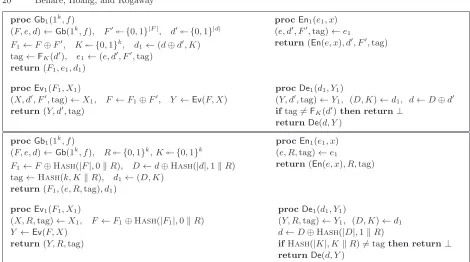
We now show how to change prv-to-prv1 to an operator all-to-all1 that promotes any xxx ∈ {prv,obv,aut} to being xxx1 secure. The insecurity of the prv-to-prv1 operator arises because the adversary can forge a fake d′, where d′ is the one-time pad masking the decoding function d. To prevent this, we choose Kև{0,1}k, and append FK(d′) to the garbled input X, where F :
{0,1}k× {0,1}∗ → {0,1}k is a PRF. The decoding function will be (d′ ⊕d, K). See Fig. 8. The
proof of the following is in Appendix D.5.


![Fig. 9. Games to define thefrom garbling schemeΠ verifiability (OSVF) (top left) and privacy (OSPR) (top right) of outsourcing scheme = (Gen, Inp, Out, Comp, ev), and the outsourcing scheme Π[G] = (Gen, Inp, Out, Comp, ev) (bottom) constructed G = (Gb, En, De, Ev, ev) .](https://thumb-us.123doks.com/thumbv2/123dok_us/7885258.1308364/24.595.103.499.137.337/thefrom-garbling-schemep-veriability-privacy-outsourcing-outsourcing-constructed.webp)