Resizable Tree-Based Oblivious RAM
Tarik Moataz1,∗,§, Travis Mayberry2,§, Erik-Oliver Blass3, and Agnes Hui Chan2 1
Dept. of Computer Science, Colorado State University, Fort Collins, CO and IMT, Telecom Bretagne, France
2
College of Computer and Information Science, Northeastern University, Boston, MA
{travism|ahchan}@ccs.neu.edu
3 Airbus Group Innovations, 81663 Munich, Germany
Abstract. Although newly proposed, tree-based Oblivious RAM schemes are drastically more efficient than older techniques, they come with a significant drawback: an inherent dependence on a fixed-size database. Yet, a flexible stor-age is vital for real-world use of Oblivious RAM since one of its most promising deployment scenarios is for cloud storage, where scalability and elasticity are crucial. We revisit the original construction by Shi et al. [17] and propose several ways to support both increasing and decreasing the ORAM’s size with sublinear communication. We show that increasing the capacity can be accomplished by adding leaf nodes to the tree, but that it must be done carefully in order to pre-serve the probabilistic integrity of data structures. We also provide new, tighter bounds for the size of interior and leaf nodes in the scheme, saving bandwidth and storage over previous constructions. Finally, we define an oblivious pruning technique for removing leaf nodes and decreasing the size of the tree. We show that this pruning method is both secure and efficient.
1
Introduction
Oblivious RAM has been a perennial research topic since it was first introduced by Goldreich [8]. ORAM allows for an access pattern to an adversarially controlled RAM to be effectively obfuscated. Conceptually, a client’s data is stored in an encrypted and shuffled form in the ORAM, such that accessing pieces of data will not produce any recognizable pattern to an adversary which observes these accesses. Being a powerful cryptographic primitive, many additional uses besides storage can be envisioned for ORAM, such as an aid for homomorphic circuit evaluation, secure multi-party compu-tation, and privacy-preserving data outsourcing. Given the advent of cloud computing and storage, and all their potential for abuse and violation of privacy, ORAM schemes are important for the real-world today.
∗
Work done while at Northeastern University.
§
A crucial aspect of ORAM schemes is their implied overhead. In today’s cloud settings, the choice to use the cloud is chiefly motivated by cost savings. If the overhead is enough that it negates any monetary advantages the cloud can offer, the use of ORAM will be impractical. Previous ORAM schemes have had a common, major drawback that has hindered real-world use: due to eventually necessary “reshuffling” operations, their worst-case communication complexity was linear in the size of the ORAM. Recent works on ORAM, e.g., by Shi et al. [17], Stefanov et al. [18], and many derivatives, have proposed new ORAM schemes that are tree-based and have only poly-logarithmic worst-case communication complexity.
However, new tree-based approaches have exposed another barrier to the real-world adoption of ORAMs: the maximum size of the data structure must be determined during initialization, and it cannot be changed. This is not an issue in previous linear schemes, because the client always had the option of picking a new size during the “reshuffling”, being effectively a “reinitialization” of the ORAM. In tree-based ORAMs, though, a reinitialization ruins the sublinear worst-case communication complexity.
Resizability is a vital property of any ORAM to be used for cloud storage. One of the selling points of cloud services is elasticity, the ability to start with a particular footprint and seamlessly scale resources up or down to match demand. Imagine a startup company that wants to securely store their information in the cloud using ORAM. At launch, they might have only a handful of users, but they expect sometime in the long-term to increase to 10,000. With current solutions, they would have to either pay for the 10,000 users worth ofstoragestarting on day one, even though most of it would be empty, or pay for thecommunicationto repeatedly reinitialize their database with new sizes as they become more popular. Reinitializing the ORAM would negate any benefit from the new worst-case constructions. Additionally, one can imagine a company that is seasonal in nature (e.g., a tax accounting service) and would like the ability to downsize their storage during off-peak times of the year to save costs.
Consequently, the problem of resizing these new tree-based ORAMs is important for practical adoption in real-world settings. In light of that, we present several tech-niques for both increasing and decreasing the size of recent tree-based ORAMs to re-duce both communication and storage complexity. We focus on constant client memory ORAM (the Shi et al. [17] ORAM), and are able to show that, although the resizing techniques themselves are intuitive, careful analysis is required to ensure security and integrity of ORAMs. In addition, we show that it is nontrivial to both allow for sublinear resizing and maintain the constant client memory property of Shi et al. [17] ORAM.
The technical highlights of this paper are as follows:
1. Three provably secure strategies for increasing the size of tree-based ORAMs, along with a rigorous analysis showing the impact on communication and storage complexity and security.
2. A provably secure method for pruning the trees to decrease the size of a tree-based ORAM, again including rigorous analysis showing that security and integrity of the data structures is preserved.
2
Building Blocks
We will briefly revisit the constant-client memory tree-based ORAM of Shi et al. [17], focusing on the relevant details which are necessary to understand our resizing tech-niques.
2.1 Preliminaries
An Oblivious RAM is a cryptographic data structure storing blocks of data in such a way that a client’s pattern of accesses to those blocks is hidden from the party which holds them. ORAMs offer block reads and writes. That is, they provideRead(a)and
Write(d, a)operations, whereais the address of a block, anddnotes some data. Let N be the total number of blocks the ORAM can store. Each ORAM block is uniquely addressable bya∈ {0,1}logN, and the size of each block is`bits.
Data in the ORAM [17] is stored as a binary tree withN leaves. Each node in the tree represents a smaller ORAM bucket[7] which holdsk (encrypted) blocks. When clear from the context, we will use the terms node and bucket interchangeably. Each leaf in the tree is uniquely identified by atag t∈ {0,1}logN. WithP(t), we denote the path which starts at the root of the tree and ends at the leaf node taggedt.
Blocks in the ORAM are associated with leaves in the tree. The association between blocks and their addresses is a lookup table with size equal toN·logN. This table is called theposition map, and in order to maintain efficiency it is recursively stored in series of smaller ORAMs [17]. The central invariant of tree-based ORAMs is that a block tagged with tagtwill always be found in a bucket somewhere on the pathP(t). Blocks will enter the tree at the root and propagate toward the leaves depending on their tag.
2.2 Tree-based Construction
Shi et al. [17]’s ORAM implements Read and Write operations by applying, first,
ReadAndRemove(a)operation, followed by anAdd(d, a). AReadAndRemove(a)will first fetch the tag t from the position map, thereby determining the pathP(t)in the ORAM tree on which that block exists. The client will download all logN nodes in
P(t), and decrypt all blocks. For each blocka0 6= aon pathP(t), the client will up-load back to the server a re-encrypted version of that block. For blocka, the client will upload an encrypteddummyblock, which is a special value signifying that the block is empty. The client does this in a bucket-by-bucket, block-by-block decrypt and encrypt manner, to keep client memory constant inN. As long as the encryption is secure, the server will not learn which block the client was interested in, because all they will see is fresh encryptions replacing every block in the path. For theAddoperation, the client uniformly chooses a new tagt← {$ 0, . . . , N−1}that associates blockato a new leaf, encryptsdand inserts the resulting ciphertext block into the root.
corresponding child (as determined by its tag). To stay oblivious, the eviction accesses both child buckets in turn, thereby (re-)encrypting both buckets. Again, this is done in a block-by-block manner to keep client memory constant.
3
Resizable ORAM
3.1 Technical Challenges
The challenge behind resizing tree-based ORAMs is threefold:
1. Increasing the size of the tree will have an impact on the bucket size. A leaf node may become an interior node while increasing the ORAM, and vice versa in the decreasing case. The original analysis by Shi et al. [17] differentiates between in-terior and leaf nodes, while for resizing we will have to generalize the analysis to consider both cases at once.
2. Forn > N elements, we must determine the most effective strategy of increasing the number of nodes to optimize storage and communication costs for the client. 3. Reducing the size of the tree is non-trivial, especially when targeting low
com-munication complexity and constant client memory. A mechanism is required for moving elements from pruned nodes into other buckets in an oblivious, yet efficient way while still maintaining overflow probabilities.
3.2 Resizing Operations
To allow for resizing, we introduce two new basic operations by which a client can resize an ORAM, namelyAllocandFree:
– Alloc: Increase the size of the ORAM so that it can hold one additional element of size`.
– Free: Decrease the size of the ORAM so that it can hold one element fewer.
3.3 Security Definition
Resizing an ORAM should not leak any information besides the current number of elements. Thus, we need to augment the standard ORAM security definition by our resizing operations.
Definition 31 Let −→y = {(op1, d1, a1),(op2, d2, a2), . . . ,(opM, dM, aM)} be a
se-quence ofM operations(opi, di, ai), whereopi denotes aRead,Write,AllocorFree
operation,aiequals the address of the block ifopi∈ {Add,ReadAndRemove}anddi
the data to be written ifopi=Add.
Let A(−→y) be the access pattern induced by sequence −→y. A resizable ORAM is secure iff, for any PPT adversaryDand any two same-length sequences −→y and −→z
where∀i∈[M] :→−y(i) =Alloc⇔ −→z(i) =Alloc∧ −→y(i) =Free⇔ −→z(i) =Free,
|P r[D(1λ, A(−→y)) = 1]−P r[D(1λ, A(−→z)) = 1]| ≤(λ),
For sake of completeness, considering buckets in resizable ORAM as trivial ORAMs [7], all blocks are IND-CPA encrypted. Also, whenever a block is accessed by any type of operation, its bucket is re-encrypted block-by-block.
4
Adding
We begin by describing ana¨ıvesolution that will add a new level of leaves whenn > N. However, this already leads to a problem: whennis only slightly larger thanN, we are using twice as much storage as we should need. The second strategy,lazy expansion, will postpone creation of an entire new level until we have enough elements to re-ally need it. In both the na¨ıve and second solution, there are thresholds causing large “jumps” in storage space. As this can be expensive, we present a third solution dubbed
dynamic expansion. This strategy progressively adds leaf nodes to the tree, thereby gradually increasing the tree’s capacity. This last strategy is particularly interesting, be-cause it results in an unbalanced tree, requiring careful analysis to ensure low overall failure probability of the ORAM.
4.1 Tightening the bounds
Communication and storage complexities represent the core comparative factor be-tween strategies, and both are dependent primarily on bucket sizes. Consequently, it is important to get a tight analysis for both interior and leaf bucket sizes. The original bounds for bucket sizes given by Shi et al. [17] are substantially larger than necessary. Therefore, as a first contribution, we give new, tighter bounds for interior and leaf node sizes.
Interior Nodes We first address the size of interior nodes by using standard queuing theory. LetIidenote the random variable for the size of interior nodes of theithlevel in the tree. For eviction rateν, we compute the probability of a bucket on levelsi >logν having a load of at leastk(i.e., a sizekbucket overflows) to:
Pr(Ii≥k) =ν−k. (1)
In [17], the eviction rate was chosen to be equal to 2 with an overflow probability equal to2−k. However, if we adjust the bucket size to be log(kν), the overflow probability is still2−k, namelyPr(Ii≥log(kν)) = 2−k.
Pr(∃i∈[ν·logN] : Ii≥ k
log(ν)) = 1−Pr(∀i∈[ν·logN] : Ii<
k
log(ν)) (2)
= 1−
ν·logN Y
i=1
(1−Pr(Ii≥ k
log(ν))) (3) = 1−(1−2−k)ν·logN.
In particular forν= 4, the optimal choice of the eviction rate,
Pr(∃i∈[4·logN] : Ii≥ k
2) = 1−(1−2
−k)4·logN.
The buckets that can overflow during an access are limited to those in the paths ac-cessed during the eviction, i.e.,ν·logNbuckets accessed. Also, the number of buckets taken into account is actuallyν·logNinstead of2ν·logN. This follows from the fact that for every parent, we write only one real element to one child. Consequently, per eviction and per level, only one child can overflow. For Eq. 3, an equality still holds since the buckets can be considered independent in steady state [12].
Given security parameterλ, to compute the size of interior buckets, we solve the equation2−λ= 1−(1−2−k)ν·logN tok=−log (1−(1−2−λ)ν·log1N).
For example, to have an overflow probability equal to2−64,λ = 64,N = 230, ν = 4, the bucket size needs to be only36while Shi et al. [17] determined the bucket size be equal72for the same overflow probability. Moreover, sinceN, the number of elements in the ORAM, has a logarithmic effect on the overflow probability, the size of interior nodes will not change for large fluctuations of the number of elementsN. For example, forN = 280, the interior node still has size36with overflow probability
2−64.
Leaf Nodes LetBidenote the random variable describing the size of theithleaf node. Thinking of a leaf node as a bin, a standard balls and bins game argument provides us the following upper bound
Pr(Bi≥k)≤
N k
· 1
Nk ≤ ek kk.
The second inequality follows from an upper bound of the binomial coefficient us-ing Stirlus-ing’s approximation. ForN leaves, we have
Pr(∃i∈[N] : Bi ≥k) = Pr( N [
i=1
Bi ≥k)
≤
N X
i=1
Pr(Bi≥k) (4)
≤ N
Note that in Eq. 4, we have used the union bound. Based on the same parameters as in the previous example, the size of a leaf node has to be set only to 28to have an overflow probability equal to2−64. To compute this result, one solves the equation k = eW(log 2eλ·N)+1, whereW(.)is the product log function. While the size of the interior node can be considered constant for large fluctuations ofN, the size of a leaf node should be carefully chosen depending onN. Every time the number of elements increases by a multiplicative factor of 32, we have to increase the size of the leaf node by1to keep the same overflow probability.
Notethat for both interior and leaf node size computations, we do not take into account the number of operations (accesses) performed by the client. As with related work, the number of ORAM operations is typically considered part of security parame-terλ. The larger the number of operations performed, the larger the security parameter has to be.
4.2 1stStrategy: na¨ıve expansion
LetNandnrespectively denote the number of leaf nodes and elements in the ORAM. The na¨ıve solution is simply adding a new leaf level, as soon as the conditionn > N occurs. The main drawback of this first na¨ıve solution is the waste of storage which can be explained from two different perspectives. The first storage waste consists on creating, in average, more leaf nodes than elements in the ORAM. The second storage waste in the under-usage of the leaf nodes while they can hold more elements with a slight size increase. Our second strategy will try to get rid of this drawback.
4.3 2ndStrategy: lazy expansion
This technique consists of creating a new tree level when the number of elements added is equal toαtimes the number of leaf nodes in the tree. For aN leaves tree, the client is allowed to store up toα·N elements in the ORAM without increasing the size of the tree. As soon asn > α·N, the client asks the server to create a new level of leaves with2·Nleaf nodes.
This lazy increase strategy is performed recursively. For example, if the size of the ORAM tree is now equal to2·N, then the client will work with the same structure as long asα·N < n≤α·2·N. Oncen > α·2·N, a new level of leaves with now4N leaf buckets is created.
To be able to store more elements, our idea is to slightly increase the leaf bucket size. Therewith, we can keep the same overflow probability. Note the tradeoff between increasing the size of leaf nodes and the communication complexity of the ORAM. To read or write an element in the ORAM, the client downloads the path starting from the root to the leaf node. If the size of this path (when increasing the size of the bucket) is larger than a regular ORAM tree with the same number of elements, then this technique would not be worth applying.
the storage cost for a given overflow probability, we instead target the computation of the valueαfor the optimal communication complexity. In our subsequent analysis, the previous bounds for interior and leaf node sizes as computed in Section 4.1 are used.
First, we determine a relation between the size xof a leaf bucket and factor α for our 2nd strategy. Then, we compute the optimal value ofαas a function of the security parameterλ, the size of the interior nodes, and the current number of leaves. To calculate the overflow probability, we focus on the worst case occurring when there areα·Nelements in an ORAM withNleaves.
Lemma 41 Letxdenote the optimal leaf bucket size for the2ndstrategy. Then,
α= x
e ·(
2−λ
N )
1
x (5)
holds, whereλis the security parameter andNthe number of leaf nodes.
Proof. By a balls-and-bins argument, we are in a scenario where we insert uniformly at randomα·N balls intoN bins. Theithbin overflows if there arexballs fromα·N that went to the sameithbin. The possible number of combinations equals α·N
x
. By applying the upper bound inequality to the probability of the union of events (possible combinations), we obtain
Pr(Bi ≥x)≤ α·N
x
· 1
Nx
≤(e·α·N
x )
x· 1 Nx
= (e·α
x ) x.
Computing the union bound over all leaf nodes results in
Pr(∃i∈[N] : Bi≥x)≤N·( e·α
x ) x.
In order to have overflow probability equal2−λas previous work, we must verify that N·(e·αx )x= 2−λwhich is equivalent toα= xe·(2−λN )1x. ut
Corollary 41 Letkdenote the size of the interior node. The best communication com-plexity for the2ndstrategy is achieved iff the leaf bucket sizexequals
x=
k ln 2+
q
k−4·k·log2−λN 2
download one path for the first and second strategy. For an interior node with sizekand a leaf bucket for the na¨ıve strategy with sizey, the communication complexitiesC1and C2compute to
C1= (logα·N−1)·k+yandC2= (logN−1)·k+x.
The best value ofxfor a fixed value ofy,kandλis the maximum value of the function f defined as
f(x) =C1−C2=y−x+k·logα.
The first derivative off is dfdx(x) = x2− k
ln(2) ·x+k·log 2−λ
N . This quadratic equation has only one valid solution for a non-negative leaf buckets size and2λ>> N. The only valid root for the first derivative isx=
k ln 2+
q
k−4·k·log2−λ N
2 . ut
Once we have computed the optimal leaf node size, we can plug the result into Eq. 5 to compute the optimal valueα. For example, forN = 230leaves, the size of the leaf bucket in the na¨ıve strategy isy= 28, the size of the interior nodek= 36. Applying the result of Corollary 41 outputs the size of the leaf bucket for an optimal communication complexity which is equal tox≈85. Applying the result of Lemma 41, we obtainα≈
15. The communication complexity saving compared to the na¨ıve strategy is around7%
while the storage savings is a significant87%.
One disadvantage of the2nd strategy is the possibility of storage underutilization. Imagine the client storesα·N elements in the ORAM tree. When adding a new ele-ment, it will trigger the creation of a new leaf level, which is a waste of storage. For example, the client can haveα·N + 1elements in his ORAM tree, then performs a loop which respectively adds and deletes two elements. This loop will imply the alloca-tion of an unused large amount of storage (inO(N)). Also, this loop implies leaf node pruning which is more expensive (in term of communication complexity) compared to leaf increasing as we will see in Section 5.
4.4 3rdstrategy: dynamic expansion
Our dynamic solution tackles the underutilization of storage described in the previous section. Instead of adding entire new levels to the tree, we will progressively add pairs of leaf nodes to gradually increase the capacity of the tree. This has the advantage of matching a user’s storage cost expectation: every time the ORAM capacity is increased, storage requirements increase proportionally. However, unlike our previous techniques, we are now no longer guaranteed to have a full binary tree. This implies a overflow probability recalculation of two different levels of leaf nodes.
Let us assume that we start with a full binary tree containingN = 2l leaf nodes. Dynamic insertion results in the creation of two different levels of leaves. The first one is on thelthlevel while the other one in on the(l+ 1)thlevel. In general, after adding η·αelements, the number of leaves in thelthlevel is equal toN−ηwhile the number of leaves in the(l+ 1)thlevel is equal to2η.
N+ηleaves, we will violate ORAM security. An adversary will be able to distinguish with non-negligible advantage between two elements added before and after increasing the number of leaf nodes in the ORAM, as the assignment probabilities to (leaf) nodes will be different at varying points in the tree’s lifecycle.
An efficient solution to this problem is to keep the probability assignment of leaf nodes equally likely for all subtrees with a common root. We implement this approach by setting a leaf’s assignment probability in thelthlevel to 1
2l and to
1
2l+1in the(l+1)th
level. We now analyze the size of leaf buckets with an overflow probability of2−λ. We consider the general case where we addη < N leaf nodes to the ORAM.
Lemma 42 LetBidenote the random variable describing the size of theithleaf node,
1 ≤i ≤N +η. For the3rdstrategy and a bucket of sizeB
i, the overflow probability
computes to
Pr(∃i∈[N+η] : Bi≥k)≤
2·N k+ 1 ·2
−k(1
2·log(k)−1).
Proof. After addingη leaf nodes to the structure, the ORAM containsN +ηleaves. The probability that at least one leaf node has size larger thankis
Pr(∃i∈[N+η] : Bi≥k) = Pr( N+η
[
i=1
Bi≥k)
≤
2·η X
i=1
Pr(Bi≥k) + N+η
X
i=2·η+1
Pr(Bi ≥k) (6)
Note that the leaf nodes ranging from1to2·η are in the(l+ 1)thlevel with an assignment probability equal to2·N1 while leaves ranging from2·η+1toN+ηbelongs to the upper level and have an assignment probability equal to N1. We obtain
for1≤i≤2·η: Pr(Bi ≥k)≤
α·(N+η) k
·( 1 2·N)
k
for2·η+ 1≤i≤N+η: Pr(Bi ≥k)≤
α·(N+η) k
·(1
N) k.
Note thatα·(N+η)is the current number of elements in the ORAM. We plug both inequalities in to Eq. 6 and get
Pr(∃i∈[N+η] : Bi ≥k)≤2·η·
α·(N+η) k
·( 1 2·N)
k+ (N
−η)·
α·(N+η) k
·(1
N) k
≤(2·η
2k +N−η)·(1 + η N)
k
·(e·α
k ) k.
The bound above is depending onη. Thus, we now compute the value ofη < N maximizing the bound. This leads us to the functiong(η) = (22·ηk +N−η)·(1 +
η N)
Function g has a local maximum value for any η,1 ≤ η ≤ N such thatηmax = N
A · k−A
A(k+1) whereA= 1− 1
2k−1. We replaceηmaxingto get an upper bound for any anyηandk≥2,
Pr(∃i∈[N+n] : Bi≥k)≤g(nmax)·( e·α
k ) k
≤N·A+ 1
k+ 1 ·(
k(A+ 1)
A(k+ 1))
k·(e·α k )
k
≤ 2·N
k+ 1·( 2·e·α
k ) k.
Ask≥2, we conclude with(kA((Ak+1)+1))k ≤2kandAk+1+1 ≤ 2
k+1. ut
So, the overflow probability decreases exponentially when increasing bucket sizek. Note that, in the proof, we have maximized the overflow probability independently of the number of nodes added (which is a function ofη). In practice,kcould be smaller for some intervals of insertions, but we have chosen a maximal value to avoid issues related to changing the leaves’ size during insertions.
4.5 Comparison of Strategies
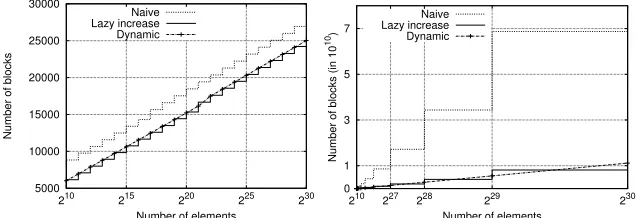
We present a comparison between our three strategies in terms of storage complex-ity (Figure 2) and communication complexcomplex-ity per access (Figure 1). We perform our comparison on a block level, thereby remaining independent of the actual block size. Communication complexity:the2ndstrategy offers best communication complexity. This is due to shorter paths, a result of flatter trees – compared to the na¨ıve1stsolution. Also, compared to the3rd strategy, the leaf buckets have smaller size. For a number of elementsN = 230and2−64 overflow probability, the interior node size equals36 which is appropriate for all three strategies. The difference consists on the size of the leaf buckets as well as the height of the resulting tree. The bucket size for the na¨ıve (1st), lazy (2nd) and dynamic (3rd) strategy respectively equals28,85and130blocks. The tree’s height for the na¨ıve solution equals30while for the lazy and dynamic solution the tree height is26sinceα≈24. In Figure 1, for an eviction rate used equals4, the entire communication complexity (upload/download) on the main ORAM respectively equals
26928,24210and25020 blocks for the na¨ıve, lazy and dynamic solution. Note that per access, we save around7%in communication cost. Recall that our main purpose is to reduce the storage overhead while maintaining the same communication complex-ity. However, our results show that storage optimization has a direct consequence on reducing the communication complexity as well.
Storage complexity:there is no “clear winner”. Depending on the client’s usage strat-egy, the dynamic (3rd) strategy can be considered best, as it provides more intuitive and fine grained control over storage size. However, if the insertion of elements follows a well defined pattern where the client is always expanding their capacity by a factor of α, the2ndstrategy will result in cheaper cost. The cost reduction is significant, around
5000 10000 15000 20000 25000 30000
210 215 220 225 230
Number of blocks
Number of elements Naive
Lazy increase Dynamic
Fig. 1: Communication, blocks per ac-cess
0 1 3 5 7
210 227 228 229 230
Number of blocks (in 10
10)
Number of elements Naive
Lazy increase Dynamic
Fig. 2: Storage cost, blocks
Independently of the blocks size, this represents87%of storage cost savings. Con-sider the following example: we fix the block size to 4096Byte and the number of elements toN= 230, resulting in a dataset size equal to4TByte. Based on Amazon S3 pricing [1] where the price is equal to0.029USD per GByte per month, the client has to store, for the na¨ıve solution,∼2.8.1014≈262TByte, implying∼7600(USD) per month. With the lazy solution, the client has to store only∼31TBytes, which is only
900(USD) per month (almost 10 times cheaper than the na¨ıve solution).
In general, both the2nd and3rd strategies outperform the na¨ıve one in terms of communication and storage complexities.
4.6 Position Map
To maintain constant client memory, it is important to recursively store the mapping between tags and elements in a position map on the server. This position map is stored in a logarithm number of ORAMs with a number of leaves increasing exponentially from one ORAM to the other. With a position map factorτ,N =τl, the position map is composed ofl−1small ORAMs where ORAMihas a number of leaves equal toτi,
1≤i≤l−1.
Surprisingly, resizing the position map is trivial, e.g., following one of the two sub-sequent strategies: (1) use the same strategy of resizing (adding/pruning) that we apply on ORAMl−1, or (2) create a new level of recursion in the case of adding, or deleting the last level of recursion in the case of pruning. AssumeN elements; each element is associated to a leaf tag that has sizelogNbits. We describe each solution for the case of the na¨ıve adding strategy.
append at the end of the tag fetched an additional bit 0 or 1 to access a random child (to stay oblivious and access the entire path). After accessing any “old” elements (old denotes elements with a previous mapping), the mapping is updated to havelogN+ 1
bits instead oflogN.
(2)The second solution is straightforward and based on creating a new level of recursion when a new level of leaves is created. Note that blocks in this level will haveO(τ ·
logN + 1) bits insteadO(τ ·logN). To access an “old” element, we use the same method described above.
5
Pruning
Assume an ORAM storingN elements. Now, the client deletesη elements from the ORAM. Consequently, the na¨ıve ORAM construction now containsN−ηelements, but still hasN leaves. Consequently, the client tries saving unnecessary storage costs and frees a number of nodes from the ORAM. Similar to adding element to the ORAM tree, we tackle pruning by presenting two different strategies. The first one, alazy pruning, prunes the entire set of leaves of the lowest levelland merges content with levell−1. Our second strategy consists of a dynamic pruningthat deletes two leaf nodes for a specific number of elements removed from the ORAM. Again, we will analyze overflow probabilities induced by such pruning as well as complexities.
5.1 Lazy pruning
In Section 4.3, we have demonstrated that leaves can store significantly more elements while only slightly increasing their size. We will use this observation to construct a new algorithm for lazy pruning. Assume that the leaf level containsNleaves forα·N elements stored. Letη denote the number of elements deleted by the client. For sake of simplicity, assume that, at the beginning, we haveη = 0 andN leaf nodes. Our pruning technique is similar to the “lazy” insertion described previously. Whenever α·N
2 < η≤α·N, we keep the same number of leaves. Within this interval, the client can add or delete elements without applying any change to the structure, as long as the number of elements remains within the defined interval. If the number of deletion equals α· N
2, the client proceeds to remove an entire level of leaf nodes. The client proceeds to read every leaf node, along with its sibling, and merges them with their parent node. While this appears to be straightforward, an oblivious merging of siblings into their parent is more complex under our constant-client memory constraint. We will discuss this in great detail below.
Besides, the major problem of this technique is its unfortunate behavior in case of a pattern oscillating around the pruning value. For example, the if the client deletes α·N
2 elements, prunes the entire level, then adds a new element back. Now the ORAM structure has more thanα· N
2 elements in N
5.2 Dynamic pruning
Given that pruning an entire level at once is very inefficient, we now investigate how pruning can be done in a more gradual way. For everyαelements we delete, we will prune two children and merge their contents into their parent node. The pruning will
fail if the number of elements in both children and parent is more than k. This can only occur if there are more thankelements associated (tagged) to these children. The following lemma states the upper bound of the overflow probability for the parent node after a merging. Recall that we begin with a full binary tree of N leaves and α·N elements. Assume that we have already deleted α(η −1) elements, and we want to delete an additionalαelements.
Lemma 51 LetPη denote the random variable of the size of theηthparent node. For
dynamic pruning, the probability that pruning will fail equals
Pr(Pη> k)≤(
2e·α k )
k
Proof. The pruning will failiff there are more than a total ofkelements in the parent and the children. Any element in these three buckets must be tagged for either the left or the right child. In order to compute the overflow probability of the parent, we compute the probability that more thankelements are tagged to both children.
Pr(Pη> k) =
α·(N−η)
k
·(2
N) k
≤(e·α·(N−η)
k )
k·(2 N)
k
≤(1− η
N)
k·(2e·α k )
k
≤(2e·α
k ) k
In conclusion, the probability decreases exponentially with bucket sizek. The upper bound is independent of the number of pruned nodes η. In practice, the bounds are tighter, especially for larger values ofη.
Complexity of oblivious merging The cost of dynamic pruning boils down to the cost of obliviously merging three buckets of sizek. We can achieve this withO(k)
communication and constant memory complexity. First, note that we do not have to merge all three buckets at once. All that is required is an algorithm which obliviously merges two buckets. We can then apply it to successively merge three buckets into one. Since the adversary already knows that the two buckets being merged have no more thank elements in them (as shown above), the idea will be to retrieve the elements from each bucket in a more efficient way that takes advantage of this property.
Input: Configuration of bucketsAandB
Output: A permutation which randomly “lines up” bucketBto bucketA
// Slots in A and B start either empty or full; mark slots in A as ‘‘assigned’’ if block from B is assigned in π x←number of empty slots inA;
y←number of full slots inB;
d←x−y; forifrom 1 tokdo
ifB[i]is fullthen
z←$ all empty slots inA; else
ifd >0then
z←$ all non-assigned slots inA;
d←d−1; else
z←$ all full slots inA; end
end
π[i]←z;
A[z]←assigned ; end
returnπ;
Algorithm 1:GeneratePermutation(A, B)
they can be merged efficiently. Special care must be given to generate this permuta-tion using only constant memory. The client makes use of “configurapermuta-tion maps” which simply indicate, for every slot in a bucket, whether that slot is currently full or empty. These maps can be stored encrypted on the server and take upO(1)space each in terms of blocks (because the buckets containO(logN)elements and a single block is at least
logNbits [17, 18]). Then, the client iterates through the slots in one bucket, randomly pairing them with compatible slots in the other (i.e., a full slot cannot be lined up with another full slot). An additional twist is that an empty slot can be lined up with either a full or empty slot in the other bucket, but not at the expense of “using up” an empty slot that might be needed later since we cannot match full with full. Therefore, we have to also keep a counter of the difference between empty slots in the target bucket and full slots in the source bucket.
As seen in Figure 3, once the client generates the permutation, they can retrieves the elements pairwise from both buckets (i.e., slotifrom one bucket and the slot which is mapped toivia the permutation from the other bucket), writing back the single real one to the merged bucket.
It remains to show that this permutation does not reveal any information to the adversary. If it was a completely random permutation, it would certainly contain no information. However, we are choosing from a reduced set: all permutations which cause the bucket to “line up” with its sibling.
5
3
2
1
4
5
1
3
2
4
Permute Merge
(1) (2) (3)
Fig. 3: Illustration of permute-and-merge process. Bucket (2) is permuted and then merged with bucket (1) to create a new, combined bucket (3).
are an equal number of bucket configurations (i.e., which slots contain real elements and which do not) for which that permutation is valid.
To make this approach work, we need to slightly modify the behavior of the bucket ORAMs. Previously, when a new element was added to a bucket, it did not matter which slot it went into in that bucket. It was possible, for instance, that all the real elements would be kept at the top of the bucket and, when adding a new one, the client would simply insert that element into the first empty slot that it could find. However, to use this permutation method equalwe require that the buckets be in a random “configura-tion” in terms of which slots are empty and which are filled. Therefore, when inserting an element, the client should choose randomly amongst the free slots. Again, this is possible with constant client memory using our configuration maps. With this behavior, applying the above logic leads to the conclusion that the adversary learns nothing about the load of the bucket from seeing the permutation.
Refer to Appendix A for the full security proof.
5.3 Privacy analysis
Theorem 51 Resizable ORAM is a secure ORAM following Definition 31, if every node is a secure trivial ORAM.
Proof (Sketch).Given that ORAM buckets are secure trivial ORAMs, we have to show that two access patterns induced by−→y and−→z of the same length are indistinguishable. Compared to traditional ORAM, resizable ORAM includes two new operations,Alloc
andFree. Note that those operations should be in the same positions for both sequences, otherwise, distinguishing between the access pattern will be straightforward. Further-more, we have already shown that, for increasing the size of the ORAM, Allocfor the2nd and3rdstrategies will not induce any leakage. Also, lazy or dynamic pruning strategies will not leak any information about the load of the buckets. That is, theFree
6
Related Work
We are the first to rigorously investigate the topic of resizing current tree-based ORAMs [5, 6, 14, 17, 18] and tackle the challenges that can arise from resizing these ORAMs. Our work especially focuses on tree-based ORAM constructions [5, 6, 14, 17, 18] for the
constant client memorysetting.
Oblivious RAM was introduced by Goldreich and Ostrovsky [7]. Much work [2– 11, 13–20] has been published to reduce the communication complexity between client and storage. Early schemes were able to optimizeamortizedcost to be poly-logarithmic, but still maintained linear worst-case cost [9, 16, 19, 20], due to the fact that they all eventually require an expensive reshuffling. Yet, resizing these types of ORAM is straightforward. Adjusting the size can be done at the same time as reshuffling, for no cost. The only leakage in this case will be the information about the total number of elements stored in the ORAM.
Avoiding the expensive reshuffling, Shi et al. [17] presented the first tree-based construction that involvespartialreshuffling of the ORAM structure for every access. Thus, the amortized cost equals the worst-case cost with communication complexity ofO(log3N)blocks. An additional advantage of this construction is its constant client memory requirement (in term of blocks). Constant client memory ORAM constructions are especially attractive in scenarios with, for example, embedded devices or otherwise constrained hardware.
Further results show that you can improve communication complexity if poly-logarithmic client memory is acceptable [5, 6, 18]. Gentry et al. [6] optimize Shi et al. [17] by in-troducing a k-ary structure with a new deterministic eviction algorithm. This results in O(log loglog3NN) for a branching factor equal to O(logN), but the client must have O(log2N) client memory available. Inspired by [17], for a client memory equal to Θ(logN), Stefanov et al. [18] presented Path ORAM, a construction with commu-nication complexity in O(log2N). A subsequent work by Fletcher et al. [5] reduces communication complexity by a factor of 2 by reducing the size of the buckets. We leave the problem of resizing these non-constant memory ORAMs to future work.
7
Conclusion
We are the first to show how to dynamically resize constant-client memory tree-based Oblivious RAM. This allows for use cases where clients do not know in advance exactly how much storage they will need and/or wishes to scale their storage needs efficiently and cheaply. We have shown that the na¨ıve solution of adding leaf nodes induces a sig-nificant, unnecessary overhead. Instead, more advanced strategies, lazy insertion and dynamic insertion, can save dramatically on communication and storage cost compared to the na¨ıve solution, although neither strategy is clearly superior to the other. Further-more, we have demonstrate that the size of a tree-based ORAM can be decreased effi-ciently using an oblivious pruning technique. Throughout the paper, we have rigorously analyzed the overflow probability for each technique and presented a tight analysis of both interior and leaf node sizes.
References
[1] Amazon. Amazon s3 pricing. http://aws.amazon.com/s3/pricing/, 2014.
[2] D. Boneh, David Mazieres, and R.A. Popa.
Re-mote oblivious storage: Making oblivious RAM practical. http://dspace.mit.edu/bitstream/handle/1721.1/62006/MIT-CSAIL-TR-2011-018.pdf, March 2011.
[3] K.-M. Chung and R. Pass. A Simple ORAM. IACR Cryptology ePrint Archive, 2013:243, 2013.
[4] I. Damg˚ard, S. Meldgaard, and J.B. Nielsen. Perfectly Secure Oblivious RAM without Random Oracles. InProceedings of Theory of Cryptography Conference, pages 144–163, Providence, USA, 2011.
[5] C.W. Fletcher, L. Ren, A. Kwon, M. van Dijk, E. Stefanov, and S. Devadas. RAW Path ORAM: A Low-Latency, Low-Area Hardware ORAM Controller with In-tegrity Verification.IACR Cryptology ePrint Archive, 2014:431, 2014.
[6] C. Gentry, K.A. Goldman, S. Halevi, C.S. Jutla, M. Raykova, and D. Wichs. Op-timizing ORAM and Using It Efficiently for Secure Computation. InProceedings of Privacy Enhancing Technologies, pages 1–18, 2013.
[7] O. Goldreich and R. Ostrovsky. Software Protection and Simulation on Oblivious RAMs.Journal of the ACM, 43(3):431–473, 1996.
[8] Oded Goldreich. Towards a Theory of Software Protection and Simulation by Oblivious RAMs. InProceedings of Symposium on Theory of Computing, pages 182–194, New York, USA, 1987.
[9] M.T. Goodrich and M. Mitzenmacher. Privacy-Preserving Access of Outsourced Data via Oblivious RAM Simulation. InProceedings of Automata, Languages and Programming, pages 576–587, Zurick, Switzerland, 2011.
[10] M.T. Goodrich, M. Mitzenmacher, O. Ohrimenko, and R. Tamassia. Oblivious RAM simulation with efficient worst-case access overhead. InProceedings of Cloud Computing Security Workshop, pages 95–100, Chicago, USA, 2011. [11] M.T. Goodrich, M. Mitzenmacher, O. Ohrimenko, and R. Tamassia.
Privacy-preserving group data access via stateless oblivious RAM simulation. In Pro-ceedings of the Symposium on Discrete Algorithms, pages 157–167, Kyoto, Japan, 2012.
[12] J. Hsu and P. Burke. Behavior of tandem buffers with geometric input and Marko-vian output.Communications, IEEE Transactions on, 24(3):358–361, 1976. [13] E. Kushilevitz, S.L., and R. Ostrovsky. On the (in)security of hash-based oblivious
RAM and a new balancing scheme. InProceedings of Symposium on Discrete Algorithms, pages 143–156, Kyoto, Japan, 2012.
[14] T. Mayberry, E.-O. Blass, and A.H. Chan. Path-PIR: Lower Worst-Case Bounds by Combining ORAM and PIR. InProceedings of the Network and Distributed System Security Symposium, San Diego, USA, 2014.
[15] R. Ostrovsky and V. Shoup. Private Information Storage (Extended Abstract). In
[16] B. Pinkas and T. Reinman. Oblivious RAM Revisited. InAdvances in Cryptology, pages 502–519, Santa Barbara, USA, 2010.
[17] E. Shi, T.-H.H. Chan, E. Stefanov, and M. Li. Oblivious RAM withO(log3(N))
Worst-Case Cost. InProceedings of Advances in Cryptology, pages 197–214, Seoul, South Korea, 2011. ISBN 978-3-642-25384-3.
[18] E. Stefanov, M. van Dijk, E. Shi, C.W. Fletcher, L. Ren, X. Yu, and S. Devadas. Path ORAM: an extremely simple oblivious RAM protocol. InConference on Computer and Communications Security, pages 299–310, 2013.
[19] P. Williams and R. Sion. Usable PIR. InProceedings of Network and Distributed System Security Symposium, San Diego, USA, 2008.
A
Proof: Oblivious Permute-and-Merge
Lemma A1 Given two buckets with maximum sizekand loadmandnrespectively, over the random configurations of those buckets, Algorithm 1 will output a uniformly random permutation which is independent ofmandn.
Proof. We can determine the probability of a particular permutationπbeing chosen, givenmandn, with a counting argument. It will be equal to
# of configurations for whichπis a valid permutation
total # of configurations ×# of valid permutations for a given configuration The number of configurations for whichπis a valid permutation depends onmand n, but not onπitself. This can be seen if you consider that applying the permutation to a fixed configuration of the bucket simply creates another, equally likely configura-tion. The number of configurations for the sibling bucket that will “match” with that bucket are exactly the same no matter what the actual configuration of the first bucket is. Knowing this, combined with the fact that the probabilities must sum to one, tells us immediately that every permutation is equally likely. However, we can continue and express the total quantity for our first expression as
k
m k
−m n
This can be thought of as choosing themfull slots for one bucket freely and then choosing thenfull slots in the second bucket to line up with the free slots in the already chosen first bucket. The number of valid permutations per configuration can equally be determined via a counting argument as
k−m n
·(k−n)!·n!
That is, choosing free slots for thenelements in the second bucket and then all permutations of those elements times the permutations of the free blocks. That gives us a final expression for the probability of choosing permutationπof
k m
k−m n
k m
k n
k−m n
·(k−n)!·n! (7)
With some algebraic computations, we can show that the Eq. 7 can be simplified to 1
k!. That is, this shows that the number of permutations, for any random distribution of load in a bucket, is independent of the current load. Again, since this does not depend onπ(but only on the size of the bucket), every permutation must be equally likely over
the random configurations of the buckets. ut
Corollary A1 A permutationπchosen by Algorithm 1 gives no information about the load of the buckets being merged.
Proof. By our above lemma, independent of the load each permutation is chosen uni-formly over the configurations of the two buckets. Therefore the permutation cannot