Energizing your Supply Chain for e-Commerce
Glenn Hardaker University of Huddersfield School of Business Tel: 01484-472417 Email: [email protected] Gary Graham University of SalfordSchool of Business
Tel: 0161-295-5824 Email: [email protected]Abstract
The concepts of supply chain design and management has come to the fore, due to the ever-increasing complexity of the systems driving buyer supplier relations in both industrial and consumer based markets. The unprecedented levels of supply chain management complexity are partly attributed to the Internet, through its more recent business acceptance and commercial use. This article is about new competitive challenges being realised from the unprecedented speed of growth of the Internet and building commercially viable supply chains to meet the challenges faced by emerging virtual organisations. Particular focus is placed on being able to harness the Internet to support solutions based innovation but also dynamic and seamless supply chain management for e-Commerce.
Introduction
In industries where new business models rapidly supplant old ones, innovation must encompass more than incremental product line extensions and efficiency gains. The current international business environments require innovation across the entire business processes. Supply chains are a key factor in many business processes. They are typically modelled at three levels: strategic, tactical and operational (Thomas and Griffin, 1986). Industrial practice suggests that very few raw materials remain in the constant ownership of one 'player' from their source, to the time they are sold to the end customer. Almost invariably, materials flow through a series of 'players' whose role may be to transform (manufacturing plants), store (warehouses) or move (distributors) material (Berry and Towill, 1992). This refocusing of company roles in terms of end customer satisfaction, is in line with a systems thinking approach to management (Parnaby, 1988). Recently the concepts of supply chain design and management has come to the fore, due to the ever-increasing complexity of the systems driving buyer supplier relations. The unprecedented levels of supply chain management complexity are partly attributed to the Internet, through its more recent business acceptance and commercial use. The Internet increases the richness of communications through greater interactivity between the firm and the customer (Watson, Akselsen, & Pitt, 1998). Some of the most memorable business success stories over the past decade, including Netscape and the development and acceptance of Open Source software solutions, have emerged out of a systemic approach to innovation via the Internet (Hardaker, 1998). This article is about new competitive challenges being realised from the unprecedented speed of growth of the Internet
and building commercially viable supply chains to meet the challenges faced by delivering e-commerce solutions.
The Competitive Challenges of Virtual Marketspace
Fast innovation management initiatives are driving the development strategies of most successful organisations today and will continued to fuel developments in the future. The diverse range of possibilities, via the emergence of on-line Internet based environments, create unprecedented change bringing both product and market uncertainty and as a consequence new market challenges. As we approach the millennium organisations need to be new architects of radical changes transforming many industries, from publishing to computing, from financial services to airlines, and from car manufacture to education (Hamel, 1998). To meet the challenges of virtual business environments organisations need to engender both a responsive and adaptable approach to market demands and how value is created. For many creativity and innovation management is a strategy of fundamental importance in sustaining development in ever increasing turbulent and volatile environments. In accepting the importance of innovation businesses need to create a shift from a product-centric view of innovation to a systemic view of innovation (Hamel, 1998). When considering innovation and creativity management it is essential to realise how the Internet is evolving into a seamless buyer-supplier communications and interaction channel. Virtual commercial environments operating in cyberspace, where information is the 'life blood' of business processes, and through which virtual value chains have emerged, can be referred to as marketspace rather than marketplace according to Rayport and Svioka (1994). The emergence of marketspace is therefore, in both consumer and business to business markets, becoming integral to enabling speedy innovation through being in-tune with market expectations and desires. The new competitive challenges focus our attention on the need for organisations to be able to respond to market demands in the highly competitive world of the Internet.
The Internet is viewed by many as an unstructured and chaotic infrastructure. But looking deeper shows an environment with a focused strategic architecture based on rules setting the boundaries of innovation. The Internet for many offers new modes of commercial trade and communications and is a clear advocate of non-linear styles of innovation. For example, the Apple Macintosh was product innovation while CDnow.com, even though offering for sale traditional CD’s, has been successful through systemic innovation. Recent success stories such as Amazon.com and Dell computers for example are not a product of re-engineering but through a fundamentally different business model driven by a systemic approach to innovation. In considering the elements of value creation in marketspace the context of transactions is clearly the fundamentally difference with marketplace transactions (Rayport and Sviokla, 1994). The context being driven by a systemic approach is clear changing value creation and as a consequence demands on supply chain management. Dell (www.dell.com) along with many other Internet based organisations, such as Cisco (www.cisco.com), has disaggregated content, context and infrastructure and have thus reconfigured the traditional value proposition (Rayport and Sviokla, 1994).
Developing Supply Chain Management on the Internet
The development of fast innovative new products needs to be based on a close alignment between technology, products and markets, with a focus on achieving increased aggregate value (Hardaker, 1998). Much of the supply chain management issues we are considering
here has been variously called logistics (Brace, 1994); production management (Burbidge, 1994); demand chains (to emphasise satisfying end customer requirements); lean supply (Lamming, 1993) and more recently the lean enterprise (Womack and Jones, 1994). Authors and practitioners from many different disciplines and functions are highlighting an increasing dependence on relationships with suppliers (see for example, Christopher, 1992; Slack, 1991; Schonberger, 1986). Closer, longer-term relationships are evident in some industries, reported notably in the Japanese automotive industry (Lamming, 1992, Womack et al., 1990), the Japanese textile industry (Dore, 1983), craft-based Italian industries (Lorenzoni and Ornati, 1988) and various Swedish manufacturing industries (Hakansson, 1987). A growing body of work in the study of relationships emphasises that there are opportunities or mutual advantage, if information is shared between the parties concerned (Christopher, 1992; Ellram, 1990, 1991; Macbeth and Ferguson, 1994; Hines, 1994).
Companies, irrespective of their line of business, have always relied on their suppliers for providing components and parts in terms of services, goods and products on time every time at the right quality and cost. Throughout the last few decades new philosophies like Just In Time (JIT), Total Quality Management (TQM), 5S’s and others have increased the level of dependency of (client) companies to their suppliers. This can be observed in the manufacturing sector in terms of early supplier involvement in developing new products, the on site and in (assembly) line delivery of products with virtually no defects allowed and the continuous strive for reduced prices. Furthermore, increased globalisation and financial markets means that companies have a wider choice in selecting their suppliers.
It is proposed that with marketspace reconfiguring the traditional value proposition, supply chain management needs to manage the organisational complexity of adopting a dynamic mix and emphasis between content, context and infrastructure. Being able to focus on one layer of the value creation model has enabled organisations, such as AOL, to be far more innovative. Shifts towards Virtual organisational architecture focuses on the importance of knowledge and intellect in creating value. Venkatraman & Henderson (1998) identified three interdependent vectors - virtual encounter, virtual sourcing, and virtual expertise - as integral to realising the virtual organisational structure. The creation of organisational integration mechanisms on the Internet such as: discussion groups, web forums, video conferencing, virtual multi-functional teams are enablers of the three independent vectors identified by Venkatraman & Henderson (1998). The process of innovation, with the adoption of an integrated approach throughout the supply chain, requires a trade-off between autonomy and control of which the balance decided upon being unique to partner relationships. The organisational challenge of reaching an acceptable balance between autonomy and control is probably best achieved by the idea of subtle control (Shrivastava & Souder, 1987).
The ‘players’ must have access to a wide range of external technological services, such as the Internet and other complimentary on-line networks, in order to operate effectively. They must have access to electronic capabilities using fibre optics, high-speed digital switches, satellite downlinks and compatible EDI ensuring reliable, efficient information flows among suppliers, manufacturers, and distributors while protecting proprietary data. Shared resources, such as harmonised electronic transfer across transportation modes and onsite education and training facilities, will also help companies improve their value chain management in the emerging marketspace. Even small and medium-sized enterprises increasingly now rely on international networks of suppliers, distributors, and customers, frequently via the Internet, to improve their global competitiveness through reducing fixed and operating costs and overall competitive position.
Individualisation of both product and process driven innovation requires high levels of organisational integration in being able to respond to market demands. Integration along the supply chain in the virtual market can be viewed as being a mix of both formal and loose integration mechanisms, similar to the Internet infrastructure. A common theme of many issues identified as important to organisations in the development of creativity and innovation is the relevance of both technological and organisational integration (see Figure 1). Clearly organisational integration is proposed in a broad sense, encompassing a wide range of issues in enabling organisations to be both responsive and adaptable through improved communications. Figure 1 Integration V i r t u a l O r g a n i s i n g G r i d Specialist Support Centers Virtual Business Communities Gateways/Utility Entertainment Advanced Customer Service Applications
Product Line Extensions
Support Virtual Network Portal Low High High Low Individualisation of Output
The dynamics of individualisation of product and service offering in relation to both technological and organisational integration is clearly reaching new levels of complexity on the information superhighway. Hence we have focused our attention on ascertaining the implications of adopting an integrated approach to E-business, in the context of individualisation of products and services (Figure 1). E-business is defined as including organisations operating solely in marketspace and also those with a mix between the traditional marketplace and market space. Each of the four quadrants in the Virtual Organising Grid (Figure 1) provides a useful framework for identifying business activities and avenues for future development.
The Portal quadrant represents what are becoming essential gateways and fundamental utilities for the wider world of cyberspace. Portals such as Netcentre, Yahoo, Adauction (www.adauction.com), all provide essential routes to the Internet for what are viewed as growing communities (Plattt, 1998). The Portals attempt to demystify and smooth the compelled communications channels through the Internet by providing guides and essential sites of importance and relevance. As Portals develop the success will clearly be reliant on being able to provide a customised service to end-users. Portals are developing what may be termed virtual communities or specialist information sources. We believe Portals currently provide relatively low individualisation of output and buyer supplier integration. Portals are highly successful through the ability to offer fast, customised, up to date information across
the Internet to the consumer. Future developments on the Internet will require in particular higher levels of creativity, based on behavioural patterns, for the consumer with flexible but loose integration. David Seigel (1999) stated that ‘markets are conversations’, which illustrates the need for a highly integrated perspective along the supply chain.
Support quadrant represents specialist support centres that offer value added information to the consumer but with relatively limited buyer supplier integration that is reflected in a lack of customisation of the service or product offering. Specialist support centres include technical support information from organisations, such as IBM in the computer industry, on products and services. In B2B markets the support quadrant is particularly relevant for spot sourcing (Kaplan, Sawhney, 2000). Many consultancy services and academic institutions also fall into support quadrant offering highly creative and leading edge knowledge but generally limited focus on the end customer resulting in limited buyer supplier organisational integration. Specialist support services are typical of Internet based information sources which are characterised as being dynamic in nature but often limited commercial concern and as a consequence fluid and evolving communications channels.
The Network quadrant identifies limited innovation but highly integrated organisations through the buyer supplier value chain. Organisations in the networked quadrant include many manufacturing businesses adopting the Internet as an essential communications channel supporting supply chain management activities including controlling the flow of goods. This suggests a move by businesses to systematic sourcing in terms of general operating inputs and manufacturing inputs (Kaplan, Sawhney, 2000). VW in particular with the launch of the 'revamped' Beetle is viewed as an exemplar of the Network quadrant, utilising the Internet as an integral tool in developing superior buyer supplier relations. Through providing an interactive and dynamic environment for existing and potential customers, many organisations and individuals regularly express their views and provide feedback on product innovation initiatives. Network organisations appreciate the flexibility and cost effectiveness of the Internet as a fundamental communications channel.
The emergence of virtual business organisations is for many being driven by the speed of Internet developments, in terms of bandwidth and commercial acceptance (Venkatraman & Henderson, 1998). The Virtual quadrant represents many leading organisations that have clearly grasped the Internet as being central to commercial activities. For organisations to operate in what we have termed the virtual quadrant, high levels of creativity and individualisation of output is required along with an integrated perspective. Advanced customer service applications are represented by organisations such as UPS, who offer the ability to track goods via the Internet providing up to date information on goods movement. In addition flexibility is being offered in the financial services sector by for example Royal Bank of Scotland (www.rbs.co.uk). RBS offer Internet based banking services that clearly increase both the levels of flexibility and also integration with their consumers. RBS also utilise leading edge Internet based developments such as intelligent agents, often called 'cookies', which enable the monitoring of activities of customers. 'Cookies' offer organisations the opportunity to capture behavioural patterns and as a consequence act as a driver for relationship marketing and loyalty building initiatives. Clearly the emergence of organisations operating in marketspace, on the Internet, are creating new organisations and business models. This is demonstrated by bookacourse.com (www.bookacourse.com) that react directly to market conditions through adopting a C2B approach. On bookacourse web site you are able to browse and choose from over 150,00 computing course, with pricing for example being based purely on supply and demand and as a consequence focused directly on
the e–customer. Highly innovative organisations integrated through the supply chain in marketspace offer the potential for far greater levels of responsiveness than traditionally accepted in marketspace (Rayport and Sviokla, 1994).
Energizing your Supply Chain for Electronic Commerce
Organisations are increasingly concentrating on responsiveness and flexibility through product innovation (Hardaker, 1998). If innovation continues to be the driving ethos of the Internet a responsive and open approach needs to be maintained by organisations operating in marketspace and also by many of the newer entrants investing in Internet based environments. If the goal of businesses is to develop a sustainable Internet presence, through commercial trade, the adoption of non-linear innovation across the whole of an organisation's business processes is seen to be a fundamental criterion. Marketspace transactions along the supply chain requires a thorough understanding of virtual markets in terms of customer interaction, organisational integration across the value chain, and leveraging diverse sources of expertise (Venkatraman & Henderson, 1998).
Integration is the essence of the deployment of a flexible and concurrent approach towards innovation (Zhang and Zhang, 1995). Lawrence & Lorsch (1969) defined integration in terms of achieving “unity of effort” in various organisational subsystems. Excellence of teams, as a valued integration mechanism, is viewed as being developed through empowerment, staffing, leadership, organisation, measurement, self-management, motivation, and leveraging success (Zhang and Zhang, 1995). The term integration therefore refers to the strategic and operational linking of business processes across functionally specialised groups while preserving their individual orientations. Through the continued development of the Internet the process of is continually becoming more fluid and responsive through changes in the traditional marketplace and unprecedented growth of marketspace. The Internet through the continual development of open systems standards has provided a relatively flexible approach to technological and as a consequence created a shift towards more dynamic communications and improved integration. Figure 2 provides a detailed framework of the main elements of an integrated perspective.
Figure 2
Factors Involved in the Integration Process
Inform ational Integration Managerial/Strategic Integration Organisationl Integration
Systems & processes Integration
Technological Integration
A key integration mechanism is via dynamic information (see figure 1). Information flows affect a firm’s ability to integrate value-adding operations and improve innovativeness. Indeed exchange of information frequently precedes physical movement of materials and products, thus enabling firms to reduce inventories and utilise resources most effectively. Strategies for organising virtual businesses have accelerated the pace of change in business processes through a focus on fundamental development issues for operating in marketspace. The effective management of business processes for the virtual enterprise is dependent on customer interaction, organisational integration across the value chain, and leveraging diverse sources of expertise. The impetus by many organisations to develop a highly individualised style of product and process innovation across the Internet is driving organisations to strive for an integrated perspective throughout the value chain.
As the technology has changed, networked computing has become more of the norm, the types of applications and the level of usage has also adapted to the widening of possibilities. The number of companies doing business electronically via integrated networks has steadily increased over the past two decades. The majority of organisations now have electronic links with suppliers and buyers from the use of fax machines through to the emergence of the Internet. In addition many businesses have deployed information technology to form virtual corporations. The development of a virtual corporation allows businesses to combine their core competencies to deliver products and services. The use of information technology is primarily the integration mechanism in facilitating business processes within and between organisations.
The technologies that we become familiar with continue to evolve as fax, EDI and e-mail have now become mainstream tools for many in day to day business activities. For instance throughout the 1980’s and 1990’s EDI was gradually adopted by much industry including retail and many manufacturing sectors. Now EDI is a fully exploited technology driven by (1) Virtually private networks connecting computer systems between buyers and sellers (2) VAN’s (Value added networks) allowing trading partners to connect indirectly through a dedicated network such as Advantis and IVAN. VAN’s for some companies are a means of plugging into an established system and as a consequence creates less development time for many. A range of other supporting facilities along the supply chain are also being widely adopted in support of improved supply chain management. Some of the services/applications currently being used include:
• Internet, intranets, extranets
• Electronic vendor/product directories • Ordering and logistic support systems
• Management information and reporting systems
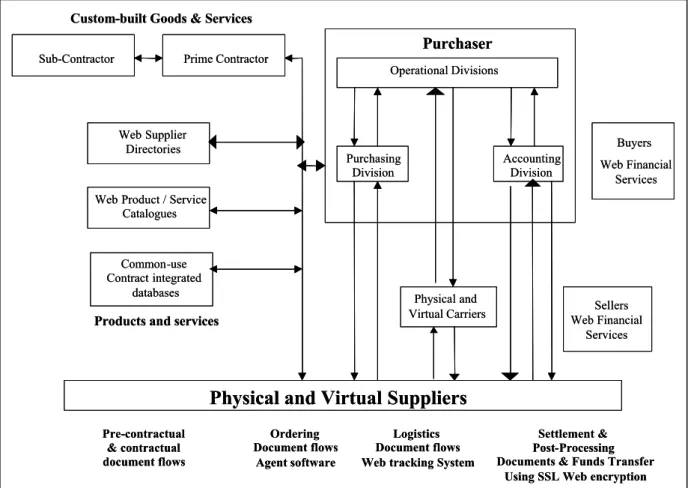
An integrated model is now emerging that is accessible to companies of all sizes and is based on internationally recognized standard. The integrated business models for electronic commerce has become a reality through the unprecedented acceptance of the Internet and in particular the World Wide Web as the commercial platform of choice in both business-to-business and business-to-business-to-consumer markets. Clarke (1993) proposed a five-phase process model for electronic commerce, which is summarized below:
Pre-contractual phase
Focused on the gathering of knowledge concerning the products and services being sought, and identifying potential sources of supply that may be from the marketspace or marketplace.
Virtual sourcing is seeing a shift in the gathering of information process from the physical to the use of semi-intelligent software agents, for example software from organisations such as Autonomy (www.autonomy.com).
Contractual phase
The stage when formal relationship between buyer and seller is created. This phase will include the establishment or acceptance of terms and conditions for transactions under the contract. The learning curve, undertaken by many organisations operating B2B markets, in the implementation of EDI systems are transferable skills to Internet based buyer-supplier activities.
Ordering and Logistics phase
For organizations operating in business-to-business markets, purchase orders are placed and processed and at this stage goods transported physically or virtually to the customer. In business-to-consumer markets this phase is probably part of the following phase and settlement will typically be expected at the time of ordering. FedEx (www.fedex.com) provides the currently accepted business model on the Internet for goods being tracked by the sender and receiver throughout the delivery process.
Settlement phase
This phase will include invoicing, payment authorization, payment and remittance transmission. Through the acceptance of the Web as a means of buying and selling the ordering, logistics and settlement have become integral activities for many organization especially in business-to-consumer markets. SSL (secure socket layer) encryption has become a recognised standard for on-line payments.
Post Processing phase
Gathering and reporting of management information based on the analysis of trade information and statistics. The Internet has created far greater integration between the buyer and the seller and as a consequence virtually real time statistics can be view through Web based management reporting tools. Many products are currently available, for example Web trends (www.webtrends.com) that specialises in e-Business intelligence and visitor relationship management.
Figure 3 – Five Phases of e-Commerce (adapted from Clarke, 1993)
The Web is allowing a highly integrated approach towards on-line transaction systems between buyers and suppliers. Businesses are able to establish new electronic storefronts on the Web or move existing electronic transactions on to the Internet, from for example VAN’s. In establishing transaction systems on the Web it requires both a technological understanding but also a new way of thinking about virtual markets. The global reach creates many new challenges as well as opportunities in terms of realising cost efficiency, customisability, speed and quality of service. Business transformation is inevitable when Web payment systems are used to automate business processes. Business-to-consumer (B2C) markets are synonymous with Amazon (http://www.amazon.com) and CD Now (http://www.cdnow.com) models of on-line trading, while in business-to-business (B2B) markets Internet Exchanges are becoming drivers of emerging industry trading hubs. The automobile industry provides an example of how B2B is harnessing the Web for on-line trading with businesses such as Ford, General Motors and Daimler-Chrysler setting up an Internet e-procurement portal across which all their suppliers will trade.
Conclusion
In conclusion it can be said the Internet, as a means of virtual organising has become a central part of a commercial drive towards systemic innovation and the re-evaluation by many of value creation. A major shift in the communications between business organisations is taking place, which is actually redefining organisations and commercial transactions. The Internet has become a key element in moulding and propelling business into new directions in the traditional marketplace and emerging marketspace. Successful organisations in particular on
Physical and Virtual Suppliers
Operational Divisions
Purchasing
Division AccountingDivision
Physical and Virtual Carriers Buyers Web Financial Services Sellers Common-use Contract integrated databases Web Product / Service
Catalogues Web Supplier
Directories
Sub-Contractor Prime Contractor Purchaser
Custom-built Goods & Services
Products and services
Pre-contractual & contractual document flows Ordering Document flows Agent software Logistics Document flows Web tracking System
Settlement & Post-Processing Documents & Funds Transfer
Using SSL Web encryption
Web Financial Services
Physical and Virtual Suppliers
Operational Divisions
Purchasing
Division AccountingDivision
Physical and Virtual Carriers Buyers Web Financial Services Sellers Common-use Contract integrated databases Web Product / Service
Catalogues Web Supplier
Directories
Sub-Contractor Prime Contractor Purchaser
Custom-built Goods & Services
Products and services
Pre-contractual & contractual document flows Ordering Document flows Agent software Logistics Document flows Web tracking System
Settlement & Post-Processing Documents & Funds Transfer
Using SSL Web encryption
Web Financial Services
the Internet are showing unprecedented levels of integration across the supply chain in the pursuit of both process and product innovation for e-commerce.
References
Adler, P. S. 1995. Interdepartmental Interdependence & Co-ordination: The Case of the Design/Manufacturing Interface. Organization Science, Vol. 6, No. 2, pp.
Ahmed, P. K., & Hardaker, G. 1996. Integrated Flexibility - Key to Competition in a Turbulent Environment. Journal of Strategic Management, Long Range Planning, Vol. 29, No. 4, pp.
Berry, D and Towill, D. R. 1992. Material flow in electronic product based supply chains. International Journal of Logistics Management., Vol. 3, No. 2, pp. 77-94.
Brace, G. Editorial Review to Logistics International. 1994. Sterling Publications Ltd. Burbidge, J. 1994. Back to production management, unpublished written communication. Clark, K. B., & Fujimoto, T. 1990. The Power of Product Integrity. Harvard Business Review, Nov-Dec.
Christopher, M, G. 1992. Logistics and Supply Chain Management. Pitman Publishing, London, UK.
Dougherty, D., & Hardy, C. 1996. Sustained Product Innovation in Large, Mature Organisations: Overcoming Innovation-to-Organisation Problems. Academy of Management Journal, Vol. 39, No. 5.
Ellram, L., M. and A. Carr. 1994. Strategic purchasing a history and review of the literature. International Journal of Purchasing and Materials Management, Spring, pp. 10-18.
Hamel, G. 1998. The Challenge Today: Changing the Rules of the Game. Business Strategy Review, Vol.9, No.2, pp.19-26
Hamel, G. 1998. Opinion Strategy Innovation and the Quest for Value. Sloan Management Review, Winter, pp.7-14
Hardaker, G. 1988. An Integrated Approach Towards Product Innovation in International Manufacturing Organisations. European Journal of Innovation Management. Vol.1 No.2, pp Hardaker G. 1997. Internet Editorial. Flexible Innovation on the Internet. Benchmarking for Quality Management & Technology. Vol.3, No.3
Hines, P. 1994. Creating World Class Suppliers: Unlocking Mutual and Competitive Advantage. Pitman, London, UK.
Kaplan, S & Sawhney, M. 2000. E-Hubs: The New B2B Marketplaces. Harvard Business Review, May-June, p.97-103.
Lamming, R. 1993. Beyond Partnership – Strategies for Innovation and Lean Supply. Prentice-Hall Inc, London.
Lawrence, P. R., & Lorsch, J. W. 1967. Differentiation and Integration in Complex Organisations. Administrative Science Quarterly, Vol. 12, pp
Lorenzoni, G. and O. Ornati. 1988. Constellations of firms and new ventures. Journal of Business Venturing, Vol. 3, pp. 41-57.
Macbeth, D. K. and N. Ferguson. 1994. Partnership Sourcing: an Integrated Supply Chain Approach. Pitman, London.
Moenaert, R. K., & Souder, W. E. 1990. An Information Transfer Model for Integrating Marketing and R&D Personnel in New Product Development Projects. Journal of Product Innovation Management, Vol. 7.
Parnaby, J. 1988. ‘A systems approach to the implementation of JIT methodology in Lucas industries’. International Journal of Production Research, Vol. 26, No. 3, pp. 483-492.
Platt, C. 1998. Smart Spider Goes Shopping. Wired, December, p.70.
Schonberger, R. J. 1986. World Class Manufacturing the Lessons of Simplicity Applied. Free Press. New York, USA.
Siegel, D. 1999. Futurize your Entreprise. Wiley and Sons, Inc, p.5.
Shrivastava, P., & Souder, W.E. 1987. The Strategic Management of Technological Innovations: A Review & a Model. Journal of Management Studies, Vol.24, No.1.
Slack, N. 1991. The Manufacturing Advantage. Mercury Business Books, London
Thomas, D J. and Griffin, P M. 1996. Co-ordinated Supply Chain Management. European Journal of Operational Research, Vol. 94, pp. 1-15.
Tushman, M. L., & Anderson, P. 1986. Technological Discontinuities and Organisational Environments. Administrative Science Quarterly, Vol. 31.
Venkatraman, N. & Henderson, J.C. 1988. Real Strategies for Virtual Organizing. Sloan Management Review, Fall, pp.33-47
Watson, R.T., Akselsen, S., Pitt, L.F. 1998. Building Mountains in the Flat Landscape of the World Wide Web. Californian Management Review, Winter, pp.36-56.
Womack, J. P., D. T. Jones and D. Roos. 1990. The Machine that Changed the World. Macmillan International, New York, USA.
Womack, J. P. and Jones, D T. 1994. From lean production to the lean enterprise’, Harvard Business Review, March-April, pp. 93-103.
Zhang, H. C., & Zhang, D. 1995. Concurrent Engineering: An Overview from Manufacturing Engineering Perspectives. Concurrent Engineering: Research and Applications, Vol. 3, No. 3.