IJEDR1603130
International Journal of Engineering Development and Research (www.ijedr.org)795
Secured Deduplication System With Auditing
Scheme
1
Mahesh J. Pawar,
2Pankaj R. Chandre
1 Student ME(Computer),2Prof. ME(Computer) 1Department of Computer Engineering 1Flora Institute of Technology, Pune,India.
________________________________________________________________________________________________________
Abstract- facts de-duplication is one of the maximum important strategies used for doing away with the identical copies of repeating records and it's far used within the cloud storage for the cause of reducing the garage area. But, there's only one copy of every record saved within the cloud although such document is owned by means of a huge quantity of users. Retaining the more than one statistics copies with comparable content de-duplication eliminates redundant information with the aid of maintaining most effective one bodily reproduction and refer other redundant statistics to that reproduction. Statistics de-duplication can be report stage or block level. The replica copies of equal document cast off by way of file level de-duplication. And block stage de-duplication gets rid of duplicate blocks of information that arise in non-identical files. To hold integrity we're offering the 0.33 party Auditor scheme which makes the audit of the report stored at cloud and notifies the records proprietor approximately file repute saved at cloud server. This system helps security challenges which include a certified reproduction test, integrity, facts confidentiality, and reliability.
IndexTerms -Data deduplication, Convergent encryption, Confidentiality, Hybrid cloud, Authorized Duplicate check
________________________________________________________________________________________________________
I.INTRODUCTION
Cloud computing gives unlimited virtualized recourse to a consumer as services throughout the whole net at the same time as hiding the platform and enforcing details. To make statistics management scalable in cloud computing, de-duplication has been invented as a traditional technique. Facts De-duplication technique is used for disposing of the reproduction copies of repeated information in cloud storage and to reduce the statistics duplication. This technique is used to improve garage utilization and also be carried out to community facts transfers to lessen the variety of bytes that must be despatched. Preserving multiple statistics copies with the same content material, de-duplication removes redundant information by way of keeping handiest one bodily copy and refers different redundant records to that copy. Records de-duplication occurs document stage in addition to block stage. The reproduction copies of same file remove by using record level de-duplication.For the block degree duplication which eliminates duplicates blocks of records that arise in non-same documents. Although statistics de-duplication takes a variety of blessings, safety, in addition to privacy issues, stand up as person’s touchy records are capable of each insider and outsider attacks. in the conventional encryption providing information confidentiality, is contradictory with facts de-duplication. Conventional encryption calls for different users to encrypt their information with very own keys.
.
II.RELATED WORK
Numerous new deduplication buildings supporting legal reproduction take a look at in hybrid cloud architecture [1], wherein the duplicate-check tokens of files are generated by means of the personal cloud server with personal keys. Security analysis demonstrates that our schemes are relaxed in phrases of insider and outsider assaults specified in the proposed security model. As a evidence of idea, we applied a prototype of our proposed authorized replica test scheme and behavior examined experiments on our prototype. We showed that our authorized reproduction take a look at scheme incurs minimal overhead compared to convergent encryption and network transfer.
Cloud computing has reached a adulthood that leads it right into a effective section [2]. This means that most of the main issues with cloud computing had been addressed to a degree that clouds have come to be thrilling for full commercial exploitation. This, but, does now not mean that all the troubles indexed above have simply been solved, most effective that the according danger s can be tolerated to a sure degree. Cloud computing is therefore still as plenty a research subject matter, as it's far a market providing. For better confidentiality and security in cloud computing, we have proposed new deduplication structures assisting legal reproduction test in hybrid cloud architecture, in which the duplicate-test tokens of documents are generated by using the private cloud server with non-public keys. The proposed gadget includes evidence of statistics proprietor so it's going to assist to enforce better safety issues in cloud computing.
IJEDR1603130
International Journal of Engineering Development and Research (www.ijedr.org)796
authorized reproduction take a look at scheme incurs minimum overhead as compared to convergent encryption and network switch.The simple idea is that we will restrict the damage of stolen facts if we lower the price of that stolen facts to the attacker[4]. we will obtain this through a ‘preventive’ disinformation assault. We posit that comfortable deduplication offerings may be enforce given additional security functions insider attacker on Deduplication and outsider attacker via the usage of the detection of masquerade hobby. The confusion of the attacker and the additional costs incurred to distinguish actual from bogus records, and the deterrence impact which, despite the fact that difficult to measure, performs a huge position in preventing masquerade activity with the aid of chance-averse attackers. We posit that the combination of these protection functions will provide unparalleled ranges of security for the deduplication.
It excludes the security problems which can rise up within the practical deployment of the present version[6]. additionally, it will increase the country wide security. It saves the reminiscence by way of deduplication the records and as a consequence affords us with enough reminiscence. It provides authorization to the non-public companies and protects the confidentiality of the vital records.
The notion of authorized facts de-duplication was proposed to shield the records protection through such as differential privileges of customers within the reproduction check[5] . We also offered numerous new de-duplication structures supporting authorized duplicate test in hybrid cloud structure, in which the replica-take a look at tokens of files are generated by means of the non-public cloud server with private keys. safety evaluation demonstrates that our schemes are comfy in terms of insider and outsider attacks exact inside the proposed safety version. As a proof of idea, we carried out a prototype of our
III.PROPOSED SYSTEM
A. Architecture
.
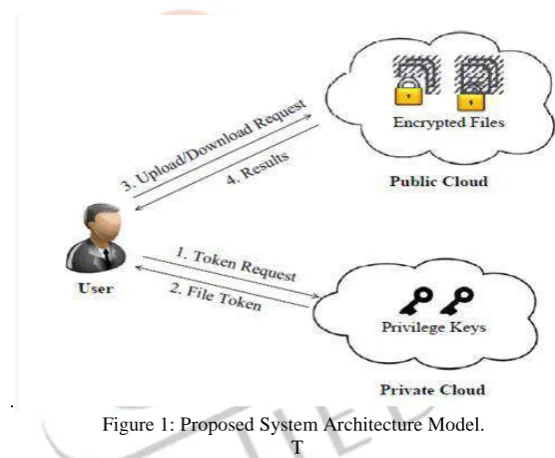
Figure 1: Proposed System Architecture Model. T
Within the Proposed machine, Convergent encryption has been used to put into effect statistics confidentiality. Records replica is encrypted underneath a key derived by means of hashing the facts itself. This convergent secret’s used for encrypting and decrypts a statistics copy. Moreover, such unauthorized customers can't decrypt the cipher text even collude with the S-CSP (storage cloud service issuer). Safety evaluation demonstrates that that system is cosy in phrases of the definitions distinct within the proposed security model.
• The designation is registered through admin or proprietor of the organisation based on his consumer id and password employees of the corporation capable of carry out operations inclusive of record add down load and replica exams at the files based on his privileges. There are 3 entities outline in hybrid cloud architecture of legal deduplication.
• Data users: A user is an entity that wants to outsource records storage to the S-CSP(storage cloud provider company) and get entry to the information later. In a garage gadget helping deduplication, the person simplest uploads particular facts however does not add any reproduction information to keep the upload bandwidth, which can be owned by using the same person or unique users. each report is included with the convergent encryption key and privilege keys to understanding the legal deduplication with differential privileges.
• private Cloud: that is a new entity for facilitating users comfortable use of cloud offerings. The personal keys for privileges are managed with the aid of private cloud, which gives the document token to customers. specifically, for the reason that computing assets at information person/proprietor aspect are confined and the general public cloud isn't always completely relied on in exercise, non-public cloud is capable of offer data person/owner with an execution surroundings and infrastructure running as an interface among a user and the general public cloud.
IJEDR1603130
International Journal of Engineering Development and Research (www.ijedr.org)797
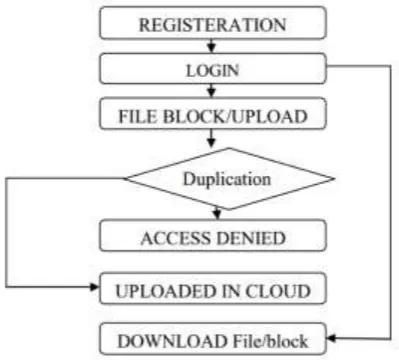
removes the garage of redundant information via deduplication and maintains only precise statistics. on this paper, we assume that S-CSP is usually on line and has ample garage capability and computation energyFigure. 2 Data flow diagram of secured dedplication system
B. Proposed Algorithms
a) Shamir’s Secret Sharing Scheme Input: Data
Process: Data is split into chunks, A chunk is split into blocks, blocks are accessed incrementally
Encryption
Ek(m) is a secure block cipher with block length n K1, K2 is the primary and secondary keys A is a primitive element in F (2n)
N is the physical address of the chunk The chunk key L is created as L = EK2 (N) The i-th block key is _i = aiL computed in F (2n) The i-th block is encrypted as Ci= EK1 (Mi) Out Put: - Encrypted Data
b) Tag Generation Algorithm Input: Encrypted information
Process: during this algorithmic program tag similarity is taken into account a form of linguistics relationship between tags, measured by means that of relative co-occurrence between tags, known as J. constant. Let A and B be the sets of resources delineated by 2 tags, relative co-occurrence is outlined as
That is, relative co-occurrence is adequate the division between the quantity of resources within which tags co-occur, and therefore the variety of resources within which seem anyone of 2 tags. During this paper, similarity supported co-occurrence is additionally known as tag overlapping.
Out Put: Most Relevant Tag with cluster.
c) Message Authentication
IJEDR1603130
International Journal of Engineering Development and Research (www.ijedr.org)798
IV. EXPERIMENTAL RESULT AND COMPARATIVE ANALYSISTable 1: Hash Algorithms Comparison
Algorithm
Output Size (Bits)
Internal State
Size
Block Size
Length Size
Word Size
Rounds
SHA-0 160 160 512 64 32 80
SHA-1 160 160 512 64 32 80
SHA-224, SHA-56
224/256 256 512 64 32 64
Above table shows hash algorithms comparison. From the above algorithms we are using SHA-256 which requires less rounds. So for this we required less execution time.
After implementing this project we get following results 1. This eliminates duplicate copies of data.
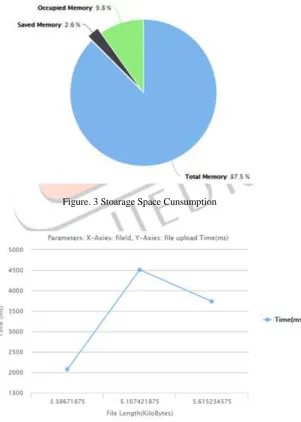
2. Reduce storage space and upload bandwidth in cloud storage. 3. Improves storage utilization while reducing reliability.
4. Formalize the notion of distributed reliable de-duplication system. 5. Provide better fault tolerance.
Figure. 3 Stoarage Space Cunsumption
IJEDR1603130
International Journal of Engineering Development and Research (www.ijedr.org)799
V.CONCLUSIONPlanned the distributed de-duplication systems to enhance the reliableness knowledge of information whereas achieving the confidentiality of the users’ outsourced data while not associate cryptography mechanism. Four constructions were planned to support file-level and fine-grained block-level information de-duplication. The safety of tag consistency and integrity were achieved. We have a tendency to enforce our de-duplication systems exploitation the Ramp secret sharing theme and incontestable that it incurs little encoding/decoding overhead compared to the network transmission overhead in regular upload/download operations
ACKNOWLEDGEMENTS
I am thankful to my guide Asst. Prof. Pankaj Chandre (FIT PUNE) who has spent his valued time and helped to me by giving his very important details regarding the dissertation report.
REFERENCES
[1] G.Prashanthi, Z.Shobarani “A Hybrid Cloud Approach for Secure Authorized Deduplication” International Journal of Innovative Research in Computer and Communication Engineering Vol.3, Special Issue 4, April 2015
[2] Gaurav Kakariya,Prof. Sonali Rangdale “A HYBRID CLOUD APPROACH FOR SECURE AUTHORIZED DEDUPLICATION” International Journal of Computer Engineering and Applications, Volume VIII, Issue I, October 14 [3] Jin Li, Yan Kit Li, Xiaofeng Chen, Patrick P. C. Lee, Wenjing Lou “A Hybrid Cloud Approach for Secure Authorized
4. Deduplication” IEEE TRANSACTIONS ON PARALLEL AND DISTRIBUTED SYSTEM VOL: PP NO:99 The year 2014
[4] N.O.AGRAWAL1, Prof Mr. S.S.KULKARNI “Secure Deduplication And Data Security With Efficient And Reliable CEKM” International Journal of Application or Innovation in Engineering & Management (IJAIEM) Volume 3, Issue 11, November 2014
[5] Prof.N.B. Kadu, Mr. Amit Tickoo” A Hybrid Cloud Approach for Secure Authorized Deduplication” International Journal of Scientific and Research Publications, Volume 5, Issue 4, April 2015 1 ISSN 2250-3153
[6] JADAPALLI NANDINI, RAMIREDDY NAVATEJA REDDY “IMPLEMENTATION OF HYBRID CLOUD APPROACH FOR SECURE AUTHORIZED DEDUPLICATION” International Research Journal of Engineering and Technology (IRJET) e-ISSN: 2395-0056 Volume: 02 Issue: 03 | June-2015
[7] Jagadish,Dr.SuvarnaNandyal “A Hybrid Cloud Approach for Secure Authorized Deduplication” International Journal of Science and Research (IJSR) ISSN (Online): 2319-7064
[8] BhushanChoudhary,AmitDravid“A Study on Authorized Deduplication Techniques in Cloud Computing” International Journal of Advanced Research in Computer Engineering & Technology (IJARCET) Volume 3, Issue 12, April 2014
[9] AnkitaMahajan“Secure Authorized Deduplication on Cloud Using Hybrid Cloud Approach” International Journal of Advance Research in Computer Science and Management Studies Volume 2, Issue 12, December 2014