OPTIONS FOR A MULTI STEP BIOTRANSFORM ATION
Fiona Olivia Vanier
A thesis submitted to the University of London for the degree of
Doctor of Philosophy
Department of Biochemical Engineering
University College London
ProQuest Number: 10011163
All rights reserved
INFORMATION TO ALL USERS
The quality of this reproduction is dependent upon the quality of the copy submitted.
In the unlikely event that the author did not send a complete manuscript and there are missing pages, these will be noted. Also, if material had to be removed,
a note will indicate the deletion.
uest.
ProQuest 10011163
Published by ProQuest LLC(2016). Copyright of the Dissertation is held by the Author.
All rights reserved.
This work is protected against unauthorized copying under Title 17, United States Code. Microform Edition © ProQuest LLC.
ProQuest LLC
789 East Eisenhower Parkway P.O. Box 1346
Fiona Vanier____________________________________PhD Thesis Acknowled£ements
Acknowledgements
I would like to thank my supervisor Dr. John Woodley for all his academic support thoughout my PhD, and Drs. John Ward & Graham Jackson for contributing their expertise on all matters biochemical. Many thanks also go to Dr. Rose Sheridan for her words of support and encouragement, and for her help during much of the practical work.
In addition, I owe a debt of gratitude to all the technical staff at UCL, especially Billy Doyle, Chris Seaton, Stuart Pope and Alison Clayton who assisted and helped with all the fermentations carried out during my Research Assistantship - good and bad.
A huge thanks goes to all the Foster Courtiers past and present (including Simon Brocklebank), and members of the Department of Biochemistry who helped in ways too numerous to mention.
A very very big thankyou goes to the staff - past and present - of the Camden Borough Libraries that I have had the pleasure of working with. It really helped to have an interest outside of UCL.
Abstract
The majority of commercially used biotransformations tend to be single step involving the conversion of a substrate to a structurally similar compound. The exploitation of an existing host native pathway such that a novel compound is synthesised on the addition of a foreign gene is also possible. The cloning of a section of a foreign metabolic pathway in such a way that the enzymes synthesise a specific product on the addition of a substrate is a powerful technique that has been seldom investigated from a process design perspective.
The aim of this work was to evaluate the processing options necessary to carry out a multi step biotransformation, undertake the decision-making stage of process design by following guidelines defined in a feasibility study, and put into practice the design of the bioprocess necessary to over accumulate a specific product using a model system. This research was based on the concept that a properly defined structured approach could be used to develop a particular biotransformation, and this approach could facilitate the development of any multi step biotransformation.
Fiona Vanier_____________________________________________ PhD Thesis Abstract
Contents
Page
A ck n ow led gem en ts
A b stract
C ontents
List of Figures
List of Tables
A b b rev ia tio n s
N om en clatu re
3
4
6
15
19
21
24
1 Introduction
1.1 Introduction
1.2 B iotransform ation
1.2.1 Enzymes as Catalysts1.2.2 Biological Cells as Catalysts
1.2.3 Process Characteristics
1.3 G enetic M anipulation
1.3.1 Mutation & Strain Selection25
25
26
26
27
28
29
Fiona Vanier___________ PhD Thesis Contents
1.3.3 Metabolic Pathway Engineering 31
1.3.3.1 Definition & Categorisation 31
1.3.3.2 Improved Production of Chemicals 31
1.3.3.3 Extension of the Substrate Range 33
1.3.3.4 Addition of New Catabolic Activities 34
1.3.3.5 Production of Chemicals New to the Host Organism 35
1.3.4 Tools for Metabolic Pathway Engineering 40
1.3.4.1 Categorisation of Tools 40
1.3.4.2 Molecular Biological Tools 40
1.3.4.3 Mathematical & Computational Tools. 41
1.3.4.4 Analytical, Chemical & Measurement Tools 41
1.3.5 Conclusion: The Use of a Model System 42
1.4 The TO L Plasmid & Arom atic D egradation
42
1.4.1 Introduction 42
1.4.2 General Description 43
1.4.3 Suitability as a Model System 43
1.4.4 TOL Me^fl-cleavage Enzymes 48
1.4.4.1 Toluene 1,2-Dioxygenase 48
1.4.4.2 Dihydrodihydroxybenzoic Acid Dehydrogenase 48
1.4.4.3 X y lT Gene Product 50
1.4.4.4 Catechol 2,3-Dioxygenase 50
1.4.5 TOL Plasmid & Biochemical Engineering 52
1.4.5.1 Cis, c/5-muconic acid production 52
1.4.5.2 Picolinic acid production 52
1.4.5.3 Dihydrodiol production 54
1.4.5.4 Catechol production 54
1.4.5.5 Summary: Future of Microbial Synthesis 55
1.5.1 Introduction 55
1.5.2 Undertaking a Feasibility Study 57
1.5.2.1 Theoretical Evaluations 57
1.5.2.2 Sequencing of Operations 57
1.5.2.3 Process Improvements 58
1.5.3 Project Aims 58
1.6 Summary
612 Feasibility Study I: A Theoretical Survey
62
2.1 Introduction
622.2 Evaluation o f the Pathway
622.3 Evaluation o f Pathway Enzym es
65
2.3.1 Iron & Sulphur Content 65
2.3.2 Enzyme Stability 66
2.3.3 Substrate Specificities 66
2.4
Evaluation o f Pathway Compounds
672.4.1 Benzoate 67
2.4.2 Benzoate Dihydrodiol 67
2.4.3 Catechol 69
2.4.4 2-Hydroxymuconic Semialdehyde 69
2.5
Characterisation of a Test System
722.5.1 Introduction 72
2.5.2 Time Constraints 72
2.5.3 Cell Growth & Viability 72
2.5.4 Enzyme Assays 73
2.5.5 Plasmid Content 74
2.5.6 Detection of Pathway Compounds 74
Fiona Vanier_____________________________________________ PhD Thesis Contents
3 Suppliers, Materials & Equipment
77
3.1
Suppliers
773.2 M aterials
773.2.1 Bacterial Strains 77
3.2.2 Fermentation Materials 77
3.2.3 Off-Line Analysis Materials 78
3.2.4 Product Removal Materials 78
3.3 E xperim ental Equipm ent
783.3.1 Fermenter & Ancillary Equipment 78
3.3.2 Off-Line & Small Scale Analysis Equipment 79
3.3.3 Substrate & Intermediate Detection 80
3.3.3.1 HPLC Analysis 80
3.3.3.2 CE Analysis 80
4 Experimental Methods
si
4.1
Strain Identification
&M aintenance
814.2 Solutions for Growth & A nalysis
81
4.2.1 Buffer Solutions 81
4.2.2 Salts for Defined Growth 82
4.2.3 Filter Sterilised Stock Solutions 82
4.3 Growth Conditions
82
4.3.1 Rapid Test for Plasmid Maintenance 82
4.3.2 Nutrient Agar Plates 82
4.3.3 Preculture Conditions 84
4.4
Ferm entation
854.4.1 General Issues 85
4.4.3 Fed-Batch Fermentations 87
4.4.3.1 Batch Medium 87
4.4.3.2 Fed-Batch Medium 87
4.4.4 Sterilisation Protocol 87
4.4.5 On-line Control & Monitoring 89
4.4.5.1 Seed Stage Analysis 89
4.4.5.2 Environmental Conditions & Inoculation 89
4.4.5.3 Fed-Batch Control 89
4.4.6 Off-Line Analytical Methods 92
4.4.6.1 Biomass Concentration 92
4.4.6.2 Plasmid Stability 92
4.4.6.3 Cell Extract Preparation 93
4.4.6.4 Enzyme & Protein Assays 93
4.5
B iotransform ations
934.5.1 Substrate, Intermediate & Product Detection 93
4.5.1.1 Capillary Electrophoresis 93
4.5.1.2 High Performance Liquid Chromatography 94
4.5.1.3 Spectrophotometry 95
4.5.2 Substrate Feeding Methodology 95
4.5.2.1 Benzoate Feeding 95
4.5.2.2 Catechol Feeding 97
4.5.3 Separation of Growth & Substrate Conversion Processes 98
4.6 Shake Flask Experim ents
98
4.6.1 Growth Related 98
4.6.1.1 Seed Stage Development 98
4.6.1.2 Benzoate Feeding 99
4.6.1.3 Sodium Metabisulphite Toxicity 100
Fiona Vanier_____________________________________________ PhD Thesis Contents
4.6.2.1 Benzoate Dihydrodiol Production 100
4.6.2.2 2-Hydroxymuconic Semialdehyde Production 101
4.6.3 Stability Studies 102
4.6.3.1 Benzoate Stability 102
4.6.3.2 Benzoate Dihydrodiol Stability 102
4.6.3.3 Catechol Stability 103
4.6.3.4 2-Hydroxymuconic Semialdehyde Stability 103
4.6.4 Product Removal Experiments 104
4.6.4.1 Resin Description 104
4.6.4.2 Resin Preparation 106
4.6.4.3 Determination of Resin Capacity 106
4.6.4.4 Determination of Non-Specific Binding 106
4.6.4.5 Resin Elution 107
5 Results
109
5.1
Introduction
1095.2 W hole Cell Biocatalyst
109
5.2.1 Choice of Microbial Host 109
5.2.2 Acetate Production 110
5.2.3 Preculture Growth 110
5.2.4 Fermenter Growth 112
5.2.4.1 Batch Fermentation 112
5.2.4.2 Fed-Batch Fermentation 116
5.2.4.3 Comparison Between Batch & Fed-Batch Fermentation 119
5.2.5 Oxygen Requirements 123
5.2.6 Test System Evaluation (I): Cellular Growth 123
5.2.7 Induction 126
5.2.7.1 Induction & Growth 126
S.2.1.2 Induction at Different Times 131
5 .2 .7 3 Long Term Induction 131
5.2.8 Process Timetable: Growth & Induction 131
5.2.9 Test System Evaluation (II): Induction 136
5.3 Substrate A ddition
1365.3.1 Effects of Substrate Addition 136
5.3.2 Substrate Addition Methods 138
5.3.3 Off-Oas Analysis 140
5.3.4 Substrate Addition & Enzyme Activity 142
5.3.4.1 Benzoate Addition 142
5.3.4.2 Catechol Addition 146
5.3.5 Substrate Addition Using Resuspended Cells 146
5.3.6 Process Timetable: Substrate Addition & Biotransformation 149
5.3.7 Test System Evaluation (III): Substrate Feeding 149
5.4
Substrate Conversion
1515.4.1 Compound Detection Methods 151
5.4.1.1 High Performance Liquid Chromatography 151
5.4.1.2 Capillary Zone Electrophoresis 153
5.4.1.3 Spectrophotometry 153
5.4.2 Effects of Feeding on Pathway Compounds 153
5.4.2.1 Pathway Compounds 153
5.4.2.2 Mass Balances 155
5.4.2.3 Multi Step & Single Step Biotransformations 160
5.4.2.4 Product Yields 160
5.4.3 Stability Studies 164
5.4.3.1 Benzoate Stability 164
5.4.3.2 Catechol Stability 167
Fiona Vanier_____________________________________________ PhD Thesis Contents
5.4.3.4 2-Hydroxymuconic Semialdehyde Stability 169
5.4.4 Test System Evaluation (VI): Substrate Conversion Effects 174
5.5 Product Recovery
175
5.5.1 Resin Binding Experiments 175
5.5.2 Non-Specific Binding 177
5.5.3 Bisulphite Toxicity 181
5.5.4 Resin Elution 181
5.5.5 Test System Evaluation (V): Product Recovery 187
5.6 Investigative Schem atics
1885.6.1 Substrate Addition & Conversion 188
5.6.2 Product Recovery 189
5.7 Sum mary
192
6
Discussion
194
6.1
Introduction
1946.2
M odel System
1946.2.1 Definition & Characteristics 194
6.2.2 Industrial Process Considerations 195
6.2.2.1 Induction 195
6.2.2.2 Oxygen Supply 196
6.3 Feasibility Study II: A Practical Survey
197
6.3.1 A Retrospective Viewpoint 197
6.3.1.1 The Choice of Process Options 197
6.3.1.2 The Design of a Test System 197
6.3.1.3 The Improvement of Cell Integrity 198
6.3.1.4 Pathway Compound Characteristics 199
6.3.2 Identification of Rate-Limiting Steps 199
63.2 .2 Methods Used for Identification 200
6.3.3 The Structured Approach to Process Design 201
6.3.3.1 Experimental Investigation 201
6.3.3.2 Operating Windows 203
6.4 Summary: G uidelines For Process Design
2096.4.1 Theoretical Evaluations 209
6.4.2 Design of a Test System 210
6.4.3 Cellular Growth & Induction 210
6.4.4 Substrate Addition & Conversion 211
6.4.5 Product Removal & Recovery 212
6.4.6 Process Design Concepts 212
7 Conclusion
213
7.1 H ost M icro-organism
213
7.2
Pathway Compound Characteristics
2137.3 Product C haracteristics
2147.4 Future W ork
215References
216
Appendices
234
I:
A utom atic Sampler Validation
234II: O xygen Transfer C alculation
238III: Calibration Curves 1:
Protein & DCW
243IV : Calibration Curves 2:
HPLC, CE & Pumps
247Fiona Vanier________________________________________ PhD Thesis List o fF isu res
List of Figures
F ig u re
Page
1.1 Classification of methods of genetic manipulation. 32
1.2 Degradation of the BTX mixture. 36
1.3 Pathways used for amino acid production. 38
1.4 Two routes used for the bacterial production of indigo. 39 1.5 The ortho- and mefa-cleavage aromatic pathways. 44 1.6 The upper and lower pathways encoded by the TOL plasmid pWWO. 45 1.7 The TOD pathway: the most studied alternative pathway. 46 1.8 The role of the multi-component enzyme, benzoate 1,2-dioxygenase. 49 1.9 The proposed role of the xylT gene product. 51 1.10 Microbial and chemical transformations effected by aromatic pathways. 53 1.11 Pathways for the degradation of aromatics by a mutant strain of P. putida. 56 1.12 The metabolic pathway used as part of the model system for this research. 59 1.13 The process scheme proposed for this research. 60
2.1 The spontaneous decay of benzoate dihydrodiol. 68 2.2 The formation and breakdown of a bisulphite adduct. 71
4.1 A schematic diagram of a typical fermenter used for this research. 86 4.2 The assembly of the fermenter with ancilliary equipment. 90 4.3 The assembly of the fermenter with fed-batch equipment. 91 4.4 Mechanisms of the anionic exchange resin chosen for product removal. 105
5.1 Off-gas analysis of a batch culture. 113 5.2 The logarithmic plot used to determine during a batch fermentation 115 5.3 Comparison of a LH20L fermenter with Chemap fermenters. 117 5.4 DOT during two similar fed-batch fermentations where the specific growth 118
rates were 0.3 hr‘1 and 0.2 hr‘C
5.5 A comparison between batch and fed-batch fermentations. 120 5.6 The change in oxygen demand during batch and fed-batch fermentations. 121
5.7 Off-gas analysis of a fed-batch culture. 122
5.8 Growth in two similar fed-batch fermentations with adjustments to \x. 124 5.9 The DOT profiles as a result of changes in \i of two similar fermentations. 125 5.10 The change in C 230 activity with biomass in an uninduced culture. 127 5.11 Growth in induced and non-induced cultures. 128 5.12 C 2 3 0 activity in induced and non-induced cultures. 129 5.13 A growth comparison between an induced and non-induced culture. 130 5.14 The biomass concentration after induction at 15,18 and 20 hours growth. 132 5.15 C 2 3 0 activity after induction at 15,18 and 20 hours growth. 133 5.16 The change in biomass concentration and C 230 activity over 41 hours. 134 5.17 Progressive development of the process with respect to planning and 135
time constraints.
5.18 C 2 3 0 activity found in cells and supernatant. 137 5.19 2-HMSA production as a result of a 20 mM benzoate batch feed, a 10 mM 139
benzoate batch feed and a 1.5 mM .hr^ benzoate fed-batch feed.
5.20 Off-gas analysis during benzoate feeding. 141 5.21 C 230 activity in cells and supernatant during substrate feeding at a rate of 143
0.093 L.L'l.hr"^ with a 3 M benzoate stock.
5.22 C 2 3 0 activity in cells and supernatant during substrate feeding at a rate 144 of 0.0025 L.L'^.hr'l with a 3 M benzoate stock.
5.23 Difference in productivity when using benzoate feed rates 0.0025 L.L'^.hr'^ 145 and 0.093 L.L‘^.hr‘1 with a 3 M benzoate stock.
5.24 The trends in C 230 activity and 2-HMSA production during catechol 147 feeding at a rate of 0.047 L.L'Thr‘1 with a 1 M catechol stock.
5.25 Product accumulation during biotransformations using resuspended and 148 non-resuspended cells.
5.26 Progressive development of the process and incorporation of the 150 biotransformation.
Fiona Vanier________________________________________ PhD Thesis List o f Figures
5.28 Changes in the concentration of the pathway compounds during benzoate 156 feeding at 0.093 L.L'^.hr'^ using a 3 M stock.
5.29 Changes in the concentration of the pathway compounds during benzoate 157 feeding at 0.0033 L.L’^.hr'^ using a 2 M stock.
5.30 Changes in the concentration of the pathway compounds during benzoate 158 feeding at 0.093 L.L'^.hr"^ using a 3 M stock.
5.31 Two mass balances based on compound levels detected using CE only and 159 CE with spectrophotometry, both compared to the substrate added.
5.32 Product accumulation during multi step and single step biotransformations. 161 5.33 Product accumulation using the feed rates 0.093 L.L'^.hr"^, 163
0.00296 L.L-l.hr-land 0.0025 L.L'Thr-T
5.34 Product accumulation using biomass concentrations 6 g.L"^ and 12 g.L'T 165 5.35 Estimations of the time taken to accumulate 2-HMSA to 3 mM using 166
different biomass concentrations based on practical data from a single biotransformation.
5.36 The change in catechol concentration as a result of degradation. 168 5.37 Degradation of benzoate dihydrodiol at pH 6.5 and 37°C or 4°C. 170 5.38 Degradation of benzoate dihydrodiol at pH 7.5 and 37°C or 4“C. 171 5.39 Degradation of 2-HMSA in the presence of buffer, buffer and cells, 172
supernatant, supernatant and cells and buffer with biotransformation cells. 5.40 Degradation of 2-HMSA at pH 6, pH 6.5 and pH 7.5. 173 5.41 Determination of the resin capacity of 0.5 g, 0.3 g and 0.1 g resin in the 176
presence of a 2-HMSA stock solution.
5.42 Resin binding in supernatant retrieved from a single step and multi step 178 biotransformation.
5.43 Resin binding to 2-HMSA in the presence of benzoate and benzoate 180 dihydrodiol.
5.44 Product removal using/5PR . 182
5.45 Effect of 1 mM, 5 mM and 10 mM bisulphite on growth in cultures when 183 compared to a culture grown in the absence of bisulphite.
5.46 Effect of 1 mM bisulphite on C 230 activity compared to a culture grown 184 in the absence of bisulphite.
5.47 Product stability when bound to the resin. 185 5.48 Elution over 200 minutes from resin bound to a known amount of 2-HMSA 186 5.49 A schematic diagram representing the experimental investigation of 190
substrate conversion effects.
5.50 A schematic diagram representing the experimental investigation of the 191 product.
6.1 The structural approach to process design using large and small scale 202 experiments.
6.2 An operating window for fed-batch growth using various specific growth 205 rates.
6.3 An operating window for the biotransformation illustrating the toxicity of 206 benzoate and the importance of pH control.
6.4 An operating window for the biotransformation which compares 207 productivity using different biomass concentrations.
6.5 An operating window based on practical data. 208
A .I.l Verification of the efficiency of the automatic sampler within the biomass 236 range 0.3 - 8.5 g.L'^ by comparison of manual and automatic samples.
A.I.2 Verification of the efficiency of the automatic sampler within the biomass 237 range 4.5 -1 9 g.L'^ by comparison of manual and automatic samples.
A .III.l A calibration curve for the Bio-Rad protein assay using BSA as a protein 245 standard.
A.III.2 A calibration curve used for the determination of DCW using OD readings 246 at 660 nm.
A .IV .l Calibration curves for HPLC using pathway compound standards. 248 A.IV.2 Calibration curves for CE using pathway compound standards. 249 A.IV.3 Calibration curves for the pumps used for substrate feeding and fed-batch 252
Fiona Vanier_________________________________________PhD Thesis List o f Tables
List of Tables
T ab le
Page
2.1 Theoretical evaluation of the pathway enzymes. 63 2.2 Theoretical evaluation of the pathway compounds. 64 2.3 The iron and sulphide requirement of some pathway enzymes. 65
4.1 The compounds used in the defined medium. 83
4.2 The compounds used in the trace elements stock solution. 83
4.3 The filter sterilised stock solutions. 84
4.4 The different fermenters used for this research and the quantities used. 85
4.5 The composition of the fed-batch medium. 88
4.6 Contents of shake flasks used to test benzoate feeding methods. 99 4.7 Contents of shake flasks used to test metabisulphite toxicity. 100 4.8 Storage conditions of a 2 M sodium benzoate stock solution. 102 4.9 Contents of shake flasks used to test product degradation. 104
5.1 Growth of precultures grown in varying amounts of carbon source. I l l 5.2 C 230 activities of precultures grown in varying amounts of carbon source. 112 5.3 C 230 activities of cultures grown at different specific growth rates. 119 5.4 The change in C 230 activity in the presence of benzoate. 140 5.5 The progressive development of a HPLC method. 152 5.6 Comparison of product yields from biotransformations. 162 5.7 The concentrations of benzoate after treatment with extreme temperatures. 167
5.8 The pH of 2-HMSA in the presence of supernatant, buffer or cells. 174 5.9 The resin capacities calculated using data shown in Figure 5.41. 177
Fiona Vanier PhD Thesis Abbreviations
Abbreviations
U nits & Processes
CE Capillary electrophoresis °C Degrees celcius
g Gramme
g'L-^ Gramme per litre, concentration hr-l per Hour, specific growth rate
HPLC High Performance liquid chromotography
L Litre
L.L’l.h r 'l Litres substrate stock per litres fermentation broth per hour, feed rate m g .L 'L h ri Milligramme per litre per hour
m g.m L 'l Milligramme per millilitre
mL Millilitres
m L .m in'l Millilitres per minute, pump rate |o,L Microlitre
^L .m L 'l Microlitre per millilitre
pimol Micromol
pim Micron
min Minute
M Molar
mM Millimolar
nm Nanometers
OD Optical density
% rpm Percentage rotation of the maximum, pump speed vv.m in'l Vessel Volume per minute, aeration
C om pounds, Proteins & Reagents
B 120 Benzoate 1,2-dioxygenase BSA Bovine serum albumin C 120 Catechol 1,2-dioxygenase C 230 Catechol 2,3-dioxygenase
DHBDH Dihydrodihydroxybenzoic acid dehydrogenase DNA Deoxy-ribonucleic acid
2-HMSA 2-Hydroxymuconic semialdehyde IPTG Isopropyl-13-D-galactoside
IS PR In situ product removal 2-KLG 2-Keto-L-gulonic acid ccMA cis,cis Muconic acid 3MC 3-Methyl catechol 4MC 4-Methyl catechol
NAD+ Nicotinamide adenine dinucleotide
NADH Nicotinamide adenine dinucleotide (reduced form) NTG N-methyl-N'-nitro-N-nitrosoguanidine
PPG Polypropylene glycol RNA Ribonucleic acid
T 1 2 0 Toluene 1,2-dioxygenase UV Ultra-violet radiation
M icrob ial Species
A. eutrophus A. niger
B. stearothermophilus C. acremonium C. tropicalis C. glutamicum E. herbicola E. coli K. planticola K. pneum oniae
Fiona Vanier PhD Thesis Abbreviations K. oxytoca
P. oleovorans P. putida P. cinnabarinus S. lividans Z. mobilis
Klebsiella oxytoca
Pseudomonas oleovorans Pseudomonas putida Pycnoporus cinnabarinus Streptomyces lividans Zymomonas mobilis
Nomenclature
X Biomass concentration, g.L'l
CER Carbon dioxide evolution rate, mmol C 02.L‘^.hr’l
dCL / dtc Change in oxygen concentration with time, mmol 02.L "l.hr'l
Cl Concentration of dissolved oxygen in fermentation broth, mmol 02.L'^ DOT Dissolved oxygen tension, %
a Interfacial area between gas & liquid per liquid volume, cm^.cm'^ m o2 Maintenance coefficient based on oxygen requirements,
g 0 2 g biom ass'l.hr’l
X I Mass transfer coefficient, cm .hr^ p-max Maximum specific growth rate, hr'^ OTR Oxygen transfer rate, mmol 02.L‘T hr'l OUR Oxygen uptake rate, mmol 02.L’l.hr"l
ro2 Rate of substrate uptake (OUR), mmol 0 2 .L 'l.h r'l
C* Saturated dissolved oxygen concentration, mmol 02.L"^ p Specific growth rate, hr'^
tc Time taken to achieve the dissolved oxygen concentration (C jJ, hr Y x/ 0 2 Yield coefficient for biomass per oxygen utilised at the exclusion of
Fiona Vanier__________________________________________PhD Thesis Introduction
1 Introduction
1.1 Introduction
The main objective of this research was to evaluate the process engineering options available to undertake a biotransformation which involves a number of steps. This type of biotransformation is known as a multi step biotransformation. Partially purified enzymes able to function in vitro and whole cells have been used for both multi step and single step biotransformations. Whole cells used for multi step biotransformations are genetically modified so that they contain a novel metabolic pathway. This kind of genetic modification is known as metabolic pathway engineering. A model system was required to illustrate the practical evaluation of a multi step biotransformation. The metabolic pathway used in the model system was the TOL mefa-cleavage pathway. The genes which convert benzoate to 2-HMSA in a linear portion of the pathway were ligated into a vector and used to transform an E. coli host strain JM107.
In this first chapter, the main aspects associated with the design of a bioprocess for a multi step biotransformation are outlined. The use of whole cells and isolated enzymes as biological catalysts, the possible effects of metabolic pathway engineering and the suitability of the TOL plasmid for use as a model system are discussed. The last section in this chapter focuses on the research programme which forms a basis for this thesis. A feasibility study was undertaken based on a stmctural approach to process design. This thesis describes the practical application of the structural approach.
1.2 B iotransform ation
1.2.1 Enzymes as Catalysts
A large number of enzymes have been characterised which are able to catalyse a broad spectrum of reactions. Some of these enzymes are capable of performing reactions too difficult to be carried out using synthetic chemical means, such as the regiospecific hydroxylation of 1-indanone by naphthalene dioxygenase (Resnick et a l,
1994) or the formation of a carbon-carbon bond by transketolase (Hobbs et a l, 1996). Enzyme catalysed reactions are highly selective with respect to the reaction and substrate type. This selectivity is illustrated in multiple enzyme systems, where enzymes are able to function independently on their substrate even in the presence of other enzymes and their corresponding substrates (Jones, 1986). Some enzymes are also able to distinguish between enantiomers within racemic mixtures and have been used to produce optically active fine chemicals such as 2,3-epoxy-1-alkanols (Daiboun
e t a l , 1993), (5)-13-tetralols (Reddy e ta l, 1996) and 1 -phenyl-1,2-ethanediol (Liese et a l, 1996). The use of enzymes consequently allow for a simpler process, since the number of side-reactions leading to the synthesis of dead end by-products is reduced, and process modifications can be easily implemented. Enzyme catalysed reactions can have reaction rates as high as 10-12 orders of magnitude faster than the same reaction in the absence of the biocatalyst. In some cases, the turnover numbers found in many enzyme catalysed reactions are often higher than those of conventional chemical catalysts, which typically operate at much higher temperatures. The use of enzymes is also attractive when addressing issues associated with ecology and safety. Fewer side- reactions means the disposal of fewer chemical by-products, and the enzymes themselves can be easily disposed of after use since they are biodegradable and most are non-toxic. Enzymes operate under relatively mild reaction conditions. This is particularly important when products are generated which are unstable in extreme conditions, and when considering the use of a reaction involving labile molecules. Consequently, the running costs associated with biocatalytic processes are less than those associated with typical chemical processes which often use extreme temperatures and pressures. The differences between a chemical process and an equivalent enzymatic process are illustrated by a comparison of catechol production using benzene and D-glucose respectively (Draths & Frost, 1995).
Fiona Vanier__________________________________________PhD Thesis Introduction
(Jones, 1986). One possible reason for their lack of commercial use is their extreme sensitivity to environmental changes away from those ideal for their operation. This characteristic can influence multiple enzyme systems if the optimum conditions for the enzymes used are different. Similarly, enzymes are often sensitive to the concentrations of the substrates and / or products present in a biocatalytic process. Modifications such as the use of a continuous substrate feeding strategy (Bang & Choi, 1995), or a product removal method such as ISPR (Freeman et a l, 1993) may be necessary in such circumstances. Alternatively, some purified enzymes are inherently unstable because they only properly function within a whole cell system. The production of enzymes involves a number of unit operations such as large scale fermentation and protein purification. Consequently, pure enzymes can be expensive. Enzymes which have energy requirements will require high energy cofactors which are also extremely expensive.
The sensitivity and instability of some enzymes, and the cost associated with enzyme production and cofactor supply are problems which may be solved by containing the enzyme within a protected environment. Ideally, this environment should form a barrier between the enzyme and toxic levels of the substrate and / or product. The physical conditions of temperature and pH should be carefully controlled and if required, a supply of cofactors should be readily available. This type of protected environment exists in the form of a biological cell.
1.2.2 Biological Cells as Catalysts
When using multiple enzyme systems, the isolation and purification of each enzyme is often time consuming and costly. A biological cell can be genetically modified so that it contains the genes which encode the enzymes in such a system. The enzyme(s) necessary for the reaction are contained within a cell which is often more robust and less sensitive to changes in the environment. Biological cell systems have been used to synthesise products such as 1,3-propanediol (Tong et a l, 1991), long- chain dicarboxylic acids (Picataggio et a l, 1992) and antibiotics such as cephalosporin C (Skatrud et a l, 1989). A fermentation is necessary for the production of this biocatalyst, but cell recovery can be done using a simple unit operation such as filtration or centrifugation followed by cell resuspension. If cofactors are required for the biotransformation to take place than the cells have to be active, and steps should be taken to ensure that the cells remain undamaged and supplied with a steady feed of the appropriate nutrients (Robinson et a l, 1992). Due to the absence of a protein
purification step and an external cofactor supply, the cost of producing a cell biocatalyst is comparatively low.
Although cells are often more robust than enzymes, they can also be sensitive to concentrations of substrates and products, and if the enzymes are intracellular, the reactants may need to cross a cell wall for the biotransformation to take place. In addition, there is often a lack of understanding of cellular metabolic pathways and their kinetic characteristics, and adverse effects such as a low product yield may not be easily explained from a metabolic viewpoint. The risk of contamination using whole cells is greater, since other proteins will be excreted from the cell wall into the medium, making purification of the desired product difficult. If the enzyme is intracellular and the reactant is potentially toxic to the cell, than cell leakage may be encouraged when the reactant crosses the cell wall. A major problem associated with whole cell biotransformations is the tight regulation of enzyme synthesis by the cell which may result in a low enzyme concentration. Genetic modifications can be used to allow external control over enzyme production by the addition of an appropriate inducer.
The overall success of a biotransformation is largely governed by two factors. These are the overproduction of a desired enzyme accomplished by genetic engineering, and the control of appropriate environmental conditions for optimum enzyme production by modification of process engineering methods.
1.2.3 Process Characteristics
The characteristics of a particular process will invariably influence the process engineering methods used. A theoretical survey of all the process characteristics is an integral part of process design, since as much information as possible is required to establish the type of problems which may be encountered. Two characteristics often found are substrate and / or product toxicity. Substrate toxicity in an aqueous reaction can be reduced by the introduction of a solvent phase (Van den Tweel et a l, 1987). However, solvent partitioning can only work if the substrate is non-water soluble, and biocatalysts are often susceptible to solvent damage (Favre-Bulle et a l, 1991). Continuous slow feeding of a substrate is another method of minimising the effects of substrate inhibition. Gbewonyo et a l, (1991) developed a process for the biotransformation of simvastatin by Nocardia sp. High substrate concentrations were found to inhibit product formation and a method for the continuos slow feeding of the substrate was introduced.
Fiona Vanier__________________________________________ PhD Thesis Introduction
inhibition can be controlled. Product inhibition is a more complicated situation. The effects of product inhibition are dependant on the rate of product synthesis. This rate may be dependant on the operating conditions used within the system, which can sometimes vary. Detection methods may need to be adopted so that the concentration of product in the reaction medium is known. Such methods must be quick, accurate and efficient if they are used during the biotransformation. Removal of the product from the biotransformation may be necessary if the toxic effects are severe (Taylor et a l, 1996), or if productivity is reduced (Planas et a l, 1996). The use of an integrated product removal system may be expensive, so the cost of a new unit operation must be weighed up against the detrimental effects of product accumulation. The method used for product recovery is dependant on the physical and / or chemical properties of the compounds involved. A rationale for selecting an appropriate product removal method is outlined by Daugulis (1994). Removal of the product during a biotransformation can be done using ISPR (Freeman et a l, 1993). This method was originally designed to increase the yield and productivity of a process by minimising the number of downstream processing steps and / or reducing losses due to product degradation if the product is unstable or highly reactive.
These kind of improvements, however necessary, are limited by the production and turnover of the enzymes which catalyse product synthesis, and further improvements must be implemented by genetic manipulation which results in the overproduction of these enzymes.
1.3 G enetic M anipulation
1.3.1 Mutation & Strain Selection
Prior to the use of recombinant DNA technology, the commercial success of strain development and improved productivity was dependant on mutation and strain selection. Methods commonly used for mutation include treatment with UV radiation and chemical reagents such as NTG. After treatment with an appropriate mutagen, the microbial strain able to express the desired phenotypic characteristics is isolated using strain selection techniques. Illustrations of the use of this technique include the development of cultures for chlortetracycline production (Stanbury & Whittaker, 1993), penicillin production (Cruegar & Cruegar, 1990) and cis,cis muconic acid production (Yoshikawa et a l, 1993).
The molecular mode of action of some mutagens is fairly well known, but what can never be predicted is the effect of a mutation on a specific gene or complex process.
The appearance of mutants is also dependant on factors such as the base sequence of the gene to be mutated, location of "hot spots", the repair system of the cell and the occurrence of suppressor mutations often resulting in reversion to wild type (Jenkins et a l, 1987). The process of mutation, strain selection and the application of an appropriate screening program can be lengthy and expensive, and some compromise must be made between the suitability of a mutant strain and its productivity. In addition, the search for producers of compounds which do not give the producing organism any selective advantage means random isolation procedures need to be adopted. Therefore a more exact and accurate method of producing strains which over accumulate desired products is useful.
1.3.2 Recombinant DNA Technology
Recombinant DNA technology allows the greater expression of targeted genes within a host micro-organism. The use of plasmids as cloning vectors facilitates the presence of multiple copies of a plasmid construct within a biological cell. High copy number plasmids are frequently used to further increase the gene dosage per cell (Martin-Rendon et a l, 1992), and hence increase the magnitude of gene expression within a fermentation or biotransformation. The use of strong promoters such as lac
promoters (Laffend & Shuler, 1994) will also increase gene expression. This technology also allows the possible transferral of targeted genes into foreign microbial hosts. An enzyme can be produced not only in the original micro-organism, but also in another microbe which may have properties making it more suitable for use in a particular biotransformation. This technique has been used to synthesise products such as ethanol (Ohta et a l, 1991), tyrosine and phenylalanine (Ikeda & Katsumata, 1992) and indigo (Flores et a l, 1996). Although interest in the use of recombinant DNA technology has increased, its use for industrial strain improvement has a long way to go before it can compete with well established mutation techniques. Reasons for this may be due to the lack of basic knowledge of the genetics of some industrial micro organisms and the relative ease of application of mutation and strain selection procedures, despite the problems associated with them.
Fiona Vanier__________________________________________ PhD Thesis Introduction
1.3.3 M etabolic Pathway Engineering 1.3.3.1 Definition and Categorisation
Naturally occurring metabolic networks are not optimised for the aims necessary for practical applications. Consequently, the success of a bioprocess involving product over-accumulation is dependant on genetic modification of the metabolic pathway. Metabolic pathway engineering involves the manipulation of a series of sequential biochemical reactions in their entirety, and has been defined as the improvement of cellular activities by manipulation of cellular functions using recombinant DNA technology (Bailey, 1991). The effects of genetically altering a metabolic pathway must be experimentally confirmed since individual pathways do not function in isolation from other pathways in the cell. Experimental confirmation is especially important so as to avoid any "metabolic surprises" which may accompany a proposed change.
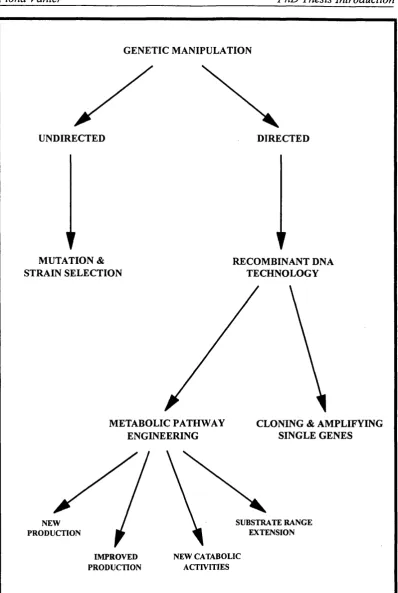
The methods of genetic manipulation discussed in this chapter are shown in Figure 1.1. The uses of metabolic engineering are divided into the four categories shown (Cameron & Tong, 1993), each of which will be covered in more detail. One should appreciate that these categories are arbitrary and some examples fit into more than one category. For example, the work of Wood & Ingram (1992) involves the improvement of ethanol production by recombinant K. oxytoca and the extension of the substrate range to incorporate cellulose.
1.3.3.2 Improved Production of Chemicals
A great deal of work has been done on ethanol production, since it is widely used for the production of alcoholic beverages and as an alternative transportation fuel. The main organisms of interest are E, coli, Z. mobilis, Erwina sp., and Klebsiella sp. In most cases, the host micro-organisms are ethanol producers but the yield from the native pathways is relatively low. The reason for such low yields is the synthesis of mixed fermentation products such as acetate, formate, lactate and butanediol - as well as ethanol. The introduction of new genetic material which favours ethanol as the principle fermentation product led to the improved production of ethanol to levels comparable to those found in industrially used micro-organisms. Earlier work involved the expression of the gene(s) encoding alcohol dehydrogenase II and pyruvate decarboxylase from Z. mobilis in host organisms such as E. coli (Ingram et a l, 1987),
GENETIC MANIPULATION
UNDIRECTED DIRECTED
MUTATION & STRAIN SELECTION
RECOMBINANT DNA TECHNOLOGY
METABOLIC PATHWAY ENGINEERING
CLONING & AMPLIFYING SINGLE GENES
SUBSTRATE RANGE EXTENSION NEW
PRODUCTION
NEW CATABOLIC ACTIVITIES IMPROVED
PRODUCTION
FIGURE 1.1:
Fiona Vanier__________________________________________ PhD Thesis Introduction
Tolan & Finn (1987^) exploited these traits by introducing the pyruvate decarboxylase gene from Z. mobilis. Later work also involves the use of Z. mobilis but as a host micro-organism instead of a gene donor. The introduction of genes from E. coli
(Deanda et al., 1996) and K. pneumoniae (Zhang et a l, 1995) enabled the recombinant organism to utilise arabinose and xylose respectively for the production of ethanol to yields greater than 85% of the theoretical.
The improvement of antibiotic production is another area of great commercial interest. In the past, it was difficult to apply recombinant DNA techniques to the improvement of antibiotic production. The main reason for this is because the synthesis of antibiotics relies of the sequential expression of genes within a metabolic pathway and the problems associated with improvement are less straightforward. The use of metabolic engineering was favourable for two reasons (Cameron & Tong, 1993). Firstly, antibiotic genes tend to be clustered, and this facilitates the cloning of whole pathways into high capacity, low copy number plasmid vectors. Secondly, genes encoding enzymes within an antibiotic producing pathway are often positively regulated. Such positive regulators, if present, could be over expressed causing an increase in antibiotic production. Chater (1990), reviewed the use of recombinant DNA technology to improve the yield of antibiotic-producing Streptomyces species, and hosts such as S. lividans and C. acremonium have been manipulated to accept high capacity vectors for the production of cephamycin C (Chen et al., 1988) and cephalosporin C (Skatrud et al., 1989) respectively. However, one must appreciate that such gene clusters can be fairly large, and successful cloning will have a size limitation. The instability of a recombinant plasmid is also another limiting factor, but this may be reduced by the use of a mutant host deficient in intra-plasmid recombination (Chater, 1990). Potential industrial advantages can be gained from research into the regulatory nature of antibiotic gene clusters. In fact, an investigation into metabolic pathways with respect to rate-limiting steps and metabolic flux is an important analytical tool used in metabolic engineering which will be discussed later.
1.3.3.3 Extension o f the Substrate Range
Much research concentrates on the engineering of micro-organisms so that they are able to utilise alternative carbon sources. Xylose and cellulose are found in plant biomass, which is the cheapest and most abundant material on earth. A plentiful supply of lactose is found in whey which is a by-product of the dairy industry, the disposal of which is a major pollution problem. Consequently, the genetic modification of micro
organisms to extend their substrate range to include these carbon sources is economically attractive. Ethanol production from cellulose (Wood & Ingram, 1992) and xylose (Ohta et a l, 1991) have both been investigated using recombinant K . oxytoca where the genes necessary for ethanol production from Z. mobilis were integrated into the host chromosome. In other studies, Z. mobilis was used as a host for the genes necessary for arabinose fermentation from E. coli (Deanda et a l, 1996) and genes necessary for pentose metabolism from K. pneumoniae (Zhang et a l, 1995). In the latter study, the fermentation of a pentose sugar (such as xylose) to ethanol was possible via a combination of the pentose phosphate and Entner-Doudoroff pathways. The production of rhamnolipids, biosurfactants which have potential industrial application, from lactose-utilising strains of P. aeruginosa was possible due to the insertion of the E. coli lacZY genes into the chromosome of the host strain (Koch et a l, 1988). The ease with which lactose utilisation can be engineered in an organism is mainly due to the vast amount of information available on the lactose operon.
Although the main substrates of interest are carbon sources used to synthesise commercially important products, the idea of extending the substrate range has also been adapted for use in biodégradation. Lee et a l, (1994), used metabolic engineering to construct a strain for the simultaneous biodégradation of a selection of environmentally dangerous compounds. Since this particular example focuses on the introduction of catabolic activity, it is discussed in the next section.
1.3.3.4 Addition o f New Catabolic Activities
W ork on the addition of new catabolic activities for the degradation o f toxic chemicals is difficult and has not progressed as far as the work in the other three areas addressed in this section. The main reasons for this are due to problems associated with the insolubility of some substrates and substrate toxicity, especially when the concentration of the substrate is high. The substrates targeted for degradation are mainly organic compounds which are common pollutants such as benzene, benzoates and various halogenated compounds. Using both metabolic pathway engineering and the characteristic ability of many bacterial strains to biodegrade such waste products, one can decrease the levels of harmful pollutants detected in the environment.
Fiona Vanier__________________________________________ PhD Thesis Introduction
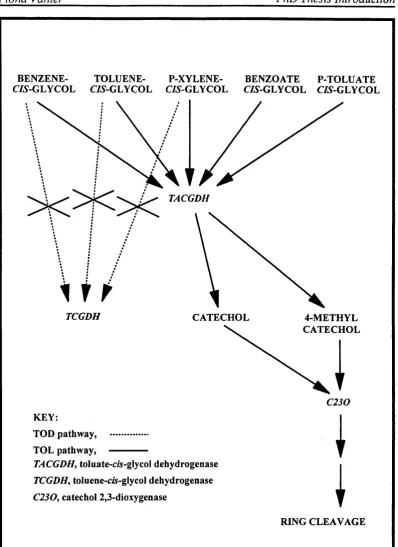
degradation of a mixture of benzene, toluene and ;?-xylene (BTX) is an example of the first strategy (Lee et a i, 1994). A hybrid pathway was constructed using cloned genes and the existing host metabolic pathway. The critical metabolic step was identified as the point at which the TOD and TOL pathways combined. Figure 1.2 shows a section of the new route mapped through the pathways. A further development followed, which involved the amplification of the cloned genes in order to improve this strategy (Lee et a i, 1995). Use of the second strategy is not so common, probably because substrates targeted for biodégradation are usually not pure compounds, and a series of inter-related metabolic pathways are more useful. Such pathways can usually only be constructed with the assistance of cloned genes from a foreign source. One example is the redesigning of an existing metabolic route for the catabolism of alkylbenzoates in P. putida (Ramos et a l, 1987). Use of the third strategy is probably the most common.
This may be because it is easier to clone a metabolic pathway which functions independent of the host than it is to construct a hybrid pathway. This strategy has been used for the degradation of trichloroethylene using E. coli containing cloned toluene dioxygenase genes (Zylstra et a l, 1989), (Winter et a l, 1989) and the degradation of halogenated compounds such as haloaromatics (Lehrbach et a l, 1984), and chlorofluorocarbons (Hur et a l, 1994).
1.3.3.5 Production o f Chemicals New to the Host Organism
This category has probably attracted the most interest with respect to research and industry. Reasons for this include the possible production of novel products by the expression of recombinant pathways in a foreign host. As previously shown in the last section, host micro-organisms can be exploited for their ability to act as a “true host” for new genetic material or for the design of new non-hybrid or hybrid pathways. As a true host, a plasmid construct containing the cloned genes is used to transform a host cell so that it overproduces a specific product on the addition of an appropriate substrate. This technique has been used to convert #-octane to octanoic acid using recombinant E. coli cells transformed with the alk genes from P. oleovorans (Favre- Bulle et a l, 1991). The production of new non-hybrid pathways involves the genetic modification of existing pathways. The existing 6-oxidation pathway in C. tropicalis
was subjected to gene disruption, the genes in the co-oxidation pathway were amplified, and the production of long-chain dicarboxylic acids was improved to 100% (Picataggio
et a l, 1992).
Gene amplification has also been used to develop recombinant micro-organisms which overproduce amino acids. Mutation and recombinant DNA techniques were
BENZENE- TOLUENE- P-XYLENE- BENZOATE P-TOLUATE
CZS-GLYCOL C/y-GLYCOL CZS-GLYCOL C/5-GLYCOL CZy-GLYCOL
TACGDH
X
TCGDH CATECHOL 4-METHYL
CATECHOL
C 230
KEY:
TOD pathway, ... TOL pathway,
---TACGDH^ toluate-c«-glycol dehydrogenase TCGDH, toIuene-c&-glycoI dehydrogenase € 2 3 0 , catechol 2,3-dioxygenase
RING CLEAVAGE
FIGURE 1.2:
Fiona Vanier__________________________________________ PhD Thesis Introduction
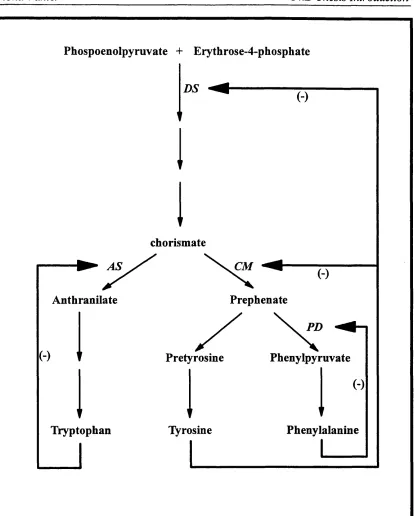
used to construct a recombinant C. glutamicum strain capable of overproducing tyrosine and phenylalanine (Ikeda & Katsumata, 1992). The pathways affected by gene amplification are shown in Figure 1.3. In C. gutamicum and other related strains, control of metabolic flow occurs mainly by way of end product inhibition as shown. Amplification of 3 genes which encode the first enzyme in the common pathway, 3- deoxy-D-am6mo-heptulosonate 7-phosphate synthase (DS), and the branch point enzymes, chorismate mutase (CM) and prephenate dehydratase (PD) results in an elimination of the bottleneck produced by the end products.
Two classic examples of metabolic pathway engineering are also examples of the development of hybrid pathways for the synthesis of new chemicals. They are the production of 2-KLG and indigo. The synthesis of 2-KLG, the final precursor in vitamin C production, involves using a genetically modified strain of E. herbicola
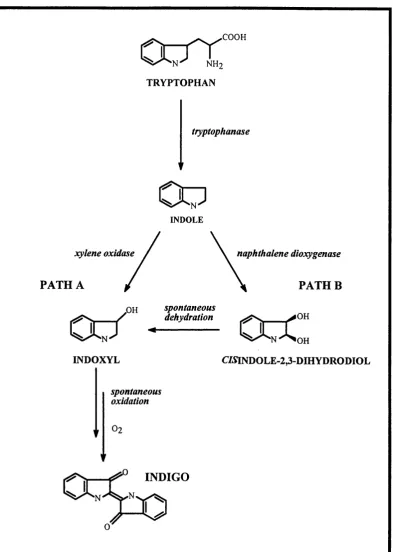
(Anderson et a l, 1985). Combining two metabolic pathways eliminates the need for two successive fermentations in a previously used method and therefore reduces production costs. Indigo, a blue pigment extensively used in the dyeing of cotton and wool fabrics, is extracted from plant species of the genus Indigofera and can also synthesised chemically. A new route to indigo production was considered, which involved the expression of cloned gene fragments in bacteria. This example illustrates the potential of metabolic engineering in the design of recombinant micro-organisms capable of synthesising commercially important chemicals. There are two routes to the bacterial production of indigo as shown in Figure 1.4. The first involves the expression of the xylene oxidase gene from the TOL plasmid (Mermod et a l, 1986), and the second involves expression of the naphthalene dioxygenase gene from the NAH7 plasmid (Ensley et a l, 1983), (Murdock et a l, 1993). In all studies, the bacterial host used was E. coli and the cloned genes originated from P. putida.
In the examples mentioned, some background knowledge pertaining to the nature of the biosynthetic pathways is necessary. Studies on the distribution of carbon, nitrogen and oxygen in a biosynthetic pathway, location of branch points critical to redirection of the metabolic flow and the identification of rate-limiting steps are all important elements which need consideration. Metabolic flux analysis is one of the tools used to determine the nature of control and sensitivity within a metabolic pathway. There are other tools used to assist metabolic engineering which draw on a wide range of technologies and disciplines. This subject covers a vast amount of literature and consequently, only the most relevant aspects will be covered in the next section.
Phospoenolpyruvate + Erythrose-4-phosphate
chorismate
CM
Prephenate Anthranilate
PD
Pretyrosine Phenylpyruvate
Tyrosine Phenylalanine Tryptophan
FIGURE 1.3:
The pathways and regulatory mechanisms required for the synthesis o f aromatic amino acids in C. glutanicum. (-) represents feedback inhibition by the amino acids (Ikeda er a/., 1992).
Fiona Vanier PhD Thesis Introduction
.COOH
TRYPTOPHAN
tryptophanase
Oo
INDOLE
xylene oxidase naphthalene dioxygenase
PATH A PATHB
spontaneous dehydration ,0H
Oo"
INDOXYL
OoC
CmNDOLE-2,3-DIHYDRODIOL
spontaneous oxidation
INDIGO
FIGURE 1.4:
The two routes for the bacterial production o f indigo. The path A uses the xylene oxidase gene (Mermod et al, 1986) and the path B uses the napththalene dioxygenase gene (Ensley et a l, 1983).
1.3.4 Tools for Metabolic Pathway Engineering 1.3.4.1 C ategorisation of Tools
The variation in the examples mentioned above illustrates the wide range of technologies that can be used for metabolic pathway engineering. These tools can be placed into the following categories:
1) Molecular biological tools.
2) Mathematical and computational tools. 3) Analytical chemistry and measurement tools.
Many traditional techniques used in genetics and analytical chemistry are frequently used as tools for metabolic pathway engineering. In addition to traditional techniques, some tools have also been developed specifically for use in this field.
1.3.4.2 M olecular Biological Tools
Fiona Vanier__________________________________________ PhD Thesis Introduction
1.3.4.3 Mathematical and Computational Tools
Metabolic engineering requires genetic, biochemical and physiological information on the host organisms used in biological processes. The majority of tools used in this category involve the use of information technology. The yield of a biosynthetic process can be improved by reducing the influence of rate-limiting steps on the process. Before this influence can be relaxed, these steps need to be identified and located. Analysis of elements such as carbon flux and acetate production (Ko et a l,
1993), glucose utilisation (Terrance et a l, 1993) and pathway enzyme activities (Patnaik et a l, 1995), have all been used to quantify the metabolic flows within target pathways. The analysis of metabolic flux distributions incorporates techniques used to identify carbon, nitrogen and oxygen distribution, pathway enzyme activities and pathway compound levels. This procedure has been used to indirectly improve the synthesis of products such as lysine (Vallino & Stephanopoulos, 1993) and L- phenylalanine (Dell & Frost, 1993).
A number of theories have been proposed and used to investigate the nature of flux distributions throughout particular metabolic pathways. Metabolic control analysis is one such theory and is defined as the quantitative analysis of the control structure of a metabolic system (Stephanopoulos & Sinskey, 1993). Biochemical systems theory and Crabtree and Newsholme's 'flux oriented' theory are two variations of metabolic control analysis (Fell, 1992). Biochemical systems theory has been used to develop a computer program capable of simulating the behaviour of a metabolic pathway on the basis of kinetic and flux data (Regan et a l, 1992). Another artificial intelligence program known as metabolic pathway systems has been designed to find the possible pathways required to transform a given substrate into a given target product. This program has also been used to predict the possible effects of adding or deleting enzymatic activity from a given cellular environment and to classify pathways according to cellular aim (Seressiotis & Bailey, 1988).
1.3.4.4 Analytical, Chemical and M easurement Tools
The majority of analytical techniques are of crucial importance for metabolic engineering. Classical techniques such as mass balancing, isotopic labelling and real time analysis using techniques such as HPLC and CZE are often used.
1.3.5 Conclusion: The Use of a Model System
Although metabolic engineering has been used to synthesise a wide range of industrially useful products, model systems are required to practically assess the feasibility of using these methods with a biological process. A model system is made up of a host micro-organism into which is cloned a foreign metabolic pathway. The recombinant micro-organism is a fully functioning system when induced levels of the pathway enzymes are able to sequentially synthesise pathway compounds on the addition of a substrate. The desired characteristics of the model system will depend on a number of properties such as the physical and chemical characteristics of the pathway compounds and the environmental conditions required by the microbial host. In order to illustrate the imperfections found in every process, the model system should not be completely ideal. Detrimental characteristics which require minimisation can be an advantage, since the ability to overcome such characteristics is a important skill aquired during process design. The next section describes the foreign metabolic pathway used as part of the model system for the practical evaluation of a multi step biotransformation.
1.4 The TO L Plasm id & Arom atic D egradation
1.4.1 Introduction
The aromatic degradation pathways have been used for the production of industrially useful compounds, the degradation of ecologically hazardous chemicals and the addition of new catabolic activities using metabolic engineering. The TOL pathway is the best understood aromatic degradation pathway and the corresponding genes are collectively organised on a plasmid labelled pWWO. The TOL plasmid was first described in 1974, and since then a large amount of research has been undertaken on this and other related pathways.
Fiona Vanier__________________________________________PhD Thesis Introduction
1.4.2 General Description
The TOL plasmid was first discovered by Williams & Murray (1974). The analysis of mutant strains of P. putida (arvilla) mt-2 showed evidence for the existence of a plasmid which contains all the genes necessary for catechol degradation via
meta-cleavage. The genes encoding the non-specific meto-cleavage pathway enzymes were somehow deactivated or lost but the genes encoding the benzoate specific
ortho-cleavage pathway enzymes were retained. These results suggested that the wild type contains two systems for benzoate degradation. The first exists on a plasmid and is non-specific with respect to induction and catalysis. This system forms the TOL
meta-cleavage pathway. The second system exists on the chromosome and is more specific to benzoate. These genes are induced in the presence of benzoate and catalyse benzoate degradation via the orr/io-cleavage pathway. The ortho- and mera-cleavage pathways are shown in Figure 1.5.
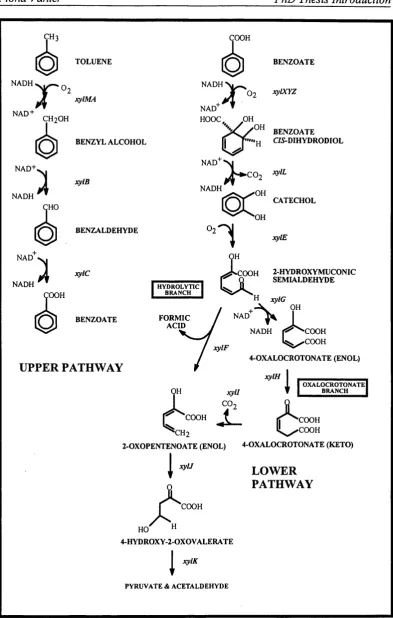
The plasmid itself is fairly large, about 117 kilobase pairs in size. The catabolic pathway and regulatory genes constitute about 40 kilobase pairs. The genes are organised into two opérons encoding the enzymes involved in the upper and lower pathways as shown in Figure 1.6 (Assinder & Williams, 1990). The plasmid also contains a transposase gene, tnyA, two genes required for resolution tnpS and tnpT
and a DNA sequence necessary in cis for resolution, known as the res site (Burlage et a l, 1989). The regulatory functions of the plasmid were investigated by Ramos et a l,
(1987^). A model was developed which suggests the mechanism controlling transcription using alkylbenzoate degradation as an example. In this model the constitutively produced xylR protein is activated by binding to the substrate as it enters the cell. The active protein binds to the xylC A B operon and promotes RNA polymerase binding.
The TOD pathway is the most studied alternative pathway and is shown in Figure 1.7. Research undertaken on this pathway includes the production of ccMA using
Arthrobacter (Yoshikawa et a l, 1990), the hydroxylation of indan by E. coli containing cloned T 120 (Brand et a l, 1992) and the hydroxylation of toluene using a mutant strain of P. putida (Hack et a l, 1992).
1.4.3 Suitability in a Model System
There are two main reasons for the use of aromatic degradation pathways in research. Firstly, toxic pollutants such as trichloroethylene (Fujita et a l, 1995), chlorobenzenes (Haigler et a l, 1992) and methylaromatics (Rojo et a l, 1987) which
COOH BENZOATE NADH NAD benzoate dioxygenase BENZOATE DIHYDRODIOL HOOC ,0H ,0H NAD+ CO. NADH
ORTHO-CLEAVAGE CATECHOL
catechol 1,2-dioxygenase
a s , CIS MUCONIC
ACID
C
COOH COOH SUCCINATE + ACETYL-CoA benzoate dihydrodiol dehydrogenase (decarboxylating) META-CLEAVAGEO2 p i
catechol 2,3-dioxygenase
COOH 2-HYDROXVMUCONIC SEMIALDEHYDE OH PYRUVATE + ACETALDEHYDE + CO2
FIGURE 1.5:
Fiona Vanier PhD Thesis Introduction
NADH
NAD+
ÇH3 COOH
TOLUENE
xylMA
BENZOATE
CH2OH
NADH'^^
NAD^ *
HOOC. .OH
O2 xylXYZ
NAD+^
NADH ^ :ho NAD NADH 0 BENZYL ALCOHOL xylB BENZALDEHYDE BENZOATE
[j T*""H C/5-DIHYDRODIOL
NAD^
NADH
O2
C O i
CATECHOL '1 OH
1
OH xylE :00H xylC BENZOATE HYDROLYTIC BRANCH UPPER PATHWAY OH^ ^ C O O H 2-HYDROXYMUCONIC 1 ^ O SEMIALDEHYDE
H xylG
FORMIC / NAD^ I
/ xylF
J 4-OXALOCROTONATE (ENOL)
I
,---T I OXALOCROTONATE
‘COOH I^^COOH
xyll BRANCH
COOH - I —
X
if^COOH COOH 2-OXOPENTENOATE (ENOL) 4-OXALOCROTONATE (KETO)I
LOWERPATHWAY
COOH
4-HYDR0XY-2 OXOVALERATE
xylK
1
PYRUVATE & ACETALDEHYDE
FIGURE 1.6:
The upper & lower pathways encoded by the TOL plasmid.