GENDER DIFFERENCES ON THE USE OF METADISCOURSE ON
REFLECTIVE ESSAYS: A CASE STUDY OF INBOUND STUDENTS
Noor Hanim Rahmat1+
Nur Anisah Tan Abdullah2
Mohamad Hanis Yahaya3
Choong Pow Yean4 Wararat
Whanchit5
1,2,3,4Akademi Pengajian Bahasa, Universiti Teknologi MARA, Malaysia.
5School of Liberal Arts, Walailak University, Thailand.
(+ Corresponding author)
ABSTRACT
Article History
Received: 10 February 2020 Revised: 16 March 2020 Accepted: 22 April 2020 Published: 1 June 2020
Keywords
Reflective essay Metadiscourse Interactive metadiscourse Interactional metadiscourse.
During the age of global learning, students’ mobility has popularized edutourism in universities around the world. Generally, students benefit in many ways. Although students completed surveys to document how they felt about their stay, the use of reflective essays can be useful for the organizers to find out how the participants felt about their stay in the host country. This study explored the data in students’ reflective essays to find out how they felt about their experience learning English in Malaysia. Specially, the use of metadiscourse is used to analyse the students’ attitudes and emotions about what they gained from the edutourism programme. The data was analysed based on interactive or interactional metadiscourse. Findings revealed students used interactive metadiscourse such as transitions, frame markers and code glosses; They used interactional metadiscourse such as hedges, boosters and self-mentions in their essays to reveal how they felt about their learning experience.
Contribution/ Originality:
This study contributes to the existing literature of global learning via edutourism. This study uses the analysis of metadiscourse elements in a reflective essay. Metadiscourse elements used in essays helped researchers understand learners’ feelings towards a learning experience.1. INTRODUCTION
1.1. Background of Study
Edutourism benefits participating learners in many ways. According to Rahmat, Addullah, and Kashiwazaki
(2020) students learn more than what was planned. Through authentic learning, they learnt in context and gain
opportunities to understand the culture of the host country. With reference to Figure 1, learners would leave edutourism package gaining authentic learning, in context and also understand the culture of the host country.
Nevertheless, many participants of the edutourism packages who came to the host country to learn a new language may not be proficient in the language to express verbally how they felt about the experience. Fortunately, many EFL learners can express themselves fairly better in written form than in spoken form. One way to know how they felt about the edutourism programme is to analyse what they wrote about their experience.
International Journal of Asian Social Science
ISSN(e): 2224-4441 ISSN(p): 2226-5139
DOI: 10.18488/journal.1.2020.105.248.261 Vol. 10, No. 5, 248-261.
Figure-1. Benefits of edutourism to learners. Source:Rahmat et al. (2020).
The use of metadiscourse can be done to investigate the writer’s effort to communicate with the audience by showing the direction and purpose of the text. Hyland (2004) introduced interaction and interactional metadiscourse to analyse what how writers interact with the audience and how the text produced can be interactional enough to convey intended message. In addition to that, the analyse of the use of metadiscourse can allow researchers to understand the attitude of the writer towards the issues presented.
1.2. Statement of Problem
Ideally, a good piece of writer is written through a linear progression of ideas. The writer uses strong, and suitable words to describe what the he/she intends to convey. A good writer Does not use words, phrases or sentences that can mislead the audience. However, according to Rahmat (2011) problems occur when writers either over or under utilize certain words and phrases. This may cause the wrong message to be conveyed. Hyland (2004)
defined metadiscours as “writing about writing” and this analyse can be done to investigate the use of words and phrases and to see if what is written is conveyed to the audience. This analysis can also help researchers to understand the attitude of the writer towards the message being conveyed. In addition to that the research on metadiscours have been done on writes from India by Mahmood, Javaid, and Mahmood (2017). There have been studies on metadiscourse by writers from China (Lu, 2011) and also on Malaysian writers by Rahmat, Yunos, Syed
Abdul Rahman, and Ibrahim (2015).
It would be interesting to continue the comparison across the globe.
1.3. Objective and Research Questions
This study is carried out to investigate the use metadiscourse on essays by Japanese undergraduates. Specifically, this study explores the use of interactive and interactional metadiscourse by the Japanese writers. This study hopes to find answers the following questions;
1. How can the interactive metadiscourse on essays by Japanese undergraduates be described in terms of transitions, frame markers and code glosses?
2. How can the interactional metadiscourse on essays by Japanese undergraduates be described in terms of hedges, boosters and self-mentions?
2. LITERATURE REVIEW
2.1. Introduction
This section presents information on communication, metadiscourse, past studies, and also the theoretical framework of the study.
2.2. Communication
Figure 2 presents the social-interaction model of writing by Nystrand (1989). This model assumes that both
the writer and reader depend on the text to communicate. Both the writer and reader have their own set of external and internal forces to deal with. The external forces for the writer would be the availability of materials needed for writing and the technical aspects involved in the writing process. The internal forces that influence the writer would be the writer’s ability in his/her content and rhetorical knowledge. The external forces of the reader would be factors such as the technical aspects of the text that hinders the readers ability to read the text. Internal forces for the reader would be the reader’s reading proficiency, and background knowledge that may influence the understanding of the text.
Figure-2. Social interactive model of written communication
Source:Nystrand (1989).
The internal aspects of the writer are the factors that enable the message to be communicated the reader through the text. This involves the writing ability or even the choice of writing style of the writer. This writing style is portrayed often through the use of metadiscourse.
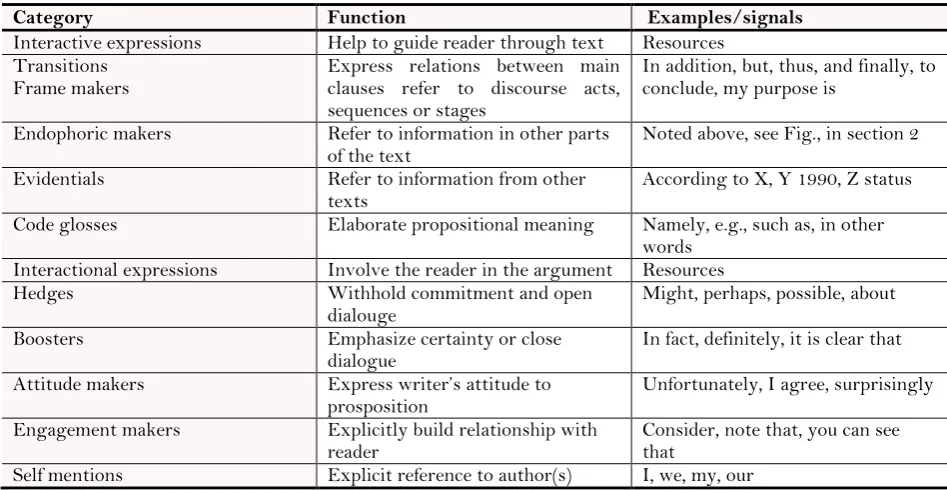
Table-1. Metadiscourse Model.
Category Function Examples/signals
Interactive expressions Help to guide reader through text Resources Transitions
Frame makers Express relations between main clauses refer to discourse acts, sequences or stages
In addition, but, thus, and finally, to conclude, my purpose is
Endophoric makers Refer to information in other parts
of the text Noted above, see Fig., in section 2
Evidentials Refer to information from other
texts According to X, Y 1990, Z status
Code glosses Elaborate propositional meaning Namely, e.g., such as, in other
words Interactional expressions Involve the reader in the argument Resources
Hedges Withhold commitment and open
dialouge Might, perhaps, possible, about
Boosters Emphasize certainty or close
dialogue In fact, definitely, it is clear that
Attitude makers Express writer’s attitude to
prosposition Unfortunately, I agree, surprisingly
Engagement makers Explicitly build relationship with
reader Consider, note that, you can see that
Self mentions Explicit reference to author(s) I, we, my, our
2.3. What is Metadiscourse?
Metadiscourse in essays is defined in several ways. Hyland (2010) reports that metadisourse can help in social engagement between the writer and the reader. Hyland and Tse (2004) add that metadiscourse is “self-reflective linguistic material referring to the evolving text and to the writer and imagined reader of that text. It is based on a view of writing as social engagement and in academic contexts reveals the ways that writers project themselves into their discourse to signal their attitude towards both the propositional content and the audience of the text.” Hyland
(2004) presents a detailed characteristics of Metadisourse Table 1.Academic writing is not only content oriented,
the writer communicates with the reader to convey messages. According to Al-Mudhaffari, Hussin, and Abdullah
(2019) writers use metadiscourse to project themselves on text so that the content as well as the writer’s stance can
be understood. In addition to that, Daciana (2014) reports that the use of metadiscourse helps to reinforce the writer and audience connection.
Table 1 presents the metadiscourse model by Hyland (2004). There are two types of metadiscourse -interactive
and interactional discourse. In order to interact with the reader, the writer may use frame markers, endophoric markers, evidentials and code glosses. In addition to that, writers my use interactional expressions such as hedges, boosters, attitude markers, engagement markers or self mentions in the text.
Metadiscourse can serve several functions to both the writer and the reader. According to Safari (2018) writers can create structurally and communicatively well-organised and coherent text through the use of metadiscourse. He adds that metadiscourse is used to allow writers to interact with the readers through the use of language. In addition to that, Cheng and Steffensen (1996) and Abdi, Rizi, and Tavakoli (2010) found that metadiscourse can enhance the writer’s awareness of the readers’ needs. It can also the sue of metadiscourse can help improve the quality of the text written. In relation to that, Hu and Cao (2011) conducted a study on the use of hedges and boosters. These two types of metadiscourse elements are considered important resources for writers to mark their epistemic stance, as well as help position reader-writer relationship.
2.4. Gender Identity in Metadiscourse
2.5. Past Studies
2.5.1. Metadiscourse Analysis in Writing
Metadiscourse is reported to have many uses for the writer. The study by Linfeng (2012) examined the use of metadiscourse in seventh-grade English textbooks in Japan and China. Four textbooks were selected for metadiscourse analysis to determine what kinds of metadiscourse used to facilitate learner understanding of propositional content. The findings imply that although both Japan and China are categorized as EFL countries, their English textbooks display different characteristics in terms of metadiscourse usage, reflecting the different ways in which learning materials are designed and developed. In another study, Anwardeen, Ong, Gabriel, and
Kalajahi (2013) analysed the usage of metadiscourse in argumentative writing by Malaysian college students. The
aims of the study was to examine the frequency and distribution of metadiscourse used by the particular students in argumentative writing as well as to analyze the errors made by the particular students in using metadiscourse. The finding shows that Malaysian college students are more inclined to use interactive metadiscourse instead of interpersonal metadiscourse. Besides, the selected students are using less code glosses and stance indicator in their argumentative writing. Pungpen (1988) conducted a study to describe the patterns of the metadiscourse features in persuasive essays written by college students. The research investigated the quantity and types of the metadiscourse features used. The data used in this study was persuasive essays written by students who came for the English placement examination. They were written by the first year American college (NES) and the new foreign students (ESL) with high and low writing proficiency. The metadiscourse types were classified and examples were given so that the patterns of their use in the four sets of essays became evident. The metadisocurse errors were also identified and counted. This study indicated that the metadisourse features can be used as an indication of writing proficiency since the high-rated texts, ESL and NES alike.
2.5.2. The Different Uses Metadiscourse
The use of metadiscourse has been shown to differ across culture. The study by Kobayashi (2016) investigated the differences in rhetorical preferences in L2 writings among different L1 groups. This study compared the use of metadiscourse markers in L2 essays and identified discourse devices used to distinguish different L1 groups. The essays were taken from the International Corpus Network of Asian Learners of English (ICNALE). The study compared essays from six L1 groups (viz., Chinese, Indonesian, Japanese, Korean, Taiwanese, and Thai) based on the frequency of metadiscourse markers. The results suggested a substantial difference in the use of metadiscourse markers between East Asian groups (viz., Chinese, Japanese, Korean, and Taiwanese) and Southeast Asian groups (viz., Indonesian and Thai). Specifically, the results indicated that there is a substantial difference in the use of metadiscourse markers between East Asian groups (viz., Chinese, Japanese, Korean, and Taiwanese) and Southeast Asian groups (viz., Indonesian and Thai). Each learner group displayed the specific characteristics of metadiscourse.
Pasaribu (2017) investigated metadiscourse markers in academic 20 essays written by male and female
There have been reported research findings to reveal that gender differences influence the use of metadiscourse.
Abdu, Jin, and Nordin (2016) investigated how interactional metadiscourse resources are used to articulate and
construct gender identity among ESL learners in Malaysia. The main aim of the study was to provide language practitioners with empirical data of how gender is projected in the academic writings of ESL learners and to what extent learners’ writings are affected by their gender. The data can then be utilised for the design and development of more effective academic writing courses in Malaysia. Quantitative and qualitative analyses were performed on the similarities and differences in the use of interactional metadiscourse resources, namely; hedges, boosters, attitude markers, engagement markers and self-mentions between male and female ESL learners involved in the study. The findings of the quantitative analyses showed no obvious differences in the writing style of female and male writers in the study, while the qualitative findings reveal slight differences in the way writers position themselves in the reader/writer interaction and in the expression of agreement statement.
In addition to that, there are evidence to show that gender does paly a role in the use of metadiscourse.
Yeganeh and Ghoreyshi (2015) explored the role of gender differences in applying Meta-discourse markers in
abstract and discussion sections of articles written in English by native speakers of Persian. This comparative study was done to probe into the frequency number of hedge and booster in these two sections. To do so, 40 English research articles written by native speakers of Persian were chosen. Accordingly, Hyland (2004) meta-discourse taxonomy was employed to identify the list of hedges and boosters. The results of quantitative and qualitative analyses revealed that gender differences played a significant role on utilizing these devices in the texts. It was also found that Iranian males were more inclined to use boosters in their academic writing while Iranian females prefer to use more hedges to express the information they supplied.
2.6. Theoretical Framework of the Study
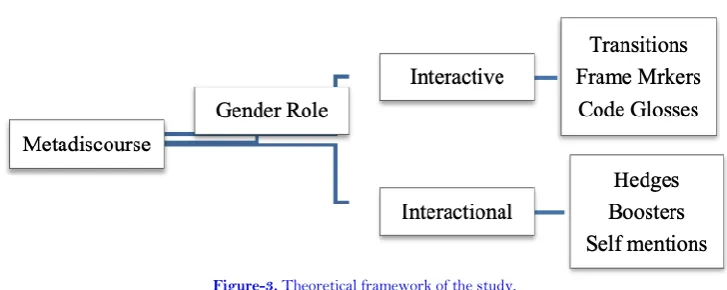
Figure-3. Theoretical framework of the study.
Figure 3 above presents the theoretical framework of the study. This study is done to find out if gender
difference plays a role in the use of metadiscourse among writers. Past studies have revelead that there are diffences in the use of interactive metadiscourse such as transitions, frame markers and code glosses. There were also previous studies revealing that there are differences in the use of interactional metadiscourse such a hedges, boosters and self- mentions.
3. METHODOLOGY
This mixed mode study explored the use of metadiscourse across gender on reflective essays done describing their experience with Edutourism programmes organized by a public university in Malaysia. Data was randomly collected from 10 participants. The essays were analysed based on the categories of metadiscourse by Hyland
(2004). This study only focused on three interactive discourses (transitions, frame markers and code glosses) and
the data analsyis done by Tarayo (2014). The categories were coded based on Hyland (2004) labels. The analysis is done manually to ensure its validity. During the analysis, only words or expressions that have metadiscoursal values were classified as metadiscourse. In order to achieve higher reliability in the manual analysis, two independent coders from the university was chosen. Both the researcher and coders conferred on the individual coding made and reached agreement in cases where opinion differed. Frequency and percentage counts were used to analyse the data.
4. FINDINGS
This section discusses the findings. To ease understanding, the findings are presented in the form of answers to the research questions presented in the previous section.
4.1. Overall Findings
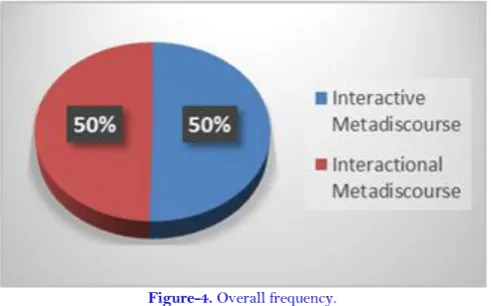
Figure-4. Overall frequency.
Figure 4 shows the overall frequency of the use of metadiscourse of all writers in the study. As a whole, the
writers used both interactive and interactional metadiscourse equally. This is not in accordance with the findings by
Anwardeen et al. (2013) who found that Malaysian college writers used more interactive than interactional
metadiscourse. Perhaps the writers for this study wrote reflective essays compared to the study by Anwardeen et al.
(2013) who studies college students writing argumentative essays. Argumentative essays need to be written in a
more forceful manner compared to the tone in reflective essays.
4.2. Interactive Metadiscourse
This section presents the answer to research question 1: How can the interactive metadiscourse on essays by Japanese undergraduates be described in terms of transitions, frame markers and code glosses? Findings is presented based on (a) transitions, (b) frame markers, and (c) code glosses.
(a) Transitions
Table-2. Frequency of use for transitions.
Transitions shown by the use of; Word Frequency Male Frequency Female Frequency Total
Similarity So 3 4
also 3 2
6 6 12 (6.1%)
Exception/Contrast but 5 9
however 3 3
In contrast 1
On the other hand 1
8 14 22 (11.2%)
Time Now 1
For a start 1
Then 1
Before 2
gradually 1
0 6 6 ( 2.2%)
Example For example 2 2
2 2 4 (2.0%)
Emphasis Of course 1
indeed 1
1 1 2 (1.0%)
Place / position In 15 11
There 3 3
On 3 2
above 1
22 16 38 (19.4%)
Cause and effect So 10 7
Therefore 3 2
Because 2 1
Hence 1
16 10 26 (13.3%)
Additional support or evidence And 18 45
Also 3 4
In addition 1
Or 1
moreover 1
Too 1
Then 1
24 51 77 (39.2%)
Conclusion/ summary In conclusion 4 5
Sum up 1
Finally 1
5 6 11 (5.6%)
ALL 84 112 196(100%)
Table-3. Frequency for frame markers.
Topic/Shifts Frequency Male Frequency Female Frequency Total
Sequencing Firstly/at first 4 6
Secondly/second 4 8
Thirdly/third 3 1
For a start 1
finally 4
11 20 31 (75.7%)
Label Stages In conclusion 3 4
Sum up 1
4 4 8 (19.5%)
Announce Goals I would like to 1
In my case 1
1 1 2 (4.8%)
(b) Frame Markers
According to Anwardeen et al. (2013) frame markers refer to discourse acts, sequences, or text stages in written texts. With reference to Table 3, the commonly used frame markers in this study are sequencing, label stages and announce goals. The most frequently used frame markers is “sequencing” (75.7%).
(c) Code Glosses
According to Anwardeen et al. (2013) code glosses helped clarify a proposition by defining, exemplifying, reformulating and simplifying it. With reference to Table 4, the most commonly used code glosses is “exemplifying” (75%). Excerpts from the data shows the male writers use of “for example” as;
[M3] “For example, there are many drivers..” [M4] “For example, how we learn..”
The female writers’ used “such as” and “for example”; [F3] “rely on other persons such as buddies…” [F4] “For example, how we live..”
Table-4. Frequency for code glosses. Type of
Proposition Example of proposition Frequency Male Frequency Female Frequency Total
exemplifying For example 2 1 3 (75%)
simplifying Such as 1 1 (25%)
2 2 4 (100%)
4.3. Interactional Metadiscourse
This section presents the answer to research question 2: How can the interactional metadiscourse on essays by Japanese undergraduates be described in terms of hedges, boosters and self-mentions? Findings is presented based on; (a) hedges, (b) boosters, and (c) self-mentions.
(a) Hedges
According to Hu and Cao (2011) hedging is a communicative strategy for increasing or reducing the force of statements . The most common hedges used by the writers in this study is “could” (50%). With reference to Table 5, the male writers from this study uses “could”, “believe”, “think” as a sign of hedging. Excerpts from the data for the male writers are;
[M1] “I could learn Malaysian culture..” [M3] “They believe that this….”
[M4] “we could find out more findings…” [M4] “I think PBL project could be useful…”
[M5] “the unique and unconventional actions by young students, I think.”
In addition to that, the female writer used “could “ and “may” in one sentence. Excerpts from this writer is; [F3] “However, if we could research about….we may get more..”
Table-5. Frequency for hedges.
Function of Hedging hedging Type of Frequency Male Frequency Female Frequency Total
To reduce the force of statements could 2 1 3 (50%)
may 1 1 (16.7%)
believe 1 1 (16.7%)
think 1 1 (16.7%)
(b) Boosters
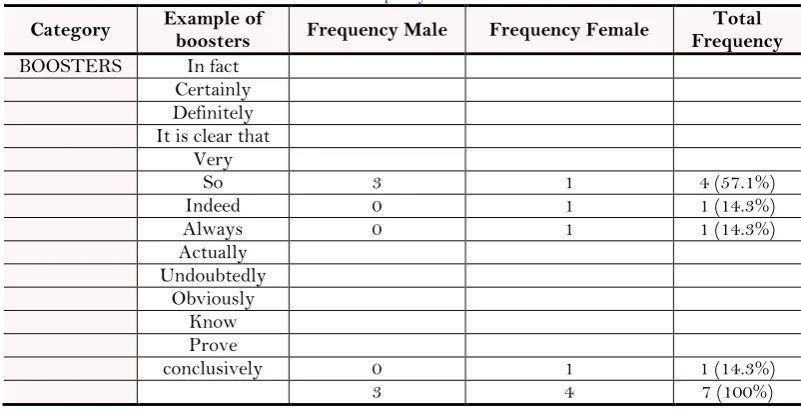
According to Daciana (2014) boosters creates an emphatic impression in the reader even if many non-native writers of English refrain from using it. However, the competence of metadiscourse devices such as boosters is crucial in having native-fluency in academic writing. The most commonly used boosters is “so” at 57.15% (refer to
Table 6.
Table-6. Frequency for boosters.
Category Example of boosters Frequency Male Frequency Female Frequency Total
BOOSTERS In fact
Certainly Definitely It is clear that
Very
So 3 1 4 (57.1%)
Indeed 0 1 1 (14.3%)
Always 0 1 1 (14.3%)
Actually Undoubtedly
Obviously Know Prove
conclusively 0 1 1 (14.3%)
3 4 7 (100%)
(c) Self-Mention
According to Daciana (2014) self-mention is a powerful rhetorical strategy for constructing authorial identity in communication, in this case, written. The most frequently used self-mention is “I” at 52.7%. This is followed by “we” at 28.6%. The least used is “our” at 2.6%.
4.4. Metadiscourse Across Gender
This section presents the answer to research question 3: How does the use of interactive and interactional discourse differ across gender? This question will be answered by comparing the frequency of use of metadiscourse among the writers.
Table-7. Frequency for self-mentions.
Type of Self-mention Example of Self-mention
Frequency Male Frequency Female Frequency Total
Constructing authorial identity “I” 56 62 118 (52.7%)
“me” 3 7 10 (4.5%)
“we” 34 30 64 (28.6%)
“my” 3 12 15 (6.7%)
“our” 6 6 (2.6%)
“us” 6 5 11 (4.9%)
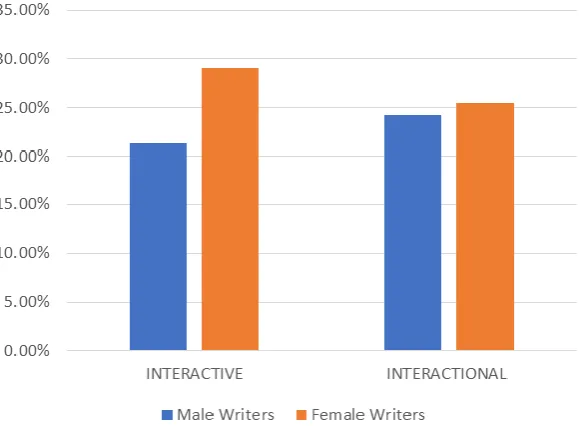
Figure-5. Interactive vs interactional across gender.
Figure 5 shows the comparison for interactive and interactional metadiscourse across gender. Female writers
used more interactive and interactional metadiscourse compared to male writers.
Table 6 shows the frequency for interactive metadiscourse. Female writers (57.2%) were reported to use more
transitions compared to the male writers (42.8%). When it comes to frame markers, again female writers (61%) used more than male writers (39%). The use of code glosses shows no difference across gender.
Figure-6. Frequency of interactive metadiscourse.
Figure 7 presents the frequency for interactional metadiscourse. Male writers (71.4%) used more hedges than
female writers (28.6%). For boosters, female writers (57.2%) used more compared to male writers (42.8%). Finally, for self-mentions, female writers (51.8%) used more than male writers (48.2%). The study by Yavari and Kashani
Figure-7. Frequency for interactional metadiscourse.
5. CONCLUSION
5.1. Summary of Findings
A summary of findings revealed that in general, writers show preferences of some types of interaction metadiscourse compared to others. For transitions, writers used more “additional support or evidence” and least for “emphasis”. When it comes to frame markers, writers in this study used “sequencing” the most and for code glosses, they used “exemplifying” and “simplifying” most often. For interactional metadiscourse, again, writers used some types more often compared to the others. For hedges, “could “ was often used. For boosters, “so” was very often used. In addition to that for self-mention, “I” and “we” were used often. This study has also revealed some gender differences in the use of metadisourse. This finding is in accordance with the study by Abdu et al. (2016) who also found gender differences when it comes to metadiscourse. When it comes to interaction metadiscourse, female writers used transitions and frame markers compared to male writers. For interactional metadiscourse, female writers used more boosters and self-mentions compared to the male writers.
5.2. Suggestion for Future Research
It is interesting to note that in the past 10 years there has been an increase in the studies of metadiscourse. This research trend should be continued because findings in the use of metadiscourse reveal a lot about the way millennium writers interact with the text and also with their audience. More reaserch should be done to compare the use of metadiscourse across the globe, across cultures and also across disciplines.
5.3. About the Writers
Dr Noor Hanim Rahmat is an associate professor at the Akademy of Language Studies , Universiti Teknologi MARA, Malaysia. She teaches Writing for Professional Communication to masters students. She has presented at conferences, written journal articles, books and chapters in books on the area of academic writing, educational psychology and English as a Second Language proficiency.
NUR ANISAH TAN has 30 yrs of teaching experience. Teaching Japanese Language to foreigner, Teaching & Learning Japanese Language for Foreigner. Her research interest includes language proficiency and language teaching and learning.
Mohamad Hanis bin Yahaya is an English language lecturer at English Language Department, Akademi Pengajian Bahasa, Universiti Teknologi MARA (UiTM), with 9 years of teaching experience. He graduated with a Bachelor’s Degree in Teaching English as Second Language (TESL) from UiTM and Master’s Degree in Applied Linguistics from Universiti Putra Malaysia (UPM). Currently, he is teaching English Language Proficiency (ELC) courses in UiTM Dengkil, an examiner for Majlis Peperiksaan Malaysia, resource team member for ELC course, and an active committee member of various summer school programmes organised by Akademi Pengajian Bahasa.
Dr Wararat Whanchit is a lecturer of English at the Department of Languages and Culture, School of Liberal Arts, Walailak University. With her personal interests in linguistics and applied linguistics, she focuses her research work on EFL writing, English language teaching, learner corpora, and cross-culture translation.
Funding: This study received no specific financial support.
Competing Interests: The authors declare that they have no competing interests.
Acknowledgement: All authors contributed equally to the conception and design of the study.
REFERENCES
Abdi, R., Rizi, M. T., & Tavakoli, M. (2010). The cooperative principle in discourse communities and genres: A framework for the use of Metadiscourse. Journal of Pragmatics, 42(6), 1669-1679.Available at: https://doi.org/10.1016/j.pragma.2009.11.001.
Abdu, l. A. R., Jin, C. C., & Nordin, N. M. (2016). The use of interactional metadiscourse in the construction of gender identities among Malaysian ESL learners. Language, Linguistics, Literature, 22(1), 207-220.Available at: https://doi.org/10.17576/3l-2016-2201-16.
Al-Mudhaffari, M., Hussin, S., & Abdullah, I. H. (2019). Interaction in academic L2 writing: An analysis of interactional metadiscourse strategies in applied linguistics research articles. 3L: Language, Linguistic, Literature: The Southeast Asian Journal of English Language Studies, 25(3), 16 – 32.Available at: http://doi.org/10.17576/3L-2019-2503-02.
Amouzadeh, M., & Zareifard, R. (2019). Interactional metadiscourse of gender in Persian: The case of conference presentations. Pragmatics and Society, 10(4), 512-537.Available at: https://doi.org/10.1075/ps.16049.amo.
Anwardeen, N. H., Ong, L. E., Gabriel, J. I., & Kalajahi, S. A. R. (2013). An analysis: The usage of metadiscourse in argumentative writing by Malaysian tertiary level of students. English Language Teaching, 6(9), 83-96.Available at: https://doi.org/10.5539/elt.v6n9p83.
Cheng, X., & Steffensen, M. S. (1996). Metadiscourse: A technique for improving student writing. Research in the Teaching of English, 30(2), 149-181.
Daciana, L. L. (2014). An analysis of the role of first language in second language acquisition. Dissertation/Thesis. Ann Arbor. San Diego State University. United State.
Hu, G., & Cao, F. (2011). Hedging and boosting in abstracts of applied linguistics articles: A comparative study of English-and Chinese-medium journals. Journal of Pragmatics, 43(11), 2795-2809.Available at: https://doi.org/10.1016/j.pragma.2011.04.007.
Hyland, K. (2004). Disciplinary interactions: Metadiscourse in L2 postgraduate writing. Journal of Second Language Writing, 13(2), 133-151.Available at: https://doi.org/10.1016/j.jslw.2004.02.001.
Hyland, K. (2010). Metadiscourse: Mapping interactions in academic writing. Nordic Journal of English Studies, 9(2), 125-143.Available at: https://doi.org/10.35360/njes.220.
Hyland, K., & Tse, P. (2004). Metadiscourse in academic writing: A reappraisal. Applied Linguistics, 25(2), 156-177.Available at: https://doi.org/10.1093/applin/25.2.156.
Kobayashi, Y. (2016). Investigating metadiscourse markers in Asian Englishes: A corpus-based approach. Language in Focus, 2(1), 19-35.Available at: https://doi.org/10.1515/lifijsal-2016-0002.
Lu, L. (2011). Metadiscourse and genre learning: English argumentative writing by Chinese undergraduates. Unpublished Thesis. University of Hong Kong, Pokfulam, Hong Kong SAR.
Mahmood, R., Javaid, G., & Mahmood, A. (2017). Analysis of metadiscourse features in argumentative writing by Pakistani undergraduate students. International Journal of English Linguistics, 7(6), 78-87.Available at: https://doi.org/10.5539/ijel.v7n6p78.
Nystrand, M. (1989). A social-interactive model of writing. Written Communication, 6(1), 66-85.Available at: https://doi.org/10.1177/0741088389006001005.
Pasaribu, T. A. (2017). Gender differences and the use of metadiscourse markers in writing essays. International Journal of Humanity Studies, 1(1), 93-102.Available at: https://doi.org/10.24071/ijhs.2017.010110.
Pungpen, I. (1988). Metadiscourse in native English speakers’ and ESL students’ persuasive essays. Dissertation/Theisi. Ann Arbor, Illionis State University.
Rahmat, N. H. (2011). Approaches in the teaching of ESL writing. Selangor: UiTM Press.
Rahmat, N. H., Addullah, N. A. T., & Kashiwazaki, K. (2020). Linking situated learning in edutourism: A case study of Japanese undergraduates. European Journal of Education Studies, 6(12), 41-55.
Rahmat., N. H., Yunos, D. R. M., Syed Abdul Rahman, S. A., & Ibrahim, N. (2015). comparing the use of meta discourse in argumentative essays among diploma in engineering and diploma in business ESL writers. Paper presented at the ICLTE Conference Proceedings. Subang Jaya.
Safari, I. (2018). A corpus-based contrastive study of code glosses used in English academic articles written by authors of politics and applied linguistics. International Journal of Linguistics, 10(2), 40-47.Available at: https://doi.org/10.5296/ijl.v10i2.12242.
Tarayo, V. N. (2014). Exploring interactions in L2 blogging: Metadiscourse in Philippine investigative journalism blog. International Journal of English Language & Translation Studies, 2(3), 35-53.
Yavari, M., & Kashani, A. F. (2013). Gender-based study of metadiscourse in research articles’ rhetorical sections. International
Journal of Applied Linguistics and English Literature, 2(2), 77-88.Available at:
https://doi.org/10.7575/aiac.ijalel.v.2n.2p.77.
Yeganeh, M. T., & Ghoreyshi, S. M. (2015). Exploring gender differences in the use of discourse markers in Iranian academic research articles. Procedia-Social and Behavioral Sciences, 192, 684-689.Available at: https://doi.org/10.1016/j.sbspro.2015.06.104.