Journal of Pain Research
Intensive interdisciplinary outpatient
pain management program for chronic
back pain: a pilot study
Juraj Artner Stephan Kurz Balkan Cakir Heiko Reichel Friederike Lattig
Department of Orthopaedic Surgery, University of Ulm, RKU, Germany
Correspondence: Juraj Artner Department of Orthopaedic Surgery, University of Ulm, RKU, Oberer Eselsberg 45, 89081 Ulm, Germany Tel +49 73 1177 5111
Fax +49 73 1177 1184 Email [email protected]
Background: Chronic back pain is relatively resistant to unimodal therapy regimes. The aim of this study was to introduce and evaluate the short-term outcome of a three-week intensive multidisciplinary outpatient program for patients with back pain and sciatica, measured according to decrease of functional impairment and pain.
Methods: The program was designed for patients suffering from chronic back pain to provide intensive interdisciplinary therapy in an outpatient setting, consisting of interventional injection techniques, medication, exercise therapy, back education, ergotherapy, traction, massage therapy, medical training, transcutaneous electrical nerve stimulation, aquatraining, and relaxation. Results: Based on Oswestry Disability Index (ODI) and Numeric Rating Scale (NRS) scores, a significant improvement in pain intensity and functionality of 66.83% NRS and an ODI of 33.33% were achieved by our pain program within 3 weeks.
Conclusion: This paper describes the organization and short-term outcome of an intensive mul-tidisciplinary program for chronic back pain on an outpatient basis provided by our orthopedic department, with clinically significant results.
Keywords: chronic back pain, intense, multidisciplinary, program, outpatient
Introduction
Chronic back pain is the most common cause of long-term disability in the middle-aged population in most countries. About 20% of the German population suffers from back pain, and 10% have pain of high intensity causing functional impairment.1–3 Back
pain that persists for longer than 3 months is deemed to be chronic. It significantly affects all aspects of life and, because of its multitude of biopsychosociocultural com-ponents, is relatively resistant to unimodal therapy regimes.4 Together with inpatient
and acute care, the special orthopedic pain management program in the Department of Orthopaedics at the University of Ulm provides an intensive interdisciplinary approach to treatment of patients with chronic back pain on an outpatient basis. The purpose of this paper was to present a retrospective analysis and critical evaluation of this program.
Materials and methods
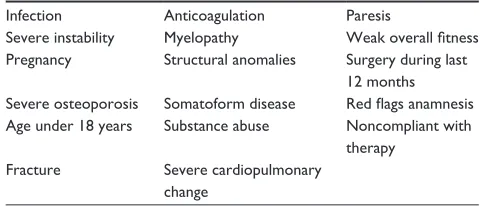
This retrospective analysis included 160 subjects from a total of 184 patients treated in our special orthopedic pain management program in 2010. There were 70 male and 90 female patients with a minimum duration of back pain of three months and persis-tence after standard medical treatment, who met the inclusion criteria for the special orthopedic pain management program described below (see Tables 1 and 2).
Dove
press
O R I G I n A L R E S E A R C H
open access to scientific and medical research
Open Access Full Text Article
Journal of Pain Research downloaded from https://www.dovepress.com/ by 118.70.13.36 on 24-Aug-2020
For personal use only.
Number of times this article has been viewed
This article was published in the following Dove Press journal: Journal of Pain Research
Unlike other pain programs, we do not exclude patients with failed back surgery syndrome or rheumatic disease, and do not set age limits as long as the above-mentioned inclusion criteria are met. Baseline and outcome parameters for pain and disability after three weeks of the program were assessed using the Numeric Rating Scale (NRS) and Oswestry Dis-ability Index (ODI) questionnaires. Patients were asked to complete these questionnaires and were also advised to com-plete a personal pain diary during the program, whereby pain intensity was rated on the NRS four times per day.
The NRS is a well accepted tool for assessment of the intensity of back pain, with 11 possible grades from 0 (no pain) to 10 (maximal pain).5 The ODI is also a well
accepted outcome instrument used in the management of spinal disorders, and has good validity and reliability.5–8
Performance of daily activities influenced by pain is evalu-ated using a 10-item questionnaire. Patients grade their impairment and pain, and indicate the extent to which pain influences their self-care, lifting, walking, sleeping, standing, sitting, traveling, social activity, and sexual function. Each item is scored on a six-point scale (0–5). The score for each item is added and divided by the total possible score (50, if all questions were answered). The possible outcome varies between 0% and 100% impairment.
The primary research question was whether there was a clinical benefit from this program, as indicated by changes in NRS and ODI scores between baseline and on comple-tion of the program, and if the conservative treatment could achieve a so-called “good outcome”, ie a clinically relevant change. We defined a “good outcome” as a minimum clini-cally important change in pain intensity of at least two points
on the NRS and of at least 10 points on the ODI, consistent with previous studies in patients with spinal disorders.9,10
Further, our results were compared with the results of other programs reported in the literature.
Special orthopedic pain management
program
Our pain management program was designed for patients suffering from chronic back pain to provide intensive inter-disciplinary therapy in an outpatient setting and consists of interventional injection techniques, medication, exercise therapy, back school, ergotherapy, traction, massage therapy, medical training, transcutaneous electrical nerve stimulation, aquatraining, relaxation, and further techniques as described below. The goal is to deliver an intensive combination of activating and relaxing cycles. An individual therapy plan is designed at the beginning of the program for each patient, depending on their disorder, chronification, and other fac-tors, including overall fitness, disability, and comorbidity. We combine group therapy with individualized treatment approaches. If indicated, further psychosomatic exploration and treatment is embarked on.
Our basic pain management team consists of an experi-enced orthopedic surgeon, who assessed patients twice daily and administered spinal injections as necessary, an anesthe-tist/algesiologist, and a group of 5–6 experienced physical therapists who provide both individual and group treatments. Each patient’s history, treatment program, and progress are discussed by the team, at meetings held 2–3 per week.
The duration of the program is three weeks, and includes work days between 8 am and 5 pm. About 3–4 patients who meet the inclusion criteria are added into the program weekly, so the group always consists of 10–12 patients. This proto-col allows group treatment to be as intensive as individual therapy. Approximately 185–200 patients are treated each year in our pain management program. The following is an overview of the therapy provided for each patient.
Medical treatment
The medical component of the program determines the indication for treatment, and includes a baseline examina-tion, documentaexamina-tion, planning of the treatment regime, control and supervision of each patient’s progress twice daily, with spinal injection and modification of analgesia as appropriate. In our department, spinal injection procedures are performed by an experienced surgeon, who also heads the program. Approximately 900–1000 epidural injections, 300–400 periradicular injections, and at least 1000 facet joint
Table 1 Program inclusion criteria
Age over 18 years Normal overall fitness
Pain duration . 12 weeks Compliant with therapy Prior standard treatment Back pain*
Note: *Nonspecific back pain, disc herniation without paresis, facet joint disease,
spinal stenosis.
Table 2 Program exclusion criteria
Infection Anticoagulation Paresis
Severe instability Myelopathy Weak overall fitness
Pregnancy Structural anomalies Surgery during last 12 months Severe osteoporosis Somatoform disease Red flags anamnesis
Age under 18 years Substance abuse noncompliant with therapy
Fracture Severe cardiopulmonary change
Dovepress
Artner et al
Journal of Pain Research downloaded from https://www.dovepress.com/ by 118.70.13.36 on 24-Aug-2020
injections are performed per year in our department. The indication for spinal injection is determined by the ortho-pedic surgeon, who is also the performing interventionalist. The decision is based on daily patient status, pain intensity, physical examination, findings on radiographic and nuclear magnetic resonance imaging, and chronification grade. All spinal injections are performed using computed tomographic or fluoroscopic guidance. Facet joint injections can be per-formed as part of treatment or to confirm facetogenic pain, as seen in spondyloarthritis, scoliosis, spondylolisthesis, or even osteoporosis. Nerve root injections are performed into the extraforaminal region or via an epidural-perineural approach in cases of nerve root compromise in patients with disc herniation, lateral spinal stenosis, or failed back sur-gery syndrome. Sacroiliac joint injections are performed in patients with low back pain and glutalgia originating from the sacroiliac joints as seen in seronegative spondyloarthropathy, sacroiliac dysfunction, limb length discrepancy, or after hip joint arthroplasty. For epidural injections into the cervical or lumbar spine we prefer the interlaminar approach in cases of spinal stenosis, unisegmental or multisegmental disc hernia-tion, failed back surgery syndrome, and osteochondrosis. In cases of severe narrowing of the interlaminar gap (severe degeneration, osteoporosis, following fusion surgery) we use a transforaminal or epidural sacral approach. We limit the number of injections and exposure to radiation and corticos-teroids (maximum 100–120 mg triamcinolone), performing 2–8 injections per patient. For therapeutic purposes, we use a combination of triamcinolone (20–40 mg per injection) and ropivacaine. When performed for diagnostic purposes, only ropivacaine is used. We use pulsed fluoroscopic guidance to limit radiation exposure in image-guided injections, and low-dose protocols in computed tomography guidance.
During the program, the medication intake of each patient, especially analgesics, is analyzed and modified as necessary by the physician, depending on pain intensity, comorbidities, side effects, and concomitant medication. We use a standardized pain diary to monitor improvement on the 10-point NRS four times per day. A pain diary also identifies circadian variation in pain more easily. First-line treatment of nonopioid analgesics and myorelaxants is provided when lower pain intensity is reported. In cases of high intensity pain, we perform spinal injections, add opioid analgesics to the medication, or even perform morphine rotation. Concomitant antidepressants or anticonvulsants are used in rare cases. In most cases, there is a decrease in analgesics intake during the program, but there are also cases when analgesics are changed, modified, or added.
Exercise therapy
Most studies of exercise treatment have found good results for reduction in intensity of back pain, ranging between 10% and 50%.11 Exercise improves range of motion, muscle strength,
posture, cardiovascular endurance, and sensitivity to pain. In our program, patients participate in intensive daily exercise consisting of cycles of physical therapy, medical training therapy, aerobic training, and aquatraining under supervision, followed by relaxation, massage, or spa therapy.
Ergotherapy
Each patient in our program learns how to adapt his/her workplace and home ergonomics on an individual basis depending on the extent of their disability.
Back education
Patients participate in an intensive back education program, which improves posture, reduces pain, and teaches them how to avoid overload and pain during activities of daily living.
Physical therapy
A growing body of evidence indicates the efficacy of physical therapy in the treatment of back pain. Every patient receives an intensive combination of spa therapy, transcutaneous electrical nerve stimulation, fango sheets, massage, manual therapy, stretching exercise, breathing gymnastics, traction, and thermal therapy, depending on the diagnosis and the patient’s response. The goals are relaxation and detonization, pain reduction, and increased blood perfusion, in combination with activating cycles of exercise.
Behavioral management
The purpose of behavioral management is to modify the patient’s perception of their pain, to reduce stress, and to learn relaxation techniques. The cycles are integrated twice per week for every patient, but can be varied on an individual basis. Behavioral management is the domain of physiothera-pists in a group setting.
Psychosomatic therapy
Depending on the degree of chronification and psychological cofactors, patients may undergo psychosomatic explora-tion and therapy in our program. Group psychotherapy is performed by a psychologist specialized in psychosomatic medicine and psychotherapy, focusing on psychosomatic and behavioral therapy, relaxation, and pain perception. The individualized approach is optional, although is used with increasing frequency. Patients are evaluated individually by
Dovepress Interdisciplinary program for chronic back pain
Journal of Pain Research downloaded from https://www.dovepress.com/ by 118.70.13.36 on 24-Aug-2020
Table 4 Baseline and outcome characteristics
Baseline, n (CI 95%)
Post-treatment, n (CI 95%)
Difference
Gender (n) Male Female
70 90
– –
Age (years) 57.18 (22–82) –
nRS (10-point scale)
6.03 (5.77–6.29) 2 (1.75–2.25) 4 (66.83%)
P, 0.0001 ODI (%) 34.39
(31.93–36.85)
24.21 (21.82–26.6) 11 (33.33%)
P, 0.0001
Abbreviations: CI, confidence interval; ODI, Oswestry Disability Index, NRS,
numeric Rating Scale. Table 3 Frequency of treatment modalities in our intensive
interdisciplinary outpatient pain management program
Medical control 2× daily Behavioral (relaxation) therapy
2× weekly
Exercise therapy 4× weekly (mean 12×)
Feldenkrais 2× weekly
Spinal injections Mean 2–8×
injections
Traction therapy
1–5× weekly
Back school 4× weekly Electrotherapy 4–5× weekly Equipment training (gym) 4× weekly Fango 4–5× weekly Sport therapy 4× weekly Walking 1× weekly Spa therapy* 4× weekly Ergotherapy 1× weekly Massage 4–5× weekly Psychosomatic
therapy
Variable
Note: *Active training therapy in swimming pool.
the psychologist using the standardized interview method devised by Kernberg and, if indicated, are treated in one or two sessions per week.12 If further treatment is needed, patients are
advised to have further therapy sessions. The treatment regime and the individual frequency of treatments may vary, depend-ing on the degree of disability and actual pain (Table 3).
Statistical analysis
Data analysis was performed using SPSS version 15 (SPSS Inc, Chicago, IL), IBM software for descriptive statistics, and the Mann-Whitney U-test (confidence interval [CI] 95% and
α= 0.05) to identify any statistically significant differences in NRS and ODI scores for low back pain before and after the program. Twenty-four incomplete datasets were excluded from the study.
Results
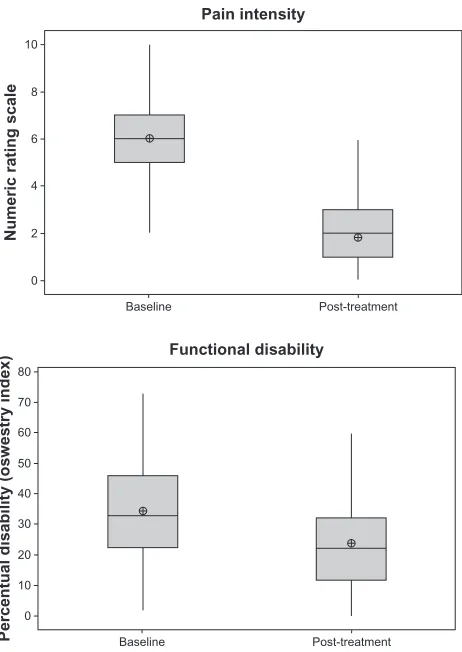
The 160 patients included in this study had a mean age of 57.18 ± 10.89 (range 22–82) years. Mean baseline NRS score was 6.03 ± 1.69 (95% CI, 5.77–6.29). Mean baseline ODI score was 34.39% ± 15.85% (95% CI, 31.93–36.85). After treatment, the mean NRS score was 2.00 ± 1.61 (95% CI, 1.75–2.25) and the mean ODI score was 24.21 ± 15.4% (95% CI, 21.82–26.60). The mean difference between before and after treatment scores on the NRS was 4.00 ± 2.01 points (95% CI, 2.69–4.31), rep-resenting a 66.83% reduction, and a reduction in ODI score of 11.00 ± 10.97 points (95% CI, 9.3–12.7), representing a 33.33% reduction. Baseline and outcome characteristics are shown in Table 4 (see also Figures 1 and 2).
Complications
There were no significant complications (eg, infection, paresis, allergic reaction, or arrhythmia) in our patients
during the study. The most frequent side effect of inten-sive exercise therapy was a temporary increase in muscle soreness, often interpreted as pain. This effect was seen on days 3–5 of the first week of therapy. Muscle soreness is self-limiting, and has been well described in other reports of intensive exercise treatment.11 From the 24 incomplete
datasets, two withdrawals due to respiratory tract infection were identified, along with two exclusions because of pain escalation at examination on the first day of the program. These patients underwent intensive hospital care for further diagnostics and intravenous analgesia. Vasovagal reac-tions to pain injecreac-tions occurred in five patients, as well as hypertonia. These side effects were self-limiting.
Discussion
This retrospective analysis indicates that good improvement in pain and functionality, as reflected by a change in visual analog scale score of 4 points (66.83%) and a change in ODI score of 11 points (33.33%), was achieved by patients in our pain program within three weeks. We did not analyze parameters like spinal mobility, and did not follow them up, because they are not representative. Our program also includes patients with ankylosing spinal diseases, such as diffuse idiopathic skeletal hyperostosis and spondylitis ankylosans, and although we achieve good results for pain and functionality in these conditions, spinal mobility param-eters would not be able to be improved in such patients. The gender distribution (90 females, 70 males) is consistent with the known fact that spinal disorders are more common in women than in men.13
To define a good clinical result in pain patients is difficult. Individual patient factors like expectations, age, pain inten-sity, diagnosis, comorbidity, and functional impairment all play a role. The principal target of interdisciplinary treat-ment is to increase function in the patient’s occupational and private life, but each patient has different priorities
Dovepress
Artner et al
Journal of Pain Research downloaded from https://www.dovepress.com/ by 118.70.13.36 on 24-Aug-2020
10
8
6
4
2
0
Baseline
Numeric rating scale
Post-treatment
Pain intensity
80
70
60
50 40
30
20
10
0
Baseline
Percentual disability (oswestry index) Post-treatment Functional disability
Figure 1 and 2 Baseline to post-treatment improvement of pain and disability.
Box plotlegend: Upper whisker – Extends to the maximum data point; interquartile
range box, middle 50% of the data; Top line – Q3 (third quartile). 75% of the data are less than or equal to this value. Middle line – Q2 (median); Target – mean value; Bottom line – Q1 (first quartile). 25% of the data are less than or equal to this value.
Lower whisker – Extends to the minimum data point.
regarding functional impairment. While younger patients consider restoration of work status, social activities, travel, and even sexual function to be important, older people are more likely to value basic functioning in the home and being able to walk. Most of these items are covered in the ODI, but the relevant data in the international literature regarding clinically significant change are inconsistent. While many researchers suggest a 4–10-point difference to determine significant change, there are also studies suggesting a range of 10.5–15 points.14–18 A raw change of −1.74 on the NRS,
corresponding to a change of −27.9%, was reported by Farrar et al as clinically significant improvement.17 Based on
statistical research, Hagg et al defined a minimal clinically significant reduction in ODI of approximately 10 points, whereas Mannion et al identified an 18% reduction of the baseline score (defined for spinal surgery outcomes) and a change of approximately 20 points on a 100-point visual analog scale, which corresponds to a minimal change of 2 points on the 11-point scale NRS scale.10,19 Maughan and
Lewis reported the smallest detectable change to be 2.4 points for the NRS and 17 points for the ODI, which is comparable with the clinical interpretation by an expert consensus panel proposing 2 points for the NRS and 10 points for the ODI.5,9,20 Fritz and Irrgang proposed that
a 6-point difference in the ODI was the minimal clinically important difference.15 Childs et al concluded from their
calculations that a 2-point change on the NRS is necessary to exceed statistical error and to be considered clinically meaningful.21 According to IMMPACT (Initiative on
Methods, Measurement, and Pain Assessment in Clinical Trials), a 10%–20% reduction in the baseline NRS score reflects a minimal important change and a reduction of 30% or more represents a clinically important difference.22 The
results seen in our intensive multidisciplinary outpatient program cohort fulfilled all of these criteria. There is a large amount of literature about the efficacy of conservative treat-ment for chronic back pain, as shown in Table 5.
Evidence for the beneficial effects of intensive inter-disciplinary programs on pain, functionality, and return to work is accumulating. Intensive (.100 hours) daily inter-disciplinary rehabilitation (defined as an intervention with a physical component plus a psychological, social, and/or occupational component) seems to be superior to nonin-terdisciplinary rehabilitation or usual care for improving short-term and long-term functional status and pain, return to work, and reducing intake of pain medication.41–47 Less
intensive interdisciplinary approaches seem to be less associated with improvement in pain or function com-pared with noninterdisciplinary outpatient rehabilitation or usual care.48
Intensive interdisciplinary treatment has both benefits and limitations. Despite its efficacy, there is still a lack of standardization regarding the frequency and amount of treatment needed. The Agency for Healthcare Research and Quality has summarized the components of interdisci-plinary treatment as consisting of four main elements, ie, medical care, physical reconditioning, behavioral medicine, and education, with team meetings and individualized therapies, undertaken for two hours twice a week to eight hours on five days a week for six weeks.49,50 In the literature,
intensive programs are understood to include more than 100–120 hours of therapy, but there is no standard terminol-ogy. One major benefit of interdisciplinary pain programs lies in the biopsychosocial approach, which focuses on functional restoration and combines a large amount of treat-ment modalities. Also, larger groups of patients can undergo this therapy in contrast to surgical or unimodal conservative
Dovepress Interdisciplinary program for chronic back pain
Journal of Pain Research downloaded from https://www.dovepress.com/ by 118.70.13.36 on 24-Aug-2020
Table 5 Sample comparison of efficacy of conservative therapies in chronic low back pain
Author Description Baseline
NRS/ODI
Post-treatment NRS/ODI
Difference NRS/ODI Descarreaux et al23 Individual home exercise program (n = 10, 6 weeks) 3.1/25.6 1.7/15.4 −45.2%/−39.8% Mannion et al24 Comparative 3 groups (twice weekly, 12 weeks)
Active physiotherapy Training devices Low-impact aerobics
4.4/×
4.2/×
4.1/×
3.2/×
3.1/×
3.4/×
−27.3%/× −26.2%/× −17.1%/×
Murtezani et al25 Comparative (2 groups, 12 weeks) High-intensity exercise
Passive treatment (heat, TEnS, ultrasound)
6.0/31 6.1/30.7
2.0/25.8 6.0/30.6
−66.7%/−49%
−1.64%/−0.33%
Brinkhaus et al26 Acupuncture (12×, 8 weeks) −28.7%/×
Borman et al27 Physical therapy and traction (10×, 2 weeks) 5.7/32.3 3.8/26.8 −33.3%/−17.03% Frost et al28 Fitness program with back school (6 months) 2.1/23.6 1.2/17.6 −28%/−25% Van der Velde
and Mierau29
Aerobic and flexibility exercise program (6 weeks) −31%/−33%
Rydeard et al30 Pilates exercise (3× per week, 4 weeks) −20.4%/×
Waagen et al31 Gibson et al32 Triano et al33 Assendelft et al34
Spinal manipulative treatments (2 weeks, reviews) −0.5 to −1/×
Tsauo et al35 Functional training program (3 months) 11.8/22 5.6/16 −53.1%/−27.3% Rainville et al36 Spine rehabilitation program (2–3× per week) −28%/−25% Sahin et al37 Back school program (n = 73, 2 weeks) 5.69/54.5 4.91/41.01 −13.7%/−24.8% Luk et al38 Multidisciplinary rehabilitation program
(n = 28, 14 weeks, follow-up 6 months)
3.8/42 22/29 −44%/−31%
Hazard et al39 Strength and endurance training, stretching, and behavioral support (n = 59, 3 weeks)
−26%/×
Edwards et al40 Resistive training, work hardening and manual
treatment (n = 54, 4 weeks) −
30%/×
Abbreviations: ODI, Oswestry Disability Index, NRS, Numeric Rating Scale; TENS, transcutaneous electrical nerve stimulation.
treatments, making this therapy cost-effective, especially in patients with significant functional impairment.41 On
the other hand, to provide individual therapy, group sizes must be limited. Another limitation is the age of the patient. Most intensive treatments focusing on functional restoration include only patients of working age, for whom the initial target is reintegration into the workforce. We do not exclude geriatric patients from our program. Despite this, overall fit-ness of our patients remains a limiting factor, and so excludes many elderly patients. Other limitations concern patients who are immigrants with language problems, who are not suitable for behavioral or educational programs in this setting. There has been an increase in this patient group, as well as the need for an interdisciplinary approach.
We have also seen an increase in uncontrolled intake of analgesics among patients suffering from back pain. An alarming long-term intake of nonsteroidal anti-inflammatory analgesics is seen, especially in the elderly population, who have an increased risk of potential side effects with these agents. According to our results, and comparing them with those in the current literature, the short-term results of our
interdisciplinary outpatient pain management program indicate a clinically significant improvement in pain and functionality.
Conclusion
Despite their efficacy, interdisciplinary treatments for back pain still lack standardization regarding the amount and intensity of the therapy regime. The use of spinal injections is a good example. Based on our experience, we use spinal injections as supportive therapy and to confirm whether pain is facetogenic, discogenic, or radicular, or if it is originating from the sacroiliac joints. Despite the controversial evidence, we see positive results in terms of symptom control in most patients when the indication is strictly controlled. Another example is the intensity of the psychologic/psychosomatic treatment. We are seeing an increasing frequency of indi-vidual psychological approaches in addition to group therapy, which is well accepted in most cases. Also, a balance in the proportion of active and passive treatments plays an impor-tant role in interdisciplinary therapy. Patients suffering from chronic pain prefer passive treatment, which is helpful in
Dovepress
Artner et al
Journal of Pain Research downloaded from https://www.dovepress.com/ by 118.70.13.36 on 24-Aug-2020
symptom control. On the other hand, one of the main aims of treatment is to increase the activity levels of the patient, which can only be achieved with adequate active therapies.
Here we describe an intensive outpatient interdisciplinary program for the management of chronic back pain which appears to have good short-term clinical results in terms of reduction in functional disability and pain relief. The limita-tions of this study are its retrospective nature, the lack of a control group, and the short duration of follow-up. However, one important advantage is the inclusion of elderly patients suffering from chronic back pain. Further investigation is needed to define the long-term results, improvement of isolated spinal disorders, interindividual differences in pain ratings, and their dependence on chronification, age, gender, occupation, coping strategies, fear-avoidance beliefs, and possibly immigration status.
Disclosure
The authors report no conflicts of interest in this work.
References
1. Bellach BM, Ellert U, Radoschewski M. Epidemiologie des Schmerzes – Ergebnisse des Bundes- Gesundheitssurveys 1998 (Epidemiology of pain: Results of a national health-survey 1998). Bundensgesundheitsblatt – Gesundheitsforschung – Gesundheitsschutz. 2000;43:424–431. German.
2. Schmidt CO, Kohlmann T. What do we know about the symptoms of back pain? Epidemiological results on prevalence, incidence, progres-sion and risk factors. Z Orthop Ihre Grenzgeb. 2005;143:292–298. German.
3. Eckardt A. Praxis LWS-Erkrankungen: Diagnosis und Therapie. (Disorders of the lumbar spine: diagnosis and treatment) Heidelberg, Germany: Springer Medizin Verlag; 2011:1.1; 2–3.
4. Turk DC. Clinical effectiveness and cost-effectiveness of treatments for patients with chronic pain. Clin J Pain. 2002;18:355–365. 5. Maughan EF, Lewis JS. Outcome measures in chronic low back pain.
Eur Spine J. 2010;19:1484–1494.
6. Fairbank JC, Pynsent PB. The Oswestry disability index. Spine. 2000;25:2940–2952.
7. Bombardier C. Outcome assessment in the evaluation of treatment of spinal disorders. Spine. 2000;25:3100–3103.
8. Junge A, Mannion AF. Questionnaires for patients with back pain. Diagnosis and outcome assessment. Orthopäde. 2004;33:545–552. German.
9. Ostelo RW, de Vet HCW. Clinically important outcomes in low back pain. Best Pract Res Clin Rheumatol. 2005;19:593–607.
10. Hagg O, Fritzell P, Nordwall A; Swedish Lumbar Spine Study Group. The clinical importance of changes in outcome scores after treatment for chronic low back pain. Eur Spine J. 2003;12:12–20.
11. Rainville J, Hartigan C, Martinez E, Limke J, Jouve C, Finno M. Exercise as a treatment for chronic low back pain. Spine J. 2004;4:106–115. 12. Kernberg O. Severe Personality Disorders:Psychotherapeutic
Strategies. New Haven, CT: Yale University Press; 1984.
13. Freburger JK, Holmes GM, Agans RP, et al. The rising prevalence of chronic low back pain. Arch Intern Med. 2009;169:251–258. 14. Beurskens AJ, de Vet HC, Koke AJ. Responsiveness of functional
status in low back pain: a comparison of different instruments. Pain. 1996;65:71–76.
15. Fritz JM, Irrgang JJ. A comparison of a modified Oswestry low back pain disability questionnaire and the Quebec back pain disability scale.
Phys Ther. 2001;81:776–788.
16. Stratford PW, Binkley J, Solomon P, Gill C, Finch E. Assessing change over time in patients with low back pain. Phys Ther. 1994;74:528–533. 17. Farrar JT, Young JP, LaMoreaux L, Werth JL, Poole RM. Clinical
importance of changes in chronic pain intensity measured on an 11-point numerical pain rating scale. Pain. 2001;94:149–158.
18. Davidson M, Keating JL. A comparison of five low back disability questionnaires: reliability and responsiveness. Phys Ther. 2002; 82:8–24.
19. Mannion AF, Junge A, Grob D, Dvorak J, Fairbank JCT. Development of a German version of the Oswestry Low Back Index. Part 2: sensitivity to change after spinal surgery. Eur Spine J. 2006;15:66–73.
20. Ostelo R, Deyo R, Stratford P, et al. Interpreting change scores for pain and functional status in low back pain. Spine. 2008;33:90–94. 21. Childs J, Riva S, Fritz J. Responsiveness of the numeric pain rating
scale in patients with low back pain. Spine. 2005;30:1331–1334. 22. Dworkin R, Turk D, Wyrwich K, et al. Interpreting the clinical
impor-tance of treatment outcomes in chronic pain trials: IMMPACT recom-mendations. J Pain. 2008;9:105–121.
23. Descarreaux M, Normand MC, Laurencelle L, Dugas C. Evaluation of a specific home exercise program for low back pain. J Manipulative Physiol Ther. 2002;25:497–503.
24. Mannion AF, Müntener M, Taimeta S, Dvorak J. Comparison of three active therapies for chronic low back pain: results of a randomized clini-cal trial with one-year follow-up. Rheumatology. 2001;40:772–778. 25. Murtezani A, Hundozi H, Orovcanec N, Sllamniku S, Osmani T.
A comparison of high intensity aerobic exercise and passive modalities for the treatment of workers with chronic low back pain: a randomized, controlled trial. Eur J Phys Rehabil Med. 2011;47:359–366. 26. Brinkhaus B, Witt CM, Jena S, et al. Acupuncture in patients with
chronic low back pain. Arch Intern Med. 2006;166:450–457. 27. Borman P, Keskin D, Bodur H. The efficacy of lumbar traction in
the management of patients with low back pain. Rheumatol Int. 2003;23:82–86.
28. Frost H, Klaber Moffet JA, Moser JS, Fairbank JCT. Randomised controlled trial for evaluation of fitness programme for patients with chronic low back pain. Br Med J. 1995;310:151–154.
29. Van der Velde G, Mierau D. The effect of exercise on percentile rank aerobic capacity, pain, and self-rated disability in patients with chronic low back pain: a retrospective chart review. Arch Phys Med Rehabil. 2000;81:1457–1463.
30. Rydeard R, Leger A, Smith D. Pilates-based therapeutic exercise: effect on subjects with nonspecific chronic low back pain and functional disability: a randomized controlled trial. Orthop Sports Phys Ther. 2006;36:472–484.
31. Waagen GN, Haldeman S, Cook G, Lopez D, DeBoer KF. Short-term trial of chiropractic adjustments for the relief of chronic low back pain.
Manual Med. 1986;2:63–67.
32. Gibson T, Grahame R, Harkness J, Woo P, Blagrave P, Hills R. Controlled comparison of short-wave diathermy treatment with osteopathic treatment in nonspecific low back pain. Lancet. 1985;1: 1258–1261.
33. Triano JJ, McGregor M, Hondras MA, Brennan PC. Manipulative therapy versus education programs in chronic low back pain. Spine. 1995;20:948–955.
34. Assendelft WJ, Morton SC, Yu EI, Suttorp MJ, Shekelle PG. Spinal manipulative therapy for low-back pain. Cochrane Database Syst Rev. 2004;1:CD000447.
35. Tsauo JY, Chen WH, Liang HW, Jang Y. The effectiveness of a func-tional training programme for patients with chronic low back pain – a pilot study. Disabil Rehabil. 2009;31:1100–1106.
36. Rainville J, Jouve CA, Hartigan C, Martinez E, Hipona M. Comparison of short- and long-term outcomes for aggressive spine rehabilitation delivered two versus three times per week. Spine J. 2002;2:402–407.
Dovepress Interdisciplinary program for chronic back pain
Journal of Pain Research downloaded from https://www.dovepress.com/ by 118.70.13.36 on 24-Aug-2020
Journal of Pain Research
Publish your work in this journal
Submit your manuscript here: http://www.dovepress.com/journal-of-pain-research-journal
The Journal of Pain Research is an international, peer-reviewed, open access, online journal that welcomes laboratory and clinical findings in the fields of pain research and the prevention and management of pain. Original research, reviews, symposium reports, hypoth-esis formation and commentaries are all considered for publication.
The manuscript management system is completely online and includes a very quick and fair peer-review system, which is all easy to use. Visit http://www.dovepress.com/testimonials.php to read real quotes from published authors.
37. Sahin N, Albayrak I, Durmus B, Ugurlu H. Effectiveness of back school for treatment of pain and functional disability in patients with chronic low back pain: a randomized controlled trial. J Rehabil Med. 2011;43:224–229.
38. Luk KDK, Wan TWM, Wong YW, et al. A multidisciplinary rehabilitation programme for patients with chronic low back pain: a prospective study. J Orthop Surg. 2010;18:131–138.
39. Hazard RG, Fenwick JW, Kalisch SM, et al. Functional restoration with behavioral support: a one-year prospective study of patients with chronic low back pain. Spine. 1989;14:157–161.
40. Edwards BC, Zusman M, Hardcastle P, Twomey L, O’Sullivan P, McLean N. A physical approach to the rehabilitation of patients disabled by chronic low back pain. Med J Aust. 1992;156:167–171.
41. Nagel B, Korb J. Interdisciplinary treatment. Long-lasting, effective and cost-effective. Orthopäde. 2009;38:910–912.
42. Guzman J, Esmail R, Karjalainen K, Malmivaara A, Irvin E, Bombardier C. Multidisciplinary bio-psycho-social rehabilitation for chronic low-back pain. Cochrane Database Syst Rev. 2002;1: CD000963.
43. Guzman J, Esmail R, Karjalainen K, Malmivaara A, Irvin E, Bombardier C. Multidisciplinary rehabilitation for chronic low back pain: systematic review. BMJ. 2001;322:1511–1516.
44. Bendix AF, Bendix T, Vaegtar KV, Lund C, Frolund L, Holm L. Multidisciplinary intensive treatment for chronic low back pain: a randomized, prospective study. Cleve Clin J Med. 1996;63:62–69. 45. Bendix AF, Bendix T, Ostenfeld S, et al. Active treatment programs
for patients with chronic low back pain: a prospective, randomized, observer-blinded study. Eur Spine J. 1995;4:148–152.
46. Alaranta H, Rytokoski U, Rissanen A, et al. Intensive physical and psychosocial training program for patients with chronic low back pain. A controlled trial. Spine. 1994;19:1340–1349.
47. Smith MJ. Accountable disease management of spine pain. Spine J. 2011;11:807–815.
48. Tveito T, Hysing M, Eriksen H. Low back pain interventions at the work-place: a systematic literature review. Occup Med. 2004;54:3–13. 49. Agency for Healthcare Research and Quality. Effective healthcare program.
Technical brief: multidisciplinary pain programs for chronic non-cancer pain. 2011. Available from: http://www.effectivehealthcare.ahrq.gov/ ehc/products/212/760/TechBrief8_PainProgramsCancer_20110930.pdf. Accessed March 14, 2012.
50. Schatman ME, Campbell A, editors. Chronic Pain Management: Guidelines for Multidisciplinary Program Development. New York, NY: Informa Healthcare; 2007.
Dovepress
Dove
press
Artner et al
Journal of Pain Research downloaded from https://www.dovepress.com/ by 118.70.13.36 on 24-Aug-2020