R E A L -L IF E P R O B L E M S O L V IN G A N D E X E C U T IV E F U N C T IO N IN R E L A T IO N T O T H E F R O N T A L L O B E S
A thesis submitted for the degree of Doctor of Philosophy
by
Sarah Jane Crawford
ProQuest Number: U643187
All rights reserved
INFORMATION TO ALL USERS
The quality of this reproduction is dependent upon the quality of the copy submitted.
In the unlikely event that the author did not send a complete manuscript and there are missing pages, these will be noted. Also, if material had to be removed,
a note will indicate the deletion.
uest.
ProQuest U643187
Published by ProQuest LLC(2015). Copyright of the Dissertation is held by the Author.
All rights reserved.
This work is protected against unauthorized copying under Title 17, United States Code. Microform Edition © ProQuest LLC.
ProQuest LLC
789 East Eisenhower Parkway P.O. Box 1346
ACKNOWLEDGEMENTS
I should like to thank Dr. Shelley Channon for supervising the research reported in this thesis. I learned a great deal w hilst w orking w ith her.
I should also like to thank all the participants who took part in the experimental studies, as the time and trouble they took was greatly appreciated.
A B ST R A C T
Clinical accounts o f the behaviour o f people w ith frontal lobe lesions suggest that they often show marked difficulties in aspects o f problem -solving and decision-m aking in their daily lives. Despite these real-life problem s, studies have shown that some o f these patients perform well on laboratory tests o f executive function. This has led to a drive to create laboratory measures with greater ecological validity than those com m only used in neuropsychological assessm ent and rehabilitation, which differ from real-life problem situations in a num ber o f ways, including the amount o f structure and feedback provided by the test. In addition, real-life problems are likely to draw m ore heavily than abstract executive measures on factors such as interpersonal com prehension and judgem ent, and previous experience.
PUBLICATIONS
The studies described in this thesis were designed and conducted by Sarah Crawford in collaboration with myself as supervisor. Sarah Crawford was responsible for all the recruitment, data collection and analysis presented in the thesis.
The experiment described in chapter 7 has been published. The reference is Channon, S. & Crawford, S. (1999). Problem-solving in real-life-type situations: The effects of anterior and posterior lesions on performance. Neuropsychologia, 37, 757-770.
The experiment described in chapter 9 has been published. The reference is Crawford, S. & Channon, S. (2002). Dissociation between performance on abstract tests of executive function and problem solving in real-life-type situations in normal aging. Aging & Mental Health, 6, 12-21.
CONTENTS
TITLE PAGE 1
ACKNOW LEDGEMENTS 2
ABSTRACT 3
PUBLICATIONS 4
CONTENTS 5
LIST OF TABLES 15
LIST OF FIGURES 17
PART I: LITERATURE REVIEW
1 INTRODUCTION TO LITERATURE REVIEW 19
1.1 EXECUTIVE FUNCTION AND ECOLOGICAL VALIDITY 19
1.1.1 Ecological validity 19
1.1.2 Executive function 19
1.1.3 Focus o f literature review 21
2 FRONTAL LOBE LESIONS 22
2.1 CONSEQUENCES OF FRONTAL LOBE LESIONS 22
2.2 DISSOCIATIONS BETWEEN BEHAVIOUR AND PERFORMANCE
ON STANDARDISED MEASURES 23
2.3 NEUROANATOMY OF THE FRONTAL LOBES 25
2.4 STANDARDISED ASSESSMENT OF THE EXECUTIVE FUNCTIONS 26
2.4.1 Inhibition 28
2.4.1.1 Attention and set-shifting 28
2.4.1.2 Inhibition and strategy generation 29
2.4.2 Planning and intentionality 30
2.4.3 Executive memory 32
2.4.4 Deductive reasoning/fluid intelligence 32
3 REAL-LIFE PROBLEM-SOLVING AND FRONTAL LOBE LESIONS 34
3.1 FORM AL ASSESSMENT OF REAL-LIFE PROBLEM-SOLVING 34
3.1.1 Differences between real-life tasks and laboratory measures 34 3.1.2 Real-life-type measure and patients with frontal lobe lesions 35
3.1.2.1 Interpersonal problem-solving 35
3.1.2.2 Non-interpersonal decision-making and emotional processes 36 3.1.2.3 Non-interpersonal planning and multitasking measures 38
3.1.2.3.1 Planning 39
3.1.2.3.2 M ultitasking 40
3.1.3 Processes contributing to real-life problem-solving performance 42
3.1.3.1 Executive processes 42
3.1.3.2 Processes involved in selecting courses o f action 43 3.1.3.3 Processes involved in judgem ent and comprehension o f
interpersonal factors 43
3.1.3.4 Experience 47
3.2 SUMMARY OF CHAPTER 3 48
4 DEVELOPM ENTAL FRONTAL LOBE DYSFUNCTION 50
4.1 DEVELOPMENTALLY ACQUIRED STRUCTURAL LESIONS 50
4.2 TOURETTE’S SYNDROME 51
4.2.1 Brain basis o f Tourette’s syndrome 51
4.2.2 Comorbidity in TS 53
4.2.3 Executive function in TS 54
4.2.3.1 Findings from mixed studies 55
4.2.3.2 Findings from studies that consider comorbidity 55
4.2.4 Real-life problem-solving and TS 57
4.3 SUMMARY OF CHAPTER 4 58
5 NORM AL AGEING 60
5.1 SOCIAL BEHAVIOUR IN HEALTHY OLDER PEOPLE 60
5.2 BRAIN BASIS OF NORM AL AGEING 60
5.3 EXECUTIVE FUNCTIONS AND NORMAL AGEING 62
5.4 REAL-LIFE PROBLEM-SOLVING AND NORMAL AGEING 65
5.4.1 Interpersonal and emotional measures 66
5.4.2 Non-interpersonal measures 67
5.4.4 Contributions to real-life problem-solving in older people 71
5.5 SUMMARY OF CHAPTER 5 72
6 AIM S OF EXPERIMENTAL STUDIES 74
6.1 STUDY 1 : REAL-LIFE PROBLEM-SOLVING 74
6.2 STUDIES 2 AND 3 : CONTRIBUTION OF PRIOR KNOW LEDGE AND
EXPERIENCE TO PROBLEM-SOLVING 75
6.3 STUDY 4: CONTRIBUTION OF SPECIFIC INTERPERSONAL PROCESSES
TO REAL-LIFE PROBLEM-SOLVING 76
6.4 STUDY 5 : CONTRIBUTION OF SPECIFIC DEFICITS IN PRIORITISATION
6.5 AND PLANNING TO REAL-LIFE PROBLEM-SOLVING 77
PART II: EXPERIMENTAL STUDIES
7 REAL-LIFE-TYPE PROBLEM SOLVING AND STRUCTURAL FOCAL
LESIONS 78
7.1 PART A 78
7.1.1 Introduction 78
7.1.1.1 Hypotheses 82
7.1.2 Method
7.1.2.1 Participants 82
7.1.2.2 Predicaments Test 85
7.1.2.2.1 An example o f a Predicament (“Dogs”) 86
7.1.2.2.2 Procedure 86
7.1.2.2.3 Factual account o f the problem situations 86
7.1.2.2.4 Ratings o f awkwardness 87
7.1.2.2.5 Solution generation 87
7.1.2.2.6 Selection o f optimal and personal solutions 88
7.1.2.2.7 Satisfaction ratings 88
7.1.2.2.8 Judgement o f alternative solutions 88
7.1.2.2.9 Scoring system 88
7.1.2.2.9.1 Problem Appreciation 89
7.1.2.2.9.2 Social Appropriateness 90
7.1.2.2.9.3 Effectiveness 90
7.1.2.2.9.4 Total Solution Quality 90
7.1.2.2.9.6 Scoring examples 91 7.12 2 .9 .1 Judgement o f Alternatives 91
7.1.2.3 Executive battery 92
7.1.2.3.1 Deductive reasoning 92
7.1.2.3.2 Attention and set-shifting 92
7.1.2.3.3 Inhibition and strategy generation 93
7.1.2.3.4 M ultitasking 94
7.1.2.3.5 Strategic encoding/retrieval 94
7.1.2.3.6 Dysexecutive Questionnaire 95
7.1.3 Results 95
7.1.3.1 Statistical analysis 95
7.1.3.2 Predicaments test 97
7.1.3.2.1 Factual account o f the Predicaments 97
7.1.3.2.2 Ratings o f awkwardness 100
7.1.3.2.3 Solution Generation 100
7.1.3.2.4 Selection o f optimal and personal solutions 103
7.1.3.2.5 Ratings o f satisfaction 106
7.1.3.2.6 Judgement o f alternative solutions 106
7.1.3.3 Executive battery 106
7.1.3.4 Site and size o f lesion in the anterior participants 110
7.1.3.5 Mode o f presentation 111
7.1.3.6 Sex 112
7.1.3.7 Correlations between Predicaments measures 112 7.1.3.8 Correlations with executive battery and DEX 113
7.1.4 Discussion 115
7.1.4.1 Summary o f results 115
7.1.4.2 Awareness o f deficits 116
7.1.4.3 Relationships between Predicaments measures 117 7.1.4.4 Contributions to impairments on the Predicaments test 117 7.1.4.4.1 The role o f executive processes 118 7.1.4.4.2 The role o f interpersonal factors 120 7.1.4.4.3 The role o f previous experience 121 7.1.4.4.4 The role o f emotional processes 121 7.1.4.5 The validity o f the Predicaments test 122
7.2 PART B 126
7.2.1 Introduction 126
7.2.1.1 Hypotheses 126
7.2.2 M ethod 127
7.2.2.1 Selection o f items 127
1.12.1 Participants and procedure 128
7.2.3 Results 128
7.2.3.1 Statistical analysis 128
7.2.3.2 Predicaments test 129
7.2.3.2.1 Factual account o f the Predicaments 130
7.2.3.2.2 Awkwardness ratings 130
7.2.3.2.3 Solution generation 130
7.2.3.2.4 Selection o f final solutions 131
7.2.3.2.5 Satisfaction ratings 133
1.1.3.1.6 Judgement o f alternative solutions 133
7.2.3.3 Site o f lesion 134
7.2.3.4. Mode o f presentation 134
7.2.3.5 Sex 134
1.1.3.6 Correlations between Predicaments measures 134
1.1.3.1 Executive Battery 135
7.2.3.8 Analysis o f covariance with executive battery 137
7.2.4 Discussion 138
8 REAL-LIFE-TYPE PROBLEM SOLVING AND TO UR ETTE’S
SYNDROME 141
8.1 INTRODUCTION 141
8.1.1 Hypotheses 145
8.2 METHOD 145
8.2.1 Participants and Procedure 145
8.2.2 Predicaments test 146
8.2.2.1 Procedure 146
8.2.2.2 Scoring o f quality o f problem solutions 147
8.2.2.3 Solution generation 148
8.2.3 Executive Battery 148
8.3 RESULTS 149
8.3.1 Statistical analysis 149
8.3.2 Predicaments test 149
8.3.2.2 Awkwardness ratings 149
8.3.2.3 Solution generation 150
8.3.2.4 Selection o f final solutions 152
8.3.2.5 Satisfaction ratings 154
8.3.2.6 Judgement o f alternative solutions 154
8.3.2.7 Effects o f sex 154
8.3.2.8 Correlations between Predicaments measures 154
8.3.3 Executive Battery 155
8.3.4 Analysis o f covariance with executive battery 158
8.3.5 Effects o f medication 159
8.4 DISCUSSION 159
8.4.1 Summary o f results 159
8.4.2 Comparison with findings seen previously in anterior participants 160
8.4.3 Relationships between Predicaments measures 161
8.4.4 Executive battery 162
8.4.5 Contributions to Predicaments impairments in the TS group 162
8.4.5.1 The role o f executive factors 163
8.4.5.2 The role o f previous experience 163
8.4.5.3 The role o f interpersonal factors 164
8.4.6 Summary 165
9 REAL-LIFE-TYPE PROBLEM SOLVING AND NORM AL AGEING 167
9.1 INTRODUCTION 167
9.1.1 Hypotheses 171
9.2 METHOD 171
9.2.1 Participants and Procedure 171
9.2.2 Predicaments test 172
9.2.2.1 Procedure 172
9.2.2.2 Scoring o f quality o f problem solutions 173
9.2.2.3 Final Solution Quality 173
9.2.2.4 Solution generation 173
9.2.3 Executive Battery 174
9.3 RESULTS 174
9.3.1 Statistical analysis 174
9.3.2 Predicaments test 175
9.3.2.1 Factual account o f the Predicaments 175
9.3.2.2 Awkwardness ratings 176
9.3.2.4 Selection o f final solutions 177
9.3.2.5 Satisfaction ratings 180
9.3.2.6 Judgement o f alternative solutions 180
9.3.2.7V ideo versus story presentation 18 0
9.3.2.8 Correlations between Predicaments measures 181
9.3.3 Executive Battery 182
9.3.4 Analysis o f Covariance 185
9.4 DISCUSSION 186
9.4.1 Summary o f results 186
9.4.2 Executive battery 186
9.4.3 Interpretation o f reduced solution fluency in older people 187 9.4.4 Selection o f solutions on the Predicaments task 188 9.4.5 The relative contributions o f executive skills, interpersonal factors and
experience to real-life problem-solving in older people 189
9.4.6 Multiple dimensions o f problem-solving 191
9.4.7 Summary o f current study 192
9.4.8 Summary o f the findings presented to date 193
10 INTERPERSONAL VERSUS NON-INTERPERSONAL PROBLEM -SOLVING
IN PEOPLE WITH FOCAL ANTERIOR BRAIN LESIONS 194
10.1 INTRODUCTION 194
10.1.1 Hypotheses 197
10.2 METHOD 197
10.2.1 Participants 197
10.2.2 Experimental measure; Interpersonal and Non-interpersonal Predicaments 199 10.2.2.1 Example o f a Interpersonal Predicament: Antibiotics 199 10.2.2.2 Example o f a Non-interpersonal Predicament: Burglary 200
10.2.2.3 Procedure 200
10.2.2.3.1 Factual account o f the problem situations 201
10.2.2.3.2 Awkwardness ratings 201
10.2.2.3.3 Solution generation 202
10.2.2.3.4 Selection o f optimal and personal solutions 202
10.2.3.3.5 Satisfaction ratings 202
10.2.2.4 Scoring 203
10.2.2.4.1 Problem appreciation 203
10.2.2.4.2 Effectiveness 204
10.2.2.4.3 Solution quality 204
10.3 RESULTS 205
10.3.1 Statistical analysis 205
10.3.2 Interpersonal and non-interpersonal Predicaments 206
10.3.2.1 Number o f prompts 207
10.3.2.2 Awkwardness ratings 208
10.3.2.3 Solution generation 208
10.3.2.4 Selection o f final solutions 210
10.3.2.5 Satisfaction ratings 212
10.3.3 Correlations between interpersonal and non-interpersonal Predicaments
measures 212
10.3.4 Effects o f side o f lesion 213
10.4 DISCUSSION 214
10.4.1 Summary o f results 214
10.4.2 Contributions to the differences between the interpersonal and
non-interpersonal problems 215
10.4.3 Contributions to the differences between the anterior and control groups 217
10.4.4 Summary 219
11 PRIORITISATION AND PLANNING IM PAIRM ENTS IN GROUPS
WITH FRONTAL LOBE DYSFUNCTION 220
11.1 RATIONALE FOR THE STUDY 220
11.2 PART A 220
11.2.1 Introduction 220
11.2.1.1 Hypotheses 223
11.2.2 Method 224
11.2.2.1 Participants 224
11.2.2.2 Experimental measures 226
11.2.2.2.1 Prioritisation task 226
11.2.2.2.1.1 Procedure 227
11.2.2.2.1.2 Scoring system 228
11.2.2.2.2 Long-term planning task 229
11.2.2.2.2.1 Scoring system 229
11.2.2.3 Executive Battery 230
11.2.3 Results 230
11.2.3.1 Statistical analysis 230
11.2.3.2 Prioritisation task 231
11.2.3.3 Long-term planning task 237
11.2.3.4 Executive battery 238
11.2.3.5 Site and size o f lesion 240
11.2.3.6 Analysis o f covariance with neuropsychological battery 240
11.2.4 Discussion 242
11.2.4.1 Summary o f results 242
11.2.4.2 Executive battery 242
11.2.4.3 The experimental tasks 243
11.2.4.3.1 Contributions to impairments on the prioritisation task 245 11.2.4.3.2 Contributions to impairment on the long-term
planning task 248
11.2.4.4 Summary 249
11.3 P A R T E 250
11.3.1 Introduction 250
11.3.1.1 Hypotheses 251
11.3.2 Method 251
11.3.2.1 Participants 251
11.3.2.2 Measures 252
11.3.3 Results 252
11.3.3.1 Experimental measures 253
11.3.3.1.1 Prioritisation task 253
11.3.3.1.1.1 Qualitative information about consequences 25A
11.3.3.1.2 Long-term planning task 257
11.3.3.1.3 Executive battery 258
11.3.3.2 Analysis o f covariance with executive battery 260
11.3.4 Discussion 261
11.3.4.1 Summary o f results 261
11.3.4.2 Executive battery 262
11.3.4.3 Prioritisation task 262
11.3.4.4 Long-term planning test 264
11.3.4.5 Summary 264
12 GENERAL DISCUSSION 266
12.1 SUMMARY OF FINDINGS 266
12.2.1 The role o f executive processes in real-life problem -solving 269 12.2.2 The role o f specific interpersonal processes in real-life problem -solving 271 12.2.3 The role o f experience in real-life problem -solving 273
12.3 CLINICAL RELEVANCE 275
12.4 LIM ITATIONS OF THE CURRENT STUDIES, AND IMPLICATIONS
FOR FUTURE WORK 276
12.4.1 Localisation 276
12.4.2 Reliability and validity o f the measures 277
12.4.3 How might factors contributing to problem -solving performance be
investigated further? 279
13 REFERENCES 283
14 APPENDICES 319
APPENDIX A: Story versions o f the Predicaments items 319
APPENDIX B: Questions asked for each Predicament 323
APPENDIX C: Story versions o f the eight Predicaments 324 APPENDIX D: Interpersonal and non-interpersonal Predicaments 326
APPENDIX E: Prioritisation test 328
LIST OF TABLES
Table 7.1 Side and site o f lesion for the anterior and posterior groups 84 Table 7.2 Mean scores and standard deviations for the anterior, posterior
and control groups: age, education, NART-IQ and TROG 85 Table 7.3 Mean scores and standard deviations for the Predicaments test:
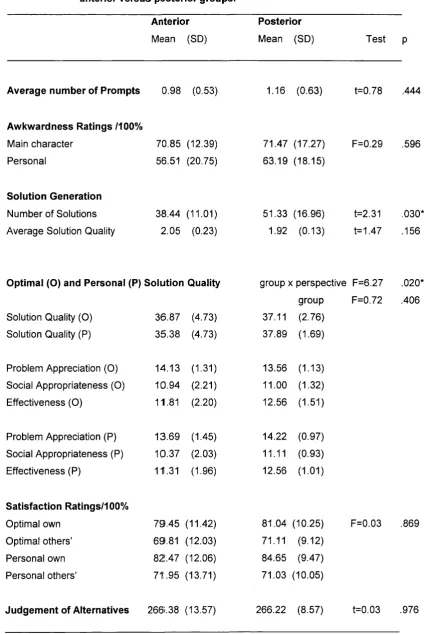
anterior versus posterior groups 98
Table 7.4 Mean scores and standard deviations for the Predicaments test:
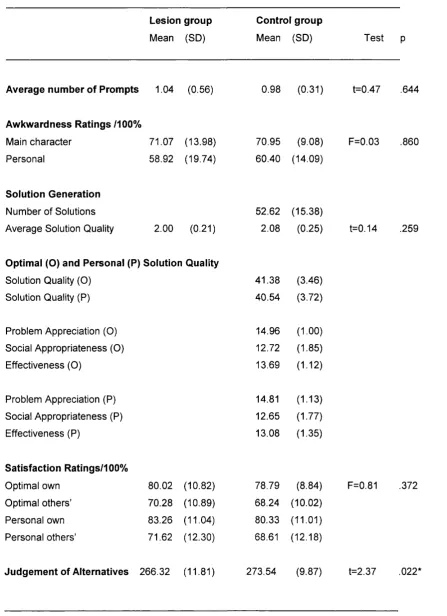
lesion participants versus the control group 99
Table 7.5 Predicaments test: Anterior group (A) versus control group (C);
Posterior group (P) versus C 102
Table 7.6 Mean scores and standard deviations for the executive battery:
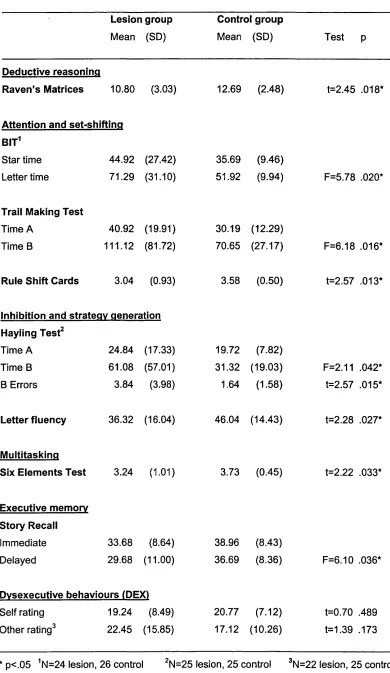
anterior versus posterior groups 107
Table 7.7 Mean scores and standard deviations for the executive battery:
lesion participants versus the control group 109 Table 7.8 Intercorrelations between Predicaments measures for the anterior
and control groups 113
Table 7.9 Mean scores and standard deviations for the Predicaments test:
anterior participants versus the control group. 129 Table 7.10 Mean scores and standard deviations for the executive battery:
anterior participants versus the control group. 136 Table 7.11 Analyses o f covariance between the Predicaments measures
and executive battery 138
Table 8.1 Mean scores and standard deviations for the Predicaments test:
TS group versus control group. 150
Table 8.2 Intercorrelations between Predicaments measures for the TS and
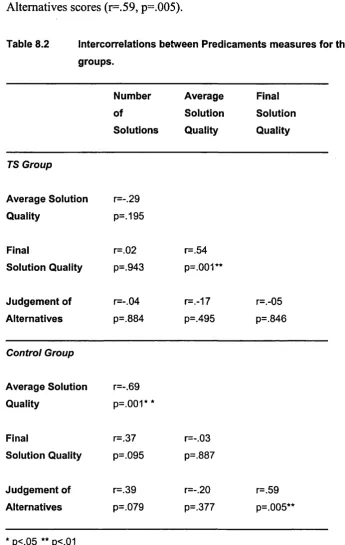
control groups. 155
Table 8.3 Mean scores and standard deviations for the executive battery:
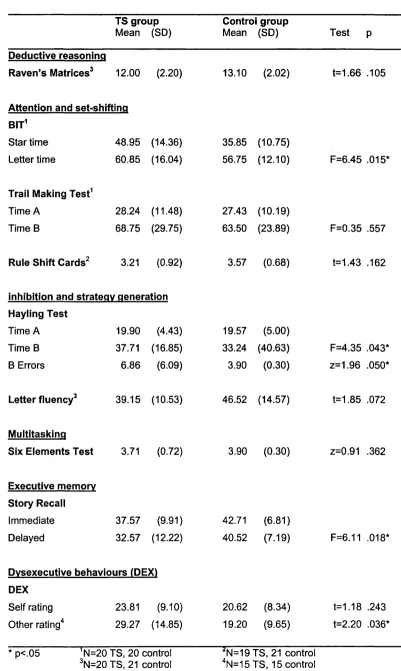
TS participants versus the control group. 156
Table 8.4 Analyses o f covariance between the Predicaments measures
and executive battery 158
Table 9.1 Mean scores and standard deviations for the Predicaments test:
older and younger groups 175
Table 9.2 Intercorrelations between Predicaments measures for the older
Table 9.3 Mean scores and standard deviations for the executive battery:
older versus younger group 184
Table 10.1 Lesion sites for the anterior group 198
Table 10.2 Mean scores and standard deviations for the interpersonal and
non-interpersonal Predicaments, for the anterior and control groups 206 Table 10.3 Correlations between interpersonal and non-interpersonal Predicaments
measures for the anterior and control groups 214
Table 11.1 Lesion sites and sizes for the anterior participants 225 Table 11.2 Mean Scores and Standard Deviations for the Prioritisation task for the
anterior and control groups 232
Table 11.3 Means and standard deviations for the long-term planning task:
anterior and control groups 237
Table 11.4 Mean scores and standard deviations for the neuropsychological battery: anterior participants versus the control group 239 Table 11.5 Analyses o f covariance between the Predicaments m easures and
executive battery 241
Table 11.6 Mean Scores and Standard Deviations for the Prioritisation task for the
TS and control groups 253
Table 11.7 Means and standard deviations for the long-term planning task: TS and
control groups 257
Table 11.8 Mean scores and standard deviations for the executive battery:
TS participants versus the control group 259
Table 11.9 Analyses o f covariance between the Predicaments measures and
executive battery 261
Table 12.1 Summary o f deficits seen in the experimental groups on the new measures
LIST OF FIGURES
Figure 7.1 Mean scores for total number o f solutions generated for the control,
anterior and posterior groups 101
Figure 7.2 Mean scores for average quality o f solutions for the control,
anterior and posterior groups 102
Figure 7.3 Mean scores for optimal and personal solution quality for the control,
anterior and posterior groups 104
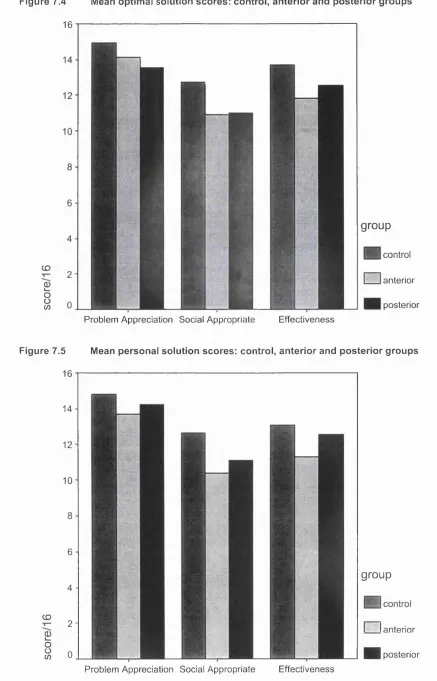
Figure 7.4 Mean optimal solution scores: control, anterior and posterior groups 105 Figure 7.5 Mean personal solution scores: control, anterior and posterior groups 105 Figure 7.6 Mean scores for Number o f Solutions for the anterior and control
groups 130
Figure 7.7 Mean scores for Average Solution Quality o f solutions for the anterior
and control groups 131
Figure 7.8 Mean scores for Final Solution Quality for the control and anterior
groups 132
Figure 7.9 Mean scores for Problem Appreciation, Social Appropriateness and
Effectiveness for the control and anterior groups 133 Figure 8.1 Mean scores for average awkwardness ratings for the control and
TS groups 151
Figure 8.2 Mean scores for Number o f Solutions generated for the control and
TS groups 151
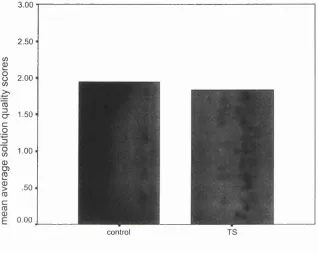
Figure 8.3 Mean Average Solution Quality scores for the control and TS groups 152 Figure 8.4 Mean Final Solution Quality scores for the control and TS groups 153 Figure 8.5 Mean Problem Appreciation, Social Appropriateness and Effectiveness
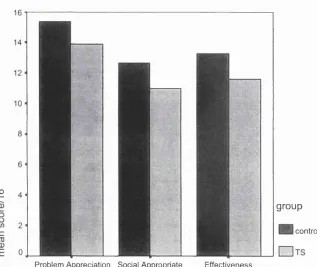
scores for the control and TS groups 153
Figure 9.1 Mean scores for Number o f Solutions for the younger and older groups 176 Figure 9.2 Mean scores for Average Solution Quality for the younger and older
groups 178
Figure 9.3 Mean scores for Final Solution Quality for the younger and older groups 179 Figure 9.4 Mean Problem Appreciation, Social Appropriateness and Effectiveness
scores for the younger and older groups 180
Figure 10.1 Mean number o f prompts for the non-interpersonal and interpersonal
stories for the anterior and control groups 207
and interpersonal Predicaments for the anterior and control groups 209 Figure 10.4 Mean Average Solution Quality for the non-interpersonal and
interpersonal stories for the anterior and control groups 210 Figure 10.5 Mean Final Solution Quality scores for the non-interpersonal and
interpersonal stories for the anterior and control groups 211 Figure 10.6 Mean satisfaction ratings for the non-interpersonal and interpersonal
PART I: LITERATURE REVIEW
CHAPTER 1
INTRODUCTION TO LITERATURE REVIEW
1.1 EXECUTIVE FUNCTION AND ECOLOGICAL VALIDITY
1.1.1 Ecological validity
Neuropsychological assessments may be conducted for a range o f reasons, such as diagnosis and research, but also to aid in planning rehabilitation programmes and targets, and helping patients understand the implications o f their injury for their future life (Lezak, 1995). The logical inference from this is that the results o f the assessments must provide reliable and valid information about the implications for functioning in daily life. However, this has been questioned with regard to a range o f processes. For example, it has been claimed that while standardised memory measures may show that a person has a deficit, they do not necessarily enable an accurate prediction of what types o f difficulties the person will have with their everyday memory (Sunderland, Harris & Baddeley, 1983). In consequence o f observations such as this, there has been a drive to create measures that have greater ‘ecological validity’, in that they have predictive power regarding what kinds o f real-life tasks the person is likely to find difficult (Wilson, 1993). Such measures have been developed in fields including memory (e.g. Rivermead Behavioural Memory Test, Wilson, Cockbum and Baddeley, 1985; Autobiographical Memory Interview, Kopelman, Wilson & Baddeley, 1990) and attention (e.g. Behavioural Inattention Test, Wilson, Cockbum & Halligan, 1987; Test o f Everyday Attention, Robertson, Ward, Ridgeway & Nimmo-Smith, 1994). More recently, attention has turned to the issues o f developing ecologically valid measures o f executive function.
1.1.2 Executive function
support for this assertion is the observation o f double dissociations in functioning. For example, if one patient shows intact performance in one cognitive domain but severely impaired performance in another, while a different patient shows the opposite pattern, this is presented as evidence that the two domains are likely to be functionally separate, and depend on different brain systems. However, there are many methodological issues in this field, and caution is needed when extrapolating theories o f normal functioning from single case studies (see Shallice, 1988 for a discussion). There is still debate about the extent o f modularity o f cognitive function, and the specialisation o f different brain regions. Cipolotti and Warrington (1995) argue that a thorough neuropsychological assessment attempts to determine both premorbid level o f functioning and current intellectual functioning, in addition to administering specific tests o f memory, language, calculation, problem solving, alertness, and visuospatial functioning. Even within these headings, there are numerous possible ways in which these functions can be split into dissociable sub processes. For example, within memory, it is argued that aspects such as verbal versus nonverbal, recall versus recognition, and implicit versus explicit memory need to be assessed, as they can potentially be affected independently.
In clinical practice, there is a range o f standardised measures purported to measure executive function. However, it is recognised that it is inappropriate to use only one such test and then extrapolate about the person’s real-life problem solving abilities from that data. For example, in a discussion o f the essential measures that should be included in an assessment o f older people’s abilities, Davies (1996) argues that three different kinds o f executive tests should be included. These are a measure o f verbal fluency (e.g. Benton & Hamsher, 1976; Thurstone & Thurstone, 1962), a test o f set-shifting ability, such as the Trail Making Test (Reitan, 1958) or Stroop Test (Stroop, 1935), and measures o f judgement and/or reasoning, for which he suggests using one or more o f the Cognitive Estimates Test (Shallice & Evans, 1978), Wisconsin Card Sorting Test (Milner 1963; Nelson 1976), Tower o f London Test (Shallice, 1982) or Six Elements Test (Shallice & Burgess, 1991; Wilson, Alderman, Burgess, Emslie & Evans, 1996). Thus, at a clinical level there is recognition that executive function is likely to be fractionated, and therefore different tasks may be measuring separable sub-processes.
1.1.3 Focus of literature review
CHAPTER 2
FRONTAL LOBE LESIONS
2.1 CONSEQUENCES OF FRONTAL LOBE LESIONS
As described above, damage to the frontal lobes is also associated with deficits in cognitive function, particularly executive function. The concept o f ‘executive function’ comes from Baddeley’s model o f working memory (e.g. Baddeley, 1986), which proposed that the ‘central executive’ was responsible for the attentional control o f working memory. The central executive is a similar concept to the ‘supervisory attentional system ’ model o f frontal lobe function, originally described by Norman and Shallice (1986), which is proposed to be involved in the performance o f any task that does not depend solely on well-leam ed routines. Therefore, the executive system is implicated in a wide variety o f tasks involving processes such as decision making and planning.
Until recently, the class of functions now considered to be ‘executive functions’ were termed ‘frontal lobe functions’. However, this term has lost favour due to the implicit assumption that such deficits should only be seen in people with direct frontal lobe involvement. It is known that patients with damage to areas outside the frontal lobes can also show deficits on executive measures, and that the personality changes that are thought to be typical o f frontal lobe dysfunction can also be seen in conditions that are not associated with focal frontal lobe damage (Baddeley & Della Sala, 1996). The term ‘dysexecutive syndrome’ was therefore coined in order to describe patients with these deficits without needing to refer to the anatomical site o f the brain dysfunction (e.g. Baddeley & Wilson, 1988). In spite o f this, the high likelihood o f such deficits following structural damage to the frontal cortex means that attempts to elucidate the exact nature and localisation o f executive processes using behavioural methodology, tend to focus on the performance o f patients with focal frontal lesions.
2.2 DISSOCIATIONS BETWEEN BEHAVIOUR AND PERFORMANCE ON
STANDARDISED MEASURES
case, referred to as EVR, who had surgery to remove a bilateral orbitofrontal meningioma. He performed normally on both the Wisconsin Card Sorting Test (WCST), and a modified cognitive estimation test. However, he had marked difficulties in his daily life, such as investing money unwisely, losing jobs, and being disorganised, all o f which were not characteristic o f him prior to the surgery. Similar dissociations between difficulties in real-life behaviour in the context o f relatively subtle deficits or intact performance on standardised neuropsychological tests have been reported in other studies, including three single cases described by Shallice and Burgess (1991)
Most o f the cases described above had lesions extending into both right and left frontal lobe regions. Therefore, the question arises o f whether such dissociations are only seen following bilateral lesions. However, there are some studies o f people with unilateral lesions who show a similar pattern, for example one case study described a patient with a unilateral left-sided lesion involving both orbital and dorsolateral areas, who showed inappropriate social behaviour in his daily life that was qualitatively similar to that reported in EVR, but performed normally on tests including the WCST, Cognitive Estimates, and Six Elements Test (Goldstein, Bernard, Fenwick, Burgess & McNeil, 1993). Two further cases with unilateral left-sided lesions have been described, who showed long-term difficulties in aspects o f their daily lives, in the context o f normal performance on standardised tests such as the WCST, Trail Making and Six Elements Test (Bardenhagen et al, 1999). Similar observations have been reported in cases with unilateral right-sided lesions (Dimitrov et al, 1999; Nies, 1999).
models. Many models of real-life problem-solving deficits in patients with focal lesions relate performance to aspects o f executive function, and to particular neuroanatomical lesion sites. The neuroanatomy o f the frontal lobes is therefore discussed below, followed by a consideration o f the executive functions.
2.3 NEUROANATOMY OF THE FRONTAL LOBES
The frontal lobes can be divided into three main areas on the basis o f function, the primary motor cortex, premotor cortex, and prefrontal cortex (Kolb & Whishaw,
1990). Studies o f the cognitive, behavioural and personality effects o f focal lesions tend to refer to patients with damage to the prefrontal areas. The prefrontal cortex is also subdivided into different regions. Kolb and Whishaw (1990) refer to dorsolateral, inferior and medial areas as having potentially different roles in cognition. Within this definition, the inferior area includes the orbitofrontal cortex, and the medial area includes the cingulate regions. Other basic texts on frontal lobe neuroanatomy take the narrower view, and refer to the functional distinction between dorsolateral, orbitofrontal and anterior cingulate regions (e.g. Malloy, Cohen & Jenkins, 1998). The exact boundaries o f these different areas are not always consistent between studies (see Elliott, Dolan & Frith, 2000 for a discussion), and it has been argued that determining clear limits for these areas within the frontal lobes is problematic (Damasio, 1991).
compared with other cortical areas (Kolb & Whishaw, 1990), although the evidence regarding left- versus right-sided lesions will also be discussed below where this has been addressed.
Duncan and Owen (2000) argued that exploring fractionation within frontal cortex might be limited by the large number o f connections that exist both within the region, and between frontal areas and non-frontal cortical and subcortical regions. Thus, a deficit seen following a focal lesion may occur because the connections to the critical area have been damaged, rather than because that specific region o f cortex subserves the behaviour in question. One method o f investigating localisation that has gained popularity in recent years is functional imaging o f non brain-injured participants while they are carrying out various cognitive tasks. In their review, Duncan and Owen (2000) argued that the evidence at present indicates that lateral and anterior cingulate areas are activated in a range o f different tasks, including inhibition o f a prepotent response, working memory and task novelty, while the studies they reviewed had not found orbitofrontal activation during any o f the measures. Evidence from lesion studies will be considered below.
2.4 STANDARDISED ASSESSMENT OF THE EXECUTIVE FUNCTIONS
different underlying non-executive processes. Alternatively, the executive functions might be fractionated into different sub-processes, and therefore different tests may be measuring separate aspects o f executive function (see e.g. Stuss, Shallice, Alexander & Picton, 1995 for a discussion). The model o f executive function put forward by Norman and Shallice (1986) has been revised (e.g. Shallice & Burgess 1991, 1993, 1996) and now argues that the system is fractionated into a range o f sub-processes, which are likely to have separate neural bases. Thus, selective damage is likely to affect only some o f the sub-processes.
The task o f categorising tasks thought to involve executive skills into those using different sub-processes is complicated by standardised measures being relatively impure. For example, it has been argued that performance on the W isconsin Card Sorting Test, a widely used clinical measure o f executive function, is dependent on a range o f potentially separable sub-processes including abstraction, flexibility, attribute identification, categorisation, working memory, inhibition, selective attention, and encoding o f verbal feedback (Ozonoff, Strayer, McMahon & Filloux, 1998). Moreover, executive tests rely on a range o f other, non-executive processes such as visuo-spatial and language abilities, which are additional sources o f possible failure. Burgess (1997) argues that impairments on standardised ‘executive’ tests can be seen in patients without frontal lobe damage, because they have difficulties with the non-executive task demands, in spite o f intact executive abilities. Rabbitt (1997) argues that investigating the distinctions between executive and non-executive tests is also hampered by the psychometric properties o f many executive tests, which, by their nature, have low test-retest reliability (due to losing novelty on repeated testing), and where the validity in terms o f predicting dysexecutive behaviour, is often questionable, as shown by the distinctions between real-life behaviour and task performance described above.
although this has been criticised due to the lack of empirical evidence as to whether the different tasks actually have separate underlying processes (Lowe & Rabbitt, 1997). Moreover, it has been argued that even if the exact processes involved are distinct, it is nevertheless plausible that the same underlying brain structures are responsible (Rabbitt, 1997). However, it is clear that performance on a range o f executive tests does not always correlate, and in the absence o f definitive details about which measures to include, it is practical to base decisions on research into fractionated sub-processes. Some o f these processes that have been proposed to be potentially independent from each other include inhibition, planning/intentionality, executive memory, initiation and deductive reasoning. Some empirical evidence that inhibition, intentionality and executive memory are indeed separable was provided in a factor analysis examining performance on standardised executive measures and relatives’ or carers’ reports o f patients’ dysexecutive behaviours in daily life (Burgess, Alderman, Evans, Emslie & Wilson, 1998).
2.4.1 Inhibition
Clinical presentations o f people with frontal lobe damage often refer to patients’ difficulties inhibiting inappropriate behaviour. Inhibitory deficits are thought to be a feature o f executive processes, although the correlations between measures thought to assess it are often poor (Rabbitt, 1997). It has been argued that there may be different types o f inhibition, for example the ability to rapidly shift set is thought to be potentially dissociable from the inability to inhibit a prepotent response (e.g. Miyake, Friedman, Emerson, Witzki & Howerter, 2000). Measures o f inhibition o f prepotent responses have also been linked with strategy generation, and therefore, these will be considered separately from measures o f set-shifting.
2.4.1.1 Attention and set-shifting
Katz & Izukawa, 2001); this applied particularly to patients with dorsolateral lesions. The Wisconsin Card Sorting Test is another widely used measure that involves set shifting, and impairments on this task have also been shown in patients with frontal lobe involvement (e.g. Stuss, Levine, Alexander, Hong, Palumbo, Hamer, et al, 2000). However, as described above (section 2.4), this test assesses a wide range o f executive and non-executive processes, and it can therefore be difficult to determine the source o f failure, which has been presented as a reason against its use in routine clinical practice (Crawford, 1998). Work has also indicated that it is not sensitive enough to differentiate between patients with frontal versus non-frontal brain lesions (Anderson, Damasio, Jones & Tranel,
1991). Impairment on other measures o f set shifting has also been shown in patients with focal frontal lesions, and it has been conceptualised as a deficit o f attention (Owen, Roberts, Polkey, Sahakian & Robbins, 1991). The frontal lobes have also been implicated in other aspects o f attention such as sustained attention (Wilkins, Shallice & McCarthy, 1987; Koski & Petrides, 2001).
2.4.1.2 Inhibition and strategy generation
one o f the factors in the anterior group’s difficulties on part B was their deficits in generating and adopting strategies. Functional imaging studies have implicated areas o f the left frontal lobe in both the initiation and response suppression aspects o f the Hayling test (Collette, Van der Linden, Delfiore, Deguildre, Luxen & Salmon, 2001). Another study using a task based on the Hayling test found that relative to initiation, the suppression condition was associated with activation in both right and left frontal areas, in addition to some regions outside the frontal lobes (De Zubicaray, Zelaya, Andrew, Williams & Bullmore, 2000).
Verbal fluency tests are also thought to measure aspects o f initiation and strategy generation. There are different types o f fluency measures, all o f which require participants to generate as many items (letters, categories or designs) as they can within a restricted time period. Studies have shown that patients with frontal lobes lesions are impaired relative to control participants on these tasks (e.g. Stuss, Alexander, Hamer, Palumbo, Dempster, Binns et al, 1998; Baldo, Shimamura, Delis, Karmer & Kaplan, 2001). Poor performance on verbal (letter and category) fluency tests has been associated particularly with left frontal lesions (e.g. Milner, 1964; Paulesu, Goldacre, Scifo, Cappa, Gilardi, Castiglioni et al, 1997; Tucha, Smely & Lange, 1999; Baldo et al, 2001). This has been linked particularly with left-sided lesions o f the medial and dorsolateral areas (Stuss et al, 1998), although the same study reported that patients with right-sided medial frontal lesions also showed a degree of impairment on these tasks. The findings with regard to design fluency are mixed, with some studies reporting no impairment in patients with frontal lobe lesions (Tucha et al, 1999), others finding selective right-sided impairment (Ruff, Allen, Farrow, Niemann & Wylie, 1994), and others reporting that both left- and right-sided lesions are associated with impairment (Baldo et al, 2001).
2.4.2 Planning and Intentionality
Bonerba, Phipps, Alexander, Shapiro & Grafman, 2000; Owen, Downes, Sahakian, Polkey & Robbins, 1990), both o f which have been conceptualised as measures o f planning (e.g. Shallice, 1982). However, it has been argued that the two tasks are fundamentally different, and that, rather than measuring planning, the Tower o f Hanoi actually assesses working memory and the ability to inhibit a prepotent response (Goel & Grafman, 1995; Goel, Pullara & Grafman, 2001). This was based on their research showing that the deficit in patients with frontal lobe lesions was not in their use o f strategies, but instead in whether or not they perform a counterintuitive move that appears to take them away from the goal, described as a goal-subgoal conflict. Another study looked at latéralisation effects on the Tower of Hanoi, and claimed that while the impairment in participants with left-sided frontal lesions was consistent with a failure to inhibit a prepotent response (goal- subgoal conflict), the deficits seen in those with right-sided lesions were attributable to a specific impairment in spatial memory ability (Morris et al, 1997). Similarly, research into the processes involved in intact performance on the Tower of London test has concluded that the nature o f the planning processes may be somewhat different from those originally conceptualised (Phillips, Wynn, McPherson & Gilhooly, 2001). A functional imaging study indicated that impaired performance in patients with frontal lobe lesions on the Tower o f London may be attributable to deficits in generation or inhibition, impulsivity, or memory difficulties rather than disrupted planning ability (Rowe, Owen, Johnsrude & Passingham, 2001). One possible explanation for these findings is that planning might not be one separable sub-process o f executive function, but might be better perceived as a multidimensional construct itself, with failure on planning tasks occurring for a variety o f reasons.
developed in the original study (Shallice & Burgess, 1991), but has been demonstrated to be sensitive to the impairments shown by patients with dysexecutive behaviours caused by neurological conditions (Burgess et al, 1998). The Six Elements test is one o f a range o f tests thought to measure ‘m ultitasking’ (Burgess, 2000a). The intentionality component o f multitasking m easures has been linked with prospective memory processes, and to medial areas o f the frontal lobes, particularly area 10 (Burgess, Veitch, Costello & Shallice, 2000).
2.4.3 Executive memory
Executive processes are also implicated in other types o f tasks. For example, a range o f memory impairments have been described in patients with focal frontal lesions, including measures o f free recall (e.g. Gershberg & Shimamura, 1995; Daum & Mayes, 2000), memory for temporal order (e.g. Kopelman, Stanhope & Kingsley, 1997; Daum & Mayes, 2000), and prospective memory (e.g. Burgess et al, 2000; Cockbum, 1995). Frontal lesions are also associated with increased amounts o f confabulation and other false memories (e.g. Moscovitch & Melo, 1997; Parkin, 1997). Theories regarding the role o f the frontal lobes in memory processes have tended to characterise these impairments as being attributable to executive deficits (see e.g. Mayes & Daum, 1997 for a discussion). For example, rather than reflecting a deficit in memory p e r se, free- recall impairments in patients _ with frontal lobe lesions are generally thought to be attributable to executive deficits in terms of active processes o f strategic encoding and retrieval, involving inhibition o f irrelevant information and monitoring o f responses (Shimamura, Janowsky & Squire, 1991; Della Rochetta & Milner, 1993; Gershberg & Shimamura, 1995; Henson, Shallice & Dolan, 1999). Functional imaging studies have provided support for the role o f the frontal lobes in free recall, implicating the left frontal lobe in encoding and the right frontal lobe in retrieval (Fletcher, Shallice & Dolan, 1998; Fletcher, Shallice, Frith, Frackowiak & Dolan, 1998).
2.4.4 Deductive reasoning/fluid intelligence
distinction between ‘crystallised’ and ‘fluid’ intelligence, in that the former is thought to be more knowledge-based than the latter (e.g. Duncan, Burgess & Emslie, 1995; Duncan, Emslie & Williams, 1996). Duncan argued that fluid intelligence measures have stronger correlations than crystallised measures with ‘Spearman’s g ’, or ‘general intelligence’. He argued that patients with frontal lobe lesions perform relatively well on measures that are largely dependent on crystallised intelligence, such as verbal subtests o f the W echsler Adult Intelligence Scales (Wechsler 1981, 1997), in the context o f being impaired on measures of fluid intelligence, such as the Culture Fair test (Duncan et al, 1995); this was presented as evidence that ‘g ’ is dependent on intact frontal lobe functioning. Therefore, deductive reasoning has been conceptualised as one potentially separable aspect o f executive function that can be measured using tests such as Raven’s matrices (Ardila, 1999; Crinella & Yu, 2000).
2.5 SUMMARY OF CHAPTER 2
CHAPTER 3
REAL-LIFE PROBLEM-SOLVING AND FRONTAL LOBE LESIONS
3.1 FORMAL ASSESSMENT OF REAL-LIFE PROBLEM-SOLVING
As reviewed above in section 2.1, a range o f single case studies has been described, all o f who showed intact performance on a range o f executive measures in the context o f marked difficulties in their daily lives. Since these observations have been made, there has been a drive to create measures that are sensitive to these deficits that can nevertheless be administered in a standardised fashion in a laboratory setting.
3.1.1 Differences between real-life tasks and laboratory measures
There are some crucial distinctions between standard laboratory measures and the types o f difficulties patients with dysexecutive behaviours show in their daily lives. Lezak (1995) argued that the amount o f structure provided within a task was a crucial aspect. She stated that one o f the important sources o f difficulty in patients with dysexecutive behaviours was their inability to structure tasks for themselves. However, this ability is not assessed in most standardised measures, which are highly structured by their nature.
D ’Zurilla and Goldfried (1971) argued that there are many inter-related processes involved in everyday problem-solving. These include recognising the relevant aspects o f the problem, generating a range o f possible solutions, deciding which solution is the most appropriate for resolving the problem, and monitoring the effectiveness o f the solution after it has been carried out.
Therefore, there is a range o f possible differences between everyday and laboratory problem-solving. Attempts to assess real-life problems in the laboratory should therefore focus on addressing some o f the issues outlined above.
3.1.2 Real-life-type measures and patients with frontal lobe lesions
Some attempts at designing more ecologically valid measures have focused specifically on the interpersonal deficits that are associated with frontal lobe damage. Others have looked at non-interpersonal aspects o f decision-making and planning. These headings are based on the descriptions provided within these studies. However, some o f the tasks share features in common, and there is likely to be overlap in the underlying processes involved in them.
3.1.2.1 Interpersonal problem-solving
collated from previous studies. However, approximately half o f the group with frontal lobe involvement differed substantially from the norms, indicating that they might have poor social problem-solving judgement. Poor performance was associated with lower scores than the other participants with frontal lobe involvement on standardised neuropsychological measures including the WCST and verbal subtests o f the WAIS-R, and on a measure o f real-life behaviour that was graded by an experimenter. The findings that the subgroup with poorer scores also had lower WAIS-R scores indicated that general intellectual level might have contributed to performance. This was supported by the observation that the patients who performed more poorly had lower educational levels. The full impact o f these factors could not be investigated since the control group were not given the standardised tests. However, the results provided tentative evidence that some patients with frontal lobe lesions have an impairment in social decision-making as measured by a structured test. Age, gender, and site o f lesion were not related to outcome.
3.1.2.2 Non-interpersonal decision-making and emotional processes
the optimal decks. It was concluded that they were unable to adjust their responses based on the feedback about relative reward and punishment. Later studies (Bechara, Tranel, Damasio & Damasio, 1996) showed that, in contrast to the control group, the patient group did not show anticipatory skin conductance responses (SCRs) before making responses that were associated with higher overall amounts o f punishment. Control participants show such responses before they are able to verbalise the relative risks o f the decks (Bechara, Damasio, Tranel, & Damasio, 1997), and therefore, the authors proposed that the anticipatory SCRs reflected a nonconscious learning of reward and punishment that was compromised in the patient group due to ventromedial damage.
Some support for this neuroanatomical dissociation has been provided by studies looking at a different gambling task, based on the same principles as the Damasio task (Rogers, Everitt, Baldacchino, Blackshaw, Swainson, Wynne, et al, 1999). The study showed that participants with damage to the orbitofrontal areas showed impairment on this task, while those whose lesions were confined to dorsolateral and dorsomedial areas did not. A functional imaging study also showed that areas of orbitofrontal, but not dorsolateral, cortex were associated with ‘risky’ decision making (Rogers, Owen, Middleton, Williams, Pickard, Sahakian, et al, 1999). In addition, another study showed a double dissociation between gambling and working memory performance, in that patients with orbitofrontal lesions were impaired on the gambling, but not the working memory task, while the opposite pattern was seen in those with dorsolateral lesions (Bechara, Damasio, Tranel & Anderson, 1998).
Other work supporting this dissociation has been provided by studies examining different patient groups with postulated frontal lobe involvement. It has been shown that patients with Huntington’s disease show intact performance on a gambling task in the context o f impaired performance on the Tower o f London Test (Watkins, Rogers, Lawrence, Sahakian, Rosser & Robbins, 2000), while the reverse pattern is seen in patients with frontotemporal dementia (Rahman, Sahakian, Rogers, Hodges & Robbins, 1999). The authors argued that this is consistent with the brain regions described above, since dorsolateral areas are thought to be affected earlier than orbitofrontal areas by the disease process in Huntington’s disease, while the converse pattern is associated with frontotemporal dementia. Therefore, the evidence overall is consistent with the orbitofrontal regions being important in gambling-type tasks, and dorsolateral regions being involved in planning and non-social executive tasks.
3.1.2.3 Non-interpersonal planning and multitasking measures
3.1.2.3.1 Planning
There have been some attempts to develop more ecologically valid planning measures. One o f these described a financial planning task (Goel, Grafman, Tajik, Sheldon & Danto, 1997) in which the performance o f ten participants with brain lesions including areas o f the frontal lobe was compared with that o f ten age- and education-matched healthy volunteers. Participants were asked to help a fictional couple to achieve four goals. These were all associated with their finances, but had different time-frames ranging from balancing their budget in the immediate term, to planning to have enough money to retire in 35 years. Participants were asked to plan out loud, and all their responses were recorded, and later coded, using a complex system. The authors argued that the anterior group did not have one ‘planning’ impairment, but instead showed a range o f deficits including structuring the problem, allocating their time appropriately across the demands o f the task, judging when they had achieved their goals, and looking beyond the immediate information o f the task in order to apply their real-world experience. They conceptualised the difficulties in terms o f a theory o f ‘structured event complexes’ (Grafman, 1995). In essence, they argued that the further away the fruition o f a plan is in time, the more difficult the planning will be for patients with frontal lobe lesions because the hypothetical future situation will come to differ more and more from their current situation, which will make it more difficult for the patient to retrieve information to the plan. This bears similarities with other theories regarding the role o f the frontal lobes in novel situations (e.g. Shallice & Burgess, 1993). Goel et al argue that the conceptual difference between these theoretical viewpoints is whether memory traces are thought to be damaged (Goel et al, 1997), or the executive control processes, as proposed in the Shallice and Burgess model.
dissociation between having knowledge and being able to apply it. His deficit was conceptualised primarily in terms of his inability to cope with the ill-structured nature o f the task. This was manifested in an excessively long period o f planning time before he was able to begin solving the problem, and an erratic approach to the various elements o f the task, which he was then unable to develop effectively.
Another test o f planning that was designed to have greater ecological validity was the ‘Virtual Planning Test’ (Miotto & Morris, 1998). This task was presented in the form o f a board game, and required participants to choose a range o f target activities from a set including distractor items. There were time constraints on most o f the activities, and some necessitated other items to be carried out prior to their execution. They tested a group with mixed unilateral and bilateral lesions, and found that, relative to a healthy control group, they chose fewer o f the target items, and were less efficient at selecting the tasks within the time constraints. They argued that the deficits were consistent with a model o f disruption to the supervisory attentional system (Shallice & Burgess, 1993; 1996).
Another study looking at more ecologically valid types o f planning, compared participants on their ability to describe plans verbally and then their ability to carry out their plans (Zalla, Plassiart, Pillon, Grafman & Sirigu, 2001). They noted that some o f the behaviours shown by the participants with frontal lobe lesions during the execution o f their plans, such as failing to fulfil goals, missing out important steps, could not have been picked up by the verbal generation phase, but required the participants to attempt to actually carry out the tasks. This clearly has importance for the development of ecologically valid measures.
3.1.2.3.2 Multitasking
Errands’ Test, which was carried out in a real-life setting, a shopping precinct, rather than in a laboratory. Participants were requested to carry out a range o f real- life tasks such as buying items from shops, whilst not breaking a set o f rules. The patients performed fewer tasks than the controls, and showed qualitative impairments in terms o f rule breaks and inefficient performance. They also showed impairments on the second specially designed measure, the Six Elements Test (SET), which was intended to be a standardised laboratory analogue o f the Multiple Errands Test. The results were interpreted within the context o f the model of supervisory attentional functions in the frontal lobes (Norman & Shallice, 1986; Shallice, 1988). They argued that the results were consistent with a fractionated system, in which processes such as goal development, forming and monitoring plans, and prospective memory are separate, and they outlined how this accounted for the types o f deficits shown in the patients.
Support for the sensitivity o f the Multiple Errands Test was provided in a case study o f a patient with a unilateral left sided lesion, who also demonstrated a range o f difficulties on the test (Goldstein et al, 1993). Thus, there is some evidence that systematic, formal studies of ‘real-life’ behaviour can demonstrate the nature o f the everyday difficulties shown by these patients. However, this test is clearly limited in terms o f practical application by the length o f time o f administration, practical complexity and qualitative scoring system. By contrast, the Six Elements Test is a possible means o f assessing these difficulties in a standardised setting, and a modified version is included in the BADS (Wilson et al, 1996).
Anterior cingulate lesions were associated with impairments in retrospective memory. Planning was linked with right dorsolateral lesions, and prospective memory impairments with medial left hemisphere lesions, including area 10. The findings that deficits can occur separately in retrospective and prospective memory and planning demonstrates that real-life problem-solving should not be considered to be a unitary concept. Burgess (2000a, 2000b) argues that many o f the everyday deficits seen in people with strategy application disorder are in situations where ‘multitasking’ is required. It is argued that situations involving multitasking share a range o f characteristics, including having a number o f discrete tasks with varying characteristics, which have to be carried out one at a time. Participants have to decide for themselves when they have achieved their goals, and they are given no immediate feedback. By contrast, many highly-structured standardised measures have one type of task, with a clear externally-provided goal, and feedback from an experimenter regarding the quality o f performance. Thus, the challenge is to contribute further to the development o f measures which are more open-ended and less structured than standard measures, and which contain multiple dimensions of problem-solving, in order to enhance knowledge o f the types o f processes which people with frontal lobe lesions find difficult.
3.1.3 Processes contributing to real-life problem-solving performance
3.1.3.1 Executive processes
might show deficits on real-life decision-making tasks due to impaired executive skills.
3.1.3.2 Processes involved in selecting courses of action
As discussed in section 2.2, patients with frontal lobe lesions can show impairments in real-life decision-making in the context o f intact performance on a range o f standardised executive measures. It is therefore possible that specific deficits in decision-making and prioritising may contribute to real-life problem solving performance in patients with anterior lesions.
3.1.3.3 Processes involved in judgement and comprehension of interpersonal
factors
the story comprehension measure. In addition, other work examining the relationship between theory o f mind and executive function in patients with focal frontal lesions has concluded that the evidence suggests that they are independent processes (Rowe, Bullock, Polkey & Morris, 2001; Bach, Happé, Fleminger & Powell, 2000). The most likely explanation o f these different findings is that difficulties on theory o f mind tasks may occur for more than one reason, such that some patients perform poorly because o f a selective deficit, while others have disruption to relevant executive sub-processes.
Some studies have attempted to address the question o f whether theory o f mind ability is independent of other, non-interpersonal processes by comparing performance with that on matched non-interpersonal control items. In her original study. Happé (1994) presented 24 ‘Strange Stories’ and 6 ‘Physical’ stories that were intended to function as controls as they did not involve inferences about mental states. However, the physical stories were easier to answer than the mental state stories, as the requisite information could be directly quoted from the text, and she concluded herself that they could not be considered to be a valid control. Later studies using the Strange Stories developed new control items. For example, Fletcher et al (1995) endeavoured to create stories that involved inferences, but not consideration o f other people’s mental states. In a pilot study o f 60 healthy control participants, they found that the mean scores of these two sets o f stories did not differ, and thus concluded that they were matched for difficulty. The measures were tested on healthy volunteers in a functional imaging study, and it was found that the same areas were activated on each, but with additional activation o f the left medial frontal gyrus and posterior cingulate cortex during the theory o f mind items. This supports the hypothesis that theory o f mind is a separate ability, with a specified brain region, and is consistent with the concept that there may be aspects of interpersonal problem-solving that are distinctly different from non-interpersonal problem-solving.
Zheng, Wilkinson, Spence, Deakin, Tarrer et al, 2001). Performance on standardised measures o f empathy has been related to performance on measures o f ‘cognitive flexibility’ such as the Wisconsin Card Sorting Test (Grattan & Eslinger, 1989), and it is hypothesised that both processes involve the ability to consider alternative viewpoints. In addition, frontal lobe lesions have been linked with difficulties in interpreting nonverbal emotional cues such as face perception or voice intonation (Homak, Rolls & Wade, 1996).
Blair and Cipolotti (2000) reported on a patient who showed ‘acquired sociopathy’, in that his behaviour was so socially inappropriate following his brain injury that he resembled patients diagnosed with Antisocial Personality Disorder. EVR, and other patients with ventrolateral damage, have also been described in this way. Unlike EVR, he did not show impairment on the gambling tasks, indicating that he had no difficulties with reward and punishment learning. However, he was impaired in his ability to recognise emotional facial expressions, and appeared to have difficulty understanding when people would be afraid, angry or embarrassed. He was also impaired in identifying social transgressions. This was in the context o f intact theory o f mind, and ability to make moral judgements. This indicates that different types o f social cognition may be dissociable. The evidence indicated that a straightforward explanation in terms o f general abstraction or inhibitory deficits did not fit with the evidence. The authors suggested that right orbitofrontal cortex is involved with understanding and interpreting other people’s anger, and that this system is dismpted in JS, although they note that he also had damage to the amygdala, which is known to be involved in processing emotions, particularly related to fear (Young, Hellawell, Van De Wal & Johnson, 1996; Adolphs, Tranel, Hamann, Young, Calder, Phelps et al, 1999).
3.1.3.4 Experience
As discussed above, one o f the proposed differences between well- and ill-defined problem-solving is whether the task contains all the relevant information for solving it (Galotti, 1989; Kahney, 1993). In everyday problem-solving, the relative role o f life experience is therefore thought to be greater than in well-defined problems, and research in cognitive psychology has shown that people can solve problems more successfully by applying knowledge they have gained from solving other problems (e.g. Kahney, 1993).
Some o f the findings from the studies reviewed above have also concluded that the role o f life experience may be crucial in aspects o f real-life problem solving. For example, studies o f EVR argued that he had intact social knowledge, but was unable to apply this knowledge in real-life problem-solving situations (Saver & Damasio, 1991). By contrast, it was argued that another case, MGS, did not have intact social knowledge (Dimitrov et al, 1999). Both cases had lesions involving orbitofrontal cortical areas, but EVR’s injury occurred at age 35, while that of MGS occurred at age 20. The authors suggested that the reason that MGS had limited social knowledge was that he would not have had enough experience of appropriate social interactions and problem solving prior to his injury, in order to have built up a knowledge base. Other authors have argued that one o f the crucial distinctions between standardised laboratory measures and real-life problem solving and planning is the increased role o f experience in the latter (e.g. Goel et al, 2001). Thus, experience is widely thought to be critical to understanding everyday problem-solving, although it is rarely important in standardised executive measures.