Optimizing Endpointing Thresholds using Dialogue
Features in a Spoken Dialogue System
Antoine Raux and Maxine Eskenazi
{antoine,max}@cs.cmu.edu Language Technologies Institute
Carnegie Mellon University Pittsburgh, PA 15213, USA
Abstract
This paper describes a novel algorithm to dy-namically set endpointing thresholds based on a rich set of dialogue features to detect the end of user utterances in a dialogue system. By analyzing the relationship between silences in user’s speech to a spoken dialogue system and a wide range of automatically extracted fea-tures from discourse, semantics, prosody, tim-ing and speaker characteristics, we found that all features correlate with pause duration and with whether a silence indicates the end of the turn, with semantics and timing being the most informative. Based on these features, the pro-posed method reduces latency by up to 24% over a fixed threshold baseline. Offline evalu-ation results were confirmed by implementing the proposed algorithm in the Let’s Go system.
1 Introduction
1.1 Responsiveness in Dialogue
Although the quality of speech technologies has im-proved drastically and spoken interaction with ma-chines is becoming a part of the everyday life of many people, dialogues with artificial agents still fall far short of their human counterpart in terms of both comfort and efficiency. Besides lingering prob-lems in speech recognition and understanding, Ward et al (Ward et al., 2005) identified turn-taking is-sues, specifically responsiveness, as important short-comings. Dialogues with artificial agents are typi-cally rigid, following a strict one-speaker-at-a-time structure with significant latencies between turns. In a previous paper, we concurred with these find-ings when analyzing issues with the Let’s Go system
(Raux et al., 2006). In contrast, empirical studies of conversation have shown that human-human dia-logues commonly feature swift exchanges with lit-tle or no gap between turns, or even non-disruptive overlap (Jaffe and Feldstein, 1970; Sacks et al., 1974). According to Conversation Analysis and psycholinguistic studies, responsiveness in human conversations is possible because participants in the conversation exchange cues indicating when a turn might end, and are able to anticipate points at which they can take over the floor smoothly. Much re-search has been devoted to finding these cues, lead-ing to the identification of many aspects of language and dialogue that relate to turn-taking behavior, in-cluding syntax (Sacks et al., 1974; Ford and Thomp-son, 1996; Furo, 2001), prosody (Duncan, 1972; Orestr¨om, 1983; Chafe, 1992; Ford and Thompson, 1996; Koiso et al., 1998; Furo, 2001), and seman-tics (Orestr¨om, 1983; Furo, 2001). However, re-garding this last aspect, Orestrom notes about his corpus that ”there is no simple way to formaliz-ing a semantic analysis of this conversational mate-rial”. This difficulty in formalizing higher levels of conversation might explain the relatively low inter-est that conversational analysts have had in seman-tics and discourse. Yet, as conversational analysts focused on micro-levels of dialogue such as turn-taking, computational linguists uncovered and for-malized macro-level dialogue structure and devised well-defined representations of semantics for at least some forms of dialogues (Allen and Perrault, 1980; Grosz and Sidner, 1986; Clark, 1996), which have in turn been implemented in spoken dialogue systems (Rich and Sidner, 1998; Allen et al., 2005).
1.2 Current Approaches to Turn-Taking in Spoken Dialogue Systems
Unfortunately, while socio- and psycho-linguists re-vealed the complexity of conversational turn-taking behavior, designers of practical spoken dialogue sys-tems have stuck to a simplistic approach to end-of-turn detection (hereafter endpointing). Typically, si-lences in user speech are detected using a low-level Voice Activity Detector (VAD) and a turn is consid-ered finished once a silence lasts longer than a fixed threshold. This approach has the advantage of being simple, only relying on easily computable low-level features. However, it leads to suboptimal behavior in many instances. First, False Alarms (FA) hap-pen when a pause lasts longer than the threshold and gets wrongly classified as a gap1. Second, latency occurs at every gap, because the system must wait for the duration of the threshold before classifying a silence as gap. When setting the threshold, system designers must consider the trade-off between these two issues: setting a low threshold reduces latency but increases FA rate, while setting a high threshold reduces FA rate but increases latency.
To help overcome the shortcomings of the single-threshold approach, several researchers have pro-posed to exploit various features. Sato et al (Sato et al., 2002) used decision trees to classify pauses longer than 750 ms as gap or pause. By using fea-tures from semantics, syntax, dialogue state, and prosody, they were able to improve the classification accuracy from a baseline of 76.2% to 83.9%. While this important study shows encouraging results on the value of using various sources of information in a dialogue system, the proposed approach (classify-ing long silences) is not completely realistic (what happens when a gap is misclassified as a pause?) and does not attempt to optimize latency. An extension to this approach was proposed in (Takeuchi et al., 2004), in which a turn-taking decision is made every 100 ms during pauses. However, in this latter work the features are limited to timing, prosody, and syn-tax (part-of-speech). Also the reported classification results, with F-measures around 50% or below do not seem to be sufficient for practical use.
1We use the terminology from (Sacks et al., 1974) where a
pause is a silence within a turn while a gap is a silence between
turns. We use the term silence to encompass both types.
Similarly, Ferrer and her colleagues (Ferrer et al., 2003) proposed the use of multiple decision trees, each triggered at a specific time in the pause, to de-cide to either endpoint or defer the decision to the next tree, unless the user resumes speaking. Using features like vowel duration or pitch for the region immediately preceding the silence, combined with a language model that predicts gaps based on the pre-ceding words, Ferrer et al are able shorten latency while keeping the FA rate constant. On a corpus of recorded spoken dialogue-like utterances (ATIS), they report reductions of up to 81% for some FA rates. While very promising, this approach has sev-eral disadvantages. First it relies on a small set of possible decision points for each pause, preventing fine optimization between them. Second, the trees are trained on increasingly smaller datasets requir-ing smoothrequir-ing of the tree scores to compensate for poor training of the later trees (which are trained on increasingly small subsets of pauses from the training set). Finally, and perhaps most importantly, these authors have investigated prosodic and lexical features, but not other aspects of dialogue, such as discourse structure, timing, and semantics.
In this paper, we propose a new approach to end-pointing that directly optimizes thresholds using au-tomatically extracted dialogue features ranging from discourse to timing and prosody. Section 2 out-lines the proposed algorithm. Section 3 describes the analysis of the relationship between silences and a wide range of features available to a standard spo-ken dialogue system (hereafter dialogue features). Evaluation results, both offline and in the deployed Let’s Go system are given in Section 4.
2 Dynamic Endpointing Threshold
Decision Trees
2.1 Overview
2003). We hypothesize that the discrepancy between these results and the good performances reported by others is due to the noisiness of the Let’s Go data (see Section 3.1.1). To overcome these issues, we propose a method that directly optimizes endpoint-ing thresholds usendpoint-ing a two-stage process. First, si-lences are clustered based on dialogue features so as to create groups of silences with similar proper-ties. Second, a single threshold is set for each clus-ter, so as to minimize the overall latency at a given false alarm rate. The result of the training process is thus a decision tree on dialogue features that con-tains thresholds at its leaves. At runtime, every time a silence is detected, the dialogue system runs the decision tree and sets its endpointing threshold ac-cordingly. The following sections describe the two training stages.
2.2 Feature-based Silence Clustering
The goal of the first stage of training is to clus-ter silences with a similar FA rate/latency trade-off. The intuition is that we would like to generate low-threshold clusters, which contain mostly gaps and short pauses, and clusters where long pauses would be concentrated with no or very few gaps, allowing to set high thresholds that reduce cut-in rate without hurting overall latency. We used a standard top-down clustering algorithm that exhaus-tively searches binary splits of the data based on fea-ture values. The split that yields the minimal overall cost is kept, where the costCn of clusterKn is de-fined by the following function:
Cn=Gn× for gaps. While other cost functions are possible, the intuition behind this formula is that it captures both the cluster’s gap ratio (first factor) and its pause du-ration distribution (second factor: root mean square of pause duration). The splitting process is repeated recursively until the reduction in cost between the original cost and the sum of the costs of the two split clusters falls below a certain threshold. By minimiz-ing C(K), the clustering algorithm will find ques-tions that yield clusters with either a smallGn, i.e.
mostly pauses, or a small root mean square pause duration. Ultimately, at the leaves of the tree are sets of silences that will share the same threshold.
2.3 Cluster Threshold Optimization
Given the clusters generated by the first phase, the goal of the second phase is to find a threshold for each cluster so that the overall latency is minimized at a given FA rate. Under the assumption that pause durations follow an exponential distribution, which is supported by previous work and our own data (see Section 3.2), we show in Figure 3 in appendix that there is a unique set of thresholds that minimizes la-tency and that the threshold for any clusternis given by:
3 Silences and Dialogue Features
3.1 Overview of the Data
3.1.1 The Let’s Go Corpus
Let’s Go is a telephone-based spoken dialogue system that provides bus schedule information for the Pittsburgh metropolitan area. It is built on the Olympus architecture (Bohus et al., 2007), using the RavenClaw dialogue management framework, and the Apollo interaction manager (Raux et al., 2007) as core components. Outside of business hours callers to the bus company’s customer service are offered the option to use Let’s Go. All calls are recorded and extensively logged for further analy-sis. The corpus used for this study was collected between December 26, 2007 and January 25, 2008, with a total of 1326 dialogues, and 18013 user turns. Of the calls that had at least 4 user turns, 73% were complete, meaning that the system provided some schedule information to the user.
than on carefully recorded corpora. For example, as reported in (Raux et al., 2005), the original speech recognizer had been found to yield a 17% word error rate on a corpus of dialogues collected by recruit-ing subjects to call the system from an office. On the live Let’s Go data, that same recognizer had a 68% WER. After acoustic and language model re-training/adaptation, that number was brought down to about 30% but it is still a testimony to the diffi-culty of obtaining robust features, particularly from acoustics.
3.1.2 Correcting Runtime Endpointing Errors
Let’s Go uses a GMM-based VAD trained on pre-viously transcribed dialogues. Endpointing deci-sions are based on a fixed 700 ms threshold on the duration of the detected silences. One issue when analyzing pause distributions from the corpus is that observed user behavior was affected by system’s be-havior at runtime. Most notably, because of the fixed threshold, no recorded pause lasts more than 700 ms. To compensate for that, we used a simple heuristic to rule some online endpointing decisions as erro-neous. If a user turn is followed within 1200 ms by another user turn, we consider these two turns to be in fact a single turn, unless the first turn was a user barge-in. This heuristic was established by hand-labeling 200 dialogues from a previous corpus with endpointing errors (i.e. each turn was annotated as correctly or incorrectly endpointed). On this dataset, the heuristic has a precision of 70.6% and a recall of 75.5% for endpointing errors. Unless specified, all subsequent results are based on this modified cor-pus.
3.2 Turn-Internal Pause Duration Distribution
Overall there were 9563 pauses in the corpus, which amounts to 0.53 pauses per turn. The latency / FA rate trade-off for the corpus is plotted in Figure 1. This curve follows an exponential function (theR2 on the linear regression of latency on Log(F A) is
0.99). This stems from the fact that pause duration approximately follows an exponential distribution, which has been observed by others in the past (Jaffe and Feldstein, 1970; Lennes and Anttila, 2002).
One consequence of the exponential-like distribu-tion is that short pauses strongly dominate the distri-bution. We decided to exclude silences shorter than
Figure 1: Overall False Alarm / Latency trade-off in the Let’s Go corpus. The dashed line represents a fitted curve of the formF A=eβ+α·Latency.
200 ms from most of the following analysis for two reasons: 1) they are more prone to voice activity detection errors or short non-pause silences within speech (e.g. unvoiced stop closure), and 2) in order to apply the results found here to online endpointing by the system, some amount of time is required to detect the silence and compute necessary features, making endpointing decisions on such very short si-lences impractical. Once short sisi-lences have been excluded, there are 3083 pauses in the corpus, 0.17 per turn.
3.3 Relationship Between Dialogue Features and Silence Distributions
3.3.1 Statistical Analysis
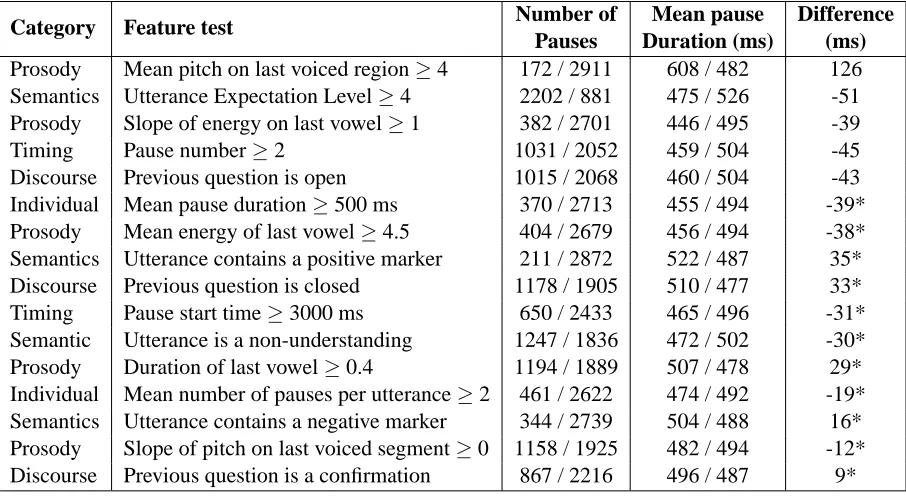
In order to get some insight into the interaction of the various aspects of dialogue and silence char-acteristics, we investigated a number of features au-tomatically extracted from the dialogue recordings and system logs. Each feature is used to split the set of silences into two subsets. For nominal fea-tures, all possible splits of one value vs all the others are tested, while for continuous and ordinal features, we tried a number of thresholds and report the one that yielded the strongest results. In order to avoid extreme cases that split the data into one very large and one very small set, we excluded all splits where either of the two sets had fewer than 1000 silences. All the investigated splits are reported in Appendix, in Table 1 and 2. We compare the two subsets gen-erated by each possible split in terms of two metrics:
gaps among all silences of a given set. We re-port the absolute difference in GR between the two sets, and use chi-square in a 2x2 design (pause vs gap and one subset vs the other) to test for statistical significance at the 0.01 level, using Bonferroni correction to compensate for multiple testings.
• Mean pause duration. The strength of the in-teraction is shown by the difference in mean pause duration, and we use Mann Whitney’s Rank Sum test for statistical significance, again at the 0.01 level, using Bonferroni correction.
We group features into five categories: discourse, semantics, prosody, turn-taking, and speaker charac-teristics, described in the following sections.
3.3.2 Discourse Structure
Discourse structure is captured by the system’s di-alogue act immediately preceding the current user turn. In the Let’s Go dialogues, 97.9% of sys-tem dialogue acts directly preceding user turns are questions2. Of these, 13% are open questions (e.g. ”What can I do for you?”), 39% are closed ques-tions (e.g. ”Where are you leaving from?”) and 46% are confirmation requests (e.g. ”Leaving from the airport. Is this correct?”)3. There are many more pauses in user responses to open questions than to the other types (cf Table 1). One explanation is that user answers to open questions tend to be longer (2046 ms on average, to be contrasted with 1268 ms for turns following closed questions and 819 ms for responses to confirmation questions). Conversely, confirmation questions lead to responses with sig-nificantly fewer pauses. 78% of such turns con-tained only one word, single YES and NO answers accounting for 81% of these one-word responses, which obviously do not lend themselves to pauses. Discourse context also has an effect on pause dura-tions, albeit a weak one, with open questions leading to turns with shorter pauses. One possible explana-tion for this is that pauses after closed and confirma-tion quesconfirma-tions tend to reflect more hesitaconfirma-tions and/or
2
The remaining 2.1% belong to other cases such as the user barging in right after the system utters a statement.
3The high number of confirmations comes from the fact that
Let’s Go is designed to ask the user to explicitly confirm every concept.
confusion on the user’s side, whereas responses to open questions also have pauses in the normal flow of speech.
3.3.3 Semantics
Semantic features are based on partial speech recognition results and on their interpretation in the current dialogue context. We use the most recent recognition hypothesis available at the time when the silence starts, parse it using the system’s standard parser and grammar, and match the parse against the ”expectation agenda” that RavenClaw (Bohus and Rudnicky, 2003) maintains. The expectation level of a partial utterance indicates how well it fits in the current dialogue context. A level of 0 means that the utterance can be interpreted as a direct answer to the last system prompt (e.g. a ”PLACE” con-cept as an answer to ”Where are you leaving from?”, a ”YES” or a ”NO” after a confirmation question). Higher levels correspond to utterances that fit in a broader dialogue context (e.g. a place name after the system asks ”Leaving from the airport. Is this correct?”, or ”HELP” in any context). Finally, non-understandings, which do not match any expecta-tion, are given a matching level of+∞.
Expectation level is strongly related to both fi-nality and pause duration. Pauses following par-tial utterances of expectation level 0 are signifi-cantly more likely to be gaps than those matching any higher level. Also, very unexpected partial ut-terances (and non-understandings) contain shorter pauses than more expected ones. Another indica-tive feature for finality is the presence of a posi-tive marker (i.e. a word like ”YES” or ”SURE”) in the partial utterance. Utterances that contain such a marker are more likely to be finished than others. In contrast, the effect of negative markers is not signif-icant. This can be explained by the fact that nega-tive responses to confirmation often lead to longer corrective utterances more prone to pauses. Indeed, 91% of complete utterances that contain a positive marker are single-word, against 67% for negative markers.
3.3.4 Prosody
location and duration were estimated by performing phoneme alignment with the speech recognizer. Du-ration was normalized to account for both vowel and speaker identity. Energy was computed as the log-transformed signal intensity on 10ms frames. Pitch was extracted using the Snack toolkit (Sjolander, 2004), also at 10ms intervals. For both energy and pitch, the slope of the contour was computed by lin-ear regression, and the mean value was normalized by Z-transformation using statistics of the dialogue-so-far. As a consequence, all threshold values for means are expressed in terms of standard deviations from the current speaker’s mean value.
Vowel energy, both slope and mean, yielded the highest correlation with silence finality, although it did not rank as high as features from other cate-gories. As expected, vowels immediately preced-ing gaps tend to have lower and fallpreced-ing intensity, whereas rising intensity makes it more likely that the turn is not finished. On the other hand, extremely high pitch is a strong cue to longer pauses, but only happen in 5.6% of the pauses.
3.3.5 Timing
Timing features, available from the Interaction Manager, provide the strongest cue to finality. The longer the on-going turn has been, the less likely it is that the current silence is a gap. This is true both in terms of time elapsed since the beginning of the ut-terance and number of pauses observed so far. This latter feature also correlates well with mean pause duration, earlier pauses of a turn tending to be longer than later ones.
3.3.6 Speaker Characteristics
These features correspond to the observed pausal behavior so far in the dialogue. The idea is that dif-ferent speakers follow difdif-ferent patterns in the way they speak (and pause), and that the system should be able to learn these patterns to anticipate future behavior. Specifically, we look at the mean num-ber of pauses per utterance observed so far, and the mean pause duration observed so far for the current dialogue. Both features correlate reasonably well with silence finality: a higher mean duration indi-cates that upcoming silences are also less likely to be final, so does a higher mean number of pauses per turn.
3.4 Discussion
What emerges from the analysis above is that fea-tures from all aspects of dialogue provide informa-tion on silence characteristics. While most previous research has focused on prosody as a cue to detect the end of utterances, timing, discourse, semantic and previously observed silences appear to corre-late more strongly with silence finality in our corpus. This can be partly explained by the fact that prosodic features are harder to reliably estimate on noisy data and that prosodic features are in fact correlated to higher levels of dialogue such as discourse and se-mantics. However, we believe our results make a strong case in favor of a broader approach to turn-taking for conversational agents, making the most of all the features that are readily available to such systems. Indeed, particularly in constrained systems like Let’s Go, higher level features like discourse and semantics might be more robust to poor acoustic conditions than prosodic features. Still, our findings on mean pause durations suggest that prosodic fea-tures might be best put to use when trying to pre-dict pause duration, or whether a pause will occur or not. The key to more natural and responsive di-alogue systems lies in their ability to combine all these features in order to make prompt and robust turn-taking decisions.
4 Evaluation of Threshold Decision Trees
4.1 Offline Evaluation Set-Up
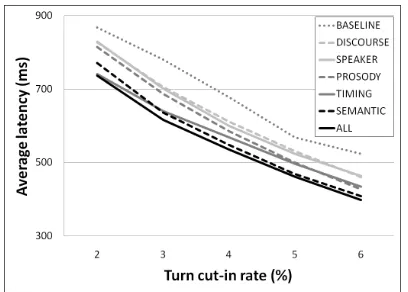
Figure 2: Performance of the proposed approach using different feature sets.
4.2 Performance of Different Feature Sets
First we evaluated each feature set individually. The results are shown in Figure 2. We concentrate on the 2-6% range of turn cut-in rate where any reasonable operational value is likely to lie (the 700 ms thresh-old of the baseline Let’s Go system yields about 4% cut-in rate). All feature sets improve over the base-line. Statistical significance of the result was tested by performing a paired sign test on latencies for the whole dataset, comparing, for each FA rate the pro-portion of gaps for which the proposed approach gives a shorter threshold than the single-threshold baseline. Latencies produced by the decision tree for all feature sets were all found to be significantly shorter (p < 0.0001) than the corresponding base-line threshold.
The best performing feature set is semantics, fol-lowed by timing, prosody, speaker, and discourse. The maximum relative latency reductions for each feature set range from 12% to 22%. When using all features, the performance improves by a small but significant amount compared to any single set, up to a maximum latency reduction of 24%. This confirms that the algorithm is able to combine features effec-tively, and that the features themselves are not com-pletely redundant. However, while removing seman-tic or timing features from the complete set degrades the performance, this is not the case for discourse, speaker, nor prosodic features. This result, similar to what (Sato et al., 2002) reported in their own ex-periment, indicates that prosodic features might be redundant with semantic and timing features.
4.3 Live Evaluation
We confirmed the offline evaluation’s findings by implementing the proposed approach in Let’s Go’s Interaction Manager. Since prosodic features were not found to be helpful and since their online ex-traction is costly and error-prone, we did not include them. At the beginning of each dialogue, the sys-tem was randomly set as a baseline version, using a 700 ms fixed threshold, or as an experimental ver-sion using the tree learned from the offline corpus. Results show that median latency (which includes both the endpointing threshold and the time to pro-duce the system’s response) is significantly shorter in the experimental version (561 ms) than in the baseline (957 ms). Overall, the proposed approach reduced latency by 50% or more in about 48% of the turns. However, global results like these might not reflect the actual improvement in user experience. Indeed, we know from human-human dialogues that relatively long latencies are normal in some circum-stances while very short or no latency is expected in others. The proposed algorithm reproduces some of these aspects. For example, after open questions, where more uncertainty and variability is expected, the experimental version is in fact slightly slower (1047 ms vs 993 ms). On the other hand, it is faster after closed question (800 ms vs 965 ms) and par-ticularly after confirmation requests (324 ms vs 965 ms), which are more predictable parts of the dia-logue where high responsiveness is both achievable and natural. This latter result indicates that our ap-proach has the potential to improve explicit confir-mations, which are often thought to be tedious and irritating to the user.
5 Conclusion
implementing the proposed algorithm in the Let’s Go system.
Acknowledgments
This work is supported by the US National Science Foundation under grant number 0208835. Any opin-ions, findings, and conclusions or recommendations expressed in this material are those of the authors and do not necessarily reflect the views of the NSF. We would like to thank Alan Black for his many comments and advice.
References
J. F. Allen and C. R. Perrault. 1980. Analyzing intention in utterances. Artificial Intelligence, 15:143–178. J. F. Allen, G. Ferguson, A. Stent, S. Stoness, M. Swift,
L. Galescu, N. Chambers, E. Campana, and G. S. Aist. 2005. Two diverse systems built using generic compo-nents for spoken dialogue (recent progress on trips). In Interactive Demonstration Track, Association of Com-putational Linguistics Annual Meeting, Ann Arbor, MI.
D. Bohus and A. Rudnicky. 2003. RavenClaw: Dia-log management using hierarchical task decomposi-tion and an expectadecomposi-tion agenda. In Eurospeech03, Geneva, Switzerland.
D. Bohus, A. Raux, T. Harris, M. Eskenazi, and A. Rud-nicky. 2007. Olympus: an open-source framework for conversational spoken language interface research. In HLT-NAACL 2007 workshop on Bridging the Gap: Academic and Industrial Research in Dialog Technol-ogy, Rochester, NY, USA.
W. L. Chafe, 1992. Talking Data: Transcription and Coding Methods for Language Research, chapter Prosodic and Functional Units of Language, pages 33– 43. Lawrence Erlbaum.
H.H. Clark. 1996. Using language. Cambridge Univer-sity Press.
S. Duncan. 1972. Some signals and rules for taking speaking turns in conversations. Journal of Person-ality and Social Psychology, 23(2):283–292.
L. Ferrer, E. Shriberg, and A. Stolcke. 2003. A prosody-based approach to end-of-utterance detection that does not require speech recognition. In ICASSP, Hong Kong.
C. E. Ford and S. A. Thompson, 1996. Interaction and Grammar, chapter Interactional Units in Conversation: Syntactic, Intonational, and Pragmatic Resources for the Management of Turns, pages 134–184. Cambridge University Press.
H. Furo. 2001. Turn-Taking in English and Japanese. Projectability in Grammar, Intonation, and Semantics. Routeledge.
B. J. Grosz and C. Sidner. 1986. Attention, intentions, and the structure of discourse. Computational Lin-guistics, 12(3):175–204.
J. Jaffe and S. Feldstein. 1970. Rhythms of Dialogue. Academic Press.
H. Koiso, Y. Horiuchi, S. Tutiya, A. Ichikawa, and Y. Den. 1998. An analysis of turn-taking and backchannels based on prosodic and syntactic features in japanese map task dialogs. Language and Speech, 41(3-4):295–321.
Mietta Lennes and Hanna Anttila. 2002. Prosodic fea-tures associated with the distribution of turns in finnish informal dialogues. In Petri Korhonen, editor, The Phonetics Symposium 2002, volume Report 67, pages 149–158. Laboratory of Acoustics and Audio Signal Processing, Helsinki University of Technology. B. Orestr¨om. 1983. Turn-Taking in English
Conversa-tion. CWK Gleerup, Lund.
A. Raux, B. Langner, D. Bohus, A. W. Black, and M. Es-kenazi. 2005. Let’s Go Public! taking a spoken dialog system to the real world. In Proc. Interspeech 2005, Lisbon, Portugal.
A. Raux, D. Bohus, B. Langner, A. W. Black, and M. Es-kenazi. 2006. Doing research on a deployed spoken dialogue system: One year of Let’s Go! experience. In Proc. Interspeech 2006, Pittsburgh, PA, USA. A. Raux, , and M. Eskenazi. 2007. A multi-layer
ar-chitecture for semi-synchronous event-driven dialogue management. In Proc. ASRU 2007, Kyoto, Japan. C. Rich and C.L. Sidner. 1998. Collagen: A
collabora-tion manager for software interface agents. An Inter-national Journal: User Modeling and User-Adapted Interaction, 8(3-4):315–350.
H. Sacks, E. A. Schegloff, and G. Jefferson. 1974. A simplest systematics for the organization of turn-taking for conversation. Language, 50(4):696–735. R. Sato, R. Higashinaka, M. Tamoto, M. Nakano, and
K. Aikawa. 2002. Learning decision trees to deter-mine turn-taking by spoken dialogue systems. In IC-SLP 2002, Denver, CO.
Kare Sjolander. 2004. The snack sound toolkit. http://www.speech.kth.se/snack/.
M. Takeuchi, N. Kitaoka, and S. Nakagawa. 2004. Timing detection for realtime dialog systems using prosodic and linguistic information. In Proc. Speech Prosody 04, Nara, Japan.
Category Feature test Number of Gap Ratio Difference Silences
Timing Pause start time≥3000 ms 1836 / 19260 65% / 87% -23%
Timing Pause number≥2 3379 / 17717 69% / 88% -19%
Discourse Previous question is open 3376 / 17720 70% / 88% -18% Semantics Utterance expectation level≥1 10025 / 11071 78% / 92% -14% Individual Mean pause duration≥500 ms 1336 / 19760 72% / 86% -14% Semantics Utterance contains a positive marker 4690 / 16406 96% / 82% 13% Prosody Mean energy of last vowel≥5 1528 / 19568 74% / 86% -12% Prosody Slope of energy on last vowel≥0 6922 / 14174 78% / 89% -10% Individual Mean number of pauses per utterance≥3 1929 / 19267 76% / 86% -10% Semantic Utterance is a non-understanding 6023/15073 79% / 88% -9% Discourse Previous question is a confirmation 8893 / 12203 90% / 82% 8% Prosody Duration of last vowel≥1 1319 / 19777 78% / 86% -8% Prosody Mean pitch on last voiced region≥5 1136 / 19960 92% / 85% 7% Prosody Slope of pitch on last voiced region≥0 6617 / 14479 82% / 87% -4% Semantics Utterance contains a negative marker 2667 / 18429 87% / 85% 2%* Discourse Previous question is closed 8451 / 12645 86% / 85% 1%*
Table 1: Effect of Dialogue Features on Pause Finality. In columns 3 and 4, the first number is for silences for which the condition in column 2 is true, while the second number is for those silences where the condition is false. * indicates that the results are not statistically significant at the 0.01 level.
Category Feature test Number of Mean pause Difference Pauses Duration (ms) (ms)
Prosody Mean pitch on last voiced region≥4 172 / 2911 608 / 482 126 Semantics Utterance Expectation Level≥4 2202 / 881 475 / 526 -51 Prosody Slope of energy on last vowel≥1 382 / 2701 446 / 495 -39
Timing Pause number≥2 1031 / 2052 459 / 504 -45
Discourse Previous question is open 1015 / 2068 460 / 504 -43 Individual Mean pause duration≥500 ms 370 / 2713 455 / 494 -39* Prosody Mean energy of last vowel≥4.5 404 / 2679 456 / 494 -38* Semantics Utterance contains a positive marker 211 / 2872 522 / 487 35* Discourse Previous question is closed 1178 / 1905 510 / 477 33* Timing Pause start time≥3000 ms 650 / 2433 465 / 496 -31* Semantic Utterance is a non-understanding 1247 / 1836 472 / 502 -30* Prosody Duration of last vowel≥0.4 1194 / 1889 507 / 478 29* Individual Mean number of pauses per utterance≥2 461 / 2622 474 / 492 -19* Semantics Utterance contains a negative marker 344 / 2739 504 / 488 16* Prosody Slope of pitch on last voiced segment≥0 1158 / 1925 482 / 494 -12* Discourse Previous question is a confirmation 867 / 2216 496 / 487 9*
Let(Kn) be a set ofnsilence clusters, the goal is to set the thresholds (θn) that minimize overall mean latency, while yielding a fixed, given number of false alarmsE. let us defineGnthe number of gaps among the silences ofKn. For each cluster, let us defineEn(θn)the number of false alarms yielded by threshold θnin clustern, and the total latencyLnby:
Ln(θn) =Gn×θn (3)
Assuming pause durations follow an exponential distribution, as shown in Section 3, the following relation holds betweenLnandEn:
eLn
(θn)
µn =βn×En(θn) (4)
whereµK andβK are cluster-specific coefficients estimated by linear regression in the log domain. If we take the log of both sides, we obtain:
Ln(θn) =µn×log(βn×En(θn)) (5)
Theorem 1. If (θn) is a set of thresholds that minimizes PnLn such that PnEn(θn) = E, then ∃As.t.∀n,dLn
dEn(θn) =A
Informal proof. The proof can be done by contradiction. Let us assume (θn) is a set of thresholds that minimizesP
nLn, and∃(p, q)s.t.dLdEpp(θp)> dLdEqq(θq). Then, there exists small neighborhoods ofθp andθq whereLp(Ep)andLq(Eq)can be approximated by their tangents. Since their slopes differ, it is possible to find a smallsuch that the decrease in FA yielded byθp+is exactly compensated by the increase yielded byθq−, but the reduction in latency inKq is bigger than the increase inKp, which contradicts the fact that(θn)minimizesL.
From Theorem 1, we get∃As.t.∀ndLn
dEn =A. Thus, by deriving Equation 5,
µn
En =Awhich givesEn=
µn
A. Given thatP
En = E,
P
µn
A = E. Hence,A =
P
µn
E . From 5, we can infer the values ofLn(θn)and, using 3, the optimal thresholdθnfor each cluster:
θn=
µn×log(βn×EP×µµnn)
Gn
(6)
where the values ofµnandβncan be estimated by linear regression from the data based on 5.