Detection of Singular Points from Fingerprint Images Using an Innovative
Algorithm
Sumedh S. Khodwe,
Jawaharlal Darda Institute of Engineering & Technology, Yavatmal, India
ABSTRACT
Fingerprint scrutiny is typically based on the location and pattern of detected singular points in
the images. These singular points (cores and deltas) not only represent the characteristics of
local ridge patterns but also determine the topological structure (i.e., fingerprint type) and
largely influence the orientation field. In this report, there is an innovative algorithm for
singular points detection. After an initial detection using the conventional Poincare Index
method, a so-called DORIVAC feature is used to remove spurious singular points. Then, the
optimal combination of singular points is selected to minimize the difference between the
original orientation field and the model-based orientation field reconstructed using the singular
points. A core-delta relation is used as a global constraint for the final selection of singular
points.
I.
Introduction
Fingerprint is the pattern of ridges and valleys [1] on the surface of a fingertip. The ridges are
black and the valleys are white. Its orientation field is defined as the local orientation the
ridge-valley structures. The minutiaeare defined as ridge endings and bifurcations. The singular points
can be viewed as points where the orientation field is discontinuous, which can be classified into
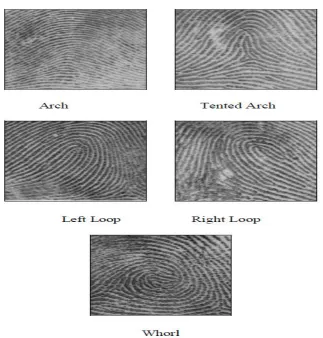
two types: core and delta [2]. Fig. 1 lists five typical types of fingerprints with singular points
noticeable. As an important topological characteristic for fingerprints, singular points can be
used for fingerprint indexing (i.e., classification for fingerprint types) [3], [4] as well as for
fingerprint arrangement and orientation field modeling [5], [6] and so forth.
Several previous works have addressed singular point detection and analysis in fingerprint
images. They can be approximately classified into two groups.
The first approach is mainly based on using the Poincare´ Index to consider the irregular
orientation distribution about singular points [2], [3], [7], [8], [9]. This sort of algorithm usually
calculates the sum of the orientation changes along a close circle about the point to judge
whether it is a singular point.
The second form of approach uses probability analysis, ridge analysis, shape analysis, or
template matching [10], [11], [12], [13], [14], [15], [16] and [17]. Compared with these latter
techniques, Poincare´ Index-based detection techniques are generally stronger to image rotation
and relatively easy to compute, so they are more extensively used in real applications.
Poincare´ Index-based algorithms usually result in many forged detections (especially for
low-quality fingerprint images), even after post-processing. The forged detected points can greatly
degrade the performance of these algorithms in lots of applications. The forged detections result
because 1) the Poincare´ Index feature alone is not sufficient for accurate singular point detection
and 2) most post-processing approaches use only local characteristic of singular points, which is
blurs, damped prints, etc. In the orientation field, some forged detection actually has almost the
same local patterns as true singular points. To accurately distinguish the genuine singular points, global
discriminative information should be incorporated into the detection.
This paper, concentrate on to singular point detection based on an innovative so-called
Difference of the ORIentation Values Along a Circle (DORIVAC) characteristic and global
restrictions. Compared with previous studies, the contributions of this paper lie in the following
aspects: 1) Paper is proposed using the DORIVAC feature for singular point verification, which
can provide more discriminative information to get rid of forged detections and 2) based on an
analysis of core-delta relationships, to select the best combination of singular points by global
restrictions. The optimal singular points are selected to minimize the variation between the
detected orientation field and model-based orientation field reconstructed using the singular
points.
The rest of this paper is organized as follows: Part II analyses the topological structure of
fingerprints. In Part III, the DORIVAC feature is proposed to remove forged SPs. Part IV
discusses how to select the optimal combination of cores and deltas using global information.
Fig 1: Various types of fingerprints with cores (marked with circles) and deltas (marked with triangles).
(a) Plain arch. (b) Tented arch. (c) Left loop. (d) Right loop. (e) Whorl
II.Topological Analysis For Fingerprint Structures
A. MathematicalBackground:
Definition. Let V (u, v) =p(u, v) + i. q(u, v) be a continuous 2-dimensional vector field. Then,
the Poincare´ Index of V (u, v) along an arbitrary simple closed path 𝛾 is defined as
where is the angle at point (u, v) and The integration is taken
The Poincare´ Index is always an integer. By computing I beside a simple closed circle around
a point P, one can find whether P is a singular point or a common point .
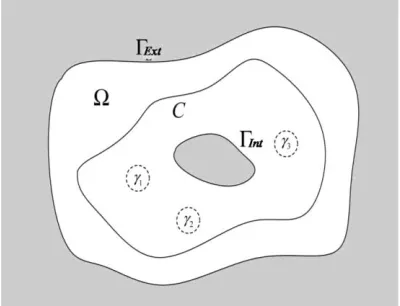
Suppose that a area Ω has an exterior boundary, ГExt, and an interior boundary, ГInt , as shown
in Fig. 2. The singular points inside Ω are indicated by the circles, . C is a simple
closed path inside Ω. Two important properties of the Poincare´ Index can be formulated as
[image:5.612.211.411.230.383.2]follows and their evidence can be derived from Complex Function Theory [19].
Fig. 2. Region with its boundary are the circles around the singular
points inside Ω. C is a simple closed path in Ω.
Property 1. The Poincare´ Index along the boundary of a given area is equal to the sum of the
Poincare´ Indices of the singular points inside this area, i.e.
Property 2. If two simple closed paths are homotopic, and there are no other singular points
between them, their Poincare´ Indices are the same. For example, I(C) = I (ΓExt), in Fig. 2.
For oriented texture images, such as fingerprints and fluid flow, it is natural to establish their
connection with 2-dimensional topology theory. This can relate the above definitions and
properties on these images. The singular points in fingerprints are found to be steady with the
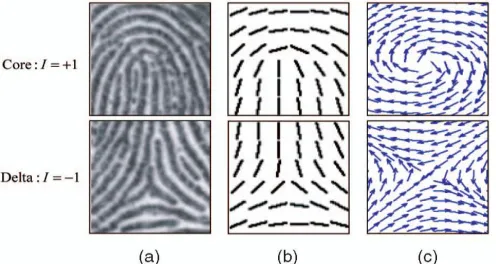
singular points defined in topology. In Fig. 3, we list two typical singular points for fingerprints,
their Poincare´ Indices, and their local patterns in the orientation field O.
Fig. 3. (a) Singular points in fingerprints with the Poincare´ Indices, (b) their local patterns in the
orientation field O, and (c) the vector field V.
A remarkable conclusion for fingerprints can be assumed based on Property 1. Since fingerprints
usually do not have interior boundary ΓInt and only have isolated singular points (cores and deltas) with
known Poincare´ index (+1 for core, -1 for delta), (2) can be written as
where Ncores is the number of the cores, Ndeltas is the number of the deltas, and ГExt is the exterior boundary
of the fingerprint.
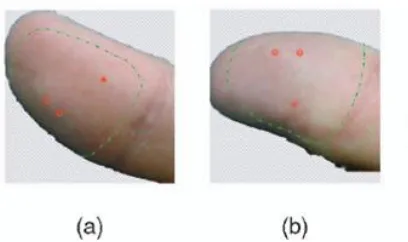
Earlier works have pointed out that cores and deltas should appear in pairs [9]. Two views of actual
thumb are shown as an example in Figs. 4a and 4b with the cores and the deltas marked. For the simple
[image:6.612.189.437.194.326.2]Fig. 4. (a) Left and (b) right views of a real thumb with singular points and boundary marked.
As for Property 2, we know that the Poincare´ Index can be calculated along any simple closed
path as long as it is homotopic with the closed circle around the same points. This allows to
adaptively choose the integral path for the boundary, for example, to choose the path where the
orientation confidence is much higher.
III.
Using DORIVAC Feature To Remove Forged Singular Points
A. DORIVACFeature:
Many earlier researchers have shown that Poincare´ Index-based methods can usually detect
nearly all true singular points when the Index is calculated along small area boundaries, but this
also guides to much forged detection. If a bigger area is chosen, true singular points will be easy
to miss [9]. In order to get rid of forged detections while conserving a good detection rate, an
innovative feature is advised here extended from the Poincare´ Index, which can provide more
perceptive features and be used to confirm the trueness of each finding after using Poincare´
[image:7.612.214.418.86.207.2]The Poincare´ Index is defined as the sum of the orientation differences beside a closed ring L.
For a given point P, suppose that the set of sampled points along L is {T1; T2; T3; . . . ; TN-1} and
oi is the orientation of point Ti. Then, the Poincare´ Index of P can be computed by [3] [5]
(4)
The Poincare´ Index is only the sum of . It contains no information about the arrangement
of and it cannot explain the singular point fully. So, when there are
creases, scars, smudges, or damped prints in the fingerprint images, the Poincare´ Index method
will easily outcome in many forged singular points. Post-processing steps are therefore
frequently essential. In this paper, two simple set of laws are used through post-processing:
1) If a delta is too close to a core (the distance between them is smaller than 8 pixels),
eradicate both of them as well as
2) In a very small area (a circular region with a radius of 8 pixels), if there is more than one
core (or delta), an average core (or delta) can be calculated instead.
Suppose that there are N cores (or deltas) in such a area, Then, the
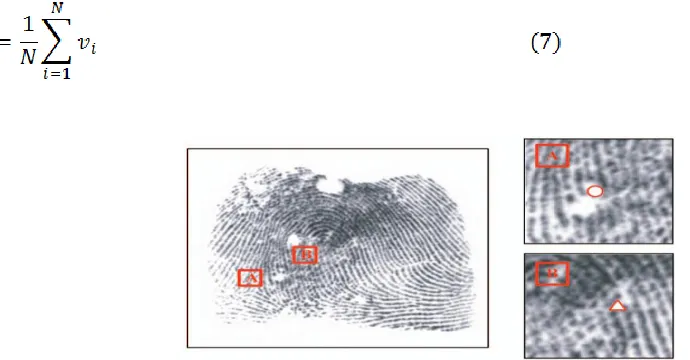
Fig. 5. Two examples of forged singular points detected using a conventional Poincare´
Index-based method and post-processing steps, in which the false core is marked with a circle and the
false delta is marked with a triangle.
However, even after this post-processing step, much forged detection still remains. Fig. 5
shows two examples from a cheap-quality fingerprint, illustrating points that are wrongly
detected as a core and a delta by using the Poincare´ Index method and this post-processing.
In order to additional remove the forged points, an innovative characteristic is used, which
contains more information about the singular point. The characteristic on point P, which consists
of the DORIVAC about P, i.e.,
DORIVAC (P) = (8)
As DORIVAC contains all , it can illustrate the singular point more absolutely. The
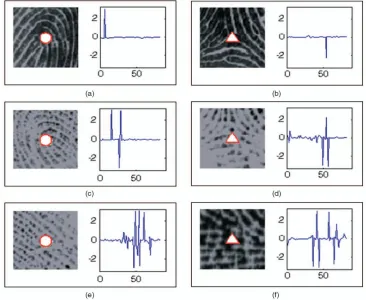
Poincare´ Index can be seen as the summation of DORIVAC features and DORIVAC features
detected by the Poincare´ Index method and their DORIVAC features are plotted as curves
[image:10.612.122.488.134.434.2](among them, Figs. 6a, 6b, 6c, and 6d are true and Figs. 6e and 6f are forged detections).
Fig. 6. Singular points detected by using the Poincare´ Index algorithm and their DORIVAC
features (plotted as curves): (a), (b), (c), and (d) are true while (e) and (f) are forged.
Since the orientation field is defined in [0, π), there will be one DORIVAC feature pulse for
each singular point (positive pulse for core, and negative pulse for delta) if the orientation field is
detected completely. See Figs. 6a and 6b for examples. Although the noise around the true
singular points may change the curves a little, there exists a clearly obvious difference between
true and forged singular points. These phenomena can be observed in Fig. 6.
After post-processing steps, the detected singular points are isolated, i.e., there is only one
features along a large circle. Then, N can be a large number, and accordingly, the curves of
DORIVAC features will be more continuous.
B. RemovingForgedSingularPoints :
To distinguish true singular points from forged ones, a two-step classifier is projected as
below. For each point with nonzero Poincare´ Index in the applicant set S, the DORIVAC feature
is calculated. If there is exactly one pulse (i.e., positive pulse for core and negative pulse for
delta) with the height nearly up to , it is a legitimate singular point and will be kept in the final
set S of singular points; otherwise, it will be removed from applicant set S and placed into an
supplementary set S’ of applicants for further processing. This process is outlined in Algorithm
1.
Algorithm 1:- Pseudo-code of the first step for removing forged SPs
1 for each detection point P in S do
2 DORIVAC (P) = ;
3 if
4 keep P in S;
5 end
6 else
7 remove P to S´
8 end
9 end
The supplementary point set S’ can contain a mixture of true singular point and forged
detections. The classifier is designed, based on training samples to differentiate between the true
Since it is time consuming to physically tag true and forged singular point samples for the
training of the classifier, the taster learning methods are used suitable for small-numbered
samples. The Support Vector Machine (SVM) is chosen to design the classifier [20]. SVMs try
to find a best separating hyper-plane in the feature space and lessen the classification error for
the training data using a nonlinear transform function.
In this problem, the missed detection rate (classifying true singular points as forged ones)
should be very small. The separating hyper-plane is defined by and b. In this
paper, an optimal b0 is selected to move the separating plane to a suitable position that will
misclassify less than 2 percent of true singular points as forged ones and, meanwhile, decrease
the error of classifying forged singular points as true ones.
From the definition of DORIVAC features, it is observed that this vector is sensitive to image
rotation. To prevail over the influence of image rotation, the training set is enlarged by rotating
each fingerprint sample image by 10 degree increments. All of the samples are used for training
the SVM classifier to make it insensible to image rotation.
Based on the SVM result, the decision can be made whether a point P in S’ should be moved
back to the final candidate set S or not. After this two-step classification process, a set of the
forged singular points are removed. For example, Figs. 6e and 6f can be successfully judged as
forged singular points while the other four are kept as true ones.
IV.
Singular Points Selection With Global Information
As pointed out earlier, local features alone are not enough to fully distinguish the true singular
points from forged detections, which can actually have similar local characteristics as the true
A. RemovingInvalidCombinations:
The core-delta relation deduced in Part II is used as a global restriction for selecting the best
set of final singular points. In real applications, many fingerprint images captured by optical or
capacitive sensors are not complete. Often they will lose one or two deltas. In this case, the
number of cores is not necessarily equal to the number of deltas. Nevertheless, (3) still presents
us a global topological restriction for singular points. Suppose the effective region of the
fingerprints is Ω. By computing we can know that only a few combinations of the
singular points are valid. In Table 1, most of the possible combinations of singular points are
listed for fingerprints with the Poincare´ Index and the possible types (PA—plain arch, TA—
tented arch, LL—left loop, RL—right loop, TL—twin loop).
TABLEI
FREQUENTCOMBINATIONSOFSINGULARPOINTSINACOMPLETEFINGERPRINT
I( Core Delta Possible
Types
0
0 0 PA
1 1 LL,RL,TA
2 2 TL,Whorl
1
1 0 LL,RL,TA
2 1 TL, Whorl
2 2 0 TL, Whorl
By calculating the global Poincare´ Index I ( ) some invalid combinations of singular points
can be removed. For example, when the global Poincare´ Index is equal to 1, the combinations of
1-core-0-delta and 2-core-1-delta are calculated and other situations are not considered. This
B. SelectionofOptimalSingularPoints:
As known, singular points can be used to determine the global structure of the orientation field
of fingerprints. The basic idea is to select the best singular points by decreasing the difference
between the original orientation field and the model-based orientation field rebuilt using the
singular points.
Denote the original orientation field as O0 and the rebuilt orientation field as O(Ө.s), where Ө
is the model’s parameter. The original orientation field, O0, is calculated by the hierarchical
gradient-based method [21]. As for the model-based rebuilt orientation field, O(Ө.s), the
Zero-Pole model proposed by Sherlock and Monro [5] is choose, considering both the model accuracy
and the computational efficiency.
V.
Conclusion
To sum up, the paper is focused on the detection of singular points in fingerprints. The
contributions lie in two aspects. 1) a new feature, DORIVAC, in addition to the Poincare´ Index,
which can successfully remove forged detections and 2) the topological relations of singular
points is taken as a global restriction for fingerprints The optimal singular points can be selected
by decreasing the difference between the original orientation field and the model-based
References
[1] Jie Zhou, Fanglin Chen, and Jinwei Gu; “A Novel Algorithm for Detecting Singular Points from Fingerprint Images”, ieee transactions on pattern analysis and machine intelligence, vol. 31, no. 7, july 2009
[2] Maltoni, D. Maio, A.K. Jain, and S. Probhaker, Handbook of Fingerprint Recognition. Springer-Verlag, 2003.
[3] K. Karu and A.K. Jain, “Fingerprint Classification,” Pattern Recognition, vol. 17, no. 3, pp. 389-404, 1996.
[4] Q. Zhang and H. Yan, “Fingerprint Classification Based on Extraction and Analysis of Singularities and Pseudo Ridges,” Pattern Recognition, vol. 37, no. 11, pp. 2233-2243, 2004. [5] B. Sherlock and D. Monro, “A Model for Interpreting Fingerprint Topology,” Pattern
Recognition, vol. 26, no. 7, pp. 1047-1055, 1993.
[6] J. Gu and J. Zhou, “A Novel Model for Orientation Field of Fingerprints,” Proc. IEEE Int’l Conf. Computer Vision and Pattern Recognition, vol. 2, pp. 493-498, June 2003.
[7] A.K. Jain, S. Prabhakar, and L. Hong, “A Multichannel Approach to Fingerprint Classification,” IEEE Trans. Pattern Analysis and Machine Intelligence, vol. 21, no. 4, pp. 348-359, Apr. 1999.
[8] M. Tico and P. Kuosmanen, “A Multiresolution Method for Singular Points Detection in Fingerprint Images,” Proc. IEEE Int’l Symp. Circuits and Systems, vol. 4, pp. 183-186, July 1999.
[9] A.M. Bazen and S.H. Gerez, “Systematic Methods for the Computation of the Directional Fields and Singular Points of Fingerprints,” IEEE Trans. Pattern Analysis and Machine Intelligence, vol. 24, no. 7, pp. 905-919, July 2002.
[10]R. Cappelli, A. Lumini, D. Maio, and D. Maltoni, “Fingerprint Classification by Directional Image Partitioning,” IEEE Trans. Pattern Analysis and Machine Intelligence, vol. 21, no. 5, pp. 402-421 May 1999.
[11]P. Ramo, M. Tico, V. Onnia, and J. Saarinen, “Optimized Singular Point Detection Algorithm for Fingerprint Images,” Proc. IEEE Int’l Conf. Image Processing, vol. 3, no. 3, pp. 242-245, Oct. 2001.
[12]C.-H. Park, J.-J. Lee, M.J.T. Smith, and K.-H. Park, “Singular Point Detection by Shape Analysis of Directional Fields in Fingerprints,” Pattern Recognition, vol. 39, no. 5, pp. 839-855, 2006.
[13]X. Wang, J. Li, and Y. Niu, “Definition and Extraction of Stable Points from Fingerprint Images,” Pattern Recognition, vol. 40, no. 6, pp. 1804-1815, 2007.
[14]K. Nilsson and J. Bigun, “Complex Filters Applied to Fingerprint Images Detecting Prominent Symmetry Points Used for Alignment,” Proc. ECCV 2002 Workshop Biometric Authentification, pp. 39-47, 2002.
[15]K. Nilsson, “Symmetry Filters Applied to Fingerprints,” PhD dissertation, Chalmers Univ. of Technology, 2005.
[17]S. Chikkerur and N.K. Ratha, “Impact of Singular Point Detectionon Fingerprint Matching Performance,” Proc. Fourth IEEE Workshop Automatic Identification Advanced Technologies, pp. 207-212, 2005.
[18]P. Perona, “Orientation Diffusions,” IEEE Trans. Image Processing, vol. 7, no. 3, pp. 457-467, 1998.
[19]E.B. Saff and A.D. Snider, Fundamentals of Complex Analysis with Applications to Engineering, Science, and Mathematics, third ed. Prentice Hall, 2002.
[20]C Burges, “A Tutorial on Support Vector Machines for Pattern Recognition,” Data Mining and Knowledge Discovery, vol. 2, no. 2, pp. 121-167, 1998.