Context
-
Aware In
-
Page Search
㜿㗙尒Yu-Hao Lin, ∱恩嗕 Yu-Lan Liu, 柷⬄佚 Tzu-Xi Yen, ⻝ὲ䚃 Jason S. Chang
⚳䩳㶭厗⣏⬠屯妲ⶍ䦳⬠䲣
Department of Computer Science National Tsing Hua University
{ catonmars.lin, ikulan12, joseph.yen, jason.jschang}@gmail.com
Abstract
In this paper we introduce a method for searching appropriate articles from knowledge bases (e.g. Wikipedia) for a given query and its context. In our approach, this problem is transformed into a multi-class classification of candidate articles. The method involves automatically augmenting smaller knowledge bases using larger ones and learning to choose adequate articles based on hyperlink similarity between article and context. At run-time, keyphrases in given context are extracted and the sense ambiguity of query term is resolved by computing similarity of keyphrases between context and candidate articles. Evaluation shows that the method significantly outperforms the strong baseline of assigning most frequent articles to the query terms. Our method effectively determines adequate articles for given query-context pairs, suggesting the possibility of using our methods in context-aware search engines.
Keywords: entity linking, word sense disambiguation, Wikipedia, support vector machine, search engine
1
Introduction
Today we surf the Internet through search engines most of the time. With the explosive growth of web pages, the accuracy and relevancy of search results have become ever more important. Traditional search engines accept keywords, and return a page full of possible relevant results. Then users can click one of the results to visit the sites they are interested in. We call this type of search “keyword-search”. Today, almost all search engines are keyword-based.
However, various classes of results mixed in the search results. For example, when a user query the search engine with the keyword “apple”, the search results comprise of two major class, “Apple Inc.”, the computer company, and “apple”, a kind of fruit. With only one keyword, even state-of-the-art keyword-based search engines could not distinguish between different search intents. Unlike keyword search, context-aware search assume each query is
associated with a context.
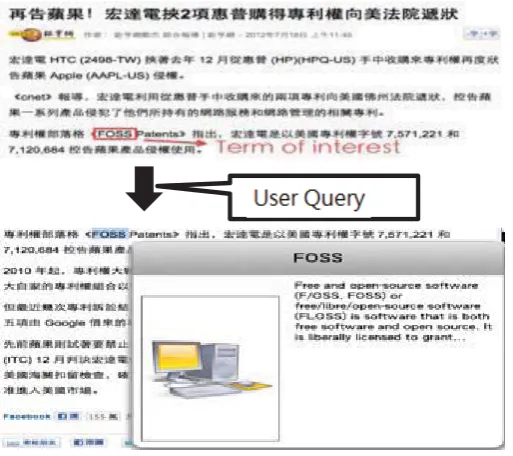
Figure 1. An example of context-aware search
Figure 2. The mention “John McCarthy” and its context.
In this paper, we present a prototypical system, In-Page Search, that automatically extract context information and use them to disambiguate ambiguous queries. Users could select the terms they are interested in, and then with a click of the mouse, the In-Page Search system shows a pop-up window with the most relevant results for the given context.(See Figure 1.) In-Page Search is similar to the “entity-linking problem”, which has long been an active research topic in IR and Database community. Entity-linking problem could be informally described as follows: given a knowledge base, in which every entry is an entity and its associated information. Given a mention and the context with the mention, determine the correct entity that the given mention really links to. For example, Figure 2 shows the mention “John McCarthy” and it’s context, in a knowledge base, there are more than 10 entities which may be linked to “John McCarthy”. The problem is determining the correct entity to link to. Intuitively, entity-linking could be considered a Named-Entity Disambiguation problem or more generally, a word sense disambiguation problem.
knowledge base to cope with the data sparseness problem which may be a problem for a language with less data. We discuss this multi-language model and the definitions of various link-based similarity measures in Chapter 3.
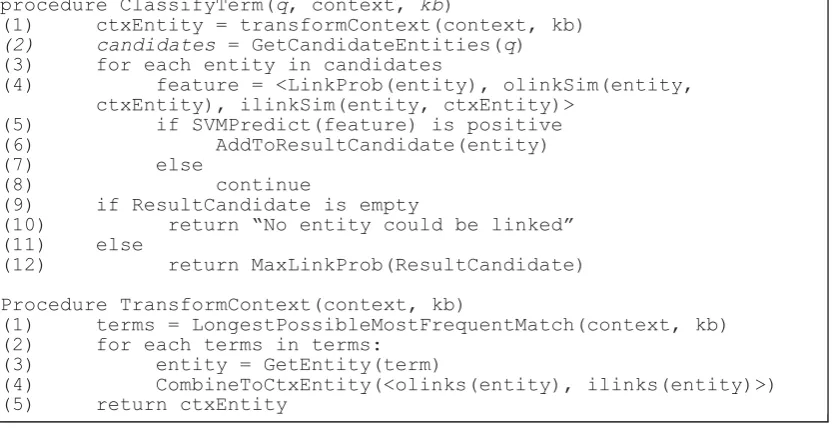
At run-time, In-Page Search starts with a query together with its context page submitted by the user. The system then extracts context terms and transforms them into machine-readable features. Finally, the system uses a SVM model (Chang and Lin, 2011) trained on a knowledge base to determine which entity in the knowledge base should be linked to the current query, and output a summarized abstract of this entity to the user. The results could be further augmented for other purposes. For example, for the input links to a geographic entity, we could show the location using a map application.
The rest of this thesis is organized as follows. We review the related work in the following chapter. Then we describe our preprocessing and runtime algorithm in Chapter 3. We then report on the experimental setup and compare our results to various baselines in Chapter 4. Conclusions are provided in Chapter 5 along with the directions of future work.
2
Related Work
Search engines and related technology has long been an active research topic in information retrieval and natural language processing. Most modern search engines (e.g. Google,Bing, and
Yahoo!) accept keyword or keyphrase as input. Today keyword search engines have excellent performance in terms of both results relevancy and response time. However, keyword search engines do not consider a query may come with a context, so they could not distinguish between different search intents. With the rise of the mobile web, some search engines have evolved to provide better user experience. One reprehensive example is the Google Now
feature of mobile edition of Google. While accepting user’s voice input, it extracts user’s context information such as GPS location, user’s schedule recorded on calendar application, and the contact information on user’s cell phone. Thus, Google Now can analyze user’s search intent and provide the most relevant information using these contexts.
Previously, much effort has been made in research on word sense disambiguation based on machine learning (Black, 1988; Hearst, 1991; Leacock, Towell, and Voorhees, 1993; Bruce and Wiebe, 1994). Yarowsky (Yarowsky, 1992) uses a Naïve Bayesian classifier trained on Roget’s thesaurus to classify words with given context into its sense category. They use class-based salient words list provided by Roget’s thesaurus as features and tuning weight by counting the frequencies of surrounding salient words in context. While achieving high accuracy, this research can be viewed as prototypical framework of most machine learning WSD systems. These approaches often rely on sense-labeled corpus. Although supervised machine learning WSD algorithms frequently gives high performance, however, sense-labeled
corpus is not always available. Compared to our approach, we use Wikipedia as our corpus, its cross-lingual nature enables us to augment smaller knowledge base with other languages.
An important branch of WSD is entity-linking. While WSD focuses on linking word to its correct sense given context, entity-linking systems focus on linking mentions of entities (often named-entities) to its correct entry in a given knowledge base. “Wikify” (Mihalcea and Csomai, 2007; Milne and Witten, 2008) is an example of entity-linking systems. These systems automatically augment user’s input texts with hyperlinks to Wikipedia entries. For example, imagine Figure 2 with links removed, these systems will automatically detect them with anchors links to proper Wikipedia articles (e.g. John McCarthy in Figure 2 links to John McCarthy (computer scientist) in Wikipedia.). Mihalcea’s system decomposes these task into two procedural: keyphrase extraction and word sense disambiguation. They achieve WSD by computing various linguistic features except the “Keyphraseness”: how frequently one phrase in Wikipedia being hyperlinks.
Milne and Witten’s system disambiguates mentions by incorporating more link-based measures. They apply normalized Google Distance (Cilibrasi and Vitanyi, 2007) to compute relatedness between two Wikipedia articles, and training machine learning models. Unlike Mihalcea’s system, they first disambiguate possible candidates in input document, and then use information from this pass of disambiguation to aid keyphrase extraction. Their system has good performance both on Wikipedia articles and wild-life news pages.
Compared to our system, most entity-linking system developed their method on English, so they could not directly apply to languages that need segmentation pre-processing. To apply our method to CJK languages, we use a scheme similar in (Milne and Witten, 2008) to transform context page into vector of context entities. In addition, we extend traditional link-based measure to a cross-lingual augmented knowledge base. To the best of our knowledge, such technique hasn’t been shown in previous systems.
3
Method
Understanding a user’s search intent basing solely on query term (e.g., ݀) is a challenging task. Short query terms typically have more than one sense which leading to multiple entities in the knowledge base that could be linked to. To assign adequate entity for a given query, a promising method is to compute the similarity between a query’s context and candidate entities’ description, and returning the most similar entity (e.g. ݀Ϧљ for ݀) in the context of a computer-related Chinese article.
3.1
Problem Statement
entity in the knowledge base for the given query. Once the entity has determined, the system returns information of this entity in various ways (e.g. text description, image, audio, video). In a Wikipedia-like knowledge base, we treat each document as an entity, its description page as the context, and hyperlinks in this page as query terms. With the hyperlinked nature of such a knowledge base, we train a classifier which estimate the similarity of link structure between each query term’s context, and determine whether a query term and an entity (i.e. the article titles) should be linked together. Thus, the problem of context-aware search is transformed to an entity-linking problem. We now formally state the problem we are addressing by first giving a definition of Wikipedia-like knowledge base.
A Wikipedia-like knowledge base is a collection of documents, each document should describe an unique concept with hyperlinks, inter-wiki links and disambiguation pages which list possible sense of an ambiguous term.
Problem Statement: We are given a set of Wikipedia-like knowledge bases KB={ kb1 ,…,
kbn| n ≥ 1 } (e.g., {Chinese Wikipedia, English Wikipedia}), a query term q, a context
document c of q, and a knowledge base kbj KB, where q should be searched. Our goal is to
assign an adequate document ei, where ei kbj = {e1,…, ej} and e1,…, ej are candidate senses.
For this, we compute the link structure similarity between each document pair (c, e), where e is in kbj, and then train a classifier to determine which (c, e) pair should be linked together.
3.2
Learning to Link with Wikipedia
-
like Databases
We attempt to resolve the sense ambiguity of a given query term by learning link structure characteristics from a collection of <Term, Entity> pairs in a Wikipedia-like knowledge base. Our learning process is shown in Figure 3.
Figure 3 Outline of the training process.
3.2.1
Generate Candidate Term
-
Entity Pairs From Knowledge Base
In the first stage of the learning process (Step (1) in Figure 3), we generate candidate <Term, Entity> pairs from KB. Once the candidate pairs have been computed and stored, the
In-Page Search system could use them to efficiently retrieve possible entities of a given query, instead of comparing every e in KB. For example, given the query “݀”, we retrieve { <” ݀”, ”݀Ϧљ”>, <”݀”, ”ഝߎ༣ႝတ”>, <”݀”, “݀(Н݀)”>, <”݀”,”݀В ൔ”>}, and then, these four entities will be disambiguated. We compute these pairs from KB using a hyperlink’s anchor text and its destination entity. The rationale behind computing <Term, Entity> pairs using anchor texts is that anchor texts reflect how people mentioning
(1) Generate Candidate Term-Entity Pairs From Knowledge Base (Section 3.2.1) (2) Augment Knowledge Bases by Inter-Wiki Links (Section 3.2.2)
(3) Train Binary SVM Classification Model (Section 3.2.3)
entities in written articles.
The input to this stage is a set of Wikipedia-like knowledge base KB. With their hyperlinked nature, we could compute <Term, Entities> pairs easily. To provide broader coverage of query, we also take into account the redirect links and disambiguation pages.
Figure 4. An input document from an Wikipedia-like knowledge base
Table 1. Samples of <Term, Entity> pairs constructed from Figure 4.
The output of this stage is a collection of <Term, Entity> pairs of a certain knowledge base. Some <Term, Entity> pairs, automatically constructed, are shown in Table 1. Figure 5 shows the algorithm for computing <Term, Entity> pairs from a Wikipedia-likedatabase.
Figure 5. Generating <Term, Entity> pairs.
In Step (1) of the algorithm we retrieve the list of all articles in kb. Then we iterate through all articles. For each article, we first identify all hyperlinks and title of article (Steps (4), (5)). If this document is a disambiguation page, for each hyperlinks in this page, we add <document
Term Entity
NASDAQ ٗථၲլ
LSE উඩچҬܰ܌
CNN Ԗጕႝຎཥᆪᆛ
Term Entity
ύҡݨ ύ୯ҡݨ
уճᅽѭ٥ уճᅽѭ٥Ԁ
݀ႝတϦљ ݀Ϧљ
procedure GenerateTermEntityPairs(kb)
(1) docs = GetDocuments(kb)
(2) list = emptyList (3) for each ei in docs
(4) links = GetLinks(ei) (5) title = GetTitle(ei)
(6) if ei is Disambiguation Page (7) for each target in links (8) list += <title,target> (9) else
(10) for each <anchor,target> in links (11) list += <anchor,target> (12) hist=Histogram(list)
title, link target> to a temp list. Otherwise we add <anchor text, link target> to the temp list (Steps (6)~(11)). Finally, we compute the histogram of the temp list, where every entry is a <Term, Entity> pair and its frequency (Steps (12)). An example of results is shown in Table 2.
Table 2. <Term, Entity> pairs of ‘݀’
Term Entity Frequency
݀ ݀ (ނ) 149
݀ ݀Ϧљ 23
݀ ݀ (ႝቹ) 1
݀ ഝߎ༣ႝတ 1
3.2.2
Augmenting Knowledge Base using Inter
-
Wiki Links
In the second stage of the learning algorithm (Step (2) in Figure 3), we augment each
Wikipedia-like knowledge base in KB using inter-wiki links. Consider Chinese Wikipedia and
English Wikipedia, language links among them link two document describe the same entity together. For example, ”ഝߎ༣ႝတ” in Chinese Wikipedia and “Macintosh” in English Wikipedia. By linking one entity to its corresponding entity in other knowledge base, we could combine the knowledge to obtain a richer representation of information of each entity. For two imbalanced knowledge bases (e.g. Chinese Wikipedia and English Wikipedia), our algorithm could augment the one with less information using the one with more information.
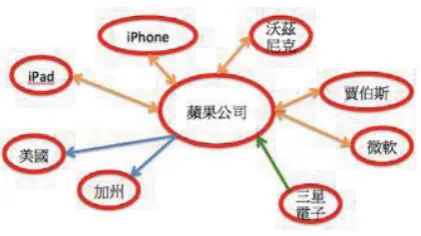
In a Wikipedia-like knowledge base, each article can be viewed as a concept (i.e. entity). From hyperlinks in documents, we could build a directed graph of the entire knowledge base, in which nodes denote articles, the edge indicate an article mentions another via hyperlinks. Thus, out-going edges of a node point to other articles mentioned in the article represented by the node, while in-coming edges of a node indicate other articles mentioning the node. We call these two edges out-links and in-links respectively (See Figure 6.).
Figure 6. A link graph. Blue edges denote outlinks, green edges denote inlinks, orange edges denote both inlinks and outlinks.
The input of this stage is two Wikipedia-like knowledge bases (e.g. <Chinese Wikipedia,
English Wikipedia>, we augment the first knowledge base using the second one. The output of this stage is an augmented knowledge base, in which each document is augmented.
Figure 7. The augmentation process.
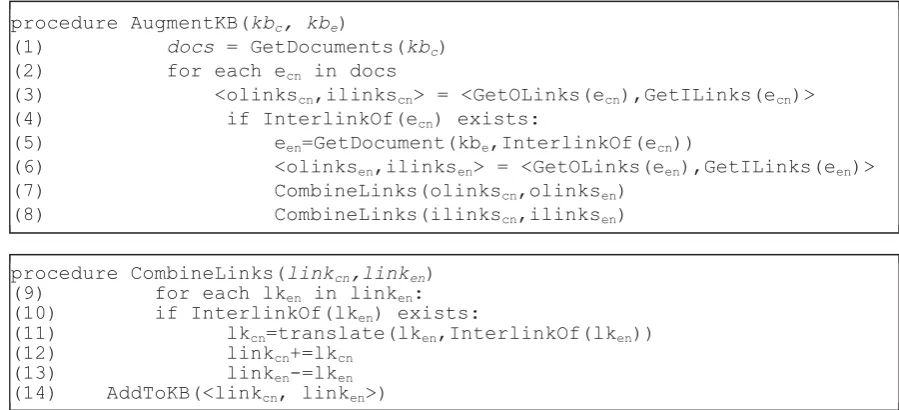
Figure 7. shows the knowledge base augmenting process. In Step (1) of the algorithm, we retrieve the list of all articles in kbc. For each article, we first examine whether it has an
inter-link points to its corresponding entity in kbe. If the result is negative, we leave the current article unchanged without augmentation. In Step (5), we identify the corresponding article in
kbe by looking at the target, een of inter-wiki link of ecn. Then, we retrieve all out-links and
in-links of een and carry out the CombineLinks procedure with both kinds of links (Step (6), (7), (8)). In the CombineLinks procedure, we iterate through all links in linken, and then determine if the link (i.e. lken) has an inter-link (Step (10)). If such an inter-link exists, we “translate” the link by replacing lken with lkcn, a hyperlink point to destination of the inter-link and has anchor text of destination title. Finally we add the translated link to the original set of link (i.e. linkcn), and store them in database. Note that the linken is also stored in kbc (Step (14)). We do that to support cross-lingual entity-linking. Once the augmentation has been done, each article in kbc has two link sets from each knowledge base. For articles with inter-links, the performance of entity-linking could be improved from the augmentation algorithm.
3.2.3
Training the Binary SVM Model
In the third and final stage of the learning process, we train a Link Similarity Model based on the link graph of Wikipedia-like knowledge base articles. To determine which entity to be linked given query term q, we compute link graph similarity between context c of q and candidate entities’ articles, and transform them to feature vectors to train a binary SVM classifier. In the rest of this section, we first explain the Link Similarity Model, which is used to estimate the similarity between two entities, and show how we incorporate the Link Similarity Model with SVM.
Consider link graphs in Figure 6. We compute similarity between two link graphs which procedure AugmentKB(kbc, kbe)
(1) docs = GetDocuments(kbc)
(2) for each ecn in docs
(3) <olinkscn,ilinkscn> = <GetOLinks(ecn),GetILinks(ecn)>
(4) if InterlinkOf(ecn) exists:
(5) een=GetDocument(kbe,InterlinkOf(ecn))
(6) <olinksen,ilinksen> = <GetOLinks(een),GetILinks(een)>
(7) CombineLinks(olinkscn,olinksen)
(8) CombineLinks(ilinkscn,ilinksen)
procedure CombineLinks(linkcn,linken)
(9) for each lken in linken:
(10) if InterlinkOf(lken) exists:
(11) lkcn=translate(lken,InterlinkOf(lken))
(12) linkcn+=lkcn
(13) linken-=lken
has vertices va, vb as central node respectively using following equations:
ܵ݅݉ሺݒ
ǡ ݒ
ሻ ൌ
ȁா
ೌתா
್ȁ
୫୧୬ሺԡா
ೌԡǡԡா
್ԡሻ
(1)
In Eq. (1) Ea, Eb denote the edges of va, vb respectively. The interpretation of Eq. (1) is that
we compute the number of edges in common with both vertices respectively, and normalize it using edges of smaller graph constructed from va and vb. In order to make range of Eq. (1) lies
in [0, 1], we choose to normalize by smaller graph. Thus, bigger value means bigger similarity between two vertices.
Given training data, we use Eq. (1) to compute features from training data and use them to train a binary SVM classifier. The procedure is shown in Figure 8.
Figure 8. Training SVM Classifier.
In Step (1) we retrieve a list of <Term, Article> pairs in which Term is an anchor text of randomly chosen hyperlink in Article, a randomly chosen article from kb. We treat Terms as query terms, and Articles as their contexts. Using <Term, Entity> pairs computed in 3.2.1, we can get candidates <Term, Entity> pairs (Step (3)). Then we iterate through them (Step (4)). In Step (5), for each <Term, Entity> pairs, we extract three features from them:
lp: The link probability defined as P(Entity|Term), which could be easily computed since we have stored the histograms in 3.2.1.
olinkSim: The link similarity considering only outlinks, i.e. Siml(article, entity).
ilinkSim: Likewise, the link similarity by considering only inlinks.
In the computation of link similarity, notice that since the knowledge base has been augmented in 3.2.2, each articles has two link sets. We utilize a set of constant coefficient <α1,
α2, α3> to interpolate between similarity computed from <linken, linkcn, linkcn0>, where linkcn0 is the unaugmented link set of kbcn. Finally we examine whether the target of term’s hyperlink equals entity, if the result is positive, we add the current feature vector to the input of SVM with positive example, otherwise with negative example (Steps (6)~(9)).
procedure GenerateSVMInput(kb)
(1) <Terms, Articles>= RandomTermArticles(kb) (2) for each <term, article> in <Terms, Articles> (3) candidates = GetTermEntity(term)
(4) for each <term, entity> in candidates
(5) <lp, olinkSim, ilinkSim> = extractFeatures(article, entity) (6) if entity==TargetOf(term)
(7) AddToOutput(<1, lp, olinkSim, ilink>) (8) else
(9) AddToOutput(<0, lp, olinkSim, ilink>)
4
Experimental Setting
The proposed Link Similarity Model and knowledge base augmentation method was designed to resolve the sense ambiguity of given query terms and to leverage broader information from larger knowledge base. As such, our models will be trained on query terms and their target entities. In this thesis we treat hyperlinks and their destination in Wikipedia as query terms and target entities. Using such data, we compiled datasets from Chinese Wikipedia for training and evaluation. In this chapter, we first present the training and test data for the evaluation (Section 4.1). Then, Section 4.2 lists the methods we use in comparison. Section 4.3 introduces the evaluation metrics. Finally, we report the settings of the parameters in Section 4.4.
4.1
Data Set
In this thesis we focus on linking Chinese query terms to articles in Chinese Wikipedia. We used the Chinese WikipediaXML file dumped at 20120503 as our main knowledge base. For the augmentation algorithm, we used 20120502 version of English Wikipedia to augment Chinese Wikipedia. Some statistics are shown in Table 3. Currently English Wikipedia is far more larger than Chinese Wikipedia, no matter in numbers of articles, numbers of language-links or average sense ambiguity. Notice that the sense ambiguity is lower in Chinese. To better investigate our algorithms, we compiled a collection of <hyperlink, article> pairs from Chinese Wikipedia with two criteria:
1. The sense ambiguity of hyperlink’s anchor text (i.e. query terms) should not be too low or high. Lower ambiguity leads to easier datasets for our classifier, while extremely high value makes running time exponential longer, which is unacceptable for a real-time system. We set this value to lie in [2,7] in our experiment.
2. The contexts (i.e. articles) where each hyperlink appeared should not be too lengthy. Our
Link Similarity Model uses hyperlinks information in context. In Wikipedia some special pages such as Lists pages, which lists instances of entities, contain extremely many hyperlinks that introduce too much noise to our model. In our implementation we make a threshold on number of hyperlinks per article to lower than 50.
Table 3. Statistics of Wikipedia
Chinese Wikipedia English Wikipedia
Number of articles 482,095 4,485,110
Percentage of language links 67% 9%
Average sense ambiguity 3.1 6.7
Using these criteria we randomly chosen 501 distinct <hyperlink, article> pairs from Chinese Wikipedia as our training data, and another distinct 2965 <hyperlink, article> pairs as testing data.
4.2
Methods Compared
The proposed method starts with a query term and its textual context, and determines a suitable entity (i.e. article) for the query term in Chinese Wikipedia. The output of our system is the linked article from Chinese Wikipedia.
In this thesis, we proposed a method for augmenting the smaller Wikipedia-like knowledge base (CN) using larger knowledge base (EN). In addition, we propose a model for computing link structure similarity between two hyperlinked articles, and then use it to train a
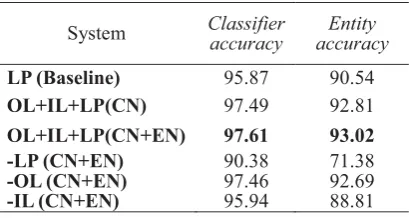
SVM classifier, in which we use out-links (OL) and in-links (IL) as features. Further, the link probability (LP) is used as a feature to balance the system performance between rare and common entities. To inspect the effectiveness of the augmentation method and these modules in more detail, the baseline and the combinations of the three main modules, OL, IL, and LP, evaluated in our experiments are described as follows:
LP: We train the SVM model using only link probability, and we use this model as baseline.
OL+IL+LP (CN): The full model trained using out-links, in-links, and link probability without augmentation.
OL+IL+LP (CN+EN): The most complete version of proposed system, using all features and augmentation process.
-LP (CN+EN): The full model with augmentation minus the link probability feature. -OL (CN+EN): The full model with augmentation minus the out-links feature. -IL (CN+EN): The full model with augmentation minus the in-links feature.
4.3
Evaluation Results
In this section, we report the evaluation results of the experiments on the methodology described in the previous chapter. Table 4. shows the results evaluated on the testing data consist of 2965 <query term, context>.
Table 4. The evaluation results of different systems
System Classifier accuracy accuracyEntity
LP (Baseline) 95.87 90.54
OL+IL+LP(CN) 97.49 92.81
OL+IL+LP(CN+EN) 97.61 93.02
-LP (CN+EN) 90.38 71.38
-OL (CN+EN) 97.46 92.69
-IL (CN+EN) 95.94 88.81
classification strategy can effectively return the most compatible entity to a given query term. As identified in previous related research (Milhacea et al., 2007; Milne et al., 2008), the baseline LP is extremely effective for determining suitable English Wikipedia articles for ambiguous query terms, in our experiment performed using Chinese Wikipedia, this is also the case.
Comparing the two full models (i.e. OL+IL+LP), the results on CN and CN+EN indicate that our augmentation process provides a small performance improvement. Although the augmentation process does not greatly improve the performance, we perform 10-fold cross validation on another test set consisting of 3001 <hyperlink, article> pairs and found that the performance gain is statistically significant.
In general, there is no significant difference between average number of in-links and
out-links, so the number of links does not explain this phenomena. We suggest that in Wikipedia, in-links reflect topics that mention an entity, while out-links reflect context terms of a certain entity. Since topics are more stable than context term, the performance influenced by
in-links are stronger.
In sum, our model achieved impressive performance for linking query terms to articles in Chinese Wikipedia. The augmentation process further significantly improve performance.
5
Conclusion and Future Works
Many avenues exist for future research and improvement of our system. For example, more features used in training the classification models could be added to boost system performance. To improve our system, language features such as collocations, N-gram counts, or part-of-speech could be added. Additionally, an interesting direction to explore is to apply our model to cross-language entity-linking. To support cross-language entity-linking, we could also augment the <Term, Entity> pairs described in 3.2.1 using similar augmentation process. Once the augmentation has been done, we could cross-link a term to other knowledge base. For example, ”݀” in Chinese Wikipedia may be linked to “Big Apple”, the nickname of New York city, in English Wikipedia.
In summary, we have introduced a method for linking a <query term, context> pair to an appropriate article in Chinese Wikipedia. Our goal is to improve user experience so that the underlying search system could distinguish between different search intents based on the context. The method involves possible candidates construction, knowledge base augmentation via inter-links, computation of various link similarity measures, and multi-class classification using binary SVM classifier. We have implemented and thoroughly evaluated the method as applied to linking query terms to Chinese Wikipedia articles. In our evaluation, we have shown