CSEIT1835230 | Received : 07 June 2018 | Accepted : 20 June 2018 | May-June-2018 [ (3)5 : 894-899]
© 2018 IJSRCSEIT | Volume 3 | Issue 5 | ISSN : 2456-3307
System Models for the Detection of Wireless Microphone Signals in Noisy
Environment for Cochlear external devices
Prof. Ramesh KDepartment of PG studies in Computer Science, Karnataka State Women’s University, Vijayapur, India
ABSTRACT
In our earlier two research papers we have proposed two‘UART to WIFI modules’ namely IEEE 802.15.4 and BLE 4.0 wireless architectures to establish wireless Communication Among Speech Processor and Transmitter 0f most recent cochlear Implant Naida CI Q90.The two proposed architectures are wireless communication systems which are much prone to adjacent noises hence quality of the voice gets degraded for the CI users.The signal to noise ratio (SNR) is one of the important measures for reducing the noise. Hence we have derived an mathematical expression in the energy detector model which is used to find the detection probability. This theoretical expression is evaluated under various values of
P
faand derived an expression to compute the predetermined threshold. The simulation shows the detection performance of energy detection over non fading AWGN channel in the noisy environment and results for great improvement in the detection performance with increase in SNR. We find good performance of the energy detector even at low SNR. Simulation results closely match with theoretical results. The proposed mathematical analysis in the model can be incorporated to sense the signal from the microphone in wireless CIs and shall be used in a clinical validation in a quiet environment.Keywords : CI, SNR, ROC, AWGN, NRI Response, mapping.
I.
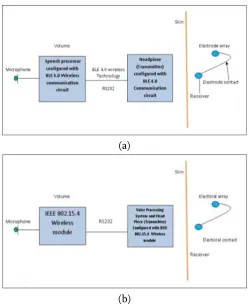
INTRODUCTIONIn recent research, we proposed two wireless architectures[4,5] for wireless communication among external devices ( Speech Processor and Transmitter(Head Piece)) of Cochlear Implants[1] as shown in the figure(1),to overcome some of the practical problems and are described in [4,5]. The architectures are based on the Bluetooth Low Energy BLE 4.0 [5] and other based on IEEE 802.15.4 [4] as shown in the block diagram (fig 2). The Architectures use the ‘UART to BLE 4.0 module’ and are available in local market. The Idea is to configure the Voice processing system and the Head piece (Transmitter) as IEEE 802.15.4 and BLE 4.0 hot spot. Then the proposed modules will connect Voice
Figure 1. External devices of CI
1.1 Thought Process
The proposal is to develop the system for managing wireless communication among external devices i.e Speech Processor and Head Piece (Transmitter) of CI [1]. The system includes first device including a Bluetooth Low Energy (BLE) and IEEE 802.15.4 wireless communication circuit configured to receive and transmit data using both wireless communication technology. The second device including a wireless testers configured to wirelessly communicate with the first device and test the both wireless communication circuit according to a wireless test mode in response to a test command associated with the wireless test mode, the second device including an analysis initiator coupled wireless testers configured to generate the test command in response to a signal requesting a diagnostic analysis of an environment of the wireless communication according to a wireless test mode in response to a test command associated with the wireless test mode, the second device including an analysis initiator coupled to the Low power BLE tester and configured to generate the test command in response to a signal requesting a diagnostic analysis of an environment of the wireless communication, wherein at least one of the first device and the second device includes the Speech Processor and Head Piece (Transmitter) of CI as shown in fig (2).
(a)
(b)
Figure 2 . (a) Proposed Bluetooth Low Power BLE 4.0 wireless module configured for CIs External Devices. (b) Proposed architecture for CIs External Device communication configured with IEEE 802.15.4
II.
System Models for the Detection of Wireless Microphone Signals in Noisy EnvironmentIn the above said Wireless modules i.e IEEE 802.15 and BLE 4.0, External devices (Head Piece and Speech Processor) of CI are communicating wirelessly. The adjacent noise may dominate the signal strength and suppresses the of SNR leading degradation of quality voice. Hence to remove such noises in the received signals and improve the SNR we have developed the mathematical models. Models are illustrated shown as below.
Let y(t)s(t)w(t) be the received signal, where
is the possible transmitted wireless microphone signal and w(t) is additive white Gaussian noise received signals samples under the two hypothesis are therefore, respectively, as follows [13]
the received sampled signal. Two probabilities are of interest. The conditional detection probability Pd
defines at hypothesis
H
1,
H1/y(n) s(n) w(n)
Pd , the probability of
sensing algorithm having detected the presence of the signal; and the conditional false alarm probability
P
fa which defines at hypothesis H0 ,
H
1/
y
(
n
)
w
(
n
)
P
fa
, the probability of sensing algorithm claiming the presence of the signal. Under1
2.1 Energy Detector Model
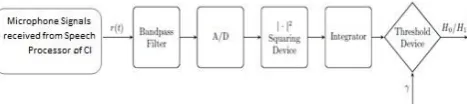
Figure 3. Energy Detector Model
In the model of energy detector the noise and adjacent signals are removed through filtering signal
) (t
y with required bandwidth B [15]. Using analog to digital (A/D) converter the signal filtered through Bandpass filter is sampled and quantized. The energy of the received signal is computed through square-binary hypotheses problem as originally proposed by [6], [7] and latter followed by most researchers [8, 9]. The received signal samples under two hypotheses are defined in equation (1).The energy detector is defined as
H
. The distribution can be expressed as [14]
Its probability density function can be written as
Where the non centrality parameter
NTo derive the probability of detection the probability density function defined under
H
1 in (4) is inserted in (6). By substituting2
n y t
and using definition of
the probability of detection is given by
III.
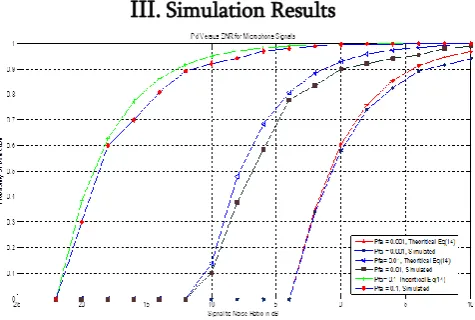
Simulation ResultsFigure 4. Pds versus SNR for microphone Signals
In the simulation, we have collected the signals from the microphone of Q70 and Q90 processors from Advanced Bionics. We have used complementary receiver operating characteristics (ROC) curves
Pmd versusSNR
to show the detectionperformance of energy detection over non fading AWGN channel in the noisy environment. From the figure, we notice that there is a great improvement in the detection performance with increase in SNR. We find good performance of the energy detector even at low SNR. Simulation results closely match with theoretical results. The results are shown in figure 4.
3.1 NRI Response
We also argue that the above mathematical model when included in Advanced Bionics Sound wave software for mapping of Naida Q90 processor from advanced bionics for a severe to profound CI Implanted patient will get the NRI Response [1] by Electrode arrays as shown in the table 1. Which are the NRI Responses from the current architecture of Q90 processor.
Table 1. NRI response from electrode array Electrode
array no’s
Stimulation range in Clinical Units CU
NRI response in micro volts Low to High
3 140 – 260 119 - 533
7 100 – 220 32 - 315
11 180 – 300 74 - 440
15 180 – 300 85 - 366
16 100 – 220 27 - 135
Similarly we also expect various environments responses of the mathematical model when included in the Sound Wave Software, are recorded as shown in the table 2.
Table 2. Environment response by Naida Q70 and Q90 processor
Sl No
Environments Response in
percentage
1 Speech in Quiet 46%
2 Music 21%
3 Speech in Noise 28%
4 Noise 5%
IV.
Conclusion and Future workThe derived expression (14) in the energy detector model can be used to find the detection probability. This theoretical expression is evaluated under various values of
P
fa. Equation (8) can be used to compute the predetermined threshold. To the best of our knowledge, the proposed mathematical analysis in the model can be incorporated to sense the signal from the microphone for the above said wireless modules such as IEEE 802.15.4 and BLE 4.0 for Cochlear Implants which may help us in replacing the wired media. In our upcoming research we are presenting a single circuit design that embeds all the external device of CI in to single IC.V.
REFERENCES1. www.advancedbionics.com
2. Ramesh K . " Wireless Transmission of Sound between Speech Processor and Transmitter for Cochlear Devices" Journal of Advances in Information Technology Vol.8, No.1 Feb 2017.
Cochlear Implant on to a single IntegratedCircuit" IOSR Journal of Computer Engineering (IOSR-JCE) e-ISSN: 2278-0661,p-ISSN: 2278-8727, Volume 18, Issue 4, Ver. III (Jul.-Aug. 2016), PP 14-19.
4. Ramesh k,Sumaya Sanober,Shivanand Lamani,S B Kulkarni "EEE 802.15.4 Wi-Fi Module for Wireless Communication among Speech Processor and Headpiece (Transmitter) of Cochlear Implants, " 978-1-5386-1887-5/17/$31.00 -2017 IEEE.
5. Ramesh k,Sumaya Sanober,Shivanand Lamani "Low Power BLE Module for Wireless Communication among Speech Processor and Headpiece (Transmitter) of Cochlear Implants Conference: Innovations in Computer Science and Engineering of the Fifth ICICSE 2017".
6. H Urkowitz, "Energy detection of unknown deterministic signals," Proceedings of IEEE, vol.55, pp. 523 - 531, April 1967.
7. R Pridham, H. Urkowitz, "Comment on energy detection of unknown deterministic signals," Proceedings of IEEE vol. 56, no. 8, pp. 1379 - 1380, 1968
8. E Axell, E. Larsson, "Optimal and sub-optimal spectrum sensing of OFDM signals in known and unknown noise variance," IEEE
Journal of Selected Areas in
Communications, vol. 29, no. 2, pp. 290 - 304, February 2011
9. E Gismalla, E. Alsusa, "On the performance of energy detection using Bartlett’s estimate for spectrum sensing in cognitive radio systems," IEEE Transactions on Signal Processing, vol. 60, no. 7, pp. 3394 - 3404, July 2012
10. D. Shnidman, "The calculation of the probability of detection and the generalized Marcum Q-function," IEEE Transactions on Information Theory, vol. 35, no. 2, pp. 389 - 400, 1989.
11. S. Andra’s, A . Baricz, Y. Sun, The generalized Marcum Q-function: an orthogonal polynomial approach, Acta Universitatis Sapientiae Mathematica vol.3, no. 1, pp. 60 - 76, 2011.
12. Omar Altrad and Sami Muhaidat "A new mathematical analysis of the probability of detection in cognitive radio over fading channels," EURASIP Journal on Wireless Communications and Networking 2013, 2013-159.
13. Rohitha Ujjinimatad and Siddarama R Patil " Spectrum Sensing in Cognitive Radio Networks with the Known and Unknown Noise Levels," IET Communications, vol. 7, no. 15, pp. 1708 - 1714. October 2013.
14. Rohitha Ujjinimatad and Siddarama R Patil "Mathematical Analysis for the Detection of Unknown Signals in Cognitive Radio Networks Over Wireless Communication Channels," IET Journal of Engineering, Volume 2014, Issue 08, p. 445-449, DOI: 10.1049/joe.2014.0173, August 2014
15. Rohitha Ujjinimatad and Siddarama R Patil Signal Detection in CR Networks Over AWGN, Nakagami-m and Nakagami-q Channels, " Eleventh IEEE International Conference on Wireless and Optical Communications Networks," WOCN2014, Vijayawada.