Computational Linguistics and Chinese Language Processing
Vol. 22, No. 1, June 2017, pp. 53-94 53 The Association for Computational Linguistics and Chinese Language Processing
An Approach to Extract Product Features from
Chinese Consumer Reviews and Establish Product
Feature Structure Tree
Xinsheng Xu
, Jing Lin
, Ying Xiao
and Jianzhe Yu
Abstract
With the progress of e-commerce and web technology, a large volume of consumer reviews for products are generated from time to time, which contain rich information regarding consumer requirements and preferences. Although China has the largest e-commerce market in the world, but few of researchers investigated how to extract product feature from Chinese consumer reviews effectively, not to analyze the relations among product features which are very significant to implement comprehensive applications. In this research, a framework is proposed to extract product features from Chinese consumer reviews and construct product feature structure tree. Through three filtering algorithms and two-stage optimizing word segmantation process, phrases are identified from consumer reviews. And the expanded rule template, which consists of elements: phrase, POS, dependency relation, governing word, and opinion, is constructed to train the model of conditional random filed (CRF). Then the product features are extracted based on CRF. Besides, two index are defined to describe product feature quantitatively such as frequency and sentiment score. Based on these, product feature structure tree is established through a potential parent node searching process. Furthermore, categories of extensive experiments are conducted based on 5,806 experimental corpuses from taobao.com, suning.com, and zhongguancun.com. The results from these experiments provide evidences to guide product feature extraction process. Finally, an application of analyzing the influences among product features is conducted based on product feature structure tree. It provides valuable management connotations for designer, manufacturer, or retailer.
China Jiliang University
An Approach to Extract Product Features from 59 Chinese Consumer Reviews and Establish Product Feature Structure Tree
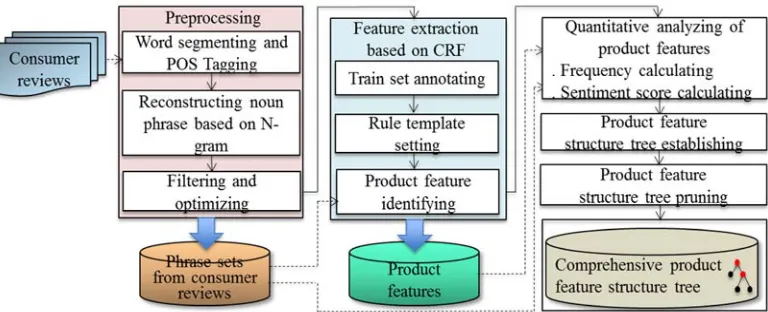
Figure 1. Overview of product feature extraction techniques for Chinese consumer reviews
3.1 Preprocessing Techniques
Preprocessing techniques consist of word segmenting and POS tagging, reconstructing noun phrase based on N-gram, filtering and optimizing.
Phase A Word Segmenting and POS Tagging
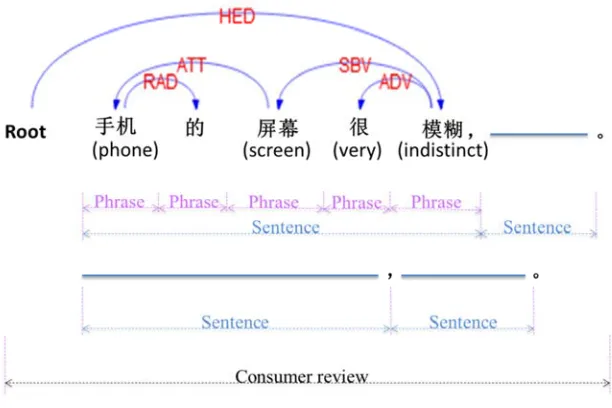
Word segmenting and POS tagging start with the inputting review sentence , and end with the pairs ( , ), where is the th word contained in sentence , and is the POS tagging result of the . For the convenience of presentation and measure, phrase (word), sentence, and consumer review are defined respectively as Figure 2. In this work, the word refers to phrase in general unless there are specific instructions. For the review sentence “手机的屏幕很模糊(The screen of this phone is very indistinct)”, the word segmenting and its POS tagging are as follows: (手机(phone), n), (的2, ude1) , (屏幕(screen), n), (很(very), d), (模 糊(indistinct), a) illustrated in Figure 2. At the same time, the dependency relations among these words and their governing words are also identified through syntactic parsing process based on consumer review (Liu & Ma, 2009; Wang & Meng, 2011; Li, 2013; Dai et al., 2014). The objective of this phase is to divide the review sentences into discrete phrases and annotate its POS tag, and provide the data resource for the next analysis phases.
60 Xinsheng Xu et al.
Figure 2. Word segmenting and its POS tagging for a case
Phase B Reconstructing Noun Phrase based on N-gram
Word segmenting process may generate some incorrect results sometimes. For example, the phrase ”分辨率(resolution)” always be divided into three kinds of independent phrases “分 (divide)”, “分辨(distinguish)”, and “率(rate)”. However, the phrase “分辨率(resolution)” should be a complete phrase for digital product e.g. intelligent mobile phone. Obviously, it is an incorrect result of word segmenting. In order to deal with this problem, it is necessary to recombine these fragmental phrases into its correct form. A reconstruct method based on n-gram is introduced which consists of two steps: (a) Identifying the number n of the n-gram method reasonably; (b) Constructing new phrases according to giving number n. Using as an example and assuming n=3, then new phrases can be generated by recombining it with adjacent words from left and right directions, respectively. For example, the reconstructing
new phrases based on 3-gram method are as follows ( , ,
, , ,
. After this reconstructing process, the phrase “分辨率 (resolution)” that was incorrect segmented will be restored to its correct from. Likeness, all other incorrect segmented phrases can also be restored to their correct forms through this kind of reconstructing process.
An Approach to Extract Product Features from 63 Chinese Consumer Reviews and Establish Product Feature Structure Tree
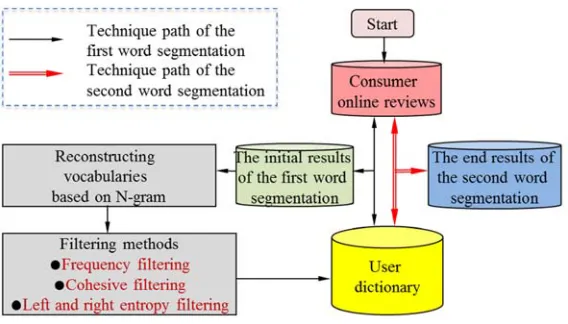
phrases into the user dictionary which is the important evidences of word segmentation process, then the word segmentation process will restart again based on this extended user dictionary. Thus, the process of word segmentation in this work contains two stages which is presented in Figure 3. These two stages can optimize the results of word segmentation to provide valid data resources for the next product feature extraction process.
Figure 3. Two-stages word segmentation process
4.
Product Feature Extraction based on CRF
The CRF (Lafferty, McCallum & Pereira, 2001; Jakob & Gurevych, 2010) is a sequence modeling framework that can solve the label bias problem in a principled way. CRF has a single exponential model for the joint probability of the entire label sequence given the observation sequence which assign a well-defined probability distribution over possible labeling, trained by maximum likelihood or MAP estimation. Therefore, the weights of features at different states can be traded off against each other. CRF perform better than HMMs and MEMMs when the true data distribution has higher-order dependencies than the model, as is often the case in practice (Zheng, Lei, Liao & Chen, 2013; Zhang & Li, 2015). With these considerations, CRF is employed to extract product features from Chinese consumer reviews in this work. The principles of CRF can be described as follows:
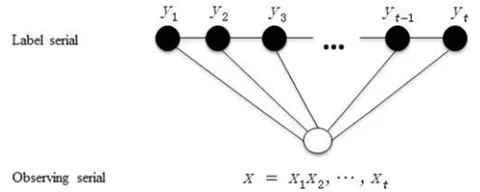
Let is a random variable over data sequences to be labeled. is a random variable over corresponding label sequences. And , , ⋯ , might range over natural language sentences, and denotes the th phrase in . , , ⋯ , range over POS taggings of those sentence s, and is the POS tag of the phrase . It is illustrated in Figure 4. The random variables and are jointly distributed. CRF, with the known observation data sequence , calculate the conditional probability | . As a result, the POS tag sequence that corresponds to the maximum value of the conditional probability
64 Xinsheng Xu et al.
The conditional probability | can be calculated as follows:
| exp ∑ ∑ , , , ∑ ∑ , , (7)
where , , , is the transfer character function. It denotes that the label corresponding to the 1 th element in the observation sequence is , and the label corresponding to the th element in the observation sequence is . , , is the status character function. It denotes that the label corresponding to the ith element in the observation sequence is . and are the weights for the transfer character function and the status character function, respectively.
Figure 4. Undirected graph of conditional random fields
According to the principle of CRF, the process of extracting product feature from the results of word segmentation mainly contains two tasks: annotating train set and designing rule template.
4.1 Annotating Train Set
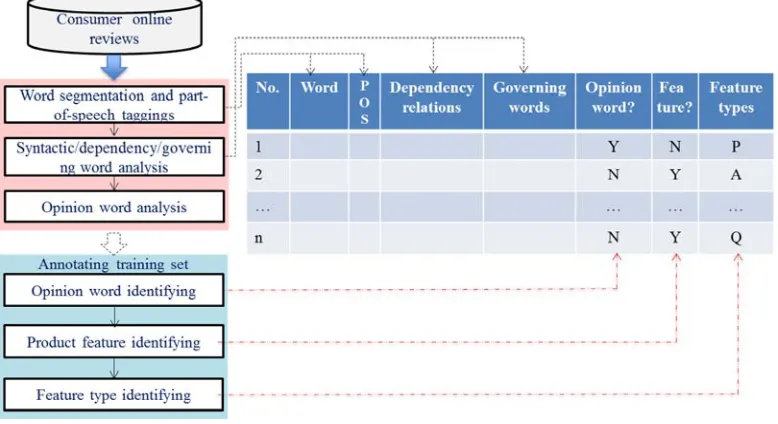
Annotating train set, based on the results of the preprocessing phase including POS tag, dependency relations, and governing words, is to identify the opinion words, product features and their types that is presented in Figure 5.
4.1.1 Opinion Word Identifying
For Chinese language, opinion words may also be other kinds of POSs, not just adjective. For example, Chinese phrase “可以(can)6” is a verb but it may express a positive opinion of
consumer sometimes. This is one of the notable differences between Chinese language and English language. However, these phrases are usually not included in traditional opinion word set. This leads to the inaccuracy of the sentiment analysis for product features inevitably,
6 The phrase “可以” expresses a positive opinion that means “good” in Chinese language. However, its
An Approach to Extract Product Features from 65 Chinese Consumer Reviews and Establish Product Feature Structure Tree
especially for Chinese product features. In order to analyze Chinese product features effectively, it is necessary to identify this kind of opinion words. Table 1 presents these unusual opinion words (partial) based on the analysis for Chinese language at preprocessing phase. Using them, many nouns or noun phrases can be identified and evaluated. This is high significant for product feature extraction from Chinese consumer reviews and its sentiment analysis.
Figure 5. Annotating train set process
Table 1. Unusual opinion words at Chinese consumer reviews
No POS Phrases Sentences
1 v 可以(can), et al. “手机的分辨率还可以”
(The resolution of this phone is good)
2 n 战斗机(fighter), et al. “手机中的战斗机”
(It is a fighter among phones)
… … … …
4.1.2 Product Feature Identifying
66 Xinsheng Xu et al.
4.1.3 Feature Type Identifying
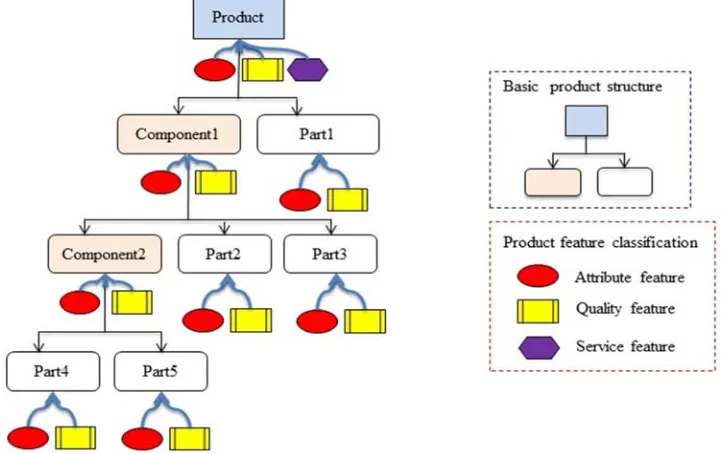
In general, the product features extracted from consumer reviews include contents and types. For example, some product features refer to the product, and some product features refer to the components/parts constituting this product while some product features refer to the attributes of the product or the components/parts. Furthermore, these attributes can be grouped into the function, performance, quality, and service and so on. Distinguishing these product features carefully can help designer, manufacturer, or retailer to insight into the correlation and influence characters among them. It provides evidences for deep comprehensive applications based on product features. Therefore, identifying feature type is very necessary.
Considering the types of product features and their classifications as well as the interrelations among them, a hierarchical structure for product features can be constructed which is presented in Figure 6. This hierarchical structure consists of two parts: basic product structure and the product features describing the attributes of the nodes in basic product structure such as function, quality, and (or) service. Basic product structure consists of root node (product), components, and parts which may also be extracted from consumer reviews and are product features. And the attributed product features including function, quality, and service are the expanded descriptions to corresponding product, component, or part. This product feature structure tree connects the attributed product features with corresponding product, component or parts. It is the foundation for implementing deep comprehensive applications based on product features.
68 Xinsheng Xu et al.
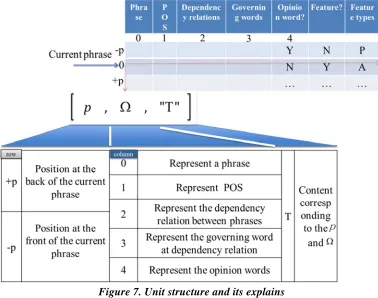
Figure 7. Unit structure and its explains
Figure 8. Combination forms of the elements and its implication
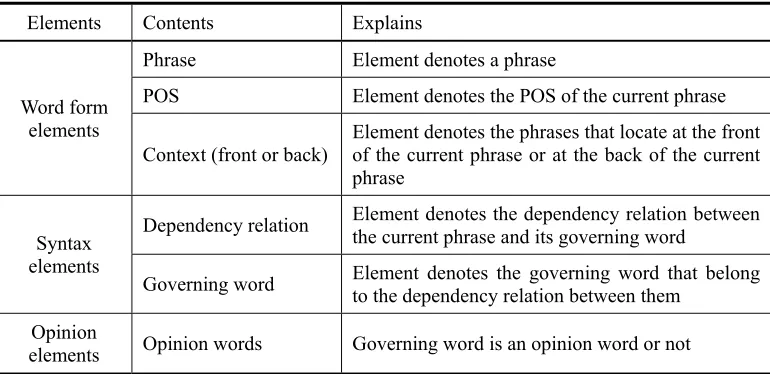
There are mainly three kinds of combination forms in this work namely phrase + opinion
word, POS + opinion word, and dependency relation + governing word. The combination
An Approach to Extract Product Features from 69 Chinese Consumer Reviews and Establish Product Feature Structure Tree
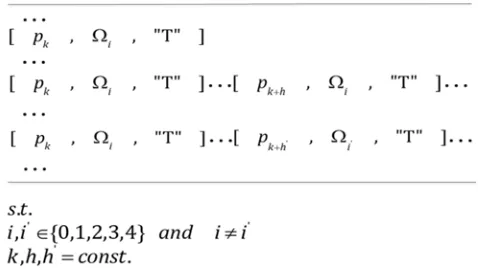
between two phrases and what is the governing word of this dependency relation. These combination utilizations of the elements, together with their sole utilizations, form a complex architecture of rule template which is illustrated in Figure 9. Based on it, product feature extraction for specific task can be achieved well.
Figure 9. General organization form of rule template
Based on train set and rule template, the models of CRF can be established through in-depth learning process which is presented in Figure 10. This learning process constructs a large amount of function sets which will be used in models to calculate the conditional probability of elements co-occurring with the form of rule unit description at consumer reviews. Then these results are used to calculate the probabilities at the transfer character and those of the state character in Equation (7), respectively.
Figure 10. Training the models of CRF
5.
Quantitative Characters of Product Features
70 Xinsheng Xu et al.
of product feature and the sentiment score of product feature which reflect the extent of consumer paying attention to them, and the positive or negative feeling of consumer for them, respectively.
5.1 Frequency of Product Feature Occurring at Consumer Reviews
The frequency of product feature occurring at consumer reviews reflects the extent of customer paying attention to it. For example, consumer maybe like a product feature very much or disappoint very much when the frequency of it is very high. The frequency of a product feature occurring at consumer reviews is generalized as follows:
_ ∑ (8)
where denotes the number of all consumer reviews. denotes the number of the th product feature appearing at the th consumer review. _ denotes the frequency of the
th product feature occurring at consumer reviews.
5.2 Sentiment Score of Product Feature
Generally, the evaluation of consumers to a product feature is either positive or negative, and its strength is different as well. How to describe this kind of distinguishes and how to measure its strength are very important to insight into the preference of consumers precisely.
After analyzing 3,000 consumer reviews, we find that the language pattern of consumer evaluating a product feature is mainly manifested as follows:
., ., (9)
where denotes a product feature. . denotes the adjective that modifies product feature . And . denotes the adverb that modifies the adjective .. The adverb . and the
adjective . modify the product feature together.
The adverb . and the adjective . that modify the product features are always
qualitative descriptions at consumer reviews. In order to describe the strengths of these adjectives . and their polarity as well as those of adverb . for the goal of calculation
and comparison, the adjective . and the adverb . should be transformed to numerical
value according to their strength and polarity. In this work, the adjective . is defined as the range [-9, +9], and the adverb . is also defined as the range [-9, +9]. From 1 to 9,
72 Xinsheng Xu et al.
existing product structure and used as frame, and the nodes of it are also the potential parent nodes for attributed product features. It needs to be noted that the nodes of the basic product structure should also the product features extracted from consumer reviews. Therefore, the key effort of constructing product feature structure tree is to find corresponding parent nodes for each attributed product feature from the results of word segmentation, and compare the corresponding parent nodes with the nodes of basic product structure.
6.1 Finding Potential Parent Node for Current Product Feature
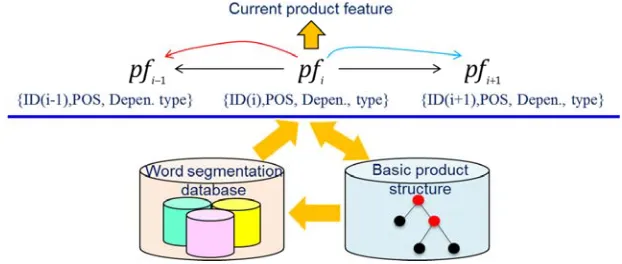
The potential parent nodes of current product features are always the parts, components, or even product. They are noun phrases. And they always co-exist with these attributed product features. Besides, considering the expression habits of Chinese consumer reviews e.g. some consumers may mention the parts or product first when they comment an object, and then evaluate its attributes for example “照相机的像素太低(The pixels of the camera is too poor)” while some other consumers may evaluate the attributes of the parts or product first, and then mention the parts or product for example “续航时间长(long battery life),电池杠杠的(the battery very good)”. Thus, keeping the current product feature as a central point, the process of finding potential parent node for current product feature is to search the phrase that satisfies with specific POS and type requirements, or the dependency relation with current product feature based on given step-length from left and right direction illustrated as Figure 11. The pseudo-code description for the algorithm of finding potential parent node for current product feature is presented in Figure 12.
Figure 11. Principle of finding the parent nodes for current product features
An Approach to Extract Product Features from 73 Chinese Consumer Reviews and Establish Product Feature Structure Tree
Figure 12. Pseudo-code of finding potential parent node
6.2 Similarity between Potential Parent Nodes and the Nodes of Basic
Product Structure
It is necessary to confirm whether a potential parent node of the current attributed product feature exists at basic product structure or not before adding the attributed product features into basic product structure. Comparing the similarity between the potential parent nodes and the nodes of basic product structure is a valid measure. Considering the characters of Chinese language, the similarity between the potential parent nodes and the nodes of basic product structure is calculated from two aspects: literal similarity and context similarity.
6.2.1 Literal Similarity
74 Xinsheng Xu et al.
similarity between potential parent nodes and the nodes of basic product structure can be calculated through the status of words appearing at these nodes (product features) namely literal similarity which is influenced by two factors: quantitative and position (Wang, Zhou & Sun, 2012).
Let and are two product features that the similarity between them need to be calculated. The literal similarity , between and is generalized as follows (Xia, 2007; Wang et al., 2012):
, α | | | , | | | | , | /2
β ∑ ,
∑
∑ ,
∑ /2 (12)
and 0 , 1 .
where α and β are the weights that describe the importance of quantitative factor at the literal similarity calculation and the importance of position factor at the literal similarity calculation respectively, and α β 1. In addition, defines the ratio of the number of words at these two product features.
min || ||,|| ||
, denotes the weight of the th word of the product feature .
, , if at ,
0,
where | | and | | denote the number of words at product feature and product feature , respectively. denotes the th word of product feature .
, denotes the set of the words that are contained in both product feature and product feature at the same time. | , | is the number of the set
, .
6.2.2 Context Similarity
An Approach to Extract Product Features from 75 Chinese Consumer Reviews and Establish Product Feature Structure Tree
Each product feature is described as a dimensional vector.
, , ⋯ , , ⋯ , (13)
where is the co-occurrence frequency between product feature and the th modified phrase.
Thereupon, the similarity calculation among product features is transformed into the similarity between two vectors. It is generalized as follows (Tu et al., 2012):
, ∑
∑ ∑ (14)
where denotes the co-occurrence frequency between product feature and the th modification phrase. denotes the occurrence frequency of product feature and the
th modification phrase. is the total number of the modification phrases in an existing group. And , is the similarity between product feature and product feature
.
An Approach to Extract Product Features from 77 Chinese Consumer Reviews and Establish Product Feature Structure Tree
product features that are extracted based on our two-stage optimizing word segmentation from
taobao.com, suning.com, and zhongguancun.com respectively (taobao:98.39%,
suning:95.97%, and zhongguancun:97.65%.). Obviously, the correct ratios of red rectangle are all higher than those of black rectangle.
Furthermore, we also calculate the average correct rate of word segmentation based on the total data from taobao.com, suning.com, and zhongguancun.com which is illustrated in Figure 15. The correct rate is also increased by 6.16%. Therefore, it is very necessary to implement two-stages optimizing word segmentation in order to increase the correctness of Chinese consumer reviews and provide valid data sources for product feature extraction.
Figure 14. Correct rates of two word segmentation methods for three data sources
7.2 Contents of Rule Template
78 Xinsheng Xu et al.
Figure 15. Correct rates of two word segmentation methods for total data
An Approach to Extract Product Features from 79 Chinese Consumer Reviews and Establish Product Feature Structure Tree
We found that the precision, recall, and F-score corresponding to the 7th rule template are
90.86%, 93.8%, and 92.31%, respectively. These are comprehensive optimal comparing with those of product feature extraction processes based on the other 9 rule templates. Thus, the rule template for CRF in this work will be established according to the 7th rule template.
7.3 Widths of Searching Window
Consumer reviews are always irregular expression because the purpose of consumer commenting on products at network platform is to exchange and share information. Especially for Chinese language, its complex syntax, grammar and diversified expressions make it more serious. Therefore, a proper search range is very important in order to find the valid phrases which are correlated with the current object.
With these considerations, three widths of searching window which had been described in Figure 11 are designed such as 3, 5, and 7 respectively to extract the potential parent nodes for current product features. We also employ precision, recall and F-score to measure the effectiveness of finding potential parent node at different widths of searching window, and the results of them are presented in Figure 17. It can be seen that the comprehensive result is the optimal when the width of searching window is 5 although the recall of it increases continuously along with the increasing of width. The precision and F-score will be decreased once expanding the width of searching window when the potential parent node cannot be found at given range. The reason is that the phrases that are found at expanding range maybe satisfy with the constraint conditions defined at our searching algorithms such as POS or rules, it may not correlate with the current product feature at all. Thus, it decreases the precision and the F-score in the end.
80 Xinsheng Xu et al.
Figure 17. Precision, recall, and F-score under different widths of searching window
An Approach to Extract Product Features from 81 Chinese Consumer Reviews and Establish Product Feature Structure Tree
Moreover, the exact coverage regions of searching window may also be different even for the same width of searching window. Using the width 5 of searching window as example, three forms of coverage regions are presented in Figure 19. Accordingly, the efficiencies of searching potential parent nodes are evaluated through precision, recall, and F-score which are presented in Figure 20. The form of coverage region in Figure (19-2) corresponds to a better result. Therefore, the practical searching range and its coverage region are set based on this result in the case study.
(19-1) Searching range [-3, 1]
(19-2) Searching range [-2, 2]
(19-3) Searching range [-1, 3]
Figure 19. Different coverage forms of searching window
These experiments and their results provide the evidences for our research works at word segmentation, product feature extraction, and product feature structure tree constructing. They are very significant for keeping the validity of our proposed methods.
82 Xinsheng Xu et al.
Figure 20. Efficiency of searching potential parent nodes under different forms of coverage regions
8.
Case Study
Consumer reviews contain rich information regarding consumer requirements and preferences. Mining valuable information effectively from consumer reviews can provide evidences for designers, manufacturers, or retailers to implement product improvement or make market strategy. With the rapid expansion of e-commerce businesses based on network platforms and clients, more and more companies have realized the importance of this kinds of utilities. Aiming at Chinese consumer reviews, this section, using intelligent mobile phone xx-F2 as example, is to elaborate the implementations of the principles and methods mentioned above, and the applications based on product features.
84 Xinsheng Xu et al.
with those obtained based on the methods of Jakob’s work (Jakob & Gurevych, 2010) which are presented in Table 4. Obviously, the precision, recall, and F-score of our methods are all better than those of Jakon’s work. It denotes that our methods of extracting product features from consumer reviews are valid, especially for Chinese consumer reviews.
Table 4. Experiment result comparision between our methods and Jakob’s work
Precision(%) Recall(%) F-score(%)
Our methods Jakob’s work Our methods Jakob’s work Our methods Jakob’s work 93.80 86.47 90.86 78.70 92.31 79.63
Based on the product features extracted above and the results of word segmentation, the frequency of each product feature is calculated, so does the sentiment score of it. And the potential parent nodes of the attributed product features are identified based on the Algorithm 1 presented in Figure 12 and the workflow presented in Figure 18. As a result, the attributed product features are added into the basic product structure of product xx-F2. Thus, product feature structure tree for xx-F2 is established which is illustrated in Figure 21. The unit of product feature structure tree is a four tuple: < Fi, frequency, score, Fj > where Fi is parent
node and Fj is child node. Frequency denotes the times of product feature Fj appearing at
consumer reviews. Score denotes the sentiment evaluation of consumer to product feature Fj.
Based on the product feature structure tree and the data on it including frequency and sentiment score, the influence or interaction relations between the parent nodes of product feature structure tree and its child nodes can be inferred conveniently.
In this work, a Bayes theory based application is investigated based on product feature structure tree that is to infer the factors (namely child nodes) of leading to the negative valuations or low sentiment scores of their parent nodes. The mathematic description of this inferring process is as following:
For a Bayes network which is concerned on a set of variables , , ⋯ , , it contains two aspects: ① network structure in which variables are conditional independency, and ② local probability distribution which connects with each variable. Let variable corresponds to a node of Bayes network, and is the parent node of variable , then the probability of child node leading to the low sentiment score of its parent node can be generalized as following.
| | (15)
An Approach to Extract Product Features from 85 Chinese Consumer Reviews and Establish Product Feature Structure Tree
∑ , ,
∑ , (16)
Where , denotes the times of product feature appearing on the sth consumer review. , , denotes the times of product feature appearing on the sth consumer review that has negative evaluating on the product feature .
Figure 21. Product feature structure tree for product xx-F2
And, | denotes the probability that a child node (product feature) being evaluated as negative (described as L) leads to its parent node (product feature) being evaluated as a poor feature (described as N) by consumers. Thus, |
can be generalized as following.
| ∑ , ⋯ , , , , ⋯ , , , (17)
Where , ⋯ , denotes the probability that the child nodes
86 Xinsheng Xu et al.
child nodes being evaluated as positive (H), negative (L), and neutral (M) respectively denotes the probability of parent node (product feature) being evaluated as a poor feature (described as N) when the child node (product feature) is evaluated as negative (described
as L) namely .
Using substructure 送 话 器(transmitter), which has a relative low sentiment score according to our statistical results and consists of three child nodes such as 麦 克 风 (microphone), 拾音器(pickup) and 话筒(mike), as example, the correlation matrix between the child node evaluations and the parent node evaluations from consumers is established by experts based on their observations on 3,000 consumer reviews which is presented Table 5. On the basis of this, the influences between parent nodes and their child nodes can be calculated based on formulas (15)-(17). The results shown that the probabilities of a relative low sentiment scores of 送话器(transmitter) causing by its child nodes such as 麦克风 (microphone), 拾音器(pickup) and 话筒(mike) are 0.415, 0.327, and 0.258, respectively. It can be seen that this relative low sentiment score of 送话器(transmitter) is the most likely caused by麦克风(microphone). Thus, designers or manufacturers should improve the麦克风 (microphone) for the future in order to increase the satisfactions of consumers for their products, and gain profit margins under fierce market competition in the end.
Table 5. Observation results of influence among product features
Similarly, the influences among other nodes on the product feature structure tree can also be analyzed in this way. It will provide valuable evidences for the designers, manufacturers, or retailers.
9.
Discussions
94 Xinsheng Xu et al.
Yi, J. & Niblack, W. (2005). Sentiment Mining in WebFountain. In Proceedings of the 21st International Conference on Data Engineering (ICDE 2005), 1073-1083. doi: 10.1109/ICDE.2005.132
Yin, C. X. & Peng, Q. K. (2009). Sentiment Analysis for Product Features in Chinese Reviews Based on Semantic Association. In Proceedings of International Conference on Artificial Intelligence and Computational Intelligence 2009(AICI 09), 81-85. doi: 10.1109/AICI.2009.326
Zhang, H. P., Yu, Z. G., Xu, M. & Shi, Y. L. (2011). Feature-level sentiment analysis for Chinese product reviews. In Proceedings of 3rd International Conference on Computer Research and Development(ICCRD 2011), 135-140. doi: 10.1109/ICCRD.2011.5764099 Zhang, S. & Li, F. (2015). Opinion Target and Polarity Extraction Based on Iterative
Two-Stage CRF Model. Journal of Chinese Information Processing, 29(1), 163-169. [In Chinese]
Zheng, M. J., Lei, Z. C., Liao, X. W. & Chen, G. L. (2013). Identify Sentiment-Objects from Chinese Sentences based on Cascaded Conditional Random Fields. Journal of Chinese Information Processing, 27(3), 69-77. [In Chinese]
Zhou, X. J., Wan, X. J. & Xiao, J. G. (2013). Collective opinion target extraction in Chinese microblogs. In Proceedings of the 2013 Conference on Empirical Methods in Natural Language Processing, 1840-1850.
Zhuang, L., Feng, J. & Zhu, X. Y. (2006). Movie review mining and summarization. In Proceedings of the 15th ACM International Conference on Information and Knowledge Management(CIKM '06), 43-50. doi: 10.1145/1183614.1183625