Design and Data Collection for the Accentological Corpus of the Russian
Language
E. Grishina*, S. Savchuk*, A. Poljakov**
*Institute of the Russian Language RAS, Moscow, Russia**Scientific Technical Centre “Informregistr”, Moscow, Russia
E-mail: [email protected], [email protected], [email protected]
Abstract
Accentological corpus provides a researcher an opportunity to study word stress and stress variation, which are very important for the Russian language. Moreover, Accentological corpus allows studying the history of the Russian language stress development. The research presents the main characteristics of Accentological corpus available at ruscorpora.ru. Corpora size, type and sources of text material, the way it is represented in the corpora, types of linguistic annotation, corpora composition and ways of their effective use according to their purposes are described.
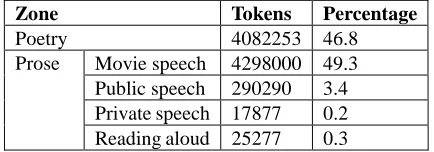
There are two zones in the Accentological corpus. 1) The zone of prose includes oral texts and films transcripts, in which stressed syllables are marked according to the real pronunciation. 2) The zone of poetry contains texts with marked accented syllables, so it is possible to define the exact word stress using special rules.
The Accentological corpus has four types of annotations (metatextual, morphological, semantic and sociological) and also has its own accentological mark-up. Due to accentological annotation each word is supplied with stress marks, so a user can make queries and retrieve the stressed or unstressed word forms in combination with grammatical and semantic features.
1.
Introduction
The interest to the spoken language data is constantly increasing in corpus linguistics, as referred to (Rayson & Mariani, 2009). There are common recommendations and standards concerning preparation and representation of oral texts in the corpus (TEI, EAGLES). Meanwhile each national corpus (British, Czech, Slovak, Russian, American etc.) offers its own way of texts selection and corpus architecture.
As far as the Russian National Corpus is concerned, we have refused the idea of creating a “universal” spoken corpus suitable for all kinds of oral speech study - from phonetic aspects to discourse analyses. That’s why there is not one but three spoken sub-corpora within the RNC, with their own features and spheres of application. These are a) Spoken sub-corpus (Grishina, 2005a; Grishina, 2009a; Grishina & Savchuk, 2009), b) Accentological sub-corpus (Grishina, 2009c) and c) Multimedia Corpus (is under development) (Grishina, 2005b; Grishina, 2009b).
The paper presents the main parameters of the Accentological corpus.
2.
Accentological corpus of Russian
Accentological corpus gives a researcher an opportunity to study word stress. This information is very important for languages with non-fixed stress. The Russian language is one of them. It has a very complicated stress system. Russian stress has the following features: firstly, it is non-fixed, which means any syllable may be stressed(for example, zo′loto ‘gold’, voro′na ‘raven’, boroda′
‘beard’); secondly, it is mobile, which means that it may shift from one part of the lexeme to another as a result of inflexion or word formation (e.g., zo′loto, noun ‘gold’ – zoloto′j, adj ‘gold’, zoloti′t’, verb ‘cover with gold’, pozolo′ta ‘gilding’; ruka′ ‘hand’ (n, f, nom, sg) – ruki′ (n, f, gen, sg), ru′ku (n, f, acc, sg), ru′ki (n, f, nom, pl).
Moreover, the Russian stress system is in the process of rearrangement, and significant accentological changes take place practically under our eyes. Change of accentological system is the main factor of occurrence of stress variation in forms of inflection or derivation. It also causes changing of stylistic evaluation: which variants can be accepted as standard and which are not. That is why normative recommendations given in certain reference books and dictionaries may differ greatly from each other and from actual usage (Mustajoki, 1990). This brings extra difficulties in learning Russian, especially for those who learn it outside Russia.
The researchers using sociolinguistic methods in studying stress variation, for example, in the form of surveys of native speakers come to a conclusion that there are no satisfactory descriptions of Russian stress system because all of them are based on lexicographical sources and reflect recommended usage. So they are far away from what ‘people are actually saying’ (Lagerberg, 2007; Marklund Sharapova, 2000; Ukiah, 2002).
diachronic corpora, which would allow studying the
1900-1949 222343 492150
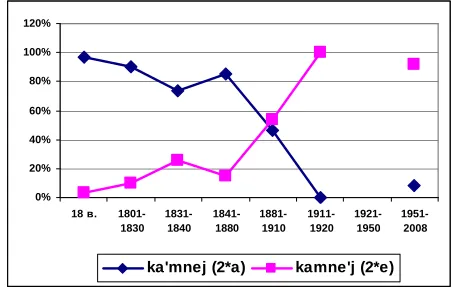
ka'mni, ka'mney) prevailed absolutely in the 18 century. As seen from the diagram, the turning point was the period from 1881 to 1910 when the accent patterns were almost equifrequent. The remarkable leap in the use of the pattern 2*e in 1831-1840 is connected with Mikhail Lermontov who was inclined, as analysis of the system of accents in his poetry shows, to use "progressist" accentological models.
Example 2. It is well known that the word muzyka (music) changed its accent (it was shifted from the second to the first syllable) during the 19th century. It is interesting to find out how it occurred. Because this word was of relatively high frequency in the Russian poetry of the 18th – 20th century, the data we obtain from accentological corpus are representative enough to show that the accent shifting process was a gradual one in this period and the turning point was the first third of the 19th century.
Figure 2: The correlation between stress variants of the word muzyka (music) in different time periods
The process was smooth and gradual as it embraced equally all the cases, as shown in Table 3.
Case form ratio
mUzyk- muzYk-
Total 100 60 40
Nom 38 60 40
Gen 24 43 57
Dat 3 100 0
Acc 12 64 36
Ins 18 69 31
Prep 5 80 20
Table 3: Distribution of stress variants in case forms of the word muzyka (music)
As can be seen from Table 3, significant deviations from the mean values (60% - accent on the first syllable and 40% on the second) are only due to the low-frequency cases of this word (dative and prepositional). Interestingly, the genitive case proved the most "conservative" in accepting the new accent. It should be noted that, as far as this parameter is concerned, I.A.Krylov’s creative work can be regarded as "revolutionary" enough: Krylov never used the stress on the second syllable and therefore was far ahead of his time.
(4) NevEzhda v fIzikE, a v mUzykE znatOk, uslYshal sOlovjA, pojUschegO na vEtke, i khOchets’A jemU imEt’ takOgo v klEtke. [I.A. Krylov. Pavlin I solovej (1788)].
(5) …Khoz’Ain mUzykU l’ubIl i zAmanIl k sebE sosEda pEvchikh slUshat’. [I.A. Krylov. Muzykanty (1807)] A more sudden shift (which occurred at the boundary between the second and third thirds of the 19th century) exhibits a change in accent in the singular masculine of the short form of the adjective sil’nyi (strong) (si’len vs. siljo’n), as it is seen in figure 3.
0% 20% 40% 60% 80% 100% 120%
1730-1759 1760-1799 1800-1829 1830-1859 1860-1930
si'len siljo'n
Figure 3: The correlation between stress variants of the short form of the adjective strong in different time periods
It should be noted again that in Ivan Krylov’s work the replacement of si'len (strong) by sil’on occurred much earlier versus other poets: all examples of sil’on with the accented second syllable in 1760-1829 can only be encountered in Krylov’s texts. (Of course, you can find therein the si'len option too.)
In the near future the expansion of the Corpus size and the increase of text variety are expected. According to this plan poems of the 1st half of the 20th century will be included to the zone of poetry. The zone of prose will be replenished with the texts belonging to different spheres of spoken communication and created in various time periods. We can mention academic lectures, interviews and TV talk-shows, sports comments, sermons, political speeches, narratives, private conversation etc.
3.
Acknowledgements
This work was supported by: Fundamental Research Programs of Branch of History and Philology RAS “Genesis and coordination of social, cultural and language communities”; “Text in sociocultural environment: levels of historical, literary and linguistic interpretation”; Presidium RAS Fundamental Research Program (project “The Russian language of the 18th century: corpus-based study of lexical and morphological variability”); RFBR (grant 08-06-00371-а).
References
Andrews, Edna (2001). The Russian Reference Grammar. Available at: http://www.seelrc.org:8080/grammar/ 0%
20% 40% 60% 80% 100% 120%
1730-1759 1760-1799 1800-1829 1830-1899 1900-1959
muzYk-mainframe.jsp?nLanguageID=6
Grishina, E.A. (2005a) Ustnaja rech v Natsional’nom korpuse russkogo jazyka. In Natsionalnyj korpus pusskogo jazyka: 2003–2005. Rezul’taty i perspektivy. Moscow. Available at: http://docs.google.com/ View?id=df52fjjj_12fcbpqbdq
Grishina, E.A. (2005b) Dva novych projekta dl’a Natsional’nogo korpusa russkogo jazyka: multimedijnyj podkorpus i podkorpus nazvanij. In Natsional’nyj korpus pusskogo jazyka: 2003–2005. Rezul’taty i perspektivy. Moscow. Available at: http://docs.google.com/View?id=df52fjjj_13fhtjh5ct Grishina, E.A. (2009a) Natsional’nyj korpus russkogo
jazyka kak istochnik svedenij ob ustnoj rechi. Rechevyje tekhnologii, 3. Available at: http://docs. google.com/View?id=df52fjjj_34g9d9w2dg
Grishina, E.A. (2009b) Multimedijnyj russk’ij korpus: problemy annotatsii. In Natsional’nyj korpus pusskogo jazyka: 2006-2008. Novyje rezul’taty i perspektivy. SPb: Nestor-Istorija. Available at: http://docs.google.com /View?id= df52fjjj_363wxt76dk
Grishina, E.A. (2009c) Korpus “Istorija russkogo udarenija” In Natsional’nyj korpus pusskogo jazyka: 2006-2008. Novyje rezul’taty i perspektivy. SPb: Nestor-Istorija. Available at: http://docs.google.com/ View?id=df52fjjj_37ghmg36cb
Grishina, E.A., S.O. Savchuk (2009) Korpus ustnyh
tekstov NKRJa: sostav i struktura. In Natsional’nyj korpus pusskogo jazyka: 2006-2008. Novyje rezul’taty i perspektivy. SPb: Nestor-Istorija. Available at: http://docs.google.com/View?id=df52fjjj_39gh8wsffv Kerek, E., P . Niemi. Russian orthography and learning to
read. In Reading in a Foreign Language, April 2009, Vol. 21, No. 1, pp. 1–21.
Lagerberg, R. (2007). Variation and Frequency in Russian Word Stress. ASEES, Vol. 21, Nos. 1-2 (2007), pp. 165-176
Marklund Shaparova, E. (2000). Implicit and Explicit Norm in Contemporary Russian Verbal Stress. Uppsala: Uppsala University (Acta Universitatis Upsaliensis. Studia Slavica Upsaliensia).
Mustajoki, A. (1990). Unifitsirujuts’a li chislovyje podparadigmy udarenija russkich suschestvitel’nych na –a? In Wiener Slawistischer Almanach, 25/26, pp. 311-326.
Rayson, P., J. Mariani. (2009) Visualizing corpus linguistics. In Corpus Linguistics 2009. 20-23 July 2009. Abstracts, p. 201. Liverpool.
Ukiah, N. (2002). The stress of Russian nouns in –a and –я of Zaliznjak’s pattern f (губа’ type). Australian Slavonic and East European Studies, 16/1-2, p. 1--39. Zaliznyak, A. (1977/2003) Grammaticheskij slovar’