A New Twitter Verb Lexicon for Natural Language Processing
Jennifer Williams, Graham Katz
Department of LinguisticsGeorgetown University, Washington, DC., USA E-mail: [email protected], [email protected]
Abstract
We describe in-progress work on the creation of a new lexical resource that contains a list of 486 verbs annotated with quantified temporal durations for the events that they describe. This resource is being compiled from more than 14 million tweets from the Twitter microblogging site. We are creating this lexicon of verbs and typical durations to address a gap in the available information that is represented in existing research. The data that is contained in this lexicon is unlike any existing resources, which have been traditionally comprised of literature excerpts, news stories, and full-length weblogs. This kind of knowledge about how long an event lasts is crucial for natural language processing and is especially useful when the temporal duration of an event is implied. We are using data from Twitter because Twitter is a rich resource since people are publicly posting real events and real durations of those events throughout the day.
Keywords: NLP, natural language understanding, temporal reasoning
1. Introduction
We describe in-progress work for the creation of a new lexical resource that contains a list of verbs that are annotated with quantified temporal durations for the events that they describe. This lexical resource is being compiled from more than 14 million tweets from the Twitter microblogging site. We are creating this lexicon of verbs and typical durations to address a gap in existing research (Pan et al., 2011; Kozareva & Hovy, 2011; Gusev et al., 2011).
The data that is contained in this lexicon is unlike any existing resources, which have been traditionally comprised of literature excerpts, news stories, and full-length weblogs. One of the advantages of using data from Twitter is that tweets are very short. Twitter limits the length of each tweet to be less than 140 characters. Users of the Twitter web service are updating their public status regarding their personal or business affairs at all times throughout the day with a simple and short message. In this way, real people are reporting real events and their durations.
In this lexical resource, each verb is annotated with typical duration concerning two kinds of usage descriptions: verbs describing particular events which constitute a single episiode, as in (1), and verbs that describe characterizing events as habits such as in (2):
(1) Had work for an hour and 30 mins now going to disneyland with my cousins :)
(2) I play in a loud rock band, I worked at a night club for two years. My ears have never hurt so much @melaniemarnie @giorossi88 @CharlieHi11
Our data contains events that are commonly mentioned on Twitter and we are especially interested in the tweets that specify how long an event lasts. For example, we
used (1) to find out that a work event can last for an hour and a half, and we used (2) to find out that a work habit can last for years. Making this distinction allows us to report typical durations for events in our collection in terms of habit-describing durations and episode-describing durations.
The kind of knowledge about how long an event lasts is crucial for natural language processing and is especially useful when the temporal duration of an event is implied. Implicit information comes in many forms, among them knowledge about typical durations for events, as well as knowledge about typical times at which an event occurs – we know that lunch lasts for perhaps half an hour to an hour and takes place around noon, a game of chess lasts from a few minutes to a few hours and can occur any time, and so when we interpret a text such as “After they ate lunch, they played a game of chess and then went to the zoo” we can infer that the zoo visit probably took place in the early afternoon.
A wide range of factors influence typical event durations. Among these are the character of a verb's arguments, the presence of negation and other embedding features. For example, eating a snack is different from
eating a meal since these events have different durations. Tweets that describe a negated event, tweets that describe an event as being conditional, and tweets in the future tense were put aside.
events. There are 99,918 tweets identified as habits and 297,032 tweets identified as episodes. We are analysing the duration distributions based on the durations for events and habits that are described by the verbs that we extracted.
Duration distributions that are disaggregated by habit-describing use and episode-habit-describing use are very informative for typical durations. After we had converted all of the durations into seconds, we binned the durations into 10 bins using a log10 scale. We found that a log10 scale is appropriate for the histograms since duration units nicely correspond to each of our bins. The x-axis is labeled such that a duration that is in the range of 100 to 1000 seconds is minutes, a duration in the range of 1001 to 10000 seconds is hours, etc.
Consider Figure 1 and Figure 2, below. In Figure 1, the distribution does not include any information about which durations are associated with habits and which durations are associated with single episodes. In addition, there is no previous work that makes this distinction when reporting typical durations of events.
Figure 1: distribution for search without any habit/episode distinction
In Figure 1, we see that a search event can typically last for hours or years. This kind of double-peak distribution is common in our data as well as previous work. Since our data has been disaggregated into characterizing events (habits) and particular events (episodes), we are able to show that the bimodal distributions exist because there are two kinds of events represented in our data: events that are particular and events that are characterizing. We can see from Figure 2 that a particular search event will typically last for some hours and a characterizing search
habit can go on for for years.
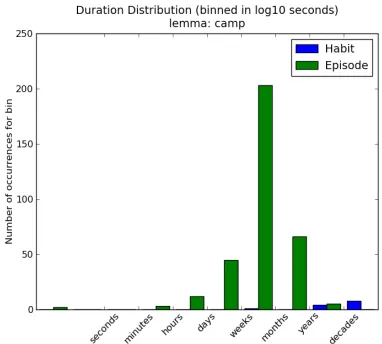
We also found some interesting groups in our collection. In Figure 3, we see that an answer event is most often reported as an episode and less often reported as a habit This is also the case for a camp event, shown in Figure 4. However an achieve event is most frequently reported as a habit, which we show in Figure 5.
Figure 2: duration distribution for search (a single episode can typically lasts for hours but a habit goes on for years)
Figure 3: duration distribution for answer
Figure 5: duration distribution for achieve
Figure 6: duration distribution for boil
Figure 7: duration distribution for discover
When reasoning about events, we can see that a camp
event can take weeks, but a single episode of camping does not take seconds and if it does go on for years or
decades then it is a habit. Consider the event boil. As seen in Figure 6, the event lasts for some short minutes and if a
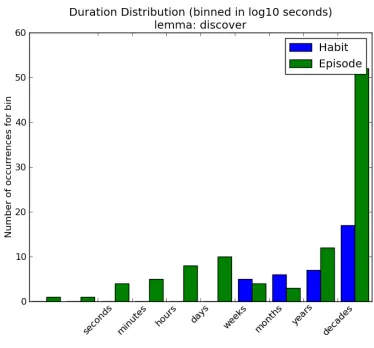
boil event lasts much longer then it is probably describing a habit. An event such as discover shown in Figure 7, can take decades for a single episode. Discover events are interesting because they typically have long episode durations and long habit durations. We know that click
lasts for seconds and can go on for minutes or hours during a particular event. A click event can have a very brief episode duration as well as a very long habit duration, shown in Figure 8.
Figure 8: duration distribution for click
We also analyzed duration distributions by calculating the mean and standard deviation. We report the modes for episode and habit durations in Table 1 for several lemmas, as well as the collection overall.
Verb lemma DurationEpisode DurationHabit
snooze minutes decades
lie hours years
say seconds years
approve minutes years
Overall
Collection minutes years
Table 1. Typical episode and habit durations for events described by verbs
5. Discussion
Our lexicon consists of 486 verbs for which we have collected at least 30 typical durations. For many verbs there is a significant difference between the typical episode length and typical habit length – and our data shows that Twitter users tweet about both.
theoretical research. Information such as what we have assembled for the Twitter Verb Lexicon will allow researchers to begin to address the problems in automatic temporal interpretation that only information about typical durations can solve, such as how to distinguish the interval specified by “shortly after” in “Shortly after I went running, I took a shower” from that in “Shortly after I lost my job, I moved to Colorado.”
6. References
Bird, S., & Loper, E. 2004. NLTK: The natural language toolkit. In Proceedings of 42nd Annual Meeting of the Association for Computational Linguistics (ACL-04). Gusev, A., Chambers, N., Khaitan, P., Khilnani, D.,
Bethard, D., & Jurafsky, D. 2011 “Using query patterns to learn the durations of events”. IEEE IWCS-2011, 9th International Conference on Web Services. Oxford, UK 2011.
Halvorsen, R., & Schierkolk, C. 2010. Tweetstream: Simple Twitter Streaming API (Version 0.3.5)
[Software]. Available from
https://bitbucket.org/runeh/tweetstream/src/
Hobbs, J., & Pustejovsky, J. 2003. “Annotating and reasoning about time and events”. In Proceedings of the AAAI Spring Symposium on Logical Formulation of Commonsense Reasoning. Stanford University, CA 2003.
Kozareva, Z., & Hovy, E. 2011. “Learning Temporal Information for States and Events”. In Proceedings of the Workshop on Semantic Annotation for Computational Linguistic Resources (ICSC 2011), Stanford.
Mathew, T. and Katz, G. 2009. "Supervised Categorization of Habitual and Episodic Sentences”.
Sixth Midwest Computational Linguistics Colloquium. Bloomington, Indiana: Indiana University, 2009. Pan, F., Mulkar, R., and Hobbs, J.R. 2006. “An Annotated
Corpus of Typical Durations of Events”. In Proceedings of the Fifth International Conference on Language Resources and Evaluation (LREC), pp. 77-82, Genoa, Italy.
Pan, F., Mulkar R., and Hobbs, J. R. 2011. "Annotating and Learning Event Durations in Text." Computational Linguistics 37(4):727-752.
M. Moens and M. Steedman. 1988. “Temporal Ontology and Temporal Reference”. Computational
Linguistics. 14(2):15-28.
Williams, J. and Katz, G. 2012. “Extracting and Modeling typical durations of events and habits from Twitter”. In Proceedings of the 50th Annual Meeting of
the Association for Computational Linguistics (ACL),