VERTa: Linguistic Features in MT Evaluation
Elisabet Comelles§, Jordi Atserias‡, Victoria Arranz*, Irene Castellón§
§University of BarcelonaGran Via de les Corts Catalanes, 585 08007 Barcelona, Spain ‡Fundació Barcelona Media
Av. Diagonal, 177 08018 Barcelona, Spain
*ELDA/ELRA 55-57 rue Brillat Savarin
75013 Paris, France
E-mail: [email protected], [email protected], [email protected], [email protected]
Abstract
In the last decades, a wide range of automatic metrics that use linguistic knowledge has been developed. Some of them are based on lexical information, such as METEOR; others rely on the use of syntax, either using constituent or dependency analysis; and others use semantic information, such as Named Entities and semantic roles. All these metrics work at a specific linguistic level, but some researchers have tried to combine linguistic information, either by combining several metrics following a machine-learning approach or focusing on the combination of a wide variety of metrics in a simple and straightforward way. However, little research has been conducted on how to combine linguistic features from a linguistic point of view. In this paper we present VERTa, a metric which aims at using and combining a wide variety of linguistic features at lexical, morphological, syntactic and semantic level. We provide a description of the metric and report some preliminary experiments which will help us to discuss the use and combination of certain linguistic features in order to improve the metric performance.
Keywords: MT evaluation, automatic metric, linguistically-based metric
1.
Introduction
In the MT field, the evaluation of MT systems plays an important role both in their development and improvement. However, human evaluation is expensive and complex, and consequently, in the last decades, a wide range of automatic metrics have been developed, from which the most well-known and widely-spread is the string-based IBM’s BLEU (Papineni et al 2002). However, researchers such as Callison-Burch et al. (2006) and Lavie and Dekowski (2009) have been critical to its performance and have highlighted its weaknesses in relation to translation quality and its tendency to favour statistically-based MT systems. In response to these weaknesses, more sophisticated metrics, most of them linguisticaly-motivated, have arisen. Some of them are based on lexical information, such as METEOR (Banerjee and Lavie, 2011); others rely on the use of syntax, either using constituent (Liu and Hildea 2005) or dependency analysis (Owczarzack et al. 2007a and 2007b; He et al. 2010); and others use semantic information, such as Named Entities and semantic roles (Giménez and Márquez 2007 and 2008a). All these metrics work at a specific linguistic level, but other researchers have tried to combine linguistic information, either by combining several metrics following a machine-learning approach, such as Leusch & Ney (2009) and Albrecht & Hwa (2007a and 2007b); or focusing on the combination of a wide variety of metrics in a simple and straightforward way (Giménez 2008b, Specia and Giménez 2010). However, little research has been conducted on the effect
of the use of linguistic features and how to combine them from a linguistic point of view. Therefore, our proposal is a linguistically-motivated metric which aims at using and combining varied linguistic knowledge at different levels in order to cover the key features that must be considered when dealing with MT evaluation from a linguistic point of view. Our hypothesis is that the use and combination of linguistic features at different levels will help us to provide a wider and more accurate coverage than those metrics working at a specific linguistic level.
In this paper we provide a description of the design and on-going development of the VERTa metric. We detail the modules we are currently using and we report some preliminary experiments which will help us to discuss the use and combination of certain linguistic features in order to improve the metric performance. Moreover, for the sake of comparison, we also add a comparative study between VERTa and other well-known automatic metrics.
2.
Methodology and metric design
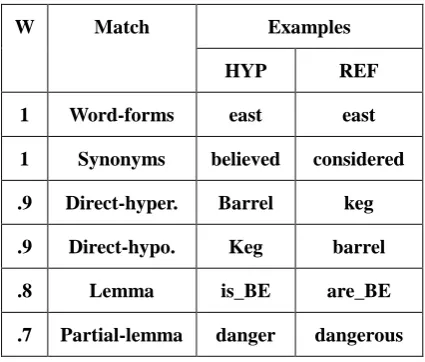
When approaching the design and development of our linguistically-motivated metric, VERTa, we identified several linguistic issues which should be considered when comparing hypothesis and reference segments. These linguistic phenomena can be classified into lexical, phrase and clause level and they affected both syntax and semantics. Therefore, the linguistic knowledge that we intend to use is organised in different layers:WordNet, stemming and paraphrasing. Our linguistic module uses some of these features (word-forms and synonyms) and adds others (hyperonyms, hyponyms, lemmas1 and partial lemmas, i.e. lemmas that share the first 4 letters) in the established order (see Table 1). In addition, we also apply a system of weights (W) on the different matches which are manually established depending on their importance in terms of semantics.
W Match Examples
HYP REF
1 Word-forms east east 1 Synonyms believed considered .9 Direct-hyper. Barrel keg .9 Direct-hypo. Keg barrel
.8 Lemma is_BE are_BE
.7 Partial-lemma danger dangerous
Table 1: Lexical matches and examples
2.2 Morphological Similarity Module
The morphological similarity metric combines lexical and morphological information in order to assess the fluency and well-formation of segments. This metric is based on the matches set in the lexical similarity metric, except for the partial-match, in combination with the Part of Speech (POS) tags from the annotated corpus2. By means of this combination, we can focus more on fluency and compensate the broader coverage that we have in the lexical module; therefore, preventing issues such as stating that invited and invite are positive matches regarding morphology. As a consequence, when assessing MT output in terms of fluency this metric will receive a higher weight, whereas when evaluating adequacy, the weight given to this module will be reduced. This module will be particularly useful when evaluating MT output of languages with a rich inflectional morphology, such as Romance languages.
Following the approach used in the lexical similarity metric, the morphological similarity metric establishes matches between items in the hypothesis and the reference sentence and a set of weights (W) is applied. However, instead of comparing single lexical items as in the previous module, in this module we compare pairs of features in the order established in Table 2.
1 Lemmas and lexical semantic relations are obtained by
means of Wordnet 3.0.
2 The corpus has been POS tagged using the Stanford
Parser (de Marneffe et al. 2006).
2.3 Dependency Similarity Module
The dependency similarity metric works at sentence level and follows the approach used by Owczarzack et al. (2007a and 2007b) and He et al. (2010) with some linguistic additions in order to adapt it to our metric combination. By means of this module we are able to capture changes in word order and similarity between expressions which are comparable in their deep structure but different on their surface. This is illustrated in Example 3 where the adjunct of time on Thursday,
although located differently in the hypothesis and reference segments, still depends on the verb announced, and therefore both segments show the same dependency analysis (Table 3).
Example 3
HYP: ... Putin on Thursday announced that...
REF: Putin announced on Thursday..
HYPOTHESIS REFERENCE
nsubj(Putin, announced) nsubj(Putin, announced) tmod(Thursday,
announced)
tmod(Thursday, announced)
Table 3: Dependency analysis
Both hypothesis and reference strings are annotated with dependency relations by means of the Stanford parser (de Marneffe et al. 2006). The reason why this parser is used is because after conducting an evaluation (Comelles et al. 2010) where the performance of several dependency parsers was assessed (Stanford, DeSR, MALT, Minipar, RASP) this proved to be the best in terms of linguistic quality.
Similarly to the morphological module, the dependency similarity metric also relies first on the matches established at lexical level − word-form, synonymy, hyperonymy, hyponymy and lemma − in order to capture lexical variation across dependencies and avoid relying only on surface word-form. Then, by means of flat triples with the form Label(Head, Mod) obtained from the parser, four different types of dependency matches have been designed as described below:
Complete (CM): Type of match used when the triples are identical, this means that the label, the head and the modifier match.
Label1(Head1,Mod1) = Label1(Head2,Mod2) Example 4:
W Match Examples
HYP REF
1 (Word-form, POS) (he, PRP) (he, PRP)
1 (Synonym, POS) (VIEW, NNS) (OPINON, NNS)
.9 (Hypern., POS) (PUBLICATION, NN) (MAGAZINE, NN)
.9 (Hypon., POS) (MAGAZINE, NN) (PUBLICATION, NN)
.8 (LEMMA, POS) can_(CAN, MD) could_(CAN, MD)
Table 2: Morphological pairs of matches and examples
Partial (PM): Three different types of partial matches are established:
o Partial_no_mod (PM_no_mod): The label and the head match but the modifier does not match
Label1 = Label2 Head1 = Head2 Example 5:
HYP:conj_and(difficult, dangerous) REF: conj_and(difficult, serious)
o Partial_no_head (PM_no_head): The label and the modifier match but the head does not match.
Label1 = Label2 Mod1 = Mod2 Example 6:
HYP: prep_between(mentioned, Lebanon) REF: prep_between(crisis, Lebanon) o Partial_no_label (PM_no_label): The head
and the modifier match but the label does not match.
Head1 = Head2 Mod1 = Mod2 Example 7:
HYP: predet(parties, all) REF: det(parties,all)
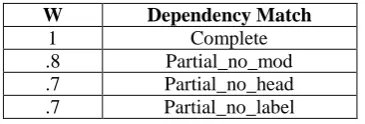
Each type of match is given a weight which ranges from the highest to the lowest weight in the following order:
W Dependency Match
1 Complete
.8 Partial_no_mod
.7 Partial_no_head
.7 Partial_no_label
Table 4: Weight for dependency matches
In addition, a couple of extra-rules have been added in order to capture the similarity between certain structures which are semantically equal but syntactically different. These structures are applied at phrase and sentence level. The former affects modifiers inside the noun phrase and the latter the passive-active voice relation. Regarding the structure inside the noun phrase, we cover the similarity
between an adjective premodifiying a noun and an of-prepositional phrase postmodifying it, as exemplified below.
Example 8:
HYP: ...between the ministries of interior...
REF: ...between the two interior ministries...
The dependency triples obtained when analysing the NP in the hypothesis and reference strings, share the same head and modifier but they do not share the same label: for the NP in the hypothesis we get the triple
prep_of(ministries, interior), whereas for the NP in the reference we get amod(ministries, interior). Although their labels differ, this couple of triples must be considered as an exact match due to their semantic similarity. Otherwise, we would penalise a couple of structures which are equal from a semantic point of view. At a clause level, structures used to express active-passive voice must be under consideration (see Example 9).
Example 9:
HYP: After meeting the Moroccan news agency published a joint statement...
REF: A joint statement published (...) by the Moroccan news agency...
In the hypothesis sentence, the dependency relation between the NP Moroccan news agency and the verb
published is that of nsubj(published, agency), whereas in the reference sentence the relation between the PP by the Moroccan news agency and the verb published is that of
agent(published, agency). Similar to the pair of dependencies dealing with modifiers, although the labels are different (nsubj and agent), both structures must be considered identical regarding their meaning and therefore, the previous couple of triples must be scored as an exact match.
2.4 N-gram Similarity Module
The n-gram similarity module is aimed at matching chunks3 in the hypothesis and reference segments, taking as a starting point the matches obtained at lexical level. Chunks length goes from bigrams to sentence length. The
3 By chunks we understand a group of words that go
Edinburgh, Scotland, UK.
Giménez, J., Màrquez, L. (2007). Linguistic features for automatic evaluation of heterogeneous MT systems. In
Proceedings of the 2nd Workshop on Statistical Machine Translation (ACL), pages 256-264, Prague, Czech Republic.
Giménez J., Màrquez, L. (2008). A smorgasbord of features for automatic MT evaluation in Proceedings of the 3rd Workshop on Statistical Machine Translation (ACL), pages 195-198, Columbus, OH.
Gimenez, J., (2008). Empirical Machine Translation and its Evaluation. Doctoral Dissertation. UPC, Barcelona, Spain.
Giménez, J., Márquez, L. (2007). Linguistic Features for Automatic Evaluation of Heterogeneous MT Systems. In Proceedings of the ACL 2nd SMTWorkshop, Prague, Czech Republic pages 256–264.
He, Y., Du J., Way, A. and van Genabith, J. (2010). The DCU Dependency-based Metric in WMT-Metrics MATR 2010. In Proceedings of the Joint Fifth Workshop on Statistical Machine Translation and Metrics MATR (WMT 2010), Uppsala, Sweden, pages 349-353.
Lavie, A., Denkowski, M.J. (2009). The METEOR Metric for Automatic Evaluation of Machine Translation.
Machine Translation, 23, Springer.
Leusch, G., Ney, H. (2008). BLEUSP, INVWER, CDER: Three improved MT evaluation measures. In NIST Metrics for Machine Translation 2008 Evaluation (MetricsMATR08), Waikiki, Honolulu, Hawaii, October 2008.
Liu, D., Hildea, D. (2005). Syntactic Features for Evaluation of Machine Translation. In Proceedings of the ACL Workshop on Intrinsic and Extrinsic Evaluation Measures for Machine Translation and/or Summarization, Ann Arbor, pages 25–32.
De Marneffe, M.C., MacCartney, B. and Manning, C.D. (2006). Generating Typed Dependency Parses from Phrase Structure Parses. In Proceedings of the 5th Edition of the International Conference on Language Resources and Evaluation (LREC-2006). Genoa, Italy. De Marneffe, M.C., Manning, C.D. (2008). The Stanford typed dependencies representation. In COLING Workshop on Cross-framework and Cross-domain Parser Evaluation, Manchester, UK.
Owczarzak, K., van Genabith, J. and Way, A.. (2007). Dependency-Based Automatic Evaluation for Machine Translation. In Proceedings of SSST, NAACL-HLT/AMTA Workshop on Syntax and Structure in Statistical Translation, Rochester, New York, pages 80– 87.
Owczarzak, K., van Genabith, J. and Way, A.. (2007). Labelled Dependencies in Machine Translation Evaluation in Proceedings of the ACL Workshop on Statistical Machine Translation, Prague, Czech Republic, pages 104– 111,.
Papineni, K., Roukos, S., Ward. T. and Zhu, W. (2002). BLEU: A Method for Automatic Evaluation of Machine Translation. In Proceedings of the 40th Annual Meeting of the Association for Computational Linguistics (ACL02), Philadelphia. PA, pages 311-318. Specia, L., Giménez, J. (2010). Combining Confidence Estimation and Reference-based Metrics for Segment-level MT Evaluation. In the 9th Conference of the Association for Machine Translation in the