CSEIT183323 | Received : 01 March 2018 | Accepted : 09 March 2018 | March-April-2018 [ (3) 3 : 14-28 ]
© 2018 IJSRCSEIT | Volume 3 | Issue 3 | ISSN : 2456-3307
14
Cashless Transactions and Its Impact - A Wise Move Towards
Digital India
Aritra Brahma*1, Rajasi Dutta2
*1Department of Computer Science and I.T (Commerce), Charuchandra College, Kolkata , West Bengal, India 2Department of Commerce, Charuchandra College, Kolkata , West Bengal, India
ABSTRACT
Cashless transaction is the system where the transactions are done without using the physical cash or the means of hard cash. The RBI and the Government of India are making several efforts to reduce the use of cash in the economy by promoting the digital payment devices including prepaid instruments and cards. RBI‘s effort to encourage these new varieties of payment and settlement facilities aims to achieve the goal of a ‗less cash‘ society. This paper focuses on the benefits, prospects and security threats relating to the cashless transactions. It finds that there are several benefits of going cashless like convenience, easy financial transactions, more availability of discounts, decreases money and time etc. Different modes are used for doing cashless transactions. The technology has spread internet banking, mobile banking, prepaid instruments, e-wallets, mobile wallets, credit and debit cards etc., and at the same time, electronic payments system is fast growing. It is expected that its impact will be felt in modernization of payment system in various sectors viz. education, business, economy etc. However, the threat of cyber attacks is the red alert which coincides with the evolution of cashless economy. It seems that while people are getting comfortable with cashless payments, some kind of negative perceptions like security problems, poor network coverage, and lack of merchant willingness, high transactional costs, lack of users‘ knowledge on technology etc. are holding back many from adopting the new system. Though there are some serious threats in the pathway of the implementation of cashless system, but its actual impact is far far-reaching.
Keywords: Cashless society, cashless transaction, electronic payment system, cashless economy, security threats.
I.
INTRODUCTION
A cashless transaction means a transaction where currency notes are not used in monetary transactions. Basically, a cashless transaction indicates a cashless society, which describes an economic state whereby financial transactions are not conducted with money in the form of physical bank notes or coins, but rather through the transfer of digital information (usually an electronic representation of money) between the transacting parties. Cashless societies have existed, based
on barter and other methods of exchange, and cashless transactions have also become possible using digital currencies such as bitcoin.
now set limits on transactions and transaction values for which non-electronic payment may be legally used.
II.
LITERATURE REVIEW
A cashless transaction basically refers to the cashless economy, that defines an economic setting in which goods and services are bought and paid for through electronic media.
The trend towards use of non-cash transactions and settlement began in daily life during the 1990s, when electronic banking became popular. By the 2010s digital payment methods were widespread in many countries, with examples including intermediaries such as PayPal, digital wallet systems operated by companies like Apple, contactless and NFC payments by electronic card or smartphone, and electronic bills and banking, all in widespread use. By the 2010s cash had become actively disfavoured in some kinds of transaction which would historically have been very ordinary to pay with physical tender, and larger cash amounts were in some situations treated with suspicion, due to some specific reasons, and actively prohibited by some suppliers and retailers, to the point of coining the expression of a "war on cash".
According to Alvares, Cliford (2009) in their reports -The problem regarding fake currency in India. It is said that the country's battle against fake currency is not getting easier and many fakes go undetected. It is also stated that counterfeiters hitherto had restricted printing facilities which made it easier to discover fakes.
Jain, P.M (2006) in the article -E-payments and e-banking‖ opined that e-payments will be able to check black -An Analysis of Growth Pattern of Cashless Transaction System. Taking fullest advantage of technology, quick payments and remittances will ensure optimal use of available funds for banks, financial institutions, business houses and common citizen of India. He also pointed
out the need for payments and modes of e-payments and communication networks.
Srinivas, N. (2006) in his study -An analysis of the defaults in credit card payments‖, has tried to analyse the socio-economic profile of the defaulters of credit cards, to identify the set of factors which contributed to such defaults and suggest relevant measures to minimize the default cases. Analysis of reasons indicated that economic hardship is the major reason identified by majority of the sample units follows by rigid payment structure and loss of job/business. The main suggestion is that the banks concerned should redesign the payment structure of credit card defaulters in a flexible and affordable instalment.
By 2016 in the United Kingdom it was reported that 1 in 7 people no longer carries or use cash. The 2016 United States User Consumer Survey Study claims that 75% or respondents preferred a credit or debit card as their payment method while only 11% of respondents preferred cash. By 2017, digital payment methods such as Venmo and Square contribute to cashless transactions. Venmo allows individuals to make direct payments to other individuals without having cash accessible. Square is an innovation that allows primarily small businesses to receive payments from their clients.
III.
OBJECTIVES
The main objectives of this paper are :
To know the benefits of cashless transaction
To discuss the impact of cashless transactions on different sectors
To identify the prospects and security threats related to cashless transactions
IV.
DATA SOURCES
secondary data – the data has been collected from internet sources, articles, newspapers, other sources.
V.
CASHLESS ECONOMY
Cashless Economy can be defined as a situation in which the flow of cash within an economy is non-existent and all transactions must be through electronic channels such as direct debit, credit cards, debit cards, electronic clearing, and payment systems such as Immediate Payment Service (IMPS), National Electronic Funds Transfer (NEFT) and Real Time Gross Settlement (RTGS) in India.
In a cashless economy most of the transaction will be done by digital means like e banking, debit and credit cards, PoS (point of sales) machines, digital wallets etc. In simpler words no liquid money or paper currency will be used by the people in a given country. In a cashless economy the third party will be in possession of your money. He will allow you to transact that money whenever it is needed. If it is not needed then the third party can use that money. Third party can be a government or any other public or private sector bank.
VI.
BENEFITS OF CASHLESS TRANSACTION
Many people from urban areas had supported cashless economy. But in rural areas, where there is very few number of smart phone users are exist and very low coverage and scope of internet access in rural area, there was big trouble for them to go cashless. But still there are some serious benefits of going cashless. Below we have mentioned some of the important benefits which will provide us more emphasis to follow cashless economy.
Convenience
No need to carry bulky notes or coins in a case. Just carrying the required cards or mobile banking will be sufficient.
Ease of Financial Transaction
The ease of conducting financial transactions is probably the biggest motivator to go digital. We will no longer need to carry wads of cash, plastic cards, or even queue up for ATM withdrawals. It‘s also a safer and easier spending option when we are travelling. ―The benefits are enormous if you leave out the low-income group, which will face a huge challenge,‖ says Kartik Jhaveri, Director, Transcend Consulting. ―For the rest of the country, it is constructive and simple. It will be especially useful in case of emergencies, say, in hospitals,‖ he says. Adds Jayant Pai, Head, Marketing, PPFAS Mutual Fund: ―You have the freedom to transact whenever and wherever you want. You don‘t have to be physically present to conduct a transaction or be forced to do so only during office hours.‖
Going Cashless Decreases Crime
No fear of being robbed unlike carrying huge cash and letting everyone know that there could be something worth snatching. In countries like US, the burglary and assault have dropped by about 10% by using the electronic transfer medium for the payments.
Saves Money and Time
Companies and Governments will get efficient and they can reduce costs as they no longer need the manual accounting work to be done. The costs associated with the accounting and handling cash is very high.
Expenditure Management
It becomes easier to determine how much was spent where, and one able to manage the budget.
Reduces Currency Production Cost
Less Cash, More Data
The government can use the data coming from the cashless transactions to improve and analyse their policies. By using such data, officials can predict or identify the pattern of activity and use such information for urban planning for sectors like energy management, housing and transportation.
Avoidance of Currency Rejection
An important issue, though seemingly insignificant issue is that of hygiene of notes will remain good, as there only few cash transaction is required. Plenty of currency notes rejected every year due to something written on it by the user, torn out or being old. Cashless transaction will remove the chance of note rejection due to such purposes.
More Discounts in Digital Transactions
More discount offers in electronic transaction will encourage the users to go cashless.
Service tax : Waiver of service tax of 15% on digital transactions up to Rs. 2,000. Fuel : 0.75% discount on digital purchase of fuel through credit/debit cards, e-wallets or mobile wallets.
Rail tickets : 0.5% discount on monthly and seasonal suburban railway tickets from 1 January 2017. Online rail ticket buyers get up to `10 lakh free accident insurance too. Rail catering : 5% discount on digital payments for railway catering, accommodation, retiring rooms, etc.
Highway toll : 10% discount on NH toll payment via RFID or fast-tags in 2016-17. Insurance : 10% discount by government general insurers on premium paid online via their portals. 8% discount on new LIC policies bought online via its site. POS: Rs 100 a month is the maximum rent that PSU banks can charge for PoS terminals. Rupay : Kisan credit card holders to get RuPay Kisan cards.
VII.
HOW TO GO CASHLESS
The RBI and government have launched several measures for the spread of electronic and other non-cash settlement culture. The Vision-2018 for Payment and Settlement Systems in India brought by the RBI in June 2016 reiterates the commitment to encourage greater use of electronic payments by all sections of society so as to achieve a ―less-cash‖ society.
―The broad contours of Vision-2018 revolve around five Cs — coverage, convenience, confidence, convergence, and cost. To achieve these, Vision-2018 will focus on four strategic initiatives such as responsive regulation, robust infrastructure, effective supervision and customer-centricity,‖ – RBI. The vision statement highlights following plans:
The regulator wants to reduce the share of paper-based clearing instruments
It aims to raise growth of the digital payments space
It wants to ensure accelerated use of Aadhaar in payment systems
Government also made fiscal measures for the encouragement of card culture in the 2016 budget. Exempting service charge on card-based and other digital payments was one such step. Aadhar based payment system will be a big boost for promoting the cashless transaction culture. A committee of seven members, chaired by a ministry official, Neeraj Kumar Gupta was formed to recommend steps for the reduction of cash based transactions.
The technology has spread internet banking, mobile banking, prepaid instruments, credit and debit cards etc. and at the same time, electronic payments system is fast growing. All these indicate that India is moving towards the RBI‘s goal of less cash economy-steady but slowly.
but also to encourage cashless payment. Instead of breaking heads by standing in ATM queue you should adopt a cashless method for the transaction. A cashless method is more transparent as every transaction can be traced easily as it leaves its footprints. Many smart people have adopted new cashless payment options.
Modes of Cashless Transactions Cheque
The cheque is one of the oldest methods of cashless payment. It is a known method to everyone. In this method, you issue a cheque for the specific amount to someone else. The cheque gets deposited in the respective bank. The bank processes a payment through a clearing house.
The entire transaction done through cheque gets recorded and there is a proof of payment. However, there are instances where cheque payments get dishonored due to signature mismatch or insufficient fund. In order to avoid such issue, we can use other cashless payment options.
Demand Draft
Demand draft is another rudimentary way of cashless transaction. It is safest option to receive payment from anyone. Demand draft (DD) never gets defaulted as it is signed by the banker. The disadvantage of DD and cheque is you need to visit a bank in order to deposit cheque and demand draft. The clearance of cheque or DD takes additional time.
Online Transfer – NEFT or RTGS
The third simplest method for the cashless transaction is online transfer using NEFT or RTGS. In order to do online money transfer, you need internet banking facility. Online transfer using NEFT or RTGS is comparatively faster than cheque or DD. Online transfer can be done from anywhere using internet facility.
Credit Card or Debit Card
Credit card or debit card is another cashless payment method. The usage of credit card and debit card was limited in India. However, usage of credit card and debit card is increasing now because of demonetization. The limitation of this payment method is an availability of swipe card facility (PoS) at merchant end.
Internet Banking or Net Banking or E-banking Internet banking accounts are given to every account holder and can be used for payments online these days. Of course, one cannot use an Internet banking account to transfer money when one is buying things across the counter of a shop physically.
For other important payments like utility bills, payment of income tax premiums, online shopping, etc., Internet banking is the best bet.
It saves the hassles of standing in a queue and helps you go cashless in comfort.
E-Wallets
E-Wallet is next cashless payment option. E-Wallet can be used to purchase products starting from grocery to airline tickets. In order to use E-Wallet customer and merchant, both require a smart phone with active internet connection. The most popular example or E-Wallet is PayPal. After registering for E-Wallet you need to link your credit card or debit card with your E-Wallet id. You can use E-Wallet for fund transfer or online shopping. It is simplest cashless method.
Mobile Wallets
UPI Apps
UPI is a mobile payment system which allows you to do various financial transactions on your smartphone. UPI allows you to send or receive money using virtual payment address without entering bank information. Merchants can enroll with banks to accept payments using UPI. Like in the case of a PoS machine, the merchant would require a current account with a bank to accept UPI payments. The examples of few UPI Apps are SBI Pay, Union Bank UPI App, PhonePe, Paytm, MobiKwik etc.
Gift Card
The next cashless payment method is a gift card. Gift card is a readymade card and can be purchased from a merchant or from the bank. The gift card is loaded with a fix cash amount you can purchase any item from the specific vendor by using a gift card.
Aadhaar Enabled Payment System
Aadhaar Enabled Payment System (AEPS) is one of the best cashless payment methods. AEPS is like Micro ATM it uses smartphone and a finger-print scanner for the transaction. In order to use this facility, it is mandatory to link your Aadhaar card to your bank account. You can use AEPS in order to perform transactions like Aadhar to Aadhaar fund transfer, Cash withdrawn, Cash deposit, etc.
Unstructured Supplementary Service Data
You can use USSD cashless option if you don‘t have a smartphone or internet connection. Unstructured Supplementary Service Data is mobile banking service. From any mobile phone, you can dial *99# and use this service. You can do all these things which are available to a person with smartphone and internet connection. Almost including SBI, ICICI, BOB, Axis Bank and PNB supports USSD payment option.
VIII.
IMPACTS OF CASHLESS TRANSACTIONS
The impacts of cashless transactions in the different sectors can be defined as follows.
Business Sectors
The impacts of Cashless Transaction on the Business sector are as following:
Businesses are legally strong.
Proper audit. Not hidden excess liability.
Increase use of e-payment.
Wallet hold business gets an advantage.
Education Sectors
The impact of Cashless Transaction on the education sector is likely to be minimal. Some of the foreseeable fallouts of demonetization on the Indian education sector are as following:
The decision of the central government to withdraw high-value bank notes to curb unaccounted cash will hurt education institutions that accept donations or capitation fees for admissions.
Accepting and accounting donations will become difficult because of the demonetisation drive. Education sector was not immune to the Indian theory of 'you can buy everything with money'. This move of demonetisation will definitely curb this mentality of many in the country.
Nursery admissions, private education institutions and professional higher education including medical and engineering are the segments which accept donations widely. For the first time, these segments are going to feel the impact in a big way.
Private educational institutions take huge of amount of donations in Cash which is 40% to 50% more than the fees of the course. We expect that demonetisation will impact the recipient.
along with donations without a glitch. The donations in medical colleges is usually more than 100% of the fees. Demonetisation will impact both admissions and also the receipt.
MBBS seats is some colleges goes for Rs40 lakh to Rs60 lakh, while MD seats has a range of Rs 2 crore price tag on it. Similarly, engineering and management stream seats have a price tag between Rs 2 lakh to Rs 10 lakh each. This move can change the course of expensive education which can be made more affordable devoid of the capitation fee.
Economic Growth:
The impact of Cashless Transaction on Economic Growth in India is as following:
According to the Bank, India's growth in the first half of FY 2017 was underpinned by robust private and public consumption, which offset slowing fixed investment, subdued industrial activity and lethargic exports.
The medium term may be liquidity expansion in the banking system, helping to lower lending rates and lift economic activity," the World Bank noted.
Impact of Information Technology in Cashless Economy
The impact of Information Technology on in cashless economy in India is as following:
Because of information technology the cost of bank will reduce that will result in lower service charges for customers.
Making Transaction is very easy by using information technology.
New IT Technology like biometric are help to do secure and transparent transaction.
IX.
THREATS TO GOING CASHLESS
To promote cashless digital/online payment is an appreciated move that will help to reduce the use of cash and papers in the economy. While reducing cash transactions in the economy is a wholly
desirable objective, equally important is the need to protect consumers and businesses from frauds that can happen on electronic and digital platforms. There is no such thing as hack-proof technology, as recent high profile security breaches have demonstrated. The threat of cyber attacks is the red alert which coincides with the evolution of cashless economy.
Phishing Attack
An attacker attempts phishing on to a mobile phone through SMS (Short Message Service), text message, telephone call, fax, voicemail etc. with a purpose to convince the recipients to share their sensitive or personal information.
Interception of OTA Transmission
Hackers can also intercept data traffic when it is transmitted over the air (OTA) between a phone and a POS terminal, resulting in security issues like identity theft, information disclosure, and replay attacks.
Mobile Banking Malwares
There have been incidents that involved sophisticated virus infecting banks mobile apps users to steal password details and even thwart two factor authentication, by presenting victims with a fake version of the login screen when they access their legitimate banking application. A key vector by which the mobile banking malware get into the mobile device is through malicious applications posing as legitimate applications that users download and then become infected. Emails or text messages asking the user to confirm or provide personal information (Debit/Credit/ATM pin, CVV, expiry date, passwords, etc.) should be ignored.
Malicious Access to Session Token
token should remain confidential. Improper session handling occurs when an app unintentionally shares such session tokens with malicious actors through hacking, thus allowing them to impersonate legitimate users. To avoid such threats, a session token must be kept encrypted within a device‘s memory and should only be shared with the user‘s server module over a secure communication channel.
Outdated OSs and Non secure Network Connections Risk factors such as outdated operating system versions, use of non secure WiFi network in mobile devices allow cyber criminals to exploit an existing online banking session to steal funds and credentials. Thus it's important to be connected only to the trusted networks and to avoid the use of public WIFI networks. More secure and trusted WIFI connections identified as "WPA or WPA2" requiring strong passwords should be use.
Malicious Third-Party Apps
Installing malicious third-party apps on mobile phone and providing elevated access rights to them may result into sensitive information disclosure and loss or corruption of file system and system resources. Thus one should only install apps from trusted hosting platforms and websites, and carefully read the app‘s instructions before installing it and granting it permissions.
Jailbroken or Rooted Devices
This is practiced to gain unrestricted or administrative access to the device's entire file system, at the risk of exposing the device vulnerable to the malicious apps download by breaking its inherent security model and limitations, allowing mobile malware and rogue apps to infect the device and control critical functions such as SMS. Thus the mobile banking app security is exposed to extreme risk on a jailbroken device.
There are also some other problems which stand in the way of India becoming a cashless society. They are as follows.
Network Connectivity
Since the day demonetisation was announced, people are trying to use more of card transactions to save that dreaded trip to the bank and to save the last penny of the hard cash in hand. However, a sudden surge in card transactions has led to connectivity issues. Several people have faced trouble while standing in line to pay for a transaction at a shop when the card machines have stopped working due to an overload on the network. Connectivity issues must be resolved before dreaming about a cashless society.
Internet Cost
The internet cost in India is still substantially high. There is no Wifi at every public places and if people do not get their monthly data packs recharged, there is no way they can be connected to make online payments. Internet connectivity is needed even for the e-wallets. In order to convince people to do cashless transactions, the cost of the internet should be lowered and free WiFi should also be provided at public places.
Charges On Cards, Online Transactions
These are additional charges that are levied by the vendors when they offer an online payment facility. But when the government is suggesting us to go cashless, shouldn‘t this compulsory fee on online transactions be taken off?
Non-Tech-Savvy
While the new generation is glued to their phones and gadgets, computer literacy among the people in the over-50-age group is still low. Not many people are comfortable using computers or mobile phones and depend on their children when it comes to using the gizmos. Before promoting a cashless society, efforts need to be taken to educate people on how to use phones for transactions.
Smart Phone Affordability
most of the population in the country. More affordable options should be launched by the government for people to buy smartphones for cashless transactions.
Lack of Proper Supporting Service
India still lacks when it comes to supporting a mobile society. It is extremely difficult to find a public charging point if the phone battery discharges. Even metro stations or railway stations in the tier one cities do not provide that infrastructure sufficiently.
Not Enough Bank Accounts
Most people still do not have bank accounts. Most often there is just one account per family which also limits the number of cards people can have individually. A family of even four people (say) cannot be dependent on just one card for all household expenditure.
Lack of Proper Internet Access
There are some hilly areas where the Internet connection is not so smooth and frequent. For such areas, it is a serious problem to get or access the Internet connection properly.
Are Banks Ready?
A cashless society needs a proper infrastructure. The banks need to be fully equipped to handle the surge in e-transactions. Infrastructure is also needed in terms of opening more accounts in the banks.
Encourage People to Spend
Spending by cards often encourages people to spend more giving cash by hand helps people keep a check on their expenses but paying by cards gives people a free hand. Not just through credit but even the debit cards give that impression that you can make that payment immediately.
A cashless society is a welcome idea but not without preparation. There is a precursor to taking such steps without which a move such as this would be more harmful that being beneficial. A cashless society, for
now, seems like a distant dream but a less cash society can be appreciated.
X.
FUTURE SCOPES
The future of the going Cashless India looks pretty promising as the response of the country people towards this move of the government and the support towards it is a clear indication that the government‘s move is likely to succeed. The transparency in the economy will increase through the e-commerce transactions and the digital payment gateways which will increase the GDP of the economy. This will increase the creditability of the country and make a rise in investments. This step of cashless is truly going to create ripples of big success. Actually, it is a great time to integrate the cashless practices will be benefitting in the near future.
XI.
CURRENT POSITION OF INDIA IN
CASHLESS TRANSACTIONS
The current position of Cashless India can be defined as follows.
The cash centric informal sectors like agriculture, real estate, etc., have been affected by demonetization. However the experts say that it's a short term scenario and this move will give positive long term consequences.
To bring the economy on track again, government is promoting cashless economy because scrapping of cash needs an alternative to cash.
India's black money has been estimated by the World Bank in 2010 to be worth about one fifth of the GDP. In a country where 90% transactions are carried out on cash basis it was a revolutionary move to transform from cash to cashless transactions.
a revolutionary move to transform from cash to cashless transactions.
Under this scheme, 250 million bank accounts have been opened in two years. As per RBI reports bank branches increased by 5% per year but ATMs, debit cards and card swiping machines have doubled in four years and online transactions have grown 20 times in six years to 2016.
All these data shows a gradual shift towards cashless economy. Demonetization has sped up this transition.
XII.
FUTURE PROSPECTS OF CASHLESS
INDIA
Smooth, simple and secure payment processes will help to bring about behavioural changes and faster adoption of digital payments and banking among un-banked segments. When new players enter the market, each with a slightly different take on the market and with differing business models, the increased competition will help the environment and offer more options for consumers to choose from. A larger pie with more players is definitely good for the changing dynamics of the payments industry, which is still nascent in India.
Indian consumption is still dominated by cash, with cards contributing only 5 per cent of the personal consumption expenditure. In developed countries, 30-50 per cent of spends happen through cards. So there is huge growth opportunity.
The rapid growth of smartphones, Internet penetration and e-commerce is complementing these; card payment volumes have been growing in excess of 25 per cent y-o-y. We expect this trend to continue, aided by the continued increase in debit card activation and usage; debit card transactions have been growing at 31 per cent each year.
Intense competition and strategic collaboration among existing and new market participants like the
payments and small banks and wallets will help scale up acceptance and foster more creativity, innovation and consumer choice. According to him, the future holds exciting times for the payments industry in India, as all stakeholders and regulatory authorities come together to achieve a ―less-cash dependent‖ and eventually ―cashless‖ society.
The credit card industry in India sees greater acceptance among consumers this year. According to Worldline India Card Payment Report 2014-15, the credit card base grew at 9.8 per cent in the past year. Worldline India is a leader in the payment and transactions services in the country. Alternative methods like mobile wallets and prepaid cash cards accounted for 3 per cent of digital transactions. This industry has been growing steadily over the past few years. Card transactions, both by debit and credit cards, are on an upward trajectory. There are interesting dynamics at play in the Indian payments industry.
XIII.
CHALLENGES OF THE
IMPLEMENTATION OF CASHLESS INDIA
The major challenges that are there to establish the cashless economy are.
Financial Inclusion
Lack of Infrastructure
In India there are many areas where bank is still a distant dream. The remote areas are still not having the banks at their door step. People have to move to distant places to have their money transactions in the banks. There are less ATM facilities in the remote areas. Even the ATMs are not fully back up with the electricity and other IT related facilities. It is the chief concern of the government and the banks to come up with the basic and secure infrastructure for the banking services.
Lack of Education
People living in the remote villages and areas of the country are still not educated enough and are not able to operate the banking services effectively. Illiterate people with bank accounts in the country are not even good enough to fill in the bank forms to deposit and withdrawal money. They have to take help of the people in the banks to fill in the forms and get their work done. It has become the prime responsibility of the government to start a campaign in the form of mission to enable the people to discharge their duty by themselves. Lack of education and the poor syllabus done in the schools are the main reasons that they are not able to operate their bank accounts. Furthermore, illiterate and the people with less exposure to such facilities are not able to operate the cards. The people are not aware of the security measures of the PIN number etc. people should be made aware enough so that they can use the basic banking facilities.
Access of Technology
Technology is the backbone to this banking revolution. Technology must be available in all the areas of the country; it means all the banks at the branch level even in the remote area should have the access to the technology. The technology must have all the aspects that can help the individuals to do the things better and effectively. The second major aspect of the technology is that it should be easily handled and used by the people. It is one of the major aspects of the banking that the consumer must
e ware of the technology and should be able to use it effectively for the purpose. The people are not aware of the technology and are not so involved in the use of it.
Large Number of People to be Covered
As discussed earlier, there are large numbers of people that are to be covered. Although many accounts are opened during Pradhan Mantri Jan Dhan Yojna, but many of them are lying dormant. Still forty percent of the India‘s population are not having access to the bank and banking services. It needs a proper penetration into the market to give the services of banking to the people. It is one of the major challenges for the government to include large number of people in the mainstream.
Unwillingness to Join Cashless Moment
Most of the people due to one reason or the other are not willing to join the cashless banking solutions. The major reasons are the sellers are not willing to accept the cards and cheques as the sale through POS terminals and cheque transactions will be accounted for. The other major aspect is that the sellers mostly ask for the transaction fee that makes the things more costly. The only solution to this problem is that if large number of people joins the revolution of cash less payments by virtue of using debit or credit card it will be easier for the banks or service provider to lower the transaction fees and adjust to the normal phenomenon.
Uneven Profile of the Participants
Customer Awareness is Missing
Consumers are not aware about the different aspects of cashless transactions. Service tax, transaction fee, security of the account all matters should be stressed upon so that consumer gets awareness and become an effective party to the mission.
XIV.
CONCLUSION
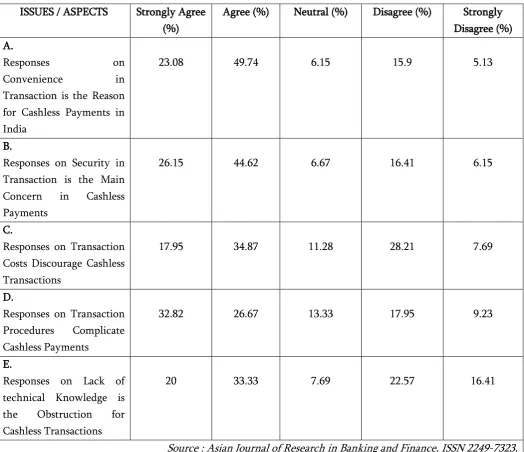
The findings reveal that while people are getting comfortable with cashless payments, some kind of negative perceptions are holding back many from adopting the new system. The negative perceptions are like security problems, poor network coverage,
and lack of merchant willingness, high transactional costs, lack of users‘ knowledge on technology, defunct POS machines, delayed reimbursement in case of failed transactions, procedures and financial limits. Convenience in use of cashless transactions and incentive system are the positive signs for the progress of cashless payments in India. Though there are some serious threats in the pathway of the implementation of cashless system, but its actual impact is far far-reaching.
Some statistical data regarding different activities of Cashless transaction is given below.
Table 1 ISSUES / ASPECTS Strongly Agree
(%)
Agree (%) Neutral (%) Disagree (%) Strongly Disagree (%) A.
Responses on Convenience in Transaction is the Reason for Cashless Payments in India
23.08 49.74 6.15 15.9 5.13
B.
Responses on Security in Transaction is the Main Concern in Cashless Payments
26.15 44.62 6.67 16.41 6.15
C.
Responses on Transaction Costs Discourage Cashless Transactions
17.95 34.87 11.28 28.21 7.69
D.
Responses on Transaction Procedures Complicate Cashless Payments
32.82 26.67 13.33 17.95 9.23
E.
Responses on Lack of technical Knowledge is the Obstruction for Cashless Transactions
20 33.33 7.69 22.57 16.41
Figure 1
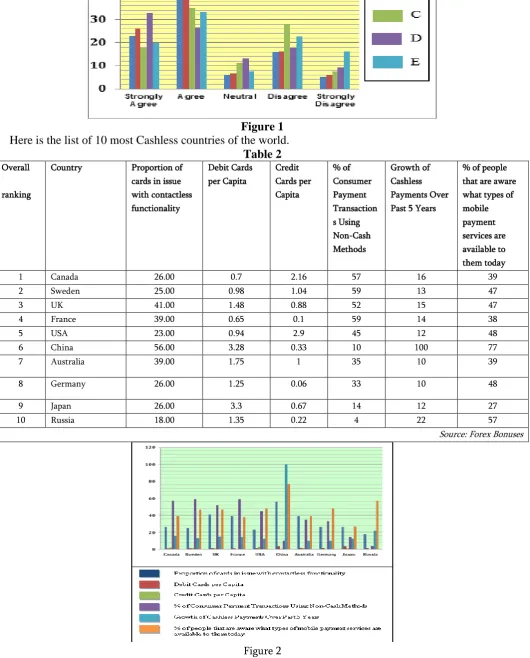
Here is the list of 10 most Cashless countries of the world.
Table 2
Overallranking
Country Proportion of cards in issue with contactless functionality
Debit Cards per Capita
Credit Cards per Capita
% of Consumer Payment Transaction s Using Non-Cash Methods
Growth of Cashless Payments Over Past 5 Years
% of people that are aware what types of mobile payment services are available to them today
1 Canada 26.00 0.7 2.16 57 16 39
2 Sweden 25.00 0.98 1.04 59 13 47
3 UK 41.00 1.48 0.88 52 15 47
4 France 39.00 0.65 0.1 59 14 38
5 USA 23.00 0.94 2.9 45 12 48
6 China 56.00 3.28 0.33 10 100 77
7 Australia 39.00 1.75 1 35 10 39
8 Germany 26.00 1.25 0.06 33 10 48
9 Japan 26.00 3.3 0.67 14 12 27
10 Russia 18.00 1.35 0.22 4 22 57
Source: Forex Bonuses
XV.
REFERENCES
[1]. Prof Mr. Pradeep H. Tawade, "FUTURE AND SCOPE OF CASHLESS ECONOMY IN INDIA", IJARIIE-ISSN(O)-2395-4396, Vol-2 Issue-3 2017, Pg. 177-181.
[2]. N Ramya, D Sivasakthi, M Nandhini, "Cashless transaction: Modes, advantages and disadvantages", IJAR 2017, ISSN (P): 2394-7500, ISSN (O): 2394-5869, Pg. 122-125.
[3]. Dr. M. Anbalagan, M. Gurusamy, "CASHLESS SOCIETY", ACADEMICIA-An International Multidisciplinary Research Journal, ISSN: 2249-7137 Vol. 7 Issue 8, August 2017, Pg. 60-64.
[4]. Avani Rachh, "Security of Online Transactions", Asian Journal of Research in Business Economics and Management, ISSN 2249-7307, Vol. 7, No. 8, August 2017, pp. 230-243.
[5]. Dr. Venkateswararao Podile, P. Rajesh, "Public Perception on Cashless Transactions in India", Asian Journal of Research in Banking and Finance, ISSN 2249-7323, Vol. 7, No. 7, July 2017, pp. 63-77.
[6]. C. Thilagavathy & Dr. S. Naga Santhi, "Impact and Importance of Cashless Transaction in India", International Journal of Recent Research and Applied Studies, ISSN: 2349-4891, Volume 4, Issue 10 (1) October 2017, Pg 1-4.
[7]. Sharad Malhotra, "Impact of Cashless Society for the Economic Growth in India".
[8]. Top 5 Benefits Of Cashless Transaction Web
prepaid payment instruments for you, By Riju
Dave, Hiral Thanawala, ET Bureau| Updated: These Countries That Have Successfully Adopted Digital Payments, Written by Saptarshi Dutta, Edited by Sonia Bhaskar |
Are there any disadvantages too? By, Virendra Sauran, former Teacher Web Link : Dave, ET Bureau, Dec 12, 2016, 06.30 AM IST
Web Link :
https://economictimes.indiatimes.com/wealth/s
pend/going-cashless-is-it-good-for-you/articleshow/55908649.cms
[16]. Why Going Cashless Is Good? Let‘s Understand the Benefits Web Link : https://www.motilaloswal.com/article.aspx/112
1/Why-Going-Cashless-Is-Good?-Lets-Understand-the-Benefits
Link : https://yourstory.com/2017/01/9631339871- cashless-india-importance-implementations-requirements-and-future/
[18]. 4 simple ways to go cashless! Posted on March 26, 2017, 08:00 IST Web Link : http://www.rediff.com/getahead/report/money -4-simple-ways-to-go-cashless/20170326.htm [19]. Pros and Cons of Cashless Economy in India By
Ashwin Honawar on December 7, 2016 Web Link : http://moneyconnexion.com/cashless-economy.htm
[20]. Securing Mobile Banking, CERTIn Advisory CIAD20160070, Indian Computer Emergency Response Team, Ministry of Electronics and Information Technology, Government of India, Original Issue Date: December 06, 2016 Web Link : http://cashlessindia.gov.in/CERT-
In%20Advisory%20Notes-Securing%20Mobile%20Banking.pdf
[21]. Securing cashless India, Published on December 18, 2016Web Link : www.thehindubusinessline.com/opinion/editor ial/securing-cashless-india/article9433188.ece [22]. Deepak Vijayaraghavan Cashless society and
cyber security Oserver Reserach Foundation December 31, 2016 Web Link : http://www.orfonline.org/research/cashless-society-cyber-security/
[23]. Cashless India: Leveraging Possibilities and Facing Security Challenges in the Mobile Space Ajit Singh - February 23, 2017
[24]. Cashless India Web Link :
http://cashlessindia.gov.in/digishala- educational-tv-channel-for-digital-payments-on-dd-free-dish.html
[25]. Cashless India Web Link : http://cashlessindia.gov.in/schemes.html [26]. Rajiv Singh, ET Bureau, Demonetisation: Why
the challenge to take digital payment to rural India is as huge as the opportunity, Nov 27, 2016
[27]. Ramya N , D Sivasakthi, M Nandhini "Cashless transaction: Modes, advantages and
disadvantages" International Journal of Applied Research ISSN Print: 2394-7500 ISSN Online: 2394-5869 January 2017.
[28]. Rajib Singha "11 Tips for Secure Cashless Transactions", December 22, 2016 Web Link : http://blogs.quickheal.com/11-tips-to-do-secure-cashless-transactions/
[29]. Sheetal Thomas & G. Krishnamurthi "Cashless Rural Economy-A Dream Or Reality ? Jharkhand Journal of Development and Management Studies XISS, Ranchi, Vol. 15, No.2, June 2017, pp. 7269-7281
[30]. Rathnakumar Arumugam " Easy ways to protect your cashless economy from the hackers" Web Link : https://securitycommunity.tcs.com/infosecsoap box/articles/2016/12/19/7-easy-ways-protect-your-cashless-economy-hackers December 20,2016