A SEARCH FOR DIFFUSE GAMMA RAYS WITH ENERGIES ABOVE 1014 eV FROM MOLECULAR CLOUDS IN THE GALAXY
C.E. Covanlt, A. Borione, J.W. Cronin, B.E. Fick, L.F. Fortson, K.G. Gibbs, T.A. McKay, B.J. Newport, R.A. OnE, L.J Rosenberg
Enrico Fermi Institute, U. of Chicago, Chicago, IL 60637
M. Catanese, K.D. Green, A. Kennedy, 2. Matthews, D. Nitz, D. Sinclair, J.C. van der Velde Dept. of Physics, U. of Michigan, Ann Arbor, MI 48100
D. Kieda Dept. of Physics, U. of Utah, Salt Lake City, UT 84112 ABSTRACT
Diffuse gamma-rays from molecular clouds are excellent tracers of cosmic rays in the galaxy over a wide range of energies. For example, diffuse emission detected by EGRET already places significant constraints on the spectrum and origin of galactic cosmic rays at GeV energies. Likewise, by measuring diffuse gamma rays with ground-based air shower experiments, we can probe the galactic distribution of cosmic rays in the energy regime above 100 TeV.
The Chicago Air Shower Array (CASA) which operates in coincidence with the Michigan muon array (MIA) is the world's most sensitive experiment to gamma-rays with energies ~ 100 TeV, and is well-suited for studies of diffuse sources based upon the muon content of air showers. We describe a search for diffuse gamma-ray emission from molecular cloud regions observed by CASA-MIA. If we assume that the flux of cosmic rays is uniform in the galaxy, then we predict that diffuse emission will probably be detectable by CASA-MIA within the lifetime of the experiment. Furthermore, if there are sources of cosmic rays in close proximity to certain molecular clouds, then the spectrum of gamma-rays from these clouds will be stronger and harder. By searching for such enhancements in the diffuse emission, and by correlating the CASA-MIA resutts with emission detected at lower energies by EGRET, we may identify or constrain the nature of cosmic rays sources in both energy regimes.
INTRODUCTION
The primary scientific aim of the CASA-MIA experiment has been to investigate the long standing puzzle of the origin of cosmic rays with energies above 1014 eV. While there exist plausible models for generating the cosmic rays with energies below 100 TeV, the origin of ultrahigh energy (UHE) cosmic rays above 100 TeV remains unknown. Large ground-based air shower experiments, such as CASA- MIA, can be used as telescopes to search for UHE gamma-rays from potential sources of cosmic rays. Gamma-ray emission should accompany the acceleration of cosmic rays. And while charged cosmic ray nuclei will be deflected by the irregular magnetic fields of the galaxy, gamma-rays will propagate in a straight line directly from the source. Research in this field has thus far primarily been directed towards searches for continuous, periodic, and episodic gamma ray emission from point sources such as Cygnus X-3 and Hercules X-1. During the early 80's there were several reports by previous smaller experiments that these compact objects might be significant sources of gamma rays at 10 is eV. Unfortunately, no such point sources have been detected by CASA-MIA (in data collected from mid-1989 through April 1991), nor by other large area arrays (such as CYGNUS) operating since the mid-80's. Based upon the CASA-MIA data gathered thus far, we can already conclude that the bulk of the UHE cosmic rays do not originate from a small number of bright galactic point source accelerators (see McKay, st al., 1993). Therefore, we are now pursuing other approaches to study the origin of UHE cosmic rays, including searches for extragalactic sources and a search for galactic diffuse sources.
G a m m a ray emission from diffuse gas clouds is an important tracer of cosmic rays in the galaxy, and can be used to probe the origins of cosmic rays of energies ranging from 100 MeV to 500 TeV or more (e.g., Hunter and Kanbach, 1991). We expect a diffuse flux of gamma rays from regions of concentrated hydrogen gas density, such as the galactic plane and giant molecular clouds. In these regions, the permeating flux of high energy cosmic rays will interact with the gas to produce new hadronic particles, including neutral pions, which subsequently decay into gamma rays.
THE CASA-MIA DETECTOR
W h e n ultrahigh energy (UHE) cosmic rays and gamma-rays strike the upper atmosphere of the earth, they produce large cascades of electromagnetic and hadronic particles. At ground level, the showers consist largely of electrons, photons, and muons. A sparse array of detectors sampling even a fraction of the shower particles can determine the total number of particles in the shower and the arrival direction of the primary particle with reasonable precision. The combination of the Chicago Air Shower Array ( C A S A ) and the Michigan M u o n Array (MIA) comprise the largest and most sensitive such array built to date.
The C A S A experiment consists of 1089 scintillation detectors laid out on a square grid of 1 5 m spac- ing (Figure 1). The experiment is located at Dugway, Utah (40.2~ 112.8~ The total collection area of the experiment is roughly 230,000 m 2.
At the D u g w a y site, beneath C A S A , we have constructed a very large array of buried m u o n counters - the Michigan M u o n A r m y (MIA). This array consists of 1024 scintillation counters buried 3 meters below ground level. The counters are grouped into sixteen Upatches~ and have a total scintillator area
of 2500 m 2.
In showers initiated by cosmic ray nuclei, muons are produced from charged pion and kaon decay in the central hadronlc core. Showers initiated by gamma-rays do not produce muons in significant quantities because the cross section for ~/-alr hadroproduction is much smaller than the cross section for electron-positron pair production ('y-air ~ e+e - ). Extensive simulations predict that the number of muons in 100 TeV gamma-ray showers is twenty to fifty times less than the number in cosmic ray showers of the same energy.
EXPERIMENTAL TECHNIQUE
To search for diffuse concentrations of cosmic gamma rays, we employ the technique developed by Matthews et ~l., (1991). We search for gamma ray emission by looking for a localized excess of cosmic rays which are muon-poor with respect to the number of muons expected from hadron-initiated showers.
Detected muons are fit to a Greisen lateral distribution to determine the total number of muons (muon size) for each shower. We parameterize the muon content by the quantity:
(N~_obs)
R • --- log10 (-N'/~..exp)' (1)
where N~_ob s and N~,_exp represent the m u o n slse actually observed and the m u o n size
ezpected
for hadronic showers. Since most gamma-ray induced showers will have significantly fewer muons, we expect that the R ~ distribution for g a m m a rays will be shifted relative to hadron showers.To determine if there is evidence for g a m m a ray emission from a Iocallzed candidate source region of the sky, we examine the distribution of R ~ for showers within some "on-source" region, and we search for an excess of muon-poor events. The excess is determined relative to some comparison "off-source" region which presumably contains a background of uniformly hadronic showers. To compare the R ~ distributions from source and background regions, we normalize so as to match the total number of events with R ~ > 0.0, assuming that all such events are purely hadronic.
Figure 2 demonstrates the application of this technique to real data for a preliminary analysis presented in Borione et sl., 1993. The R ~ distribution for candidate diffuse source events within the galactic plane (bH = + 5 ~ 50 o < I H < 200 ~ is plotted against the R ~ for the off-source background region. Analysis of residuals, (X~ :1.07, v : 64 d.o.f., see Figure 3) shows no significant difference between the source and background distributions, and gives us confidence that the systematics have largely been removed. Remaining systematic fluctuations are likely due to binning effects which we expect to scale with the statistical errors.
C. E. Covault
et al.
501
CASA-MIA SENSITIVITY TO DIFFUSE EMISSION
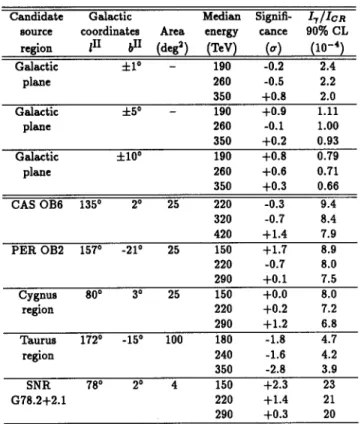
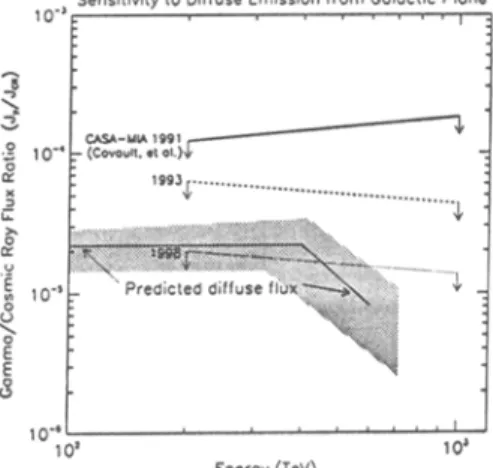
F i g u r e 4 shows the current and projected CASA-MIA sensitivities to diffuse flux from molecular clouds in the plane of the galaxy. Results through 1991 (183 million events) were already reported by Covau]t et al., 1991. Flux sensitivities for 1993 are based on an analysis of over 700 million events, as reported in Borione ei al., 1993. Table 1 shows the current flux limits obtained for several candidate regions. These flux limits represent the most sensitive search for UHE diffuse emission that has been achieved thus far.
The predicted flux limit for 1998 is a conservative extrapolation of the sensitivity achievable over the lifetime of the CASA-MIA experiment, assuming that there are no changes or improvements to the muon rejection system and that there are no unanticipated sources of systematic error. We note that because the muon rejection efficiency increases with energy, the sensitivity of CASA-MIA to diffuse emission is relatively fiat in the region from 200 to 500 TeV.
We predict that during the 5 to 10 year lifetime of the experiment, CASA-MIA is likely to detect the combined diffuse flux from the plane of the galaxy. If there are indeed regions of enhanced diffuse flux, then CASA-MIA may detect this emission in the near future. In fact, CASA-MIA can already rule out a naive extrapolation of the diffuse spectra seen in the COS-B satellite data by Bloemen (1991) and will place strong constraints on any spectral hardening coming from the outer part of the galaxy during the lifetime of the CASA-MIA experiment.
Searches for diffuse emission at 100 TeV are also likely to be improved and complemented by observations of diffuse emission at 1 GeV by the EGRET experiment aboard the Compton GRO spacecraft. In particular, if there are regions of stronger-than-expected diffuse emission at 1 GeV, then these regions may be in proximity to sources of cosmic rays at these energies. If future measurements indicate that enhancements of diffuse emission detected at GeV energies are spatially correlated with enhanced emission at ultrahigh energies then this would be evidence that the sources of cosmic rays within both energy regimes are associated.
The authors acknowledge the help and support of the members of the University of Utah's Fly's Eye Collaboration and the staff of the Dugway Proving Ground. We wish to thank E. McCullen, S. Golwala, M. Kidd, K. Knutson, J. He, P. Rauske and S. Sampson for help in processing the data. We thank F.A. Aharonian for helpful discussions. This work is supported in part by the National Science Foundation, the U.S. Department of Energy. JWC and RAO acknowledge the support of the W.W. Grainger Foundation, and the Alfred. P. Sloan Foundation.
R E F E R E N C E S
Aharonian, F.A., 1991, Ap. Space Sci., 180, 305.
Beresinsky, V.S., and Kudryavtsev, V.A., 1990, Ap. J., 349 820. Bloemen, J.B.G.M. et al., 1084, Astron. Astr., 139, 37. Bloemen, J.B.G.M., 1901, Ap. J., 317, L15.
Borione, A., et al., 1993, 23rd ICRC 1,479. Covault, C.E., et al., 1991, 22nd ICRC, 1,448. Dermer, C.D., 1986, Astron. Astr. 157, 223.
Drury, L., Ahaconian, F.A., and Volk, H., 1993, Astron. Astr. (in press). Hunter, S.D., and Kanbach, G., 1991, 22nd ICRC, 1, 149.
Galsser, T.K., and Stanev, T., 1991, 22nd ICRC,1, 584. Greisen, K., 1980, Ann. Rev. Nucl. Part. Sci., 10, 63. Matthews, J., et al., 1991, Ap. J., 375, 202.
C a n d i d a t e Galactic source coordinates region 1II blI
Median Signifi-
I~/IcR
Area energy cance 90% CL (deg') (TeV) (a) (10-*)Galactic -I"1 ~ - 190 -0.2 2.4 plane 260 -0.5 2.2 350 +0.8 2.0 Galactic +50 - 190 +0.9 1.11 plane 260 -0.1 1.00 350 +0.2 0.93 Galactic +100 190 +0.8 0.79 plane 260 +0.6 0.71 350 +0.3 0.66 CAS OB6 1350 2 ~ 25 220 -0.3 9.4 320 -0.7 8.4 420 + 1 . 4 7.9 P E R OB2 1570 -21 ~ 25 150 +1.7 8.9 220 -0.7 8.0 290 +0.1 7.5 C y g n u s 800 30 25 150 +0.0 8.0 region 220 +0.2 7.2 290 +1.2 6.8 T a u r u s 172 ~ -15 ~ 100 180 -1.8 4.7 region 240 -1.6 4.2 350 -2.8 3.9 SNR 78 ~ 20 4 150 +2.3 23 G78.2+2.1 220 + 1 . 4 21 290 +0.3 20
Table 1: Current results from CASA-MIA on the search for diffuse emission from several candidate regions. No significant excesses have been detected from any candidate source region. Results for t h e galactic plane are t h e m o s t sensitive limits obtained t h u s far. G78.2+2.1 is a supernova r e m n a n t in t h e vicinity of a molecular cloud (See Drury e~ ai., 1993).
C. E. Covault et al.
503
Figure I: The U M C (Utah-Michigan-Chicago) air shower detector facility at Dugway, Utah. Each small point on the regular grid represents one of 1089 surface stations (CASA). Also shown are the underground m u o n counters (MIA) arranged in 16
patches.
Figure 3: Residual differences between source and background distributions events within 5 degrees of the galactic plane. ResiduMs are shown as s ratio of events (top) and in terms of sigma signif- icance differences (bottom) on a bin-by-bin basis. The reduced Chi-squared (X~), is ~ 1.07, indicat- ing that the systematics of the background are not large compared to the fluctuations expected from background statistics alone. There is no evidence of excess muon poor events above a fraction of 10 -4 .
Figure 2: R / ~ -
log(N~(observed)/N~(expected))
distribution for C A S A - M I A ( U M C ) events within 5 degrees of the galactic plane (points with er- rors) compared against the background distribu- tion (solid line histogram). To reduce systematics, the background was sampled only from off-plane events with the same distribution of local sky co- ordinates (As-El) as the source events.
Figure 4: Projected CASA-MIA sensitivity to dif- fuse g a m m a ray emission from the central plane of the galaxy (b11 : 15~ ~ < t~! < 200~ Sensitivities are given in terms of the fraction of g a m m a rays relative to the detected all-particle flux of cosmic rays at the earth. The prediction for the g a m m a ray flux is derived by Aharonian (1901). The C A S A - M I A flux limits (90% confi- dence) are indicated assuming continuous opera- tion of the array.