Laurea Polytechnic
ABSTRACT
Network management capability is of paramount importance for any organization in the era of a network economy. Despite the rapid growth of business network research, effective approaches for systematic network management are still in their infancy. Existing business network literature mostly concentrates on describing the nature of the network around a focal company. This article introduces a systematic approach for managing networksKey Network Management (KNM). A Key Network refers to a set of actors mobilized by the focal company to realize an opportunity. An opportunity is anything that potentially represents or results in value to the company. A company may manage several Key Networks. The KNM approach includes four basic elements: 1) Scanning and analyzing the Opportunity Network, 2) Identifying a manageable Key Network, 3) Strategies for managing actors of the Key Network, and 4) Developing and applying operational level methods for managing actors of the Key Network. Indeed, the KNM-approach is not only focused on using networks to fulfill existing needs, but also on discovering new opportunities and establishing and managing networks to realize these opportunities. Also, this article suggests a framework for KNM practices for effective implementation of this approach.
Keywords: Networks, Key Network Management, Key Account Management
INTRODUCTION
Networks have attracted a great deal of interest among several research traditions. Grandori and Soda (1995) identified a number of different research approaches and perspectives to networks: industrial economics, historical and evolutionary, organizational, negotiation analysis, resource dependence, neo-institutional, social networks, industrial marketing, entrepreneurship, economic policy and law, and population ecology. Being one of the above approaches, the IMP research approach (Håkansson ed. 1982) has provided front-line knowledge on networks (Mattson 1985; Håkansson and Snehota 1989; Alajoutsijärvi 1996; Möller and Halinen 1999).
The term 'network' refers to a set of nodes and relationships which connect them (Fombrun 1982). Since a network is a web of relationships, relationship research also essentially belongs to network research. Thus, the interaction approach, in other words, how two organizations interact (Ford 1982; Ford and Rosson 1982; Dwyer, Schurr and Oh 1987; Liljegren 1988; Wilson and Mummalaneni 1990) and the relationship marketing approach (Berry 1983; Jackson 1985; Gummesson 1987; Grönroos 1989) are
essentially related to the network approach. The importance of networks has also been recognized, for example, by logistics and supply chain research (Christopher 1995). Furthermore, information technology, and particularly the Internet, is a major reason for the increased need for a knowledge of networks. IT makes possible new products, services, business concepts, organizations, and forms of co-operation. A virtual organization is a network and an example of a new kind of organization facilitated by IT (Mowshowitz 1997; Christie and Levary 1998; Hoogeweegen et al. 1999).
Most of the vast amount of network literature is descriptive and includes hardly any systematic approaches for the management of networks, while there is an evident need for such approaches. This article corresponds to this need by developing a conceptual framework for Key Network Management (KNM). This framework is developed based on an extensive literature analysis of business networks and relationships. First, this paper briefly explains the nature of business networks. Second, it develops a model for systematic KNM. Third, it suggests a framework for KNM practices in terms of the developed model. Finally, the paper draws conclusions and offers directions for further research.
THE NATURE OF BUSINESS NETWORKS
A business network is a set of two or more connected business relationships, in which each exchange relation is between business firms that are conceptualized as collective actors (Emerson 1981). A network consists of ‘nodes’ or positions (occupied by firms, households, strategic business units inside a diversified concern, trade associations, and other types of organizations) and links manifested by interaction between positions (Thorelli 1986). These “links” are usually called relationships, and, for example, the whole relationship management approach is focused on them. The relationships are usually continuous over time, rather than being composed of discrete transactions (Håkansson and Snehota 1989). Understanding the nature of networks requires knowledge of both (single) relationships and a web of relationships (cf. Ritter 1999). Relationships are parts of networks and a network is also called a “secondary function” of a relationship (Anderson et al. 1994, p. 3). According to Hammarkvist et al. (1983), a critical mass in terms of quantity and quality of relationships is required before one can really talk about a network, however defining and measuring this mass is obviously very difficult.
Networks are evolving organisms and their dynamics is caused by the fact that actors, relationships, needs, problems, capabilities, and resources change over time. A single member entering, positioning, repositioning, or exiting from the network causes changes to the entirety (Thorelli 1986). A network can be approached in terms of its activities, resources, and actors (Håkansson and Snehota 1989, p. 191). The activities in two different relationships can complement each other, if they are part of the same activity chain, or they may be in competition. Resources used, accessed, or exchanged in one relationship can complement or compete with those used, accessed, or exchanged in another relationship in which the organization is involved. Actors can use the existence of complementary or competitiveness in their relationships in different ways when interacting with each other. This can create not only triangular relationships, but also a complex entity involving many more participating organizations linked to each other (Håkansson and Snehota 1989).
Achrol and Kotler (1999) identify four types of networks: internal, vertical, intermarket, and opportunity networks. Internal networks are designed to reduce hierarchy and open firms to their environments. Vertical networks maximize the productivity of serially dependent functions by creating partnerships among interdependent skill-specialized firms. Intermarket networks seek to leverage horizontal synergies across industries. Opportunity networks are organized around customer needs and market opportunities, and designed to search for the best solutions to them.
DEVELOPING MANAGEMENT APPROACHES
Starting with some general comments on developing managerial approaches, the literature points out several challenges, risks, and paradoxes related to the development of network management (e.g. Håkansson and Ford 2002; Wilkinson and Young 2002). On the other hand, management approaches developed for any other phenomenon related a company’s environment (human resources, accounting systems, communication, IT, etc.) also have their limitations. What is said about a phenomenon at management level usually does not do justice to what is said at the description level. Suggesting a management approach is often like forcing a beautiful phenomenon into a strait jacket. Management approaches typically simplify the world. They usually see things just from one perspective (e.g. from the own company's perspective). They often
disregard the time aspect and dynamics of various factors (changes in environment, short- and long-term effects). They aim too much at quantifying and measuring things (“you get what you measure”), and, thus, disregard important qualitative or otherwise immeasurable factors. They tend to offer quick and mechanistic standard solutions to complex problems (“quick fix” solution may be efficient but not effective and sustainable). Obviously, much of the above discussion on the general limitations of management approaches applies also to the present KNM approach. On the other hand, practitioners seldom expect any management approach to be a “magic tool” providing perfect solutions. From their own experience, they understand that things are much more complicated in reality than shown in management frameworks, and they have to be prepared to adjust the approach for their own situation as well as they can. Managers have to deal with a large number of matters and they are not experts in all fields, and, thus, they tend to appreciate simplistic and concrete practices rather than abstract advice and philosophical speculation. Managers are often forced to act fast and they do not have time for long and expensive analyses providing multiple aspects to their situation. In such cases, a quick and simple management approach may serve the purpose. Furthermore, when developing management approaches for companies one should not forget the fundamental goals of companies. From the management viewpoint, human resources, accounting systems, communication, IT, relationships, networks, etc. are seldom ends as such but rather means. Instead, very often an increased, earlier, and more stable positive cash flow, as well as increased profitability and shareholder value are more fundamental goals.
THE KEY NETWORK MANAGEMENT APPROACH
Indeed, as mentioned earlier, the literature includes very few management approaches for business networks, and there is a clear need to increase knowledge and discussion in this area. Concrete and simple practices are particularly lacking. The present KNM approach aims at contributing to this evident need.
According to Thorelli (1986), network management involves marketing, technology transfer, information exchange, accounting, and finance, as well as public and interpersonal relations. Jüttner and Schlange (1996) belong to the very few suggesting a systematic framework for developing a network strategy. Their framework includes
determining firstly, which is the strategic situation to be analyzed; secondly, which are the actors to be focused; thirdly, who determines the nature of the relationships, fourthly, which part in the network does each actor play; and fifthly, what leverage and what steering potential does each actor have? Möller and Halinen (1999) suggest four basic levels of network management: firstly, industries as networks-level - involving network visioning; secondly, firms in networks-level - involving net management; thirdly, relationship portfolios-level - involving portfolio management; and fourthly, exchange relationship-level - involving relationship management.
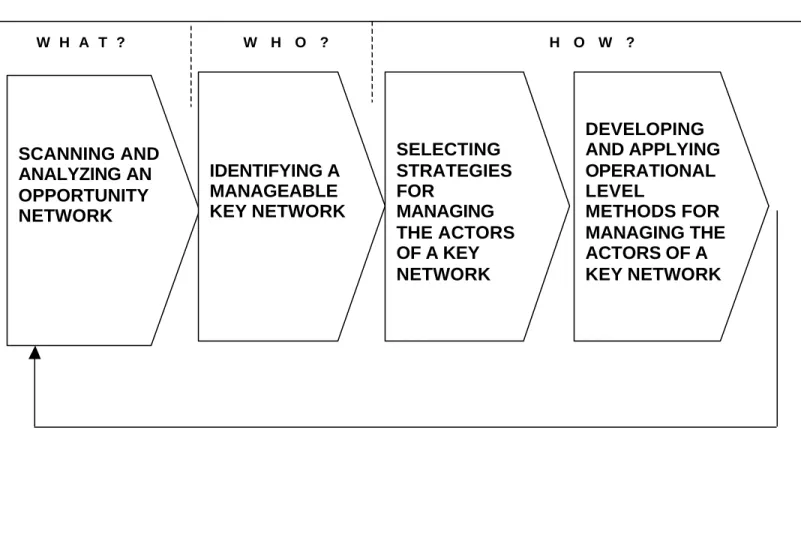
The KNM approach suggested here includes four basic elements: 1) Scanning and analyzing an Opportunity Network (what?), 2) Identifying a manageable Key Network (who?),
3) Strategies for managing actors of a Key Network (how?), and
4) Developing and applying operational level methods for managing actors of a Key Network (how?)(Figure 1).
WHAT?
Scanning and Analyzing an Opportunity Network
Scanning and analyzing opportunities is an essential part of effective network management (cf. Achrol and Kotler 1999, Möller and Halinen 1999). Scanning opportunities is a continuous process, since opportunities emerge and disappear rapidly in the dynamic network economy (cf. Christie and Levary 1998). Finding new opportunities may happen, for example, by systematically analyzing and predicting needs, problems, and different kinds of sources of value in the marketplace, in one's own organization, or in the internal or external value chain. Opportunity Network refers to the set of opportunities available to the company. An opportunity is anything that potentially represents or results in value to the company. Different opportunities are often interrelated and form a web. An Opportunity Network, as defined here, includes anything that is potentially valuable to the company (e.g. favorable publicity), and, thus, is a broader concept than Achrol and Kotler’s (1999, p. 157) concept of customer opportunity network.
Their concept refers to “a body of customers organized around a central information company that serves as a clearing house for the marketing transactions it brokers and regulates on behalf of its member customers and participating suppliers, which
represent a range of products, technologies, and services.” Scanning and analyzing opportunities results in the goal and fundamental function of a Key Network, which can also be called the Key Network strategy.
Figure 1 Key Network Management (KNM)
The illustrative example of Figure 2 shows four identified opportunities for the focal company: a new need in the market place, cost reduction by choosing a new supplier, favorable publicity, and a new technical standard. A co-operative set of actors - a
K E Y N E T W O R K M A N A G E M E N T W H A T ? W H O ? H O W ? SCANNING AND ANALYZING AN OPPORTUNITY NETWORK IDENTIFYING A MANAGEABLE KEY NETWORK SELECTING STRATEGIES FOR MANAGING THE ACTORS OF A KEY NETWORK DEVELOPING AND APPLYING OPERATIONAL LEVEL METHODS FOR MANAGING THE ACTORS OF A KEY NETWORK
manageable Key Network - is identified and established around each opportunity. The goal of a Key Network is to explore, exploit, and materialize the opportunity. The focal company selects a suitable management strategy for each actor in a Key Network. The company also develops and applies case specific operational level practices for managing each Key Network and interaction with each actor in these networks.
WHO?
Identifying a Manageable Key Network
According to the literature, the boundaries of business networks cannot be defined exactly (e.g. Håkansson and Snehota 1989). This makes the management of a network difficult. The dynamics of networks is another characteristic that makes network management challenging.
A Key Network refers to a set of actors mobilized by the focal company to realize an opportunity. In the KNM approach, the focal company decides which actors (organizations, individuals) are inside the Key Network. In other words, the company has to decide and know through which access points it interacts with a larger network. Indeed, the boundaries of business networks cannot be defined exactly. However, 'Key Network' can be understood as a defined sub-net, a defined set of access points to a larger unlimited network. The value received by the focal company does not have to be created within the Key Network; its creation is mobilized or received through the Key Network. For example, the company obviously has to decide from which sub-contractor it buys the goods. However, it does not necessarily have to know which sub-contractor’s sub-contractors have participated in manufacturing these goods.
The idea of a Key Network resembles what Möller and Halinen (1999) call management of a relationship portfolio in the context of network management. Wilkinson and Young (2002) emphasize the meaning of bottom-up self-organizing systems in networks, which may imply that a company should not make an explicit decision regarding with whom they are dealing in the network. However, they (ibid. p. 129) also admit “this does not undermine the use of traditional management analysis and planning techniques because firms are still required to act, learn, respond, and adapt in intended rational ways in networks if the self-organizing process is to work effectively over time.”
Figure 2 Key Networks of a companyAn Example of four Key Networks Focal company Actor Actor Actor Actor Actor Actor Actor Actor Actor Actor Key Network 1 O P P O R T U N I T Y 1 N e w n e e d i n t h e m a r k e t p l a c e Actor Actor Actor O P P O R T U N I T Y 2 C o s t r e d u c t i o n b y c h o o s i n g a n e w s u p p l i e r Actor Actor Actor Actor Key Network 2 O P P O R T U N I T Y 3 F a v o r a b l e p u b l i c i t y Actor Actor Actor Actor Actor Actor Actor Key Network 3 O P P O R T U N I T Y 4 N e w t e c h n i c a l s t a n d a r d Actor Actor Actor Actor Actor Actor Actor Actor Actor Actor Actor Actor Actor Actor Key Network 4 Actor Actor Actor
Certain criteria are needed to identify suitable members for a Key Network. Firstly, the actor should provide relevant capabilities to contribute towards achieving the goals of the Key Network. Capabilities refer to the ability to mobilize, access, and mix resources (Håkansson and Snehota 1995). Capabilities brought into and developed in the network should be difficult for competitors to replicate (cf. Ogilive 1994). Each capability brought into the Key Network should also complement other capabilities in the network so that a synergy develops helping the network to reach its goals quickly, efficiently, and effectively (cf. Christie and Levary 1998). Relationship and network specific assets learned and developed over time are what create a competitive advantage. Secondly, some necessary capabilities (not all) of an actor should be controllable by the focal company. For example, the focal company may want to strictly control that their manufacturing sub-contractor does not show the technical specifications of the product to anyone else. The focal company may not know all the partners of its subcontractor, however it indirectly and partly also controls the information they receive they do not see the particular technical specification. The focal company may also want to control quality and deliveries of the products coming from the sub-contractor, in order to fulfill its own promises to the market. However, as long as the confidential information remains secret and the intellectual properties are safe, and the quality and deliveries of products are as promised, the manufacturing actors of the network may freely organize their operation. Indeed, the terms “managing” and “controlling” an actor or its capabilities in KNM do not mean total management and control. Furthermore, “manage” and “control” in KNM are not synonyms for “command” and the opportunistic use of coercive power over a weaker actor, but rather these terms include a facilitating approach related to, for example, joint learning, innovating, knowledge transfer, supporting, and helping. Indeed, successful long-term management of a relationship should aim at a win-win situation. Trying to control too many capabilities of actors in the Key Network will obviously reduce the various benefits received from the network. A dominant power position in the network is not the goal as such in KNM and seldom is it even possible to achieve. The management and control may possibly be so slight that a company does not even know that they belong to some other company’s Key Network. According to Håkansson and Ford (2002, p. 135), “no company and no relationship in a network has been built or operates independently of
others. A business network is seldom the result of one “designer”, although some companies might believe that. Generally, the network is the outcome of the deliberations, aims, and actions of a number of the participants. Similarly, no company is the “hub” of the network or is likely to have complete control over it, although some will act as if they were in control.” Indeed, finding the right balance with controllable and non-controllable capabilities of a network partner is at the core of KNM. Similarly, Stabell and Fjelstad (1998, p. 416) discuss value networks and value creation and say “To maintain strategic and manageable perspective on value creation, it is important that the activity disaggregating not be too detailed, while still enabling one to identify those activities that are strategically important.” A society as a whole can also be understood as a network; with too much control it turns into a prison, with no control it is the Wild West.
To summarize, a manageable key network refers to a set of actors which a) provide relevant capabilities to contribute towards achieving the goals of the Key Network and b) the necessary capabilities (not all) of these actors can be controlled by the focal company. The actors of a Key Network often belong to the company’s external value chain. In other words, they are the company’s customers, suppliers, or organizations that have the role of both a customer and supplier. However, in addition to customers and suppliers, there can be many other actors which can help in achieving the goals of a Key Network, such as financiers and investors, opinion leaders, government bodies, labor unions, trade commissions, universities, media, etc.
HOW?
Strategies for managing the actors of a Key Network
Once an opportunity has been discovered, the company has to find a way to take advantage of it. For this purpose, the company may either use its own resources or establish a Key Network. Indeed, the strategy is not necessarily the one that creates value but mobilizes different actors to create value for each other through a network managed by the company. This is characterized by the general transition from value chains to web-like value constellations (Normann and Ramírez 1993). In value constellations, the key strategic task is the reconfiguration of roles and relationships among a constellation of actors, in order to mobilize the creation of value in new forms and by new players. This strategy process is continuous or at least frequently recurring
(Håkansson and Snehota 1989). Since relationships with different actors of a network may evolve very differently (Ojasalo 2000a), the need for updating the relationship strategy also varies.
It is suggested here, that the strategy for managing an actor depends on to what extent the actor is capable of contributing to the goals of the Key Network and to what extent the Key Network is capable of contributing to the goals of the actor (Figure 3).
High Grow/ Develop/ Invest Selectively
invest Actor’s capability
to contribute to the goals of the
Key Network Maintain/ Abandon/ Low Manage for Manage for
earnings cash
High Low Key Network’s capability to contribute to the goals of the actor
Figure 3 Strategies for managing the actors of a Key Network
The capability to contribute to the other party’s goals strongly affects the commitment to the relationship (Ojasalo, 2002). Such capabilities may change over time. The strategy alternatives for network members suggested here are: Grow/Invest, Develop/Selectively invest, Maintain/Manage for earning, and Abandon/Manage for cash (modified from McDonald and Rogers 1998, p. 82). When the actor’s capability to contribute to the Key Network’s goals is high, and the Key Network’s capability to contribute to the actor’s goals is also high, the suggested strategy is to grow the relationship and invest in this actor. When the actor’s capability to contribute to the Key Network’s goals is high, but the Key Network’s capability to contribute to the actor’s goals is low, the suggested strategy is to develop the relationship and selectively invest.
When the actor’s capability to contribute to the Key Network’s goals is low, but the Key Network’s capability to contribute to the actor’s goals is high, the suggested strategy is to maintain the relationship and manage for earnings. Finally, when the actor’s capability to contribute to the Key Network’s goals is low and the Key Network’s capability to contribute to the actor’s goals is also low, the suggested strategy is to abandon the actor and manage for cash (immediate incomes). Furthermore, different actors may also be prioritized and even ranked in terms of various prioritizing criteria such as positive cash flow generation, information, reference value, security, new competences, and new business opportunities received (cf. Ojasalo 2001a).
DEVELOPING AND APPLYING OPERATIONAL LEVEL METHODS FOR MANAGING THE ACTORS OF A KEY NETWORK
As suggested above, each member of a Key Network can be managed in terms of four main strategies: grow, develop, maintain, and abandon. Realizing each strategy alternative requires suitable operational level methods. These operational level methods are, of course, highly case specific. The Key Account Management (KAM) approach is an effective and systematic way to manage customers in the business-to-business market. Key Accounts are customers in a b-to-b market identified by selling companies as of strategic importance (McDonald et al. 1997). Although, the actors of a Key Network are not necessarily customers, KAM can easily be applied to the management of relationships with any kind of actors.
Several researchers (e.g. Ehrlinger 1979; Diller 1989; Millman 1994; 1996; Millman and Wilson 1994; Pardo et al. 1995; McDonald et al. 1996; Spencer,1999; Kempeners and van der Hart 1999) have used the term 'Key Account Management'. The terms “national account marketing” (NAM) (Stevenson and Page 1979; Stevenson 1980; 1981) and “strategic account management” (SAM) (Storbacka et al.1999) have also been used in the literature meaning about the same as KAM. According to Ojasalo (2001b, p. 201), “KAM refers to the selling company’s activities including identifying and analyzing their key accounts, and selecting suitable strategies and developing operational level capabilities to build, grow, and maintain profitable and long-lasting relationships with them.” Drawing on the operational level capabilities of KAM (Ojasalo 2001b), the following areas can be emphasized in developing and applying
operational level methods for managing the actors of a Key Network: products and services, organizational structure, information exchange, and individuals.
In improving the quality of products/services, the focus is on product and service performance, economic competitiveness, measures improvement, reduction of the costs of poor quality, and performance of macroprocesses in the organization (Juran 1992). The challenge here is that the expectations of actors towards the products and services often change over time (Ojasalo 2001c). Joint R&D projects are typical between different actors in industrial and high-tech networks. According to Campbell and Cooper (1999), new products developed in a partnership are not automatically more successful than those developed in-house. However, the R&D project may bring other kinds of long-term benefits, such as access to the other actor’s organization and learning. In general, understanding both short- and long-term benefits of co-operation is extremely important in relationship management (Ojasalo 2000b). Developing capabilities for providing services in the Key Network is extremely important, because even when the core product is a tangible good, it is often the related services that differentiate the total offering from competitors’ offerings and provide a competitive advantage (Grönroos 1990).
The organizational ability to meet the Key Network’s needs can be developed, for example, by adjusting the organizational structure to correspond to other actors’ global and local needs (cf. McDonald et al. 1997) and by increasing the number of interfaces to different actors (Araujo et al. 1999) and, thus, also the number of interacting people. Organizational capabilities can also be developed by organizing teams, consisting of people with the necessary competencies and authority, to take care of different actors and problems (McDonald et al. 1997; Fiesser and Esser 1998; Helfert and Vith 1999; Möller and Rajala 1999).
Information exchange between actors is particularly important for successful KNM. Information exchange is important, for example, for the increase of competencies and expertise of actors in relationships and networks (Ojasalo 2001d). According to Walter (1999), an important relationship-specific task is to search, filter, judge, and store information about the organizations, strategies, goals, potentials, and problems of the partners. Information exchange depends, to a large extent, on the mutual trust and attitudes of the parties, and on the technical arrangements. Trust is something that has to
be earned over time by performance, whereas the technical side can be developed, for example, with IT. Aspects of interpersonal communication are important in attempting to understand issues such as long-term bonding, various forms of adaptations, and the development of trust and mutuality in interorganizational relationships and networks (Olkkonen, Tikkanen, and Alajoutsijärvi 2000).
Grant (1990) and Rosenbröijer (1998) analyze relationships and networks and address the importance of human capabilities. A company’s capabilities related to individuals can be developed by selecting the right people to manage relationships and joint-teams between actors, and by developing the skills of these people. It is also important that the key people have sufficient authority to take care of their responsibilities. The responsibilities of these people are often complex and varied, and, therefore, require a large number of skills and qualifications which should be taken into account in their selection and development (McDonald et al. 1996; Gruner et al. 1997).
MANAGERIAL IMPLICATION: A FRAMEWORK FOR KEY NETWORK MANAGEMENT PRACTICES
This paper suggested an approach for systematic KNM. It includes four basic elements: (1) Scanning and analyzing an Opportunity Network (what?); (2) Identifying a manageable Key Network (who?); (3) Strategies for managing the actors of a Key Network (how?); and (4) Developing and applying operational level methods for managing the actors of a Key Network (how?).
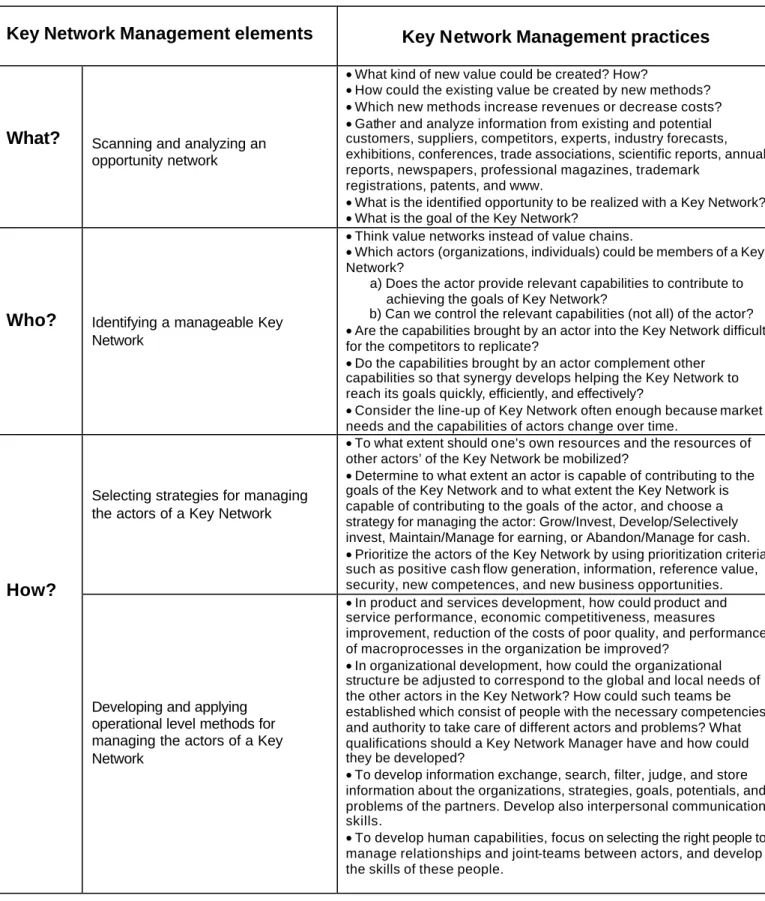
Concrete methods required for realizing KNM are always case-specific. However, based on the above discussion the following practices can be suggested for each basic element of KNM (Figure 4).
When scanning and analyzing an opportunity network, it is important to consider both how the existing value could be created by new methods and how a new kind of value could be created. This may happen by gathering information from existing and potential customers, suppliers, competitors, experts, industry forecasts, exhibitions, conferences, trade associations, scientific reports, annual reports, newspapers, professional magazines, trademark registrations, patents, www, etc. Qualitative data may be obtained in personal interviews and focus groups. Quantitative data may be obtained by surveys.
Key Network Management elements Key Network Management practices
What? Scanning and analyzing an
opportunity network
• What kind of new value could be created? How?
• How could the existing value be created by new methods? • Which new methods increase revenues or decrease costs? • Gather and analyze information from existing and potential customers, suppliers, competitors, experts, industry forecasts, exhibitions, conferences, trade associations, scientific reports, annual reports, newspapers, professional magazines, trademark
registrations, patents, and www.
• What is the identified opportunity to be realized with a Key Network? • What is the goal of the Key Network?
Who? Identifying a manageable Key Network
• Think value networks instead of value chains.
• Which actors (organizations, individuals) could be members of a Key Network?
a) Does the actor provide relevant capabilities to contribute to achieving the goals of Key Network?
b) Can we control the relevant capabilities (not all) of the actor? • Are the capabilities brought by an actor into the Key Network difficult for the competitors to replicate?
• Do the capabilities brought by an actor complement other capabilities so that synergy develops helping the Key Network to reach its goals quickly, efficiently, and effectively?
• Consider the line-up of Key Network often enough because market needs and the capabilities of actors change over time.
Selecting strategies for managing the actors of a Key Network
• To what extent should one's own resources and the resources of other actors’ of the Key Network be mobilized?
• Determine to what extent an actor is capable of contributing to the goals of the Key Network and to what extent the Key Network is capable of contributing to the goals of the actor, and choose a strategy for managing the actor: Grow/Invest, Develop/Selectively invest, Maintain/Manage for earning, or Abandon/Manage for cash. • Prioritize the actors of the Key Network by using prioritization criteria such as positive cash flow generation, information, reference value, security, new competences, and new business opportunities. How?
Developing and applying operational level methods for managing the actors of a Key Network
• In product and services development, how could product and service performance, economic competitiveness, measures
improvement, reduction of the costs of poor quality, and performance of macroprocesses in the organization be improved?
• In organizational development, how could the organizational structure be adjusted to correspond to the global and local needs of the other actors in the Key Network? How could such teams be established which consist of people with the necessary competencies and authority to take care of different actors and problems? What qualifications should a Key Network Manager have and how could they be developed?
• To develop information exchange, search, filter, judge, and store information about the organizations, strategies, goals, potentials, and problems of the partners. Develop also interpersonal communication skills.
• To develop human capabilities, focus on selecting the right people to manage relationships and joint-teams between actors, and develop the skills of these people.
To identify a manageable Key Network, it is important to think value networks instead of value chains. Members selected to a Key Network should a) provide relevant capabilities to contribute towards achieving the goals of the Key Network and b) some necessary capabilities (not all) of an actor should be controllable by the focal company.
When selecting strategies for managing the actors of a Key Network, it is important to decide the extent to which one's own resources and the resources of the other actors of the Key Network should be mobilized. Also, it is relevant to determine to what extent an actor is capable of contributing to the goals of the Key Network and to what extent the Key Network is capable of contributing to the goals of the actor, and based on this to choose a strategy for managing the actor. The strategy may be Grow/Invest, Develop/Selectively invest, Maintain/Manage for earning, or Abandon/Manage for cash. Furthermore, it is relevant to prioritize the actors of the Key Network by using prioritization criteria such as positive cash flow generation, information, reference value, security, new competences, and new business opportunities.
Developing and applying the operational level for managing Key Networks often requires highly case-specific practices. However, it is important to focus on at least the following areas: products and services, organizational structure, information exchange, and individuals.
CONCLUSIONS
This article introduced KNM that is a systematic approach for managing business networks. Earlier business network literature has mostly concentrated on describing the nature of networks. The contribution of the KNM approach is in its simplicity and practicality. The KNM approach is not only focused on using networks to fulfill existing needs, but also on discovering new opportunities and establishing and managing networks for realizing these opportunities. As a managerial implication, this article suggested a framework for KNM practices.
Finally, the following directions for further research can be suggested. Firstly, opportunity management is an important part of KNM, and should clearly be further examined and developed. Secondly, the role and nature of network management may be somewhat different in large and small companies. Indeed, it would be fruitful to address this issue in further research. Thirdly, more knowledge is needed of which elements and
tasks of network management can effectively and reliably be computerized and which always require human control. Fourthly, since information and knowledge is one of the most important resources in the new economy, it would be relevant to examine the role of knowledge management in networks. Fifthly, some Key Networks have a long-term nature and others a short-term nature, and obviously this affects their management. This issue clearly requires further research.
REFERENCES
Achrol, R. S. and Kotler, P. (1999), “Marketing in the Network Economy”, Journal of Marketing, 63 (Special Issue 1999), pp. 146-63.
Alajoutsijärvi, Kimmo (1996), A Dyad Made of Steel: Kymmene Corporation and Valmet Paper Machinery and their Relationship, Local Network and Macro Environment 1948-90. Jyväskylä: Jyväskylä University Printing House.
Anderson, James C., Håkan Håkansson and Jan Johanson, (1994), “Dyadic Business Relationships within a Business Network Context”, Journal of Marketing, 58 (Oct.), 1-15.
Araujo, Louis, Anna Dubois and Lars-Erik Gadde (1999), “Managing Interfaces with Suppliers”, Industrial Marketing Management, 28, 497-506.
Berry, Leonard L. (1983), “Relationship Marketing”, In Emerging Perspectives on Services Marketing, Leonard L. Berry, G. Lynn Shostack and Gregory D. Upah, eds. Chicago: AMA American Marketing Association.
Campbell, A. J. and R.G. Cooper (1999), “Do Customer Partnerships Improve New Product Success Rates?”, Industrial Marketing Management, 28, 507-519.
Christie, P. M. J. and Levary, R. R. (1998), “Virtual corporations”, Industrial Management, (Jul-Aug), 7-11.
Christopher, Martin (1995), Networks and Logistics: Managing Supply Chain Relationships, Paper presented at the 3rd international colloquium on relationship marketing, July, Swedish School of Economics and Business Administration, Helsinki.
Diller, Hermann (1989), ”Key-Account-Managemen t als vertikale s
Marketingkonzept”, Marketing:Zeitschrift für Forshcung und Praxis, 4, 213-23.
Dwyer, Robert F., Paul H. Schurr and Sejo Oh (1987), “Developing Buyer-Seller Relationships”, Journal of Marketing, 51 (April), 11-27.
Ehrlinger, Erich (1979), ”Kundengruppenmanagement”, Die Betriebswirtschaft, 39 (2), 261-73.
Emerson, Richard M. (1981), “Social Exchange Theory” in Social Psychology: Sociological Perspectives, Morris Rosenberg and Ralph Turner, eds. New York: Basic Books, 30-65.
Fiesser, G and Esser, D. (1998), “Wege zum Key-Account-Erfolgsteam”, Absatzwirschaft, 7/98, 46-51.
Fombrun, C. J. (1982), “Strategies for Network Research in Organizations,” Academy of Management Review, 7 (2), 280-291.
Ford, David (1982), “The Development of Buyer-Seller Relationships in Industrial
Markets”, in International Marketing and Purchasing of Industrial Goods: An Interaction Approach, Håkan Håkansson, ed. Chichester, UK: John Wiley & Sons, 288-303.
Ford, David and Philip J. Rosson (1982), “The Relationship Between Export
Manufacturers and the Overseas Distributors”, in Export Management, Michael R. Czinkota and George Tesar eds. New York: Praeger Publishers, 257-275.
Grandori, Anna and Giuseppe Soda (1995), “Inter-Firm Networks: Antecedents, Mechanisms and Forms,”
Grant, R. M. (1990), “The Resource-Based Theory of Competitive Advantage”, California Management Review, 33 (3), 114-35.
Gruner, K., Garbe, B. and Homburg, C. (1997), “Produkt- and Key-Account-Management als objektorientierte Formen der Marketingorganisation”, Die Betriebswirtschaft, (März/Apr.), 234- 51.
Grönroos, Christian (1989), A Relationship Approach to Marketing: The Need for a New Paradigm, Helsinki: Swedish School of Economics and Business Administration, Working Papers 190.
--- (1990), Service Management and Marketing. Managing the Moments of Truth in Service Competition. Massachusetts: Lexington Books.
Gummesson, Evert (1987), “The New Marketing - Developing Long-term Interactive Relationships”, Long Range Planning, 20 (4), 10-20.
Hammarkvist, K.-O, Håkan Håkansson and L-G. Mattsson (1983), Marknadsföring för konkurrentskraft, Malmö, Sweden: Liber.
Helfert, G. and Vith, K. (1999), “Relationship Marketing Teams - Improving the Utilization of Customer Relationship Potentials Through a High Team Design Quality”, Industrial Marketing Management, 28, 553-64.
Hoogeweegen, Martin R., Wim J.M. Teunissen, Peter H.M. Vervest and Rene W. Wagenaar (1999), “Modular Network Design: Using Information and Communication Technology to Allocate Production Tasks in a Virtual Organization”, Decision Sciences, (Fall), 1073-1103.
Håkansson, Håkan (1982), International Marketing and Purchasing of Industrial Goods, An Interaction Approach. Chichester: John Wiley & Sons.
--- and David Ford (2002), “How should companies interact in business networks?, ” Journal of Business Research, 55, 133-139.
--- and Ivan Snehota (1989), “No Business is an Island: The Network Concept of Business Strategy”, Scandinavian Journal of Management, 5 (3), 187-200.
--- and Snehota (eds.) (1995), Developing Relationships in Business Networks. London: Routledge.
Jackson, Barbara Bund (1985), “Build Customer Relationships that Last”, Harvard Business Review, (Nov-Dec), 120-128.
Juran, J. M. (1992), Juran on Quality by Design - The New Steps for Planning Quality into Goods and Services. New York: Mcmillan.
Jüttner, Uta and Lutz E. Schlange (1996), ”A Network Approach to Strategy”, International Journal of Research in Marketing, 13, 479-94.
Kempeners, Mario A. and Hein W. van der Hart (1999), “Designed account
management organizations”, Journal of Business and Industrial Marketing, 4 (4), 310-27.
Liljegren, G. (1988), Interdependens och dynamik i långsiktiga kundrelationer.
Industriell förjsäljning i ett nätverksperspektiv, Stockholm: Handelshögskolan i Stockholm.
Mattson, L.-G. (1985), “An Application of a Network Approach to Marketing. Defining and Changing Market Positions”, in Alternative Paradigms for Widening Marketing Theory, J. Dholakia and J. Arndt, eds. Greenwich, CT: JAI Press, 263-88.
McDonald, Malcolm, Tony Millman and Beth Rogers (1996), Key Account
Management-Learning from Supplier and Customer Perspectives, Cranfield: Cranfield School of Management.
---, --- and --- (1997), ”Key Account Management: Theory, Practice and Challenges”, Journal of Marketing Management, 13, 737-57.
--- and Beth Rogers (1998), “Key Account Management: Learning from Supplier and Customer Perspectives”, Oxford: Butterworth-Heinemann.
Millman, T. F. (1994), Relational aspects of key account management, 4th Seminar of the European Research Network for Project Marketing and System Selling, April, University of Pisa, Pisa.
--- (1996), “Global Key Account Management and System Selling”, International Business Review, 5 (6), 631-45.
--- and Wilson, K.J. (1994), From Key Account Selling to Key Account Management, 10th Annual Conference on Industrial Marketing and Purchasing, September, University of Groningen, Groningen.
Mowshowitz, Abbe (1997), “On the Theory of Virtual Organization. Systems research and Behavioral Science, 14 (6), 373-84.
Möller, Kristian K. and Aino Halinen (1999), “Business Relationships and Networks: Managerial Challenge of Network Era”, Industrial Marketing Management, 28, 413-27.
--- and Arto Rajala (1999), “The Role of Internal Marketing Relationships”, Industrial Marketing Management, 28, 521-35.
Normann, Richard and Rafael Ramirez (1993), “From Value Chain to Value Constellation: Designing Interactive Strategy”, Harvard Business Review, (Jul-Aug), 65-77.
Ogilive, Heather (1994), “At the Core, It’s the Virtual Organization”, Journal of Business Strategy, (Sept./Oct).
Ojasalo, Jukka (2000a), “The Episodic, Phase, and State Approaches to Customer Relationships”, in Marketing in a Global Economy, Francesca Van Gorp Cooley, F., ed, Chicago: AMA American Marketing Association, 363-70.
--- (2000b), “Managing Short- and Long-Term Quality in Professional Business Relationships," in Service Quality in the New Economy: Interdisciplinary and International Dimensions, Bo Edvardsson, Stephen W. Brown, Robert
Johnston and Eberhard E. Scheuing, eds. New York: ISQA International Service Quality Association Inc., 47-56.
--- (2001a), “Prioritizing Customers and Adjusting Offering in Key Account Management”, The 9th International Colloquium in Relationship Marketing Proceedings, Michèle Paulin and Ronald Ferguson, Concordia University, John Molson School of Business, September 24-26, Montreal, Canada.
--- (2001b), “Key Account Management at Company and Individual Levels in Business-to-Business Relationships”, Journal of Business & Industrial Marketing, 16 (3), 199-216.
--- (2001c): “Managing Customer Expectations in Professional Services”, Managing Service Quality, 11 (3), 200-12.
--- (2001d), “Customer Expertise: A Challenge in Managing Customer Relationships in Professional Business-to-Business Services”, Services Marketing Quarterly, 22 (2), 1-16.
--- (2002), “Customer Commitment in Key Account Management,” The Marketing Review, 2, 301-18.
Olkkonen, Rami, Henrikki Tikkanen and Kimmo Alajoutsijärvi (2000), ”The Role of Communication in Business relationships and Networks,” Management Decision, 38 (6), 403-9.
Pardo, Catherine, Robert Salle and Robert Spencer (1995), “The Key Accountization of the Firm”, Industrial Marketing Management, 22, 123-43.
Ritter, Thomas (1999), “The Network Company - Antecedents for Coping with
Relationships and Networks Effectively”, Industrial Marketing Management, 28, 467-79.
Rosenbröijer, Carl-Johan (1998), Capability Development in Business Networks. Helsinki: Swedish School of Economics and Business Administration Finland.
Spencer, Robert (1999), “Key Accounts: Effectively Managing Strategic Complexity”, Journal of Business and Industrial Marketing, 4 (4), 291-309.
Stabell, Charles B and Øysten D. Fjelstad (1998), “Configuring Value for Competitive Advantage: On Chains, Shops, and Networks,” Strategic Management Journal, 19, 413-427.
Stevenson, Thomas H. (1980), “Classifying a Customer as a National Account”, Industrial Marketing Management, 9, 133-6.
--- (1981), “Payoffs from National Account Management”, Industrial Marketing Management, 10, 119-24.
--- and Albert L. Page (1979), “The Adaptation of National Account Marketing by Industrial Firms”, Industrial Marketing Management, 8, 94-100.
Storbacka, Kaj, Sivula, P. and Kaario, K. (1999), Create Value with Strategic Accounts. Helsinki: Multiprint.
Thorelli, H. B. (1986) “Networks: Between Markets and Hierarchies”, Strategic Management Journal, 7, 37-51.
Walter, Achim (1999), “Relationship Promoters - Driving Forces for Successful Customer Relationships”, Industrial Marketing Management, 28, 537-51.
Wilkinson, Ian and Louise Young (2002), “On Cooperating Firms, Relations and Networks,” Journal of Business Research, 55, 123-132.
Wilson, David T. and Mummalaneni, Venkatapparao (1990), “Bonding and
Commitment in Buyer-Seller Relationships: A Preliminary Conceptualisation,” in Understanding Business Markets: Interaction, Relationships and Networks, David Ford, (ed.). Cambridge: Academic Press, 408-420.