A class of quantum LDPC codes:
construction and performances under iterative
decoding
Thomas Camara
INRIA, Projet Codes, BP 105, Domaine de Voluceau F-78153 Le Chesnay, France. Email: [email protected]
Harold Ollivier
Perimeter Institute, 31 Caroline St. N, Waterloo, ON N2L 2Y5, Canada. Email: [email protected]Jean-Pierre Tillich
INRIA, Projet Codes, BP 105, Domaine de Voluceau
F-78153 Le Chesnay, France. Email: [email protected]
Abstract— A generic method for constructing quantum LDPC codes is presented. We first explain how to overcome the difficulty of finding a set of low weight generators for the stabilizer group of the code. Our approach is based on a graph representation of the generators of the stabilizer group and on a simple local rule to ensure commutativity. We provide several specific examples of quantum LDPC codes obtained by our method, together with numerical simulations over the depolarizing channel and the erasure channel.
I. INTRODUCTION
The idea of using quantum systems for processing informa-tion has first been suggested by Feynman and it has developed since into an exciting research area with implications ranging from cryptography to complexity theory. As a concrete exam-ple, quantum computer would be able to solve efficiently some hard problems such as integer factorization [11].
However, for taking advantage of the quantum nature of physical systems to process information, it is necessary to protect them from unwanted evolutions. Indeed, if quantum registers are not protected from noise, the very fragile super-positions required for efficiently manipulating quantum infor-mation tend to disappear exponentially fast with the number of qubits involved. This effect — called decoherence — can nonetheless be reduced by using quantum error correcting codes. The first scheme of this kind has been proposed in 1995 by P. Shor [12]. Since then, quantum error correction has evolved much. Most notable, is the introduction of the stabilizer formalism [6], [3] for defining quantum codes . With this tools at hand, it has been shown that quantum information processing can be done fault-tolerantly (see for instance [1]), i.e. would be feasible even in the presence of qubit errors and gate faults — provided these events are rare enough.
In spite of these important results, properties of quantum channels and of quantum codes are less understood than for their classical counterparts. For instance, the capacity for sending quantum information is unknown even for the depolarizing channel. It is thus of interest to tackle the problem from a pragmatic point of view: devise versatile constructions of quantum codes inspired by the best classical codes, and
analyze their performances.
When sending classical information over memoryless clas-sical channels, it has been demonstrated that a very efficient way for approaching the channel capacity is obtained by using LDPC codes with Gallager’s iterative decoding algo-rithm. Generalizing these notions to quantum codes seems a promising way, and has indeed been proposed recently [9]. The approach promoted by these authors is to define quantum LDPC codes using a subclass of stabilizer codes, namely the CSS codes, which can be constructed from a couple of classical binary codes, each of them containing the dual of the other. MacKayet al.have shown that it is possible to find sparse classical binary codes which meet this property and use them for defining quantum LDPC codes. Several other papers have followed the same approach by constructing sparse CSS codes, namely [8], [7].
Our work is aimed at improving the aforementioned codes by finding other constructions of LDPC quantum codes using the more general family of stabilizer codes. While a brief in-troduction to stabilizer codes is provided below, we would like to pinpoint here the main difficulty for finding LDPC stabilizer codes. As explained in [3], every stabilizer code can be viewed as a code overF4, the field with four elements. However, the
converse is not true: to correspond to valid stabilizer codes, these codes must be self-orthogonal for some hermitian trace inner product. Fulfillment of this peculiar constraint makes the usual constructions of LDPC codes useless in the quantum setting.
Our work provides a partial solution to this problem by defining such codes through a group theoretical construction (see Section III). The resulting codes can be viewed as quantum analogues of regular Gallager codes: each qubit is involved in the same number of “parity-check equations”, and each parity-check equation involves the same number of qubits. We have decoded these codes with an iterative decod-ing algorithm applied to a certain Tanner graph associated to our construction and present the results of these numerical simulations in Section V.
II. STABILIZER CODES
An [n, k] quantum code is a subspace of dimension2k of
the Hilbert space Hn ∼= (C2)⊗n ofn qubits. Such a space
allows to encodekqubits and the rate of this code is defined
to be k
n. While defining such code subspace can be done in
many different ways, a particularly useful method is known as the stabilizer formalism, which we now briefly review [6].
Preliminaries: Stabilizer codes rely heavily on properties ofGn, then-qubit Pauli group. This group is defined in terms
of the Pauli matrices for a single qubit: I = 1 0 0 1 ,X = 0 1 1 0 ,Y = 0i−0i,Z = 1 00−1 . The group Gn is the
multiplicative group generated by the n-fold tensor products
of single qubit Pauli matrices. The crucial fact about Gn, is
that any pair of elements either commutes or anti-commutes. For our purpose here, phases are irrelevant and it will be more convenient to work with the effective Pauli group
Gn
def
=Gn/{±I⊗n;±iI⊗n}(see [3]). There are4elements in
G1 which are [I], [X], [Y], and [Z]. Here, [P] denotes the
equivalence class ofP ∈ Gn, that is {±P,±iP}.
Definition of the code subspace: The code subspaceCof
an [n, k] stabilizer code is the largest subspace stabilized by
the action ofS, an Abelian subgroup ofGn. If−I⊗n∈ S/ and
ifS is generated byn−k independent operatorsSj, then the
associated code is of rate k
n. The code subspace is equivalently
defined byn−keigenvalue equations:|ψi ∈Cif and only if
∀j∈ {1, . . . , n−k}, Sj|ψi=|ψi. It is sufficient to represent
the set of generators of the stabilizer group{Sj}j by the set
of equivalence classes {Sj}whereSj = [Sj]which generate
a subgroupS ofGn. Using a slight abuse in terminology, we
also call S the stabilizer group of the code and {Sj}j the
stabilizer set of the code.
Error model: Since any error recovery procedure is a linear operation, it is sufficient to describe it for an error basis. This basis can be chosen to be the set of elements E1
⊗ E2
⊗ · · · ⊗ En, where the
Ei’s belong to
{I,X,Y,Z}.
An error E is viewed as an element of Gn which acts on a
vector |ψi of the code subspace. The depolarizing channel with crossover probability pis an error model where the Ei’s
are chosen independently of each other, Ei being equal to I
with probability1−pandX,Y,Z with probabilityp/3. The
quantum erasure channel with erasure probabilitypis an error
model where each qubit is erased with probability pand the
receiver knows which qubit has been erased or not. When the i-th qubit is erased, Ei is equal to
I,X,Y,Z, each with
probability1/4and when it is not,Ei is equal to
I.
Capacity: Similarly to the classical setting, there is a notion of capacity. For a given quantum channel it is the supre-mum of the rate of a quantum code with fidelity arbitrarily close to 1after decoding as the length goes to infinity. There
is basically just one non-classical channel where the capacity is known exactly, namely the quantum erasure channel which has capacity 1−2p [2]. Even for the depolarizing channel
there are only lower and upper bounds which do not match. It
is known1 that its capacity is greater than1 +plog
2p+ (1−
p) log2(1−p)−plog23. On the other hand, the no-cloning
theorem implies that forp≥ 1
4, the capacity is equal to0.
Syndrome measurement: It is readily checked that for a stabilizer code, there are physical measurements revealing the binary vector s(E) = (s1(E), . . . , sn−k(E)), where si(E) is
equal to 0 iff Sj and E commute and to 1 otherwise. s(E)
is called the syndrome of E. This allows to cast errors in three categories: (i) thedetectable errorswhich have non-zero syndrome; (ii) the harmless undetectable errors which have zero syndrome, but belong toS; (iii) theharmful undetectable errorswhich have zero syndrome, those that belong toN(S)− S, whereN(S)is the normalizer of S .
Minimum distance: It is defined as the smallest Hamming weight of a harmful undetectable error.
Stabilizer codes as codes over F4: For the purpose of
establishing a correspondance between quantum and classical codes, it is useful to view stabilizer codes as codes overF4[3].
This duality is due to the additive structure ofF4which echoes
the additive structure of the effective Pauli group G1. The
mapping between them is given by[I]↔0,[X]↔ω,[Z]↔ ¯
ωand[Y]↔1, whereω¯def=ω2is the conjugate ofω. Elements
ofGnwill in turn be associated to vectors ofFn4 in an obvious
way. It can then be checked that two Pauli operators P and Q commute iff the two elements P andQ ofF4 associated
to [P] and [Q] satisfy tr(PQ¯) = 0, and anti-commute iff
tr(PQ¯) = 1. Here, tr(U)def=U+ ¯U=U+U2 is the trace
operator inF4. This motivates the definition of the following
inner product overFn
4 : U?Vdef=tr n X i=1 UiV¯i.
The generators of a stabilizer code, when expressed as row-vectors ofFn
4, form a matrix Swhich will be called a
parity-check matrixof the stabilizer code. In the following, a rowSj
ofSis associated to thej-th elementSj of the stabilizer set.
By construction, the rows ofSare orthogonal with respect to
the inner product ”?”. The converse is also true: any(n−k)×n
matrix overF4with orthogonal rows defines a stabilizer code
overn qubits.
We now review the complete correspondence between sta-bilizer codes and self-orthogonal codes overF4:
- An errorE is associated to a vectorE ofFn
4;
- The stabilizer groupS is associated to the vector space over F2 generated by S1,S2, . . . ,Sn−k—i.e. spanF2{Sj};
- The syndrome associated to an error E is the binary vector
(E?Si)ni=1−k;
- Harmless undetectable errors are associated to elements of
Fn
4 with zero syndrome and belonging to spanF2{Sj}; - Harmful undetectable errors are associated to elements ofFn
4
with zero syndrome which do not belong to spanF2{Sj};
- A successful decoding of the error E is reached when the decoding algorithm outputs an error vectorE0such thatE+E0
is a harmless undetectable error, that isE+E0∈spanF2{Sj}. 1Actually a slightly better bound holds from [13], [14], but the improvement is quite small.
Quantum LDPC codes: With this definition of parity-check matrix for stabilizer codes, it is natural to define quantum LDPC codes as stabilizer codes which have a sparse parity check matrix. In this article we are going to construct regular LDPC codes.
Definition 1: A quantum regular LDPC code of type(a, b)
is a stabilizer code which has a parity-check matrixSwitha
non-zero entries per column and b non-zero entries per row.
When the number ofω’s,ω¯’s and1’s is fixed per column, and
equal respectively to aω, aω¯, a1 we say that it is of detailed
type([aω, aω¯, a1], b).
III. AGENERIC CONSTRUCTION OF(a, b)QUANTUMLDPC CODES
In the following we restrict our attention to quantum LDPC codes having only two kind of non-zero entries, ω andω¯.
Generic construction of the Tanner graph of(a, b)
quan-tum LDPC codes: We use the following Tanner graph asso-ciated to a parity check matrixS. It is a bipartite graph with
vertex set A∪B, whereA is the set of variables nodes (i.e.
the qubits of the code, or the columns ofS) andB is the set
of check nodes (i.e. the generators of the stabilizer group, or the rows of S). There is an edge betweenα∈Aandβ ∈B
iff the corresponding entry in S, that is Sα
β is non zero. We
label this edge with the entrySα β.
We start our construction by choosing a group G with
cardinality equal to a multiple of the length of the code we are interested in. Then we choose two subgroupsH andKof G, with|K| ≥ |H|. The cosetsxH are associated to variable
nodes whereas the cosets yK are associated to check nodes.
In other words, the lengthnand the number of rowsn−kin
the parity check matrix are given byn= ||HG||andn−k=||KG||.
We then pick up a set of generators Γ of G which can
be partitioned into two sets Γ = Γω∪Γω¯ satisfying the 3
following properties:
(Γω)−1= Γω, (Γ¯ω)−1= Γω¯; (1)
∀(gω, gω¯, h)∈Γω×Γ¯ω×H,∃(h0, k0, k00)∈H×K2 s.t.,
hgωk0gω¯ =gω¯k00gωh0; (2)
hgk=h0g0k0, g, g0∈Γ, h, h0∈H, k, k0∈K, =⇒ g=g0. (3)
We put an edge betweenxHandyKiff there exists ag∈Γ
such thatxHg∩yK6=∅, or equivalently iff there existh∈H, k∈Kandg∈Γsuch thaty=xhgk. We label this edge with ω if the correspondinggbelongs toΓωand withω¯otherwise.
It can be checked that the degree of any vertexxH is equal to adef=Pg∈Γ |H|gH∩|K| and the degree of any vertexyK is equal
to bdef=Pg∈Γ|H|gK∩|K|, where Hg
def
=g−1Hg. This is a simple
consequence of
Lemma 1: Hgis a subgroup ofGand eitherxHg∩yK=∅
orxHg∩yK=z(Hg∩K)for some z∈G.
Soundness of the construction: This defines the Tanner graph of our stabilizer code and therefore also its parity-check matrix. The point of this construction is that property (2), which expresses some weak commutation of gω and gω¯
modulo elements ofH andK, implies the orthogonality of the
• • • •qubit check-node gω gω¯ xH yK zK ⊗ ⊗ xH x0H yK zK ⊗ ⊗ ⊗
Fig. 1. Subgraph showing that each qubitxHof the second type (involved
in theSicorresponding toyKwith anωand in theSjcorresponding tozK
with anω¯) is necessarily part of a 4-cycle with another qubit of the second type.
rows of the associated parity-check matrix (so that it represents a valid parity-check matrix of a stabilizer code). Property (3) is used to show that there are no multiples edges in the graph.
Proposition 1: The parity-check matrixSassociated to the
Tanner graph given by this construction has orthogonal rows.
Proof: Given two rowsSiandSj ofS, the set of qubits
can be partitioned in two classes : qubitskfor whichSk i?Skj =
0and those for whichSk
i?Skj = 1.SiandSjare orthogonal iff
the number of qubits of the second type is even. Equivalently, and this is how our construction is tailored, we must show that qubits of the second type can be paired together.
Consider a qubit belonging to the second class; say it corresponds to xH and that rows Si and Sj correspond to
yK andzK. Then necessarily one of these two rows has an ω at the entry corresponding toxH and the other one has an
¯
ω. W.l.o.g. we may assume that the subgraph of the Tanner
graph induced byxH,yK andzKis as in Fig. 1
In other words there exist gω ∈ Γω, gω¯ ∈ Γ¯ω such that
xHgω∩yK 6=∅ and xHgω¯ ∩zK 6=∅. That is, there exist
h1, h2 inH andk1, k2 inK such that
y = xh1gωk1
z = xh2gω¯k2.
From Property 2, there exists(h0, k0, k00)∈H×K2such that,
h1gωk0gω¯ =h2gω¯k00gωh0. Letx0
def
=xh1gωk0gω¯, then we have
the following equalities:
x0gω−¯1k0− 1 k1 = xh1gωk0gω¯g−¯ω1k0− 1 k1=y, and x0h0−1g−ω1k00− 1 k2 = xh1gωk0gω¯h0−1gω−1k00− 1 k2 = xh2gω¯k00gωh0h0−1g−ω1k00− 1 k2 = z.
This implies that there is an edge labeled byω¯ betweenx0H and yK, and an edge labeled ω between x0H and zK, i.e.
xH and x0H are involved in a 4-cycle (see Fig. 1. Using
property (3), it is easy to show that qubits of the second type are paired in a unique fashion through the 4-cycles described above.
IV. ON THE NECESSITY OF HAVING4-CYCLES IN THE
TANNER GRAPH
It can be noticed that there are4-cycles in the construction
we suggest. Indeed, we wish to point out that this is not a characteristic of our construction, but rather thatanystabilizer code which detects all single qubit errors necessarily has a
Tanner graph with4-cycles. This comes from the fact that: (i)
in order to detect such errors, each column of the parity-check matrix must contain at least two different non-zero entries; and that (ii) two rows which differ in some position by having two different non-zero entries, must differ in the same way in at least one other position in order to commute.
It will be convenient to bring in the following definition.
Definition 1: The 4-cycle graph associated to a Tanner graph is the graph with vertex set the qubits and with edges connecting two qubits each time they are involved in a4-cycle
in the Tanner graph.
For several examples, the (a, b)quantum LDPC codes we
construct are of detailed type([a/2, a/2,0], b). Point (ii) above
implies that the vertices of the associated4-cycle graph haveat
leastdegreea2/4. A simple calculation shows that the
exam-ples we provide have 4-cycles graph which are a2/4-regular.
Therefore, they meet this lower bound for every vertex. On the contrary, quantum codes of detailed type([a/2, a/2,0], b)
obtained from the CSS-construction based on dual-containing codes, as is the case in [9], have 4-cycle graphs of minimum
degree at leasta2/4+a(a/2
−1), which is significantly larger.
This4-cycle graph contains other useful information about
the possible performance of the codes. For instance, one should avoid generators which involve qubits which induce a subgraph of the4-cycle graph which has more than one
con-nected component. Such a configuration yields a potentially harmful undetected error of small Hamming weight.
Lemma 1: Consider a row Si of the parity-check matrix
S of the code and the set of positions j such that Sji 6= 0.
A connected component of the subgraph of the 4-cycle graph induced by thosej’s yields an undetected errorEof Hamming
weight the size of the subgraph. This element is obtained by giving at each qubit position j involved in the subgraph its
value taken bySi, that isSji and0elsewhere.
Proof: We just have to prove that E is orthogonal to
each row of S. First of all, it is orthogonal to Si. Second, it
obviously commutes with all rowsSj which have no overlap
with E. Third, consider an Sj which overlaps with E at
position k. All the positions of overlap between Si and Sj
are adjacent to k in the subgraph of the 4-cycle graph, thus
they are also inE. SinceSi andSj are orthogonal,EandSj
are also orthogonal.
V. RESULTS
We present simulation results of several quantum LDPC codes under iterative decoding (namely the SUM-PRODUCT algorithm applied to their Tanner Graph in their syndrome decoding form) on the depolarizing channel and the quantum erasure channel. We use here two different groups as ingredi-ents in our construction.
I is here a generic notation for the identity of a group. The group it refers to will depend on the context. The first one is a semi-direct product Z/30Z o Z/2Z, which has for
presentation {ρ, τ | ρ30 = τ2 = I, τ ρτ = ρ19
}. The last groupS4is the symmetric group on4elements. We use these
groups in the following constructions :
Code A of type (6,12): -length : 34560, rate1/2, -G=S4×Z/30Z o Z/2Z× S4. -H ={I}andK={I, u}withu= ((2,3), τ,(2,3)) - Γω ={g1, g−11, g2},with g22=I,g1= (1,2,3), ρ5,I, and g2= (1,4), ρ3τ,I -Γω¯ ={g3, g−31, g4},withg42=I,g3= I, ρ10,(1,2,3)and g4= ρ6τ,I,(1,4). Code B of type (8,16): -length : 34560, rate1/2, -G=S4×Z/30Z o Z/2Z× S4. -H ={I}andK={I, u}withu= ((2,3), τ,(2,3)) - Γω = {g1, g2, g1−1},with g22 = I, g1= (1,2,3,4), ρ5,I, g2= (1,4), ρ3τ,I, - Γω¯ = {g3, g4, g5, g3−1, g4−1},with g3= I, ρ10,(1,2,3,4),
g4 = I, ρ3τ,(1,3,4) and g5 = I, ρ6τ,(1,4). Note that
g52=I. In the last example, the Tanner graph displays some
irregularity, it is of detailed type([3,5,0],16).
Code C : The two previous codes have been found to be of distance12. There is a simple way to increase the minimum
distance by using concatenation which works in the same way as classical concatenated codes. We refer to [10], [4] for more details about this topic. We found it useful to concatenate the previous code B with a quantum generalization of the parity-code of length4given by the parity-check matrix
ω ω ω ω
¯
ω ω¯ ω¯ ω¯
The inner code is the code of length 4and the outer code is
B. The length of the concatenated code is the product of the
lengths, namely138240and the rate the product of the rates,
that is 1 4.
Such a code can be decoded in the same way as classical serial turbo-codes. Its quantum version has been presented in [10].
The following figures display the performances of iterative decoding of these codes over the erasure channel(resp. the depolarizing channel). We plot here the block error after iter-ative decoding against the erasure probability (resp. crossover probability) of the channel.
Fig. 2. Performances of A and B over the erasure channel
1e-06 1e-05 1e-04 0.001 0.01 0.1 1 0.12 0.14 0.16 0.18 0.2 0.22
block error probability
erasure probability "codeA" "codeB"
Fig. 3. Performances of A and B over the depolarizing channel 1e-04 0.001 0.01 0.1 1 0.01 0.015 0.02 0.025 0.03 0.035 0.04 0.045 0.05 0.055 0.06
block error probability
crossover probability "codeA" "codeB"
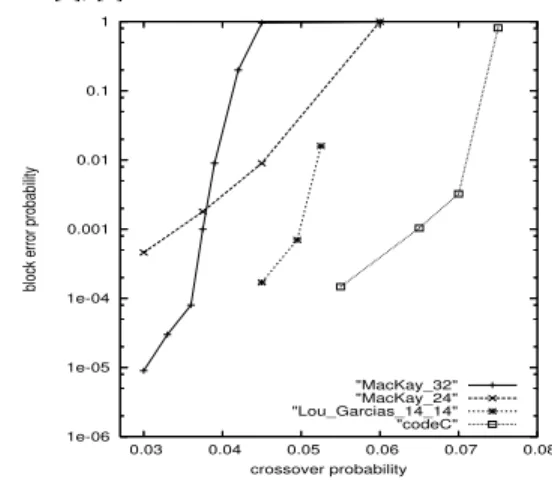
Fig. 4. Performances of C against the performances of other codes of rate
1 4 taken from [8], [9] 1e-06 1e-05 1e-04 0.001 0.01 0.1 1 0.03 0.04 0.05 0.06 0.07 0.08
block error probability
crossover probability "MacKay_32" "MacKay_24" "Lou_Garcias_14_14" "codeC"
Several remarks can be made here
1) The erasure probability threshold is slightly below 0.2
for the(8,16)-code and slightly above0.2for the(6,12)
-code. This should be compared with the erasure proba-bility that the best codes of rate 1
2 can sustain which is 0.25.
2) Code A and B given here show an error-floor which
starts at block error probability of order10−4. This is
due to the fact that they all turned out to have a minimum distance which is12.
3) CodeAandBhave a rather good block error probability
for a crossover probability in the range(0.05−0.055).
This has to be compared with the crossover probability threshold for random stabilizer codes of rate 1
2 which is
of about0.0743. CodeCgives better performances than
the codes of the same rate given in [8], [9]. VI. CONCLUSION
The quantum(6,12)and(8,16)-codes of rate 12 constructed
here look very much like quantum analogs of classical(3,6)
Gallager codes in terms of the noise values they sustain for moderate block error probabilities (say in the range
(10−3,10−1)) both on the quantum erasure channel and on
the quantum depolarizing channel. They already display quite respectable performances in this range. Unfortunately, the error floor starts much earlier in our case than for the classical
(3,6)-code and is due to the rather small minimum distance of
our codes. This does not seem to be an unavoidable problem of our general construction. It seems to be due to the particular choice of groups and group generators. It might be quite interesting to study whether a clever choice of families of groups and group generators would yield a linear minimum distance. The quantum LDPC codes constructed in this article also have associated Tanner graphs with several cycles of size
4(but this was also the case in [8], [9]). However, it should be
emphasized that this is not due to the particular construction chosen here, but that it is a characteristic of all stabilizer codes. This affects iterative decoding performances when the usual SUM-PRODUCT or MIN-SUM algorithm is used. It would be interesting to study how variants of this algorithm (see [15] for instance) would overcome this problem.
Finally, we would like to point out that quantum LDPC codes might be good candidates for constructing fault-tolerant architectures. First, we hope that the minimum distance of these codes increases linearly with the block size, as it is the case for most classical LDPC codes. This would warrant that any finite weight error can be corrected for sufficiently large block sizes. Second, the rate of such codes does not decrease to zero, thus possibly improving the overhead requirements over schemes employing concatenation or toric codes [5].
REFERENCES
[1] D. Aharonov and M. Ben-Or. Fault-tolerant quantum computation with constant error rate. In Proc. 29th. Ann. ACM Symp. on Theory of Computing, 1997. Longer version quant-ph/9906129.
[2] C.H. Bennett, D.P. DiVincenzo, and J.A. Smolin. Capacities of quantum erasure channels. Phys. Rev. Lett., 78:3217, 1997.
[3] A. R. Calderbank, E. M. Rains, P. W. Shor, and N. J. A. Sloane. Quantum error correction via codes over GF(4).IEEE Trans. Inf. Theory, 44:1369, 1998.
[4] T. Camara, H. Ollivier, and J.-P. Tillich. Construction and performance of classes of quantum ldpc codes, 2005.
[5] E. Dennis, A. Kitaev, A. Landahl, and J. Preskill. Topological quantum memory. J. Math. Phys., quant-ph/0110143(9):4452–4505, 2002. [6] D. Gottesman. Stabilizer codes and quantum error correction. PhD
thesis, California Institute of Technology, Pasadena, CA, 1997. [7] L. Ioffe and M. M´ezard. Asymmetric quantum error correcting codes,
2006.
[8] H. Lou and J. Garcia-Frias. On the application of error-correcting codes with low-density generator matrix over different quantum channels. In
Proceedings of Turbo-coding 2006, Munich, April 2006.
[9] D. J. C. MacKay, G. Mitchison, and P. L. McFadden. Sparse graph codes for quantum error-correction. IEEE Trans. Info. Theory, 50(10):2315– 2330, 2004.
[10] H. Ollivier and J.-P. Tillich. Interleaved serial concatenation of quantum convolutional codes: gate implementation and iterative error estimation algorithm. InProceedings of the 26th Symposium on Information Theory in the Benelux, Brussels, Belgium,, 2005.
[11] P. W. Shor. Algorithms for quantum computation: Discrete logarithms and factoring. In S. Goldwasser, editor,Proceedings of the 35th Annual Symposium on the Foundations of Computer Science, pages 124–134, Los Alamitos, CA, 1994. IEEE Computer Society.
[12] P. W. Shor. Scheme for reducing decoherence in quantum computer memory. Phys. Rev. A, 52:2493, 1995.
[13] P. W. Shor and J. A. Smolin. Quantum error-correcting codes need not completly reveal the error syndrome, 1996.
[14] G. Smith and J.A. Smolin. A subexponential time algorithm for the dihedral hidden subgroup problem with polynomial space, 2006. [15] J. S. Yedidia, W. T. Freeman, and Y. Weiss. Constructing free energy
approximations and generalized belief propagation algorithms. Technical Report TR2004-40, Mitsubishi Electric Research Laboratories, 2004.