University of Wollongong
Research Online
Faculty of Education - Papers (Archive)
Faculty of Social Sciences
2005
Technology-supported collaboration on
field-based authentic tasks
Gwyn Brickell
University of Wollongong, [email protected]
J. Herrington
University of Wollongong, [email protected]
Barry Harper
University of Wollongong, [email protected]
Research Online is the open access institutional repository for the University of Wollongong. For further information contact the UOW Library: [email protected]
Publication Details
This conference paper was originally published as Brickell, G, Herrington, J and Harper, B, Technology-supported collaboration on field-based authentic tasks, World Conference on Educational Multimedia, Hypermedia and Telecommunications (EDMEDIA) 2005, Montreal, Canada, 27 June 2005. Copyright Association for Advancement in Computing Education 2005. Original conference information availablehere
Technology-supported collaboration on field-based authentic tasks
Gwyn Brickell, Jan Herrington and Barry Harper
Research in Interactive Learning Environments (RILE) Faculty of Education
University of Wollongong, Australia Email contact: [email protected]
Abstract: The traditional ‘work-sheet’ approach has long been a favoured method for the conduct of field trips and excursions for school students. Such an approach fails to capitalise on constructivist theory and more specifically, collaborative learning, which holds rich potential to engage students and enhance learning on excursions. This paper describes a new approach to school excursions where learners are challenged in multiple learning contexts in a School Excursion Education Program at Sydney Olympic Park. The Park has a wealth of opportunities for the examination of a range of issues other than Olympic sport, such as natural environments, endangered species, pollution and toxic waste disposal, Aboriginal significance, sustainable housing, and design and technology in the built environment. In this project, a technology -based learning environment was developed for an excursion program for schools based on constructivist philosophy and collaborative and situated learning theory.
Introduction
Fie ld trips and excursions, while traditionally hands-on and active by their very nature, have not always been quick to adapt to more constructivist approaches. One could argue that they continue to use a traditional ‘work-sheet’ approach, where complex tasks are typically broken down into more simple and straightforward steps, which students complete individually. Students often finish these tasks without ever having to make choices, and without full understanding of the meaning of the tasks. Such an approach fails to capitalize on the rich opportunities offered by field trips, and fails to acknowledge the benefits to be gained from more collaborative, engaging tasks.
This paper outlines a substantially different approach to field excursions for high school students. It describes the design of a prototype online ‘learner challenge’ involving an excursion to Sydney Olympic Park that is based on a constructivist approach, emphasizing learner collaboration (Crook, 1994). The Parklands at Sydney Olympic Park, while probably best known in recent times as the location of the Sydney Olympic Games in 2000, have a rich and diverse history. The site covers over 400 hectares and consists of a unique mix of natural and made environments including: pristine woodlands, salt marshes and wetlands that play host to a diversity of flora and fauna in close proximity to reclaimed industrial sites and a naval depot, a modern sporting complex and housing and industrial estates. The Parklands are also a place of Aboriginal significance and historic importance. The Sydney Olympic Park Authority (SOPA) is responsible for promoting the historic, scientific, cultural, and educational value of the Parklands. In promoting the educational value of the Parklands, SOPA has embarked upon the development of an innovative School Excursion Education Project (SEEP) creating a unique and imaginative program that has the potential to set new standards in the use of information and communication technologies in learning.
In the past, school visits to the Sydney Olympic Park have followed a conventional excursion model. Teachers wishing to take students to the park would have a choice of pre -determined excursion themes, from which they would choose one, and information on the activities and venue would be forwarded to the school. Variations to the excursion activities could be negotiated to suit individual school requirements. Arrangements would be made to
transport students to the park, and the students would generally have minimal preparation for the tasks they were to perform while at the park, and little follow up later on their understanding of the events that occurred during the day.
An alternative approach to excursions
The new excursion program (described in more detail in Brickell, Lockyer, Herrington, Brown,Harper, 2004) adopts a more radical approach, underpinned by recent learning theory and research. It actively draws on principles of situated and authentic learning to embed investigation of the natural and built environment at the park into realistic problem solving tasks that specifically address curriculum outcomes for the NSW schooling system. It draws on the broad base of research on computer supported collaborative learning to engage students in sustained challenges with their peers, at the small group, school and school visitors level. Rather than see the excursion as a one-off, isolated event, the new approach is to situate the on-site events within the context of a comprehensive pre- and post-visit program. It establishes links between classroom-based and non-classroom based learning and information and communications technologies. New technology has been specifically designed for the excursion site in the form of computer terminals installed at a range of locations (named pods).
Students, with computer access through a collaborative-group-issued smart card, are able to integrate direct observation and experience in this unique physical world with resources held electronically in responding to their learning challenge. Students participating in the excursion program will explore and interrogate targeted databases of learning activities that will support a range of syllabus requirements. In groups, the students will work on a single complex and sustained challenge through related activities in the class, at home, and through a critically timed visit to Sydney Olympic Park. They will engage in work on the web, in class, in the field and in technology pods with an emphasis on student-centred, task driven, collaborative activities that will require them to explore data and information, construct and test hypotheses where appropriate, and present conclusions and solutions in the form of a range of artefacts.
The concept of a learner challenge has been developed to present a single complex and sustained task for each excursion. The task takes the form of a realistic problem that could not be completed within the timeframe typically given to excursion activities. Pre- and post-excursion tasks are necessary to prepare for the excursion and to follow up with the creation of an artefact or product, which represents both the collaborative group understanding of the challenge solution and the individual understanding. Learners, in collaborative groups, accept a challenge and are scaffolded in the initial investigation process before choosing a theme for the research question. Learner groups then develop a research plan through a series of learner tasks, then visit the site for a series of excursion activities before developing their solution/artefact to represent their constructed knowledge as a post excursion activity.
Theoretical foundations of the program
The new excursion program has been designed within a constructivist philosophy, drawing more specifically on situated learning theory and incorporating collaborative learning underpinnings. Technology-supported problem solving embodies many of these elements through emphasis on solving problems in authentic contexts that enhance the development of higher-order thinking skills.
In keeping with this approach, the concept of computer supported collaborative learning (CSCL), drawing specifically on Vygotsky's sociocultural theory of learning, can support the design of learner collaborative tasks. Learner opportunities for clarification of common understandings, shared work activities and collaboratively developed products/artefacts all scaffolded through cognitive support tools (Harper, Hedberg, Corderoy & Wright, 2000) can be effectively implemented through the affordances of web based environments.Collaboration, and the opportunity to collaboratively construct knowledge, are seen as important elements of a situated learning model. A situated learning environment supports the collaborative construction of knowledge (Brown, Collins & Duguid, 1989), but as Hooper (1992) has pointed out, simply placing students in groups will not necessarily result in collaboration. Similarly, group use of computers does not, guarantee collaboration. Katz and Lesgold (1993) point out that collaboration is more than cooperation: ‘Cooperation ... involves a division of labour in achieving a task.
Collaboration happens synchronously; cooperation is either synchronous or asynchronous’ (p. 289). Roschelle and Behrend define collaboration as: ‘the mutual engagement of participants in a coordinated effort to solve a problem together’ (Roschelle & Behrend, 1993, cited in Katz & Lesgold, 1993, p. 289). Jonassen’s (1995) discussion of collaboration also emphasizes learners’ social roles in ‘exploiting each other’s skills while providing social support and modeling and observing the contributions of each member’ (p. 60). Forman and Cazden take this definition even further by suggesting that true collaboration is not simply working together but also ‘solving a problem or creating a product which could not have been completed independently’ (Forman & Cazden, 1985, cited in Repman, Weller, & Lan, 1993, p. 286). Forman and Cazden have also noted that student discourse in solving collaborative problems has shown that students gain new cognitive strategies through peer collaboration by interpersonal discourse, yet as their understanding of a problem grows and the initial support, encouragement and guidance of peers offers additional confidence, learners can move to articulate their own argument and resolve conflict. The implications for design of the learning environment and learner scaffolding will be drawn from these theoretical considerations and research findings to develop cognitive tools to support learner collaboration at multiple levels.
In this context cognitive tools will be considered as tools that can assist learners to accomplish cognitive tasks. Such tools have been described in the literature by writers such as Pea (1985), who proposed the term cognitive technologies and Salomon, Perkins and Globerson (1991), who used the term technologies of the mind. Likewise, Jonassen (1996) described cognitive tools as technologies that enhance the cognitive powers of human beings during thinking, problem solving and learning and has used to term mindtools. Lajoie (1993) has proposed that such tools can be classified according to the function they serve. She has proposed that cognitive tools can assist learners when they support cognitive processes, such as, memory and metacognitive processes, share the cognitive load by providing support for lower level cognitive skills so that (cognitive) resources are left over for higher order thinking skills, allow the learner to engage in cognitive activities that would be out of reach otherwise, and allow learners to generate and test hypotheses in the context of problem solving (Lajoie, 1993, p. 261). Jonassen and Reeves (1996) proposed that cognitive tools are best used as reflection tools that amplify, extend, and even reorganize human mental powers, in order to help learners construct their own realities and complete challenging tasks. They summarized the foundations for cognitive tools research, as:
• Cognitive tools will have their greatest effectiveness when they are applied to constructivist learning environments.
• Cognitive tools empower learners to design their own representations of knowledge rather than absorbing knowledge representations preconceived by others.
• Cognitive tools can be used to support the deep reflective thinking that is necessary for meaningful learning.
• Ideally, tasks or problems for the application of cognitive tools should be situated in realistic contexts with results that are personally meaningful for learners. (Jonassen & Reeves 1996, p. 698)
If students are to create their own meanings and understandings of the phenomena they encounter in this environment, then tools that will enable them to present their findings are essential to this project. Within this overall underpinning framework a complex and realistic task is the central focus of both the excursion and other pre- and post-excursion activities. A generic problem solving approach—based on models proposed by Bransford and Stein (1992) and Jonassen (1997)—is used to focus students’ efforts on the challenge and the development of possible solutions. The design guidelines and technologies used are customized for different purposes in each stage, as described below.
Pre-excursion tasks
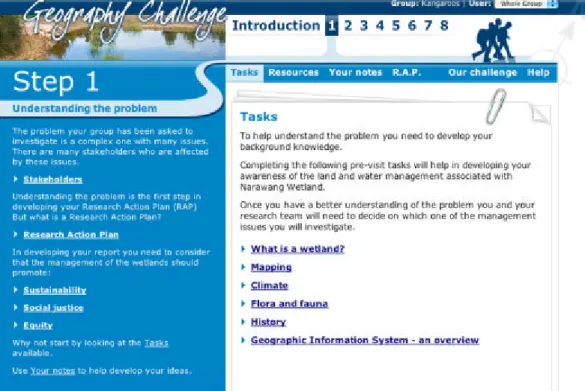
Pre-excursion tasks begin several weeks before the on-site visit to Sydney Olympic Park, and from the beginning, collaboration between students is used to analyze and assess the problem. Student engagement begins through the posing of an authentic sustained challenge (Figure 1), which sets the parameters for the scope of the investigation, without specifying step by step how the challenge should be resolved. It also provides brief information on the artefact or product that the students will prepare, and the context and nature of the presentation of their findings.
In groups, students have the opportunity to investigate a range of online tasks prior to their on-site excursion to the Park. These tasks support the first steps in a research action plan, such as: exploring the scope of the problem, generating research questions, deciding on the data that will be required to answer the questions, and identifying data collection strategies. In completing these tasks, students have access to a variety of resources that present diverse viewpoints and interests, as well as expert opinion and comment. The students work collaboratively in groups with support from both their own teacher and with in-built scaffolding and prompts on the website. The processes that students typically utilize in this stage are brainstorming, problem definition and general background research, together with decision-making on the data that are required and how they will be collected.
Technology and tools are used extensively within the collaborative learning environment, and include access to the Sydney Olympic Park excursion website (documents, photographs, maps, video and audio resources, and GIS mapping technology), brainstorming tools such as concept map software/templates, and research tools such as web browsers and library resources.
Figure 1:- Setting an authentic challenge for learners as the first step in pre-excursion activities
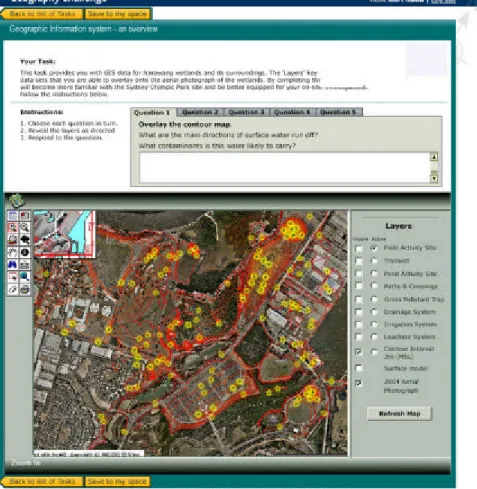
Use of a Geographic Information System (GIS) is an example of a specific contributing task designed to build user understanding. Students have an opportunity to interrogate the infrastructure of wetland through visualizing, manipulating and analysing spatial representations to gain a better understanding of the problem-related theme under investigation. Geographic data is gathered and organized to support the investigation and students choose from a range of layers. Each layer represents a particular feature of the Narawang wetland at the Park and is linked to focus questions that help scaffold student inquiry (Figure 2). This tool is also available in both the on-site and post-visit phases of the Ch allenge.
Products from this pre-visit stage include the definition of the problem and research parameters, and the required data. A group space is provided on the website for storing the deliberations and products of each group and this information is accessible both at the site and through the school accessible web site.
On-site activities
On-site at Sydney Olympic Park, data is collected, through student engagement in a range of fieldwork activities, and stored in a retrievable form. Students rotate in their groups between data collection onsite and data inputting activities in the computer terminals in the pods. In this phase, additional theoretical principles apply that draw from literature and research on field trips, nature trails and excursions (e.g., Landis, 1996; Trust, 1991) and from theory relevant to learning from museums —informal or free-choice learning (Falk, 2004; Anderson & Lucas, 1997). Emphasis in this stage is on effective preparation through the use of advance organizers, efficient data collection strategies and effective use of tools and technology in the pods for data entry and initial analysis. Tools used for data collection include navigation aids such as maps and compasses, observation and measurement tools such as magnifying glasses, measuring tapes and thermometers, and recording tools such as data sheets, video and digital cameras. The activities at the site are designed for learners to explore their challenge further in the site setting, collect data in the field and analyze that data at the pods located at the site. In the pods, information is location specific and easy to read, as time is limited and data must be entered quickly and efficiently. Students are able to enter their own group data and compare their findings to other groups on the same day, as well as to historical data.
Figure 2:- A student task that makes use of a Geographic Information System to help students visualize, analyze and manipulate spatial representations of the Narawang Wetland.
Learners enter the data they have collected then explore and analyze it, reflecting on their understanding in relation to the learner challenge. In this analysis, they are given two levels of scaffolding which they can choose to use. At the first level, students are given a collaborative workspace to explore their understanding of their data (and how it
relates to the data of other groups at the park and to historical data) under three broad headings: Analysis/comment, Theme focus, and Summary. At the next level, questions are provided to prompt their thinking, such as: ‘One solution for reducing mosquitoes in the Narawang Wetlands is to use chemical sprays. How do you think different interest groups would see this approach?’ If they so choose, students can access further prompt questions such as ‘How do you think local residents would react? Do you think they would be pleased that something was being done or do you think they might object to spraying potentially dangerous chemicals near their homes and schools? What about regular visitors to the park? What about ecologists and environmentalists?’
The product from this stage is data and preliminary analysis of that data in a form that is retrievable from the Sydney Olympic Park website via the home school location. The data entered at the technology pods is saved to a server, and is then available to students on return to school to continue with the completion of their research plan and report. At this point the data collected by each group is shared across all groups while the analysis and group comment is accessible only by that group. In respect to the curriculum content, this initial prototype is focused on geography and in this context the students treat the data they have collected as a primary source of data, while the data collected by other groups is considered to be secondary data.
Post-excursion tasks
The post-excursion tasks focus on completion of the research action plan by guiding students to further analyze their data, draw conclusions and make recommendations. In these stages, students collaboratively work towards the creation of a polished product, such as a report, a video or a presentation, to present their findings and recommendations. Tools used in this stage include research analysis tools such as spreadsheets, word processors, and calculators, and presentation tools such as Powerpoint, web authoring tools and video-editing software. The product of the final stage is the culmination of the entire challenge.
Formative evaluation of the Geography Challenge
A formative evaluation of the website component of the excursion challenge has been conducted with two sample groups of Year 10 Geography students (17 in total) who volunteered for the study. Additionally two of their teachers, who also gave advise to the design team on activities and curriculum issues, were interviewed. The purpose of formative evaluation according to Reeves and Hedberg (2003) is to gather information ‘to guide decisions about creating, debugging, and enhancing an interactive learning system at various stages of its development’ (p. 60). Accordingly, the formative evaluation was designed to inform decisions on the future development and refinement of the learning environment. In particular, the study was designed to investigate:
• Whether the intended benefits of the overall approach were realised.
• Whether the activities need to be adapted or redesigned for the target group.
• Whether the interface and individual screens should be adapted or redesigned.
• Whether the underlying pedagogy is instantiated in the learning environment.
The formative evaluation was effectively limited to student’s impressions of the excursion challenge and tasks, as the evaluation took place over 90 minutes, while the excursion program in its entirety would normally be conducted over a period of several weeks. Nevertheless, students were able to immerse themselves in the idea of the overall
challenge and attempt many of the interactive tasks. Students completed the activities in pairs, as in the intended collaborative groupings of the fully implemented challenge, and they were able to share their ideas as they worked through the problem. Again for the two teachers interviewed the formative evaluation is limited to their impressions of the site, but the teachers also observed their students working on the site and were also involved in advising the project design team on tasks that may be used, links to state curricula and the use of the Geography Research Action Plan.
As students worked they were asked to note down specific usability issues, and for the last 20 minutes of the session, they were asked to participate in group interviews. There were three major themes explored in these focus groups: the overall appearance and appeal of the site, usability issues, and the nature and ext ent of collaboration. The same issues were explored with the students’ teachers.
An analysis of transcripts of interviews revealed that students generally perceived value in the authentic nature of the challenge. For example, one student reported: ‘It’s pretty helpful that this is for real … you had to do it … for real’. The authentic nature of the task reflected the situated learning theory that guided the design of the environment, giving some indication that the excursion program instantiates the underlying theory of the program.
Some students reported initially being uncertain as to how to proceed with the challenge, and requested that more explicit and direct instructions be given on exactly what needed to be done. The environment has been designed as a complex and realistic one, where students are required to propose the steps required to solve the problem, rather than be given step -by-step instructions. Again this response indicates that by failing to provide such direct instructions, the environment is true to its theoretical foundations. The teachers supported the student views arguing that they believed the navigation was well structured and easy to use and that there was an appropriate balance of instruction and a need for students to explore the site beyond this instruction. The teachers in particular noted that the
implementation of the Research Action Plan from the Geography syllabus would "…make it easier for students to understand." what is seen by teachers as a difficult concept.
The study revealed many practical issues that will improve the usability of the program and undoubtedly increase its appeal to the target group when implemented.
The collaborative nature of the environment was generally one that was valued by the participants, both within and between groups as well as by the teachers. The joint decision-making and reflection on the tasks appeared to assist students with the complex nature of the challenge. As one student pointed out: ‘You got to talk it out. Each had different ideas and you had to think about the consequences of that idea’.
Such valuable feedback will inform refinements to the website, and provide some confirmation that the underlying pedagogical theory is realized within the challenge, and that the collaborative approach is positive and effective within this context.
Conclusion
The learning activities and interactions designed for this project are being constructed within the framework of the New South Wales, Australia, school curriculum and the educational philosophy and pedagogical description of the educational setting at Sydney Olympic Park. However, the project also draws on recent research and theory that informs design in relation to how people learn in different educational contexts and settings. The range of contexts presented in an onsite visit, embedded within extensive pre-and post- visit tasks, provides a significant design challenge. Situated cognition, as a general theory of knowledge acquisition, has particular relevance to this development where the ‘learning challenges’ are presented as a function of the activity, context and culture in which they occur. Collaborative endeavour is a crucial aspect of this situated approach, not only in its own right, but also as a vehicle for many other important aspects of the model, such as articulation and reflection. Students in collaborative groups are better able to articulate and reflect on their growing understanding of complex problems, than individuals who silently explore the same problems from a single perspective.
References
Anderson, D., & Lucas, K.B. (1997). The effectiveness of orienting students to the physical features of a science museum prior to visitation. Research in Science Education, 27(4), 485-494.
Brickell, G., Lockyer, L., Herrington, J., Brown, G., & Harper, B. (2004) A Technology Supported Visitation Program to the Sydney Olympic Park: Learner Challenges and Teacher Support. In Lorenzo Cantoni & Catherine. McLoughlin (Eds.) Proceedings of ED-MEDIA2004 World Conference on Educational Multimedia, Hypermedia and Telecommunications (pp. 4683-4689). Norfolk, VA: Association for the Advancement of Computing in Education.
Brown, J. S., Collins, A., & Duguid, P. (1989). Situated cognition and the culture of learning. Educational Researcher, 18(1), 32-42.
Crook, C. (1994). Computers and the collaborative experience of learning. London: Routledge.
Falk, J. (2004). The director's cut: Toward an improved understanding of learning from museums. Science Education, 88(1), 83-96.
Harper, B., Hedberg, J., Corderoy, R.. & Wright, R. (2000). Employing cognitive tools within interactive multimedia applications. In S.P. Lajoie (Ed.), Computers as cognitive tools: The next generation (pp. 227-245). Mahwah, NJ: Lawrence Erlbaun Publishers.
Jonassen, D. H., & Reeves, T. C. (1996) Learning with Technology: Using Computers as Cognitive Tools. In D. H. Jonassen, (Ed.) Handbook of Research on Educational Communications and Technology. New York Scholastic Press in collaboration with the Association for Educational Communications and Technology, Chapter 25
Jonassen, D.H. (1997). Instructional design models for well-structured and ill-structured problem-solving learning outcomes.
Education Technology Research & Development, 45(1), 65-94
Katz, S., & Lesgold, A. (1993). The role of the tutor in computer-based collaborative learning situations. In S.P. Lajoie & S.J. Derry (Eds.), Computers as cognitive tools (pp. 289-317). Hillsdale, NJ: Lawrence Erlbaum.
Lajoie, S.P. (1993). Computer Environments as Cognitive Tools for Enhancing Learning. In Lajoie,S.P.and Derry, S.J. (Eds.)
Computers as Cognitive Tools. Hillsdale. NJ:Erlbaum, pp. 261-288.
Landis, C. (1996). Teaching science in the field (ED 402 154). Columbus: ERIC Clearinghouse for Science Mathematics and Environmental Education.
Pea, R. D., (1985) Beyond Amplification: Using the Computer to Reorganize Mental Functioning, Educational Psychologist,
20(4), 167-182
Repman, J., Weller, H. G., & Lan, W. (1993). The impact of social context on learning in hypermedia-based instruction. Journal
of Educational Multimedia and Hypermedia, 2(3), 283-298.
Salomon,G., Perkins, D.N., & Globerson,T., (1991). Partners in cognition: Extending human intelligence with intelligent technologies. Educational Researcher, 20, 10-16