1
© Global Society of Scientific Research and Researchers http://asrjetsjournal.org/
Influence of Documentation of School Facilities on Pupils’
Performance in Kenya Certificate of Primary Education
John M. Mbunde
*Senior Lecturer, School of Education Presbyterian University of East Africa, Nairobi, Kenya
Abstract
The paper discusses the influence of documentation of school facilities on pupils’ performance in KCPE. The research objective was to assess the extent to which documentation of school facilities influences pupils’ performance in KCPE. The study employed descriptive survey design. The schools selected were 14 from Westland and Dagoretti districts and 13 from Lang’ata district through simple random sampling. The 41 head teachers and 41 senior teachers from each school were selected by census. The research instruments used were the two sets of questionnaires for the head teachers and senior teachers. Validation of both instruments was done by the expert judgment review by supervisors from the Department of Educational Administration and Planning of the University of Nairobi. The reliability coefficient of the research instruments was determined by split-half method, and was found to be 0.73 and 0.88 for the head teachers’ and senior teachers’ questionnaires respectively. Descriptive statistics was used to analyze the data which was presented in tables. The finding was that the schools with very adequate documentation of facilities had the best KCPE results mean grade. Thus, it was concluded that very adequate documentation of facilities positively influenced pupils’ performance in KCPE. The following recommendation was put forward: The Directorate of Quality Assurance and Standards in collaboration with the head teachers, teachers and Board of Management should carry out regular supervision of schools, in particular, on documentation of facilities to enhance quality management.
Key words: Facility; Influence; Performance; Primary Education.
1. Introduction
Background to the study
The author in [12] noted that among the options for the future success of education in Europe and Central Asia is effective management of facilities. This can be achieved by sharing common facilities across schools such as playgrounds, swimming pools, libraries and laboratories.
--- * Corresponding author.
2
Also, there should be use of incentives to reduce negligence of facilities to encourage and reward good school management of facilities. The author in [5] stated in the study on management of facilities in the United Kingdom, when games facilities are used they enable the less able children to stay on task and remain motivated for a longer period. The author in [21] pointed out that in an empirical study in Nigeria, the essential facilities such as equipment like radio, television, computer, chemicals, specimens, radio tape, stove, Bunsen burners, models and charts were not available in schools. The author in [30] indicated that in Kenya a maximum of six textbooks are approved from which a school chooses one textbook per subject.
The authors in [8, 9] argued that the decline in performance in schools is related to poor learning environment created by inadequacy of the schools facilities. The author in [38] noted that in Latin America, Africa and poor countries, the majority of the teachers not only lack adequate hardware and software, but also reliable internet access. The author in [16] stated that the availability and adequacy of school facilities promote effective teaching and learning process.
The author in [2] asserted that some schools have adequate laboratories, workshops, libraries, and other facilities for effective teaching and learning, others have none, and where they exist they are poorly equipped. While some classes are held under trees and pupils are exposed to harsh weather conditions others are held in air conditioned classrooms. It is therefore, imperative that different levels of Government have to address the issue of development and implantation of minimum standards of school management of facilities.
The author in [22] indicated that child has a right to education. The Children’s Act which came into force on 1st
March, 2002 vests this responsibility on the Kenya Government and parents.
The authors in [18] pointed out that Education has been found to play a major role in social, political, economic and cultural aspects of a country. The authors in [29] indicated that Education provides critical mass of skilled people needed to enhance the environment which is in line with the Millennium Development Goal No.1. The authors in [31, 37] noted that incidences of poverty fall and levels of private returns increase with increase in education level from primary to secondary.
The authors in [24] stated that there has been criticism on the way the school facilities are managed in Kenya by head teachers. The authors in [25] indicated that the head teachers have to be equipped with relevant knowledge, skills and competences to perform management duties which include planning, organizing, staffing, directing, coordinating, reporting and budgeting. The author in [31] stated that the implementation of Free Primary Education in Kenya found head teachers had not been adequately prepared for the change and therefore, found it challenging.
The author in [1] asserted that despite the heavy investment in education, management capacity remains ineffectively developed. The author in [20] pointed out that Just as societal and school demographics have changed in recent decades, so has the type of leadership needed to successfully head the rapidly changing school of this century. The authors in [6, 10, 13, 14] noted that it is undisputed that the head teacher is the most significant factor in enhancing school performance. The authors in [11] stated that successful and dynamic
3
schools can quickly slide backwards with the departure of a successful head teacher. The author in [33] argued that head teachers are critical in ensuring that school management efforts are successful.
The authors in [35, 36] indicated that the primary education ushers pupils to secondary schools. The KCPE taken at the end of eight years of primary education is used to select those to join secondary school. The kind of secondary school one will join depends on the total marks obtained at KCPE. Those who score the highest go to the national schools, second best go to provincial schools and the third join the district schools. All these schools are different in terms of school facilities. The national schools have the best, followed by provincial and district schools. The costs of schooling in the form of direct fees and indirect charges serve as a deterrent to Universal Primary Education can be found in the huge spurts of enrolment.
The author in [34] stated that Kenya, Uganda and Tanzania have fees and cut costs of schooling with positive results for enrolment. However, the cost of uniforms, supplementary reading books and some stationery often
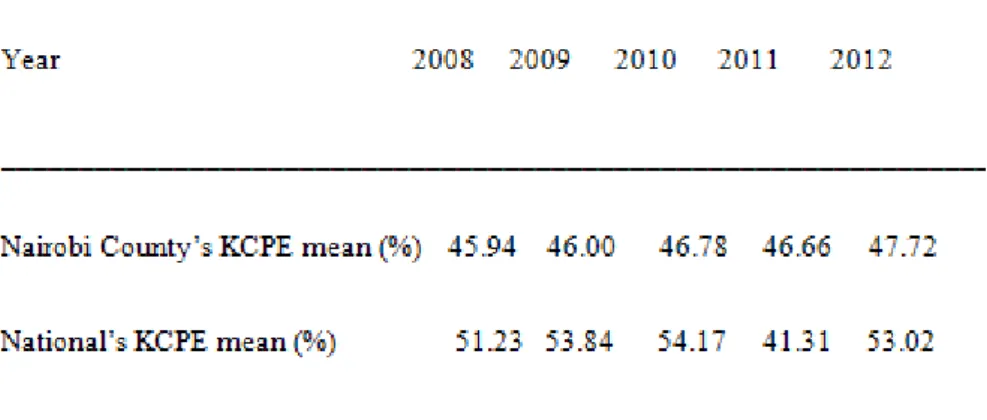
add a more significant cost than tuition fee. The author in [27] argued that the Free Primary Education policy posed a serious hindrance to children wanting to access education in schools. The author in [23] The significance of Kenya Certificate of Primary Education (KCPE) is to: serve as a feedback to the education planners, Kenya National Examinations Council, teachers, pupils, parents and other stakeholders; planners can use it to modify, introduce or drop a topic or subject; screening/selection, for further studies, training; research work and certification. The pupils’ performance in KCPE (Years 2008 to 2012) in Nairobi County and nationally is shown in Table 1.
Table 1: Pupils’ performance in KCPE (Years 2008 to 2012) in Nairobi County and nationally
Source: The year 2012 KCPE examination report (Kenya National Examinations Council, 2013)
The data in Table 1.1 indicates fluctuation of pupils’ performance in KCPE in Nairobi County and nationally in the same period (Year 2011). In addition, the pupils’ performances in KCPE mean scores for the County were
below average (less than 50.0 percent) compared with the national performance in the same period.
The author in [3] noted that the national goals of education in Kenya and the primary education level objectives reflect the importance of primary education. In particular, the objectives of primary education are carried out in
4
producing Kenyans who have knowledge and skills that enables them to fit in the society. This is reflected in many key Government documents. Key among them is the National Development Plan of 2002-2008 in which the Government has identified education as key to the attainment of the Millennium Development Goals and Education For All.
The author in [39] stated that they acknowledge that a weak educational foundation will seriously impair a nation’s development progress. Effective primary education is a rock-bottom necessity for development. The effects of primary education in development are largely a result of the cognitive skills: literacy, numeracy and problem solving. Poor primary schools compromise the entire system for human capital development. They provide graduates who are poorly prepared for secondary and tertiary education and ill-equipped for life-long learning. The consequence is an insufficient number of truly educated managers, workers and parents who can effectively contribute to development. The most effective sign of ineffective primary education systems are
inadequate enrolments, low primary completion and low pupil achievement.
The authors in [1] asserted that the mass media analyze, and publish KCPE results and have to rank and highlight the schools which have performed well. The author in [7] argued that the quality of education in Kenya is examination oriented. The quality of education is seen in terms of pupils passing national examinations. Therefore, there was the need for the study on the influence of documentation of school facilities on pupils’ performance in KCPE in Nairobi County, Kenya.
The authors in [21] pointed out that documents are useful for accountability and transparency in particular, during supervision and auditing by the Directorate of Quality Assurance and Standards and auditors respectively from the Ministry of Education Science and Technology. The authors in [28] indicated that the documents are often useful very early in the research for providing background of what is known and helping in the development of hypotheses. But they can also be a source of data, either on their own or in addition to surveys, observations, and/or informant interviews.
The authors in [21] pointed out that at school level documents help in reference, auditing, accountability and transparency in management of facilities. The following documents can be utilized in schools: General ledger is a group of accounts. It shows the various accounts in management of facilities for the Ministry of Education Science and Technology auditors. This has an influence on KCPE performance depending on the feedback of the auditors; delivery note accompanies the school facilities delivered. The head teacher checks the school facilities delivered and the contents of the delivery note against the original order to ensure that supplies are according to order; invoice contains the quantities and description of the facilities supplied and their prices and receipts are issued to the head teachers when they pay cash for school facilities supplied. No person should collect school levies without issuing an official receipt.
The author in (4) argued that consumable inventory is the types of facilities which lose their shape, function or form in the process of use like stationery. These stores ledgers are constantly used therefore; we can have more than one in a year. It is however, important to keep the school records up- to- date even if more record books will be needed; admissions register is a permanent record book in which every child’s name is written on the
5
first day she/he becomes a pupil of that school. The admissions register becomes useful when some of the old pupils write back to the school for letters of recommendations for certain appointments. The attendance notice board provides a quick way of knowing the situation in the school as far as attendance is concerned on any particular day.
The author in [7] noted that the quality of education is seen in terms of pupils passing national examinations hence, examination oriented. Therefore, the paper discusses t of school facilities and the influence on pupils’ performance in KCPE.
2. Statement of the problem
The authors in [23] noted that the increases in enrolment due to the success of Free Primary Education has put pressure on existing school facilities which has in many ways differed from lack of investment over a number of years with tangible influence at KCPE level. Although priorities vary significantly from school to school, the majority of the schools have overcrowded classrooms and inadequate water and sanitary facilities and a huge deficit of furniture. The requirement for additional investment in primary school facilities is particularly acute in
urban slums and the poorest areas in Kenya.
In some of these ASAL areas primary school enrolment remains low and inadequate school facilities is one of the barriers to pupils’ learning process The authors in [21] stated that the Government of Kenya has to uphold the overall policy for quality improvement of education and training to reduce the cost of education to the households through the provision of teachers, school facilities, grants to schools to cover operational and maintenance expenses under the Free Primary Education policy. Needs-based capitation grants have to be allocated to primary schools.
3. Objectives of the study
The study addressed the following objective:
To assess the extent to which documentation of school facilities influences pupils’ performance in KCPE.
4. Limitations of the study
Some respondents may not have been honest. However, the researcher solved this problem by carrying out interviews with the accounts’ clerks and document analysis guide for verification purposes. In addition, the researcher assured the respondents that he was bound by ethical considerations and as such their responses would be used for the study only and their identities would be treated with strict confidence.
5. Research methodology
The study employed descriptive survey designbecause it allowed collection of data on head teachers’ academic
6
The schools selected were 14 from the Westland and Dagoretti districts and 13 from Langat district through simple random sampling. The 41 head teachers and 41 senior teachers from each school were selected by census from the selected schools. The research instruments consisted of the head teachers and senior teachers questionnaires. Validation of both instruments was done by the expert judgment review by supervisors from the Department of Educational Administration and Planning of the University of Nairobi. The reliability coefficient of the research instruments was determined by split-half method, and was found to be 0.73 and 0.88 for the head teachers’ and senior teachers’ questionnaire respectively.
The authors in [4] argued that data analysis entails making sense of the massive amount of data, reduces the volume of information, and identifies significant patterns and constructing a framework for communicating the evidence of what the data revealed. The researcher carried out editing to check the logic of the answers, consistency and relevance of the responses to the items in both questionnaires. Thereafter, coded, entered and processed the data using Statistical Package for Social Sciences (SPSS) version 20 computer software. Descriptive statistics (measures of central tendency (mode, mean and median) and distributions (frequencies and percentages) techniques were utilized to analyze the data which was presented in tables.
6. Research finding and discussion
Research Question:To what extent does documentation of school facilities influences pupils’ performance in KCPE?
Documents refer to school records kept by the head teachers in facilities’ management. The level of
documentation of facilities by the head teachers was included in the study to determine how they influence
pupils’ performance in KCPE. The senior teachers were asked to rate their head teachers’ level of
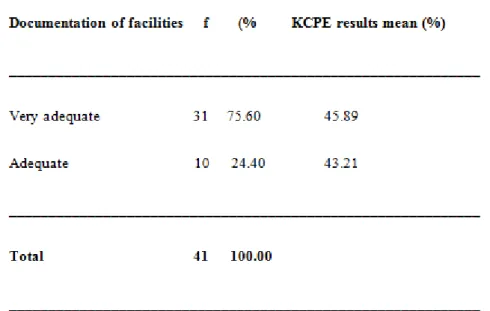
documentation of facilitiesmanagement of facilities that influence pupils’ performance in KCPE and the results
are shown in Table 2.
7
The data in Table 2 indicates that the schools with very adequate documentation of school facilities had the best
KCPE results mean grade (45.89 percent) while those with adequate school facilities had 43.21 percent.
7. Conclusion
Considering the findings of the study the following conclusion was drawn:
The study established that the schools with very adequate documentation of facilities by the head teachers in management of facilities had the best KCPE results mean grade. Thus, very adequate documentation of facilities positively influenced pupils’ performance in KCPE.
8. Recommendation
On the basis of the findings of the study the following recommendation is put forward: The Directorate of Quality Assurance and Standards in collaboration with the head teachers, teachers and Board of Management should carry out regular supervision of schools, in particular, on documentation of facilities to enhance quality management.
References
[1]. Abagi, O. & Odipo, G. (1997). Discussion paper No. 004/97. Nairobi: Institute of Policy analysis and research.
[2]. Asiabaka, P. I. (2008). The need for effective facility management in schools in Nigeria. New York
science journal. 2008:1(2) 10-21. Retrieved on 20th July, 2013 from http//www.sciencepub.org.
[3]. Ayot, H. O. & Briggs, H. (1992). Economics of education. Nairobi: Education Research and
Publications.
[4]. Best, J. W. & Khan, J. V. (2004). Research in education (7th ed.). New Delhi: Prentice Hall. London: Mission Book Service.
[5]. Denyer, G. (1998). Science games in the national curriculum. Science Education Newsletter, 140, 5-6.
[6]. Dinham, S. (2004). “Principals’ leadership for outstanding outcomes”. Journal of Educational
Administration, 43 (4), 338-356.
[7]. Eshiwani, G. S. (1993). Education in Kenya since independence. Nairobi: East African Publishers,
Kenya.
[8]. Fabayo, O. R. (1998). Evaluation of some aspects of schools quality in secondary schools in Kwara
state. Unpublished PhD, Thesis. Ibadan: University of Ibadan.
[9]. Farombi, I. (1998). Resources concentration utilization and management as correlates of pupils’
learning outcomes study of quality in oyo state. Unpublished PhD, Thesis. Ibadan: University of Ibadan.
[10]. Gentilucci, J. L. (2007). Principals’ influence in academic achievement. The student perspective. The
national association of secondary schools principals, bulletin September, 2007. Retrieved on January,
14th 2014 from ProQuest Educational Journal, htt://Proquest.uni.com.library.
8
[11]. Hargreaves, A. & Fink, D. (2004). “The seven principals of sustainable leadership”. Educational
Leadership, 61 (7), 8-13.
[12]. Heyneman, P. (1994). Education in Europe and Central Asia region :poleis of adjustment and
excellence. London: World Bank.
[13]. Janereette, D. &Shereetz, K. (2007). School leadership and student achievement. Educational Policy
Brief. Retrieved on February 5th, 2014 from http://www.educ.de].edu].
[14]. Kearney, K. (2005). “Guiding improvements in principal’s performance” Educational Leadership, 35
(1), 18-21.
[15]. Kenya National Examinations Council. (2013). The year 2012 KCPE examination report. Nairobi:
KNEC.
[16]. Mapaderun, O. (2002). Teaching method of business, social science and technical education. Ibadan:
Holyem Communications.
[17]. Maranga, J. S. (1992). Suggestions for improving teaching, learning, administration and supervision.,
future perspectives on teacher preparation for Basic Education For All for the 21st Century. Basic
Education Forum.
[18]. Mbeche, F. & Nderitu, A. (2005). Educational policy and Planning. The Flemish association for
development and technical assistance, 2005, Nairobi.
[19]. Mbiti, D. M. (2003). Foundations of school administration. Nairobi: Oxford University Press.
[20]. Meleod, I. N. (2008). Exploring the relationship between school leadership and middle school
mathematics achievement: an examination of leadership practices of principals. Unpublished PhD, Dissertation. Maryland: University of Maryland, College Park.
[21]. Ministry of Education. (2013), Basic Education Act, 2013. Nairobi: Ministry of Education.
[22]. Ministry of Education. (2010), Elimu News issue No. 5. Nairobi: Ministry of Education.
[23]. Ministry of Education. (2007), Kenya education sector support programme. “School infrastructure
technical handbook”. School infrastructure management unit. Version one 2007. Nairobi: Ministry of Education.
[24]. Musera,G., Achoki, J. & Mugasia, E. (2012). Perception of secondary school teachers on the Principals’ leadership styles in school management in Kakamega Central District, Kenya. Implications for Vision 2030. International Journal of Humanities and Social Science, Vol. 2 No.6 (Special issue March 2012)
[25]. Ngaroga, M. (2001). PTE revision education. Nairobi: East African Publishers.
[26]. Nwoji, J. R. (1999). Evaluating the use of learning resources for primary science education.
Implications for learners: 40th annual conference proceedings of STAN, 245-249.
[27]. Okwach, A. & George, O. (1997). Efficiency of primary education in Kenya:
situational analysis and implications for educational reform. Nairobi: Institute of Policy Analysis and Research.
[28]. Peil, M. (1995). Social science research methods. A handbook for Africa (2nd ed.). Nairobi: East Africa Educational Publishers.
[29]. Republic of Kenya. (2007). Handbook for inspection of educational institutions. Nairobi: Government
Printers.
9
instructional materials. Nairobi: Government Printers.
[31]. Republic of Kenya. (2005). A policy framework of education, training and research. Sessional Paper
No. 5. Nairobi: Government Printers.
[32]. Republic of Kenya. (2002). Report of the sector review and development direction. Nairobi:
Government Printers.
[33]. Rutledge, L. (2009). Teacher leadership and school improvement: a case study of teacher participating
in the teacher leadership network a regional service education centre. Unpublished PhD, Dissertation. San Marcos: Graduate Council of Texas State University.
[34]. Subrahmanian, R. (2007). Gender in primary and secondary education. A handbook for policy makers
and other stakeholders. London: Commonwealth Secretariat.
[35]. Tomasevski, K. (2006). Free and compulsory education for all children the gap between promise and
performance. Rights to education printers, No. 2.
[36]. UN Millennium Project. (2005). Towards universal primary education, investment, incentives and
institutions. Taskforce on education and gender equality. New York: UN Millennium Project.
[37]. UNESCO (2005). Challenges of implementing free primary education in Kenya: assessment report,
Kenya. Nairobi: Ministry of Education.
[38]. World Bank. (2006). How do ICT education institutions contribute to the millennium
development goals? Retrieved on 6th May, 2013 from www.worldbank. Org|website|external|topics.
[39]. World Bank. (1995). Policy paper on primary education. Nairobi: World Bank.