INFLUENCE OF CLASSROOM LEARNING ENVIRONMENT ON LOWER PRIMARY SCHOOL PUPILS’ PERFORMANCE IN SOCIAL STUDIES
IN MAKUENI COUNTY, KENYA
MAKAU MATHIAS WAMBUA E55/CE/23737/2012
A RESEARCH THESIS SUBMITTED IN PARTIAL FULFILMENT FOR THE AWARD OF THE DEGREE OF MASTER OF EDUCATION, DEPARTMENT OF
EARLY CHILDHOOD STUDIES IN THE SCHOOL OF EDUCATION, KENYATTA UNIVERSITY
DECLARATION
I declare that this thesis is my original work and has not been presented in any other
university/institution for consideration. This research thesis has been complemented by
referenced sources duly acknowledged. Where text, data (including spoken words),
graphics, pictures or tables have been borrowed from other sources, including the
internet, these are specifically accredited and references cited in accordance in line with
anti-plagiarism regulations.
Signature ……….. Date ……….………
Makau Mathias Wambua E55/CE/23737/2012
This research thesis has been submitted for appraisal with our approval as university
supervisors.
Signature ……….. Date ……….………
Dr. Nyakwara Begi Senior Lecturer
Department of Early Childhood Studies, Kenyatta University
Signature ……….. Date ……….………
Dr. Catherine Gakii Murungi Senior Lecturer
DEDICATION
ACKNOWLEDGEMENT
First and foremost my gratitude goes to my supervisors Dr. Nyakwara Begi and Dr.
Catherine Gakii Murungi for their positive critics, motivation and intellectual guidance
which saw me through the writing of this research thesis. I also thank my colleagues
more sincerely Mr. Julius Kisendi who assisted me through discussion and critiquing my
TABLE OF CONTENTS
DECLARATION... ii
DEDICATION... iii
ACKNOWLEDGEMENT ... iv
LIST OF TABLES ... viii
LIST OF FIGURES ... ix
ABBREVIATIONS AND ACRONYMS ... x
ABSTRACT ... xi
CHAPTER ONE: INTRODUCTION AND CONTEXT OF THE STUDY ... 1
1.0 Introduction ... 1
1.1 Background to the Study ... 1
1.2 Statement of the Problem ... 4
1.2.1 Purpose of the Study ... 6
1.2.2 Objectives of the Study ... 6
1.2.3 Research Questions ... 6
1.3 Significance of the Study ... 7
1.4 Delimitations and Limitation of the Study... 8
1.4.1 Delimitation of the Study ... 8
1.4.2 Limitation of the Study ... 9
1.5 Assumption of the Study ... 9
1.6 Theoretical and Conceptual Frame Work ... 9
1.6.1 Theoretical Framework ... 10
1.6.2 Conceptual Framework ... 12
1.7 Operational Definition of Terms ... 15
CHAPTER TWO: LITERATURE REVIEW ... 16
2.1 Introduction ... 16
2.2 Availability of Teaching Learning Materials and Pupils’ Performance in Social Studies ... 16
2.4 Availability and use of Physical Facilities and Pupils Performance in Social studies 22
2.5 Strategies to Improve Pupils’ Performance in Social studies ... 24
2.6 Summary of Literature Reviewed ... 26
CHAPTER THREE: RESEARCH DESIGN AND METHODOLOGY ... 27
3.0 Introduction ... 27
3.1 Research Design... 27
3.2 Variables ... 27
3.2.1 Independent Variable ... 28
3.2.2 Dependent Variable ... 29
3.3 Location of the Study ... 30
3.4 Target Population ... 32
3.5 Sampling Technique and Sample Size ... 32
3.5.1 Sampling Techniques ... 32
3.5.2 Sample Size ... 34
3.6 Research Instruments ... 34
3.6.1 Questionnaire for Lower Primary School Teachers ... 35
3.6.2 Observation Guide ... 35
3.7 Pilot Study ... 35
3.7.1 Validity ... 36
3.7.2 Reliability ... 37
3.8 Data Collections Techniques ... 37
3.9 Data Analysis ... 38
3.10 Logistical and Ethical Consideration ... 39
3.10.1 Logistical considerations ... 39
3.10.2 Ethical Considerations ... 39
CHAPTER FOUR : FINDINGS, INTERPRETATION AND DISCUSSIONS ... 41
4.0 Introduction ... 41
4.2 Availability and use of Teaching Learning Materials and Pupils Performance in
Social studies ... 44
4.3 Teacher Pupil Ratio and Pupils Performance in Social studies ... 51
4.4 Availability and use of Physical Facilities and Pupils Performance in Social studies 53 4.5 Strategies to Improve Pupils’ Performance in Social studies in Lower Primary Schools ... 56
4.5.2 Measures to be Taken to Improve Pupil’s Teacher Ratio in Lower Primary Schools ... 59
CHAPTER FIVE: SUMMARY OF FINDINGS, CONCLUSION AND RECOMMENDATIONS ... 61
5.0 Introduction ... 61
5.1 Summary of the Findings ... 61
5.2 Conclusion ... 62
5.3 Recommendations ... 63
5.3.1 Ministry of Education ... 64
5.3.2 Parents and the Community ... 64
5.3.3 Teachers Service Commission ... 64
5.3.4 Lower Primary Teachers ... 65
5.4 Suggestion for Further Research ... 65
REFERENCES ... 66
APPENDICES ... 66
Appendix i: Lower Primary School Teacher’s Questionnaire ... 71
Appendix ii: Observation Schedule ... 75
Appendix iii: Respondents Informed Consent ... 76
Appendix iv: Approval Letter From Graduate School ... 77
Appendix v : Authorization Letter From Graduate School ... 77
Appendix vi : Authorization Letter From Nacosti ... 77
LIST OF TABLES
Table: 3.1 : Sampling Frame for the Study ... 34
Table 4.1 : Teacher Demographic Characteristics ... 42
Table 4.2 : Pupils’ Mean Scores in Social Studies in Lower Primary Schools ... 45
Table 4.3 : Availability and use of teaching learning materials in lower primary ... 46
Table 4.4 : Availability and Use of Teaching Learning Materials in Lower Primary and Pupils’ Performance in Social Studies ... 49
Table: 4.5: Pupils’- Teacher Ratio and Pupils’ Performance in Social Studies in Lower Primary Schools ... 51
Table 4.6 : Availability and Use of Physical Facilities in Lower Primary Schools... 54
Table 4.7 : Strategies to Improve Availability and Use of Teaching Learning Materials 57 Table 4.8 : Measures Related to Availability and Use Physical Facilities and Teaching Learning Resources in Lower Primary Schools ... 58
LIST OF FIGURES
Figure 1.1 : Conceptual Framework for the Study ... 13 Figure 3.1 : A map of Makueni County showing Kibwezi Zone, (adopted from Makueni
ABBREVIATIONS AND ACRONYMS
ANPPCA The African Network For The Prevention And Protection Against Child Abuse And Neglect.
ASSP African Social studies Programme BOM Board of Management
CDF Constituency Development Fund CSO Curriculum Support Officer CRE Christian, Religious Education EGO Educational Government Officers FPE Free Primary Education
KCPE Kenya Certificate of Primary Education KICD Kenya Institute of Curriculum Development KU-ERC Kenyatta University Ethics Review Committee MOE Ministry of Education
N.D National Development
NCSTI National Commission for Science and Technology Innovations PLE Primary Leaving Examinations
SEF Learning environmental Factors SST Social studies
UK United Kingdom
ABSTRACT
CHAPTER ONE
INTRODUCTION AND CONTEXT OF THE STUDY 1.0 Introduction
This chapter presents the background to the study, statement of the problem, purpose of
the study, research objectives and questions, significance of the study, limitations and
delimitation, assumptions, theoretical and conceptual framework. Operational definitions
of terms are also described in this chapter.
1.1 Background to the Study
Social studies is important in the lives of young children. It has a great significance of
enabling young learners to comprehend, get involved in activities, and making decisions
about their surroundings (Jere, 2009). Social studies help students to build relationship
with their peers, grownups, schools and to the environment in which they live so as to be
equipped with knowledge, skills and understanding of the past (Zhao, 2005). It provides
children with skills to effectively solve problem and make decisions. Social studies give
skills and make young children to be responsible future grownups who participate
locally, nationally, regionally and globally.
Learning environment consists of many factors such as teaching and learning materials
such as text books and charts and physical facilities such as classrooms, library, resting
rooms, and playground among others. According to Janet, (2008) an effective classroom
is attributed to its physical appearance or layout which encourages social and emotional
of her social studies lessons there should be provision of conducive environment with
provision of enough instructional teaching learning materials.
Different scholars have defined Social studies differently. According to Jennifer, (2007)
social studies is a process of education that gives children an opportunity to interact with
other people and the society in their environment. Learning environment is the physical
environment in a school setting such as school facilities, equipment’s, school practice
such as making facilities available, allocation of staff to teach primary education and
strategies to promote participation Bary,(2005). In this research study learning
environment is defined as materials and facilities or equipment found in school or areas
of study and that which help teachers and pupils to improve the acquisition of social
studies knowledge, skills and attitude.
Globally, studies suggest that for social studies to be well performed teachers should
build interest of their students in the environment around them. Study on Learning
environmental carried by Linda, (2007), suggest that teachers should know the subject
matter and then engage students in the learning process through variety of instructional
strategies. Social studies subject require meaningful teaching, reflective planning,
instructions, and assessment. Okojie, (2005) reported that safe and orderly classroom
environment and school facilities were significantly related to student academic
performance in Canadian Schools. Adayemi, (2008) noted that small classes and teacher
In Africa, primary schools in Nigeria have been attributed to inadequate instructional
materials in social studies (Igu, 2012). He farther states that social studies is an activity
based subject and therefore depends on instructional materials utilization for effective
teaching. Omabe (2006) asserts that instructional materials are the most important while
teaching-learning social studies regardless of efficiency and the effectiveness in lesson
delivery by the teacher. Umameh, (2011) Bristol and Van der berg, 2009 in South Africa
observed that availability or scarcity of key school resources were linked to better
educational outcomes in mathematics. Research done by Hienno, (2005) and Dadzie,
(2010) in Ghana explained that uneven sharing of resources in schools and poor
educational infrastructures negatively affect the quality of education. Therefore, this
study determined how adequacy and use of teaching and learning materials influenced
pupils’ academic performance in social studies in Kibwezi Zone lower primary in
primary schools.
Makori (2003) points out that there was overcrowding and congested classrooms due to
Free Primary Education in Kenya which also brought about shortage of teachers and
teaching-learning materials. The report farther states that Kenyan schools are seriously hit
by lack of teaching resources and poor physical conditions of classroom spaces. There are
big class sizes of more than 80 pupils which a single teacher cannot handle. According to
Grant (2007) social studies in lower primary classes should have teachers who are
academically prepared to use available resources effectively and efficiently. Learning
examined the extent at which teacher-pupil ratio and how class size influenced the pupils’
performance in social studies in lower primary schools in Kibwezi zone.
In Makueni County, Uwezo Kenya (2012) had shown that social studies acquisition by
pupils was poor in primary schools. The report indicated that one out of five children in
class six to eight was not able to tell the meaning of the colours of the Kenyan flag.
Kibwezi zone which is in Makueni County has been performing poorly in social study
subject, with most primary schools in the zone scoring below 50% (Makueni County
Quality Assurance KCPE Reports, 2012-2016). Therefore, it was important to explore the
influence of classroom learning environment on lower primary school pupils’
performances in social studies in Kibwezi Zone because lower primary is the level where
young children acquire basic study skills.
1.2 Statement of the Problem
Social study content equips pupils with knowledge, skills, and positive attitudes to help
them to become active and responsible citizens. It inculcates critical values in children
and develops understanding and appreciation and respect for their culture which helps
them to be useful citizens. The subject also provides pupils opportunities to understand
and appreciate their environment and how human beings depend on the environment.
When children learn social studies they get opportunity to interact with other people in
the society in which they live and hence making them useful citizens (Jere, 2009; Zhao,
Social Studies academic performance in Kibwezi zone Makueni County for the past five
years has been below average. An average score for a primary school pupil in social
study subject tested in both KCPE and the lower primary level is believed to be at least
50%.Majority of primary schools have not or in rare occasions attained an average score.
The studies which have been done in Kenya to establish the causes of poor performance
in KCPE examinations appeared to have focused more on other subjects like
mathematics, languages and science while social studies had been given very little
attention especially in elementary classes. The studies to understand causes of poor
performance in KCPE examinations in Kenya and in the county had also focused more on
teacher related factors and less on classroom learning environment. This emerging trend
is the insight that led to this current study to ascertain to what extend does the classroom
learning environment influence academic performance in social studies in lower primary
schools and come up with possible solutions that can reverse the same.
Asuga, (2014) carried a study on influence of school learning environment on pupils
enrolment in public primary schools, in Kenya Hamis Sub-county and recommended that
a study need to be done on influence of school environment on academic performance.
This study seeks to fill the gap that exists in classroom which is within the school
environment. According to Katana, (2010) public primary schools in rural areas are
characterized by lack of adequate teaching and learning materials, poor school buildings,
small and overcrowded classrooms among others. Kenya has few empirical studies that
have directly examined how classroom environment influences teaching and learning of
1.2.1 Purpose of the Study
The purpose of this study was to find out classroom learning environment on lower
primary school pupils’ performance in social studies in Kibwezi Zone, Makueni County
Kenya.
1.2.2 Objectives of the Study
This research study was guided by the following four objectives;
i. To determine the influence of availability and use of teaching learning materials on
pupils’ performance in social studies in lower Primary schools in Kibwezi Zone.
ii. To find out the influence of teacher - pupil ratio on pupils’ performance in social
studies in lower primary schools in Kibwezi Zone.
iii. To find out the influence of availability and use of physical facilities on pupils’
performance in social studies in lower primary schools in Kibwezi zone.
iv. To determine the strategies used by teachers to improve pupils’ performance in
social studies in lower primary schools in Kibwezi zone.
1.2.3 Research Questions
This research study was guided by the following questions;
i. How does the availability and use of teaching learning materials influence Pupils
performance in social studies in lower primary schools in Kibwezi zone?
ii. How does pupils’ teacher ratio influence pupils’ performance in social studies in
iii. How does the availability and use of Physical facilities influence pupils’
performance in social studies in Lower primary schools in Kibwezi zone?
iv. What are the strategies used by teachers to improve social studies performance in
lower primary Schools in Kibwezi zone?
1.3 Significance of the Study
It is hoped that the findings of this study would assist the Ministry of Education and
Kenya as a whole in recognizing that classroom environment has a critical role to play
which has a direct influence on pupils’ performance in social studies in lower primary
schools.
The findings of this study also would help stake holders differently:
The study will help CSOs to find out the extent to which social studies is effectively
taught in Kenya lower primary schools and indeed provide insight into the extent to
which classroom learning environment would improve social studies performance in the
same.
The findings of this study may help KICD evaluate the classroom learning environment
of lower primary schools into which social studies syllabus content is being implemented
and how this influences pupils’ performance in the same subject in Kenya. More so,
Social studies teachers who teach lower primary schools would find this study useful. It
the issues within classroom learning environment and how they undermine pupils’
performance in social studies and possible intervention of these issues.
School Board of Management would use this study to establish the availability and use of
social studies teaching learning materials in their primary schools with an aim of making
classroom learning environment condusive. More importantly, the results of this study
could be used by TSC County Education Directors to determine the teacher –pupil ratio
which could farther help the Government to tackle issues concerning staffing of teachers
especially in primary schools and more so those who teach social studies . In general the
results of this study aimed at helping all the education stakeholders in the lower
primary schools to improve classroom learning environment by using variety of teaching
learning materials, facilities, use of adequate qualified teachers and use of variety
strategies so as to acquire good performance in social studies.
1.4 Delimitations and Limitation of the Study They are described in the following sub-sections;
1.4.1 Delimitation of the Study
This research study was delimited to Kibwezi zone in Makueni County in Kenya. The
study was delimited to public and private lower primary schools in Kibwezi zone where
only teachers and pupils in lower primary were involved in the study. The research
objectives were delimited to availability and use of teaching learning materials,
lower primary school teachers to improve pupils’ performance in social studies. The
study was also delimited to classroom learning environment which was the main variable.
1.4.2 Limitation of the Study
The study was constrained by the respondents’ failure to return the questionnaires on
time for analysis. However, to mitigate this researcher collected the questionnaires
personally from the respondents. Some of the lower primary school teachers were not
willing to give information because they thought the researcher was on fact finding
mission. This was rectified by assuring the respondents their confidentiality and creating
a rapport with them by ensuring they read and signed an informed consent.
1.5 Assumption of the Study
The researcher assumed that pupils in all lower primary schools had the potential of
excelling in their social studies despite that they were affected by different Classroom
learning environments. It was also assumed that findings in Kibwezi zone could be
generalized to larger Makueni County and other Counties in Kenya. The study also
assumed that all the participants will be willing and honest in their responses and that
classroom learning environment is a reliable variable in pupils’ performance in social
studies in lower primary schools.
1.6.1 Theoretical Framework
This research study adopted the ecological model by Urie Brofenbrenner (1979).The
theory was found convenient in this study because it focuses on child development within
context of systems of interactions in child environment. This study model has got five
layers: Microsystem, Mesosystem, Exosystem, Macrosystem and Chronosystem. This
research study focused on learning environment and this theory conveniently explains
how various factors from different systems influence pupils’ academic performance in
social studies. The ecological theory explains that environment to a child plays major role
but the influence varies from culture to culture (Santrock, 2007).
Microsystem in this study is the environment the child lives. This involves the family
members, friends, institutions, the community around and teachers. This is the
environment where the child has direct social interactions. This study established learning
environment and teachers as the direct Microsystems into which lower primary pupils
interact so as to acquire good academic grades and test scores in social studies.
Mesosystem is the relationship between the Microsystems in one’s life. The attitude
developed by low chance of developing positive attitude towards others such as parents,
peers and teachers because one feels rejected. The child may not cooperate with peers
and may withdraw from a group of classmates who rejects him/her. Mesosystem setting
was found applicable in this study because relationships between pupils, teachers and the
Exosystem include all links between a social interaction where the individual does not
have an active participation and the individual’s immediate context. Change of this
pattern causes conflict with the immediate environment. Exosystem was found
convenient in this study because teaching learning process in social studies in Kibwezi
Zone elementary classes may be influenced by lack of enough teachers due to transfers or
deployment of teachers in institutions of higher learning. This study therefore aimed at
establishing the influence of teacher -pupil ratio on lower primary pupils’ performance in
social studies.
Macrosystem setting is the actual way of life of an individual. It is the interaction and
economic status of the person and even his people, poverty, his tribe and where they live
(Bronfenbrenner, 1979). Macrosystem was found applicable in this study because
Kibwezi zone is found in Kenya which is a developing or a third world country where
schools in elementary classes such as lower primary were likely to lack enough facilities
and teaching learning materials. This study therefore established the availability of
facilities and teaching learning materials and how they influenced pupils’ academic
performance in social studies in Kibwezi Zone lower primary schools.
Chronosystem is the way environment affects life events and transitions in one’s life as
well as the social historical circumstances and shifts in one’s lifespan (Santrock,
2007).Chonosystem setting was found appropriate for this study because lower primary
pupils’ performance in social studies may be influenced by the pattern of learning
chronosystem as pattern in learning environment in finding out the availability of
qualified teachers and the strategies they used in teaching social studies in Kibwezi Zone
lower primary schools. This research study focused on school learning environment and
this theory has shown clearly how different systems of environment influence pupils’
academic performance in social studies.
1.6.2 Conceptual Framework
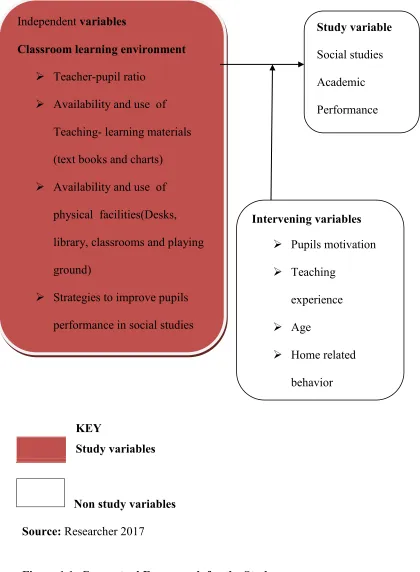
Several studies suggest that student performance is produced by several inputs in the
educational process such as class size, availability of teaching and learning materials and
teacher availability among others. Influences of academic performance include the
number of teachers in a school, pupils’ enrolment and teacher knowledge on subject
matter. The extent to which academic performance is attained depends on how
effectively teachers are able to use instructional materials to improve the teaching and
learning process. This research study was seeking to investigate if learning environment
factors were influencing lower primary pupils’ performance in social studies in Kibwezi
Zone primary schools in Kibwezi zone Makueni County. Variables of the study were
KEY
Study variables
Non study variables Source: Researcher 2017
Figure 1.1: Conceptual Framework for the Study Independent variables
Classroom learning environment Teacher-pupil ratio
Availability and use of
Teaching- learning materials
(text books and charts)
Availability and use of
physical facilities(Desks,
library, classrooms and playing
ground)
Strategies to improve pupils
performance in social studies
Study variable Social studies
Academic
Performance
Intervening variables Pupils motivation
Teaching
experience
Age
Home related
behavior
Government
policies
The above figure indicates that qualified teachers, pupils’ enrolment, enough teachers,
teaching learning materials (course books and charts), school facilities such as desks,
library, classrooms and playing ground and use of variety of teaching methods are
independent variables that influence performance of social studies which forms the
dependent variable. However, teacher attitude, teaching experience, pupils’ motivation,
home related factors and Government policies are intervening variables that may
1.7 Operational Definition of Terms
Classroom learning environment: Teaching learning materials, teacher-pupils ratio and facilities in a classroom setting.
Facilities : Teaching learning aids such as library, classrooms and play grounds.
Influence : It is phenomena that are likely to affect an activity positively or negatively in this study.
Instructional materials : Teaching learning resources such as text books and charts that are used by teachers and students during
teaching and learning of social studies.
Performance : Pupils scores in social studies in Kibwezi Zone end of term examinations.
Physical facilities : Infrastructure such as desks, study rooms, play grounds and play fixed equipment at the field.
School infrastructure : School equipment and physical facilities used to help in teaching and learning process such as classrooms
library, teachers and furniture.
Teaching-learning materials : This refers to materials that are used during teaching and learning process such as text books, chalkboard
CHAPTER TWO LITERATURE REVIEW 2.1 Introduction
In this chapter related literature in relation to the topic were discussed. The literature
review and the summary of the findings were discussed so as to bring the knowledge gap
in this study. This study explained the trend of the pupils’ performance in social studies
in Kibwezi Zone lower primary schools. The study farther explained classroom learning
environmental factors that contributed to such performance pattern and strategies
employed to improve social studies performance in lower primary schools. The literature
review was organized as per the objectives of the study and as per the following
subtopics:
2.2 Availability of Teaching Learning Materials and Pupils’ Performance in Social Studies
For decades social studies has been ranked among the least liked and poorly performed
subjects in schools (Craig, 2006). Uwezo Kenya (2012) has emerged with some facts
about general learning that cuts across all subjects learned in public primary schools in
Kenya and more so the lower primary school level. The report bears the following facts:
Nationally only 1 out of 5 children in classes 6 to 8 are able to tell the meaning of the
colours on the Kenyan flag. The report farther states, pupils in class 1-8 enrollments
are 64 as compared to 40 pupils recommended by the MOEST. This may affect pupils’
academic performance in elementary classes which is expected to be emulated in higher
five years since 2013-2016 indicated that social studies had mostly scored less than 50%
in most of primary schools in Makueni County. Kibwezi zone was quoted as the most hit.
Almost every primary school had been scoring an average of 47.0 % in K.C.P.E results
drawn from KNEC examination every year. Many educators associated this performance
with the classroom learning environment in primary schools. Some of these learning
environments were not limited to availability and use of social studies teaching and
learning materials. Agwu, (2001) views teaching and learning materials as those
apparatus of teaching which may include text books, workbooks, charts, audio visual aids
and other relevant things that attract students’ attention and which should be introduced
at the appropriate time by the teacher farther his defined teaching learning materials as
all materials and equipments used to enhance effective learning.
A Study carried out by Dudeck, (2000) on academic performances in primary schools
explains that school teaching and learning material helps good academic practices in
classroom. The study state that academic success comes through effective management,
training and information where students and teachers are provided with appropriate use of
resources. Effective use of teaching –learning materials is critical to learning and many
studies support that there is positive relationship between use of instructional materials
and performance. Omabe (2006) was of the opinion that the use of teaching and learning
materials such as text books help teachers builds literacy connections to social studies
topic. This enables student acquire facts and therefore, this research study suggested that
instructional materials in education are importance to the teaching of any subject in
primary schools in Africa lack important equipment such as desks, tables, maps, pictures
and posters. The journal concludes that success of lesson in classroom depends on how a
teacher prepares his lesson and the teaching aids used.
Etsey (2005) states that use of appropriate teaching and learning materials in a teacher’s
lesson make the lesson more practical. Farther, he stated that inadequate use of teaching
and learning materials may cause low academic performance because inadequate
teaching and learning materials in schools make it difficult for the students to understand
the lesson.
In West Africa (Isola, 2010) conducted research on instructional materials and academic
performance and concluded that material resources have a significance effect on students
performance in each of the subjects. Free primary school Education in Malawi (1994),
made the enrolment in primary education rise from 1.9 Million to about 3 million pupils.
The government solved the problem by recruiting untrained teachers. There resulted
larger class size with lack of teacher specialists. The report on education in Kenya on
Free Primary Education explains that the year 2003 Kenya observed large classes with
limited number of teaching and learning materials and as result teachers could not
manage the enrolment.
Kaambakadzanja (2001) state that lack of resources causes in effective lessons.
Therefore, the availability and use of learning materials that are adequate motivate and
and use of adequate teaching learning materials and facilities and how this influenced the
lower primary pupils’ performance in social studies in Kibwezi Zone primary schools in
Kibwezi zone. Despite the government efforts in FPE on provision of teaching learning
instructional materials some of the primary schools were still lacking teaching materials
in elementary classes such as lower primary schools.
2.3 Teacher Pupil Ratio and Pupils’ Performance in Social studies
According to Williams, (1979) Teacher Pupil Ratio refers to the number of learners
enrolled in a given level of education divided by the number of teachers in the system.
Class sizes have been identified by researchers as a determinant and a motivating factor
for a better academic performance. This study defines class size within conducive
classroom learning environment as the one which has manageable enrollment and with
which one teacher can effectively teach, mark and corrects pupils’ assignment in time.
Too large class sizes without enough teachers might be one of the unfavourable
conditions that affect performance in most primary schools. Studies suggest that schools
with smaller classes with enough teachers perform better academically than schools with
large class size without adequate teachers. Studies carried in Texas and Israel about
class size on academic performance in basic education found that small classes with
effective teaching produces high scores (Rivkin, 2005). Class size of above 40 has
negative effect on teaching and learning on students’ performance (Ezegbe, 2008).
The African Network for the Prevention and Protection against Child Abuse and Neglect
Primary schools as unmanageable by the available teachers. Teacher- pupil ratio in
Kenya primary schools is quoted as 1: 80.Astudy carried by UNESCO,(2006) observed
that by 2005 an average class size in class one in Kenya was 83.The study farther
explained that some class one classrooms had more than 100 pupils a number which one
teacher could not manage. Africa has adopted 1:40 teacher –child ratio apart from the
more acceptable ratio of 1:25 in the developed world. A study carried by Nanyonjo,
(2007) on learning environmental characteristics and how they influenced student
performance in Uganda, observed that overcrowding of students, lack of enough teaching
materials and high pupil teacher ratio affected performance.
In Kenya studies indicate that the school enrolment in lower primary school classes went
higher in the year 2003 and beyond due to inception of F.P.E .This increase in class size
has brought trail problem of ineffective class management, poor supervision of
assignment and ineffective teaching and personal pupil -teacher contacts. Some of the
Government policies such as FPE have been quoted as contributing to teacher-pupil ratio
in Kenya primary schools. This study therefore, discussed the teacher-pupil ratio and how
it has influenced pupils’ performance in social studies in Kibwezi Zone lower primary
schools. More so, this research study looked forward on advising policy makers to
come up with clear policies on creating conducive classroom learning environment so as
to encourage manageable enrollment and curriculum support programme in lower
So as to handle the big classroom enrolment and achieve condusive classroom learning
environment in lower primary classes, enough teachers with Professional qualifications
and education advancement of same teachers is equally important. This study defines
teachers’ professional qualification as the ability of the teacher to deliver the intended
curriculum efficiently and effectively in manner that adds value to pupils’ performance in
academic performance. In Europe a study carried by Clotfelter, (2007) on influence of
teacher qualification on student academic performance explains that highly qualified
teachers are able to handle many pupils and they produce greater students’ performance
than comparatives less qualified teachers.
Jere, (2009) states that the professional skills of a teacher in class room establish a
productive learning environment from the start and professional competency transforms
in to high quality of teaching which influences the learning of students. Teachers have
much to determine what is taught in the classroom, regardless of the prescribed
curriculum content, standards and methods. Therefore, this study suggests that teachers
need professional development so as to be able to handle big and challenging pupil
enrolment and also to create and handle social studies content efficiently. Grant, (2007)
reported that teachers should have both academic and professional skills so as to learn
and handle the subjects they teach positively. Study carried by Van den Bergh, (2014) on
Teacher qualification and pupils Academic Performance in South Africa states that
teachers skills, values and cultural models influence academic performance of pupils and
even implementation of educational reforms. The study also states that Technology
In Ghana Emma (2011) stated that teaching qualification of a teacher influences student
performance and therefore teachers need academic and professional training to help
students perform and attain high academic grades. In Uganda Daily Monitor (July 2011)
reported that there was a significant relationship between teachers qualification, the
enrolment they handled and of which influenced pupils academic performance in the
Primary schools in Eastern Uganda. The study recommended that experienced teachers
should handle huge classrooms so as to create good classroom learning environment.
Study carried out by (UNESCO 2005) in Bungoma County, Kenya on Teacher
qualification and student Performance explains that enough qualified teachers greatly
contribute to students performance. Therefore, this study argues that enough and
qualified teachers have effective classroom learning environment and influences Lower
Primary Pupils performance in Social studies. This study suggest that Teachers who teach
social studies in lower primary schools in Kibwezi zone,Makueni County should be
academically qualified and experienced so as to be able to improve classroom learning
environment in lower primary schools which are overcrowded with pupils.
2.4 Availability and use of Physical Facilities and Pupils Performance in Social studies
Facilities such as library, classrooms and playground are also established as being
important factors that influence teaching and learning of social studies. According to
Mutai, (2006) availability and use of physical facilities laboratories, classrooms and
supported the same information and added that inputs such as school facilities make
classroom environment very interesting and exciting and encourages more students to
join school.
A study on nature of schools and academic performance of public schools carried by
Damien, (2010) in Rwanda explained that school buildings must be not only a container
or a functional program but also a friendly and attractive. The study also stated that
buildings and toilets are some of the basic facilities that impact on academic
performance. In a related study on effective use of educational inputs carried by
Nanyonjo,(2007) in Uganda lack of facilities was stated as impacting student’s
performance in languages. The study also confirmed a strong and positive relationship
between quality of school facilities and student performance in mathematics.
In Kenya Lilian, (2015) investigated the classroom environment on pupils academic
performance in primary schools in Bungoma Sub county, Kenya and the study pointed
out that availability of physical facilities in schools contributed positively to pupil’s
performance.
Abubakar (2013) carried out a study or school based factors affecting the KCSE
performance of student in Garrisa County. The most influential factors discussed were
availability of facilities as a factor that affected performance in KCSE. The study was
Mbugua, (2012) carried out a study on school based factors in secondary schools. This
was to determine what school based factors affect students’ performance in mathematics
public day secondary schools. This was a case study of Baringo County, Kenya and
results revealed that Performance was better in schools with facilities than those without.
Eshiwani (2001) stated that school facilities such as laboratories, playing fields and
library positively influenced student’s performance. Zachariah, (2011) carried a study to
establish influence of teaching and learning resources for mathematics were available
and used in secondary schools in Kenya and found that availability of teaching and
learning resources in secondary schools impacted positively on student performance.
However, this study targeted physical facilities and how they influenced learning
environment in performance of social studies in Kibwezi Zone lower primary school.
2.5 Strategies to Improve Pupils’ Performance in Social studies
Many studies suggest that the subject social studies is one of the least liked in schools
(Chiodo, 2004).Therefore, there should be strategies intervening measures for pupils
performance in social studies . This study defined strategies as effective methods that are
used to improve the effectiveness of delivery service of curriculum content in teaching
process. Most of the studies propose that increasing content application to real world
situations is a way of promoting the relevancy of school subjects and elevating student
interest level (Allazz, 2004).Studies demonstrate that student should be encouraged to
work collaboratively in class hence creating a shared goal. Variety of teaching devices
allowing students to move from teacher-centered to student-centered in classrooms
influence over what and how they teach (Wills &Soundholtz, 2009).Teachers that are
using some circular materials can use them differently and afford their students different
experiences. The choice of teaching methods that teachers use in teaching depends on
many factors such as the level of the class, nature of the topics, pupil’s ability and
available facilities in the school, Gumo (2003). Many teachers prefer to teach class as a
whole all the time, which may not field the desired educational results. Weak students
may not benefit much in a large class of mixed ability.
UNESCO, (2005) indicated that the time students are present in schools and the time
actually spent learning specific subjects either in schools or homework positively affects
performance. Teaching must combine good mastery of content with methodology to
guide students to be in control of media and tools for expression. This study wanted to
suggest that teachers should possess command of the subject matter, use of variety
instructional materials, variety of instructional methods, reflective planning, instructions
and assessment. This study suggested that children should learn through different
activities and teaching methods which should be linked to children’s practical
experiences in everyday life.
Above all, monitoring of curriculum implementation by education officer and head
teachers has been identified as strategies to improve academic performance. Etsey (2005)
says supervision is a process of stimulating growth, and means of helping teachers and
students. Ndani, (2008) carried a study on impact of community participation on
and found that community participation in Pre-school welfare impacted learning
environment positively. This study was investigating if the above mentioned strategies
were being used by the lower primary teachers who taught social studies and their
effectiveness in teaching learning process of social studies in Kibwezi Zone Kibwezi
zone.
2.6 Summary of Literature Reviewed
Various studies conducted by different studies in Kenya and the world revealed that
social studies is important in everyone’s life. More so, these studies have revealed that
social studies build our foundation of socialization on which future learning is based on.
This study discussed a number of factors that contribute to pupils’ potential success in
social studies. They include adequate teaching learning materials, pupils’ –teacher ratio,
physical facilities, teaching strategies and coverage of syllabus among others. This study
intended to find out the classroom learning environment on lower primary pupils’
academic performance in social studies in Kibwezi Zone primary schools in Kibwezi
zone. Different studies discuss differently concerning how school learning environment
influences pupils’ performance in social studies in Kibwezi Zone primary schools. Even
though literature has revealed that various factors influence pupils’ performance in social
studies most studies were carried in upper primary schools and even secondary schools.
There is no any study on physical facilities, teaching learning materials, pupils’ teacher
ratio or strategies on social studies performance that had ever been carried in Kibwezi
CHAPTER THREE
RESEARCH DESIGN AND METHODOLOGY 3.0 Introduction
The methodology used in the study is described in this chapter. It includes: research
design, location of the study, population and sampling procedures. Pilot study,
instruments, validity and reliability, data collection procedure, data analysis and ethical
considerations are also discussed in this chapter.
3.1 Research Design
The design used in this study was descriptive survey research design to investigate the
classroom learning environment on pupils’ performance in social studies in lower
primary schools in Kibwezi Zone, Makueni County.
A descriptive survey research design was used in this study because according to
Mugenda and Mugenda, (2003) such a research design helps the researcher to determine
the immediate status of population so as to come up with conclusion about the facts
discovered. According to Orodho (2004), descriptive survey design allows the use of
instruments like questionnaire which the research used in this study during data
collection.
3.2 Variables
3.2.1 Independent Variable
The independent variables in this study were classroom learning environment which
included:
i. Pupil-Teacher Ratio which referred to number of pupils handled by one teacher in lower primary school. The recommended is 1:40 as per Ministry of Education guide
line (2012).The indicators of this were teachers’ adequacy, class size and
qualification of teachers. Measurement scale for these was interval and nominal and
the statistical analysis was descriptive.
ii. Availability and use of teaching learning materials.
The indicators were: Availability and use of text books, charts, syllabus and
chalkboard for facilitating social studies. Social studies measuring scale was pupils’
text book ratio which found out number of children sharing one text book. Charts
and syllabus measuring scale were nominal which included observing their
availability and use. Chalkboard was measured by observing whether each class had
one in the right size and if in good condition. Statistical analysis was used to
descriptive the variables.
iii. Availability and use of physical facilities
Indicators were number of desks, teachers’ chairs, classrooms, playground and
library available and used by respondents. Desks were measured by checking if they
were available and met the required standard in the ratio of seating 3:1 in a desk. By
observing the size and the height of the desk the researcher determined if the desk
was suitable for the pupils’ age. Teachers’ chairs were measured by observing if
preparation. The study investigated if pupils learned in a classroom and whether the
room was appropriate for the pupils. Library was measured by observing if it was
available and had social studies materials and text books which were used by
teachers and pupils in lower primary schools. Descriptive analysis was used to
describe the above variables.
iv. Teaching learning strategies:
This variable was indicated by teachers using varied of teaching learning methods
while teaching social studies in lower primary schools. The measurement scale for this
was interval scale which included observing and listening to teachers as they taught
social studies in Kibwezi Zone in their respective classrooms. The researcher used
descriptive statistical analysis to describe Strategies used by teachers to teach social
studies in lower primary schools.
3.2.2 Dependent Variable
The dependent variable in this research study was pupils’ performance in social studies.
The indicators of how pupils in lower primary performed in their end of term zonal
examinations was determined by use of results of lower primary classes obtained from
zonal education office in Kibwezi zone. Ordinal scale was used to measure pupils’
performance in different subjects that are learned in lower primary schools in Kenya.
Descriptive Statistical analysis was used to explain the pupils’ performance in social
3.3 Location of the Study
The research was carried in Kibwezi Zone, Makueni County, Kenya. Kibwezi zone had
three sub-zones namely; Kinyambu, Kalulini and Kibwezi. The zone consisted of both
public schools and private schools with different classroom learning environments.
Although Makueni County had several educational zones, researcher chose Kibwezi zone
as study area. This was contributed by the fact that KCPE results in the zone had been
disappointing as compared to other zones. Another reason for selecting Kibwezi Zone
was due to the fact that Social studies results in the KCPE for the last nine years had been
poor as compared to other subjects (Kibwezi Sub-county KCPE analysis, 2014).
The researcher being a resident teacher in the same area had observed stakeholders
discontent on the same performance and hence came with the idea that Classroom
learning environment on lower primary school pupils’ performance in social studies
could be contributing such performance. This was with support that foundation of reading
for future academic success is found with improved learning classroom environment
3.4 Target Population
The target population of this study was all primary school teachers and lower primary
school pupils in Kibwezi zone. The researcher used lower primary school pupils in this
study because this is the basic level in which, children’s reading and comprehending
skills in social studies is developed. Kibwezi zone had 16 public and 5 private primary
schools. The lower primary enrolment in public primary schools was1006.The
enrolments in the private schools in lower primary were 120.The teachers who taught
lower primary schools in Kibwezi zone in both public and private were 21 (Kibwezi
Education Office, 2015).
3.5 Sampling Technique and Sample Size
According to Orodho & Kombo, (2002) sampling is the process of selecting a number of
individuals or objects from a population such that the selected group contains elements
representative of the characteristics found in the entire group. Sampling technique is the
process into which the sample size was selected. They are described as follows;
3.5.1 Sampling Techniques
(i) Selection of zone and Lower Primary Schools
The research used purposive sampling technique to select Kibwezi Zone. This is because
the locals were economically heterogeneous. Furthermore, the area carried schools that
were informally settled and others well to do estates. This provided the researcher with
Lower Primary school Pupils were also purposively sampled. This is because lower
primary is the start of formal primary schooling and the stepping stone for learning Social
studies skills and of which if skipped may cause problems in progressive learning in
higher classes or institutions. According to Creswell (2002) purposive sampling is used
by researchers to select subjects in their local area so as to understand a phenomenon.
(ii) Selection of schools and Pupils
Stratified random sampling was used to select primary schools in the zone to be involved
in the study. According to Kothari, (2004) stratified sampling is used where the
population is divided into several sub-populations that are individually more
homogeneous than the total population. The sampling method was found appropriate for
this study because the local population was stratified in terms of public and private
primary schools, boys and girls. 7(30%) of primary schools in the zone were selected to
be involved in the study. Gay (1992) spelt that a sample size of 10% to 30% of the total
population is representative enough in descriptive research. This ensured that every
stratum in the population was appropriately presented in the sample. This research study
involved all public and private primary schools in Kibwezi zone. Numbers 1-16 were
written on pieces of paper to represent the 16 public primary schools in Kibwezi zone.
The researcher picked 5 papers at random to form a sample of public primary schools.
The selection of the private primary schools was done in the same manner where at
random 2 papers were picked to represent the 5 private primary school in Kibwezi zone.
Teachers who taught the 7 sampled lower primary schools were purposively involved in
3.5.2 Sample Size
The sample size used in this study is as shown in table 3.1
Table: 3.1 Sampling Frame for the Study
TYPE OF
SCHOOL
NUMBER OF SCHOOLS Total Number of schools (100%)
Sample size of schools (30%)
Public 16 5
Private 5 2
Total 21 7
There was total population of 21 primary schools in the zone, 7(30%) of the schools, five
public and two private were sampled for this study. This was based on Mugenda and
Mugenda (2003) suggestion that in descriptive studies any study sample above thirty
percent (30%) in a study is representative enough to generate characteristics being
observed. In this research study therefore, 30% of the accessible population was found
convenient to give valid results. All teachers of the sampled schools who taught in the
lower primary participated in the study.
3.6 Research Instruments
3.6.1 Questionnaire for Lower Primary School Teachers
Questionnaire was used to collect data from teachers who taught social studies in
Kibwezi Zone lower primary schools. The questionnaire comprised of two parts, A and
B. Part A was used to obtain demographic information of the respondents. Part B
contained items that were developed based on research questions.
3.6.2 Observation Guide
An observation guide was used as check list on classroom learning environment. It was
used to determine the availability of resources in lower primary schools. It was also used
to collect data on teaching learning materials, class enrolment ,availability of social
studies text books, teachers’ qualification and Pupils performance scores. The researcher
also used the lower primary zonal exams to get pupils test scores from sampled schools.
3.7 Pilot Study
The questionnaire and the observation schedule were pre-tested through a pilot study in
two schools which were randomly selected from the zone. Pretesting of the instruments
helped the researcher to determine difficulties the respondents faced during the actual
data collection from the field of study. The information obtained from pilot study was
used by the researcher to amend the research instrument to make them more suitable for
the study. Schools and teachers who were selected for the piloting were not included in
the final study sample because they were having prior information about the study.
instrument by ensuring use of proper language and any other factor that may be lacking
before the actual data collection.
3.7.1 Validity
Instrument validity refers to accuracy, meaningfulness and technical soundness of the
research instrument .It is the degree to which instrument measures what is supposed to
measure (Mugenda and Mugenda, 1999, Best and Khan, 2003). The researcher focused
on contents of this study as per the research questions. According to Kothari (2004)
content validity is the agreement among experts that an instrument logically is accurately
measuring what it is supposed to measure. This was accomplished in many ways. First,
extensive literature on the classroom learning environment on pupils’ performance in
social studies in lower primary schools. This made it possible to identify the relevant
content areas to be captured in line with the four objectives of this study. Secondly, items
in the instruments were prepared in line with objectives of this study. Thirdly, the
instruments were piloted; the questionnaires were appraised by the supervisors to
evaluate the applicability and appropriateness of the content and adequacy of the
instruments. Field test was conducted with a pilot of two schools that were not part of this
study where 16 public and 5 private primary schools were involved in Kibwezi zone. The
lower primary enrolment in public primary schools was1006.The enrolments in the
private schools in lower primary were 120.The teachers who taught lower primary
schools in Kibwezi zone in both public and private were 21 (Kibwezi Education Office,
3.7.2 Reliability
According to Orodho (2004) reliability is the degree to which empirical indicators gives
same results within two or more attempts in a theoretical concept. Kombo and Tromp,
(2009) stated that reliability is a measure of how consistent results from given test are.
Donald, (2006) asserts that research instruments are expected to yield the same results
with repeated trials under similar conditions. Therefore, to support the above definitions,
the researcher used test –retest technique in order to test the reliability of the instruments.
The same instrument was administered twice to the same study sample after a period of
two weeks then the researcher made comparison of round one and two and made
necessary amendments. The subjects that were retested were excluded from the final
study. So as to test consistency of results as stated by Orodho, (2009) that reliability
coefficient of 0.7 makes the instrument to be reliable, the researcher computed the results
using SPSS and found out the degree to which there was a consistence response meaning
that the instruments were reliable.
3.8 Data Collections Techniques
A permit to conduct the study was obtained from National Commission for Science and
Technological Innovation and is Curriculum Support Officer. The researcher visited the
sampled schools so as to familiarize with classroom learning environment in lower
primary schools in Kibwezi Zone. Teachers were issued with consent forms to indicate
Stage 1: Administration of questionnaire
The questionnaires were issued to teachers in schools. After teachers filled researcher
checked for errors before collecting all the questionnaires. This ensured the results were
reliable.
Stage 2: Conducting Observation
The research study used observation check list to observe classroom learning
environment factors in the sampled primary schools. Pupils’ performance in social
studies was obtained from Kibwezi zonal examinations merit lists. The documents that
were analysed included end of term exams and their overall mean scores obtained from
the sampled lower primary schools. These documents showed pupils’ performance in
social studies. Using observation the researcher observed the availability of social
studies text books against the class enrolment. This helped the researcher to establish
pupil text book ratio and the availability of physical facilities.
3.9 Data Analysis
Data analysis is a process of inspecting, cleaning, transforming and modeling data with
the goal of discovering useful information, suggesting conclusion and supporting
decision making. Data analysis refers to the process in which raw data is ordered and
organized to make it useful information (Mugenda and Mugenda, 1999). Quantitative and
qualitative data processing and analysis began with editing questionnaires to minimize
errors then coding for the open ended data analysis and then interpretation. The statistical
and frequency distribution were displayed automatically reporting on classroom learning
environment on pupils’ performance in social studies in lower primary schools in
Kibwezi zone. Conclusion and recommendation were based on patterns that arose from
the analysis of data. Data was reported by use of tables and the researcher explained the
meaning of the captured data using text then made conclusion.
3.10 Logistical and Ethical Consideration 3.10.1 Logistical considerations
The researcher had obtained an introductory letter from Kenyatta University Graduate
School and clearance from Kenyatta University Ethics and Review Committee and then
obtained research permits from the National Council for Science and Technology. In
order to get approval to conduct research in the sampled primary schools, the researcher
sought permission from relevant authorities in Makueni county and Kibwezi sub-county.
Appointments with the Head teachers of the sampled schools were made by the
researcher to notify and request for permission to carry the research study in their
schools.
3.10.2 Ethical Considerations
(i) Care and protection of Research participants
The respondents were informed of significance of study and that the researcher allowed
them to ask as many questions as possible for clarification. The participants were further
assured of privacy and confidentiality and they were identified by use of codes and not
information obtained from the respondents was also kept confidential and was used for
the purpose of this study only.
(ii) Informed Consent
The respondents were requested to willingly give consent because their privacy and
confidentiality was assured during the research study. Consent for lower primary school
pupils to participate in the study was obtained from their parents through the head teacher
because they were under age
(iii) Community Considerations
The community here referred to teachers, pupils and lower primary schools in Kibwezi
Zone, Makueni County, Kenya. This study finding was to be useful to teachers, pupils
and all schools of Makueni County. The findings of this study may also be used to make
recommendations to improve pupils’ performance in social studies in Kibwezi Zone