Working-Memory-Triggered Dynamic Adjustments in Cognitive Control
Amishi P. Jha and Anastasia Kiyonaga
University of Pennsylvania
Dynamic adjustments in cognitive control are well documented in conflict tasks, wherein competition from irrelevant stimulus attributes intensifies selection demands and leads to subsequent performance benefits. The current study investigated whether mnemonic demands, in a working memory (WM) task, can drive similar online control modifications. Demand levels (high vs. low) of WM maintenance (memory load of 2 items vs. 1 item) and delay-spanning distractor interference (confusable vs. not confusable with memoranda) were manipulated using a factorial design during a WM delayed-recognition task. Performance was best subsequent to trials in which both maintenance and distractor interference demands were high, followed by trials with high demand in either of these 2 control domains, and worst following trials with low demand in both domains. These results suggest that dynamic adjustments in cognitive control are not triggered exclusively by conflict-specific contexts but are also triggered by WM demands, revealing a putative mechanism by which this system configures itself for successful task performance.
Keywords:cognitive control, working memory, conflict adaptation, sequence effects, dynamic control
Working memory (WM) is critical for surviving and thriving in complex, ever-changing, and challenging situations. Stressful en-vironments degrade WM performance (Evans & Schamberg, 2009; Vasterling et al., 2006), and greater performance impairments signal greater risk for psychiatric dysfunction (Unsworth, Heitz, & Engle, 2005). Yet, little is known about how WM operates on a moment-to-moment basis in the face of changing demands and stressors. Rather than implicating a homunculus, who sits patiently deciding if cognitive control should be up- or down-regulated, a comprehensive account of WM should aim to delineate the cir-cumstances under which WM processes are dynamically modified to influence subsequent behavior, as demands are encountered in the environment. As a first step, we investigated the impact of prior mnemonic demands during a WM delayed-recognition task, on subsequent task performance.
Working memory involves maintaining and manipulating rele-vant information over short intervals without getting distracted by irrelevant information. Maintenance-related cognitive control op-erations activate dorsolateral prefrontal cortex, whereas control processes protecting against interference activate ventrolateral pre-frontal cortex and other structures (Dolcos, Miller, Kragel, Jha, & McCarthy, 2007; Jha, Fabian, & Aguirre, 2004; Jha & McCarthy, 2000). Numerous studies have established that neural activity
levels within these structures increase, and behavioral performance levels decrease, with parametric increases in memory load and distractor interference during delayed-recognition tasks (see D’Esposito, Postle, & Rypma, 2000). Thus, the type of cognitive demand, as well as the level of demand, can be tracked with neural and behavioral measures. While studies utilizing such experimen-tal manipulations have been invaluable in elucidating WM’s func-tional neural architecture (D’Esposito et al., 2000), such studies fail to advance understanding of how WM control processes are configured in response to shifting demands.
Computational theories of cognitive control, which emphasize dynamic adjustments in control during response conflict tasks, have successfully demonstrated when control is most likely to be engaged, modulated, or withdrawn (Botvinick, Braver, Barch, Carter, & Cohen, 2001; Brown & Braver, 2008). In these tasks, conflict trials contain distracting stimulus features associated with an incorrect response. Cognitive demands are higher, response times are slower, and accuracy is lower for conflict versus no-conflict trials because these distracting features trigger prepotent response tendencies that must be overcome for successful perfor-mance. Many studies have shown that performance on high-conflict trials is better following high- (vs. low-) high-conflict trials (Botvinick, Nystrom, Fissell, Carter, & Cohen, 1999; Gratton, Coles, & Donchin, 1992; Kerns et al., 2004). This facilitated performance as a function of previous high demand (high conflict) is referred to asconflict adaptationand is proposed to result from a conflict-triggered upregulation in cognitive control. Trials im-mediately following conflict trials, thus, enjoy greater access to control resources to resolve interference from irrelevant stimulus features (Botvinick et al., 2001).
There is some evidence that the engagement of WM control operations at one moment in time has consequent effects on task performance (Persson & Reuter-Lorenz, 2008; Pessoa, Gutierrez, Bandettini, & Ungerleider, 2002; Schmeichel, 2007). Yet, none of these studies have examined the moment-to-moment influence of
Amishi P. Jha and Anastasia Kiyonaga, Center for Cognitive Neuro-science and Department of Psychology, University of Pennsylvania.
This work was supported by National Center for Complementary and Alternative Medicine Grant NIH-R21-AT-002761-02 and the Mind and Life Education Research Network. We thank Ling Wong, Kartik Sreeniva-san, and Pauline Baniqued for assistance with data collection and analysis and Steven Most for helpful comments.
Correspondence concerning this article should be addressed to Amishi P. Jha, who is now at the Department of Psychology, University of Miami, Flipse Building, 5665 Ponce De Leon Drive, Coral Gables, FL 33146. E-mail: [email protected]
current demand level on subsequent engagement of control during WM tasks. Nonetheless, conflict adaptation provides prima facie support that engagement of cognitive control can be dynamically adjusted based on prior control demands. What remains unclear is whether this important feature of cognitive control is present exclusively during conflict tasks, characterized by the need to overcome prepotency, or whether it is present in other demand contexts.
A recent study by Fischer, Dreisbach, and Goschke (2008) found that not only response conflict, but also variations in the difficulty of a number comparison task, generated alterations in subsequent processing. While their results certainly broaden the task contexts in which control adjustments are observed, since they too incorporated a response-conflict component in their task, more studies are required to determine the specific conditions under which dynamic adjustments occur. In the present study we inves-tigated whether parametric manipulations in memory load and distractor interference, which successfully modulate control de-mands duringWM delayed-recognition trials (see D’Esposito et al., 2000), may also trigger dynamic adjustments in controlacross
trials.
High- and low-demand conditions of memory maintenance (memory load of two items vs. one item) and delay-spanning distractor interference (distractors confusable vs. not confusable with memoranda) were combined in a factorial design. We asked three main questions. First, will current trial performance be sen-sitive to the level of cognitive demand in the previous trial? In line with conflict adaptation, we predicted that performance would be better on trials preceded by high- (vs. low-) demand trials. Second, will current trial performance differ on the basis of the domain (maintenance-related or interference-related) of cognitive demand in the previous trial? Past research has suggested that WM
perfor-mance is sensitive to demand levels of maintenance- and interference-related control processes (Jha et al., 2004; Jha & McCarthy, 2000). As such, we had no a priori reason to suspect that these control domains would differ in their ability to provoke dynamic adjustments in subsequent trials. Third, if dynamic ad-justments in subsequent trial performance are observed, will their magnitude vary as a function of current trial demand level or domain? Since conflict adaptation occurs only when current trial conflict is high, we predicted that current high-demand trials would be most sensitive to previous trial demand level. We had no a priori reason to suspect that this pattern would differ across the two control domains investigated herein.
Method
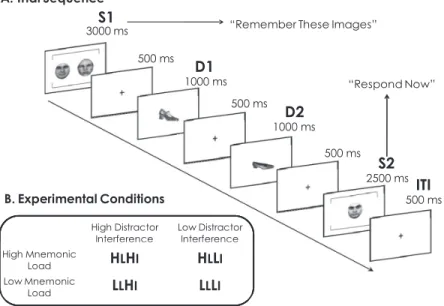
Fifty-four (30 female) healthy volunteers provided informed consent prior to entry into this study, which was approved by the University of Pennsylvania Institutional Review Board. All par-ticipants sat in a quiet room, 57 cm from a monitor, to perform a delayed-recognition WM task, instructing them to remember im-ages of faces or shoes across individual trials (see Figure 1A).
As shown in Figure 1, each trial began with the presentation of a memory array (S1), consisting of either two memoranda (high mnemonic load) or one memorandum and a noise mask (low mnemonic load), appearing side by side for 3,000 ms. S1 offset was followed by a 3,500-ms delay period, after which a test item (S2) was presented centrally for 2,500 ms. On half of the trials, S2 was a single image from the S1 array (match trials), and on the remaining trials, S2 was a novel image that had not appeared at any other point in the experiment (nonmatch trials). S2 was always from the same stimulus category as S1 (e.g., if S1 consisted of faces, S2 was a face). Participants were instructed to determine
3000 ms
S1
“Remember These Images”A. Trial Sequence 1000 ms
D1
500 ms “Respond Now” 1000 msD2
500 ms p 2500 msS2
500 ms High Distractor Interference Low Distractor Interference B. Experimental Conditions Interference Interference High Mnemonic Load HLHI HLLI Low Mnemonic Load LLHI LLLI Load 500 msITI
Figure 1. A: Time course of one trial of delayed recognition working memory task. Face and shoe working memory trials were intermixed. After a series of practice trials, participants began the experiment, which consisted of two experimental blocks of 30 trials each, totaling 60 trials. B: Examples of each of the distinct manipulations of mnemonic load and distractor interference, and the labeling system used to describe these specific conditions.
whether S2 matched either S1 memorandum and to indicate a match or nonmatch response by pressing a designated button. Before beginning the experiment, participants were instructed to respond in a manner that would ensure that they made accurate responses without being unduly slow. Half of the trials required working memory for faces, whereas the other half required work-ing memory for shoes, and these trial types were intermixed.
On all trials, two task-irrelevant distractors, consisting of either faces or shoes, were presented sequentially during the delay inter-val. Both distractor images within a trial were always of the same category (e.g., two faces or two shoes), were never repeated across trials, and were never identical to any S1 or S2 items. Participants were instructed to keep their gaze focused at fixation and to disregard these distractors. Both S1 and S2 featured brackets above and below the images to distinguish them from distractors, which appeared without brackets. On half of the trials the distractors were from the same stimulus category as the memory items (high distractor interference), whereas on the other half the distractors were from the other stimulus category (low distractor interfer-ence). These trial types were randomly intermixed. After a series of practice trials, participants began the experiment, which con-sisted of two experimental blocks of 30 trials each, totaling 60 trials.
Thus, control demands were manipulated along the two domains of mnemonic load and distractor interference, yielding four distinct trial types that occurred equally often and were pseudorandomly intermixed (Figure 1B). We chose these levels of load and inter-ference on the basis of previous studies (Jha et al., 2004; Jha & McCarthy, 2000) indicating that manipulations along both dimen-sions should affect performance comparably. Furthermore, al-though a load difference of only one item may seem small, we had several specific reasons for choosing load levels of one and two. First, our prior results (see Jha & McCarthy, 2000) suggested that the differences in activation level within prefrontal regions, during fMRI studies of working memory maintenance, show a large activation difference between one and two items and a much smaller difference between two and three items. These activity profiles were consistent with the behavioral differences in accu-racy as a function of load level. Thus, on the basis of our previous results, we did not suspect that the functional differences would be
as pronounced if the high load level was three instead of two. Beyond three faces, as reported in Jha and McCarthy (2000), performance begins to drop closer to chance levels. In addition, when load levels are very high, the strategy used to perform the task may shift. Braver and colleagues (Braver, Gray, & Burgess, 2007) suggested that when load is low, a proactive strategy of actively maintaining memory items over the course of the delay interval may be used. When the load level is too great, however, individuals may shift to a reactive or familiarity-based strategy in which they do not actively maintain the items—rather they simply wait until the S2 test item appears to actively recall the encoding episode. Thus, we chose load levels of one and two to maximize our chances of promoting an active perceptual maintenance strat-egy, while not overtaxing participants to the point of chance performance.
Results
Because the instructions to participants emphasized ensuring accuracy more than speed, the primary analyses were conducted using participants’ accuracy (percentage correct) for identifying S2 as a match or nonmatch. To ensure that the results were not driven by speed–accuracy tradeoff, and for the sake of completion, re-sponse times (RT, in milliseconds) on correct trials were also investigated. Accuracy and RT scores were examined according to the specific conditions of the current trial (trial N), as seen in Figure 2. In addition, current trial performance, collapsed across current trial condition, was examined as a function of the previous trial type (trialN⫺1), as seen in Figure 3. In this analysis, only trials on which trialN⫺1 responses were correct were included. We conducted repeated measures analyses of variance (ANOVA) separately for the effects of current (trialN) and pre-vious trial (trialN⫺1) control demands, each with two factors and two levels within each factor (Control Domain: Mnemonic Load and Distractor Interference⫻Demand Level: High and Low).
Consistent with prior work (Jha & McCarthy, 2000), the ANOVA for current trial effects revealed a main effect of mne-monic load: Participants were more accurate (93% vs. 85%),F(1, 53)⫽37.85,MSE⫽.008,p2⫽.42,p⬍.001, and faster (936 ms
vs. 1,111 ms),F(1, 53)⫽109.42,MSE⫽14532.088,p2⫽.67,
C
B
A
1050 1150 1250 90% 95% 100% Mnemonic Load Distractor Interference 90% 95% 100% uracy se Time 850 950 1050 75% 80% 85% 75% 80% 85%HLHI HLLI LLHI LLLI
Accu
HLHI HLLI LLHI LLLI
Respon
Hi h D d L D d
HLHI HLLI LLHI LLLI
Trial N
HLHI HLLI LLHI LLLI
Trial N
High Demand Low Demand Trial N
Figure 2. A: Participants’ average accuracy (percentage correct) for each of the specific current trial condi-tions. B: Participants’ average response time (in milliseconds) for each of the indicated current trial condicondi-tions. C: Average accuracy as a function of high versus low current trial control demand, in the domains of mnemonic load and distractor interference, separately, while collapsed across levels of the alternate domain. HLHI⫽high mnemonic load, high distractor interference; HLLI⫽high mnemonic load, low distractor interference; LLHI⫽ low mnemonic load, high distractor interference; LLLI⫽low mnemonic load, low distractor interference. Error bars represent one standard error above and below the mean.
p⬍.001, when the current trial was low mnemonic load (vs. high load). Also in keeping with prior findings (Jha et al., 2004; Sreenivasan & Jha, 2007), there was a main effect of distractor interference: Participants were more accurate (93% vs. 85%),F(1, 53)⫽37.96,MSE⫽.009,p2⫽.42,p⬍.001, and faster (984 ms
vs. 1,060 ms),F(1, 53)⫽40.40,MSE⫽8715.212,p2⫽.43,p⬍
.001, when the current trial had low distractor interference (vs. high interference). There was no interaction between the mne-monic load and distractor interference effects on either accuracy (p ⬎ .42) or RT (p ⬎ .58). The magnitude of the effects of mnemonic and interference demands on accuracy did not differ (p⬎.52; see Figure 2C), though the magnitude of the effect of current trial mnemonic load on RT was greater than that of distractor interference,t(1, 53)⫽4.20,p⬎.001.
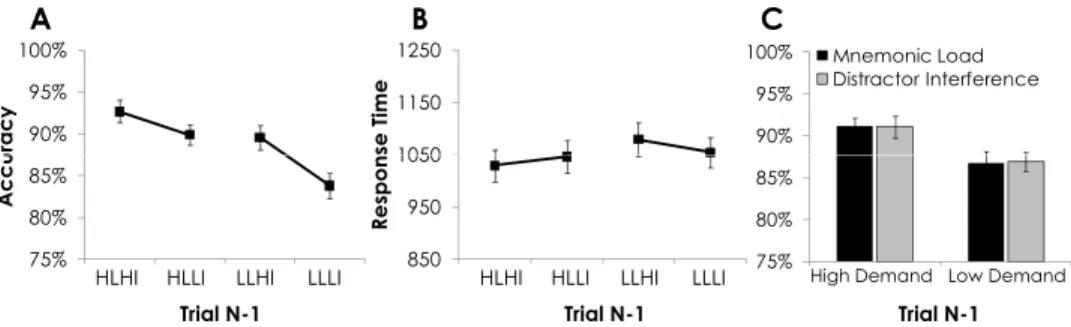
The ANOVA for previous trial control demands revealed a main effect of previous mnemonic load (mnemonic load on trialN⫺1): Participants were more accurate (91% vs. 87%),F(1, 53)⫽17.98,
MSE⫽.006,p2⫽.25,p⬍.001, and faster (1,004 ms vs. 1,039
ms),F(1, 53)⫽5.93,MSE⫽7144.808,p2⫽.10,p⬍.02, when
the preceding trial was high mnemonic load (vs. low mnemonic load). There was also a main effect of previous distractor interfer-ence (interferinterfer-ence level on trial N ⫺ 1) on accuracy (91% vs. 86%),F(1, 53)⫽9.20,MSE⫽.009,p2⫽.15,p⬍.01, but not
on RT,p⬎.10. Participants were more accurate when the previous trial was high interference (vs. low interference). There were no significant interactions between previous trial mnemonic and in-terference demands for either accuracy,p⬎.20, or RT,p⬎.12, and current trial performance benefits as a function of high versus low previous trial demand levels were comparable across both previous trial control domains (see Figure 3C).
We also conducted a series of ANOVAs to examine the impact of previous control demands at each current trial demand level. As there were no significant interactions between mnemonic and interference demands on performance as a function of either cur-rent or previous trial type, we examined the Curcur-rent Trial ⫻ Previous Trial interactions by entering only one current trial and one previous trial demand category at a time. In addition, because the task instructions emphasized accuracy and no evidence of
speed–accuracy tradeoffs was observed, this analysis explored task accuracy exclusively.
Each ANOVA had one current trial factor and one previous trial factor with two levels of demand for each factor (high and low). The four resulting ANOVAs were as follows: (a) current mnemonic load, previous mnemonic load; (b) current distractor interference, previous mnemonic load; (c) current mnemonic load, previous distractor interference; and (d) current distractor interfer-ence, previous distractor interference.
In all four ANOVAs, the main effects for current trial and previous trial were significant,p⬍.05, and replicated the patterns reported above. Briefly, current trial accuracy (collapsed across
previous trial demand level) was higher when the current trial demand level was low (vs. high) for both mnemonic load and distractor interference. Current trial accuracy (collapsed across
currenttrial load level) was higher when previous trial demand level was high (vs. low) for both control domains as well. Based on the prior conflict adaptation results (see Egner, 2007, for a sum-mary), we anticipated that the interactions between current and previous trial demand level would be significant. Specifically, we predicted that the benefits of previous high versus low demand would be more robust when the current demand levels were high (vs. low).
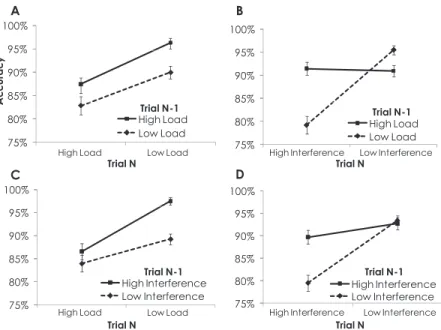
The results as a function of current trial mnemonic load were not consistent with this prediction. The magnitudes of performance benefits resulting from previous high (vs. low) mnemonic demand were comparable when the current trial mnemonic load level was low (vs. high), resulting in a nonsignificant interaction between current trial mnemonic load and previous trial mnemonic load,p⬎
.32 (Figure 4A). The magnitude of performance benefits resulting from previous high (vs. low) interference demands was greater when the current trial load level was low (vs. high), corresponding with a significant Current Trial Mnemonic Load⫻Previous Trial Distractor Interference interaction,F(1, 53)⫽5.69,MSE⫽.009,
p2⫽.10,p⬍.05 (Figure 4C). Thus, neither of the previous trial
domains produced greater benefits for current high (vs. low) mne-monic load trials.
C
B
A
90% 95% 100% 90% 95% 100% Mnemonic Load Distractor Interference 1050 1150 1250 u racy se Time 75% 80% 85% 75% 80% 85% 850 950 1050HLHI HLLI LLHI LLLI
Acc
u
HLHI HLLI LLHI LLLI
Respon
Hi h D d L D d
HLHI HLLI LLHI LLLI
Trial N-1
HLHI HLLI LLHI LLLI
Trial N-1
High Demand Low Demand Trial N-1 Figure 3. A: Participants’ average accuracy on the current trial, when the immediately preceding trial (trialN⫺ 1) was the specific condition indicated. B: Average response time on the current trial, when the preceding trial (trialN⫺1) was the condition indicated. C: Average accuracy as a function of high versus low previous trial control demand, in the domains of mnemonic load and distractor interference, separately, while collapsed across levels of the alternate domain. HLHI⫽ high mnemonic load, high distractor interference; HLLI⫽ high mnemonic load, low distractor interference; LLHI⫽low mnemonic load, high distractor interference; LLLI⫽ low mnemonic load, low distractor interference. Error bars represent one standard error above and below the mean.
An examination of current trial distractor interference revealed patterns consistent with previous studies of conflict adaptation. Previous trial benefits were observed when current trial interfer-ence demand levels were high but not low. Indeed, significant interactions with previous trial mnemonic load,F(1, 53)⫽50.08,
MSE⫽.008,p2⫽.47,p⬍.001 (Figure 4B) and previous trial
distractor interference,F(1, 53)⫽24.38,MSE⫽.006,p2⫽.32,
p⬍.001 (Figure 4D) were observed.
Discussion
We investigated whether mnemonic demands in a delayed rec-ognition WM task would trigger performance benefits on subse-quent trials, similar to effects demonstrated in conflict tasks in the form of conflict adaptation (Egner, 2008). We found that increas-ing WM demands on current trials corresponded to parametric decreases in current trial accuracy (Figure 2A, collapsed across previous trial type) as predicted by numerous previous studies of WM (see D’Esposito et al., 2000, for an overview). It is important that increasing previous trial WM demands corresponded to com-mensurate increases in current trial accuracy (Figure 3A, collapsed across all current trial types). Thus, these results give positive support for working-memory-triggered dynamic adjustments in cognitive control.
Although the proposal that conflict adaptation results from conflict-triggered upregulation in cognitive control motivated many of our hypotheses, there have been recent challenges to this proposal. Mayr, Awh, and Laurey (2003) argued that the perfor-mance patterns observed in conflict adaptation result from repeti-tion priming. They noted that the condirepeti-tions demonstrating facil-itated performance are also those in which priming of perceptual
and response features of stimuli over subsequent trials could reduce task demands. However, several studies have now con-firmed that conflict adaptation persists when controlling for stim-ulus and response repetitions (see Ullsperger, Bylsma, & Botvin-ick, 2005). In the current study, no memory items were repeated across trials. The only time a memory item was seen more than once, over the course of the entire experiment, was if it appeared as a match stimulus at S2. None of the distractor images were repeated across trials either. In addition to controlling for stimulus repetitions, we pseudorandomly varied the type of response that was required across consecutive trials (match or nonmatch), as well as the stimulus category (face or shoe) that might appear on subsequent trials as memoranda or distractors. Thus, our results cannot be explained by repetition priming associated with repeti-tion of specific exemplars, category of stimuli, or responses made over consecutive trials.
A topic of active investigation within the conflict adaptation literature concerns the nature of conflict-triggered upregulation of control processes. In the context of conflict tasks, the domain of control is determined by the specific stimulus and task require-ments that produce conflict. For example, conflict could occur at the perceptual/representational level or at the response level. Sev-eral studies have suggested that the conflict-driven upregulation of control is domain general (see Botvinick et al., 2001; Freitas, Bahar, Yang, & Banai, 2007), so that conflict resolution improves subsequent to high-conflict trials even if conflict domains differ across trials. Cross-conflict adaptation is proposed to result from conflict on trialN⫺ 1, triggering enhancement of all top-down selection mechanisms necessary to resolve conflict in the overall task set. 95% 100% 95% 100% B A 85% 90% 95% 85% 90% 95% A ccu ra cy 75% 80% High Load Low Load 75% 80% 85% High Load Low Load Trial N-1 Trial N-1
High Load Low Load High Interference Low Interference
A
100% 100%
High Load Low Load High Interference Low Interference
N l a i r T N l a i r T C D 85% 90% 95% 85% 90% 95% 75% 80% 85% High Interference Low Interference 75% 80% 85% High Interference Low Interference 1 -N l a i r T 1 -N l a i r T Hi h L d L L d Hi h I t f L I t f
High Load Low Load High Interference Low Interference
N l a i r T N l a i r T
Figure 4. A: Accuracy for current high versus low mnemonic load trials as a function of the mnemonic load of the previous trial. B: Accuracy for current high versus low distractor interference trials as a function of the mnemonic load of the previous trial. C: Accuracy for current high versus low mnemonic load trials as a function of the distractor interference of the previous trial. D: Accuracy for current high versus low distractor interference trials as a function of the distractor interference of the previous trial. Error bars represent one standard error above and below the mean.
Maintenance and distractor interference resolution were the two WM control domains examined herein. In the context of our delayed-recognition task, maintenance processes keep representa-tions of memoranda active over the delay interval, and distractor interference resolution protects memory representations from deg-radation due to competing, task-irrelevant information. At the neural level, maintenance processes for visual stimuli are instan-tiated as tonic delay-spanning activity within prefrontal and per-ceptual cortices biased in favor of the perper-ceptual features of memoranda (see Chelazzi, Miller, Duncan, & Desimone, 1993; Fuster & Jervey, 1982). Distractor interference resolution has been proposed to be supported by phasic, gain-control mechanisms that selectively amplify neural activity evoked by memoranda and selectively suppress distractors, with the magnitude of signal mod-ulation commensurate with the level of interference (Sreenivasan & Jha, 2007). Thus, extant evidence suggests that these two control domains are supported by distinct neural mechanisms when they are employed within current trials. Might neural signaling of upregulation of control, triggered by high demand in each of these domains, also be distinct? Or might upregulation be domain gen-eral, such that bothtypes of selection mechanism (tonic biasing and phasic gain-control modulation) are enhanced subsequent to high demands for either domain?
Because we did not investigate neural activity in the current study, we are unable to answer this question. Although our behav-ioral results revealed, when collapsed across all current trial types, that performance benefits as a function of previous high (vs. low) demand level were comparable across both domains (see Figure 3C), interaction patterns between current and previous domains were not comparable across both current trial domains. Although performance benefits were exclusively observed for current high interference trials for both previous control domains (see Figures 4B and 4D), performance benefits were not exclusive to current high mnemonic load trials. In addition, current mnemonic load did not show comparable patterns across both control domains (see Figures 4A and 4C). These results challenge the proposal of a domain-general mechanism.
Recent results from the conflict adaptation literature also chal-lenge a domain-general mechanism. When a conflict task is de-signed so that conflict domains are independent, combined in a factorial design, and methodologically unconfounded, cross-conflict adaptation is not observed. Egner and others (see Egner, 2008) have suggested that dynamic upregulation of control pro-cesses may be domain specific. From this point of view, a partic-ular conflict domain would trigger upregulation of only the subset of top-down selection processes necessary to resolve that instan-tiation of conflict. Control processes tied to other domains of conflict, which may be present within the task set, would not be upregulated. Thus, in a task context that included multiple inde-pendent conflict domains, conflict adaptation would be observed only when the conflict domain in trialsN⫺1 andNwere identical. In the current study, we found that performance accuracy was comparably modulated by both previous domains for current high interference trials (Figures 4B and 4D). Yet, it is possible that distinct, control-specific neural mechanisms lead to these perfor-mance improvements. For instance, when previous mnemonic load was high, there may have been upregulation in the form of tonic increases in neural representations of trialNmemoranda, whereas high previous interference demands may have improved trial N
distractor suppression in a gain-control fashion. Both of these mechanisms, while distinct, may lead to similar modulations in performance. Thus, strong evidence in support of domain-specific mechanisms would require neural measures to uncover dynamic effects at multiple processing stages.
In summary, the current results suggest that dynamic control adjustments can be found during WM tasks as they are in conflict tasks. Nonetheless, many more studies must be conducted to fully understand the specific mechanisms supporting our behavioral results. Future studies should examine neural measures to help illuminate the nature of the signal(s) passed along from one trial to the next. Additionally, WM is known to be influenced by many factors, such as age (Bunge & Crone, 2009; Cabeza et al., 2004) and stress (Evans & Schamberg, 2009), so future studies should examine how the dynamic properties of WM interact with these and other factors. Since the WM system is critical for everyday survival as well as lifelong flourishing, a better understanding of how WM dynamically configures itself for best task performance may, one day, inform development of training programs to protect against, or even prevent, age-related or stress-related vulnerabili-ties.
References
Botvinick, M. M., Braver, T. S., Barch, D. M., Carter, C. S., & Cohen, J. D. (2001). Conflict monitoring and cognitive control.Psychological Re-view, 108,624 – 652. doi:10.1037/0033-295X.108.3.624
Botvinick, M., Nystrom, L. E., Fissell, K., Carter, C. S., & Cohen, J. D. (1999). Conflict monitoring versus selection-for-action in anterior cin-gulate cortex.Nature, 402(6758), 179 –181. doi:10.1038/46035 Braver, T. S., Gray, J. R., & Burgess, G. C. (2007). Explaining the many
varieties of working memory variation: Dual mechanisms of cognitive control. In A. R. A. Conway, C. Jarrold, M. J. Kane, A. Miyake, & J. N. Towse (Eds.),Variation in working memory(pp. 76 –106). New York, NY: Oxford University Press.
Brown, J. W., & Braver, T. S. (2008). A computational model of risk, conflict, and individual difference effects in the anterior cingulate cor-tex.Brain Research, 1202,99 –108. doi:10.1016/j.brainres.2007.06.080 Bunge, S. A., & Crone, E. A. (2009). Neural correlates of the development of cognitive control. In J. Rumsey & M. Ernst (Eds.),Neuroimaging in developmental clinical neuroscience(pp. 22–37). Cambridge, England: Cambridge University Press.
Cabeza, R., Daselaar, S. M., Dolcos, F., Prince, S. E., Buddle, M., & Nyberg, L. (2004). Task-independent and task-specific age effects on brain activity during working memory, visual attention and episodic retrieval.Cerebral Cortex, 14,364 –375. doi:10.1093/cercor/bhg133 Chelazzi, L., Miller, E. K., Duncan, J., & Desimone, R. (1993). A neural
basis for visual search in inferior temporal cortex.Nature, 363,345–347. doi:10.1038/363345a0
D’Esposito, M., Postle, B. R., & Rypma, B. (2000). Prefrontal cortical contributions to working memory: Evidence from event-related fMRI studies. Experimental Brain Research, 133, 3–11. doi:10.1007/ s002210000395
Dolcos, F., Miller, B., Kragel, P., Jha, A., & McCarthy, G. (2007). Regional brain differences in the effect of distraction during the delay interval of a working memory task.Brain Research, 1152,171–181. Egner, T. (2007). Congruency sequence effects and cognitive control.
Cognitive, Affective, & Behavioral Neuroscience, 7, 380 –390. doi: 10.3758/CABN.7.4.380
Egner, T. (2008). Multiple conflict-driven control mechanisms in the human brain.Trends in Cognitive Sciences, 12,374 –380. doi:10.1016/ j.tics.2008.07.001
Evans, G. W., & Schamberg, M. A. (2009). Childhood poverty, chronic stress, and adult working memory.Proceedings of the National Academy of Sciences, USA, 106,6545– 6549. doi:10.1073/pnas.0811910106 Fischer, R., Dreisbach, G., & Goschke, T. (2008). Context-sensitive
ad-justments of cognitive control: Conflict-adaptation effects are modulated by processing demands of the ongoing task.Journal of Experimental Psychology: Learning, Memory, and Cognition, 34, 712–718. doi: 10.1037/0278-7393.34.3.712
Freitas, A. L., Bahar, M., Yang, S., & Banai, R. (2007). Contextual adjustments in cognitive control across tasks.Psychological Science, 18, 1040 –1043. doi:10.1111/j.1467-9280.2007.02022.x
Fuster, J. M., & Jervey, J. P. (1982). Neuronal firing in the inferior temporal cortex of the monkey in a visual memory task. Journal of Neuroscience, 2,361–375.
Gratton, G., Coles, M. G., & Donchin, E. (1992). Optimizing the use of information: Strategic control of activation of responses. Journal of Experimental Psychology: General, 121, 480 –506. doi:10.1037/0096-3445.121.4.480
Jha, A. P., Fabian, S. A., & Aguirre, G. K. (2004). The role of prefrontal cortex in resolving distractor interference.Cognitive, Affective, & Be-havioral Neuroscience, 4,517–527. doi:10.3758/CABN.4.4.517 Jha, A. P., & McCarthy, G. (2000). The influence of memory load upon
delay-interval activity in a working-memory task: An event-related functional MRI study.Journal of Cognitive Neuroscience, 12(Suppl. 2), 90 –105. doi:10.1162/089892900564091
Kerns, J. G., Cohen, J. D., MacDonald, A. W., III, Cho, R. Y., Stenger, V. A., & Carter, C. S. (2004). Anterior cingulate conflict monitoring and adjustments in control. Science, 303, 1023–1026. doi:10.1126/ science.1089910
Mayr, U., Awh, E., & Laurey, P. (2003). Conflict adaptation effects in the absence of executive control.Nature Neuroscience, 6,450 – 452.
Persson, J., & Reuter-Lorenz, P. A. (2008). Gaining control: Training execu-tive function and far transfer of the ability to resolve interference. Psycho-logical Science, 19,881– 888. doi:10.1111/j.1467-9280.2008.02172.x Pessoa, L., Gutierrez, E., Bandettini, P., & Ungerleider, L. (2002). Neural
correlates of visual working memory: fMRI amplitude predicts task perfor-mance.Neuron, 35,975–987. doi:10.1016/S0896-6273(02)00817-6 Schmeichel, B. J. (2007). Attention control, memory updating, and
emo-tion regulaemo-tion temporarily reduce the capacity for executive control. Journal of Experimental Psychology: General, 136, 241–255. doi: 10.1037/0096-3445.136.2.241
Sreenivasan, K. K., & Jha, A. P. (2007). Selective attention supports working memory maintenance by modulating perceptual processing of distractors.Journal of Cognitive Neuroscience, 19,32– 41. doi:10.1162/ jocn.2007.19.1.32
Ullsperger, M., Bylsma, L. M., & Botvinick, M. (2005). The conflict adaptation effect: It’s not just priming.Cognitive, Affective, & Behav-ioral Neuroscience, 5,467– 472. doi:10.3758/CABN.5.4.467
Unsworth, N., Heitz, R. P., & Engle, R. W. (2005). Working memory capacity in hot and cold cognition. In R. W. Engle, G. Sedek, U. Hecker, & D. N. McIntosh (Eds.),Cognitive limitations in aging and psychopa-thology(pp. 19 – 43). New York, NY: Cambridge University Press. Vasterling, J. J., Proctor, S. P., Amoroso, P., Kane, R., Heeren, T., &
White, R. F. (2006). Neuropsychological outcomes of army personnel following deployment to the Iraq war.Journal of the American Medical Association, 296,519 –529. doi:10.1001/jama.296.5.519
Received July 23, 2009 Revision received January 29, 2010