Tools and Technologies for Architecture
Knowledge Management
Peng Liang and Paris Avgeriou
Abstract As management of architectural knowledge becomes vital for
improv-ing an organization’s architectural capabilities, support for (semi-) automatimprov-ing this
management is required. There exist already several tools that specialize in
architec-ture knowledge management, as well as generic technologies that can potentially be
used for this purpose. Both tools and technologies cover a wide number of potential
use cases for architecture knowledge management. In this chapter, we survey the
existing tool support and related technologies for different architecture knowledge
management strategies, and present them according to the use cases they offer.
6.1 Introduction
Architecting is a multifaceted technical process, involving complex
knowledge-intensive tasks [198]. The knowledge that is both produced and consumed during the
architecting activities is voluminous, broad, complex, and evolving and thus cannot
be manually managed by the architect. Furthermore, such architectural knowledge
(AK) [196] needs to be shared and reused among a number of different stakeholders,
and across a number of the lifecycle phases. Especially as the size and complexity
of systems increase, more stakeholders need to get efficiently involved in the
archi-tecting process and the knowledge management issues become quite challenging.
The problem is exacerbated in the context of multi-site or global software
devel-opment [77]. Finally the industry has also come to realize the need for efficient
inter-organization AK sharing [78].
Therefore, the management of AK needs to be automated or semi-automated by
appropriate tool support. This can be achieved similarly to traditional knowledge
management tool support, by emphasizing the characteristics of software
architect-ing. For example, tool support for architecture knowledge management (AKM) may
Peng Liang, Paris AvgeriouUniversity of Groningen, The Netherlands, e-mail:[liangp@,paris]@cs.rug.nl
concern enforcing an architecting process, reusing architecting best practices,
docu-menting architecture decisions, providing traceability between design artifacts, and
recalling past decisions and their rationale. AKM tools can support a wide number
of use cases, thus reducing the complexity of knowledge management in the
archi-tecting process and facilitating the knowledge-based collaboration of the involved
stakeholders.
In knowledge management, a distinction is often made between two types of
knowledge: implicit and explicit knowledge [236]; see also Chapter 4. Implicit (or
tacit) knowledge is knowledge residing in people’s heads, whereas explicit
knowl-edge is knowlknowl-edge which has been codified in some form (e.g. a document, or a
model). Two forms of explicit knowledge can be discerned: documented and
for-mal knowledge. Documented knowledge is explicit knowledge which is expressed
in natural language or images in documents. Typical examples of documented AK
are Word and Excel documents that contain architecture description and analysis
models. Formal knowledge is explicit knowledge codified using a formal language
or model of which the exact semantics are defined. Typical examples of formal AK
models include AK ontologies [193] or AK domain models [10, 44, 330] that
for-mally define concepts and relations, and aim at providing a common language for
unambiguous interpretation by stakeholders. Organizations can employ three
dis-tinct strategies for managing their knowledge: codification, personalization [7, 147],
and the hybrid strategy which combines the previous two [95]; see also Chapter 1.
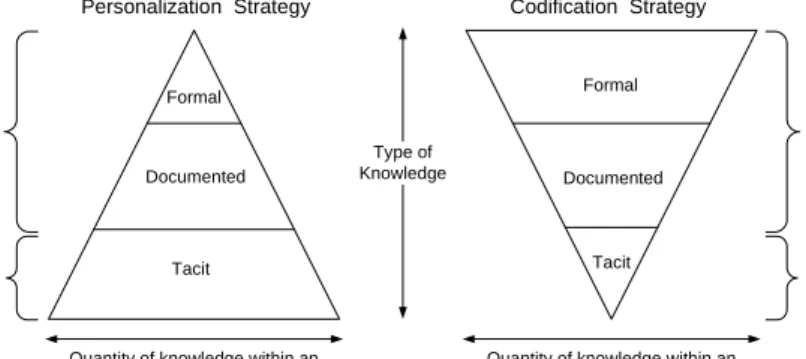
Figure 6.1 presents these different knowledge types in the vertical dimension
com-bined with two knowledge management strategies in the horizontal dimension.
Personalization Strategy Codification Strategy
Type of Knowledge Formal Documented Tacit Tacit Documented Formal
Quantity of knowledge within an organization
Quantity of knowledge within an organization Explicit
Implicit
Explicit
Implicit
Fig. 6.1: Pyramid of knowledge types and the associated knowledge management strategies [162]
In this chapter, we first present a set of possible use cases that can be supported by
AKM tooling. The set is not meant to be exhaustive; however it is well-grounded as
it comprises a superset of the use cases either implemented or being in the wish-list
of the existing AKM tools. In the next two sections, we present existing tool support
for the codification and hybrid knowledge management strategies, respectively. To
the best of our knowledge there are no tools that support purely the
personaliza-tion strategy without any codificapersonaliza-tion. However we will present some technologies
for personalization in section 6.5. Some of the technologies are mature and can be
used off-the-shelf while others are still applied in an experimental setting and are
presented here as a future research challenge.
6.2 Use Cases of AK Management
In this section, we describe use cases for AKM tooling to present the potential set
of tool features in this domain and also set the stage for presenting existing tools
and technologies (discussed in sections 6.3, 6.4 and 6.5). The use cases define the
requirements for developing an AKM tool, i.e. who would use it (actors), to do what
(use cases)? We came up with this use case model by surveying a series of papers
[10, 117, 195, 331], which provide at least some kind of usage of AK (requirements,
services, functions, use cases, etc.). We formed a superset of use cases by selecting,
merging, and generalizing from the use cases of the individual approaches. Some of
them came from interviews with practicing architects, while others originate from
researchers’ experience. Furthermore some use cases have been implemented in
tools, while others remained in the “wish-list” of researchers.
6.2.1 Actors
Who would use the AKM tool?
•
Architects designing a system (or a subsystem of a large system) by making
de-cisions. They keep the tacit AK in mind or transform it from tacit to documented
or formalized knowledge [331].
•
Reviewers involved in judging the quality or progress of an architecture [195].
•
Requirements engineers who view AK from the problem space [195]. Developers
involved in the implementation of the architecture design and decisions [331].
•
Maintainers who evolve or maintain the system and need to understand the
cor-relation between the decisions they take and existing, relevant AK [331].
•
Users of the AKM tool are the entire set of system stakeholders [195]. All the
actors mentioned above are specialized actors of User.
6.2.2 Use Cases
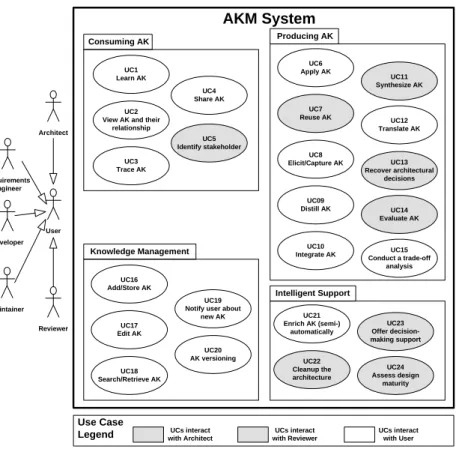
We present the use cases (UC) by grouping them into four distinct categories, as
illustrated in Figure 6.2: Actors either consume AK by using it for specific
pur-poses, or produce AK by creating new or modifying existing AK [198]; knowledge
management concerns general low-level functionality to manage AK data; and
in-telligent support concerns automating AKM tasks within the architecting process
that require either rigor or intelligence.
We do not claim that the list of use cases is exhaustive, but they do capture all
use cases in the surveyed literature. Some use cases are kept unchanged from the
original source (e.g. Assess design maturity [331]) while others have been merged
(e.g. Reuse AK [331] includes Clone AK [195] and Stimulate reuse of best practices
[117]), or generalized (e.g. Identify stakeholders is generalized from Identify the
subversive stakeholder [195] and Identify affected stakeholders on change [331]).
These use cases, together with their included and specialized use cases, are
dis-cussed within the presentation of the AKM tools in sections 6.3 and 6.4. In this
section, we very briefly discuss each use case, and refer to the original sources for
more information. It is noted that the actors are explicitly specified only for the use
cases whose actor is the Architect or the Reviewer and not the generic User. Also
we consider the generalization relationship between use cases as in [41].
Consuming AK
•
UC1, Learn AK [318]: learn and comprehend the AK, e.g. understand the
ratio-nale of a design decision.
•
UC2, View AK and their relationships [199]: view both AK elements and
re-lationships e.g. the architectural decisions made and the rere-lationships between
these decisions.
•
UC3, Trace AK [12]]: trace between various AK elements, e.g. design decisions,
rationale, and design.
•
UC4, Share AK [318]: share knowledge with one or more actors of the system.
•
UC5, Identify stakeholder [195, 331]: the architect identifies a stakeholder
ac-cording to certain criteria, e.g. who has the most “weight” on the architectural
decisions.
Producing AK
•
UC6, Apply general AK [318]: use application-independent AK, e.g. apply
archi-tecture patterns to solve the problems at hand.
•
UC7, Reuse AK [331]: the architect reuses AK in another project context, e.g.
reusing architectural design decisions from an old to a new project.
•
UC8, Elicit/Capture AK [10, 199]: elicit and capture AK from various resources,
e.g. individuals, teams, or documents.
•
UC9, Distill AK [318]: distill specific knowledge from a system into general
knowledge (e.g. architecture pattern) that can be reused in future systems.
•
UC10, Integrate AK [318]: integrate different types of information into concrete
AK, e.g. integrate stakeholder requirements, system context, and technology
con-straints into system requirements.
•
UC11, Synthesize AK [318]: the architect applies the design decisions and
pro-duces the system design (e.g. components and connectors).
•
UC12, Translate AK [211]: translate the formal AK based on a given AK domain
model into another domain model to facilitate reuse.
AKM System
UC14 Evaluate AK User UC24 Assess design maturity UC7 Reuse AK UC22 Cleanup the architecture UC15 Conduct a trade-off analysis UC19 Notify user aboutnew AK UC18 Search/Retrieve AK UC16 Add/Store AK UC13 Recover architectural decisions UC4 Share AK UC8 Elicit/Capture AK UC17 Edit AK UC2 View AK and their
relationship UC21 Enrich AK (semi-) automatically UC09 Distill AK UC6 Apply AK UC3 Trace AK UC10 Integrate AK UC1 Learn AK UC23 Offer decision-making support UC11 Synthesize AK UC5 Identify stakeholder Consuming AK Producing AK Intelligent Support Knowledge Management UC12 Translate AK Architect Developer Requirements engineer Maintainer Reviewer Use Case
Legend with ArchitectUCs interact
UCs interact with User UCs interact with Reviewer UC20 AK versioning
Fig. 6.2: Panorama of the AKM use case model
•
UC13, Recover architectural decisions [331]: the architect reconstructs decisions
with their associated rationale from an existing or 3rd party system.
•
UC14, Evaluate AK [318, 331]: the reviewer performs a critical evaluation of the
AK, e.g. to make sure that requirements have been satisfied in the architecture
design.
•
UC15, Conduct a trade-off analysis [331]: analyze the architecture by trading off
different quality attributes.
Knowledge Management
•
UC16, Add/Store AK [195]: add and store elements of AK into the knowledge
repository.
•
UC17, Edit AK [10]: modify or delete AK elements in the repository.
•
UC18, Search/Retrieve AK [199, 318]: search through the existing AK using
cer-tain criteria (e.g. keywords and categories, etc.).
•
UC19, Notify user about AK changes [117]: subscribe to specific AK elements,
and subsequently get notified about changes to them.
•
UC20, AK versioning [195]: create and manage different versions of the AK.
Intelligent Support
•
UC21, Enrich AK (semi-) automatically [199]: generate AK content proactively,
e.g. automatically distilling and interpreting AK from text without the users’
in-tervention.
•
UC22, Cleanup the architecture [331]: the architect makes sure that all the
de-pendencies of removed AK (e.g. the consequences of an architectural decision)
have been removed as well.
•
UC23, Offer decision-making support [117, 199]: provide automated support for
the Architect in the process of making decisions, e.g. through well-founded
ad-vices and guidelines.
•
UC24, Assess design maturity [331]: the architect evaluates when the architecture
can be considered as finished, complete, and consistent, e.g. verify whether a
system conforming to the architecture can be made or bought.
6.3 Tool Support for Codification
In this section, we present the AKM tools that support the codification strategy by
discussing for each one: a brief introduction, how they support the use cases listed
in section 6.2.2 (full or partial support) and their special focus (e.g. architecture
de-sign support, evaluation support, etc). The order of presenting the tools is organized
according to the type of knowledge they support: the SEI-ADWiki supports
docu-mented AKM; ADkwik and ADDSS support both docudocu-mented and formal AKM;
and the rest support formal AKM.
6.3.1 SEI-ADWiki
This tool is a wiki-based collaborative environment for creating architecture
docu-mentation and is used by students in the Carnegie Mellon University Master of
Soft-ware Engineering program [26]. The tool is not named, so we call it SEI-ADWiki
for ease of reference within this chapter.
Supported use cases
6.3.1.1 View AK and their relationships (UC2): users can view the content of
ar-chitecture documents and relationships within that content (e.g. mapping
between architecture views) through a navigation bar.
6.3.1.2 Trace AK (UC3): users can create traceability between architectural artifacts
(documented AK represented in wiki pages) through hyperlinks.
6.3.1.3 Share AK (UC4): users can share the content of architecture documents with
other users after saving the content in wiki pages.
6.3.1.4 Add/Store AK (UC16): users can add and save architectural artifacts in wiki
pages.
6.3.1.5 Edit AK (UC17): users can change and remove the content of architecture
document in wiki pages.
6.3.1.6 Search/Retrieve AK (UC18): users can use the search box on every wiki
page to search the entire wiki by keywords.
6.3.1.7 Notify user about the AK changes (UC19): users can opt to receive
noti-fication (e.g. by email) when a monitored wiki page (documented AK) is
modified by other users or when a new wiki page is created.
6.3.1.8 AK versioning (UC20): users can create different versions for the
architec-ture artifacts represented in wiki pages through the versioning function of
wiki.
6.3.1.9 View the change history of AK (includes UC20): users can view the change
history based on the versioned AK. The change history documents which
part of the architecture has been added or modified since the last review.
AK versioning produces versioned AK for viewing the AK change history,
therefore this UC includes UC20.
Special focus
SEI-ADWiki is able to create and maintain architecture documentation in a dynamic
and collaborative way. The basic form of knowledge in SEI-ADWiki is the wiki
page (documented AK), which provides a combination of editing and version
man-agement tools with the advantage of open access.
6.3.2 ADkwik
ADkwik
1(Architectural Decision Knowledge Wiki) is a Web 2.0 system which
sup-ports the collaborative decision-making work of software architects [295]. Similarly
to other wikis, the users (team members) only need a Web browser to work with the
system. But still ADkwik is different from a plain standard wiki which is explained
in details below. An elaborate application of ADkwik is discussed in Chapter 12.
Supported use cases
6.3.2.1 View AK (UC2): users can use the navigation bar to view the AK in a
dy-namic wiki page (e.g. all dependencies to an architectural decision) using
Web 2.0 context-aware mashup techniques [17].
6.3.2.2 Trace AK (UC3): users can create and manage dependency relationships
based on the SOAD architectural decision model [352].
6.3.2.3 Share AK (UC4): users can share AK across project boundaries with other
users. Special attention is given to architecture decisions, which are codified
in formal AK and shared according to the SOAD model.
6.3.2.4 Reuse AK (UC7): users can reuse the AK about enterprise application
ar-chitectures contained in the architectural decision repository.
6.3.2.5 Harvest AK (generalized UC from UC8 and UC9): users can update the
AK with new decisions, experiences, patterns and rationale gathered by
both successful and failed projects. This UC concerns eliciting/capturing
AK (e.g. decisions) and distilling AK (e.g. patterns) and, therefore it is a
generalized UC from UC8 and UC9.
6.3.2.6 Search/Retrieve AK (UC18): users can search/retrieve the AK from the
tagged wiki pages.
6.3.2.7 AK versioning (UC20): users can manage different versions of the AK by
tracing the wiki changes at the page level.
6.3.2.8 Offer decision-making support (UC23): users can find and reuse appropriate
decisions in the architectural decision repository.
Special focus
The main difference of ADkwik from other wikis is that ADkwik is an
applica-tion wiki as opposed to a plain standard wiki. It is supported by relaapplica-tional database
underneath whose tables are structured based on the SOAD domain model [352],
while standard wikis also have databases, but the tables are wiki pages. The AK in
ADkwik is also structured according to SOAD model to enable formal AK
shar-ing between stakeholders and projects. Consequently ADkwik combines the open
access of wikis and formal knowledge based on the underneath domain model to
provide efficient AK sharing and management.
6.3.3 ADDSS
ADDSS
2(Architecture Design Decision Support System) is a Web-based tool for
storing, managing and documenting architectural design decisions taken during the
architecting process and providing traceability between requirements and
architec-tures through the decisions [69].
Supported use cases
6.3.3.1 Learn AK (UC1): users can understand the architectural decisions by
view-ing and replayview-ing the evolution of decisions over time.
6.3.3.2 View AK and their relationships (UC2): users can easily view the AK and
their relationships presented in Web pages and structured according to
spe-cific templates.
6.3.3.3 Trace AK (UC3): users can trace architectural decisions to other elements
(e.g. Architecture, Stakeholder) based on the ADDSS architectural decision
domain model.
6.3.3.4 Share AK (UC4): users can interact and share AK through groupware
sup-port in order to check and solve their conflicts. Another solution to share
AK in ADDSS is to generate standard documents (e.g. PDF) with all the
architectural information, and send it to related stakeholders.
6.3.3.5 Elicit/Capture AK (UC8): users can capture the architectural design
deci-sions using a template that consists of mandatory and optional attributes.
6.3.3.6 Chronological view of AK (included in UC2): users can view the
architec-tural decisions in a chronological order, to better understand the decision
making process. This is a special case of viewing AK and their
relation-ships and, therefore it is an included UC of UC2.
6.3.3.7 Add/Store AK (UC16): users can add/store architectural design decisions or
design patterns and architectural styles. Decisions can be described using
free text, and patterns/styles can be described using graphical and textual
description.
6.3.3.8 Search/Retrieve AK (UC18): users can query the system about related
re-quirements, decisions and architectures.
6.3.3.9 Offer decision-making support (UC23): users can make design decisions by
selecting well-known design patterns and architectural styles.
Special focus
ADDSS uses a flexible approach based on a set of mandatory and optional attributes
for characterizing architectural design decisions. Hence, ADDSS provides a
cus-tomizable codification strategy that makes capturing AK more flexible. ADDSS
fo-cuses on the evolution of AK by capturing both architecture designs and
architec-tural design decisions following an iterative process, and visualizing this evolution
over time. ADDSS also stresses on applying general knowledge (e.g. architectural
patterns).
6.3.4 Archium
The Archium
3[164, 166] aims at providing traceability among a wide range of AK
concepts such as requirements, decisions, architecture descriptions, and
implemen-tation. The tool facilitates the maintenance of this AK (e.g. resolve conflicts and
synchronize various parts) during the life cycle of a system. All these AK concepts
can be expressed in a single language: the Archium language.
Supported use cases
6.3.4.1 Trace AK (UC3): users can trace architectural decisions to requirements,
architectural models and implementation in the Archium language.
6.3.4.2 Distill patterns of architectural decision dependencies (specialized of UC9):
users can discover general patterns of dependencies between architectural
decisions by viewing their functional dependencies. The patterns of
archi-tectural decision dependencies are a type of AK, so this is a specialized UC
of UC9.
6.3.4.3 Add/Store AK (UC16): users can add/store architectural decisions specified
in the Archium language into the repository.
6.3.4.4 Retrieve AK (included in UC18): users can manually select any component
or connector and retrieve the relevant architectural decisions.
6.3.4.5 Check superfluous architectural decisions (included in UC22): users can
identify one class of superfluous decisions in Archium: the unnecessary
de-cisions that have no effect on the architecture. Checking superfluous
ar-chitectural decisions is a prerequisite for cleaning up the architecture and,
therefore this UC is included in UC22. The same reason applies for the next
UC.
6.3.4.6 Get consequences of an architectural decision (included in UC22): users
can get the consequence of a decision by viewing the dependency graph of
architectural decisions.
6.3.4.7 Check for consistency of architectural decisions (included in UC24): users
can employ the Archium compiler and run-time environment supporting
the Archium language to check different types of consistency between
ar-chitectural decisions, design and implementation. For example, they can
check whether dependencies such as refines or dependsOn of an
architec-tural decision are satisfied with other decisions. Checking consistency of
ar-chitectural decisions is part of accessing design maturity and therefore this
is an included UC of UC24. The same reason applies for the UCs 6.3.4.8 to
6.3.4.10.
6.3.4.8 Validate architectural decisions against requirements (included in UC24):
users can check whether all requirements are addressed in one or more
ar-chitectural decisions based on the Archium language.
6.3.4.9 Check implementation against architectural decisions (included in UC24):
the Archium compiler generates code by transforming the architectural
ele-ments (e.g. components, connectors) into Java classes. During the process,
the compiler also analyzes and verifies whether the transformed Java classes
comply with the architectural decisions.
6.3.4.10 Check for completeness (included in UC24): users can check whether any
elements (e.g. motivations, causes, and problems) of an architectural
deci-sion are missing.
Special focus
Visualization and traceability of architectural decisions are the core features of
Archium, which are essential for better understanding the architecture design.
Archium provides a pragmatic approach to using architectural decisions in
architect-ing: the decisions are bidirectionally linked with the system implementation through
transformations, which are transparent to user.
6.3.5 AREL
AREL
4(Architecture Rationale and Elements Linkage) is a UML-based tool that
aims in creating and documenting architectural design with a focus on architectural
decisions and design rationale [321]. Three types of AK are captured in AREL:
design concerns, design decisions and design outcomes, which are all represented
in UML. An extensive example of the use of AREL in design reasoning is provided
in Chapter 9.
Supported use cases
6.3.5.1 Learn AK (UC1): users can understand the design outcome with its
asso-ciated design rationale (concern and decision) based on the AREL causal
model.
6.3.5.2 View AK (UC2): users can view the AK elements and relationships in UML
diagrams.
6.3.5.3 Trace AK (UC3): users can trace design concerns and design outcomes to
design decisions using the UML dependency relationship.
6.3.5.4 Identify AK change impacts (included in UC14): users can identify all the
design decisions and other AK elements, that are directly or indirectly
im-pacted when AK is modified, based on the AREL causal model. This UC
provides information for evaluating AK, e.g. evaluate the impact of AK
change, so this is an included UC of UC14.
6.3.5.5 Elicit/Capture AK (UC8): users can capture AK during the architecting
pro-cess using a UML modeling tool. They can also elicit AK from text-based
requirement specifications using UML models.
6.3.5.6 Synthesize AK (UC11): users can implement design decisions into the
sys-tem design in UML diagrams, based on the AREL domain model.
6.3.5.7 Conduct a trade-off analysis (UC15): cross-cutting concerns often require
trade-off analysis at multiple decision points, and users can conduct such an
analysis by tracing between design concerns and design outcomes that
im-plement the cross-cutting concerns (especially the non-functional
require-ments).
6.3.5.8 Add/Store AK (UC16): users can save the elicited/captured AK in UML
models.
6.3.5.9 Edit AK (UC17): users can edit the AK through the corresponding UML
models.
6.3.5.10 Search/Retrieve AK (UC18): users can use the search and retrieval
func-tions provided by the UML modeling to find AK elements within the UML
models.
6.3.5.11 Detect architecture design conflicts (included in UC24): users can detect
the design conflicts by looking at the missing links (design gaps) between
design concerns and design outcomes using the AREL causal model. This
UC can be used for accessing design maturity and, therefore it is included
in UC24.
Special focus
AREL represents various AK elements using UML profiles, thus integrate AKM
into a UML modeling tool (e.g. Enterprise Architect). This enables the architect
to record the design decisions as part of the architecture design. AREL focuses on
linking the problem space (design concerns) to the solution space (design outcomes)
through design decisions in a uniform way.
6.3.6 Knowledge Architect
The Knowledge Architect (KA) is a tool suite for capturing, using, translating,
shar-ing and managshar-ing AK. It is based on a common AK repository accessed by
dif-ferent clients (Document Knowledge Client, Excel and Python Plug-in, Knowledge
Explorer and Knowledge Translator) [211]. The tool suite makes extensive use of
technologies developed for the Semantic Web to allow for formal AK management.
The Knowledge Architect is one outcome of the GRIFFIN project, discussed in
Chapter 8.
Supported use cases
6.3.6.1 View AK and their relationship (UC2): users can view the AK entities and
their relationships in the Knowledge Explorer.
6.3.6.2 Trace AK (UC3): users can create traceability between AK entities using
the different client tools.
6.3.6.3 Share AK (UC4): users can share AK entities with other users by storing
it centrally in the Knowledge Repository and accessing it using the various
client tools.
6.3.6.4 Elicit/Capture AK (UC8): users can elicit/capture AK by annotating
archi-tecture documents and models using the KA client tools.
6.3.6.5 Integrate AK (UC10): users can integrate various types of AK (from
re-quirements to design artifacts) into the Knowledge Repository based on a
common domain model.
6.3.6.6 Translate AK (UC12): users can perform automatic translation based on
different AK domain models through the Knowledge Translator [210].
6.3.6.7 Add/Store AK (UC16): users can save the captured (annotated) AK entities
into the Knowledge Repository through the client tools.
6.3.6.8 Edit AK (UC17): users can edit the AK entities through the client tools.
6.3.6.9 Search/Retrieve AK (UC18): users can query the AK entities and their
rela-tionships in the Knowledge Repository through its Query Engine, using the
RDF query language.
6.3.6.10 Check completeness of AK (included in UC24): users can check the
com-pleteness of AK in a document (e.g. whether a Decision Topic has been
addressed by at least one Alternative) through the Document Knowledge
Client. Checking completeness of AK is part of accessing design maturity,
so this is an included UC of UC24.
Special focus
The Knowledge Architect focuses on capturing AK through annotating
informa-tion in different sources (e.g. Word, Excel documents), and sharing it in a central
repository. The tools suite also focuses on traceability management and intelligent
support, as AK entities and relationships are semantically specified in OWL [38].
6.3.7 SEURAT
SEURAT
5(Software Engineering Using RATionale system) is an Eclipse plug-in
that is targeted to rationale knowledge management in an integrated development
environment (IDE), from requirements to design and finally to source code [62][64].
The concept of rationale knowledge in SEURAT is composed of design decisions,
alternative solutions considered, and the reasons (arguments for each solution)
be-hind the final decisions.
Supported use cases
6.3.7.1 Learn AK (UC1): users can understand rationale knowledge and all its parts.
It is represented with a formal argument ontology (for details on the
argu-ment ontology see [61]), which semantically assists the understanding of
the rationale knowledge.
6.3.7.2 View AK (UC2): users can view rationale knowledge within the Eclipse
en-vironment in a hierarchical view - from list of decisions to alternative
solu-tions and finally to the “arguments” for or against each solution. Users can
also view rationale knowledge through the rationale hierarchy report (in the
same layout as in the hierarchical view) and the rationale traceability matrix
report generated by the tool.
6.3.7.3 Trace AK (UC3): users can trace the rationale knowledge (e.g. “how do we
compare dates?”) to source code (e.g. function compareDates()) directly
in the Eclipse environment using bookmarks. Users can also trace
require-ments to the decisions made and captured in the rationale.
6.3.7.4 Elicit/Capture AK (UC8): users can capture rationale knowledge during
source code development. They can also import rationale knowledge from
Word documents where text has been annotated as rationale.
6.3.7.5 Decision evaluation and impact assessment (included in UC14): users can
evaluate decisions by calculating the “support score” for each alternative
solution based on the arguments for and against it. Users can also disable
some requirements when stakeholders change their mind about them, and
see which decisions may require re-examination due to the impact
ment of requirements. This UC aims at evaluating design decisions, a type
of AK, so this is an included UC of UC14.
6.3.7.6 Conduct a trade-off analysis (UC15): users can conduct trade-off analysis
of a decision based on the “background knowledge” (e.g. “A more flexible
solution costs more to develop”) of this decision which is explicitly recorded
in the rationale.
6.3.7.7 Add/Store AK (UC16): users can add rationale knowledge using an editing
interface integrated in Eclipse and store it in a relational database.
6.3.7.8 Edit AK (UC17): users can edit the text of rationale knowledge using the
editing interface.
6.3.7.9 Search/Retrieve AK (UC18): users can search/retrieve rationale knowledge
elements through keyword-based search, including requirements, decisions,
alternatives and arguments.
6.3.7.10 Offer decision-making support (UC23): users can get decision-making
support using the “support scores” for each alternative solution.
6.3.7.11 Check for completeness and consistency of rationale knowledge (included
in UC24): users can detect the incompleteness and inconsistency of the
ra-tionale knowledge through inferencing based on the argument ontology, e.g.
for completeness, checks are made to ensure that there are alternatives
pro-posed for each decision. This UC can be used for accessing design maturity
and, therefore it is included in UC24.
Special focus
SEURAT is not specifically used for the management of AK but for rationale
knowl-edge. However, in a broad sense, rationale knowledge about architecture design (e.g.
arguments linked from requirements to alternative design solutions) is an important
part of AK. In addition, SEURAT mainly focuses on the application of rationale
knowledge supporting software maintenance [63].
6.4 Tool Support for the Hybrid Strategy
In this section, we present the AKM tools that support the hybrid strategy in the
same structure as in section 6.3.
6.4.1 EAGLE
EAGLE [118, 117] is an AK sharing portal that implements best practices from
knowledge management for improving AK sharing. The main features of
EA-GLE include integrated support for both codified and personalized AK, support
for stakeholder-specific content, and AK subscription and notification. EAGLE is
a result of the GRIFFIN project, discussed in Chapter 8.
Supported use cases
6.4.1.1 Share AK (UC4): users can share AK in both personalized (e.g. news, events
and experience with colleagues) and codified (e.g. best practices,
docu-ments) formats.
6.4.1.2 Find a colleague based on expertise or competence (included in UC4): users
can find the right person, whose personal knowledge may match a specific
AK request. This UC provides information for personalized AK sharing, so
it is an included UC of UC4.
6.4.1.3 Overview of personal information of colleagues (included in UC4): users
can get an overview of “who knows what” and “who is doing what” among
their colleagues. This UC also provides information for personalized AK
sharing, so it is an included UC of UC4.
6.4.1.4 Add/Store best practices (specialized of UC16): users can add best practices
to a repository (codified AK) for reuse and decision making support. Best
practices are a special type of AK, so this is a specialized UC of UC16.
6.4.1.5 Add/Store architecture document (specialized of UC16): users can add
ar-chitecture documents to a repository according to various AK categories.
Similarly to the UC in 5.1.4, this is also a specialized UC of UC16.
6.4.1.6 Search/Retrieve AK (UC18): users can access generic documentation
(dif-ferent types of company documents) by document title, keywords or
cate-gories, and also search for project-specific AK documentation.
6.4.1.7 Search/Retrieve related AK (included in UC18): users can access external
information sources to find related AK, such as white papers (codified AK),
seminars and trainings (personalized AK) or other corporate
communica-tion, e.g. discussion board (personalized AK). Related AK is a special kind
of AK, so this is a specialized UC of UC18.
6.4.1.8 Notify user about new AK (specialized of UC19): user can stay up-to-date
about new AK through subscription and notification mechanisms. New AK
is a kind of AK change and, therefore this is a specialized UC of UC19.
6.4.1.9 Offer decision-making support (UC23): Users can get intelligent support
by answering a questionnaire during the decision-making process, and
au-tomatically receiving a number of architectural guidelines that match their
answers.
6.4.1.10 Overview of project stakeholders (included in UC24): users can have an
overview about project stakeholders, e.g. contact information and expertise
area. They can subsequently request all the involved stakeholders to access
the design maturity and, therefore this is an included UC of UC24.
Special focus
EAGLE focuses on stakeholder collaboration during the architecting process, by
enabling them to connect to colleagues or other involved stakeholders by retrieving
“who is doing what” and “who knows what”. In addition, codified AK in a document
repository or best practice repository can also be easily accessed using advanced
search mechanisms.
6.4.2 PAKME
PAKME
6(Process-based Architecture Knowledge Management Environment) is a
Web-based tool aimed at providing knowledge management support for the software
architecture process. PAKME supports both codification and personalization as it
not only provides access to AK but also identifies the knowledge source [8, 12].
Supported use cases
6.4.2.1 View AK and their relationships (UC2): users can view AK elements (e.g.
architectural patterns) in template-driven Web pages, and their relationships
through hyperlinks.
6.4.2.2 Trace AK (UC3): users can trace AK using hyperlinks and relationship types
(e.g. constrain or conflictWith relationships between architectural design
de-cisions) defined in PAKME.
6.4.2.3 Share AK (UC4): users can share the AK stored in the PAKME repository
through the Web user interface.
6.4.2.4 Apply general AK (UC6): users can apply general AK (e.g. patterns, general
scenarios) to design a suitable architecture for a new application.
6.4.2.5 Reuse AK (UC7): users can reuse alternative design solutions in 4 steps
(searching, retrieving, reviewing and integrating).
6.4.2.6 Elicit/Capture AK (UC8): users can use various Web forms based on
tem-plates (e.g. architectural decision and pattern temtem-plates) to elicit, structure
and capture AK before storing it into the repository.
6.4.2.7 Add/Store AK (UC16): users can use various Web forms to enter generic or
project-specific AK into the repository, including the knowledge producer
information.
6.4.2.8 Edit AK (UC17): users can modify and delete the AK stored in the
reposi-tory through the Web user interface.
6.4.2.9 Search/Retrieve AK (UC18): users can search/retrieve AK elements through
keyword-based search, advanced search and navigation-based search. For
personalization purposes the source of AK (e.g. knowledge producer) can
also be retrieved.
Special focus
PAKME focuses on various collaborative AK management features for
geographi-cally distributed stakeholders involved in the architecture process by managing and
sharing codified AK (pattern, decision, etc.) and personalized AK (contact
manage-ment, online collaboration, etc).
6.5 Technologies
Some of the AKM tools described in the previous sections were not built from
scratch but made use of various technologies. Such technologies are generic and
can be employed to support the AKM use cases presented in section 6.2. In this
section, we present a number of these technologies to demonstrate their value for
AKM tools, and to assist tool vendors in selecting the appropriate ones for their
own needs. The order of presenting the technologies is organized according to the
type of knowledge they support: Web portal, blog and wiki support the hybrid
strat-egy, voting and ranking support the personalization stratstrat-egy, and the rest support the
codification strategy.
6.5.1 Web Portal
A Web portal [135, 324] is a Web site that provides integrated modules, like hosted
databases, yellow pages, discussion boards, news push, document management,
email and more. Web portals automatically personalize the content generated from
these modules to provide a personalized experience to users. The yellow pages
mod-ule can record the expertise area, involved projects and contact information of all the
architects in an organization, thus providing support for personalized AK sharing
(UC4). Emails, news push and discussion boards provide communication support
for AK sharing (UC4) through a collaboration space among users. News push also
supports AK changes notification (UC19) when personalized information is changed
(e.g. personnel movement).
This technology is also useful for codified AK management. The hosted
cen-tral databases and client/server architecture can facilitate AK sharing (UC4), and
Web forms can be used for tracing (UC3), eliciting/capturing (UC8), adding/storing
(UC16), and editing (UC17) AK.
6.5.2 Blog and Wiki
Different from yellow pages, blogs and wikis are both editable Web pages by
indi-vidual users who are distributed over the network. Blogs are for single users, and
wikis are designed to enable anyone to contribute or modify content, so they both
support personalized AK sharing (UC4). For example individual users can provide
up-to-date and more reliable personal information, such as their expertise area and
personal knowledge.
As a collaborative Web editing system, wikis also support codified AK
manage-ment for both documanage-mented and formal AK. We classify the wikis as general wikis
for documented AKM (e.g. SEI-ADWiki) and semantic wikis for formal AKM
(e.g. ADkwik). Both types of wikis can support the following AKM use cases:
AK viewing (UC2) and AK traceability (UC3), adding/storing AK (UC16), editing
AK (UC17), searching/retrieving AK (UC18), user notification about AK changes
(UC19), and AK sharing (UC4). Some practical experience of applying wikis to
support AK sharing can also be found in [120].
Generic wikis simply document AK in the wiki pages. On the other hand,
seman-tic wikis provide semanseman-tic support through formal models (e.g. semanseman-tic annotation
and semantic query of AK). In addition, wikis have also been used in requirements
engineering to support requirements knowledge management in a codification
strat-egy, e.g. for documented requirements [94] and formal requirements knowledge
[215].
6.5.3 Voting and Ranking
Voting and ranking is a method to evaluate and rank the characteristics (e.g.
credibil-ity and reliabilcredibil-ity, etc.) of objects or people by different users in an online
commu-nity. It has been widely applied in many social networking systems (e.g. LinkedIn)
and C2C business platforms (e.g. eBay) for the evaluation and ranking of personal
information.
The personal information recorded in Web portals, wikis and yellow pages has
unavoidably personal and subjective bias (e.g. the expertise of an architect). Using
the voting and ranking mechanism can partially mitigate this problem, and provide
more credible personal information. For example ranking the expertise of different
stakeholders on a technology platform by other members of an organization helps to
create reliable “who knows what” information, and thus efficient personalized AK
sharing (UC4).
6.5.4 Natural Language Processing
Natural language processing (NLP) is concerned with the understanding of human
natural languages by computers. Since documentation in natural language is
domi-nant in AK resources (most documented AK is in natural language), it is beneficial
to introduce NLP techniques in AKM tools.
Several AKM use cases have been supported by NLP techniques. The LSA
(La-tent Semantic Analysis) technique has been used to elicit/capture AK (UC8)
semi-automatically [45]. Text mining techniques have been used to enrich AK (UC21)
[118], and offer decision-making support (UC23) [199].
6.5.5 Ontologies
Ontologies are formal structures supporting knowledge representation,
manage-ment, sharing and reusing [124], and have been widely used in various fields, such as
the Semantic Web. They represent explicitly the semantics of structured and
semi-structured information and so enable sophisticated automatic support for acquiring,
maintaining and accessing information [93]. Formal AK, as a kind of formal
knowl-edge, can be represented by ontology models (see for example [193]). Various
on-tology techniques have been explored in AKM tools, including onon-tology modeling,
ontology database, ontology mapping, and ontology-based inferencing. These
tech-niques will be elaborated in the following paragraphs.
Ontology modeling can be used to describe domain concepts and their
relation-ships. In this respect, AK ontology models are composed of AK domain concepts
(e.g. Design Decision, Alternative, and Risk) and relationships (e.g. addressedBy
and containedIn). Related standards on ontology specification to specify the
ontol-ogy modeling results have been defined by the W3C, e.g. RDF [187] and OWL [38],
with ontology modeling tools support, e.g. Prot´eg´e
7. Combined with ontology
mod-els, an AKM tool can support the following use cases of formal AK management:
UC1 (Learn AK) - the ontology concepts and relationships can help users understand
the meaning of AK; UC2 (View AK and their relationships), UC3 (Trace AK) and
UC22 (Clean up architecture) - these use cases are supported by using the semantic
relationships defined between AK concepts.
Ontology databases store data in ontological data models. For example the RDF
store Sesame [55] stores data in the RDF triple format. Ontology databases provide
semantic querying using their specific query language, e.g. SPARQL [261] of the
W3C, SeRQL for Sesame. For example, one can query the ontology database by
posing question like “Tell me all the alternative solutions addressed to decision topic
’the control method over the data processing pipelines’ which are not in conflict
with each other”. The following use cases can be supported by ontology databases
in formal AK management tools: Add/Store AK (UC16) in ontological data models,
Search/Retrieve AK (UC18) by query languages, and Share AK (UC4) after getting
the query results.
Ontology mapping is an activity to semantically relate two ontologies [115].
It provides a semantic translation between heterogeneous ontologies and therefore
enables knowledge sharing in a semantically sound manner [172]. This is essential
for sharing AK that originates from different organizations and is based on different
AK ontologies. UC4 (Share AK) and UC12 (Translate AK) can be supported by
ontology mapping techniques (see e.g. the Knowledge Translator [211]).
Ontology-based inferencing concerns retrieving knowledge and creating
de-ductive knowledge based on ontology models with logic-based reasoning [338]. In
AKM tools, the inferencer can be mostly used to automatically infer the
relation-ships that exist between the formal AK entities, e.g. an inverse relationship between
AK elements (for traceability) or a mapping relationship between elements from
different AK domain models (for translation). The inferencer can support the
fol-lowing use cases: Search/Retrieve AK (UC18) e.g. by the SeRQL query language of
OWLIM inference engine [184], Check for completeness (included in UC24) e.g. by
the KA client tools [211], and Translate AK (UC12) e.g. by the Knowledge
Trans-lator [211].
6.5.6 Plug-in
A plug-in consists of a program that connects and interacts with a host system (e.g.
a Web browser or an email client) to provide a specific function on demand. This
technology is quite beneficial for promoting AK usage through tools that architects
have being working and are familiar with. Typical tools that architects use through
the architecting process include word processors for architecture documentation,
spreadsheets for quantitative architecture evaluation and UML modelers for
archi-tecture design.
Examples of the tool plug-in technology include the KA Document Knowledge
Client (Word plug-in) and AREL (UML modeling tool plug-in). Both plug-ins
sup-port the following AKM use cases: Learn AK (UC1), View AK (UC2), Trace AK
(UC3), Elicit/Capture AK (UC8), Synthesize AK (UC11), Add/Store AK (UC16)
and Edit AK (UC17).
6.5.7 Version Management
This technology concerns the management of multiple revisions of the same unit of
information. The versioning function of wikis, SVN (Subversion) and CVS
(Con-current Versions System) are typical examples of this technology. Wikis can track
the version changes at the page level. For every page, it is easy to look up earlier
versions, display the differences between two versions, and revert to an older
ver-sion. SVN and CVS provide similar functions for the version management of files
which can be used to record documented AK (e.g. Word documents) and also
for-mal AK (e.g. RDF files). AK evolves rapidly during the architecting process, and
effective version management of AK can support directly AK versioning (UC20)
and indirectly viewing the change history of AK (includes UC20).
6.5.8 Web 2.0
Web 2.0 aims to enhance creativity, information sharing, collaboration and
func-tionality of the Web. Interesting techniques in Web 2.0 for codified AKM include
push and pull mechanisms, tags and context-aware mashups. Push and pull
mecha-nisms (e.g. RSS - Rich Site Summary) can be used to notify user about AK changes
(UC19) for subscribed users [118]. Tags can be used to search/retrieve AK (UC18)
for Web pages that have been tagged. Context-aware mashups can be used to view
AK and their relationships (UC2) e.g. all the inter-dependent elements of an
archi-tectural decision can be shown in a dynamic mashup Web page, which combines the
AK elements from more than one source into a single integrated Web page [17].
6.6 Epilogue
For the effective usage of AK in the architecting activities, the AKM tools have
been recognized as a great contribution [7]. In this chapter, we provide a survey of
current tools and technologies with respect to the AKM strategies they adopt and the
use cases they support. We hope to help AKM tool developers in understanding the
state-of-the art and practice and get inspired in building their own tools. We expect
that depending on their specific needs and organizational context, they will mix and
match the appropriate technologies and ideas from existing tools, in order to build
customized AKM tools. We are confident that, as more AKM tools are built, more
AK will be used in practice and shared among organizations and thus contribute to
establishing AKM in the daily organizational practices.
It is noted that the following use cases, identified in section 6.2 , have not been
fully supported (implemented) by existing AKM tools: UC5 (Identify stakeholder),
UC11 (Synthesize AK), UC13 (Recover architectural decisions), UC14 (Evaluate
AK), UC21 (Enrich AK (semi-) automatically), and UC24 (Assess design maturity).
We regard these use cases as the future challenges, which AKM tool developers can
work on to provide more added value to existing AKM. We also believe that some
promising technologies can be the key for implementing these use cases, such as
NLP for intelligent support (advices and guidelines for making decisions) [199],
context-aware text mining for the elicitation of user interests about AK, and
ontol-ogy inferencing for the enrichment of AK.
Acknowledgements
This research has been partially sponsored by the Dutch Joint Academic and
Com-mercial Quality Research & Development (Jacquard) program on Software
Engi-neering Research via contract 638.001.406 GRIFFIN: a GRId For inFormatIoN
about architectural knowledge.
1. Ackerman, M.S., Halverson, C.A.: Reexamining organizational memory. Communications of the ACM 43(1), 59–64 (2000)
2. Akerman, A., Tyree, J.: Using ontology to support development of software architecture. IBM Systems Journal 45(4), 813–825 (2006)
3. Al-Naeem, T., Gorton, I., Babar, M.A., Rabhi, F.A., Benatallah, B.: A quality-driven sys-tematic approach for architecting distributed software applications. In: Proceedings 27th International Conference on Software Engineering (ICSE), pp. 244–253 (2005)
4. Aldrich, J.: Using types to enforce architectural structure. In: Seventh Working IEEE/IFIP Conference on Software Architecture (WICSA 2008), pp. 211–220. IEEE (2008)
5. Aleksovski, Z.: Using background knowledge in ontology matching. Ph.D. thesis, VU Uni-versity Amsterdam (2008)
6. Aleman-Meza, B., Halaschek, C., Budak Arpinar, I.: Collective knowledge composition in a peer-to-peer network: A survey for peer-to-peer applications. In: L.C. Rivero, J.H. Doorn, V.E. Ferraggine (eds.) Encyclopedia of Database Technologies and Applications, pp. 74–77. Idea Group (2005)
7. Ali-Babar, M., de Boer, R.C., Dingsøyr, T., Farenhorst, R.: Architectural knowledge man-agement strategies: Approaches in research and industry. In: ICSE Second Workshop on Sharing and Reusing Architectural Knowledge - Architecture, Rationale, and Design Intent (SHARK/ADI ’07). Minneapolis, MN, USA (2007)
8. Ali-Babar, M., Gorton, I.: A Tool for Managing Software Architecture Knowledge. In: 2nd Workshop on SHAring and Reusing architectural Knowledge - Architecture, rationale, and Design Intent (SHARK/ADI). Minneapolis, USA (2007)
9. Ali-Babar, M., Gorton, I., Jeffery, R.: Capturing and Using Software Architecture Knowledge for Architecture-Based Software Development. In: 5th International Conference on Quality Software. IEEE Computer Press, Melbourne, Australia (2005)
10. Ali-Babar, M., Gorton, I., Kitchenham, B.: A framework for supporting architecture knowl-edge and rationale management. In: A. Dutoit, R. McCall, I. Mistr`ık, B. Paech (eds.) Ratio-nale Management in Software Engineering, pp. 237–254. Springer (2006)
11. Ali-Babar, M., Kitchenham, B., Maheshwari, P., Jeffery, R.: Mining Patterns for Improving Architecting Activities - A Research Program and Preliminary Assessment. In: Proceed-ings of the 9th International Conference on Empirical Assessment in Software Engineering. Keele, UK (2005)
12. Ali-Babar, M., Northway, A., Gorton, I., Heuer, P., Nguyen, T.: Introducing tool support for managing architectural knowledge: an experience report. In: Proceedings of the 15th IEEE International Conference on Engineering of Computer-Based Systems (ECBS), pp. 105–113. IEEE Computer Society (2008)
13. Ali-Babar, M., Zhu, L., Jeffery, R.: A Framework for Classifying and Comparing Software Architecture Evaluation Methods. In: Proceedings of the 15th Australian Software Engineer-ing Conference, pp. 309–319. Melbourne, Australia (2004)
14. Allmann, C., Winkler, L., K¨olzow, T.: The Requirements Engineering Gap in the OEM-Supplier Relationship. Journal of Universal Knowledge Management 1(2), 103–111 (2006) 15. America, P., Rommes, E., Obbink, H.: Multi-view variation modeling for scenario analysis.
Springer-Verlag (2003)
16. Androutsellis-Theotokis, S., Spinellis, D.: A survey of peer-to-peer content distribution tech-nologies. ACM Comput. Surv. 36(4), 335–371 (2004)
17. Ankolekar, A., Kr¨otzsch, M., Tran, T., Vrandeˇci´c, D.: The two cultures: mashing up web 2.0 and the semantic web. Web Semantics: Science, Services and Agents on the World Wide Web 6(1), 70–75 (2008)
18. Antoniou, G., van Harmelen, F.: A Semantic Web Primer. MIT Press (2004)
19. Argyris, C., Sch¨on, D.A.: Organizational Learning II: Theory, Method and Practise. Organi-zation Development Series. Addison Wesley (1996)
20. Arsanjani, A.: Service-oriented Modeling and Architecture. IBM developerWorks (2004) 21. Arumugam, M., Sheth, A., Arpinar, I.B.: Towards peer-to-peer semantic web: A distributed
environment for sharing semantic knowledge on the web. In: International World Wide Web Conference (WWW) (2002)
22. Aurum, A., Jeffery, R., Wohlin, C., Handzic, M.: Managing Software Engineering Knowl-edge. Springer Verlag, Berlin (2003)
23. Avgeriou, P., Kruchten, P., Lago, P., Grisham, P., Perry, D.: Architectural Knowledge and Rationale - Issues, Trends, Challenges. ACM SIGSOFT Software Engineering Notes 32, 41–46 (2007)
24. Babu T, L., Seetha Ramaiah, M., Prabhakar, T.V., Rambabu, D.A.: ArchVoc–Towards an Ontology for Software Architecture. In: M. Seetha Ramaiah (ed.) Second Workshop on Sharing and Reusing Architectural Knowledge - Architecture, Rationale, and Design Intent (SHARK/ADI), pp. 5–5 (2007)
25. Baccarini, D.: The logical framework method for defining project success. Project Manage-ment Journal 30, 25–32 (1999)
26. Bachmann, F., Merson, P.: Experience using the web-based tool wiki for architecture docu-mentation. Tech. Rep. SEI-2005-TN-041, Carnegie Mellon University (2005)
27. Bacon, S.F.: Religious Meditations (1597)
28. Bales, D., Greenwald, R., Stackowiak, R.: Oracle Application Server 10g Essentials. O’Reilly (2004)
29. Barbacci, M.R., Ellison, R., Lattanze, A.J., Stafford, J.A., Weinstock, C.B., Wood, W.G.: Quality Attribute Workshops (QAWs). Tech. Rep. CMU/SEI-2003-TR-016, SEI, Carnegie Mellon University, USA. (2003)
30. Bartsch-Sp¨orl, B.: Transfer of Experience – Issues Beyond Tool Building. In: Workshop on Learning Software Organizations, pp. 3–8. Fraunhofer Publica, Kaiserslautern, Germany (1999)
31. Basili, V., Caldiera, G.: Improve software quality by using knowledge and experience. Sloan Management Review (Fall) (1995)
32. Basili, V., Rombach, H.: The TAME Project: Towards Improvement-Oriented Software En-vironments. IEEE Transactions on Software Engineering 14(6), 758–773 (1988)
33. Basili, V.R., Caldiera, G.: Improving software quality reusing knowledge and experience. Sloan Management Review 37(1), 55–64 (1995)
34. Basili, V.R., Caldiera, G., Rombach, H.D.: The experience factory. In: J.J. Marciniak (ed.) Encyclopedia of Software Engineering, vol. 1, pp. 469–476. John Wiley (1994)
35. Bass, L., Clements, P., Kazman, R.: Software Architecture in Practice, second edn. Addison Wesley (2003)
36. Bass, L., Kazman, R.: Architecture-Based Development. Tech. Rep. CMU/SEI-99-TR-007, Software Engineering Institute (SEI), Carnegie Mellon University, Pittsburgh, USA (1999) 37. Batini, C., Ceri, S., Navathe, S.B., Navathe, S.: Conceptual Database Design: An
38. Bechhofer, S., van Harmelen, F., Hendler, J., Horrocks, I., McGuinness, D., Patel-Schneider, P., Stein, L.: Web Ontology Language (OWL) Reference. W3C Recommendation (2004). URLhttp://www.w3.org/TR/2004/REC-owl-ref-20040210/
39. Beck, K.: Extreme Programming Explained: Embrace Change. Addison-Wesley, Boston (2000)
40. Bengtsson, P., Lassing, N., Bosch, J., van Vliet, H.: Architecture-level modifiability analysis (ALMA). Journal of Systems and Software 69(1-2), 129–147 (2004). TY - JOUR 41. Bittner, K., Spence, I.: Use Case Modeling. Addison-Wesley Professional (2002)
42. Bjørnsson, F.O., Dingsøyr, T.: Knowledge Management in Software Engineering: A System-atic Review of Studied Concepts and Research Methods Used. Information and Software Technology 50(11), 1055–1168 (2008)
43. Boehm, B.: Software Engineering Economics. Prentice Hall (1981)
44. de Boer, R., Farenhorst, R., Lago, P., van Vliet, H., Clerc, V., Jansen, A.: Architectural Knowledge: Getting to the Core. In: Proceedings 3rd International Conference on the Quality of Software-Architectures (QoSA), pp. 197–214. Springer, LNCS 4880 (2007)
45. de Boer, R., van Vliet, H.: Architecture Knowledge Discovery with Latent Semantic Anal-ysis: Constructing a Reading Guide for Software Product Audits. Journal of System and Software 81(9), 1456–1469 (2008)
46. de Boer, R., van Vliet, H.: On the Similarity between Architecture and Requirements. Journal of System and Software 82(3), 544–550 (2009)
47. de Boer, R.C., Farenhorst, R.: In Search of ‘Architectural Knowledge’. In: 3rd Workshop on SHAring and Reusing architectural Knowledge (SHARK). Leipzig, Germany (2008) 48. de Boer, R.C., Farenhorst, R., Lago, P., van Vliet, H., Clerc, V., Jansen, A.: Architectural
knowledge: Getting to the core. In: 3rd International Conference on the Quality of Software-Architectures (QoSA), pp. 197–214 (2007)
49. Booch, G.: Handbook of Software Architecture. Available online: http://www.booch.com/architecture/index.jsp
50. Bosch, J.: Software architecture: The next step. In: F. Oquendo, B. Warboys, R. Morrison (eds.) Software Architecture, First European Workshop (EWSA), pp. 194–199. Springer, LNCS 3047 (2004)
51. Boussaidi, G.E., Mili, H.: A model-driven framework for representing and applying design patterns. In: 31st Annual International Computer Software and Applications Conference, pp. 97–100. IEEE (2007)
52. Bradbury, J.S., Cordy, J.R., Dingel, J., Wermelinger, M.: A Survey of Self-Management in Dynamic Software Architecture Specifications. In: 1st ACM SIGSOFT workshop on Self-managed systems, pp. 28–33. Newport Beach, California (2004)
53. Bratthall, L., Johansson, E., Regnell, B.: Is a Design Rationale Vital when Predicting Change Impact? A Controlled Experiment on Software Architecture Evolution. In: Second Interna-tional Conference on Product Focused Software Process Improvement, pp. 126–139 (2000) 54. van den Brink, P.: Social, Organization, and Technological Conditions that Enable
Knowl-edge Sharing. Ph.D. thesis, Technische Universiteit Delft (2003)
55. Broekstra, J., Kampman, A., van Harmelen, F.: Sesame: A generic architecture for storing and querying RDF and RDF schema. In: Proceedings of the 1st International Semantic Web Conference (ISWC), pp. 54–68 (2002)
56. Brooks, F.P.: The Mythical Man-Month. Addison-Wesley, Reading, MA (1975)
57. Brown, J.S., Duguid, P.: Organizational Learning and Communities-of-practise: Toward a unified view of working, learning and innovation. Organizational Science 2(1), 40 – 57 (1991)
58. de Bruin, H., van Vliet, H.: Quality-driven software architecture composition. Journal of Systems and Software 66(3), 269–284 (2003)
59. de Bruin, H., van Vliet, H., Baida, Z.: Documenting and Analyzing a Context-Sensitive De-sign Space. In: J. Bosch, M. Gentleman, C. Hofmeister, J. Kuusela (eds.) Software Architec-ture: System Design, Development and Maintenance, Proceedings 3rd Working IFIP/IEEE Conference on Software Architecture, pp. 127–141. Kluwer Academic Publishers (2002)
60. Buckingham Shum, S., Hammond, N.: Argumentation-Based Design Rationale: What Use at What Cost? International Journal of Human-Computer Studies 40(4), 603–652 (1994) 61. Burge, J.: Software Engineering Using design RATionale. Ph.D. thesis, Worcester
Poly-technic Institute (2005). URL http://www.wpi.edu/Pubs/ETD/Available/ etd-050205-085625/
62. Burge, J., Brown, D.: An integrated approach for software design checking using rationale. In: J. Gero (ed.) Design Computing and Cognition, pp. 557–576. Kluwer Academic Publish-ers (2004)
63. Burge, J., Brown, D.: Rationale-based support for software maintenance. In: A. Dutoit, R. McCall, I. Mistr`ık, B. Paech (eds.) Rationale Management in Software Engineering, pp. 273–296. Springer (2006)
64. Burge, J., Brown, D.: SEURAT: integrated rationale management. In: Proceedings of the 30th International Conference on Software Engineering (ICSE), pp. 835–838. ACM (2008) 65. Burge, J., Brown, D.: Software Engineering Using RATionale. Journal of Systems and
Soft-ware 81(3), 395–413 (2008)
66. Buschmann, F., Meunier, R., Rohnert, H., Sommerlad, P.: Pattern-Oriented Software Archi-tecture: A System of Patterns. Wiley (1996)
67. Buxton, J.N., Randell, B.: Software Engineering Techniques: Report of a conference spon-sored by the NATO Science Committee, Rome, Italy, 27-31 Oct. 1969. NATO, Scientific Affairs Division, Brussels (1970)
68. Capilla, R., Nava, F., Due˜nas, J.C.: Modeling and documenting the evolution of architectural design decisions. In: SHark-ADI workshop (at ICSE 2007) (2007)
69. Capilla, R., Nava, F., P´erez, S., Due˜nas, J.C.: A Web-based Tool for Managing Architectural Design Decisions. In: 1st ACM Workshop on SHaring ARchitectural Knowledge (SHARK). Torino, Italy (2006)
70. Capiluppi, A., Lago, P., Morisio, M.: Characterizing the oss process. In: 2nd Workshop on Open Source Software engineering (2002)
71. Chowdhury, F.: Practice of Team Based Management. http://www.bdresearchers.org/Article/ PracticeofTeamBasedManagement (2008)
72. Clarke, R.: Web 2.0 as syndication. Journal of Theoretical and Applied Electronic Commerce Research 3(2), 30–43 (2008)
73. Clements, P., Bachmann, F., Bass, L., Garlan, D., Ivers, J., Little, R., Nord, R., Stafford, J.: Documenting Software Architectures : Views and Beyond, first edn. Addison Wesley (2002) 74. Clements, P., Kazman, R., Klein, M.: Evaluating Software Architectures: Methods and Case
Studies. Addison-Wesley (2001)
75. Clements, P., Kazman, R., Klein, M., Devesh, D., Reddy, S., Verma, P.: The Duties, Skills, and Knowledge of Software Architects. In: 6th Working IEEE/IFIP Conference on Software Architecture (WICSA), p. 20. IEEE Computer Society, Mumbai, India (2007)
76. Clements, P., Northrop, L.: Software Product Lines: Practice and Patterns. Addison-Wesley, Boston (2002)
77. Clerc, V.: Towards Architectural Knowledge Management Practices for Global Software Development. In: Third Workshop on SHAring and Reusing Architectural Knowledge (SHARK), ICSE 2008. ACM (2008)
78. Clerc, V., Lago, P., van Vliet, H.: Assessing a Multi-Site Development Organization for Ar-chitectural Compliance. In: Proceedings 6th Working IEEE/IFIP Conference on Software Architecture. IEEE Computer Society (2007)
79. Clerc, V., Lago, P., van Vliet, H.: Global Software Development: Are Architectural Rules the Answer? In: Proceedings Second IEEE International Conference on Global Software Engineering (ICGSE 2007), pp. 225–234. IEEE Computer Society (2007)
80. Clerc, V., Lago, P., van Vliet, H.: The Architect’s Mindset. In: Proceedings 3rd International Conference on the Quality of Software-Architectures (QoSA). Springer, LNCS 4880 (2007) 81. Clerc, V., Lago, P., Vliet, H.v.: Global Software Development: Are Architectural Rules the Answer? In: Proceedings International Conference on Global Software Engineering (ICGSE’07). IEEE (2007)
82. Conklin, E., K.C., B.Y.: A Process-Oriented Approach to Design Rationale. In: T. Moran, J. Carroll (eds.) Design Rationale: Concepts, Techniques and Use, chap. 14, pp. 393–427. Lawrence Erlbaum Associates (1996)
83. Cook D. Cripps P., S.P.: An Introduction to the IBM Views and Viewpoints Framework for IT Systems. IBM developerWorks (2008)
84. Coplien, J.O., Harrison, N.B.: Organizational Patterns of Agile Software Development. Pren-tice Hall (2004)
85. Coplien, J.O., Schmidt, D.C.: Pattern Languages of Program Design. Addison Wesley (1995) 86. Coulouris, G., Dollimore, J., Kindberg, T.: Distributed Systems: Concepts and Design, 4th
edn. Addison Wesley (2005)
87. Cronbach, L.J.: Coefficient alpha and the internal structure of tests. Psychometrika 16(3), 297–334 (1951)
88. Cui, X., Sun, Y., Mei, H.: Towards automated solution synthesis and rationale capture in decision-centric architecture design. In: Seventh Working IEEE/IFIP Conference on Soft-ware Architecture (WICSA ’08), pp. 221–230 (2008)
89. Damian, D.: Stakeholders in Global Requirements Engineering: Lessons Learned from Prac-tice 24(2), 21–27 (2007)
90. Damian, D., Izquierdo, L., Singer, J., Kwan, I.: Awareness in the Wild: Why Communication Breakdowns Occur. In: Second International Conference on Global Software Engineering, pp. 81–90. IEEE Computer Society (2007)
91. Davenport, T., Probst, G.: Knowledge Management Case Book – Best Practises. Publicis MCD, John Wiley & Sons (2000)
92. Davenport, T.H., Prusak, L.: Working Knowledge: How Organizations Manage What They Know. Harvard Business School Press (1998)
93. Davies, J., Fensel, D., Van Harmelen, F., NetLibrary, I.: Towards the Semantic Web: Ontology-driven Knowledge Management. Wiley (2003)
94. Decker, B., Ras, E., Rech, J., Jaubert, P., Rieth, M.: Wiki-based stakeholder participation in requirements engineering. IEEE Software 24(2), 28–35 (2007)
95. Desouza, K., Awazu, Y., Baloh, P.: Managing Knowledge in Global Software Development Efforts: Issues and Practices. IEEE Software 23(5), 30–37 (2006)
96. Desouza, K.C.: Barriers to Effective Use of Knowledge Management Systems in Software Engineering. Communications of the ACM 46(1), 99–101 (2003)
97. Desouza, K.C., Evaristo, J.R.: Managing Knowledge in Distributed Projects. Communication of the ACM 47(4), 87–91 (2004)
98. Dierkes, M., Berthoin Antal, A., Child, J., Nonaka, I.: Handbook of Organizational Learning and Knowledge. Oxford University Press (2001)
99. Dingsøyr, T., Conradi, R.: A survey of case studies of the use of knowledge management in software engineering. International Journal of Software Engineering and Knowledge Engi-neering 12(4), 391 – 414 (2002)
100. Dingsøyr, T., Lago, P., Vliet, H.v.: Assumptions promote Learning about Architectural Knowledge. In: C.G. von Wangenheim, A.R. Rocha (eds.) 8th International Workshop on Learning Software Organizations, pp. 59–67. Rio de Janeiro, Brazil (2006)
101. Dingsøyr, T., Moe, N.B.: The Impact of Employee Participation on the Use of an Electronic Process Guide: A Longitudinal Case Study. IEEE Transactions on Software Engineering 34(2), 212–225 (2008)
102. Dingsøyr, T., Røyrvik, E.: An Empirical Study of an Informal Knowledge Repository in a Medium-Sized Software Consulting Company. In: Proceedings 25th International Con-ference on Software Engi