A joint Initiative of Ludwig-Maximilians-Universität and Ifo Institute for Economic Research
Working Papers
January 2002
Category 1: Public Finance
CESifo
Center for Economic Studies & Ifo Institute for Economic Research Poschingerstr. 5, 81679 Munich, Germany
Phone: +49 (89) 9224-1410 - Fax: +49 (89) 9224-1409 e-mail: [email protected]
ISSN 1617-9595
¯
An electronic version of the paper may be downloaded• from the SSRN website: www.SSRN.com• from the CESifo website: www.CESifo.de
COORDINATING VATs BETWEEN
EU MEMBER STATES
Bernd Genser
CESifo
Working Paper No. 648
January 2002
COORDINATING VATs BETWEEN
EU MEMBER STATES
Abstract
The paper surveys the characteristics of the common European VAT system, proposed by the EU-Commission to overcome the weaknesses of the transitional European VAT system, which was enacted in 1993 and is still in force. We argue that a harmonized VAT rate will generate substantial costs for EU member states to meet national budget requirements and that the revenue sharing mechanisms will generate adverse incentives to national efforts in VAT collection and control. A comparison of the Commission proposal with four alternative VAT regimes favours a modified VIVAT system as an attractive compromise.
JEL Classification: H20, H87, F42.
Keywords: value-added taxation, tax coordination.
Bernd Genser University of Konstanz Department of Economics Box D133 78457 Konstanz Germany [email protected]
I. Introduction*
The traditional European VAT system (Cnossen/Shoup 1987, Tait 1988), laid down in the two VAT-Directives of 1967, offers four attractive economic features:
(i) The credit/invoice system applied to each production stage avoids the cascading effect, which is characteristic of gross turnover taxes and which discriminates against specialised firms in favour of vertically integrated firms
(ii) The recouping effect ensures that final consumption bears the intended (standard, reduced or zero rate) VAT burden, irrespective of the VAT rates, which are applied at intermediate stages in the chain of business production.
(iii) Zero-rating of exports in the country of origin and charging import VAT in the country of destination ensure that these desirable properties carry over to international transactions. All commodities and services sold to the final consumers in a country are taxed at the same rate, whether they have been produced domestically or abroad. The destination principle is fulfilled.
(iv) The European type VAT raises more revenue with lower administrative and economic costs than any other broad-based consumption tax and allows the government to raise tax revenue of roughly 0.4 per cent of GDP for every percentage point of VAT rate.
* For helpful remarks on a prior version of the paper I owe thanks to Michel Aujean (EU Commission),
Stephen Smith (University College London), Dirk Schindler (University of Konstanz) and the participants in the Conference on Tax Policy in the European Union (October 2001, The Hague).
Border controls have been an important corner-stone of the European VAT system, since they provided evidence of border-crossing transactions, thus verifying the entitlement for zero-rating upon exports as well as the obligation to pay import VAT.
Upon completion of the single EU market in 1993 border controls between EU member countries were abolished and the well-established border adjustment mechanisms could no longer be operated and controlled by customs authorities. Facing this problem, the EU Commission had launched several proposals for a modified European VAT system. The draft directives of 1987 and 1989 did, however, not find unanimous support in the EC Council. Finally, the Commission proposed a transitional VAT system, which was approved in a series of directives in 1991 and 1992. The member countries changed their VAT codes and the transitional VAT regime was implemented by January 1, 1993. This new VAT system, which was supposed to be preliminary from the outset and which was announced to be replaced by a definite European VAT system by 1996, deviates from the traditional European VAT system in three aspects:
(i) The border tax adjustment procedure for commercial cross border trade between EU member countries was changed, as national tax authorities could no longer rely on customs authorities. Since 1993, they have to monitor the proper rebate of VAT credits for exports to EU member countries (now intra-Community supplies) and the proper payment of VAT on imports from EU member countries now (intra-Community acquisitions) by checking the books of registered enterprises. This ‘deferred payment system’, however, has not been new for all EU member countries. The Benelux countries have already been applying this mechanism successfully on their bilateral trade since the early seventies. Deferred payment means that import VAT is not charged at the border, but implicitly at the time of the next periodic VAT-return, since the importing firm cannot claim a VAT credit on a VAT-free acquisition.
(ii) Cross-border consumer purchases are no longer subject to border tax adjustment but carry the VAT burden levied in the country of purchase. Within the single EU-market, direct imports of households are therefore taxed according to the origin principle. There are exemptions from this general rule, as the destination principle is still applied for special regimes, viz. household purchases of new motor vehicles, mail ordering and intra-community acquisitions of intermediate inputs by VAT-exempt firms.
(iii) National VAT rate autonomy has been restricted by an EU-wide minimum standard rate of 15 percent and a ban of VAT rates, which are higher than the standard rate.1 For the member states of the EU the adaptation to the European VAT system must be regarded as a process of diminishing tax autonomy. The VAT directives of the Community have constrained the room for the national design of a general consumption tax. Coordination requirements have been extended in steps, the most important harmonization measure certainly was the introduction of the present transitional system, which for the first time did not only constrain the VAT structure but also the scope for rate differentials (minimum standard rate, restriction of the number of reduced rates, abolition of special VAT rates on luxuries) and VAT-administration (VAT identification numbers, VAT information exchange system, multiple registration of companies for VAT purposes, VAT representatives). Most of the coordination requirements of the nineties are closely related to the abolition of border controls. As a matter of fact, the then 12 EU member countries unanimously agreed on the restriction of their traditional VAT competences in order to complete the single market, but they opposed to Commission proposals for further harmonization. In particular, unanimity
1 Special VAT rates on a limited group of luxuries, in particular motor vehicles, were levied in most
could not be achieved for VAT rate bands and VAT revenue distribution through cross-border VAT crediting plus a subsequent clearing mechanism.
The remainder of the paper deals with the future of the European VAT system. In section 2 we address problems associated with the present transitional system, which the Commission seeks to avoid in its proposal for a common European VAT. In section 3 we argue that VAT has become one of the two pillars of general government revenue across Europe and thus a harmonized VAT rate is unlikely to meet national budget requirements of EU member states. In section 4 we show that the clearing mechanisms, proposed to supplement the definitive European VAT, generate adverse incentives to national efforts in VAT collection and control. Section 5 considers alternatives to the Commission’s VAT proposal and compares them with respect to the fundamental economic and political objectives for a definitive European VAT. Section 6 evaluates harmonization requirements of various VAT proposals and favours VIVAT as a serious candidate for a final European VAT regime. Section 7 concludes.
2 The Commission’s Proposal for a Definitive VAT
The transitional VAT regime has been frequently criticised by the EU-Commission and, in particular, by the German government2. Objections against the transitional system focused on three problems.3
2 See, e.g. European Parliament (1995), Commission (1996), Bundesministerium der Finanzen (1994). 3 See, Commission (1996) or Smith (1997).
(i) VAT regulations on supplies and acquisitions of firms residing in different EU countries deviate from VAT regulations for transactions among resident firms. This asymmetry causes non-symmetric compliance costs, which have been regarded as an untenable violation of the concept of a genuine single market and create a “border tax burden”, which discriminates against intra-community trade (cf. Verwaal/Cnossen 2001).
(ii) The deferred payment system breaks the VAT chain at a very vulnerable stage, viz. at the borderline of domestic and foreign tax administration. This weakness in VAT control may be exploited by VAT frauds, given the fact that in the EU there is a permanent and huge flow of commodities, which circulate free of VAT after the export VAT rebate in the exporting country has been granted and before the deferred VAT payment in the importing country becomes effective.
(iii) Differing national VAT rates provide incentives for price arbitrage to consumers and for strategic VAT rate competition among EU governments, which lead to unintended and undesirable revenue shifts between national treasuries as a consequence of strategic undercutting of VAT rates.
Given these shortcomings, the Commission announced a definitive VAT regime to replace the transitory regime by 1997, but had to defer its plans after signals that unanimous support by the member states could not be attained.
In 1996, the Commission submitted a comprehensive work programme for a common VAT system (Commission 1996, Smith 1997, Aujean 1998), which was supposed to be implemented by 2002. Although the EU Commission regards this proposal as a completely
new and innovative approach, it adheres to the basic features of the draft proposals of 1987 and 1989. The common VAT system can be characterised by five basic properties:
(i) VAT on intra-community transactions is levied according to an EU-wide
credit/invoice system. Although zero-rating of intra-community supplies is abolished, the recouping effect prevails and consumer goods sold via retail traders are charged according to the destination principle.
(ii) VAT liability of any firm is calculated according to the ‘single place of taxation’ principle.
(iii) VAT revenue which is collected by national tax authorities is redistributed to the national treasuries by a supranational apportionment of EU-wide VAT revenue according to national account data on consumption.
(iv) VAT bases and VAT rates are harmonised EU-wide.
(v) National tax authorities follow standardised rules in collecting and controlling VAT payments and are obliged to provide mutual assistance to VAT authorities of other EU member countries.
It becomes evident that only (ii) is a novel feature, whereas (iii) is closely related to the macro-clearing concept of 1989 and the three others have already been key elements of the VAT draft directive of 1987, which was rejected by the EC Council.
The search for any definitive European VAT system faces the dilemma of two mutually exclusive objectives, namely:
• the preservation of tax autonomy in EU member states, a target which has gained strong political support after the explicit embodiment of the subsidiarity principle in the Maastricht treaty (now art. 5 of EC treaty), and
• the non-interference of commodity taxation with the fundamental economic target of undistorted competition in the Single European Market.
The EU Commission seems to have solved this dilemma by sacrificing VAT rate autonomy. Fiscal autonomy, i.e. the national right to levy taxes in line with budget needs, and political autonomy, i.e. the national right to determine the structure of tax rates in line with national equity standards, have been ranked lower than single market objectives, at least with respect to VAT. Although not being very clear with respect to its objectives, the EU-Commission expects that the common VAT regime will generate gains in efficiency as well as in international tax equity.
While it is true that tax harmonization can act as a remedy against welfare losses of strategic tax rate competition by avoiding a ruinous race to the bottom, it is much less clear if welfare gains through harmonization can be earned in a world with symmetric countries and non-perfect mobility of national tax bases. Within the EU efficiency requires that each country’s government provides the welfare maximising amount of public goods, to be financed by least distorting pattern of tax revenues. Any binding constraint on national VAT rate setting will prevent a member country from earning the desired amount of VAT revenue, will incur higher welfare costs of revenue collection and public good provision and will violate the international efficiency target (Genser/Haufler 1996, Lockwood 1998). Furthermore, the international equity target is affected, if national governments are no longer able to raise their desirable amount of tax revenue from national tax bases because of losing the competence to set efficient tax rates. The EU Commission, however, seems to have a different understanding
of tax equity: equity prevails if a member country earns the amount of VAT revenue, which the Council regards as equitable. This international equity target ignores national costs of substituting VAT revenue gaps by less efficient third-best taxes and does it comply with the subsidiarity principle.
3 VAT as a source of general government revenue
Since its first introduction in the six founding members of the EEC in the late sixties VAT has become an important source of budget revenue, which is levied in 123 states across the world by 2000 (Bird/Gendron 2001). Besides its virtues with respect to competition and foreign trade relations, it is certainly its fiscal capacity, which has been responsible for the success story of VAT.
Tab. 1: VAT revenue and VAT rates in Germany
1965a 1970 1975 1980 1985 1990 1995 1998
Revenue in bill. DM 24 38 54 93 110 155 235 250 in % of total tax revenue 16.5 17.1 14.6 16.6 15.8 16.6 17.4 17,9 in % of GDP 5.2 5.6 5.3 5.5 5.2 5.4 6.7 6.6 VAT rates
(reduced/standard) 4 5.5/11 5.5/11 6.5/13 7/14 7/14 7/15 7/16
a gross turnover tax
Source: OECD (2000); Bundesministerium der Finanzen (2000a).
Germany was one of the first nations to introduce VAT in 1968. The importance of VAT for the German public sector can hardly be underestimated (see Table 1). First, VAT revenue accounts for 30% of general tax revenue (excluding social security contributions) and almost
18% of total tax revenue (including social security contributions) in 1998. Second, the standard rate has been raised six times in the last three decades in order to meet general government budget requirements. Third, VAT revenue has become the fundamental source of revenue for subfederal governments. In line with constitutional entitlements of states, VAT revenue share of the states have been raised from 30% in the seventies to almost 50% in 2001, and the horizontal distribution of VAT plays an important role in closing the gap between poor and rich German states.
Table 2: VAT revenue ratios in the EU
in percent of total tax revenue in percent of GDP 1965 1990 1998 1965 1990 1998 Austria 18.7 20.8 18.7 6.3 8.4 8.3 Belgium 21.1 16.4 15.3 6.6 7.1 7.0 Denmark 9.1 20.7 19.6 2.7 9.8 9.8 Finland 18.5 20.6 18.5 5.6 9.2 8.5 France 23.3 18.8 17.5 8.0 8.1 7.9 Germany 16.5 16.6 17.9 5.2 5,4 6.6 Greece 10.3 26.5 22.9 1.9 7.8 7.7 Ireland 5.7 20.6 22.2 1.4 6.9 7.2 Italy 12.9 14.7 14.2 3.3 5.7 6.1 Luxembourg 12.4 13.4 13.7 3.4 5.5 5.7 Netherlands 12.4 16.5 16.9 4.1 7.1 6.9 Portugala 8.4 19.6 23.3 1.7 5.8 8.0 Spain 22.2 16.0 16.6 3.3 5.3 5.7 Sweden 10.4 14.9 13.6 3.6 8.0 7.1 United Kingdom 5.9 17.0 18.1 1.8 6.1 6.7 EU 15 average 13.3 18.2 17.9 3.8 7.1 7.3
a Figures for 1970 instead of 1965
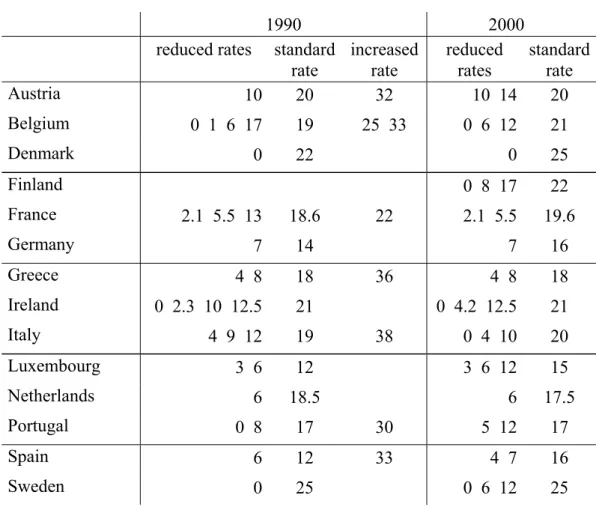
In other member states the fiscal importance of VAT is even higher. Table 2 shows a 25 percent increase of the VAT/GDP ratio in Germany, whereas the respective figure for the EU 15 almost doubled between the mid-sixties and the mid-nineties. In 1998, fiscal revenue from VAT covers less than 14 percent of total tax revenue in Sweden and Luxembourg but more than 23 percent in Portugal. The relative span of fiscal importance is even larger in relation to GDP, ranging from 5.7 percent in Luxembourg to 9.8 percent in Denmark. Apart from fiscal policy targets, most EU countries made use of the VAT rate autonomy in order to meet distributional objectives by applying reduced rates to necessities and higher rates on luxuries (see first column in Table 3). In spite of VAT rate convergence under the transitional regime, there are still significant rate differences across EU member states revealing different fiscal needs and distributive objectives (cf. Genser 2000).
Table 3: VAT rates in the EU in percent
1990 2000
reduced rates standard rate increased rate reduced rates standard rate Austria 10 20 32 10 14 20 Belgium 0 1 6 17 19 25 33 0 6 12 21 Denmark 0 22 0 25 Finland 0 8 17 22 France 2.1 5.5 13 18.6 22 2.1 5.5 19.6 Germany 7 14 7 16 Greece 4 8 18 36 4 8 18 Ireland 0 2.3 10 12.5 21 0 4.2 12.5 21 Italy 4 9 12 19 38 0 4 10 20 Luxembourg 3 6 12 3 6 12 15 Netherlands 6 18.5 6 17.5 Portugal 0 8 17 30 5 12 17 Spain 6 12 33 4 7 16 Sweden 0 25 0 6 12 25
United Kingdom 0 17.5 0 5 17.5 Source: Bundesministerium der Finanzen (2000).
Given the evidence that member states are willing to use the room for VAT autonomy, there is no doubt that the Commission proposal of a harmonized VAT rate in the Single Market will prove harmful for most of them. Harmonizing the standard rate will not only impose a burden by restructuring the government revenue pattern, but also affect tax incidence and thus interpersonal redistribution.
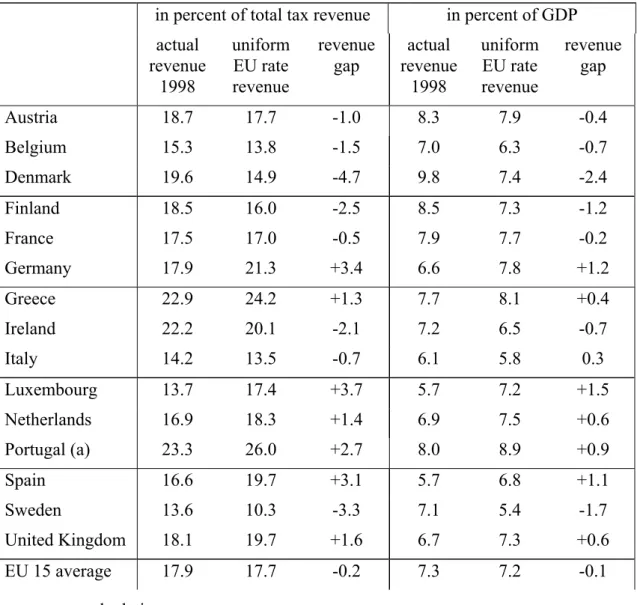
Table 4: Revenue gaps for a harmonized EU VAT rate of 19% in percent of total tax revenue in percent of GDP actual revenue 1998 uniform EU rate revenue revenue gap actual revenue 1998 uniform EU rate revenue revenue gap Austria 18.7 17.7 -1.0 8.3 7.9 -0.4 Belgium 15.3 13.8 -1.5 7.0 6.3 -0.7 Denmark 19.6 14.9 -4.7 9.8 7.4 -2.4 Finland 18.5 16.0 -2.5 8.5 7.3 -1.2 France 17.5 17.0 -0.5 7.9 7.7 -0.2 Germany 17.9 21.3 +3.4 6.6 7.8 +1.2 Greece 22.9 24.2 +1.3 7.7 8.1 +0.4 Ireland 22.2 20.1 -2.1 7.2 6.5 -0.7 Italy 14.2 13.5 -0.7 6.1 5.8 0.3 Luxembourg 13.7 17.4 +3.7 5.7 7.2 +1.5 Netherlands 16.9 18.3 +1.4 6.9 7.5 +0.6 Portugal (a) 23.3 26.0 +2.7 8.0 8.9 +0.9 Spain 16.6 19.7 +3.1 5.7 6.8 +1.1 Sweden 13.6 10.3 -3.3 7.1 5.4 -1.7 United Kingdom 18.1 19.7 +1.6 6.7 7.3 +0.6 EU 15 average 17.9 17.7 -0.2 7.3 7.2 -0.1 Source: own calculation
A harmonized European VAT rate of 19%, corresponding to the unweighted average of the standard VAT rates in 2000 would create a revenue shortfall of 4.7 percent in Denmark and a revenue surplus of 3.7 percent in Luxembourg (see Table 4). Since member states would not only have to bear the costs for the redistribution of EU-wide VAT revenue, but also adjustment costs, if they are forced to accommodate to an EU rate which is higher or lower than their optimal national VAT rate, there seems to be little hope that these costs can be outweighed by “efficiency gains” under the new European VAT regime.
4 Incentive effects of clearing
Switching from export zero-rating to international VAT credits implies that VAT revenue charged on intra-Community supplies remains in the exporting country, whereas importing countries lose exactly the same amount of VAT revenue by matching VAT credit claims on intra-Community acquisitions. The Commission intends to compensate these revenue shifts between member countries and has made several proposals for a clearing mechanism.
While the 1987 directive suggested a system of micro-clearing, based on business documents of intra-Community transactions, the 1989 directive proposed a system of macro-clearing, based on national accounts data on intra-Community trade and aggregate consumption. Both clearing models were criticised as complex, non-transparent and costly and these arguments have to be regarded as major impediments against an approval of the respective draft directives in the Council. The Commission’s common VAT proposal of 1996 expands the macro-clearing mechanism to aggregate VAT revenue in the Community. It requires that VAT revenue flows to a supra-national tax authority first and is redistributed to national fiscs according to well defined macroeconomic consumption figures in a second step. This type of
revenue sharing is well known in federal states (Germany, Austria, Australia), where shares of (joint) federal taxes are distributed to subfederal fiscs according to negotiated quotas which give rise to permanent political dispute.
The ultimate objective of VAT-clearing is the distribution of VAT revenue across member states according to final consumption, paying attention to the understanding that VAT is a consumption tax rather than a production tax. Even if micro- and macro-clearing are based on consistent consumption data, and if operating and data collection costs are neglected, the two clearing mechanisms are not economically equivalent, since they generate different economic incentive patterns. Unfortunately both clearing methods suffer from adverse incentives, which tend to erode national efforts to collect and control VAT properly and jeopardise efficiency gains from a common VAT system which relies on clearing.
4.1 Incentive effects of macro-clearing
Under a macro-clearing regime, each national government receives a certain share of European VAT revenue. The share is determined by national account figures, which are checked and published by the European Statistical Office. Under a macro clearing regime Dutch VAT revenue depends on the Dutch consumption share as well as on total European VAT revenue. The amount of Dutch VAT revenue will be higher, if efforts in tax administration and control prevent revenue losses through sloppiness and fraud in all member countries.
Even under a macro-clearing regime, VAT administration will remain the business of national tax authorities. Since higher efforts incur higher costs, the choice of the optimal effort level is an economic problem. For the national government, it will pay to invest an additional Euro in
tax collection effort, as long as national tax revenue will rise by one Euro or more. While this incentive to provide an efficient effort level works, if additional tax revenue flows back to the national budget, European revenue sharing creates a positive fiscal externality setting and rational governments will undersupply tax collection efforts.
Let B be the net benefit from investment in VAT collection efforts for member state i (e.g. the Netherlands)
(1) B(VATi) = αiVAT – we(VATi)
where αi is the consumption based revenue share of member state i, which is assumed
invariant with respect to marginal changes of the effort level. VATi is VAT revenue collected
in state i, VAT = ΣVATj is total European VAT revenue. Variable w is the unit cost of tax
collection effort, and e(VATi) is a monotonically increasing and strictly convex effort
function, i.e. e’(VATi) > 0 and e’’(VATi) > 0. Maximising (1) leads to the first order
condition
(2) dB/dVATi = αi – w de/dVATi = 0
The efficient effort level ei for member state i is characterized by
(3) e’(VATi) = αi/w
For the European Union as a whole, the efficient effort level for state i, e*i, is determined by
maximising the aggregate benefit level Bt from VAT revenue, irrespective whether it remains
in state i or whether it is allocated to another member state, viz. (4) Bt(VATi) = VATi – we(VATi)
(5) dBt/dVATi = 1 – w de/dVATi = 0
and e*i is characterized by
(6) e’(VATi) = 1/w > αi/w
Since marginal effort is monotonically increasing, this implies e*i > ei. Effort levels in VAT
collection will be inefficiently low, unless the positive fiscal externalities of national VAT collection are fully internalised. Ceteris paribus, the effort gap and the revenue shortfall will be the higher, the smaller is αi, the percentage share of an additional unit of VAT, which
flows to state i.
If the Dutch VAT administration were able to collect a marginal revenue increment of 100 Euro, then consumption-based macro-clearing would raise Dutch VAT revenue only by 4 Euro. The VAT share is even below 4% for the nine member states, which are smaller than the Netherlands. Thus macro-clearing provides incentives for low effort levels in VAT administration and lax VAT control in all member states. Resultant welfare losses could only be overcome if agreements on efficient VAT administration were enforceable in all member countries.
4.2 Incentive effects of micro-clearing
Under a micro-clearing scheme, each national fisc transfers VAT revenue charged on intra-Community supplies to the clearing house but is entitled to claim refund for VAT credits granted on intra-community acquisitions. The clearing-house breaks even, if inflows and outflows are based on the complete set of trade documents. But as long as the clearing-house is supposed to rely on independent trade figures submitted by national VAT authorities, there are consolidation problems, since for each taxable intra-Community transaction VAT
payment and the corresponding VAT credit are documented in separate VAT returns and in separate national trade statistics. Whenever the clearing house has to rely on summary statistics, it is not able to trace back taxable transactions to firms in single countries. Given this information asymmetry, there is an incentive for member countries to monitor carefully proper VAT payment on intra-Community supplies, which increases national VAT revenue, whereas it hardly pays to invest in efforts on monitoring credit claims. As VAT credit claims are fully refunded by the clearing house, marginal returns on monitoring efforts are likely to be negative. Undersupply of monitoring efforts on VAT credit claims will generate deficits in the clearing house balances, which have to be covered by all member states, and welfare losses. Again enforceable agreements on efficient VAT administration would be necessary throughout the EU.
5 Alternative approaches for a common European VAT system
In face of the problems attributed to the transitional VAT system raised in section 2 and the weaknesses of the Commission’s common VAT proposal addressed in the two previous sections, we can set up a list of four desiderata, which might be used as a litmus test for VAT proposals. A promising European VAT regime can be characterized by
(1) avoidance of compliance asymmetry
(2) avoidance of zero-rating of intra-Community supplies (3) adherence to national VAT rate autonomy
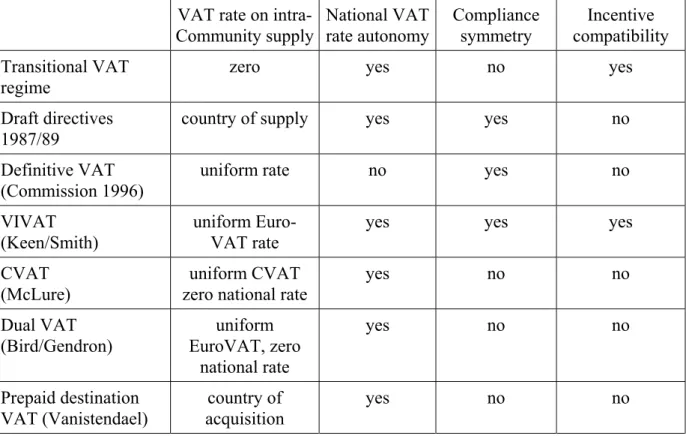
Evidently, the transitional system as well as the Commission proposals violate one or more of these requirements (see Table 5).
We therefore extend the evaluation of VAT regimes by four others, which have recently been discussed in academic journals. Three of them deviate from the Commission proposal by extending the VAT rate structure and require the application of different non-zero VAT rates to taxable transactions.
Keen/Smith (1996, 2000) proposed VIVAT, a viable integrated VAT regime, which applies a two-tier VAT. The first of these two VAT-rates is harmonized across the EU, the “Euro-VAT” is charged on all taxable transactions at the same rate in all 15 member countries. The second VAT is a national retail sales tax, which is levied on sales to final consumers (and non-registered firms). The retail sales VAT rate is at the discretion of each member country. Registered firms can claim Euro-VAT credits on intra-Community acquisitions which exclude cascading. Final consumers pay an aggregate VAT burden consisting of the Euro-VAT and the retail sales VAT in the country of purchase. Apart from cross-border shopping the residence principle prevails.
Bird/Gendron (1998, 2000, 2001) recommended the Canadian dual VAT as a blueprint for the definitive VAT regime. For the EU this proposal would require a supra-national European VAT, applied to all taxable transactions, and an autonomous national VAT, which is applied to domestic sales only, since intra-Community supplies are zero-rated. For final consumers the “dual VAT regime” is equivalent to VIVAT, only registered domestic firms have to handle VAT credit claims on both the supra-national VAT and the national VAT.
McLure (2000) advocated a CVAT regime (compensating VAT), which is based on a VAT proposal for the Brazilian federation (Varsano 1995). Under a European CVAT in each
member state sales to domestic customers (registered firms and final consumers) would be charged at the national VAT rate, whereas sales to non-domestic customers are subject to CVAT, which is levied at the same rate in all member countries. Registered firms can claim VAT credits for national VAT and for supra-national CVAT, paid on their domestic or intra-Community purchases of intermediate inputs.
While both, the dual VAT regime and the CVAT regime start out from a supra-national VAT, which does not exist in the EU, the proposals are nevertheless applicable, since supra-national VAT revenue need not flow to the EU budget, but can be redistributed immediately to the member states. In this respect both proposals are similar to the Commission’s common VAT regime, although revenue clearing is restricted to the supra-national VAT component, whereas national VAT immediately feeds national fiscs.
Table 5: Comparison of VAT proposals for the EU Single Market VAT rate on
intra-Community supply National VAT rate autonomy Compliance symmetry Incentive compatibility Transitional VAT regime
zero yes no yes
Draft directives 1987/89
country of supply yes yes no Definitive VAT
(Commission 1996)
uniform rate no yes no
VIVAT (Keen/Smith)
uniform Euro-VAT rate
yes yes yes
CVAT (McLure)
uniform CVAT zero national rate
yes no no Dual VAT (Bird/Gendron) uniform EuroVAT, zero national rate yes no no Prepaid destination VAT (Vanistendael) country of acquisition yes no no
A fourth proposal, due to Vanistendael (1995), requires registered firms to charge VAT on taxable transactions at the rates of their customers’ residence. In addition, VAT revenue from no-domestic clients has to be transferred immediately to the tax authorities of the clients’ countries of residence. Basically, this regime extends the current special regime for mail ordering to all taxable transactions.
In Table 5 we present an evaluation of these additional proposals based on the four desiderata developed above. The result of this comparison is that VIVAT proves to be the only regime, which treats domestic and intra-community supplies alike, leaves room for tax autonomy, avoids the problems of zero-rating of intra-Community supplies and provides incentives for decentralized VAT administration.
This favourable result does, however, not indicate an undisputable superiority of the VIVAT regime over its competitors. The evaluation is based on a set of criteria, which might be regarded selective and incomplete. Cnossen (1998) argues in favour of the transitional system, indicating that compliance symmetry is not a very important desideratum for him. On the other hand he recognizes the problem of tax fraud which in his view should be tackled by improving monitoring facilities for VAT administration, in particular by introducing unified VAT documents which can be checked by tax authorities in the origin and in the destination country. Furthermore, some Table 5 desiderata will be less important if the focus is not the EU but a tax union of developing or transformation countries. In such a tax union problems of incentive compatibility might be of second order, since some member countries will not be able to administer VAT efficiently but will have to rely on a newly established supranational authority. Finally, the importance of compliance symmetry fades, if experience in VAT compliance and control is poor in a developing country, and identification of clients is required anyway (see Keen/Smith 2000, 744ff.).
6 The coordination requirements for alternative VAT regimes
Although EU member countries were forced to respect a series of VAT directives under the traditional European VAT regime, harmonization requirements were regarded low. Once the credit/invoice type, destination-based VAT system was adopted, member states only had the obligation to zero-rate exports and to charge proper national VAT rates on imports in a transparent and non-discriminatory way. Most EU members applied border-controls to implement the border-adjustment process, Belgium, Luxembourg and the Netherlands, however, applied the deferred payment system on bilateral trade flows. Member countries were not only free to levy VAT rates according to national policy objectives, to decide upon national regulations of VAT compliance, VAT payment and VAT control, they were also able to use considerable room with respect to the determination of national VAT bases. Harmonization requirements, laid down in the 6th VAT Directive, did not force member states to change their VAT bases. The directive rather defined the benchmark for an aggregate national VAT base, which enabled the Commission to calculate proper shares for the VAT-related contributions of EU member states to the EU-budget.
The transitional system upheld most of the attractive features of the traditional VAT regime, apart from additional information requirements to replace former border documents. VAT identification numbers were introduced to identify registered businesses from other member countries, which qualify for zero-rating, and firms were obliged to provide additional information on trade with other member countries in order to increase the probability of detecting VAT fraud, in particular through diverting zero-rated intra-Community supplies to final consumers without paying VAT. The abolition of border controls also opens the door to
introduction of the minimum standard rate and the abolition of increased VAT rates have been motivated by curbing cross-border shopping and incentives for strategic VAT rate undercutting, we keep aside this kind of VAT rate harmonization in the following for two reasons. First, we consider cross-border shopping as a specific phenomenon, which occurs under all regimes without border controls. Second, we acknowledge empirical evidence that cross-border shopping is a local phenomenon, which has only limited effects on trade flows and national VAT revenue.
The common VAT system of the Commission, however, implies a far higher degree of harmonization, viz. on tax bases, tax rates, measures for revenue sharing and VAT control. VAT-base harmonization is required in order to extend the credit/invoice principle to intra-Community transactions. Rate harmonization is desirable to curb strategic VAT competition and to facilitate clearing. Harmonized national account principles are necessary in order to assign VAT revenue in line with final consumption. Harmonized VAT control is unavoidable to overcome the disincentive effects in favour of lax VAT administration at the national level.
A condensed summary of the coordination requirements of the traditional and the transitional VAT regimes as well as the Commission proposals of 1987/89 and 1996 is given in the four upper rows of Table 6. In the four lower rows we extend the evaluation of harmonization requirements to the four alternative VAT regimes introduced in Table 5.
Tax base harmonization is an element of all four VAT regimes, although national VAT bases may deviate from the harmonized Community VAT base under a dual VAT.
VAT rate harmonization is required for the three two-tier VATs, which apply a harmonized Euro-VAT (VIVAT, dual VAT, CVAT). But opposite to the Commission proposal rate
harmonization under these regimes leaves room for marginal variations of national VAT revenue through the second tier. In Table 6 we capture this lower degree of harmonization by a “partial” entry in column 3, which is further explained by remarks in brackets.
Table 6: Coordination requirement of VAT proposals in the EU Single Market harmonized VAT base harmonized VAT rate(s) harmonized revenue sharing harmonized VAT control Traditional VAT regime
(up to 1992)
no no no no
Transitional VAT regime (since 1993)
no no no yes (zero-rating,
tax fraud) Draft directives 1987/89 yes no yes yes (undersupply
of control effort) Definitive VAT
(Commission 1996)
yes yes yes yes (undersupply
of control effort) VIVAT
(Keen/Smith)
yes partial (supra national VAT rate)
low low
CVAT (McLure)
yes partial (VAT on cross border trade)
yes yes (undersupply of control effort) Dual VAT
(Bird/Gendron)
no partial (supra national VAT rate)
yes yes (undersupply of control effort) Prepaid destination VAT
(Vanistendael) yes no yes yes (undersupplyof control effort)
The larger the VAT share, which has to be redistributed by a clearing mechanism, the more attention has to be devoted to the revenue sharing scheme and to efficient VAT control. A European CVAT or dual VAT regime will generate supranational VAT revenue, which by far exceeds the budget requirement of the EU and therefore has to be redistributed to the national fiscs. The protagonists of these regimes do not address this redistribution issue explicitly, but basically both regimes require a revenue sharing mechanism in analogy to the common European VAT. Under a prepaid destination VAT regime, revenue collected in the origin
Under a VIVAT regime Euro-VAT revenue on intra-Community supplies remains in the origin state rather than in the destination state. But as intra-Community trade is subject to a single tax rate, the clearing volume of a member country shrinks to a relatively low level, viz. VAT on the country’s multilateral trade balance with the rest of the EU members4. In Table 6 we capture this property by a “low” entry for VIVAT in column 4.
Problems with efficient VAT control arise, whenever higher efforts in VAT administration create substantial positive externalities in other member countries. With respect to our VAT regimes harmonization of VAT control is necessary, because national incentives are insufficient to avoid tax fraud in neighbour states or to control proper VAT compliance. In column 5 of Table 6 we mark the reason for harmonization in VAT control in brackets and add a “low” entry for VIVAT because of the lower clearing volume.
A comparison of all the alternatives offers evidence that coordination requirements for the transitional system and for VIVAT are lower than for all the other VAT regimes. On the one hand, Table 6 rationalizes the approval of the transitional VAT system in the early nineties, since it requires less harmonization than the alternative VAT proposals. On the other hand, the three low entries for VIVAT reveal that it may be worthwhile for the Commission to have a closer look at this VAT regime as an option to overcome the present deadlock situation.
4 This is one of the reasons why the Commission favoured a VAT rate harmonization across Europe,
because then cross-border VAT crediting will only shift VAT revenue between member states with respect to aggregated trade imbalances with all other EU member countries, rather than with respect to VAT rate differentials and bilateral trade imbalances.
6.1 Further room for autonomy in tax policy and tax administration
Although coordination requirements are regarded low under a VIVAT regime, they can even be further reduced if the clearing mechanism is discarded. While national VAT revenue without clearing (consisting of revenue from Euro-VAT and national retail sales VAT) will deviate from the VAT revenue benchmark of the transitional regime, if there is a net intra-Community supply or acquisition surplus in trade between registered firms, VIVAT also offers the opportunity to close this revenue gain or revenue loss by a variation of the national retail sales VAT rate.
While the VIVAT proposal of Keen/Smith (1996) is based on a single VAT rate in each member country (consisting of the harmonized VAT rate on business trade plus the national retail sales VAT), there is nevertheless room for national distribution policy since national retail sales VAT could well be operated with more than one national VAT rate. Even negative sales tax rates on necessities are conceivable, although politicians might be well advised to offer a consumer expenditure relief through a personal VAT subsidy rather than through reduced VAT rates.
The necessity for a harmonized treatment of small businesses becomes less urgent, since VAT relief can be granted through retail sales VAT exemption, a measure which can be chosen autonomously by national parliaments.
Although two independent and different VATs have to be administered there are hardly any additional compliance and control costs, if the VAT base for both VATs is the same. The retail sales VAT then can be regarded as a split rate system with a VAT rate of zero to registered firms.
Finally, VIVAT need not be restricted to retail sales VAT rates, which are the same across the whole member country. Within the VIVAT regime there should be room for regionally differing retail sales VAT rates, e.g. in the different provinces of a member country. Such a variation might be desirable to cover different fiscal needs, to increase fiscal responsibility of subfederal governments, or to cope with strategic sales tax competition in border regions.
7 Conclusion
Although the EU member states have learned to live with the present VAT regime for almost one decennium, the Commission does not want to reform the transitional VAT system but to replace it by a new final VAT regime. The common European VAT regime proposed by the Commission is able to avoid certain problems of VAT fraud, of compliance-based trade discrimination and of undesirable VAT revenue shifts. But it also generates a considerable loss of national VAT autonomy, introduces a new supranational mechanism of revenue sharing and requires harmonized VAT administration in the member states.
Since it is still not very likely that the Commission will find unanimous support for its common European VAT proposal, VIVAT should become a viable compromise. First, VIVAT respects two major desiderata of the Commission for the final European VAT system, viz. abolishment of zero-rated intra-Community supplies and compliance symmetry. Second, VIVAT respects fiscal VAT autonomy and incentive compatible VAT administration in line with the principle of subsidiarity Third, the “single place of taxation”-rule, which the Commission regards as a vital, simplifying element of the final VAT system, may be operated under VIVAT as under any other VAT regime. Fourth, EU member states, which are reluctant to support the Commission proposal, should be less opposed to VIVAT, which keeps fiscal
VAT autonomy and requires less harmonization. Fifth, critics of VIVAT should recognize that the two-tier VAT structure generates a coherent VAT regime, which reconciles the conflict between fiscal subsidiarity and undistorted competition in the single European market, and that different VAT rates to registered firms and to final consumers are neither discriminating nor costly.
8 References
Aujean, Michel M.. (1998). “Towards a VAT system tailored to meet the needs of the Single Market in the 21st century.” In Austrian Federal Ministry of Finance, ed., Tax competition and co-ordination of tax policy in the European Union. Austrian Institute of Economic Research, Vienna, 105-122.
Bird, Richard and Pierre-Pascal Gendron. (1998). “Dual VATs and cross-border trade: two problems, one solution.” International Tax and Public Finance 5, 429-442.
Bird, Richard and Pierre-Pascal Gendron. (2000). „CVAT, VIVAT and dual VAT: Vertical sharing and international trade.” International Tax and Public Finance 7, 753-761. Bird, Richard and Pierre-Pascal Gendron. (2001). VATs in federal states: International
experiences and emerging possibilities. Discussion Paper, International Centre for Tax Studies, University of Toronto, March 2001.
Bundesministerium der Finanzen. (1994). Ausarbeitung der endgültigen Regelung für die Umsatzbesteuerung des innergemeinschaftlichen Waren- und Dienstleistungsverkehrs und für ein funktionsfähiges Clearing-Verfahren (Gutachten der Ursprungslandkommission). Bonn: Stollfuß.
Bundesministerium der Finanzen. (2000). Die wichtigsten Steuern im internationalen Vergleich. Bonn.
Bundesministerium der Finanzen. (2000a). Finanzbericht 2001. Bonn: Stollfuß.
Cnossen, Sijbren and Carl S. Shoup. (1987). “Coordination of value-added taxes.” In S. Cnossen (ed.), Tax Coordination in the European Community, Deventer: Kluwer, 59-84.
Cnossen, Sijbren. (1998). “Global trends and issues in value-added taxation.” International Tax and Public Finance 5, 399-428.
Commission of the European Communities. (1996). “A common system of VAT: A programme for the Single Market.” COM(9), 328 fin.
European Parliament. (1995). “Options for a definitive VAT system.” Working Papers.
Economic Affairs Series E-5.
Genser, Bernd. (1996). “A generalized equivalence property of mixed international VAT regimes.” Scandinavian Journal of Economics 98, 253-262.
Genser, Bernd. (2000). “VAT Reform in Federal States.” In Hans-Georg. Petersen, P. Gallagher (eds.), Tax and transfer reform in Germany and Australia. Berliner Debatte Wissenschaftsverlag, Berlin, 305-318.
Genser, Bernd, Andreas Haufler and Peter B. Sørensen. (1995). „Indirect taxation in an integrated Europe: Is there a way of avoiding trade distortions without sacrificing national tax autonomy?” Journal of Economic Integration 10, 178-205.
Genser, Bernd and Andreas Haufler. (1996). „Tax competition, tax coordination and tax harmonization: The effects of EMU.” Empirica 23, 59-89.
Keen, Michael. (2000). „VIVAT, CVAT and all that: New Forms of value-added tax for federal systems.” Canadian Tax Journal 48, 409-424.
Keen, Michael and Stephen Smith. (1996). “The future of value-added tax in the European Union.” Economic Policy 23, 375-420.
Keen, Michael and Stephen Smith. (2000). “Viva VIVAT!”, International Tax and Public Finance, 7, 741-51.
Lockwood, Ben. (1998). „For a VAT System adapted to the needs of the Single Market in the 21st century.” Discussant’s comments. In Austrian Federal Ministry of Finance (ed.), Tax competition and co-ordination of tax policy in the European Union. Austrian Institute of Economic Research. Vienna: 123-129.
McLure, Charles. (2000). „Implementing subnational VATs on internal trade: The compensating VAT (CVAT).” International Tax and Public Finance 7, 723-40.
OECD. (2000). Revenue statistics 1965-1999. Paris.
Smith, Stephen. (1997). The definitive regime for VAT. Commentary 63. London: Institute for Fiscal Studies.
Tait, Alan. (1988). Value added tax: International practice and problems. Washington: International Monetary Fund.
Vanistendael, Frans. (1995). “A Proposal for a definitive VAT System. Taxation in the country of origin at the rate of the country of destination without clearing.” EC Tax Review 1995/1, 45-53.
Verwaal, Ernst and Sjibren Cnossen. (2001). Europe´s New Border Taxes. Research Centre for Economic Policy (OCFEB). Research Memorandum 008, Rotterdam: Erasmus University.