Does Selective Search Benefit
from WAND Optimization?
Yubin Kim1, Jamie Callan1, J. Shane Culpepper2, and Alistair Moffat3
1
Carnegie Mellon University, Pittsburgh, USA 2
RMIT University, Melbourne, Australia 3
The University of Melbourne, Melbourne, Australia
Abstract. Selective search is a distributed retrieval technique that reduces the
computational cost of large-scale information retrieval. By partitioning the col-lection into topical shards, and using a resource secol-lection algorithm to identify a subset of shards to search, selective search allows retrieval effectiveness to be maintained while evaluating fewer postings, often resulting in90+% reduc-tions in querying cost. However, there has been only limited attention given to the interaction between dynamic pruning algorithms and topical index shards. We demonstrate that the WAND dynamic pruning algorithm is more effective on topical index shards than it is on randomly-organized index shards, and that the savings generated by selective search and WAND are additive. We also compare two methods for applying WAND to topical shards: searching each shard with a separate top-kheap and threshold; and sequentially passing a shared top-kheap and threshold from one shard to the next, in the order established by a resource selection mechanism. Separate top-kheaps provide low query latency, whereas a shared top-kheap provides higher throughput.
Keywords: Selective search, distributed search, dynamic pruning, efficiency
1
Introduction
Selective searchis a technique for large-scale distributed search in which the document corpus is partitioned intoptopic-based shards during indexing. When a query is re-ceived, a resource selection algorithm such as Taily [1] or Rank-S [13] selects the most relevantkshards to search, wherek p. Results lists from those shards are merged to form a final answer listing to be returned to the user. Selective search has substan-tially lower computational costs than partitioning the corpus randomly and searching all index shards, which is the most common approach to distributed search [11, 12].
Dynamic pruning algorithms such asWeighted AND(WAND) [3] andterm-bounded
max score(TBMS) [22] improve the computational efficiency of retrieval systems by
eliminating or early-terminating score calculations for documents which cannot appear in the top-kof the final ranked list. But topic-based partitioning and resource selection change the environment in which dynamic pruning is performed, and query term post-ing lists are likely to be longer in shards selected by the resource selection algorithm than in shards that are not selected. As well, each topic-based shard should contain sim-ilar documents, meaning that it might be difficult for dynamic pruning to distinguish
amongst them using only partial score calculations. Conversely, the documents in the shards that werenotselected for search might be the ones that a dynamic pruning algo-rithm would have bypassed if it had encountered them. That is, while the behavior of dynamic pruning algorithms on randomly-organized shards is well-understood, the in-teraction between dynamic pruning and selective search is not. As an extreme position, it might be argued that selective search is simply achieving the same computational savings that dynamic pruning would have produced, but incurs the additional overhead of clustering the collection and creating the shards. To address these concerns, we in-vestigate the behavior of the well-known Weighted AND(WAND) dynamic pruning algorithm in the context of selective search, considering two research questions:
RQ1: Does dynamic pruning improve selective search, and if so, why?
RQ2: Can the efficiency of selective search be improved further using a cascaded prun-ing threshold durprun-ing shard search?
2
Related Work
Selective search is a cluster-based retrieval technique [6, 19] that combines ideas from conventional distributed search and federated search [12]. Modern cluster-based sys-tems use inverted indexes to store clusters that were defined using criteria such as broad topics [4] or geography [5]. The shards’ vocabularies are assumed to be random and queries are sent to a single best shard, forwarding to additional shards as needed [5].
In selective search, the corpus is automatically clustered into query-independent
topic-based shardswith skewed vocabularies and distributed across resources. When a
query arrives, a resource selection algorithm identifies a subset of shards that are likely to contain the relevant documents. The selected shards are searched in parallel, and their top-klists merged to form a final answer. Because only a few shards are searched for each query, total cost per query is reduced, leading to higher throughput.
Previous studies showed that selective search accuracy is comparable to a typical distributed search architecture, but that efficiency is better [1, 12], where computational cost is determined by counting the number of postings processed [1, 12], or by measur-ing the execution time of a proof-of-concept implementation.
Resource Selection Choosing which index shards to search for a query is critical to search accuracy. There are three broad categories of resource selection algorithm: term-based, sample-based, and classification-based. Term-based algorithms model the language distribution of a shard to estimate the relevance of the shard to a query, with the vocabulary of each shard typically treated as a bag of words. The estimation of relevance is accomplished by adapting an existing document scoring algorithm [8] or by developing a new algorithm specifically for resource selection [1, 9, 15, 24]. Taily [1] is one of the more successful approaches, and fits a Gamma distribution over the relevance scores for each term. At query time, these distributions are used to estimate the number of highly scoring documents in the shard.
Sample-based algorithms extract a small (of the order of1%) sample of the entire collection, and index it. When a query is received, the sample index is searched and each top-ranked document acts as a (possibly weighted) vote for the corresponding index
shard [13, 16, 20, 21, 23]. One example is Rank-S [13], which uses an exponentially decaying voting function derived from the document’s retrieval rank. The (usually small number of) resources with scores greater than0.0001are selected.
Classification-based algorithms use training data to learn models for resources using features such as text, the scores of term-based and sample-based algorithms, and query similarity to historical query logs [2, 10]. While classification-based algorithms can be more effective than unsupervised methods, they require access to training data. Their main advantage lies in combining heterogeneous resources such as search verticals.
The Rank-S [13] and Taily [1] have both been used in prior work with similar effec-tiveness. However Taily is more efficient, because lookups for Gamma parameters are substantially faster than searching a sample index. We use both in our experiments.
Dynamic Pruning Weighted AND(WAND) is a dynamic pruning algorithm that only scores documents that may become one of the current top k based on a preliminary estimate [3]. Dimopoulos et al. [7] developed a Block-Max version of WAND in which continuous segments of postings data are bypassed under some circumstances by us-ing an index where each block of postus-ings has a local maximum score. Petri et al. [17] explored the relationship between WAND-style pruning and document similarity for-mulations. They found that WAND is more sensitive than Block-Max WAND to the document ranking algorithm. If the distribution of scores is skewed, as is common with BM25, then WAND alone is sufficient. However, if the scoring regime is derived from a language model, then the distribution of scores is top-heavy, and BlockMax WAND should be used. Rojas et al. [18] presented a method to improve performance of systems combining WAND and a distributed architecture with random shards.
Term-Bounded Max Score(TBMS) [22] is an alternative document-at-a-time
dy-namic pruning algorithm that is currently used in the Indri Search Engine. The key idea of TBMS is to precompute a “topdoc” list for each term, ordered by the frequency of the term in the document, and divided by the document length. The algorithm uses the union of the topdoc lists for the terms to determine a candidate list of documents to be scored. The number of documents in the topdoc list for each term is experimentally de-termined, a choice that can have an impact on overall performance. Kulkarni and Callan [12] explored the effects of TBMS on selective search and traditional distributed search architectures. Based on a small set of queries they measured efficiency improvements of 23-40% for a traditional distributed search architecture, and 19-32% for selective search, indicating that pruning can improve the efficiency of both approaches.
3
Experiments
The observations of Kulkarni and Callan [12] provide evidence that dynamic pruning and selective search can be complementary. Our work extends that exploration in sev-eral important directions. First, we investigate whether there is a correlation between the rank of a shard and dynamic pruning effectiveness for that shard. A correlation could imply that dynamic pruning effectiveness depends on the number of shards searched. We focus on the widely-used WAND pruning algorithm, chosen because it is both effi-cient and versatile, particularly when combined with a scoring function such as BM25 that gives rise to skewed score distributions [7, 17].
0 5 10 15 20 25 30 35 40
Number of documents in shard
N u m b e r o f s h a rd s 0 200k 400k 600k 800k 1000k >1000k
Fig. 1: Distribution of shard sizes, with a total of100shards.
Experiments were conducted using the ClueWeb09 Category B dataset, containing 50million web documents. The dataset was partitioned into100topical shards using
k-means clustering and a KL-divergence similarity metric, as described by Kulkarni and Callan [11], and stopped using the default Indri stoplist and stemmed using the Krovetz stemmer. On average, the topical shards contain around500k documents, with considerable variation, see Figure 1. A second partition of100random shards was also created, a system in which exhaustive “all shards” search is the only way of obtaining effective retrieval. Each shard in the two systems was searched using BM25, withk1= 0.9,b= 0.4, and global corpus statistics foridf and average document length.4
Each selected shard returned its top1,000documents, which were merged by score to produce a final list ofk = 1,000 documents. In selective search, deeper ranks are necessary because most of the good documents may be in one or two shards due to the term skew. Also, deeperksupports learning-to-rank algorithms. Postings lists were compressed and stored in blocks of128entries using the FastPFOR library [14], sup-porting fast block-based skipping during the WAND traversal.
Two resource selection algorithms were used: Taily [1] and Rank-S [13]. The Taily parameters were taken from Aly et al. [1]:n= 400andv= 50, wherevis the cut-off score andnrepresents the theoretical depth of the ranked list. The Rank-S parameters used are consistent with the values reported by Kulkarni et al. [13]. A decay base of
B= 5with a centralized sample index (CSI) containing1% of the documents was used – approximately the same size as the average shard. We were unable to find parameters that consistently yielded better results than the original published values.
We conducted evaluations using the first1,000unique queries from each of the AOL query log5and the TREC 2009 Million Query Track. We removed single-term queries,
which do not benefit from WAND, and queries where the resource selection process did not select any shards. Removing single-term queries is a common procedure for research with WAND [3] and allows our results to be compared with prior work. That left713queries from the AOL log, and756queries from MQT, a total of1,469queries.
4
The values forbandk1are based on the parameter choices reported for Atire and Lucene in the 2015 IR-Reproducibility Challenge, seegithub.com/lintool/IR-Reproducibility. 5
We recognize that the AOL log has been withdrawn, but also note that it continues to be widely used for research purposes.
100 101 102 103 104 105 106 107 10−3 10−2 10−1 100 101 102 103 104
Number of Postings Evaluated
Query Time (ms)
Fig. 2: Correlation between the number of postings processed for a query and the time taken for query evaluation. Data points are generated from MQT queries using both WAND and full evaluation, applied independently to all100topical shards and all100 random shards. In total,756×200×2≈300,000points are plotted.
Our focus is on the efficiency of shard search, rather than resource selection. To compare the efficiency of different shard search methods, we count the number of post-ings scored, a metric that is strongly correlated with total processing time [3], and is less sensitive to system-specific tuning and precise hardware configuration than is measured execution time. As a verification of this relationship, Figure 2 shows the correlation be-tween processing time per query, per shard, and the number of postings evaluated. There is a strong linear relationship; note also that more than99.9%of queries completed in under1second with only a few extreme outliers requiring longer.
Pruning Effectiveness of WAND on Topical Shards The first experiment investi-gated how WAND performs on the topical shards constructed by selective search. Each shard was searched independently, as is typical in distributed settings – parallelism is crucial to low response latency.w, the number of posting evaluations required in each shard by WAND-based query evaluation was recorded. The total length of the postings for the query terms in the selected shards was also recorded, and is denoted asb, repre-senting the number of postings processed by an unpruned search in the same shard. The ratiow/bthen measures the fraction of the work WAND carried out compared to an unpruned search. The lower the ratio, the greater the savings. Values ofw/bcan then be combined across queries in two different ways: and macro-averaging. In micro-averaging,wandbare summed over the queries and a single value ofw/bis calculated from the two sums. In macro-averaging,w/bis calculated for each query, and averaged across queries. The variance inherent in queries means that the two averaging methods can produce different values, although broad trends are typically consistent.
Figure 3 and Table 1 provide insights into the behavior of macro- and micro-averaging. Figure 3 uses the AOL queries and all100topical shards, plottingw/bvalues on a per query per shard basis as a function of the total length of the postings lists for that query in that shard. Queries involving only rare terms benefit much less from WAND than queries with common terms. Thus, the macro-average ofw/bis higher than the
0 20 40 60 80 100 120 0 0.2 0.4 0.6 0.8 1
Total postings per query (in millions)
R a tio o f p o st in g s e va lu a te d b y W A N D
Fig. 3: Ratio of savings achieved by WAND as a function of the total postings length of each query in the AOL set, measured on a per shard basis. A total of100×713≈71,000 points are plotted. Queries containing only rare terms derive little benefit from WAND.
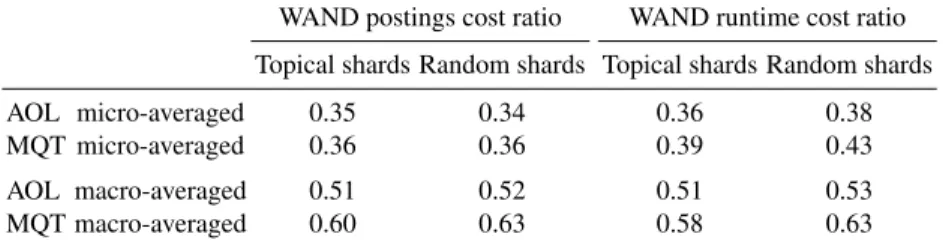
WAND postings cost ratio WAND runtime cost ratio Topical shards Random shards Topical shards Random shards AOL micro-averaged 0.35 0.34 0.36 0.38 MQT micro-averaged 0.36 0.36 0.39 0.43 AOL macro-averaged 0.51 0.52 0.51 0.53 MQT macro-averaged 0.60 0.63 0.58 0.63
Table 1: Ratio of per shard per query postings evaluated and per shard per query execu-tion time for WAND-based search, as ratios relative to unpruned search, averaged over 100topical shards and over100randomized shards, and over two groups each of700+ queries. The differences between the Topical and Random macro-averaged ratios are significant for both query sets and both measures (paired two-tailed t-test,p <0.01).
micro-average. Micro-averaging more accurately represents the total system savings, whereas macro-averaging allows paired significance testing. We report both metrics in Table 1. The second pair of columns gives millisecond equivalents ofw/b, to further validate the postings-cost metric. These values are micro- and macro-averagedwt/bt ratios, wherewtis the time in milliseconds taken to process one of the queries on one of the100shards using WAND, andbtis the time taken to process the same query with a full, unpruned search. A key result of Table 1 is that WAND is just as effective across the full set of topical shards as it is on the full set of randomly formed shards. More-over, the broad trend of the postings cost ratios – that WAND avoids nearly half of the postings – is supported by the execution time measurements.
WAND and Resource Ranking Interactions The second experiment compares the effectiveness of the WAND algorithm on the shards that the resource ranking algorithm would, and would not, select in connection with each query. The Taily and Rank-S resource selection algorithms were used to determine which shards to search. For each
Shards searched WAND postings cost ratio WAND runtime cost ratio Selected Non-selected Selected Non-selected
Taily AOL 3.1 0.32 0.35 0.36 0.36
Taily MQT 2.7 0.23 0.37 0.30 0.40
Rank-S AOL 3.8 0.27 0.36 0.30 0.37
Rank-S MQT 3.9 0.24 0.37 0.30 0.40
Table 2: Average number of shards searched, and micro-averaged postings ratios for those selected shards and for the complement set of shards, together with the corre-sponding query time cost ratios, in each case comparing WAND-based search to un-pruned search. Smaller numbers indicate greater savings.
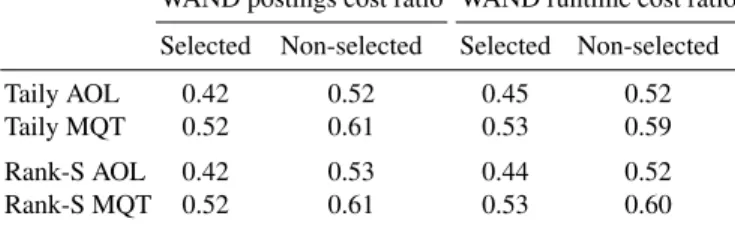
WAND postings cost ratio WAND runtime cost ratio Selected Non-selected Selected Non-selected Taily AOL 0.42 0.52 0.45 0.52 Taily MQT 0.52 0.61 0.53 0.59 Rank-S AOL 0.42 0.53 0.44 0.52 Rank-S MQT 0.52 0.61 0.53 0.60
Table 3: As for Table 2, but showing macro-averaged ratios. All differences between selected and non-selected shards are significant (paired two-tailed t-test,p <0.01).
query the WAND savings were calculated for the small set of selected shards, and the much larger set of non-selected shards.
Table 2 lists micro-averaged w/b ratios, and Table 3 the corresponding macro-averaged ratios. While all shards see improvements with WAND, the selected shards see a greater efficiency gain than the non-selected shards, reinforcing our contention that resource selection is an important component in search efficiency. When compared to the ratios shown in Table 1, the selected shards see substantially higher benefit than average shards; the two orthogonal optimizations generate better-than-additive savings. Figure 4a shows the distribution of the individual per query per shard times for the MQT query set, covering in the first four cases only the shards chosen by the two re-source selection processes. The fifth exhaustive search configuration includes data for all of the100randomly-generated shards making up the second system, and is provided as a reference point. Figure 4b gives numeric values for the mean and median of each of the five distributions. When WAND is combined with selective search, it both re-duces the average time required to search a shard and also rere-duces the variance of the query costs. Note the large differences between the mean and median query processing times for the unpruned search and the reduction in that gap when WAND is used; this gain arises because query and shard combinations that have high processing times due to long postings lists are the ones that benefit most from WAND. Therefore, in typical distributed environments where shards are evaulated in parallel, the slowest, bottleneck shard will benefit the most from WAND and may result in additional gains in latency
re-0 500 1,000 1,500
Rank−S Full Rank−S WAND Taily Full Taily WAND Exhaustive WAND
Query Time (ms) (a) Mean Median Rank-S Full 85.0 13.0 Rank-S WAND 28.5 11.3 Taily Full 134.0 34.2 Taily WAND 42.7 23.6 Exhaustive WAND 26.6 21.8 (b)
Fig. 4: Distribution of query response times for MQT queries on shards: (a) as a box plot distribution, with a data point plotted for each query-shard pair; (b) as a table of corresponding means and medians. In (a), the center line of the box indicates the median, the outer edges of the box the first and third quartiles, and the blue circle the mean. The whiskers extend to include all points within1.5times the inter-quartile range of the box. The graph was truncated to omit a small number of extreme points for both Rank-S Full and Taily-Full. The maximum time for both these two runs was6,611ms.
0 10 20 30 40 50 60 70 80 90 100 0 0.2 0.4 0.6 0.8 1 MQT AOL Shard rank N o rm a liz e d th re sh o ld
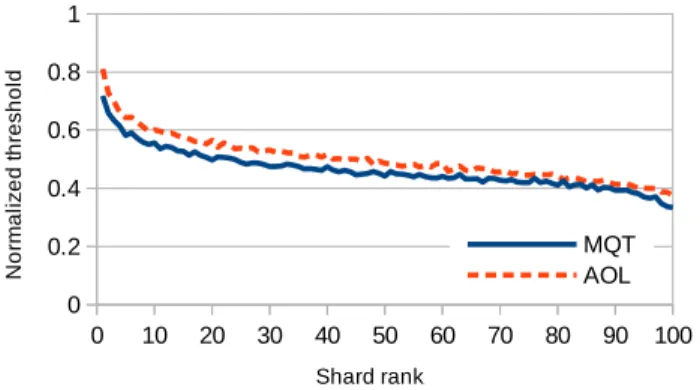
Fig. 5: Normalized 1,000th document scores from shards, averaged over queries and then shard ranks, and expressed as a fraction of the collection-wide maximum document score for each corresponding query. The score falls with rank, as fewer high-scoring documents appear in lower-ranked shards.
duction. Furthermore, while Figure 4 shows similar per shard query costs for selective and exhaustive search, the totalworkassociated with selective search is substantially less than exhaustive search because only3–5 shards are searched per query, whereas exhaustive search involves all100 shards. Taken in conjunction with the previous ta-bles, Figure 4 provides clear evidence that WAND amplifies the savings generated by selective search, answering the first part of RQ1 with a “yes”. In addition, these exper-iments have confirmed that execution time is closely correlated with measured posting evaluations. The remaining experiments utilize postings counts as the cost metric.
We now consider the second part of RQ1 and seek to explainwhydynamic prun-ing improves selective search. Part of the reason is that the postprun-ings lists of the query
0 10 20 30 40 50 60 70 80 90 100 0 0.1 0.2 0.3 0.4 0.5 MQT Topic shards AOL Topic shards MQT Randomized shards AOL Randomized shards
Shard rank R a tio o f p o st in g s e va lu a te d b y W A N D
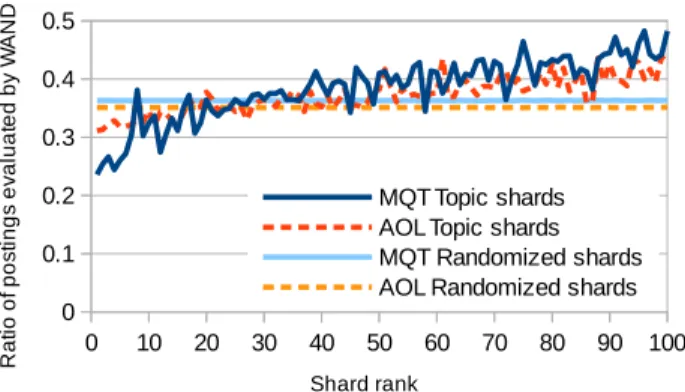
Fig. 6: The micro-averagew/bratio for WAND postings evaluations, as a function of the per query shard rankings assigned by Taily. Early shards generate greater savings.
terms associated with the highly ranked shards are longer than they are in a typical randomized shard. With these long postings lists, there is more opportunity for WAND to achieve early termination. Figure 5 shows normalized final heap-entry thresholds, or equivalently, the similarity score of the1,000th ranked document in each shard. The scores are expressed as a fraction of the maximum document score for that query across all shards, then plotted as a function of the resource selector’s shard ranking using Taily, averaged over queries. Shards that Taily did not score because they did not contain any query terms were ordered randomly. For example, for the AOL log the1,000th doc-ument in the shard ranked highest by Taily attains, on average across queries, a score that is a little over80% of the maximum score attained by any single document for that same query. The downward trend in Figure 5 indicates that the resource ranking process is effective, with the high heap-entry thresholds in the early shards suggesting – as we would hope – that they contain more of the high-scoring documents.
To further illustrate the positive relationship between shard ranking and WAND,
w/bwas calculated for each shard in the per query shard orderings, and then micro-averaged at each shard rank. Figure 6 plots the average as a function of shard rank, and confirms the bias towards greater savings on the early shards – exactly the ones selected for evaluation. As a reference point, the same statistic was calculated for a random or-dering of the randomized shards (random since no shard ranking is applied in traditional distributed search), with the savings ratio being a near-horizontal line. If an unpruned full search were to be plotted, it would be a horizontal line at1.0. The importance of resource selection to retrieval effectiveness has long been known; Figure 6 indicates that effective resource selection can improve overall efficiency as well.
Improving Efficiency with Cascaded Pruning Thresholds In the experiments re-ported so far, the rankings were computed on each shard independently, presuming that they would be executing in parallel and employing private top-kheaps and private heap-entry thresholds, with no ability to share information. This approach minimizes search latency when multiple machines are available, and is the typical configuration in a distributed search architecture. An alternative approach is suggested by our second research question: what happens if the shards are instead searched sequentially, passing
0 10 20 30 40 50 60 70 80 90 100 0 0.2 0.4 0.6 0.8 1 MQT Taily order AOL Taily order MQT Random order AOL Random order
Shard rank N o rm a liz e d th re sh o ld
Fig. 7: Normalized1,000th document scores from shards relative to the highest score attained by any document for the corresponding query, micro-averaged over queries, assuming that shards are processed sequentially rather than in parallel, using the Taily-based ordering of topical shards and a random ordering of the same shards.
0 10 20 30 40 50 60 70 80 90 100 0 0.1 0.2 0.3 0.4 0.5 Sequential Independent Shard rank R a tio o f p o st in g s e va lu a te d b y W A N D
Fig. 8: Ratio of postings evaluated by WAND for independent shard search versus se-quential shard search, AOL queries with micro-averaging. Shard ranking was deter-mined by Taily.
the score threshold and top-kheap from each shard to the next? The heap-entry score threshold is then non-decreasing across the shards, and additional savings should result. While this approach would be unlikely to be used in an on-line system, it provides an upper bound on the efficiency gains that are possible if a single heap was shared by all shards, and would increase throughput when limited resources are available and latency is not a concern: for example, in off-line search and text analytics applications.
Figure 7 demonstrates the threshold in the sequential WAND configuration, with shards ordered in two ways: by Taily score, and randomly. The normalized threshold rises quickly towards the maximum document score through the first few shards in the Taily ordering, which is where most of the documents related to the query are expected to reside. Figure 8 similarly plots thew/b WAND savings ratio at each shard rank, also micro-averaged over queries, and with shard ordering again determined by the Taily score. The independent and sequential configurations diverge markedly in their
behavior, with a deep search in the latter processing far fewer postings than a deep search in the former. The MQT query set displayed similar trends. Sharing the dynamic pruning thresholds has a large effect on the efficiency of selective search.
Our measurements suggest that a hybrid approach between independent and sequen-tial search could be beneficial. A resource-ranker might be configured to underestimate the number of shards that are required, with the understanding that a second round of shard ranking can be instigated in situations where deeper search is needed, identified through examining the scores or the quantity of documents retrieved. When a second wave of shards is activated, passing the maximum heap-entry threshold attained by the first-wave process would reduce the computational cost. If the majority of queries are handled within the first wave, a new combination of latency and workload will result.
4
Conclusion
Selective search reduces the computational costs of large-scale search by evaluating fewer postings than the standard distributed architecture, resulting in computational work savings of up to90%. To date there has been only limited consideration of the interaction between dynamic pruning and selective search [12], and it has been un-clear whether dynamic pruning methods improve selective search, or whether selective search is capturing some or all of the same underlying savings as pruning does, just via a different approach. In this paper we have explored WAND dynamic pruning us-ing a large dataset and two different query sets. In contrast to Kulkarni’s findus-ings with TBMS [12], we show that WAND-based evaluation and selective search generate what are effectively independent savings, and that the combination is more potent than ei-ther technique is alone – that is, that their interaction is a positive one. In particular, when resource selection is used to choose query-appropriate shards, the improvements from WAND on the selected shards is greater than the savings accruing on random shards, confirming that dynamic pruning further improves selective search – a rare sit-uation where orthogonal optimizations are better-than-additive. We also demonstrated that there is a direct correlation between the efficiency gains generated by WAND and the shard’s ranking. While it is well-known that resource selection improves effective-ness, our results suggest that it can also improve overall efficiency too.
Finally, two different methods of applying WAND to selective search were com-pared and we found that passing the top-kheap through a sequential shard evaluation greatly reduced the volume of postings evaluated by WAND. The significant difference in efficiency between this approach and the usual fully-parallel mechanism suggests avenues for future development in which hybrid models are used to balance latency and throughput in novel ways.
Acknowledgments This research was supported by National Science Foundation (NSF) grant IIS-1302206; a Natural Sciences and Engineering Research Council of Canada (NSERC) Postgraduate Scholarship-Doctoral award; and the Australian Re-search Council (ARC) under the Discovery Projects scheme (DP140103256). Shane Culpepper is the recipient of an Australian Research Council (ARC) DECRA Research Fellowship (DE140100275).
References
[1] Aly, R., Hiemstra, D., Demeester, T.: Taily: Shard Selection Using the Tail of Score Distri-butions. In: Proc. SIGIR. pp. 673–682 (2013)
[2] Arguello, J., Callan, J., Diaz, F.: Classification-based resource selection. In: Proc. CIKM. pp. 1277–1286 (2009)
[3] Broder, A.Z., Carmel, D., Herscovici, M., Soffer, A., Zien, J.: Efficient query evaluation using a two-level retrieval process. In: Proc. CIKM. pp. 426–434 (2003)
[4] Cacheda, F., Carneiro, V., Plachouras, V., Ounis, I.: Performance comparison of clustered and replicated information retrieval systems. In: Proc. ECIR. pp. 124–135. Berlin, Heidel-berg (2007)
[5] Cambazoglu, B.B., Varol, E., Kayaaslan, E., Aykanat, C., Baeza-Yates, R.: Query forward-ing in geographically distributed search engines. In: Proc. SIGIR. pp. 90–97 (2010) [6] Croft, W.B.: A model of cluster searching based on classification. In: Information Systems.
pp. 189–195 (1980)
[7] Dimopoulos, C., Nepomnyachiy, S., Suel, T.: Optimizing top-kdocument retrieval strate-gies for block-max indexes. In: Proc. WSDM. pp. 113–122 (2013)
[8] Gravano, L., Garc´ıa-Molina, H., Tomasic, A.: GlOSS: Text-source discovery over the inter-net. ACM Trans. Database Systems 24, 229–264 (Jun 1999)
[9] Ipeirotis, P.G., Gravano, L.: Distributed search over the hidden Web: Hierarchical database sampling and selection. In: Proc. VLDB. pp. 394–405 (2002)
[10] Kang, C., Wang, X., Chang, Y., Tseng, B.: Learning to rank with multi-aspect relevance for vertical search. In: Proc. WSDM. pp. 453–462 (2012)
[11] Kulkarni, A., Callan, J.: Document allocation policies for selective searching of distributed indexes. In: Proc. CIKM. pp. 449–458 (2010)
[12] Kulkarni, A., Callan, J.: Selective search: Efficient and effective search of large textual collections. ACM Trans. Information Systems 33(4), 17:1–17:33 (2015)
[13] Kulkarni, A., Tigelaar, A., Hiemstra, D., Callan, J.: Shard ranking and cutoff estimation for topically partitioned collections. In: Proc. CIKM. pp. 555–564 (2012)
[14] Lemire, D., Boytsov, L.: Decoding billions of integers per second through vectorization. Soft. Prac. & Exp. 41(1), 1–29 (2015)
[15] Nottelmann, H., Fuhr, N.: Evaluating different methods of estimating retrieval quality for resource selection. In: Proc. SIGIR. pp. 290–297 (2003)
[16] Paltoglou, G., Salampasis, M., Satratzemi, M.: Integral based source selection for uncoop-erative distributed information retrieval environments. In: Proc. LSDIR. pp. 67–74 (2008) [17] Petri, M., Culpepper, J.S., Moffat, A.: Exploring the magic of WAND. In: Proc. Aust. Doc.
Comp. Symp. pp. 58–65 (2013)
[18] Rojas, O., Gil-Costa, V., Marin, M.: Distributing efficiently the block-max wand algorithm. In: Proc. ICCS. pp. 120–129 (2013)
[19] Salton, G.: Automatic Information Organization and Retrieval. McGraw-Hill (1968) [20] Shokouhi, M.: Central-rank-based collection selection in uncooperative distributed
infor-mation retrieval. In: Proc. ECIR. pp. 160–172 (2007)
[21] Si, L., Callan, J.: Relevant document distribution estimation method for resource selection. In: Proc. SIGIR. pp. 298–305 (2003)
[22] Strohman, T., Turtle, H., Croft, W.B.: Optimization strategies for complex queries. In: Proc. SIGIR. pp. 219–225 (2005)
[23] Thomas, P., Shokouhi, M.: Sushi: Scoring scaled samples for server selection. In: Proc. SIGIR. pp. 419–426 (2009)
[24] Yuwono, B., Lee, D.L.: Server ranking for distributed text retrieval systems on internet. In: Proc. DASFAA. pp. 41–49 (1997)