doi:10.4236/jmp.2010.16057 Published Online December 2010 (http://www.SciRP.org/journal/jmp)
Calculation of the Effective G-Factor for the
2
2
2
1 2
3 2
1 2
ns S
np P
n s S
Transitions in
Hydrogen-Like Atoms and Its Application to the
Atomic Cesium
Ziya Saglam1, S. Burcin Bayram2, Mesude Saglam3
1
Department of Physics, Faculty of Science, Aksaray University, Aksaray, Turkey
2
Department of Physics, Miami University Ohio, USA
3
Department of Physics, Ankara University, Ankara, Turkey E-mail: [email protected]
Received August 14, 2010; revised October 25, 2010; accepted October 27, 2010
Abstract
We have calculated the effective g-factor
g* for the
2
2
2
1 2 3 2 1 2
ns S np P n s S transitions in
hydrogen-like atoms and applied it to atomic cesium. We have identified that not only the g* factor in this case is an integer number g* = 1, but also the existence of possible entangled states related to the above tran-sitions. Furthermore we have used the above result to calculate the transition energies which are in complete agreement (within the 1% margin error). Such results can give access to the production of new laser lights from atomic cesium.
Keywords:Photonic Transitions, Hydrogen-Like (Hydrogenic) Atoms, Landé G-Factor, Quantum
Entanglement
1. Introduction
The study and accurate determination of the excited-state properties of atomic and molecular systems, such as the fine and hyperfine coupling constants and oscillator strengths play an important role in testing high-precision atomic theories and quantum mechanics.
In particular the investigation of hydrogen-like atoms and its applications in modern technology go beyond the hydrogen atom itself. Amongst hydrogenic atoms, ce-sium with its low ionization potential and simplicity of its outer shell structure has attracted a lot of attention. In particular cesium has been involved in a number of sig-nificant studies within the field of laser cooling as well as in the development of atomic clocks. Furthermore investigations of parity violation [1] in cesium have been able to yield high precision results.
Recently it was also shown that cesium atoms are ideal candidates for optical computers, since cesium vapor is optically highly nonlinear, as well as possessing
sensitiv-tion a new series of scientific experiments on the proper-ties and behavior of cesium atoms have been used to prove fundamental connections between chaos theory [3] and quantum entanglement.
The aim of the present st
ity much greater than most semiconductors [2]. In
addi-udy is to investigate the ef-fective g-factor (g) for the
P3
1 2
transitions inhy-dro-gen-like atoms and apply it to
ling a one-electron hydrogen-like at
2 2 2
1 2 2
ns S np n s S
atomic cesium. We identify that the effective g factor has an integer value of g*=1 as well as the existence of possible entangled states related to the above transitions. We show that the al-lowed transitions occur vertically from one crossing point to another with respect to g* variable. Moreover calculations of their corresponding energy values reveal complete agreement with our previous results [4] (within the 1% margin of error), giving access to new laser lights from atomic cesium.
We start by mode
om in the presence of a magnetic field BBzˆ. We
netic moment e (orj) which has two components,
namely, the orbital part, l and the spinning part s.
We note that th Cou b potential in both cases re-quires planar orbits for th lectron, therefore the dir -tion of
e lom
e e ec
p
is taken to be in z-direction.
Moreover it was recently shown by Saglam et al. [5,6]
that the quantized magnetic flux through the electronic orbits of the Dirac hydrogen atom corresponding to the quantum state n l m, , j is given by
n l m, , j
n l mj
0 where
7 2
hc
0 4.14 10 G c is the flux quantum. the abo ationship is i
m
nd
e
ve rel
Since ependent of
p, e
, it cangen-like atoms. Note that be easily g neralized to e hydro
in such a cases p would be replaced b agnetic
moment of the positively charged ion core. The above calculated flux re lts in very high magnetic field values (such as 107 108
G G) inside a hydrogen-like atom.
Therefore when such an atom is placed in an external magnetic f its effect would be to orient
y the m su
B
ield Bzˆ
p
in the z-direction and e
in the opposite direction.
Nevertheless the agnetic field inside the atom will be of the same or r with the initial value
7 8
10 G10 G because of the fact that B107G. Such
high magnetic field values have not been achieved so far.
The total magnetic field inside the atom will be called the local magnetic f
total m
still de
, B
perime
ield . The investigation of th ef
ntally
e fective g-factor
*g requires to study the Zeeman
effect in detail, therefore th eigenstates must be distin-guished in the Ze sense including the quantum number
e eman
j l s
m m m [7-8]. Using a non relativistic
Hamiltonian [9] we proceed to investigate the Zeeman fine ener e shown that for the above mag-netic field values the spin-orbit coupling and the quad-rupole moment energy can be neglected. Considering diamagnetic and paramagnetic effects the energy eigen-values become
gies. It can b
*
, , , C
E n l mj B B m g m
n2 B l s
corresponding to the n l m, , j eigenstate. Note th
magnetic f eld is replaced by the local magnetic f factor is
at the ield i B
B and the Lande-g replaced by the effective
Lande-g factor, g which is treated here as a varying
ameter. It should be noted that the same expression is also applicable in the case of an atom subject to a laser beam, where due to the photon’s magnetic moment [11] and hence the large intrinsic magnetic field comparable with the above large values [12], the same diamagnetic and paramagnetic effects are present inside the atom.
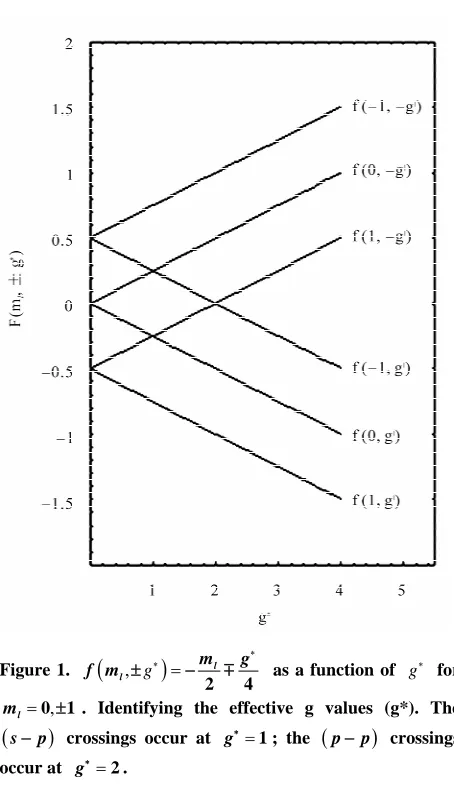
To proceed further, by using the above energy relation we define a new dimensionless function
par
*2
, , , , l
l j c
m
2 4
g C
f m g E n l m B
n
which allows us to investigate the effective-g-factor va ues
l-
*g more easily. For s l 0 and p l( 1)
levels where we have ml 0, 1 , the plotting of
f ml,g as a function of g that c
of these lines correspond to either g 1,
shows rossings
sp
r g 2
crossings o , which corresponds to pp
crossings. As the subject of the present w t tigate the effective g-factor
* ork is oinves-g for the
2
2
2
1 2 3 2 1 2
ns S np P n s S transitions in
hydro-gen-like atoms, our graphic clearly shows that for the above transitions we have: g
ese cr
1. At these crossing points, two states with opposite spin have the same en-ergy value. We believe that th ossing points corre-spond also to the entangled states [12]. After finding the effective g-factor value which is equal to one
g1
,we set g 1 in the energy expressions
, , ,
E n l mj B . Substituting the value of
2
B
e mc
and
1 2
s
m , we find:
2 2 * *l m C E n
n
, ,
4
c c
j
m B . Here the constant is the characteristic of each hy
calculated from the ionization ene ab
tiv- ist
C drogen-like atom and
rgies. Applying the ove results to atomic cesium and calculating the cor-responding Zeeman fine energies at the s-p crossings, reveals complete agreement with experiment [4,13] (within the 1% margin of error). The above treatment can give access to new laser lights from atomic cesium.
The outline of the present study is as follows: In Sec-tion 2 we calculate the energy levels of the non-rela
ic hydrogen-like atom in the presence of an effec-tive(local) magnetic field, *
B . From the above energy
relation we calculate the effective g-factor for the
2
2
1 2 3 2 1 2
ns S np P n s transitions. In
Sec-tion 3 we apply the present energy results to atomic ce-oncluding remarks.
2. Calculation of the Energy Levels of
2
S
sium. In Section 4 we present the c
Le Hamiltonian [9] for a ne-electron hydrogen-like atom in the presence of an
Hydrogen-Like Atoms in the Presence of a
Uniform Magnetic Field
t us consider the non-relativistic o
external magnetic field, BBzˆ:
2 2
1 1
.
2 4
Ze
0
2 2
2
8 B
H p r L S
m
r
e
L gS B B r
mc
The first term corresponds to the kinetic energy op-erator, the second term is the Coulomb potential, the third term is the spin-orbit coupling, the fo
dipole moment energy and the last term is the quadrupole moment energy. As was discussed in [9] for fields up to rth term is the
4T the spin-orbit coupling and the quadratic terms
can be neglected so the Hamiltonian is reduced to:
10
2 2 0 0 1 1 2 4 B reduced B ZeH p L gS B H H
m r (2) where H0 is the Hamiltonian for a free electron and
B B
H LgS B
is the perturbing Hamiltonian
Using Dirac notation, we denote the eigenstates of H0
by n l m, , l thus writing:
0 , , l n , , l 2 , , l
C
H n l m E n l m n l m
n
(3)
where E C2 n
is the energy of the free hydrog
n en-
like atom (here the constant C is determined t ionization energy).
If we denote the eigenstates of the Hamiltonian, by
hrough the
reduced
H , ,n l mj where mj = ml + ms, the energy
eigenvalues E n l m B
, , j,
EnEZeeman will containthe Zeeman correction which is first order in B, i.e.:
0
, , , ,
, ,
reduced j B j
, , j, j
H n l m H H n l m
E B n l m
(4)
Here the field dependent part
n l m
.B B
H LgS B
corresponds to the Zeeman energy, EZeeman i.e.:
, , , ,
, ,
B j Zeeman j
B l s j
H n l m E n l m
(5) and (5 quation (4) gives the energy eigenvalue,
B m gm n l m
Substitution of the Equations (3) ) in E
, , j,
, j,
E n l m B E n m Brection:
including the Zeeman
cor-
, j,
2 B
l s
C
E n m B B m gm
n
(6)
where 2
B
e ohr magneton and
mc
is the B g is the
Lande-g factor which is equal to 2 for a free electron an atom or ion in a free space the Lande-g fac given by:
. For tor [14] is
1 1 1
J S S L L
(7) 1 2 1 J g J J
agnetic field [12], we will have diamagnetic and paramagnetic effects [10] inside the atom. Therefore the magnetic field inside the atom must be
the local magnetic field
When an atom is subject to a laser beam because of the photon’s magnetic moment [11] and hence the large intrinsic m
replaced by
B [15]. The Lande-g factor is
also replaced by the effective Lande-g factor, g which
is treated as a varying parameter [16,17]. Therefore the magnetic field B and the Lande-g factor in Equation (6)
must be replaced by the effective values, B and g
respectively, such that:
, j,
2 B
l s
C
E n m B B m g m
n
(8)
Substituting the value of
2 B
e mc
and 1
2 s m
in Equation (8), we find:
*2
, ,
2 4
l c c
j
m g
C E n m B
n
*
(9) Where *
c
eB
mc
is the cyclotron frequency corre- sponding to B.
Let us proceed by defining a dimensionles using the above energy expression given in E such as:
s function quation (9)
** ml
2 , , , 2 4 j c l g C
f m g E n m B
n
(10)
which does not have an explicit n dependence:
Plotting f m
l, g
for
m 0, 1
as a functionof g lea win l gure 1):
The h
ds to the follo crossings of t
g results (Fi
ese ,
1) f m
l g
lines co spond to
rre-1
g or g2.
2) At ts, with opposite these cr ints correspo angled st
F
these crossing poin two states
spin have the same energy value. We believe that ossing po nd to ent ates [12].
3) or the crossings (entanglements) of the [
S
an
2
ns 1 2
d
2
3 2np P ] as well as [
ns S2 1 2
and
21 2
np P ]
states, the effective g- factor is found to be equal to one:
1 g .
4) The crossing for the
pp
states occur at 2g .
In the present study since we concentrate on the
S
n
tran s at thfor all energy calculations. Here we note the allowed
ph ically f
point to nother one.
2 2 2
1 2 3 2 1 2
ns p P n s S sition e
crossing points, we substitute g 1 in Equation (9)
otonic transitions occur vert rom one crossing a
To find the energy eigenvalues, we start with s l 0.
orientations we have two
We note that depending on the spin
2
1 2
Figure 1.
, g
2 4
l l
m g
f m as a function of g for . Identifying the effective g values (g*). The
,
0 1
l
m
sp
crossings occur at g1; the
p p
crossings occur at g2.,0,0,
n n,0,0,1 2 and ,0,0,n,0,0, 2.
ation (9) the corresponding energy eigenvalues ossing points are given by:
1
n
From Equ at the cr
,0,0,1 2
2 *4 c
C E n
n
(11) and
,0,0, 1 2
C *E n 2
4 c
n
(12) respectively.
Equations (11) and (12) we see that the state From
1 2
,0,
n 0,n,0,0, has the lowest energy so it is
identified as the ground state. Next we consider the p l 1
up states
states, w states in total. The spin
hich are six
1 2
,1,1, ,
n 1
2
,1,0,
n
and 1 2
,1, 1,
n states are denoted by 2 3 2
e spin down states
np P while
th n,1,1, 1 2 , n,1,0, 1 2 and
,1, 1, 1 2
n are written as np P2 1 2. Using Equation
(9) the corresponding energy eigenvalues are:
* 24
* *
2
3 ,1,1,1 2
2 4
c c c
C C
E n
n n
(13)
,1,1, 1 2
2 * * 2 *2 4 4
C E n
n n
c c C c
(14)
C c*2
,1,0,1 2
4
E n
n
(15)
,1,0, 1 2
2 *4
c
C E n
n
(16)
,1, 1,1 2
2 * * 22 4
*
c c c
C C
E n
n n
4
(17)
,1, 1, 1 2
2 * * 2 32 4
*
c c c
C C
E n
n n
4
(18)
3. Application to Atomic Cesium
The ionization energy for cesium is , while the smallest amount of energy th
the ground state to the neares herefore in Equation (11) setting th
3.89 eV
at allows a transition t excited state is
e lowest en from 1.38 eV.
ergy to T
3.89 eV
we can write:
6,0,0,1 2
24 6
c
E V (19)
From Equation (12) and Equation (17) the nearest excited state energy is given by
3.89
C
e
2 4
6
c
C
. Since
the smallest amount of energy that allows a transition from the ground is then the energ
level will be
1.38 eV, y of this
2 4 3.89 1.38
6
C c 2.51 eV (20) From Equations (19) and (20), we find that the un- knowns: C115 eV and
*
1.38
c eV
. Thus for the 2
cesium atom Equation (9) is written as:
21 115
, , , , , , 1.38 0.69
2
j l l
E n l m B E n l m B m g
n
ange of es the values (
lot the energies bers:
(21) where the r ml tak -1,0,1) for the
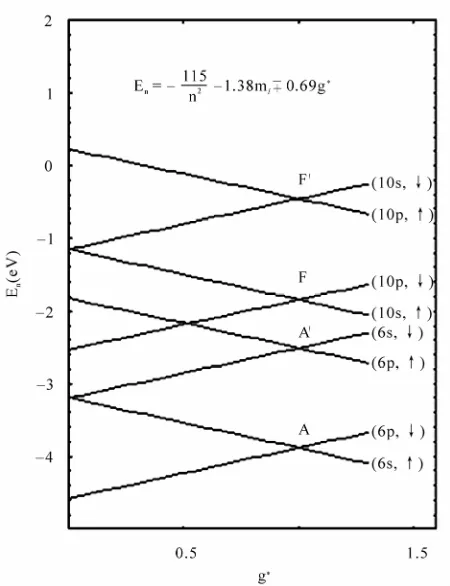
present transitions. In Figure 2 we p
given in Equation (21) for quantum num n6 and 10
n .
Plotting the energies corresponding to Equation (21) against g for n6,7,8,9,10 gives crossings at
1
g as ex
which are denoted
[image:4.595.315.541.80.271.2]Figure 2. The plots of E n m g
, l,
with respect to g for the
6 ,sp
and
10s,p
statoccur at g
respect to
es for at
it is cross and transitio s take pl ly with
omic cesium. As n seen the
ace vertical
ings 1
g. and
'
C , D, D' F, F'. Their energies and related
n in
from states are give Table 1.
To excite electron A to A' ,which
orre-sponds to a
c
2
2
3 2
6s S1 2 6 ener
p P transition, the
re-quired gy is A' A 2.51 3.891.38 eV .
To excite electron from '
E E
A to F, which corresponds
to
2
2
1 26p P3 2 10s S transi
2.51
e giv 44 erim
ti
en e
o e required en-
rgy is When
electron rela
nts involving cesium
clusions
n, th 2.06
by: Th
e '
xes bac to e ground state the energy of the corresponding laser will
0.45
F A
E E eV.
k
ent with
th b exp
the
0.45 3.89 3.
FEA eV. ese values are
in good agreem lasers [4].
4. Con
We have calculated the effective g-factor
E
g for the
ns S2
np P2
2
transitions in hydro-gen-like atoms and applied it to atomic cesium. We have found that the value of
1 2 3 2 n s S1 2
g is exactly equal to 1 for the
bove men a
p
tioned photon an
resent results to atomic cesium gives complete agree-
nd the raleted states at the crossing ,10.
ic tr sitions. Application of the
Table 1. Energies a oints for n = 6,7,8,9
p
Energies Mixture of states
3.89
A
E eV 6,0,0, and 61,1,
' 2.51
A
E eV 6,0,0, and 6,1, 1,
3.04
B
E eV 7,0,0, and 7,1,1,
' 1.66
B
E eV 7,0,0, and 7,1, 1,
2.49
C
E eV 8,0,0, and 8,1,1,
' 1.11
C
E eV 8,0,0, and 8,1, 1,
2.09
D
E eV 9,0,0, and 9,1,1,
' 0.71
D
E eV 9,0,0, and 9,1, 1,
0.45
F
E eV 10,0,0, and 10,1,1,
' 0.93
F
E eV 10,0,0, and 10,1, 1,
ment (within the margin of error) with the previous experimental results. We have also s the ex tence of possible entangled states related to the above transi-tions. Application the above tre ac-cess to the production of new laser from atomic cesium.
. References
ipkin, “Cesium Atoms for Optical Computers,” Sci-146, No. 14, 1994, pp. 214-215.
ating Ions Get Entangled,” Nature, 2009. Internet Available: http://www.nature.com/news/2009/
rnal of Russian Laser
377-382.
1%
hown is s of atment can give
lights
5
[1] J. Guena, D. Chauvat, P. Jacquier, M. Lintz, M. D. Plimmer and M. A. Bouchiat, “Sensitive Pulsed Pump-probe Atomic Polarimetry for Parity-violation Measurements in Caesium,” Journal of Quantum and Semiclassical Optics, Vol. 10, No. 6, 1998, pp. 733-752. [2] R. L
ence News, Vol. 3] Z. Merali, “Vibr [
090603/full/news.2009.540.html
[4] S. B. Bayram, S. Kin, M. J. Welsh and J. D. Hinkle, “Collisional Depolarization of Zeeman Coherences in the 133Cs 6p 2P
3/2 Level: Double-resonance Two-photon Polarization Spectroscopy,” Physical Review A (Atomic, Molecular, and Optical Physics), Vol. 73, No. 4, 2006, pp. 42713-1-6.
[5] M. Saglam, Z. Saglam, B. Boyacioglu and K. K. Wan, “Quantized Magnetic Flux Through the Excited State Orbits of Hydrogen Atom,” Jou
Research, Vol. 28, No. 3, 2007, pp. 267-271.
[6] M. Saglam, B. Boyacıoglu and Z. Saglam, “Spin-Flip Investigation of 1s-2p and 2p-3d Transitions of Dirac Hydrogen Atom in Terms of the Flux-quantization Argument,” Journal of Russian Laser Research, Vol. 28, No. 4, 2007, pp.
[image:5.595.307.539.105.309.2]09.
Hill, New York, 1985.
,” Springer-Verlag, Berlin, 1985.
s,” 8th
33-142.
ca E, dent Selection Rules for Dipole Transitions in Hydrogen
Atom,” The Journal of Old and New Concepts in Physics, Vol. 3, 2006, pp. 181-189.
[8] Z. Saglam and M. Saglam, “Quantized Magnetic Flux through the Electronic Orbits of Dirac Hydrogen Atom and its Relation with the Spin Dependent Selection Rules and Photons Intrinsic Flux,” Journal of Physics: Con- ference Series, Vol. 194, 20
[9] G. Drake, “Handbook of Atomic, Molecular and Optical Physics,” Springer, New York, 2006.
[10] E. Purcell, “Electricity and Magnetism,” Berkley Physics
Course, 2nd Edition, McGraw Vol.
[11] G. Sahin and M. Saglam, “Calculation of the Magnetic Moment of the Photon,” Journal of Physics: Conference Series, Vol. 194, 2009.
[12] M. Saglam and G. Sahin, “Photon in the Frame of the Current Loop Model,” International Journal of Modern Physics B, Vol. 23, No. 24, 2009, pp. 4977-4985.
[13] A. Radzig and B. M. Simirnow, “Reference Data on At-oms, Molecules and Ions
[14] M. Born, “Atomic Physics,” 7th Edition, Hafner, New York, 1962.
[15] C. Kittel, “An Introduction to Solid State Physic Edition, John Wiley & Sons Ltd., Chichester, 2004. [16] M. Saglam and B. Boyacioglu, “The Absence of the
Decimal g-Factor,” Physica Status Solidi B, Vol. 230, No. 1, 2002, pp. 1
[17] M. Saglam, “Flux Quantization Associated with Electron Spin for Correlated Electron System in QHE,” Physi
17, 2003, pp. 345-346.