Degree Programme in Computer Science and Engineering
Maksim Smirnov
Clustering and classification methods
for spam analysis
Master’s Thesis Espoo, June 18, 2018
Supervisor: Professor Tuomas Aura, Aalto University Advisor: Päivi Tynninen M.Sc. (Tech.), F-Secure
Degree Programme in Computer Science and
Engineering MASTER’S THESISABSTRACT OF
Author: Maksim Smirnov
Title: Clustering and classification methods for spam analysis
Date: June 18, 2018 Pages: vii + 73
Major: Security and Cloud Computing Code: SCI3084 Supervisor: Professor Tuomas Aura
Advisor: Päivi Tynninen M.Sc. (Tech.)
Spam emails are a major tool for criminals to distribute malware, conduct fraudulent activity, sell counterfeit products, etc. Thus, security companies are interested in researching spam. Unfortunately, due to the spammers’ detection-avoidance techniques, most of the existing tools for spam analysis are not able to provide accurate information about spam campaigns. More-over, they are not able to link together campaigns initiated by the same sender.
F-Secure, a cybersecurity company, collects vast amounts of spam for analy-sis. The threat intelligence collection from these messages currently involves a lot of manual work. In this thesis we apply state-of-the-art data-analysis techniques to increase the level of automation in the analysis process, thus enabling the human experts to focus on high-level information such as cam-paigns and actors.
The thesis discusses a novel method of spam analysis in which email messages are clustered by different characteristics and the clusters are presented as a graph. The graph representation allows the analyst to see evolving campaigns and even connections between related messages which themselves have no fea-tures in common. This makes our analysis tool more powerful than previous methods that simply cluster emails to sets.
We implemented a proof of concept version of the analysis tool to evaluate the usefulness of the approach. Experiments show that the graph representation and clustering by different features makes it possible to link together large and complex spam campaigns that were previously not detected. The tools also found evidence that different campaigns were likely to be organized by the same spammer. The results indicate that the graph-based approach is able to extract new, useful information about spam campaigns.
Keywords: spam campaigns, mass email, malware, clustering, graph analysis, threat intelligence
Language: English
I wish to thank my supervisor, Professor Tuomas Aura, for his insightful an-swers and comments which significantly helped me with this thesis and studies in general. I also want to thank my advisor at F-Secure, Päivi Tynninen, for hours of constructive discussions and helping me to define a strict scope for the research.
I also want to thank fellows at F-Secure for helping me with the research. Most particularly, I am grateful to Karmina, Robin, Alexey and Dmitry Ko-mashinskiy.
Special gratitude to the ITMO University for the opportunity to study at the Aalto University.
Espoo, June 18, 2018 Maksim Smirnov
ARPANET The Advanced Research Projects Agency Network ASCII American Standard Code for Information Interchange
BCC Blind Carbon Copy
BEC Business Email Compromise
CC Carbon Copy
CCTree Categorical Clustering Tree CPU Central Processing Unit CSV Comma-Separated Values
CTPH Context Triggered Piecewise Hashing
DBSCAN Density-Based Spatial Clustering of Applications with Noise
DCC Distributed Checksum Clearinghouse DKIM Domain Keys Identified Mail
DNS Domain Name System
DNSBL Domain Name System-based Blackhole List DOM Document Object Model
Email Electronic mail
FBI Federal Bureau of Investigation FPTree Frequent Pattern Tree
FWS Folding White Spaces
HTML Hypertext Markup Language HTTP Hypertext Transfer Protocol
HTTPS Hypertext Transfer Protocol Secure
ICANN Internet Corporation for Assigned Names and Numbers
ID Identifier
IEEE Institute of Electrical and Electronics Engineers IMAP Internet Message Access Protocol
IP Internet Protocol
IT Information Technology
LCS Longest Common Subsequence
MIME Multipurpose Internet Mail Extensions NDA Non-Disclosure Agreement
NFR Non-Functional Requirement POP Post Office Protocol
RBL Real-time Blackhole List
RBLDNS Real-time Block List Domain Name System RFC Request For Comments
SHA Secure Hash Algorithm
SMTP Simple Mail Transfer Protocol SPF Sender Policy Framework URL Uniform Resource Locator
Abstract ii
Abbreviations and Acronyms iv
1 Introduction and Scope 1
2 Background and related work 4
2.1 Email . . . 4 2.1.1 Email protocol . . . 4 2.1.2 Email format . . . 6 2.2 Spam . . . 8 2.2.1 Collecting spam . . . 8 2.2.2 Spam statistics . . . 9
2.2.3 Spam filtering techniques . . . 10
2.2.4 Filters evasion techniques . . . 12
2.3 Clustering algorithms . . . 14 2.3.1 K-Means . . . 15 2.3.2 DBSCAN . . . 16 2.3.3 Hierarchical clustering . . . 17 2.4 Related work . . . 18 2.4.1 Hierarchical approaches . . . 18
2.4.2 Text based clustering approach . . . 21
3 Tool requirements 23 3.1 Functional requirements . . . 23
3.2 Non-functional requirements . . . 23
4 Clustering algorithms and visualization 24 4.1 Feature selection for clustering . . . 24
4.1.1 Subjects . . . 25 4.1.2 Bodies . . . 30 4.1.3 URLs . . . 33 4.1.4 Source IP addresses . . . 36 4.1.5 Attachments . . . 36 4.1.6 Recipients . . . 37 4.2 Visualization . . . 37 5 Technical implementation 40 5.1 Design . . . 40
5.1.1 Loading and parsing emails . . . 41
5.1.2 Clustering . . . 42
5.1.3 Visualization . . . 44 v
6.2 Practical results . . . 48
6.2.1 Synonym swapping . . . 48
6.2.2 Tracking by features . . . 48
6.2.3 Same identity clustering . . . 53
6.3 Researchers’ comments . . . 54
6.4 Comparison with previous work . . . 55
6.5 Requirement fulfillment . . . 56
7 Discussion 58
8 Conclusions 61
Bibliography 67
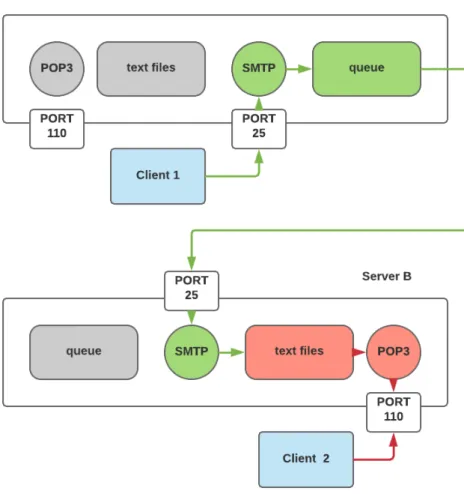
2.1 Common email transferring process . . . 5
2.2 Percentage of spam . . . 9
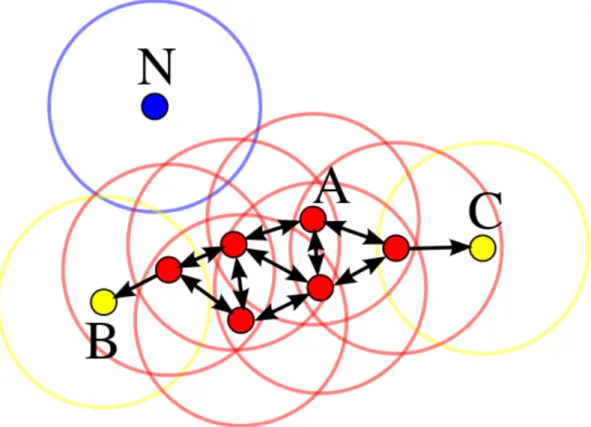
2.3 DBSCAN example . . . 16
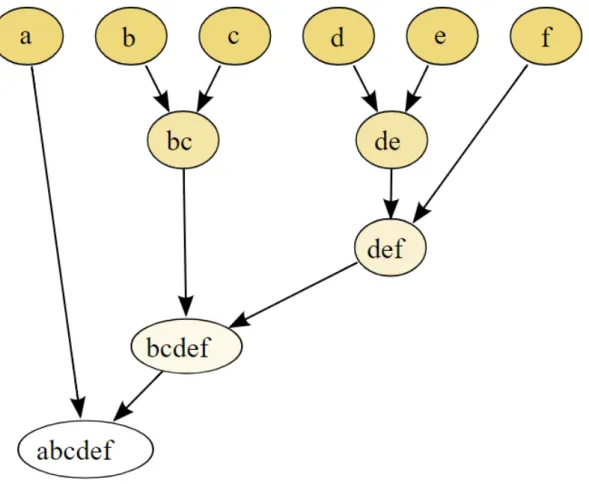
2.4 Tree representation of a hierarchical clustering . . . 17
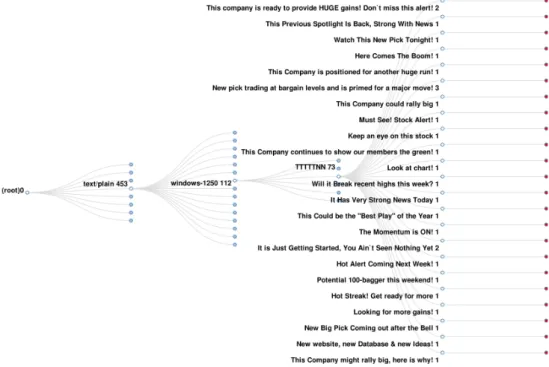
2.5 FPTree example . . . 19
2.6 FPTree campaigns similarity evaluation . . . 19
2.7 Fuzzy hashing clustering process . . . 21
4.1 Considered clustering features and approaches . . . 25
4.2 TP-FP EPS evaluation for subjects clustering. MinPts = 2 . . . 27
4.3 TP-FP EPS evaluation for subjects clustering. MinPts = 2. 50% of the labeled set . . . 28
4.4 Clusters and outliers for changing MinPts for subjects cluster-ing. EPS = 0.34 . . . 29
4.5 TP-FP for changing MinPts for subjects clustering. EPS = 0.34 29 4.6 TP-FP EPS evaluation for bodies clustering. MinPts = 2 . . . . 32
4.7 Clusters and outliers for changing EPS for bodies clustering. MinPts = 2 . . . 33
4.8 Histogram of URLs count in used dataset . . . 34
4.9 TP-FP-TN-FN EPS evaluation for URLs clustering. MinPts = 2 35 4.10 TP-FP EPS evaluation for URLs clustering. MinPts = 2 . . . . 36
4.11 Clusters visualization example . . . 38
5.1 Clustering process . . . 41
6.1 Time complexity comparison for distance matrix creation . . . . 47
6.2 Time complexity comparison for DBSCAN clustering . . . 47
6.3 Clustering by tracking changes of features . . . 49
6.4 Subgraph of campaign distributing malware pretending to be a delivery service . . . 51
6.5 Wrong connection between clusters . . . 52
6.6 Different campaigns clustered because of common resource . . . 54
1 Graph representation of the synonym table extracted from a real-world dataset . . . 69
Introduction and Scope
Electronic mail, also known as email, is a common communication mechanism that is used by many companies and people. Companies use email to keep in touch with their clients, promote their goods and services, receive feedback from clients. People often use email for communication as the default way of reaching other people. Like any widely used technology, email can also be misused. Unsolicited email messages, also known as spam, appeared in the same time as email system appeared. The first spam message was sent on May 1, 1978, by Digital Equipment Corporation to advertise their product to several hundred users on ARPANET[43]. When the Internet opened for commercial and personal use in the 90s, spam became a widespread phenomenon. Thus with the rise of the email system, rose spam. In the first half of 2017, spam accounted for 54% of all email traffic[27].
Most of the spam emails are intended to aggressively advertise goods or websites, and they do not do much harm except wasting people’s time and re-sources. However, besides that, spam serves an important role in cyber attacks and distribution of malicious software. According to Symantec research, it is the most frequently used mechanism to deliver malware. Also, their research states that a user is twice as likely to get infected by malware through email than to get infected through a malicious website.[27] Spam is also used for various types of fraudulent activities targeted at businesses. According to a recent analysis by FBI[38], between 2013 and 2016 years, businesses suffered losses of over $5 billion because of email fraud. These consequences of spam make it an essential attack vector for security service companies to invest their analytic resources.
Information security companies are interested in understanding trends in spam and in predicting what can happen and how to mitigate the threats. Getting a representative overview of spam is a task that requires some prepa-ration. To do that, security companies maintain email honeypots and buy vast amounts of spam from specialized providers. Getting as many malware and phishing samples as possible and updating the detection databases on time can significantly reduce the damage caused by malware and fraud to the security company’s clients.
Malicious attachments and URLs is not the only information that can be extracted from spam. Often spam discloses enough information to group differ-ent spam campaigns by a common sender. Iddiffer-entifying senders not only allows authorities to take actions against them but also to understand the spammers’ intentions and to improve automated detection mechanisms.
One key thing about spam is that it is often not qualitative but
tive. Even if only 0.1% of users opens a spam email and follows the link, it brings one client for every 1000 messages. Moreover, spam is so cheap that one client can payoff millions of messages. According to Symantec’s report, every 9th user had a malicious email sent to him during first half of 2017.[27] Mass character of spam leads to one of the technical problems of spam anal-ysis: massive amounts of data. F-Secure, the case company in this research, receives tens of thousands of messages every day and also purchases spam from companies which specialize in collecting it. Without special data mining tools, it is practically impossible to get a broad view of the collected data. Currently, such tools are not available on the market and companies that are interested in researching spam are forced to develop their own approaches according to their needs.
This thesis aims at making the analysis of email messages easier, providing tools and approaches to present and correlate email messages in such way that researchers can analyze large sets of email messages.
Two fields of computer science had been used to address this problem: ma-chine learning and graph analysis. Mama-chine learning, specifically clustering, provides ways of grouping objects that are similar according to some selected set of features. Most of the email messages differ insignificantly, therefore, al-lowing to combine thousands of similar messages into quite well-defined groups. This methodology can frequently provide insights about ongoing spam cam-paigns.
Another problem addressed in this research is data visualization. Graphs are chosen for the visualization of the clustered emails as they allows analysts to connect objects that have no direct link to each other but are connected through networks of other objects. The graph-based approach might disclose some information about the likeliness of having a common source behind both clusters.
This thesis attempts to answer the following research question:
How clustering techniques can facilitate analysis of unsolicited bulk messages?
The main research question can be divided into the following questions:
• What features can be used for clustering?
• Does clustering spam emails provide better visibility over spam cam-paigns?
• How can the clustering results be visualized?
The primary focus of the thesis lies on the novel method of correlating bulk email messages and presenting them to the user in such way that representa-tion can provide addirepresenta-tional informarepresenta-tion about the email senders that was not visible by inspecting the individual emails or even individual clusters. Feature selection is an essential part of the research as it determines the quality of the clustering, on which the presentation part relies. The developed tool is not yet
a complete product but helps to answer research questions and to evaluate the novel method of analyzing emails.
Although this thesis is focused on researching spam, the underlying analysis and presentation techniques can be applied to other types of objects.
The following section provides more details about spam, clustering algo-rithms and discusses relevant researches. After the background section, re-quirements for the tool are introduced. Next three chapters discuss a selection of the algorithms and their parameters, practical implementation of the soft-ware, and the obtained results with use cases. The discussion chapter explains the overall value of the results, how they influence the research area, and what future research directions can be taken. The conclusion chapter sums up the research.
Background and related work
Email spam has existed for a long time and has a significant impact on human-ity. Therefore, spam is a well-explored area with many effective approaches to spam filtering.
This chapter provides background information about the email, spam, and researches on the topic of spam clustering. The first section of the chapter describes electronic mail, explains main concepts, protocols, and formats. The second section discusses spam focusing on spam filtering techniques and tech-niques to avoid spam filters. The third section focuses on a comparison of commonly utilized clustering algorithms. The last section discusses researches on spam clustering and classification.
2.1
Electronic mail is a method of exchanging text messages between computer users. The core concept of email is that everyone can send messages to ev-eryone. Email protocol was designed in such way that the whole system is decentralized. This section explains how email works.
2.1.1
Email protocol
Email network consists of servers that store, transfer and process email mes-sages. Email messages are transferred bySimple Mail Transfer Protocolservers. SMTP allows establishing communication and routing between different email users only using an address from an email and information from DNS servers.[22] This protocol operates within computer networks in such way that interlocu-tors do not have to be online simultaneously. It also allows relaying messages across different networks.[21]
Although it is possible to send and receive emails using only SMTP servers, common use case includes a mail retrieval service, such as IMAP or POP3. Mail retrieval services provide an easier way of working with incoming messages by storing and maintaining a mailbox. Services are usually run on the same server as SMTP server and allow users to fetch messages from the system. The difference between IMAP and POP3 is that IMAP stores messages on the server allowing to access mailbox from different devices, and POP3 reads messages, deleting them from the server.[26, 4]
Although most of the email clients support POP3 and IMAP, some email clients introduce their own protocols for fetching data from mail servers. Figure 2.1 depicts simplified example of an email message transfer:
1. Email client, for example, MS Outlook, connects to the known SMTP server, running on the host A. Then email client tells the address of the recipient and an email message contents to the connected SMTP server. 2. SMTP server A requests DNS server to get the IP address of the
recipi-ent’s SMTP server.
3. SMTP server A connects to the SMTP server B to send information received from Outlook email client.
4. SMTP server B receives the message and hands it to the IMAP service. 5. Email client 2 connects to the IMAP service, authenticates, and fetches
new messages. Now user can see these messages in his email client.
Email payload does not change during the transfer. However, there is one exception: each SMTP server has to append "Received" header storing information about the current SMTP server to the email. It is done to track the route of the message and find slow servers. Next section elaborates on message format and explains this header more thoroughly.
2.1.2
Email format
An email message is essentially a sequence of characters split into fixed-length lines. Lines are separated with "CRLF" line break.[34] Each email message consists of headers and a body. Body is optional and can be omitted.
A header is essentially a set of lines consisting of printable US-ASCII char-acters. It is separated from the body with an empty line. Each line of the email must not be longer than 998 characters and should not be longer than 78 characters. Each header field starts with a field name and is followed by a colon. A line is terminated by "CRLF."
The body of a message is simply lines of US-ASCII characters with several limitations: line cannot be longer than 998 characters, and "CRLF" can be used only for line breaks.[33] RFC 5322 references several other RFCs that greatly extend specification of a body, allowing it to encode non-textual mes-sage bodies[12], multi-part mesmes-sage bodies[13, 2], and body/headers in differ-ent character sets[25].
Header fields are logically divided into groups by a purpose. RFC 5322 de-fines eight groups of header fields: Origination Date Fields, Originator Fields, Destination Address Fields, Identification Fields, Informational Fields, Resent Fields, and Optional Fields.[33]
The Origination Date Field
Orig-date. Specifies time and date when the user decided to submit the email to the mailing system.
Originator Fields
From. Specifies the author or authors of the message represented as a comma-separated set of mailboxes.
Sender. Defines sender of the message. This field must be present if "From" field has more than one author. This mailbox is directly responsible for sending the message.
Reply-To. Optional field that contains a comma-separated set of email ad-dresses for the reply.
Destination Address Fields
To. Specifies primary recipients of the message.
Carbon Copy. Specifies addresses that will also receive the email although they are not primary recipients.
not be revealed to other recipients. It is achieved by sending separate messages to each of the recipients removing the BCC field from the email.
Identification Fields
Message-Id. Contains a unique identifier of the message. Must present in each email.
In-Reply-To & References fields. Fields that are used in replies to carry ID of the original message. References field is filled with the content of the parent’s references field,In-Reply-To is filled with parent’s "Message-ID."
Informational Fields
Subject. A common field that describes the topic of the email message. For replies, it is common to inherit the parent’s subject adding "Re: " substring at the beginning of the new subject.
Comments. Not mandatory field that may contain comments to the message body.
Keywords. Comma-separated set of important words that might be useful for the recipient.
Resent Fields
FieldsResent-Date,Resent-From,Resent-Sender,Resent-To,Resent-Cc, Resent-Bcc, andResent-Message-ID are used only when original message was reintro-duced to the electronic mail system by another user. These fields are purely informational and are not used for routing the message.
Trace Fields
When a message reaches an SMTP server, the server must append some trace information to that message to identify the sender host, receiver host, and the date and time according to the current host.
Received. Mandatory field to help keep track of emails routing through relays. When SMTP server processes the email, it must add a Received field with information about itself, for example, its IP address, the IP address of the previous SMTP server, and a current time. It helps to find slow relays and spoofed IP addresses.
Return-Path. An optional field that contains an email address to return email to. A message indicating failed delivery will be returned to this email. Some-times it is removed by the last SMTP server on the route.
Optional Fields
A client is allowed to add any fields to an email if the field name is made up of the printable US-ASCII characters, followed by a colon, followed by any text that conforms to the unstructured syntax.[33, p. 30]
2.2
Spam
Unsolicited messages sent by email are called email spam. Spam has been a burden to the email system for a long time. According to Symantec report, amount of spam during the first half of 2017-th reached 54%, and one of every nine emails was malicious.[27] Email is still one of the prevalent vectors of malware distribution. Therefore, it is very important for security-related companies to analyze this source of information.
Basically, any unwanted email message is called spam. Thus it can be very hard to distinguish spam message from a real email message.
2.2.1
Collecting spam
Spam is easy to get without putting any effort but getting a complete repre-sentation of what is happening in the spam world is a complicated task. Five methods of harvesting spam are commonly used.[31]
Botnet malware observation
Putting a botnet malware into a sandbox and collecting all emails sent from it. This method provides the clearest spam as it comes directly from the source[31].
MX honeypot
Configuring SMTP server to accept all messages that were sent to it. The goal is to receive all emails, even those that were generated by a spammer. To let spammers know that domain has an email server, email addresses hosted on that domain must be collected by a spammer first. One good example of addresses distribution is temporary mailbox services that are used by real people to avoid usage of their real email addresses when they register some-where. People use these temporary email services to register in other services where they do not need to receive any emails from that service. Accepting all incoming messages allows receiving significant amounts of spam that was intended for the owners of temporary addresses. Nobody will read spam on these accounts thus spammers might filter them for not being active.
Seeded honey accounts
Email addresses are created on third-party email resources and seeded by the owner of the feed. This technique provides a better diversity of domain names and, in many cases, cannot be filtered by domain names from spammers’ databases. Such accounts are also not active thus will be quickly filtered by advanced spammers.
Human identified
as spam manually. Messages flagged by real users are often high-quality cam-paigns as they manage to evade automated spam filters and get to the users. The downside is that such feeds are not scalable as to provide larger feeds they require to get more people using the email service.[31] Another downside is that different people have a different definition of spam so false negatives rate will be significant.
Domain blacklists
Domain blacklists are manually maintained feeds that can be driven by differ-ent combinations of spam source data based on the organization that maintains them[31].
2.2.2
Spam statistics
Figure 2.2 depicts rise in spam over last several years. Comparing to 2015 and 2016 years, spam rates increased in 2017. Unsolicited email messages composed more than half of the whole email volume during 2017 year.[27]
Figure 2.2: Percentage of spam
The increase in spam is not equal for all sectors. Manufacturing, mining sectors, construction, and retail trade targeted spam increased 50% in the first six months of 2017, according to Symantec spam report.[27]
Spam is mostly used to advertise goods or services, distribute malware and deliver phishing messages. Here are some key facts from the Symantec report:
• Infection of email users happens twice more often through emails than through all other infection methods
• 8000 businesses each month are being targeted by Business Email Com-promise (BEC) scam through spam. Targeted organizations receive on average 5.2 BEC emails per month
2.2.3
Spam filtering techniques
In the beginning, spam was very simple. Anyone could send millions of mes-sages to anyone just knowing his or her email address. Then first spam filtering techniques started to appear. Spammers also had to improve their techniques. This section serves the purpose of explaining the situation in the spam market and what difficulties can be met during spam clustering.
SPF and DKIM
Sending an email, a spammer can put any email address into the "From" field and any domain name into the HELO command. SPF and DKIM are two common techniques that allow binding IP address to a domain name.
Sender Policy Framework (SPF) technique allows to check if sending host is allowed to send messages using some domain.[46] To enable SPF check do-main owner must add a DNS record that will define which IP addresses are authorized to use the domain name as an identifier.[48]
Domain Keys Identified Mail (DKIM)is another way to perform such veri-fication, but instead of storing authorized hosts in DNS, a public key is stored as DNS record.[5] Then to each email "DKIM-Signature" field is added. This field stores signed information about the domain that is later compared against "From" field’s domain. To check that information is valid, a receiver uses the public key stored in DNS record.
Real Time Black Lists
Real-Time Black Lists (RBL) or DNS Black Lists (DNSBL) is a spam mit-igation technique described in RFC 5782. It is used to drop messages that came from sources that are suspected of sending massive amounts of spam.[24] These sources are not necessary servers that were created by spammers but also can be misconfigured legit SMTP-servers abused by spammers.
RBL uses DNS infrastructure to store blocked IP addresses, and any SMTP server can access these records from standard DNS servers or specialized servers like RBLDNS.
This method also blocks SMTP servers that allow sending spam through them, for example, open SMTP relays that relay all traffic that comes in with-out checking the IP address correctness. The Internet is being scanned to detect such SMTP nodes to add them to the RBL before spammers start us-ing them.
Greylisting
triplet: sender’s IP address, sender’s email address, and recipient’s email ad-dresses.[47] When the recipient receives a message with the unseen triplet, it rejects the message. It is an effective strategy because spammers often do not have proper infrastructure to process bounced messages and send them again. Moreover, even if they will try to resend the message in some time, they will be already filtered by RBL because, during the delay time, the spammer was sending messages to other clients.
Razor and DCC
Razor is a distributed network for checking spam body contents that allow de-tecting texts seen in spam without disclosing the real message.[32] Razor uses a fuzzy signature matching algorithm called Nilsimsa. Nilsimsa creates a statis-tical model of a message or part of a message in such way that small automatic mutations made to the message do not change the output significantly.[6]
Razor depends on user feedback about spam messages. If spam messages are not reported as spam by Razor users, Razor will give many false negatives. Distributed Checksum Clearinghouse (DCC) is a similar way of content blacklisting, but it does not rely on user’s feedback. Instead, it counts similar messages and considers all mass-sent texts as spam. So without white-listing, it will have a high rate of false-positives.[40]
Spamassassin
Spamassassin is a powerful tool for detecting spam. It is configured by adding rules where each rule has a score, and all rules are run for every received email.[11] Scores of these rules are summed up and compared to the threshold value. If the sum is higher than a threshold value, then the message is con-sidered spam. Users can add their own rules which are in the form of regular expression. A rule can be run against all parts of the message, not only body or header. Spamassassin also allows adding more sophisticated rules and plug-ins for all kinds of spam checks such as statistical analysis tests, RBL tests, Bayesian filtering, and domain name verification.
Bayesian filtering
Bayesian spam filtering is based on a statistical theorem that estimates a proba-bility of an event. It can be configured in different ways, but two most common approaches are to detect words and letter sequences.[1]
Words analysis is rather simple. Bayes filter has to be trained on spam samples and legit messages. Using information from the training, it is possible to see which words are often used in spam emails and which are not. Bayesian filter adapts to new spammers techniques very fast, for example, when spam-mers started using the word "f-r-e-e" instead of "free" to avoid Spamassassin word filters, Bayesian filter managed to learn that "f-r-e-e" is a good indication for spam emails because it is mostly used in spam.
that spammers often add to their messages to avoid having completely simi-lar messages. It is possible because the probability of having a pair of letters together is not same for all pairs and generated text will not have this dis-tribution of probability. One example of software using the Bayesian filter is DSPAM.[17]
2.2.4
Filters evasion techniques
Spamming techniques are aimed against spam filtering techniques. Filtering was the reason why filtering techniques evolved, and evolution of filtering tech-niques lead to improvement of spamming techtech-niques.
One interesting thing to keep in mind is that email servers configured differ-ently thus making even obsolete spamming methods to reach some percentage of the recipients. So the existence of anti-spamming techniques that is hard to avoid does not mean that all email servers will apply the new technique and spammers will have to find some new technique immediately. The process of applying new methods takes time.
Email forgery
Changing sender’s address or domain in an email message is called email forgery or email spoofing. It is possible because email protocols do not have any authentication mechanisms in them by design.
To send an email using SMTP, a client has to provide two core pieces of information that compose "envelope" part of the email message. These pieces are:
• RCPT TO - specifies email addresses of recipients
• MAIL FROM - specifies the sender that will be presented to the recipient in the "Return-path" field of the email message
If SMTP server accepts the envelope, the client can send the DATA part of the email that includes "From" and "Sender" fields that will be shown to the sender. As a result, a receiver will see the wrong email and may respond to the wrong mailbox. Another consequence is that the spammers can exploit Non-Delivery reports by forging "Reply-to" field in such way, that Non-Non-Delivery report will be sent to the wrong mailbox. Such wrongly routed emails are called backscatters".
In terms of this research, it means that often sender fields cannot be trusted if they are not verified with DKIM or SPF.
Hiding text in email body
One way of confusing spam filters is adding fake text to the message body. Many flavors of such technique, but the concept stays the same: make spam filters check a text, that is not part of real payload intended to be shown to a
recipient. The simplest way to do that is to add some generated text to the body after the payload text and to put padding after the payload. In most cases, recipients will not see the appended fake text if they do not scroll the message to its end.[40] Adding text from Wikipedia articles can also confuse Bayesian filters as suspicious part of the text will be smaller compared to the amount of legit text.
Another way is to add generated text as HTML at the beginning of the message, making it the same color as background thus making text invisible to a human. Some spam filters will parse generated text as legit body text, and it can lead to a false negative result.
Generating subject and body text
Message subject line and body text are the way for the spammer to say some-thing to a receiver of a message. Many anti-spam techniques have been devel-oped to track and provide real-time information about spam campaigns based on subject lines and body messages. For example, Razor, discussed above, generates hashes of text parts and checks if they had been seen in other emails submitted before. This section discusses common ways of evading text-based blocking techniques.
Writing millions of similar subjects and texts would be the perfect solution for the spammers, but it requires an enormous amount of resources that will not pay-off. Spam has to be cheap to be profitable. Thus an automated generation of texts is much more preferable for the spammers.
One of the techniques for text generation is calledsynonym swapping. Syn-onyms swapping is a method allowing to generate sets of sentences that have the same meaning but use different words from a pre-defined set of tokens. It is done by splitting the sentence into several parts and picking a set of possible interchangeable words or collocations.[40] Splitting message on more parts and creating bigger sets of words for each sentence allows to increase the number of possible combinations significantly.
A table is the simplest form of the source structure. Another way of defin-ing the pattern is to create a finite state machine where each node is a set of tokens. Example of such state machine can be seen in Appendix 1. By going from root node through the graph and picking random token from each node, a program can generate different sentences that will have the same meaning. Table 1 shows examples of generated texts.
Generating URLs
URL addresses in emails serve two purposes: track which recipients were inter-ested enough to click the link and to provide some easier way for a user to get to the provided service or get exposed to malicious content. Therefore links cannot be obfuscated in such way that they stop working. It makes parsing and analyzing them an easier task for spam filters compared to the text-based filters.
URL consists of three parts:
1. Scheme - identifies the protocol used to fetch the content.
Spammers often use HTTP scheme because it does not require to get HTTPS certificate for the server. Many legitimate websites often use HTTP as well.
2. Hostname - points to a machine running the web service. It is also referred as a domain name. To get a domain name, web service owner has to register it through a domain name registrar at the organization called ICANN. The usual cost of owning a domain name for a year varies from $10 to $35.
Hostnames cost too much to make them unique for each email message, but sub-domains can be generated for free. DNS supports wildcard DNS records that will redirect all requests to sub-domains to a single server thus making the generation of sub-domains an easy option of randomizing the domain name. Comparing domain names between different messages can be tricky due to sub-domain generation.
Some domain owners provide their sub-domains to other people, so if two emails have the same domain name but different sub-domains it does not necessarily mean that the same person sent them. Fortunately, it is not common in spam for some reason.
3. Path and Query. It includes resource location and query for that re-source. It is possible to make it random for each recipient, however, due to the implementation of the software used for displaying the content, the pattern of this part of URL often stays the same.
Apart from generating sub-domains and randomizing the query format, spam-mers often use URL shortening. Several services are commonly used such as "bit.ly" and "goo.gl." These services allow creating links that will redirect users to any other link. Use of such services can also thwart using URLs inside message bodies as the domain will not be seen without following the shortened link.
2.3
Clustering algorithms
Clustering is an analysis method to discover groupings in a data set.[20] This section provides background information for common clustering algorithms that had been considered for the research and discusses their advantages and disadvantages.
2.3.1
K-Means
K-Means clusters data by randomly putting points, or centroids, across the dataset and moving them each iteration closer to the closest cluster’s center. After converging, points are set again. After N iterations, the best result is selected according to the evaluation function. The objective of the algorithm is to find: argmin s k X i=1 X x∈Si ||x−µi||2 =argmin s k X i=1 |Si|V arSi (2.1) Where x - data points, k - the number of result clusters, S - sets of points forming clusters, µ - mean of a set.
K-Means requires two arguments: number of centroids and number of it-erations.
Disadvantages of K-Means:[36]
• Clusters must be convex
• Requires clusters to have a center of mass and for each point to have a set of coordinates. Needs vectorization of the data
• In rare cases, the algorithm can give a not optimal result because it involves random selection of centroids
2.3.2
DBSCAN
Density-based spatial clustering of applications with noise (DBSCAN) is a density-based clustering algorithm that clusters together closely lying points. DBSCAN introduces the concept of core points, composing dense clusters. Result clusters also include points that are not core points but are neighbors of at least one of core points. Outliers do not have any core point neighbors. Figure 2.3 depicts example cluster. A point is a core point,Band Care parts of the cluster but not core points, and N point is an outlier.
Figure 2.3: DBSCAN example DBSCAN requires two parameters:
• ε or EPS - maximum distance between neighbours
• MinPts or min_samples - minimum neighbor samples to consider the point to be a core point
Disadvantages:
• Not entirely deterministic
Non-core points that are reachable from different clusters can be assigned randomly depending on the order of data processing.
• Scalability issues
algorithm has average runtime complexity of O(nlogn) and worst-case complexity of O(n2).[19] When working with not vectorized data,
im-plementations often require pre-built distance matrix that requires min-imum O(n2/2) for symmetrical distances.
2.3.3
Hierarchical clustering
Hierarchical clustering is a set of clustering algorithms, the main concept of which is to build new clusters by separating existing ones or delete clusters by merging them. Hierarchy is often represented by a tree where leaves of some node are components of the same cluster. Figure 2.4 depicts an example tree. Agglomerate clustering is a hierarchical clustering that uses a bottom-up ap-proach. In the beginning, all nodes are considered clusters of one node. Each iteration, clusters are being merged into bigger clusters.
Figure 2.4: Tree representation of a hierarchical clustering
Disadvantages:
• Computational and memory complex. Has O(n3) computational
com-plexity and O(n2) memory complexity [7]
2.4
Related work
This chapter is dedicated to researches on the subject of "Email Clustering." Each section describes one approach to the problem and overviews existing papers, evaluating results of each approach.
2.4.1
Hierarchical approaches
"Spam campaign detection, analysis, and investigation"[9] research proposes an approach based on frequent pattern tree (FPTree) algorithm. Authors con-sider 6 different features.
Content Type. Common content types are "text/plain", "application/octet-stream", "multipart/mixed", "text/html", etc.
Attachment Names. Names of the email attachments as a string.
Character Set. Roughly represents the spam language. For example, "windows-1251" usually used for Cyrillic alphabets.
Subject. Email subject as a string.
URL Tokens. Each URL is split into features such as hostname, path, and parameters.
Email Layout. Each email body is converted into a sequence of charac-ters such as "T" (Text), "U" (URL), and "N" (newline).
FPTree is a tree where all nodes represent features and their frequency.[15] Each path from a root to a leaf represents an email. All children of the node X are extracted from emails that have all features from root to X.
Figure 2.5 depicts an example of how FPTree is used to work with emails. As can be seen from email subjects, all emails share the common topic.
Figure 2.5: FPTree example
Evaluation of the clustering is also present in the paper. Authors used three methods of evaluation that rely on the text similarities: W-shingling, Content Triggered Piecewise Hashing, and Locality-Sensitive Hashing. Figure 2.6 shows results of the evaluation. The vertical axis represents the score of each metric and horizontal axis represent campaigns sorted by their similarity scores. As we can see from evaluation, about 30% of campaigns have a quite low similarity score.
This method relies on email patterns and does not rely on actual texts thus it will cluster campaigns that have completely different bodies but constructed using the same pattern.
Also, spammers can evade such technique by generating invisible parts of HTML that will change the pattern significantly.
Figure 2.6: FPTree campaigns similarity evaluation
"Fast and Effective Clustering of Spam Emails based on Structural Similar-ity"[37] yet another tree-related approach for clustering emails. It introduces
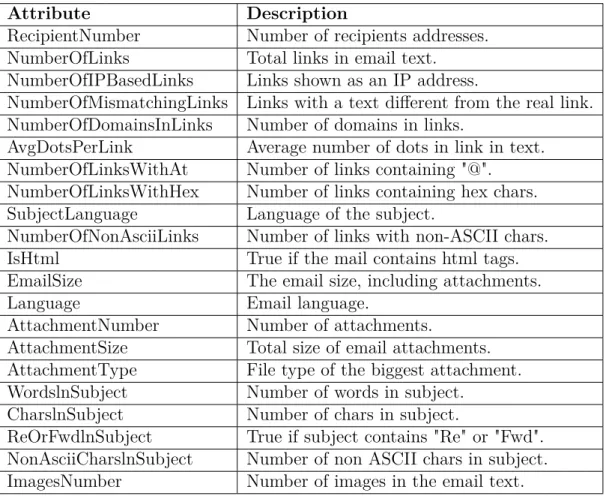
Categorical Clustering Tree (CCTree) algorithm that utilizes 21 features ex-tracted from each email message. Features are mostly related to the email contents, such as number of links, number of images, number of attachments, body and subject language, email message size, number of words in a body, types of attachments, and some other similar features. Full set of features is shown in table 2.1.
Attribute Description
RecipientNumber Number of recipients addresses. NumberOfLinks Total links in email text.
NumberOfIPBasedLinks Links shown as an IP address.
NumberOfMismatchingLinks Links with a text different from the real link. NumberOfDomainsInLinks Number of domains in links.
AvgDotsPerLink Average number of dots in link in text. NumberOfLinksWithAt Number of links containing "@".
NumberOfLinksWithHex Number of links containing hex chars. SubjectLanguage Language of the subject.
NumberOfNonAsciiLinks Number of links with non-ASCII chars. IsHtml True if the mail contains html tags. EmailSize The email size, including attachments.
Language Email language.
AttachmentNumber Number of attachments.
AttachmentSize Total size of email attachments. AttachmentType File type of the biggest attachment. WordslnSubject Number of words in subject.
CharslnSubject Number of chars in subject.
ReOrFwdlnSubject True if subject contains "Re" or "Fwd". NonAsciiCharslnSubject Number of non ASCII chars in subject. ImagesNumber Number of images in the email text.
Table 2.1: Features extracted from each email
The main concept is the same as in FPTree approach, but all features are categorical. To convert numerical values into categories, ChiMerge discretiza-tion method is used.
This paper is valuable because of the features that were utilized as they mostly relate to the structure of the document and not to exact resources. Also, the big number of features is highlighted as one of the advantages of this work.
"Mining Spam Email to Identify Common Origins for Forensic Application"[45] is yet another hierarchical approach to work with spam. Research consists of two parts: hierarchical clustering and fixing false positives. For hierarchical clustering, two features have been used: subject lines and domain names extracted from URLs. The first iteration of hierarchical
clus-tering combines all messages that have the same subject. The second itera-tion merges clusters that have the same URLs in bodies with a single-linkage clustering algorithm. Single-linkage clustering algorithm clusters two nodes together if they have at least one connection between the elements of different clusters. After the second iteration, researchers noticed that one cluster has 67% of the emails with URLs.
To resolve false positives, researchers applied graph approach. They created a vertex for each domain in the biggest cluster and an edge for each common subject between two domains. This approach allows finding weakly connected subgraphs that are connected only by several edges and separating them to split the cluster into smaller clusters. The main idea is that campaigns that accidentally happen to have the same subject will be weakly connected because the probability of sending messages with the same subjects is low. By applying this technique, researchers managed to reduce the number of clusters and make them more related.
This paper partially inspired approach applied in this research as it also utilizes graphs to correlate different features together. However, the approach suggested in this thesis differs significantly from what was proposed in "Mining Spam Email to Identify Common Origins for Forensic Application".
2.4.2
Text based clustering approach
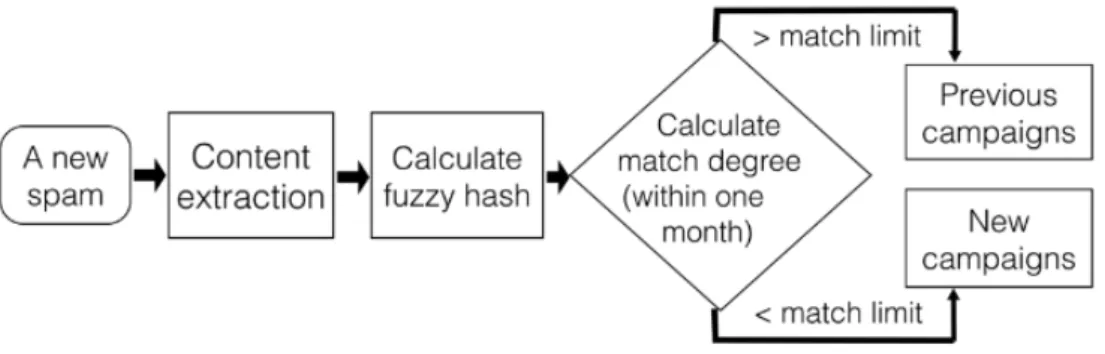
"Clustering Spam Campaigns with Fuzzy Hashing" [3] uses fuzzy hashing to cluster emails into campaigns. Fuzzy hashing is used because spammers often slightly change email messages to evade spam filters. Thus researchers propose approach depicted in figure 2.7 that allows to cluster new messages into existing clusters and create new clusters if a message cannot be assigned to an existing cluster.
Figure 2.7: Fuzzy hashing clustering process
Context triggered piecewise hashing (CTPH) is used to hash each message. To compare two hashes, researchers used weighted edit distance.
Each new message is compared against all existing clusters using above metric and assigned to a cluster with the highest similarity rate if the
simi-larity is bigger than the constant threshold. If the simisimi-larity is less than the threshold, a new cluster is created.
The computation cost is low because the method relies on a simple hash, although it still requires pair-wise comparison among two hashes to obtain a similarity score.[3] This paper does not provide research of how adding random invisible text changes effectiveness of the algorithm.
After empirically selecting the threshold and clustering 550000 samples, researchers got 118760 clusters. Such big number of clusters researchers explain by the diversity of the dataset. It also might be explained by text obfuscation methods applied by spammers.
Tool requirements
The purpose of the developed software is to show how the suggested approach can be utilized in a real environment on real data. Although the tool is just a proof of concept, usability is an important part of it. If researchers have problems using the tool, it can be hard to evaluate its advantages for them. Thus, before creating a user interface, few questions had been asked, and few core requirements developed. This chapter describes requirements suggested by the researchers.
3.1
Functional requirements
Functional requirements determine what system’s behaviour: what system supposed to do, what functionality supposed to implement.
FR1: Clustering
Emails sharing common features must be grouped together. FR2: Searching
A user must be able to work with the results of clustering and be able to search the data by different attributes.
3.2
Non-functional requirements
Non-functional requirements describe properties of the system. Usability and performance are often part of non-functional requirements[39].
NFR1: Performance
The system must be able to provide browsing functionality in real time. NFR2: Visualization
Data must be presented through a graphical interface. NFR3: Learning curve
The learning curve for the instrument must be reasonable. A researcher should be able to work with the data with less than one-day training.
Clustering algorithms and
visu-alization
In unprocessed raw format, email messages are text documents stored in a database or a file system. To work with the data, researchers often parse emails and put valuable features into some databases or search engines like Elastic Search. Search engines allow to easily search through the data and build simple clusters using parsed features. However, loading all the data into the database costs a significant amount of money and loading more than a year worth of data, even omitting attachments and message bodies, might be too expensive for a company, especially because it still lacks methods for presenting the data in a way that researcher will not be overwhelmed with the it.
Researchers’ main aim is to get information about running campaigns. Spammers often share features inside a single campaign and sometimes even between different campaigns.[3] Such features can be meaningful parts of email bodies, message templates, used software, IP addresses, email subjects, domain names within the message, and other characteristics of an email message that is hard to change randomly. These features can be used for clustering.
Some campaigns last for quite a long time[3] and undergo different changes to their features to avoid spam filters.[29] Spammers often try to obfuscate some features in such way that it is practically impossible to cluster them by an obfuscated feature. Therefore clustering should be done in such way that email messages will be connected even if one of the features is obfuscated or changed.
One of the solutions might be clustering by different features and searching for overlapping clusters. Thus if features change during the campaign not simultaneously, messages will still be connected with other clusters.
This chapter discusses the selection of features and clustering algorithms. Visualization of the clusters is being discussed at the end of the chapter.
4.1
Feature selection for clustering
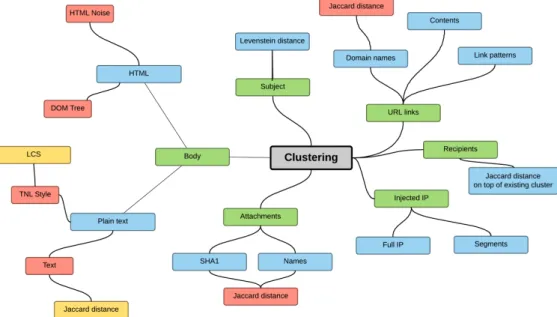
This section enumerates features extracted from the messages. Each feature’s significance is discussed. For some of the valuable features, clustering algo-rithms are implemented and tested on the dataset to select optimal parame-ters. These parameters are used later in the implementation chapter. Figure 4.1 depicts all considered approaches as a mind map.
Figure 4.1: Considered clustering features and approaches
4.1.1
Subjects
A subject line is often present in spam messages. It is the first thing that receiver sees in the inbox, so it has to be human-readable and enchanting for a recipient to open the email. A spammer can change a subject line during a campaign, but often meaning stays the same. The technique called synonym swapping, described in 2.2.4 section, allows to generate meaningful subjects and bodies with a low similarity between different email messages. However, it is rarely used because it demands a human effort to compose such table. On practice, spam subjects from one campaign look the same, and most of the messages can be clustered only according to the similarity of subject lines. Clustering. Clustering by subjects is done in 4 steps:
1. Parse subjects from email messages. This includes decoding the subject and converting it into readable Unicode text.
2. Cut subject line to 78 characters. Cutting subject lines not only improves performance but also is related to RFC standard. RFC states that fields should not be longer than 78 characters[33], therefore, longer subjects are often cut by RFC-compliant email clients.
3. Create n2 distance matrix with all distances between all messages.
4. Run DBSCAN clustering on calculated distance matrix with learned pa-rameters.
Levenshtein distance is used as similarity metric for subject lines because changes made to campaigns are often insignificant and limited to adding or changing words or punctuation.
DBSCAN is a clustering algorithm that works by separating low-density areas from high-density areas. It had been selected for clustering because of the next properties:
• No vectorization needed
Selected distance metric does not allow to generate vectors for the mes-sages, but it can be used to generate distance matrices for the whole set.
• No cluster number estimation needed
The algorithm must work with any amount of clusters and data without the need to revise data each time to determine parameters for the algo-rithm. DBSCAN allows setting constant density which is related to the similarity of subject lines.
• Shape of clusters can be non-convex
If synonym swapping, discussed in 2.2.4, is used DBSCAN will be able to cluster them by finding subjects that have only a few different words building a bridge between completely different subjects but created using same synonyms table.
Estimation of Clustering Parameters. DBSCAN requires two parameters to define density of clusters: EPS - maximum distance between neighbours and MinPts - minimum neighbours for sample to be considered a core sample.
Estimation of the parameters is a simple optimization task. Iterating pa-rameters through possible values is one of the existing approaches to determine parameters of clustering algorithms.[10] Both parameters were iterated sepa-rately, and the optimal value was determined. With MinPts value equal to 2, EPS value was iterated from 0 to 1 with 0.01 step. After determining the optimal EPS, MinPts was iterated from 1 to 10, keeping EPS optimal.
Test set had to be created to evaluate the clustering. 600 samples were labeled manually into 56 clusters. Manual labeling was performed according to many different features, not only subject lines. In some cases, subject lines were completely different for samples advertising same goods, and in some cases, emails with same subject lines were clearly from different campaigns.
For each step next six characteristics were collected: number of false pos-itives (FP), number of false negatives (FN), number of true pospos-itives (TP), number of false negatives (FN), number of clusters, and number of outliers. For clustering, terms "positive" and "negative" are applied to each possible pair of samples. For example, if two samples that are supposed to be in the same cluster are put in different clusters, it can be called false negative. If they are put in the same cluster - true positive.
Figure 4.2 depicts results of clustering and evaluation according to the la-beled set. As can be seen from the figure, TP and TN rise rapidly until EPS equal to 0.37. FP rate starts to rise from EPS 0.35. Interval of EPS from 0.26 to 0.34 gives a good amount of TP and TN, meanwhile having 0 FP and comparably low FN. Table 4.1 depicts confusion matrix for EPS equal 0.34.
Figure 4.2: TP-FP EPS evaluation for subjects clustering. MinPts = 2
Predicted: No Predicted: Yes Actual: No TN=263792 FP=0
Actual: Yes FN=40372 TP=79616
Table 4.1: Confusion matrix for EPS=0.34. Subjects clustering
It is common to separate labeled set on a training set and a test set to prevent overfitting of machine learning algorithms. In this research, parame-ters for clustering are being selected manually, so correctness of the clustering parameters rely only on how representative labeled dataset is.
To show that labeled dataset is sufficient to select parameters, all graphs are also created for a dataset having random 50% of the full labeled dataset. Figure 4.3 depicts evaluation of EPS for 50% of the whole labeled set. It can be seen that results are the same as for 100% set. Similarity of FP and TP rates for different sizes of labeled datasets shows that increasing size of labeled dataset will not provide more precise results for threshold selection.
Different sizes of test datasets were tested for threshold selection for other features too, but it did not change the selection of the threshold. Therefore graphs for 50% datasets are omitted in future parameters estimations.
Figure 4.3: TP-FP EPS evaluation for subjects clustering. MinPts = 2. 50% of the labeled set
Figure 4.4 shows how the number of outliers and clusters change with the change of MinPts. It can be seen that with MinPts = 1 many more outliers were clustered while keeping rates of TP and FP, depicted in figure 4.5, almost the same. However, further inspection showed that it happened because with such low MinPts clusters were created with only one email in them. After removing 650 clusters that consisted only from one email, number of clusters happened to be same as with MinPts = 2.
Figure 4.4: Clusters and outliers for changing MinPts for subjects clustering. EPS = 0.34
Figure 4.5: TP-FP for changing MinPts for subjects clustering. EPS = 0.34
MinPts was checked for all features, and it behaved the same as here. Thus graphs are omitted. MinPts for future clustering parameters evaluation is set to two.
4.1.2
Bodies
As discussed in 2.1.2 section, body is optional. However, most of the spam samples have it. Body is viewed by people who got interested in the email by reading the subject of the email. Thus it has to be simple and engaging enough to make the user perform some simple actions such as clicking on the link, downloading and running the attachment or responding to the email.
Bodies are much easier to obfuscate due to the variety of formats that mod-ern email clients support. Common methods to obfuscate body are discussed in 2.2.4 section. Body is often present either in HTML or plaintext format.
HTML itself can also be considered as a feature for clustering. Two features related to the HTML can be retrieved: HTML noise and DOM tree. Rendered text can also be a feature for clustering.
HTML noise
HTML noise had been already utilized to track and cluster web spam in "Track-ing Web Spam with Hidden Style Similarity"[44], but it had never been applied to spam.
Noise retrieval allows recovering details of messages, such as spaces and symbols, that are produced by the software used to generate the HTML tem-plate for the campaign. If two different campaigns have same temtem-plates noise, it might indicate that the same spammer is responsible for different campaigns. However, if different actors use the same software or standards-compliant soft-ware, the approach will give many false positives as many samples will have similar HTML noise.
Although it still can be used to find some valuable insights in some cases, it had been considered to be not strong enough and had been postponed for the future.
DOM Tree
Email messages quite often have some unique structure, although it is possible to obfuscate DOM structure for each email, often template is not changed or changed only slightly. Thus different tags and their positions might compose a feature that stays persistent during the campaign.
One of the advantages of this feature is that it might disclose campaigns with completely different content but that have the same HTML template to generate messages. Thus it can show campaigns created by the same sender. However, this feature also has two significant disadvantages:
• Spammers can easily change the template or start using common tem-plates to mimic legitimate mailing software
• Not all spam is HTML, so it is not a universal feature
This feature is quite promising, and it might be used in future implementa-tions, but now it had not been selected for the implementation.
Text
The text is present in almost every email message, although sometimes it comes in HTML layout. Spammers are interested in a client being able to read the text and having text to look not suspicious. Therefore, text can often be ex-tracted from an HTML using deterministic approaches similar to those used in HTML rendering. Three properties of the body text has been considered: Text meaning
What is advertised or discussed in the text. Text layout
Representing text as a complex of text fragments, URLs, and line breaks. The text itself is excluded. This approach had been implemented and tested in "Spam campaign detection, analysis, and investigation" research.[9]
Characters or words sequence
Perceiving body text as a sequence of characters or words that can be changed during the campaign only slightly by replacing words or changing symbols in them.
Body text represented as a set of identifiers has been selected for the imple-mentation as it is the most obvious and straightforward way to cluster similar generated text.
Many distance functions exist to compare texts[14], here some of the com-monly used ones:
• Jaccard index based distance
Measuring distance between sets of words using Jaccard index. This approach does not take into account words order. Complexity is O(n2) for n size sets [8].
• Levenshtein distance
It is a memory and time intensive distance measurement. It has memory and time complexity ofO(m∗n) [23].
• LCS (Longest Common Substring) length
LCS will find common substrings, but it also should take into account length of the overall message. It has no tolerance for small changes in the text.
Jaccard index was chosen because as it is working with words and size of sets will be much less than when working with characters in Levenshtein distance.
Clustering is done in next steps:
1. Parse HTML and extract first 20 words from the parsed text.
Manual inspection of spam messages showed that all, or almost all, spam messages try to provide the main idea and important content in the first 20 words. It might be because spammers have to keep a recipient interested from the first moment he opens the email. Otherwise, the message will be sent to spam.
2. Filter everything except words and create sets from the sentences. 3. Calculate distance matrix from every set to every set using Jaccard index
based distance.
Jaccard index is a similarity measure. To convert it to distance metric it must be subtracted from 1.
4. Cluster emails using DBSCAN with distance matrix.
Estimation of Clustering Parameters. The process is very similar to Levenshtein-DBSCAN clustering showed before. Figure 4.6 depicts evaluation of TP and FP for changing EPS. False positives go shallowly and start going up very steep from value 0.71. True negatives reach the peak at EPS 0.67 and True positives going up very fast from 0.48 to 0.72. According to the graph, the optimal value is 0.70 as it provides highest true positives rates with almost no false negatives.
Figure 4.7 depicts how the number of clusters and outliers changed with the change of EPS. It can be noticed that starting from EPS 0.74 clusters start to decrease faster than outliers and eventually intersect outliers graph. It means that algorithm starts to merge clusters instead of clustering outliers.
Figure 4.7: Clusters and outliers for changing EPS for bodies clustering. MinPts = 2
4.1.3
URLs
URLs often present in SPAM. Figure 4.8 depicts histogram of number of URLs in the emails found in F-Secure’s spam database (10000 emails were sampled). Emails without any URLs compose only 0.01% of the dataset.
URLs are part of spammers’ resources. Domains cost money, and it is quite expensive to use unique domains for each email in big campaigns. Although domain names can stay the same for different campaigns, unlike topic or similar template, it is much less likely that different spammers share control over same domain names. Finding campaigns that share domain names can help to identify likeliness of campaigns to be sent by the same spammer.
Figure 4.8: Histogram of URLs count in used dataset
Clustering
Clustering by URLs had been proposed[37][44][45][29] before and was discussed in section 2.2.4. URLs have several features that that were considered:
• Domain names
Domain names cost money, although it is possible to create sub-domains almost for free, it is still possible to extract domain name cutting off sub-domains. One of the drawbacks is that some services might sell their sub-domains or provide a service to redirect requests, for example, URL shortener discussed in section 2.2.4. However, it will always lead to the real server controlled by the spammer and can be extracted from the email by following the shortened link.
• URL patterns
URL patterns are easy to change in theory, but practical experience shows that it is often not done by spammers.
Full domains had been chosen as a feature for clustering as it is easy to imple-ment and validate the approach.
Clustering is done in next four steps:
1. Parsing the whole body and extracting all used domain names. 2. Creating a set of used domain names.
3. Creating a distance matrix using Jaccard index based distance. 4. Running DBSCAN clustering on the calculated distance matrix.
This approach can perform worse if spammers append fake URLs to the end of the email or make them invisible. In that case, Jaccard index will output significantly lower value if sets will have many different domain names. How-ever, it is not highly likely as it will not help email message to get through the spam filter and manual inspection showed that it does not happen in practice. Estimation of Clustering Parameters. DBSCAN was run with different EPS values to evaluate the results. Figure 4.9 shows overall results. As can be seen from the picture, TP and FP values are on a significantly lower level than true and false negatives. False negatives number is much bigger because spammers often use different domains during one campaign.
Figure 4.10 depicts only false positives and true positives. Level of true positives is higher from the start, and at EPS 0.31 it jumps while the number of false positives stays the same. The second jump appears at EPS 0.5, but now both values increased. On value 0.66 both false positives and true positives jump, but false positives go up significantly faster than true positives.
EPS = 0.46 was chosen as the optimal value. It will provide strict infor-mation about the similarity of used domains and will tend to provide as least false positives as possible.
Figure 4.10: TP-FP EPS evaluation for URLs clustering. MinPts = 2
4.1.4
Source IP addresses
IP address used to send an email is a very important feature that can be used to identify the real sender. Unfortunately, based solely on a received email message, it can be hard or even impossible to determine the real IP address that was used to send the message. As discussed in section 2.2.4, IP address can be forged as well as "Received" headers. Meaning that even if IP address should always be in "received" headers list, it can be impossible to say which one exactly is the real source IP address.
Because this feature is not reliable, it was decided to postpone it to future researches. Some of the possible solutions might be taking several possible addresses from the Received headers and compare them as sets.
4.1.5
Attachments
Attachments can serve different purposes that can be divided into two groups: attachments providing additional content to the message and attachments serv-ing as a separate payload that has to be opened by the recipient explicitly.
Each attachment has a file name and a content. The name often contains extension and the name of the attachment. Thereby three features from each attachment can be extracted: file name, file extension, and content.
Attachments related features are valuable and often can show that two emails are from the same campaign.