Beata Gavurova, Kristina Kocisova, Zoltan Rozsa, and Martina Halaskova / Montenegrin Journal of Economics, Vol. 15, No. 2 (2019), 041-057
41 ‘
What Affects the Interest Rate on Deposit From Households?
BEATA GAVUROVA
1, KRISTINA KOCISOVA
2, ZOLTAN ROZSA
3,
and MARTINA HALASKOVA
41 Assoc. Prof., Technical University of Kosice, Faculty of Economics, Kosice, Slovakia,
e-mail: [email protected]
2 Assoc. Prof., Technical University of Kosice, Faculty of Economics, Kosice, Slovakia,
e-mail: [email protected]
3 Assoc. ProfAlexander Dubcek University of Trencin, Faculty of Social and Economic Relations, Trencin, Slovakia,
e-mail: [email protected]
4 Assoc. Prof., VSB - Technical University of Ostrava, Faculty of Economics, Ostrava, Czech Republic,
e-mail: [email protected]
A R T I C L E I N F O
A B S T R A C T
Received December 15, 2018 Revised from January 25, 2019 Accepted February 27, 2018 Available online June 15, 2019
The contribution aim to identify the factors influencing the level of the interest rate in the conditions of the Slovak banking sector. The analysis itself is carried out using a correlation and regression analysis based on quarterly data from the database of National Bank of Slovakia for the period from 1st quarter 2006 to the 4th quarter of 2017. The research has been motivated by the three research questions about the impact of the selected market and intra-bank variables (Does the growth of market concentration lead to a decrease in deposits interest rates? Does the interest rate on the interbank market have a positive impact on deposits interest rates? Does the growth of liquidity lead to a decrease in deposits interest rates?). Based on the results of regression model we have found out, that the increasing concentration, declining interbank interest rate, disinflation, increasing bank capitalisation and declining bank liquidity have a significant impact on the decline in interest rates on deposit products under the conditions of the Slovak banking sector. This support the Structure-conduct-performance hypothesis which states that higher market concertation leads to less favourable pricing to customers. We have also found out, that highly capitalised banking sector has a lower pass-through for deposits, which means that the pricing behaviour of this banking sector is least tied to market development. So when the market rate decrease, the deposit rate of highly capitalised banking sector must also decrease and this decrease must be higher than the decrease in market rate.
JEL classification: E43, G21, L11, P34. DOI: 10.14254/1800-5845/2019.15-2.4 Keywords: Interest rate, deposits’ market, household sector, interest rate determinants.
INTRODUCTION
Deposits and loans interest rates are set at banks usually around the key interest rate of the central bank, and therefore they can be called "managed rates". The National Bank of Slovakia is a
Montenegrin Journal of Economics
Vol. 15, No. 2 (2019), 041-057Beata Gavurova, Kristina Kocisova, Zoltan Rozsa, and Martina Halaskova / Montenegrin Journal of Economics, Vol. 15, No. 2 (2019), 041-057
42
member of the Euro system, and its role is to participate in a standard monetary policy determined by the European Central Bank, whose primary aim is to maintain price stability, thereby contributing to higher employment and sustainable non-inflationary economic growth. In order to secure its goal, the central bank may use all monetary policy instruments, but most often the key interest rates that are reflected in market interbank and subsequent client interest rates (Beka, 2014). The central bank may determine the short-term nominal interest rates on loans provided to commercial banks that offer their products to clients and at the same time must fulfil the minimum reserve requirements in the form of deposits with the central bank.
Interest rates can be affected by various factors. According to several authors (Neumark and Sharpe, 1992, Hutchison, 1995, Carsky and Trajlinková, 2007, Medveď and Tkac, 2013, Ganic, 2018), they include determinants as the supply of money and the demand for them; the monetary policy of the central bank; the interbank interest rate; bank performance; economic growth; developments of inflation and exchange rates as well as the level of competitors’ interest rates. From the deposits point of view, the maturity term may also be an essential determinant of the interest rate since a higher rate motivates the client to keep his resources in the bank for a more extended period and then a bank can use them longer to realise its active trades. The size of the deposit is also an important factor influencing the interest rates because banks often apply rates based on the invested amount of money which means that the higher the deposit leads to the higher interest rate.
The article aim is to analyse of interest rate developments for selected types of household deposits with the aim to identify the factors influencing the level of the interest rate in the conditions of the Slovak banking sector. It would also like to point out to findings in the field of research on deposit rate determinants with the application of regression analysis. Based on the findings in the field of research, we will verify the following research questions: RQ1: Does the growth of market concentration lead to a decrease in interest rates on deposits from households? RQ2: Does the interest rate on the interbank market (12M EURIBOR respectively 12M BRIBOR until the ends of the year 2008) have a positive impact on deposits interest rates? RQ3: Does the growth of liquidity lead to a decrease in deposits interest rates?
Deposits of commercial banks are significant for the stability of financial institutions. As the primary role of commercial banks is the financial intermediation, we can suppose that if the financial institution is not able to obtain deposits from clients on liabilities site, it is also not able to offer loans for clients on asset site. As the rate offered on deposits influences the volume of savings attracted by banks, it is essential to know which determinants can affect this rate. Therefore it is crucial to gain more insight into factors that influence the deposit rate especially in times of unstable financial markets and increased competition between banks.
This paper is organised as follow: Chapter 2 gives an overview of the factors of influence derived from existing literature. Chapter 3 discusses the methodology and data gathering of the factor influence. Chapter 4 describes the statistical models and tests used in this study in order to find the most significant variables. Chapter 5 obtain a short conclusion followed by the limitations of this research and recommendation for future research.
1.
THEORETICAL BACKGROUND AND REVISION OF LITERATURE
Banks implement their deposit policy in particular by setting interest rates and compiling deposit products. In determining interest rates on deposits, they must take into account the current economic situation as well as actual balance sheet structure, pricing policy or market position within a competitive environment. Deposits' interest rate represents a consumers reward for leaving their funds in the particular form of deposit products with a bank or other financial institution to secure a particular source of income in the future. For consumers, it is crucial that their deposited funds bear interest at the highest interest rate to obtain the highest return on their
Beata Gavurova, Kristina Kocisova, Zoltan Rozsa, and Martina Halaskova / Montenegrin Journal of Economics, Vol. 15, No. 2 (2019), 041-057
43 deposits. On the other hand, for the banks, deposits' interest rates represent costs, and for this reasons, it is advantageous for them to provide the rates as low as possible. The bank's goal should be to find a compromise between these opposing interests of depositors and the bank itself, taking into account the impact of significant determinants that should be reflected in achieving the desired return to an acceptable risk measure for both parties.
The issues of interest rates changes, their development and factors are explored by many authors in their research not only at the national level but also in the European and international context (Maudos and De Guevara, 2004; Claeys and Vander Vennet, 2008; Gambacorta, 2008; Bernhofer and van Treeck, 2013; Ganic, 2018; Saaskilahti, 2018; Tarus and Manyala, 2018). Medveď and Tkac (2013) define interest as a remuneration for the waiver of money in the form of deposits or as a reward for the possibility to dispose of temporarily free money in the form of a loan. The difference between the received and the paid interest is called the interest margin, which forms a substantial part of the bank's profit. Interest includes in itself the real yield that the lender wants to achieve from its funds, expected inflation, liquidity and risk premium. Senkyrova (1999) argues that the interest rate on deposits should be higher than the assumed average annual rate of inflation and at the same time cannot be higher than the interest rate on loans reduced by an interest margin to enable the bank to cover its costs and realise the average profit. In determining it, competitors' deposit products must also be taken into account; therefore, it is necessary to set the interest rates at least as interesting as on the competitors' deposit products.
Banking behaviour in setting interest rates can be influenced by many factors that banks have to take into account, either they are market factors or intra-bank environment factors. Among the market factors, the authors of the scientific studies most often rank the level of competition in the banking market, the market interbank interest rate, inflation and GDP. In the context of intra-bank factors which determine banks' deposit products interest rates, the authors examined variables such as bank capital, liquidity, bank size, or operational inefficiency.
It is assumed that one of the market determinants of price behaviour among banks is the level of competition, most often expressed by the degree of concentration on the banking market. The degree of market concentration as a determinant of the interest rate has been subjected to several authors' analysis based on two competing hypotheses (Grigorian and Manole, 2006; Rum-ler and Waschiczek, 2012). The first, the structure-conduct-performance hypothesis (SCP), explains the positive relationship between the concentration and performance of banks in the market, using market concentration indicators (such as Herfindahl-Hirschman Index (HHI), or Concentration Ratio of 5 largest banks on the market (CR5)) to measure concentration. This hypothesis suggests that a concentrated market structure characterised by a smaller number of banks in a given market leads to a coordinated approach by banks that are thus exposed to less competitive pressure. Just coordinated approach and the same policy of banks to set up fees and interest rates for clients will then be reflected in the performance of all banks in the banking market. Thus, the higher absolute concentration on the banking market means the higher profits of all market participants as a result of the reduced costs consequent price fixing.
On the other hand, the result also will be less favourable changes in clients’ interest rates (Rumler and Waschiczek, 2012). The second competitive hypothesis is defined by the efficient-structure hypothesis (ES), which states that banks with higher market shares can influence the development of market prices in their favour, leading to higher profitability of only the most powerful banks. In this case, relative concentration ratios (e.g. market share) are used to measure the level of market concentration. A concentrated market structure, characterised by a smaller number of banks with a higher market share, allows large banks to set the prices of their deposits above the level of marginal costs, allowing them to gain higher profits in the highly concentrated markets (Grigorian and Manole, 2006).
Gropp et al. (2007) surveyed interest rates for four deposit product categories and four loans product categories. The authors examined the impact of the market concentration and confirm the
Beata Gavurova, Kristina Kocisova, Zoltan Rozsa, and Martina Halaskova / Montenegrin Journal of Economics, Vol. 15, No. 2 (2019), 041-057
44
findings of Neumark and Sharpe (1992) that banks in the concentrated markets increase interest rates on deposits in response to rising market interest rates slower, but on the other hand they respond more quickly to falling market interest rates by lowering interest rates on deposits. Based on this behaviour of banks in concentrated markets, they also confirm the claim, that when market interest rates fluctuate in both directions, banks in concentrated markets can leverage more surplus than depositors compared to banks in less concentrated markets. In this regard, Hutchison (1995) states that interest rates on deposits are on average lower on more concentrated markets and that their response to the rise in short-term market interest rates is slow and tends to react with delays. His model also captures the empirical observation that the difference between the market interest rate and the interest rate on deposits is increasing when market interest rates are rising. Also, Halamova and Kocisova (2018) came to the same conclusion about the positive adjustment to the delay in the projection of interbank interest rates into bank interest on deposits of households in the conditions of the Slovak Republic.
De Graeve et al. (2007) examined the interest rates of 31 banks for 13 credit and deposit products on the Belgian banking market. They found that the banks with the largest market share mark their products at least competitive and the disposal of a large market share enables banks to pay lower interest rates on deposits and achieve higher interest margins. They added, besides market concentration, other intra-bank variables to tested regression models. Their results showed that bank capital has a positive impact on the interest margin and that liquidity implies an adverse effect on the projection of market interest rates into deposit interest rates. Martin-Oliver et al. (2008) investigated the determinants of interest rates on deposits and loans on the Spanish banking market. Regarding bank deposits, the authors have classified them into four main product classes: current accounts, savings accounts, deposits and REPO operations with a maturity of fewer than 3 months, and deposits with a maturity of more than 2 years. In their study, they found that both the level and spread of interest rates on deposits are increasing with the number of banks in the market. Stesevic (2008) has constructed an econometric model that analyses the factors that determine the interest rate on deposits in Montenegro. The results of the regression analysis showed that growth in household consumption leads to an increase in interest rates on deposits because any increase in consumption means delaying the decision to save and means an increase in the lack of the necessary amount of money. He also found that the rise in market capitalisation led to a decline in the interest rate on deposits. Gambacorta (2008), in his work systematically analyses the factors that influence the behaviour of Italian banks in determining prices. He points out that bank efficiency reduces the interest rate on loans and increases the interest rate on deposits. From a perspective of the bank's capital, he claims that low-capitalised banks have a low ability to issue bonds and therefore try to increase the amount of deposits by raising their rates. Within market factors, he also points to the impact of inflation and GDP and states that the interest rate on deposits is negatively affected by real GDP and positively influenced by inflation.
Other authors, Maudos and De Guevara (2004), analyse the interest margins of Europe's lea-ding banking sector leaders such as Germany, France, the United Kingdom, Italy and Spain. They found that market power, expressed by the Lerner index which is defined as the difference between price and marginal cost, is a significant determinant positively influencing interest margin. Claeys and Vander Vennet (2008) investigated the determinants of bank interest margins in Cen-tral and Eastern European countries, systematically comparing these banks with Western Euro-pean banks. The authors analysed whether the relatively high-interest rates of banks operating in transit economies in Central and Eastern Europe are caused by low efficiency or uncompetitive market conditions. They also examined to what extent the banking behaviour of these banks is similar to that observed in Western Europe and also surveyed how the presence of foreign and state banks influences the differences between bank interest rates within the banking market.
Many scientific studies and authors address the issues of monetary policy and its influence on macroeconomic aggregates (Kuttner, 2001; Kleimeier and Sander, 2006; Agénor and Aynaoui, 2010; Kapuscinski and Stanislawska, 2018). Wu and Xia (2016) deal with the macroeconomic
Beata Gavurova, Kristina Kocisova, Zoltan Rozsa, and Martina Halaskova / Montenegrin Journal of Economics, Vol. 15, No. 2 (2019), 041-057
45 impacts of the Federal Reserve System (FED), when the federal funds rate was on a technical zero, and therefore the traditional monetary policy did not work, and the unconventional one had to come. The authors prove that the unconventional monetary policy of the FED, implemented through quantitative easing, has succeeded in contributing to stimulating the economy and maintaining a lower level of unemployment. Černohorska and Klejzar (2018) more closely address the effectiveness of unconventional monetary policy on inflation and Gross domestic product (GDP) on the example of selected central banks in the Czech Republic, the Eurozone, Switzerland and the USA. They are trying to find a cointegration relationship between unconventional monetary policy and selected indicators (GDP and inflation). Agenor and Aynaoui (2010) explain the financial and realistic effects of changes in the cost of borrowing from the central bank and changes in the required reserves indicator in the case when surplus liquidity indirectly impacts on the price behaviour of banks. Banks may, according to these authors, be more willing to reduce interest rates on deposits following changes in monetary policy instruments, in particular as a result of a decline in the refinancing rate or an increase in the required reserve ratio, taking into account the fact that both policies lead to a reduction in the supply of households deposits. Other surveys also address monetary policy analyses and changes in interest rates in the conditions of the Slovak Republic. For instance, Sinicakova and Gavurova (2017) assess the compatibility of euro area interest rates with the macroeconomic situation in Slovakia. Results demonstrate that the Euro area interbank interest rates did not react sufficiently either to Slovak inflation nor output gap.
2. USED DATA AND METHODOLOGY
Correlation analysis and linear regression analysis (see Hendl, 2012) were used in the article. Data were processed in R Commander programs. As stated by Výrost et al. (2013) in regression models we often encounter the problem of time-series non-stationarity, which can lead to spurious regression. One of the ways how to alternatively avoid the problem with spurious regression is the transformation of non-stationary time series into stationary one, for instance with time series differentiation. For this reason, our time series will be, in the first step, tested for stationarity with ADF test (Augmented Dickey-Fuller test). In the case of non-stationarity at the level of the original data, the differentiated value will then be used in the regression models.
Subsequently, we tested the linear regression assumptions under linear regression:
The presence of heteroscedasticity examined with the Breusch-Pagan test. If the p-value is lower than the chosen significance level (0.05), we assert that we have succeeded in rejecting a zero hypothesis about the absence of heteroskedasticity (H0: heteroskedasticity absent); thus we can assume that heteroskedasticity is present in the model.
The presence of autocorrelation, examined with the Breusch–Godfrey test. If the p-value is lower than the chosen significance level (0.05), we assert that we were able to reject the zero hypothesis about the absence of autocorrelation (H0: autocorrelation absent); thus we can assume that higher order autocorrelation is present in the model.
The presence of multicollinearity, expressing the correlation between independent variables, which does not exist in the model if the VIC (variance inflation factor) is less than 5.
The acceptability verification of the functional shape of the model with the Ramsey Regression Equation Specification Error Test (RESET) test. If the p-value is lower than the chosen significance level (0.05), we claim that we have been able to reject a zero hypothesis on the appropriate model specification (H0: the model is correctly specified), so we can assume it is not a suitable model.
The optimal number of variables verification with the Akaike information criterion (AIC). Using this criterion, we are looking for an optimal number of regressions by minimising the AIC criteria.
Beata Gavurova, Kristina Kocisova, Zoltan Rozsa, and Martina Halaskova / Montenegrin Journal of Economics, Vol. 15, No. 2 (2019), 041-057
46
The data used for the selected dependent and independent variables (see Table 2) were obtained from the National Bank of Slovakia's (NBS) macroeconomic database as well as from the NBS statements. The examined variables were verified at quarterly frequencies in the period from 1st quarter 2006 to 4th quarter 2017. We analysed interest rates for selected types of deposit products:
The average interest rate on deposits from households (expressed in%) - IR;
The interest rate on deposits from households repayable on demand (expressed in%) - IRO; The interest rate on deposits from households with a maturity of up to one-year (expressed
in%) - IR1;
The interest rate on deposits from households with a maturity of 1 to 2 years (expressed in%) - IR2;
The interest rate on deposits from households with maturity over 2 years (expressed in%) - IR3; The interest rate on deposits from households with up to 3 months period of notice (expressed
in%) - IR4;
The interest rate on deposits from households with a period of notice exceeding 3 months (expressed in %) - IR5).
We also analysed the indicators describing market factors (market concentration, market interbank interest rate, gross domestic product, inflation) and intra-bank factors (capitalisation, size, operational inefficiency, liquidity).
Market concentration serves as an indirect measure of absolute market competitiveness and most frequently is described by the Herfindahl-Hirschman Index (HHI). When calculating HHI, we take into account the number of banks in the sector and their market share. It is calculated by squaring the market share of each bank competing in a market and then summing the resulting numbers. It takes values from 0 to 1 (SBA, 2006). If the HHI value is less than 0.1, we talk about the unconcentrated market if it is more than 0.1 and less than 0.18 is a slightly concentrated market, and if its value exceeds 0.18, we can talk about a highly concentrated market. For the needs of our analysis, we will work with HHI on the market of the total deposits received from clients (HHI).
The role of the market interbank interest rate, in the euro area conditions, takes EURIBOR. It is an interbank interest rate, within the economic and monetary union, for which the reference bank is willing to lend the funds in euros to another reference bank. In the Slovak banking sector, BRIBOR fulfilled the role of the interbank interest rate until the year 2009. However, with the standard monetary policy and Slovakia's entry in the Eurozone was its function replaced by EURIBOR. For this work, we will use the 12-month BRIBOR for the period until 2009 and for the period after the entry into the Eurozone, from the year 2009, we will use data describing the evolution of the EURIBOR also with the maturity of 12 months (expressed in % - EURIBOR12M).
For our analysis, the following indicators are also used. 1) Gross domestic product (GDP), which is a measure of economic activity in the country and represents the value of goods and services produced in the national economy for a certain period of production factors in the territory of the country, broken down by form, use and income (closer to the ECB, 2013). We will work on GDP calculated from the seasonally cleaned expenditure method, expressed in current prices, which we convert from EUR millions into a logarithmic expression. 2) Harmonised Index of Consumer Prices (HICP), which is harmonised for all EU Member States, including Slovakia, and is one of the indicators of the price stability of the state. HICP index calculated according to the NBS basic structure, after seasonal adjustment (HICP). 3) Capitalisation, expressed as a share of equity in total assets in the banking sector, serves as an indicator of the stability of the banking sector. In our case, the capitalisation indicator is expressed in percentage (CAP). The increasing value of capitalisation indicates a higher resistance of the banking sector to adverse market shocks. 4) Bank size, respectively in our case, the banking sector can be defined by the value of the balance
Beata Gavurova, Kristina Kocisova, Zoltan Rozsa, and Martina Halaskova / Montenegrin Journal of Economics, Vol. 15, No. 2 (2019), 041-057
47 sheet total, i.e. the volume of total assets. In our analysis, we used the total volume of assets in the banking sector in logarithmic terms (BS). 5) The ratio of bank operating costs to operating income, "Cost to income ratio" (CI), expressed in percentage. The primary objective of the bank's operational efficiency is to achieve economic growth at lower technical and social costs. 6) Loan to Deposit ratio (LTD), expressed in percentage, which measures credit coverage by stable sources. The rising value of the LTD indicates the growth of illiquidity in the banking sector and its high value means that the value of illiquid assets is higher per customer deposit unit.
3. RESULTS AND DISCUSSIONS
This part of the paper analyses the development of the interest rate on deposits from the households in Slovakia for the period 2006-2017 and subsequently evaluates the interest rate determinants using the regression analysis.
3.1 Analysis of the interest rate on deposits from the households in Slovakia
For households, it may be essential to secure a guaranteed income in the future, while a favourable situation for them is the highest interest rate on deposits. However, recently, this rate is at a shallow level, and its trend is declining respectively stagnant.
Figure 1. Development of the average interest rate on deposits from households (IR) (%) in Slovakia.
Source: Authors calculation based on NBS (2017)
Figure 1 illustrates how the average interest rate on deposits from households (IR) developed between 2006 and 2017. In the period 2006-2008, the development of the interest rate (IR) was rising. During this period, the Slovak economy was experiencing the biggest boom in economic growth, was preparing to join the Eurozone thus adoption of the euro as common currency. However, at the end of 2008, the effects of the global financial crisis were also reflected in the Slovak banking sector, and the interest rate on deposits from households began to fall sharply since December 2008. In November 2008, the interest rate on deposits from households reached on 1.36% its maximum, and compared to the value at the end of the analysed period (0.07%) was more than twenty times higher. The interest rate on deposits from households showed a growing trend until December 2008, but in December 2008 started to fall sharply and over the nine-month period during which this rapid decline continued, it fell by 0.83 percentage points to around 0.52%
Beata Gavurova, Kristina Kocisova, Zoltan Rozsa, and Martina Halaskova / Montenegrin Journal of Economics, Vol. 15, No. 2 (2019), 041-057
48
compared to December 2008. In the months ahead, the interest rate picked up slightly, but as of June 2012, it began to gain a downward trend until it reached its bottom at the end of the analysed period.
Figure 2. Development of interest rates on individual types of deposits from households (%) in Slovakia
Source: Authors calculation based on NBS (2017)
Different types of interest rates on deposits from households show on new agreements similar development (Figure 2). The lowest interest rate throughout the period has deposits from house-holds payable on demand (IR0). Deposits with agreed maturity (IR1, IR2, IR3) reach the highest in-terest rate, but we can see that the inin-terest rate on deposits with an agreed maturity of more than 2 years (IR3) fell below the level of interest rates on notice deposits (IR4, IR5), and in April 2008 it even approached the level of the interest rate on deposits payable on demand (IR0).
Beata Gavurova, Kristina Kocisova, Zoltan Rozsa, and Martina Halaskova / Montenegrin Journal of Economics, Vol. 15, No. 2 (2019), 041-057
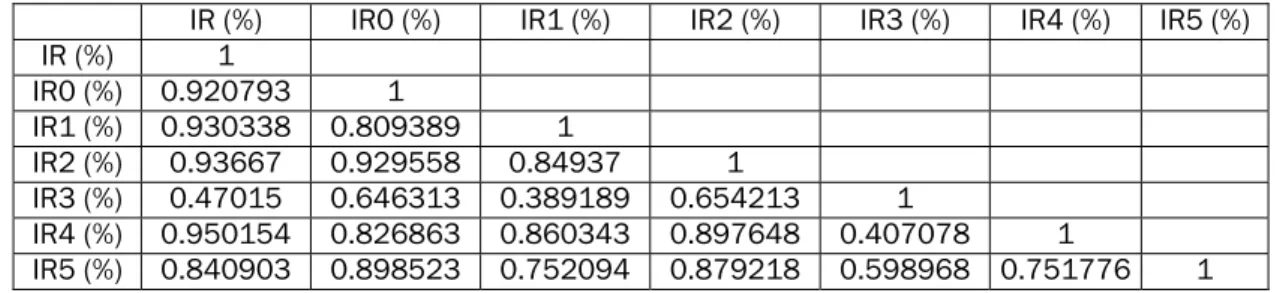
49 Table 1. Correlation coefficients between interest rates on deposit products
IR (%) IR0 (%) IR1 (%) IR2 (%) IR3 (%) IR4 (%) IR5 (%) IR (%) 1 IR0 (%) 0.920793 1 IR1 (%) 0.930338 0.809389 1 IR2 (%) 0.93667 0.929558 0.84937 1 IR3 (%) 0.47015 0.646313 0.389189 0.654213 1 IR4 (%) 0.950154 0.826863 0.860343 0.897648 0.407078 1 IR5 (%) 0.840903 0.898523 0.752094 0.879218 0.598968 0.751776 1
Source: Authors calculation based on NBS (2017)
Based on the graphical view, we can see the same development trends for all interest rates. We also decided to verify this assumption by calculating the correlation coefficients between these interest rates (Table 1). The results of the correlation analysis show an almost positive correlation between the average interest rate on deposits from households and the partial interest rates for each type of deposit product. A robust positive correlation can also be seen between individual partial rates on deposit products. For this reason, in the next part of the paper, we have decided to look for determinants for the above-mentioned average interest rate on deposits from households.
3.2 Evaluation of interest rate on deposits from households’ determinants
using regression analysis
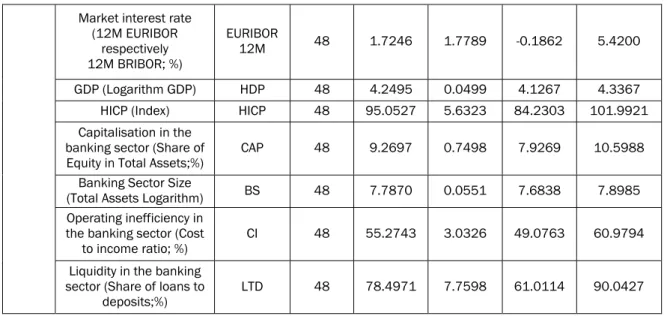
The development and the level of interest rates on individual deposits from households may be affected by various factors. Based on the works of authors cited in the literature review (e.g. Neumark and Sharpe, 1992; Berger, 1995; Maudos and De Guevara, 2004; Gropp et al., 2007; Claeys and Vander Vennet, 2008; Ganić, 2018; Tarus and Manyala , 2018), we can assume that even under the conditions of the Slovak banking sector the interest rate on deposits from house-holds may be potentially affected by some market or intra-bank factors. In the context of regres-sion analysis to find out determinants of the average interest rate on deposits from households, we considered market and intra-bank independent variables whose descriptive statistics are shown in Table 2.
Table 2. Descriptive statistics of investigated (dependent and independent) variables
INVESTIGATED VARIABLES Number of obser-vations Average
value Standard deviation MIN MAX
Dependent
The average interest rate on deposits from households (%) IR 48 0.5870 0.3389 0.0665 1.3514 In depen den t Market concentration (Herfindahl-Hirschman Index) HHI 48 0.1275 0.0044 0.1213 0.1391
Beata Gavurova, Kristina Kocisova, Zoltan Rozsa, and Martina Halaskova / Montenegrin Journal of Economics, Vol. 15, No. 2 (2019), 041-057
50
Market interest rate (12M EURIBOR respectively 12M BRIBOR; %) EURIBOR 12M 48 1.7246 1.7789 -0.1862 5.4200 GDP (Logarithm GDP) HDP 48 4.2495 0.0499 4.1267 4.3367 HICP (Index) HICP 48 95.0527 5.6323 84.2303 101.9921 Capitalisation in the
banking sector (Share of Equity in Total Assets;%)
CAP 48 9.2697 0.7498 7.9269 10.5988
Banking Sector Size
(Total Assets Logarithm) BS 48 7.7870 0.0551 7.6838 7.8985 Operating inefficiency in
the banking sector (Cost
to income ratio; %) CI 48 55.2743 3.0326 49.0763 60.9794 Liquidity in the banking
sector (Share of loans to
deposits;%) LTD 48 78.4971 7.7598 61.0114 90.0427
Source: Authors calculation using the R program
First, the correlation matrix between all variables is constructed. This matrix shows the correlations and their corresponding significance between variables. The correlation matrix gives a first insight in the direction and the strength of the relationship between variables. The results of the correlation analysis are displayed at the next table (Table 3).
Table 3. Correlation coefficients between analysed variables
IR HHI EURIBOR 12M HDP HICP CAP BS CI LTD IR 1 HHI -0.1459 1 EURIBOR 12M 0.945449 -0.01452 1 HDP -0.77702 0.223149 -0.80868 1 HICP -0.80038 -0.04966 -0.88816 0.921735 1 CAP -0.10034 0.11642 -0.11488 0.542244 0.357864 1 BS -0.75836 0.399417 -0.74522 0.960342 0.829941 0.551492 1 CI 0.202934 0.057951 0.162048 -0.30275 -0.21267 -0.08741 -0.25518 1 LTD -0.83685 0.135485 -0.88924 0.936581 0.931146 0.326916 0.860198 -0.30416 1
Source: Authors calculation using the R program
The results of the correlation analysis (Table 3) show a high positive correlation between the average interest rate on deposits from households and the interbank interest rate. A high correlation is also visible between the interest rate on deposits and gross domestic product, inflation, the size of the banking sector and liquidity of the banking sector. In this case, however, it is a negative correlation. A high correlation (negative or positive) is also visible between the independent variables. For example, between the interbank interest rate and the gross domestic product, inflation, the size of the banking sector and liquidity, as well as the gross domestic
pro-Beata Gavurova, Kristina Kocisova, Zoltan Rozsa, and Martina Halaskova / Montenegrin Journal of Economics, Vol. 15, No. 2 (2019), 041-057
51 duct and inflation, the size of the banking sector and liquidity, between inflation and the size of the banking sector and liquidity, and between the size of the banking sector and liquidity in this market. When the correlation between two or more independent variables is too high, the problem of multicollinearity occurs. The problem of multicollinearity may lead to less accurate results in the analysis; the coefficients may have very high standard errors and perhaps even incorrect signs or implausibly large magnitudes (Baddeley and Borrowclough, 2009). Therefore, one of the necessary tests to test the regression model parameters will also be testing the multicollinearity between variables using the VIF test.
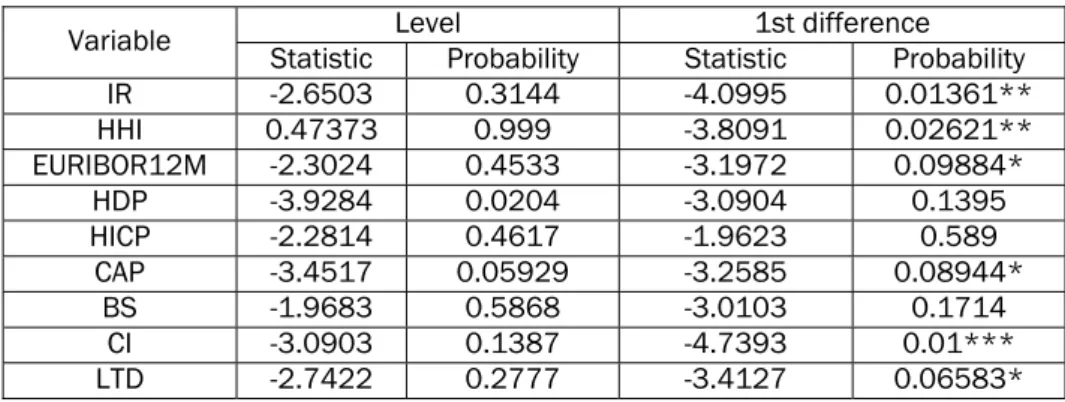
Before we begin to compile a regression model, we must test the stationarity of the time series as their non-stationarity could lead to spurious regression. The results of the ADF test at the original data as well as at the first difference level are shown in the following table (Table 4). The test results have highlighted the non-stationarity of data at the time-series level, which we can eliminate for most variables by using differentiated values. Based on the results of this test, we decided not to build a linear regression model at the original time series, but to test the importance of the impact of selected market and intra-factor factors at the level of the first differences.
Table 4. Testing stationarity of time series
Variable Statistic Probability Level Statistic 1st difference Probability
IR -2.6503 0.3144 -4.0995 0.01361** HHI 0.47373 0.999 -3.8091 0.02621** EURIBOR12M -2.3024 0.4533 -3.1972 0.09884* HDP -3.9284 0.0204 -3.0904 0.1395 HICP -2.2814 0.4617 -1.9623 0.589 CAP -3.4517 0.05929 -3.2585 0.08944* BS -1.9683 0.5868 -3.0103 0.1714 CI -3.0903 0.1387 -4.7393 0.01*** LTD -2.7422 0.2777 -3.4127 0.06583*
Note: Significance level ‘***’ 0.01 ‘**’ 0.05 ‘*’ 0.1 Source: Authors calculation using the R program
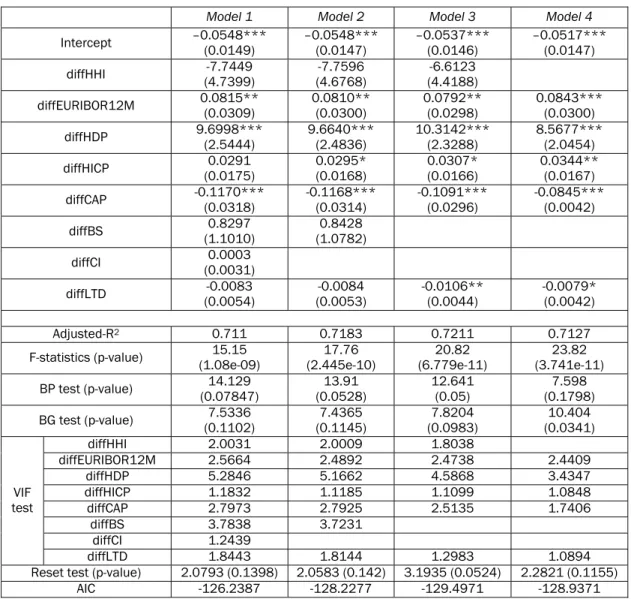
The linear regression with ordinary least squares analysis (OLS), usually used for cross-sectional data analysis, shows the coefficients of the variables and the fit of the model. The OLS method assumes the linearity in parameters, the mean of the errors terms is zero, no multicol-linearity between variables, no heteroscedasticity, and no serial correlation (autocorrelation). The results of the regression model testing are shown in the following table (Table 5). Based on the results of individual tests for Model 1, we can conclude that the linear model of average interest rate determinants of deposits from households (IR) meets all assumptions about the absence of heteroskedasticity, the absence of autocorrelation, the absence of multicollinearity between variables and at the same time it is correctly specified. Based on the results of the F-test, we can state that Model 1 as a whole is statistically significant as the p-value is less than the significance level of 0.05. The adjusted R² determination coefficient of the given test indicates that the model can explain up to 71.1% of the variability of the explained IR variable. The T-test results of statistical significance of regression coefficients in this model suggest that three of the explanatory variables (EURIBOR12M, GDP and CAP) are statistically significant in explaining the IR dependent variable.
Beata Gavurova, Kristina Kocisova, Zoltan Rozsa, and Martina Halaskova / Montenegrin Journal of Economics, Vol. 15, No. 2 (2019), 041-057
52
Since Model 1 identified only three statistically significant variables, we decided to use the method of gradually eliminating statistically insignificant variables from the model in an attempt to increase the predictive ability of the model. In order to verify that the removal of the variables has led to improving the predictive ability of the model's, we will use the AIC criterion to indicate whether the deletion of the variable was positive or negative for the newly created model. Sub-sequently, for interpretation, we will select a model whose AIC will be the lowest. The results of the gradual elimination of non-significant variables are shown in Table 5.
Table 5. Determinants of the average interest rate on deposits from households
Model 1 Model 2 Model 3 Model 4
Intercept –0.0548*** (0.0149) –0.0548*** (0.0147) –0.0537*** (0.0146) –0.0517*** (0.0147) diffHHI (4.7399) -7.7449 (4.6768) -7.7596 (4.4188) -6.6123 diffEURIBOR12M 0.0815** (0.0309) 0.0810** (0.0300) 0.0792** (0.0298) 0.0843*** (0.0300) diffHDP 9.6998*** (2.5444) 9.6640*** (2.4836) 10.3142*** (2.3288) 8.5677*** (2.0454) diffHICP (0.0175) 0.0291 0.0295* (0.0168) 0.0307* (0.0166) 0.0344** (0.0167) diffCAP -0.1170*** (0.0318) -0.1168*** (0.0314) -0.1091*** (0.0296) -0.0845*** (0.0042) diffBS (1.1010) 0.8297 (1.0782) 0.8428 diffCI (0.0031) 0.0003 diffLTD (0.0054) -0.0083 (0.0053) -0.0084 -0.0106** (0.0044) -0.0079* (0.0042) Adjusted-R2 0.711 0.7183 0.7211 0.7127
F-statistics (p-value) (1.08e-09) 15.15 (2.445e-10) 17.76 (6.779e-11) 20.82 (3.741e-11) 23.82 BP test (p-value) (0.07847) 14.129 (0.0528) 13.91 12.641 (0.05) (0.1798) 7.598 BG test (p-value) (0.1102) 7.5336 (0.1145) 7.4365 (0.0983) 7.8204 (0.0341) 10.404 VIF test diffHHI 2.0031 2.0009 1.8038 diffEURIBOR12M 2.5664 2.4892 2.4738 2.4409 diffHDP 5.2846 5.1662 4.5868 3.4347 diffHICP 1.1832 1.1185 1.1099 1.0848 diffCAP 2.7973 2.7925 2.5135 1.7406 diffBS 3.7838 3.7231 diffCI 1.2439 diffLTD 1.8443 1.8144 1.2983 1.0894 Reset test (p-value) 2.0793 (0.1398) 2.0583 (0.142) 3.1935 (0.0524) 2.2821 (0.1155)
AIC -126.2387 -128.2277 -129.4971 -128.9371
Note: Significance level ‘***’ 0.01 ‘**’ 0.05 ‘*’ 0.1. For the independent variables is given the standard deviation in brackets.
Source: Authors calculation using the R program
First, we removed the operational inefficiency variable from the model, since the variable had, in Model 1, the lowest significance expressed with p-value 0.9255. Generated Model 2 fulfilled all model assumptions (heteroskedasticity, autocorrelation, multicollinearity), was correctly specified, the adjusted determination coefficient increased, the AIC decreased, and the other variable (HICP)
Beata Gavurova, Kristina Kocisova, Zoltan Rozsa, and Martina Halaskova / Montenegrin Journal of Economics, Vol. 15, No. 2 (2019), 041-057
53 was marked as statistically significant. We can see, therefore, that the removal of the operational inefficiency variable has contributed to improving the predictive ability of the model.
In the next step, we eliminated the variable size of the banking sector, whose p-value in Model 2 was the highest (0.4391). Created Model 3 fulfilled all assumptions of the model (hetero-skedasticity, autocorrelation, multicollinearity), was correctly specified, the adjusted determination coefficient was increased, the AIC decreased and at the same time model marked the next variable (LTD) as statistically significant. We can see, therefore, that the elimination of the second variable (BS) has also contributed to improving the predictive ability of the model.
We can see another statistically insignificant variable (HHI) in Model 3, so we created a Model 4 that does not include this variable. Created Model 4 contains only statistically significant variables. However, we can see that the adjusted coefficient of determination in this model dec-reased compared to Model 3, the statistical significance of the parameter LTD decdec-reased, autocor-relation was detected, and the AIC slightly increased. For these reasons and based on the results of our analysis, we will assume that Model 3 is the most appropriate model describing the change in the average interest rate on deposits from households in Slovakia.
Within the model, explaining variables HHI, CAP and LTD have a negative impact on the average interest rate on deposits from households. Although the HHI variable was not statistically significant in Model 3, we could see that the exclusion of this variable had an adverse effect on the model's predictive power.
Therefore, we can assume that even though the HHI is not statistically significant, its change has, concerning the model as a whole, influenced the development of the average interest rate on deposits from households in Slovakia in the analysed period. These findings confirm our assump-tion of the negative impact of HHI formulated on the basis of the authors (e. g. Neumark and Shar-pe, 1992, Hutchison, 1995, Gropp et al., 2007, De Graeve et al., 2007, Rumler and Waschiczek, 2012) who also point to a negative relationship between these variables. On this basis, we can confirm under the conditions of the Slovak banking sector the validity of the SCP hypothesis, which assumes of a lower deposit interest rate in more concentrated markets. It also led to the confir-mation of a research question RQ1 (Does the growth of market concentration lead to a decrease in interest rates on deposits from households?).
Similarly, the assumption of the negative impact of capitalisation (CAP) on the development of interest rates on deposits was confirmed. According to Svitek (2001), the decline in bank capital may be a reflection of missing financial flows as a consequence of the loss of problem loans or may be a reflection of the bank's operational inefficiency when the bank receives high-cost depo-sits that it is not able to conceal from the generated interest yields. At a time of insufficient fi-nancial flows, the bank must approach the acquisition of missing funds at a higher price as ref-lected in the growth of interest rates on deposit products. On the other hand, in the case of the Bank's growing stability, as reflected in a growing share of equity in total assets, we can assume that the bank will also reflect this stable position in the reduction of interest rates on deposit pro-ducts. As long as the bank's position on the market is stable, it is not forced to acquire deposits from clients at a high price and therefore may reduce the price of deposits.
Among the parameters with a negative impact on the average interest rate on deposits from households also belong the indicator LTD, which describes the liquidity, respectively illiquidity on the banking market. During analysed the period was the liquidity of the Slovak banking sector at an optimum level (see Kocisova, 2015). The optimal value of the LTD ratio can be considered as 80-90%, which indicates a reasonable combination of caution and regulatory compliance. Banks did not have to borrow expensive and risky resources on the secondary market (LTD> 100%), nor did have to place the received deposits in a riskier way, by investing in securities or other assets. During the reporting period, the ECB also began to apply a policy of low interest rates, which was gradually transferred to the reduction of interest rates on loans and deposits. Pressure by the re-gulator, after the financial crisis, has forced banks to comply with stricter credit standards, making
Beata Gavurova, Kristina Kocisova, Zoltan Rozsa, and Martina Halaskova / Montenegrin Journal of Economics, Vol. 15, No. 2 (2019), 041-057
54
banks more cautious in providing loans that volume has slowed down. Stringent regulations impo-sed pressure on the banks not to create excess reserves in the national central banks and at the same time stimulated the banks to be more cautious receiving deposits. If the bank knew that it was able to provide the given or larger volume of loans from the available deposits, preferred a low deposit rate approach that did not attract new clients or increase the volume of deposits, which would create surplus reserves. In times of interest rate fall and stringent liquidity requirements, there were situations where banks significantly reduced interest rates on deposits rather than cre-dit products. It may have led to a situation that even though the liquicre-dity of the bank declined (LTD grew) with a decline in the interest rate on deposits from households. These findings did not make possible to confirm the validity of the research question RQ3 (Does the growth of liquidity lead to a decrease in deposits interest rates?) which may be affected by the specific characteristics of the analysed period, namely by the ECB's low interest rates policy, strict credit standards, and the regulation of excess liquidity on the market.
Model 3 placed three variables (EURIBOR 12M, GDP, HICP) among the parameters with a positive impact on the average interest rate on deposits from households. The positive impact of the EURIBOR 12M on the explained variable (IR) was predicted based on the review of the authors work (Hutchison, 1995; Beka, 2014; Halamová and Kocisova, 2018). By confirming the predefi-ned assumptions, we were also able to verify the validity of the research question RQ2 (Does the interest rate on the interbank market (12M EURIBOR respectively 12M BRIBOR until the ends of the year 2008) have a positive impact on deposits interest rates?) mentioned in the introduction of this contribution. Also, Halamova and Kocisova (2018) came to the same conclusion about the positive adjustment to the delay in the projection of interbank interest rates into bank interest on deposits from households in the conditions of the Slovak Republic.
Another variable with a positive effect on the development of the average interest rate on deposits from households was the indicator of the country's economic activity (GDP). Based on the work of Gambacrot (2008), it was possible to assume a negative impact on the interest rate on deposits from households. On the other hand, Stešević (2008) points to the positive relationship between the growth of consumption in times of economic growth, which leads to the growth of interest rates on deposit products in an attempt to reduce the excessive consumption tendency of households and to encourage a tendency to savings. The results of our analysis are attributed to the findings of Stesevic (2008) where, in the period of economic growth, interest rates on deposits from households grew.
The last variable, with a positive effect on the average interest rate on deposits from house-holds, was HICP inflation. Based on the work of Gambracort (2008) we assumed its positive im-pact. This assumption has been confirmed. We can see, therefore, that in the period of rising infla-tion there was also a rise in the interest rate on deposits. This fact only confirms the economic reality when banks with a rise in the price level also raise real interest rates which take into account the impact of the expected inflation. However, the rise in the real interest rate may not be the same as a change in inflation, and as a result, nominal interest rates may, nonetheless, decline. However, monitoring the impact of the change in inflation on nominal interest rates has not been the subject of the article, but it can be further investigated.
CONCLUSIONS
Deposits mean a way to secure a certain future income for households in the form of interests. Their deposits are, at the same time, the bank's financial source for performing active operations. By analysing the development of interest rates on deposits from households, we found that the outbreak of the economic crisis led to a substantial turnaround in the development of interest rates which is to the detriment of households and thus to the benefit of financial institutions, as a decreasing tendency characterises the interest rate on deposits from households. Individual types of interest rates on deposits from households developed similarly within the analysed period
Beata Gavurova, Kristina Kocisova, Zoltan Rozsa, and Martina Halaskova / Montenegrin Journal of Economics, Vol. 15, No. 2 (2019), 041-057
55 except for the interest rate with maturity over two years whose development is at least correlated with the development of the other analysed deposit rates. The development and value of the interest rate on deposits from households may be affected by various factors, in particular deter-minants such as supply and demand for money, central bank monetary policy, interbank interest rates, bank performance, economic performance, inflation and exchange rate developments as well as competitors interest rates, concentrations in deposit market, loans received from clients, or capitalisation. By regression analysis, we found that the 12-month EURIBOR was a significant po-sitive determinant of the average interest rate on deposits from households, which confirmed the validity of the second research question (RQ2). An important market determinant was also the concentration of the deposit market received from clients, which negatively affected the interest rate on deposits from households. This finding had again enabled us to verify the validity of defined research questions, namely the first research question (RQ1). Within intra-bank factors also capitalisation had a significant negative impact on the interest rate on deposits from households. Another statistically significant determinant was liquidity, which had a positive effect on the inte-rest rate on deposits from households. This finding was inconsistent with the formulated research question (RQ3) because it did not validate the results of our analysis. It may be influenced by the ECB's policy of decreasing interest rates, which to a certain extent has influenced the standard de-velopment of interest rates on the deposit market. Strengthening the credit policy by the regulator as well as sanctioning surplus reserves deposited in the NBS eliminated to a certain extent the efforts of banks to over-attract new clients, which could lead to non-confirmation of predefined assumptions. Summing up these results, we can conclude that market and intra-bank factors determined the development and adjustment of interest rates on deposits from households, so it is not only dependent on the bank's management decisions but is also influenced by develop-ments in the interbank market and the country's economic environment.
The pricing strategy of the bank determines whether the bank prefers margin or volume. When a bank focuses on volume, it will probably set a relatively high deposit rate in order to attract a high amount of savings. However, when a bank focuses on margin, it will probably set a relatively low deposit rate in order to gain a high internal margin. So this means that having a high deposit rate is not automatically ‘good’ or ‘bad’, it depends on the pricing strategy of the bank. Each bank will try to find the optimal deposit rate to maintain or increase its volume but also its margin. The trade-off between margin and volume is also dependent on the pricing behaviour of the bank’s competitors. An increase in the deposit rate of one bank may lead to an increase in the volume of the bank. However, when all banks increase their deposit rates, the retail clients will not transfer their savings, and the only result of the increase in deposit rate will be a decrease in the margin of the bank (Vink, 2010).
This research contains some limitations regarding the research design, data sources and analyses. First, only cumulative data for the whole banking sector was used. The inclusion of bank level data could lead to a complete picture of the Slovak deposit market. Also, the analysed period (2006-2017) is significantly influenced by the financial crisis and non-standard tool of ECB monetary policy. Therefore, the broader period or the adding dummy variable describing the crisis period could improve the results of the analysis.
In this research, the consumer is not taken into account. Initially, consumer-related factors were also included in this research, but the necessary data were unavailable to gather. However, the behaviour of retail consumers, like interest rate sensitivity, demand for deposits, and search and switch costs, may affect the deposit rate offered by banks. It would be exciting if future research is dedicated to the relationship between consumers and deposit rate. Another factor which is not taken into account is the volume of savings. In this research, only the factors that influence the deposit rate are included. However, it would have been interesting to also test the reaction in volume after an increase or decrease of the deposit rate.
Beata Gavurova, Kristina Kocisova, Zoltan Rozsa, and Martina Halaskova / Montenegrin Journal of Economics, Vol. 15, No. 2 (2019), 041-057
56
REFERENCES
Agénor, P. R., El Aynaoui, K. (2010), “Excess liquidity, bank pricing rules, and monetary poli-cy”, Journal of Banking & Finance, Vol. 34, No. 5, p. 923-933.
Baddeley, M. C., Barrowclough, D. V. (2009), Running regressions: A practical guide to quantitative
research in economics, finance and development studies, Cambridge University Press, UK.
Beka, J. (2014), “NBS. Transmission Mechanism of Monetary Policy in Slovakia”, Biatec, Vol. 22, No. 3, pp. 12-17 (in Slovak).
Berger, A. N. (1995), “The profit-structure relationship in banking--tests of market-power and efficient-structure hypotheses”, Journal of Money, Credit and Banking, Vol. 27, No. 2, pp. 404-431. http://dx.doi.org/10.2307/207787.
Bernhofer, D., van Treeck, T. (2013), “New evidence of heterogeneous bank interest rate pass-through in the euro area”, Economic Modelling, Vol. 35, No. 6, pp. 418-429. http://dx.doi.org/10.1016/j.econmod.2013.07.020
Claeys, S., Vander Vennet, R. (2008), “Determinants of bank interest margins in Central and Eastern Europe: A comparison with the West”, Economic Systems, Vol. 32, No. 2, pp. 197-216. http://dx.doi.org/10.1016/j.ecosys.2007.04.001.
Carsky, R., Trajlinkova, K. (2007), “Analysis of the impact of monetary policy on interest income and corporate and public expenditure”, Biatec, Vol. 15, No. 3, pp. 2-7 (in Slovak).
Cernohorska, L., Klejzar, V. (2018), “The Influence of (Un)Conventional Monetary Policy on the GDP and Inflation”, Scientific Papers of the University of Pardubice – Series D, 25 (42(1/2018)), pp. 29-40.
De Graeve, F., De Jonghe, O., Vander Vennet, R. (2007), “Competition, transmission and bank pricing policies: Evidence from Belgian loan and deposit markets”, Journal of Banking &
Finance, Vol. 31, No. 1, pp. 259-278. http://dx.doi.org/10.1016/j.jbankfin.2006.03.003
ECB (2013), Annual report 2013, Retrieved from https://www.ecb.europa.eu/pub/pdf/annrep/ ar2013sk.pdf?98b35123e0a187a97fc3ac8c53f0b630.
Gambacorta, L. (2008), “How do banks set interest rates?”, European Economic Review, Vol. 52, No. 5, pp. 792-819. http://dx.doi.org/10.1016/j.euroecorev.2007.06.022.
Ganic, M. (2018), “An Empirical Analysis of Factors Affecting Bank Interest Margins: Evidence from the South East European Countries”, Comparative Economic Research, Vol. 21, No. 2, pp. 81-98.
Grigorian, D.A., Manole, V. (2006), “Determinants of Commercial Bank Performance in Transition: An Application of Data Envelopment Analysis”, Comparative Economic Studies, Vol.48, No. 3, pp. 497-522, http://dx.doi.org/10.1057/palgrave.ces.8100129.
Gropp, R., Kok, Ch., Lichtenberger, J. D. (2007), “The dynamics of bank spreads and financial structure”, Working Paper Series, No. 714, ECB, Retrieved from https://www.ecb.europa. eu/pub/pdf/scpwps/ecbwp714.pdf?c88050cbc7c568ced050af8997781a7f.
Halamova, V., Kocisovs, K. (2018), “Interbank interest rates are passed on to client rates in Slo-vakia (2004-2016)”, Political Economy, Vol. 66, No. 4, pp. 473-490 (in Slovak).
Hendl, J. (2012), Overview of statistical data processing methods: data analysis and meta-analysis, Portal, Prague.
Hutchison, D. E. (1995), “Retail bank deposit pricing: An intertemporal asset pricing appro-ach”, Journal of Money, Credit and Banking, Vol. 27, No. 1, pp. 217-231. http://dx.doi.org/ 10.2307/2077860.
Kapuscinski, M., Stanislawska, E. (2018), “Measuring bank funding costs in the analysis of interest rate pass-through: Evidence from Poland”, Economic Modelling, Vol. 70, No. 3, pp. 288-300.
Kleimeier, S., Sander, H. (2006), “Expected versus unexpected monetary policy impulses and in-terest rate pass-through in euro-zone retail banking markets”, Journal of Banking & Finan-ce, Vol. 30, No. 7, pp. 1839-1870. http://dx.doi.org/10.1016/j.jbankfin.2005.07.006. Kocisova, K. (2015), “Analysis indicator Loan to Deposit in the countries of the Visegrad Four”,
Beata Gavurova, Kristina Kocisova, Zoltan Rozsa, and Martina Halaskova / Montenegrin Journal of Economics, Vol. 15, No. 2 (2019), 041-057
57 Kuttner, KN. (2001), “Monetary policy surprises and interest rates: Evidence from the Fed funds
futures market”, Journal of Monetary Economics, Vol. 47, No. 3, pp. 523-544. http://dx. doi.org/10.1016/S0304-3932(01)00055-1.
NBS (2017), Macroeconomic database, Retrieved from https://www.nbs.sk/sk/menova-politika/ makroekonomicka-databaza/makroekonomicke-ukazovatele-graf.
Martin-Oliver, A.; Salas-Fumas, V. Saurina, J. (2008), “Search cost and price dispersion in vertically related markets: the case of bank loans and deposits”, Review of Industrial Organization, Vol. 33, No. 4, pp. 297-323. http://dx.doi.org/10.1007/s11151-008-9192-x.
Maudos, J., De Guevara, J. F. (2004), “Factors explaining the interest margin in the banking sectors of the European Union”, Journal of Banking & Finance, Vol. 28, No. 9, pp. 2259-2281. http://dx.doi.org/10.1016/j.jbankfin.2003.09.004.
Medveď, J., Tkac, M. et al. (2013), Banks - history, theory and practice, Sprint 2, Bratislava (in Slovak).
Neumark, D; Sharpe, S. A. (1992), “Market structure and the nature of price rigidity: evidence from the market for consumer deposits”, The Quarterly Journal of Economics, Vol. 107, No. 2, pp. 657-680. http://dx.doi.org/10.2307/2118485.
Rumler, F., Waschiczek, W. (2012), Have Changes in the Financial Structure Affected Bank
Profitability? Evidence for Austria, Oesterreichische Nationalbank. Doi: 10.1080/
1351847X.2014.984815.
Saaskilahti, J. (2018), “Retail Bank Interest Margins in Low Interest Rate Environments”, Journal of
Financial Services Research, Vol. 53, No. 1, pp. 37-68,
http://dx.doi.org/10.1007/s10693-016-0262-1.
SBA (2006), How strong is the competition in the banking sector in Slovakia?, Retrieved from http://www.sbaonline.sk/files/subory/analyzy/verejne/Konkurencia-v-bankovom-sektore.pdf (in Slovak).
Sinicakova, M., Gavurova, B. (2017), “Single Monetary Policy versus Macroeconomic Fundamen-tals in Slovakia”, Ekonomicky casopis, Vol. 65, No. 2, pp. 158-172.
Stesevic, I. (2008), “Econometric model of interest rates on deposits in Montenegro”, Panoeconomicus, Vol. 55, No. 3, pp. 383-398.
Svitek, M. (2001), “Banking capital functions”, Biatec, Vol. 9, No. 5, 16-19 (in Slovak). Senkyrova, B. et al. (1999), Banking I, GRADA Publishing, Praha (in Czech).
Tarus, D.K., Manyala, P.O. (2018), “What determines bank interest rate spread? Evidence from Sub-Saharan Africa”, African Journal of Economic and Management Studies, Vol. 9, No. 3, pp. 335-348. http://dx.doi.org/10.1108/AJEMS-05-2017-0094.
Vink, H. (2010), Determinants of Deposit Rates, Master thesis, Tilburg University, Retrieved from http://arno.uvt.nl/show.cgi?fid=113125.
Vyrost, T., Baumohl, E., Lyocsa, S. (2013), Quantitative methods in economics III, Elfa, Kosice (in Slovak).
Wu, J. C., Xia, F. D. (2016), “Measuring the macroeconomic impact of monetary policy at the zero lower bound”, Journal of Money, Credit and Banking, Vol. 48, No. 2-3, pp. 253-291. http://dx.doi.org/10.1111/jmcb.12300.