AIS Electronic Library (AISeL)
ACIS 2007 Proceedings
Australasian (ACIS)
2007
Does Mobile Payment Technology Mnet Attract
Potential Consumers? The Case of Kuwait
Kamel Rouibah
Kuwait University, [email protected]
Follow this and additional works at:
http://aisel.aisnet.org/acis2007
This material is brought to you by the Australasian (ACIS) at AIS Electronic Library (AISeL). It has been accepted for inclusion in ACIS 2007 Proceedings by an authorized administrator of AIS Electronic Library (AISeL). For more information, please [email protected].
Recommended Citation
Rouibah, Kamel, "Does Mobile Payment Technology Mnet Attract Potential Consumers? The Case of Kuwait" (2007).ACIS 2007 Proceedings. 24.
Does Mobile Payment Technology Mnet Attract Potential
Consumers? The Case of Kuwait
Kamel Rouibah
Department of Quantitative Methods & Information System College of Business Administration
Kuwait University Kuwait
Email: [email protected]
Abstract
Drawing on the technology acceptance model, gratification research and theory of reasoned action, this study examines the factors and barriers to the adoption of mobile payment – Mnet technology- through the moderation effect of gender and experience. Of the two research methods employed, the first is a quantitative field study of students. The instrument measures the impact of six variables (social norm, enjoyment, ease of use, usefulness, trust and privacy) on the intention to use Mnet. Using regression analysis on a sample of 175 respondents, findings show that gender and experience are two important factors on Mnet acceptance. The study reveals that intention to use is perceived usefulness and enjoyment driven for experienced and inexperienced male users, while it is enjoyment driven for female users. Perceived trust affect intention to use Mnet, regardless of users' experience, perceived trust affects intention to use Mnet only of female users, and social norm and privacy play the weakest effect on intention to use Mnet. The second method is a qualitative analysis of respondents' free format comments. These findings reinforce the quantitative findings and highlight additional encouraging and discouraging factors to the Mnet acceptance that still need to be studied.
Keywords
Mobile payment, technology acceptance, TAM, enjoyment, social norm, trust, privacy
Introduction
The number of mobile phone in use over the world has reached 2.45 millions. With the widespread of these technologies studies dedicated to mobile device adoption increased. A number of past studies focused on different services offered by mobile devices including short message services (Nysveen et al., 2005a,b), games (Nysveen et al., 2005a,b), digital camera (Rouibah and Hasan 2006), m-commerce (Coursaris and Hassanein, 2002); and mobile payment (Szmigin and Bourne 1999; Van Hove, 2001; Peffers and Ma 2003; Chou et al., 2004; Mallat 2006; Dahlberg and Öörni 2007; Dahlberg's et al., 2007).
Among these services, mobile payment, noted hence forth as m-payment, is the focus of this paper. With the increase use of mobile phones, experts expect that they will become consumers’ preferred choice for m-payments (Au and Kauffman 2007). For example Mallat et al., (2004) report on the use of mobile phones in Helsinki, Finland, where 55% of tram tickets and 10% of public transportation tickets by Helsinki City Transport originate with mobile phone-based orders. M-payments are payments for goods, services, and bills/invoices with a mobile device by taking advantage of wireless and new communication technologies. M-payments have been suggested as a solution to facilitate micro-M-payments in electronic and mobile commerce, and to provide an alternative for the diminishing use of cash at point-of-sale (Coursaris and Hassanein, 2002). M-payment is growing rapidly. From less than $2 million in 2000, m-commerce has reached $ 69 billions in 2005 and will reach 88 billion by 2009 (Juniper Research 2007). M-payment is also rapidly expanding and is expected to reach $10 billions in total revenue by 2010 (Juniper Research 2006). M-payment systems are now an essential part of m-commerce and mobile business and will not only make purchasing activities more flexible and convenient, but also create unimagined new markets.
In late 1990s and early 2000s m-payment services became a hot topic and still remain. Hundreds of m-payment services as well as access to e-payment and Internet banking were introduced all over the world. Strikingly many of these efforts failed, such as Paybox in Germany, the Simpay initiative in Europe, and several smart card systems (Szmigin and Bourne 1999; Van Hove 2001; Carat 2002). The difference to the rapid diffusion of the Visa Electron smart card or eBay/PayPal is striking. Dahlberg et al., (2007) questioned why have Visa Electron and PayPal succeeded in where m-payment services failed and suggest carrying more studies in order to shed light on the factors that attract consumers, merchants and banks. An apparent conclusion is that these services have failed to meet consumers’ payment needs (Peffers and Ma 2003; Dahlberg and Öörni 2007). Deeper
understanding of consumer adoption motivations is thus needed to develop and launch m-payment services successfully (Mallat 2006). For example, the study of Dahlberg and Öörni (2007) highlight this issue. It found that m-payment is ranked the least used e-payment alternatives after cash, on-line bank cards, credit cards, Internet bank buttons, and Visa Electron.
In order to launch an adapted and therefore successful m-payment solution (such as Mnet in Kuwait), it is crucial to study and understand the adoption factors. There is little empirical evidence on what value do payment solutions provide to their consumers or why would they want switch from current payment to m-payment instruments (e.g. to Mnet). As the user interface of m-m-payment solutions falls into information systems domain, we argue that it is beneficial to study m-payment solutions not only as new payment instrument and new technological payment method but as new technology waiting for user adoption.
Since hardly any research to date has attempted using m-payment system in the Arab world, the primary objective of this paper is to understand the motivational factors that lead non m-payment users to adopt a new technology in Kuwait, named Mnet. Although millions of dollars have been spent on building this technology, it is unclear whether potential users may intent to use Mnet despite its availability. Thus, research is needed to identify the factors determining its users' acceptance. With regard to this issue, most researchers have tackled this problem from the perspectives of technology acceptance model (TAM) and technology diffusion. Thus, this research aims to answer the following in Kuwait: Does the m-payment adoption depend on the cognitive instrumental process (perceived usefulness) and cognitive complexity (ease of use)? Does the m-payment adoption depend on the social norms that govern Arab people? Does the m-payment adoption depend on the gratification process (perceived enjoyment)? Or does it depend on the trust? Does the adoption to use Mnet differ based on the effect of gender? Does the intention differ based on users' experience?
In answering the above questions, the reminder of the article is organized as follow: Section 2 reviewed related studies on electronic and m-payment literature, the state of IT/ICT in the Arab region including the Mnet technology in Kuwait, and reviewed past-IT/ICT adoption studies. Section 3 introduces the research model. Section 4 describes the research methodology. Results and discussions follow. The last section concludes the research and points to relevant implications useful to both practice and research.
Theoretical Background and Literature Review
Related Research on Electronic and Mobile Payment
The literature review shows that many papers focused on m-payment in well developed countries, and less works was done in developing countries, except few studies (Ramayah et al., 2005).
Over the last two decades, researchers tackled different issues including consumers' adoption of m-payment services, merchants' adoption of m-payment services, literature review papers (Dahlberg et al., 2007; Au and Kauffman 2007), comparison of different alternatives of e-payment (Chou et al., 2004), economic analysis of m-payments and identification of the relevant stakeholders in the market (Au and Kauffman 2007). With regard to this matter, the following analyses only studies related to consumers' adoption of m-payment services.
Szmigin and bourne (1999) interviewed a sample of 25 students in UK on why they use of a specific form of electronic cash, namely Mondex. Results show that all respondents compared the performance of electronic cash with the traditional form of cash. A number of problems were encountered by students in relation to security, and complexity of use, although in some situations e-cash was a preferred alternative.
Khodawandi et al. (2003) in Europe focused on what factors lead 4432 consumers in Europe to adopt or not to adopt payment. Results revealed several drivers for adoption: One-third said that they would adopt payments to replace other payment instruments. Out of the total, one-sixth also said that they would use m-payments for micro-payment transactions. The factors they cited as reasons for adoptions include ease-of-use, short processing time, and ubiquitous availability.Respondents said they would not adopt m-payments for the following reasons: Perceived lack of security, preference for other payment instruments, unfamiliarity with m-payments, complexity, general subjective rejection, and trust/security reasons.
Chou et al., (2004) studied the preference of consumers' preference for four e-payment alternatives (credit card, stored-value card, smart card, and the telecommunication billing system). They compared these four methods based on three factors (technological, economic, and social) and several criteria under each factor. Using 43 interviewees in Taiwan, results showed that stored value cards were the most preferred e-payment. In the technology factor, security was ranked first, in the economy factor, cost was ranked first, and in the social factor, privacy was also the most preferred criteria.
Other studies approach the issues using well known theory model such as the technology acceptance model, noted TAM or diffusion of innovations theory with additional constructs adapted to study m-payments.
Dahlberg et al., (2003b) discussed the effect of trust in m-payment and explore whether the TAM offers a comprehensive explanation for consumer decisions related to adoption of m-payment solutions. Interviews with 61 subjects in Finland revealed that several measures of perceived usefulness and ease of use were mentioned in the interviews. Additional factors related to security and trust were mentioned by the interviewees, which are not included in the original TAM.
Dewan and Chen (2005) discussed the consumers' perceptions and expectations of m-payment in USA based on
TAM. Results showed that US consumers are optimistic about the benefits of m-payment and significant
incentives exist for consumers to adopt m-payment. Results revealed that 61.5% believe m-payment will be useful for their shopping, 74.3% it will improve the speed of transaction, 53% it will improve convenience, and
54.3% expressed strong intention to use m-payment in their shopping. As for m-payment complexity, 78% believe m-payment will be easy of use. However, consumers show concerns for security and privacy: 52.7% do
not think m-payment is secure, while 48.2%believe m-payment will put their privacy at high risk.
Nysveen et al., (2005b) investigated antecedents of mobile service usage across four mobile services (text messaging, contact, e-payment, and gaming) using an extended TAM. Based on a sample of 171 Norwegian users, authors found that perceived enjoyment, usefulness, ease of use and social norm have direct effect on intention to use mobile services, while perceived enjoyment exerts the strongest effect, social norms exerts the weakest effect.
Ramayah et al., (2005) investigated the intention to use an online bill payment among a sample of 120 MBA Malaysian students. Authors build their model on extended TAM and theory of reasoned action. They found that both ease of use and perceived usefulness were found to have significant affect on the intention to use online payment system. However, the effect of ease of use is greater than that of usefulness. The study also found a significant affect of social norm on perceived usefulness but failed to find such a path with intention to use. Mallat (2006) discussed consumer's behavior to adopt m-payment based on diffusion of innovations theory. Using interviews with 46 subjects (teenagers, students, and parents); results suggest that the relative advantages (usefulness) of m-payments depend on certain situational factors such as lack of other payment methods or urgency. Barriers to m-payment include: Premium pricing of the payments, complexity of payment procedures, lack of widespread merchant acceptance, and perceived risks.
Dahlberg and Öörni (2007) focused on how 978 consumers in Finlandintend to change their payment habits
(m-payment and electronic invoices) on two periods of times: during the next 6 months and next five years. Authors used diffusion of innovations theory and found that among factors studied that affect intention to use,
perceived ease of use exerts the most determinant of m-payment and electronic invoices.
A detailed analysis of the past literature review on electronic and m-payment reveals the following observations. First, there is little about successful model adoption of m-payment systems, which will help m-commerce to take off.
Second, although millions of dollars have been spent on building m-payment systems, reports showed that potential users may not be using the systems, despite their availability (e.g. Szmigin and Bourne 1999, Carat 2002; Van Hove, 2001).
Third, while many past studies focused on technology adoption over the last two decades there are few studies on how m-payments are perceived by consumers in well developed countries, and there is a lack of knowledge/awareness on how they are perceived in developing countries such as the case of Kuwait.
Forth, most past studies focused on subjects who were users of the technology (Szmigin and Bourne 1999; Chou et al., 2004, Dahlberg's et al., 2003b, Mallat 2006, Dahlberg and Öörni 2007), and seldom used well-know theories, including TAM or diffusion of innovations theory (Dahlberg's et al., 2003b; Nysveen et al., 2005b; Mallat 2006; Dahlberg and Öörni 2007).
Fifth past studies on m-payments used either quantitative (based questionnaire) (e.g. Dahlberg and Öörni 2007) or qualitative (based-interviews) (Dahlberg et al. 2003b; Mallat 2006), but none past study used a combine approach in the case of m-payment, and few studies did combine both approach in the case of general IT/ICT acceptance, such as the case of internet usage in the Arab World (Loch et al., 2003).
Sixth, besides the above remarks, there is a paucity of knowledge about how IT/ICT is accepted and used in the Arab world, and none past study focused on m-payment (see Loch et al., 2003; Rouibah 2008) who called for additional research to shed light on other ICT in the Arab region.
ICT and Mobile Payment (Mnet) Technology in Kuwait
Kuwait is the focus of this study because it is one of the rare Arab countries that has achieved a high of IT/ICT utilization. The number of cellular phone account 75% of the population and far exceeds the internet penetration (27%) and PC penetration (20%).
ICT and mobile devices are well developed and used in Kuwait. For example, in the banking sector, all the nine national banks in Kuwait offer online and mobile banking services. Customers are offered wireless alert about changes in account information on their digital cell phones. Banks' customers can use their mobile phone or internet for a variety of transactions such as: check account balances, transfer funds between savings and other accounts, pay their mobile phone and internet usage charges, purchase prepaid cards for online shopping, and sell and buy actions.
With the purpose of this study, three main characteristics distinguish the Arab culture. First, it is high in collectivism, where social norms are valued, and individual decisions should comply with what is best for the group. The study of Loch et al., (2003) in Egypt found that social norms explain 47% of about Internet usage. Second, Arab culture is a masculine-oriented, where men dominate in most settings, and thus the attitude of male user attitude toward technology adoption is different. For example, one of the rare Kuwait studies that examined the effect of gender on attitude toward information ethics found that privacy and property issues different between male and female (Alshawaf et al., 2002). Third, Arab culture exhibit high enjoyment and high preference for face-to-face social interactions. For example two studies carried in Kuwait about technology adoption found that perceived enjoyment is the most determinant factor of instant messaging usage (Rouibah and Ould-Ali 2005), and camera mobile phone adoption (Rouibah and Hasan 2006). As for face to face interaction, in Kuwait, as the case of other Arab countries, the more popular modes of payments for purchases are cash, and debit and credit cards. A recent study performed by the national bank of Kuwait (Al Qabas 2007) revealed that the number of electronic cards (ATM and credit cards) issued between June 2006 and June 2007 increased by 12% from 2.56 to 2.78 millions. This number was 1.3 million in 2005, out of a population of 3.3 millions. During the same period, the amount of transactions performed by electronic cards account for $30.10 billions, where $ 8.2 billions account for payment and $ 21.9 billions for withdrawal by ATM cards. The study's results revealed also that the annual rate of electronic card payment is increasing (40%) against 27% increase for withdrawal.
In order to grasp the increase use of electronic cards and the high percentage of mobile devices usage, Mnet (www.mnet.com.kw) was established in 2003 in Kuwait, and launched its services in January 2005. It is the sole provider of m-payment services in Kuwait, and the first country in the Middle East. Mnet acts as intermediary role between consumers and merchants in Kuwait by the joint effort of four market-leading companies: A mobile telecommunications company, a largest bank in the Arab world, an internet service provider, and two leading retaining Kuwaiti companies.
Mnet enables customers to conveniently pay with their mobile phones at points-of-sale or remotely. It allows also retailers, service providers, restaurants, and delivery services to always be connected to their customers. The Mnet services are provided through a secured telecommunication network which connects users (there are more than 10000 by June 2007), merchants (more than 200) and banks (in 2007 Mnet works only with the National Bank of Kuwait).
Any consumer willing to use Mnet needs to follow this process: (a) have a contract that precedes the actual consumption situation. Currently, consumers have to open a pre-paid mobile account only at one bank, (b) call back, based on their mobile phone, the Mnet to authorize any micro-payment done at any shop in Kuwait. (c) after the consumer notifies Mnet about his/her wishes to complete a transaction the Mnet flashes a message on a subscriber’s cell phone when a payment is due, and the user then types in a secret number to authorize the payment from her/his bank account.
Mnet has several benefits for its customers including usefulness, ease of use, security and privacy. From the customers’ perspective, Mnet offers customers a convenient and secure way to deliver m-payments on a daily basis. For instance, Mnet user may pay off the purchase bills from anywhere and anytime, whether he/she is at work, home or at a restaurant with the condition being that the point-of-sale is an Mnet user too. Users who do wish to keep their personal details or mobile phone secret when interacting with the call center during transaction may be given, upon their request, a ‘secondary’ number – which can be used instead of their mobile phone number for finalizing a purchase transaction.
Other Related IT Acceptance Literature-TAM
Several theories have been proposed to explain user adoption and acceptance of new technologies, including, but not restricted to, diffusion of innovations, theory of reasoned action, and Technology Adoption Model-TAM
(Davis et al., 1989). Among these theories, TAM is the most used, tested, replicated and parsimonious to explain new technology usage.
A critical review of TAM (King and He 2006) has revealed that there is a need to include other components in order to gain a broader view and a better explanation of IT/ICT adoption. In line with this observation, several variation of TAM model were proposed to increase the TAM parsimony by combining different IT acceptance models. For example, Venkatesh and Morris (2000) included subjective norm; however they remove attitude. Other researchers included perceived enjoyment derived from gratification research (Su and Zhang 2006; Hwang 2005). Gefen et al., (2003) extended TAM by integrating trust and its causes. Rouibah and Hasan (2006) extended TAM by including privacy for camera mobile phone adoption.
Research Model and Hypotheses
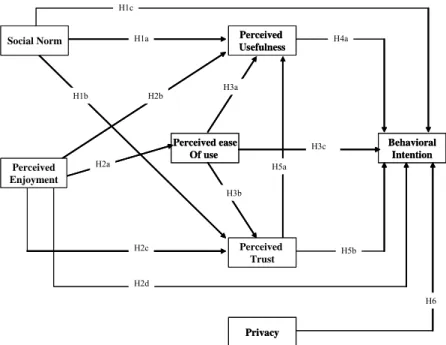
Based on the literature review in the area of IT/ICT and m-payment, and context of Kuwait, we generate the research model depicted in the Figure 1. In this study, the impact of two motivating variables (subjective norm and perceived enjoyment) on m-payment intention to use is examined. Using regression analysis, the relative influences on intention to use of these two external variables were computed through the mediation of perceived ease of use, perceived trust and perceived usefulness.
TAM assumes that beliefs about perceived usefulness (PU) and perceived ease of use (PEOU) are always the primary determinants of intention to use. Previous studies on m-payment found that PU and PEOU have direct affect on behavioral intention (BI) to use, and PEOU has also an affect on PU (Ramayah et al., 2005; Nysveen et al., 2005b). Thus hypotheses H3a, H3c, and H4a are generated. Subjective norm is derived from theory of reasoned action as a determinant of behavioral intention. Subjective norm refer to a persons’ perception that most people who are important to him think he should or should not perform the behaviour in question. Social norm has a strong impact on ICT acceptance in the Arab world as revealed by Loch et al. (2003). Ramayah et al., (2005) found that social norm has an affect on PU of online bill payment system. Nysveen et al. (2005b) found that SN has direct effect on intention to use m-payment in Finland, while Loch et al., (2003) found that SN plays the most significant determinant on Internet usage in Egypt. Hypotheses H1a & H1c are also formulated. Perceived enjoyment is defined as the extent to which the activity of using the new technology is perceived to be enjoyable in its own right, apart from any performance consequences that may be anticipated. This construct is derived from use & gratification research. Several recent studies (E.g. see Nysveen et al., 2005b) found that perceived enjoyment exerts stronger direct effect on intention to use than does PU. Similar result was found in Kuwait (Rouibah and Ould-Ali 2005; Rouibah and Hasan 2006). In addition, past studies related to IT adoption have found that perceived enjoyment is related to PU (Hwang 2005; Sun and Zhang 2006; Rouibah and Hasan 2006), and also to PEOU (Hwang 2005; Sun and Zhang 2006). Thus hypotheses H2a, H2b & H2d were formulated.
Lack of trust has been repeatedly identified as one of the most formidable barriers to people for engaging in e-commerce. Trust has become a central focus in system acceptance field after the internet emerged and was integrated in TAM in the case of intention to use online shopping (Gefen et al., 2003). When trying to integrate trust in our research model, we faced two issues. First, we posit social norm and perceived enjoyment as antecedent of trust, and we lack theoretical support for these two hypotheses (H1b & H2c). We believe that Arab culture is a collectivist culture, with high on the avoidance of uncertainty and risk, and Arab people enjoy any thing new. Since Mnet is a new technology, we therefore anticipate that effect of social norm and perceived enjoyment will positively affect the perceived trust of Mnet. Second, we faced the problem on how to operationalize the trust construct. Obviously there is much difference between trust in online shopping and trust in m-payment. First, the number of the actors in the market is different. Second, consumers are more likely to have some prior knowledge on the seller side (when shopping online). M-payment systems, on the other hand, appear to be more difficult for consumers to grasp. Thus, more emphasis is likely placed by consumers on the reputation of bank with whom the consumer opens an account as well as the reputation of the m-payment provider. Accordingly, trust indicators used in online shopping needs to be customized to reflect the unique needs of m-payment. We achieved this customization by focusing more on the trust potential customers may put on the bank, partner of the Mnet Company. Other three hypotheses were also formulated (H3b, H5a, H5b) based on previous study of Gefen et al., (2003) about intention to shop online. These are: PEOU-Trust, Trust-PU, and Trust-Intention to use.
Privacy is also included in the research model because it is becoming a serious issue as mobile device services gain popularity (Chou et al., 2004, Rouibah and Hasan 2006) and m-payment get acceptance (Peffers and Ma 2003; Luo and Lee 2004; Dewan and Chen 2005). Studies that focused on the effect of privacy found a positive
affect of this construct on intention m-payment in USA (Dewan and Chen 2005), on intention to use e-commerce between American and Taiwanese (Liu et al., 2004), and indirectly related to intention to use camera mobile phone in Kuwait (Rouibah and Hasan 2006). In collectivist culture more Mnet guarantees privacy likely potential users will intent to use it. Thus hypothesis is also formulated (H6).
Past studies on technology acceptance found gender influences technology use (Venkatesh and Morris 2000; Nysveen et al., 2005a), while other found that users' experience affects new technology acceptance (Taylor and Todd 1995a). Based on literature review, we propose to validate the hypotheses in Figure 1, and we test them based on the effect of gender and users' experience with Mnet.
Behavioral Intention Perceived ease Of use Perceived Usefulness Privacy H3a H6 H5b H3c H4a H5a H3b H2c H1b H1c H1a Social Norm H2b H2a Perceived Enjoyment H2d Perceived Trust Behavioral Intention Perceived ease Of use Perceived Usefulness Privacy H3a H6 H5b H3c H4a H5a H3b H2c H1b H1c H1a Social Norm H2b H2a Perceived Enjoyment H2d Perceived Trust
Figure 1: The research model
Research Methodology
The purpose of this research is to examine motivational factors, drivers and barriers for intention to use Mnet. Due to the newness of the topic, the research approach is exploratory and presents findings from both a quantitative and qualitative perspective. Similar approaches were adopted recently (Loch et al., 2003).
Quantitative Data Collection
An instrument design was developed on three steps. First, author reviewed existing literature on electronic and m-payment. To complete this task, several online databases were searched including (ProQuest Direct, ScienceDirect, ACM Digital Library, and Google Scholar). Search was based on the descriptors “mobile payment”, “m-payment”, and “wireless payment” that were to be found on the title or abstract of the paper. Second, a brainstorming session was held with 20 students enrolled in a course dedicated to e-commerce and m-payment. It was conducted with the purpose to highlight the main reasons that lead potential consumers to adopt Mnet in Kuwait. Third, a literature review of existing models about ICT adoption was conducted, and the main characteristics of Arab culture were also identified. Based on this study, a subset of variables was identified, and a comparison between the results of the brainstorming and this list of variables was made. Especially the study selected six variables (see Figure 1). In addition, the brainstorming session shows that antecedents of trust (calculative-based, structural assurance, situation normality, and familiarity) as advocated by Gefen et al. (2003), were not important in Mnet intention to adopt. Accordingly, they were not incorporated in this study. Fourth, this study developed a survey instrument and which was checked by two faculty members, in order to examine the questionnaire for validity, completeness, and readability.
This survey instrument was then distributed to over 230 students at Kuwait University. The selected students were selected because of the following: Student can be considered a convenient sample as Mnet is a new technology in Kuwait, and less people are aware of its existence. In addition, the TAM has been widely used with students, see literature review in (King and He 2006), and found to be just as valid and reliable as when it is used with other groups (McCoy et al., 2007).
Selected subjects were students enrolled in the course introduction to management information systems, after they had been introduced to e-commerce and e-payments. Among 230 distributed questionnaires, 175 were fully completed. All the students were first initiated to services of m-commerce, but the sample was split into two groups. The first one include 97 students who were initiated and introduced to m-payment Mnet with several life experience orders from different merchants. The second group includes 78 students who were just briefly introduced to Mnet without life demonstration and orders. The first group was named experienced users, and the second inexperienced users. 73 % of the respondents were female students, which is close to the same
percentage at Kuwait University. The majority of respondents (98.2%) are young since their ages are less than 25. Most of respondents are doing well since 89.7% have had a GPA greater than 2. In addition, 73.7% have been in their college since more than two year. 88.5% owned a mobile phone, which reveals high penetration of this technology in Kuwait.
With regard to e-payment, results revealed that credit card payment system in the most used one in the sample (68.5%), followed by ATM card (58.9%), then Internet cards (16%) to purchase online. The study also reveals that a small fraction of respondents (8.5%) are aware of Mnet and use it, while 11.5% use CashU. This is a stored value card, which is one of the largest internet payment solutions in the Middle East, and allows users to pay and transfer money online (www.cashu.com/).
All the constructs in the research model, except privacy, were operationalized using standard scales from past literature. PU and PEOU were taken from an updated TAM (Venkatesh and Davis 2000). Perceived enjoyment was measured with three items of Davis et al., (1992). Subjective norm was measured with three items, two were taken from Taylor and Todd (1995) which reflect friends and family, as well a third item to reflect the effect of lecturer/instructor since the study is performed within an education institution. Perceived trust was measured based on four items taken from Gefen et al., (2003) and customized to fit the Mnet context. Privacy was measured using two new items derived from studies on information privacy.Intention to use was measured with two items of TAM model (Venkatesh and Davis 2000) as well as two new items.
Qualitative Data Collection
The qualitative research was conducted with the purpose to get deeper knowledge about the drivers and barriers for potential consumer's intention to adopt Mnet in order to augment our research model, and to gain preliminary understanding about factors that impact the intention to use Mnet. Thirty-three female students and 22 male students from three sections enrolled in an undergraduate course dedicated to "introduction to information system" participated in this study. Respondents were asked to list encouraging and discouraging factors to using Mnet in the short term. They were given one hour time to complete this task. Students were asked to write free format answers using either English or Arabic languages. All students' answers were collected, combined and compiled (see Table 1 and Table 2).
Results and Discussion
In order to develop regression models, data was coded and entered into SPSS version 14. In order to ensure statistical reliability, SPSS tests were run on the 175 questionnaires and returned a Cronbach alpha value of 0.93 for the all sample, indicating high reliability. In addition, the 26 attitudinal items were condensed into seven factors using the principal component analysis of SPSS, namely intention to use, perceived usefulness, perceived ease of use, perceived trust, perceived enjoyment and social norm, and the scores for these were found to be satisfactory explain 70.11 of the total variance.
Quantitative Data Analysis -Regression Analysis
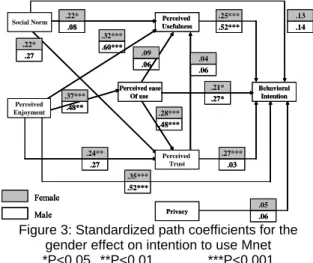
We build four regression models which were used to explain the intention to use Mnet for four groups: experienced vs. inexperienced users, male vs. female users. The outcome of the regression models are shown Figure 2 and 3.
Predicting behavioral intention to use Mnet. Results indicate that experienced users intend to use Mnet because
of its PU first, followed by perceived trust (β=.27; p<0.01), and third by perceived enjoyment (β=.24; p<0.01). Thus, PEOU does not have the most determinant on BI, as shown by Dahlberg and Öörni (2007) on m-payment acceptance in Finland. Results also indicate that for inexperienced users BI is driven first, by PU (β=.47; p<0.001), second by perceived enjoyment (β=.45; p<0.001), and third by PEOU (β=.18; p<0.05). Results indicate that PU is a stronger for inexperienced users, thus confirm findings of Taylor and Todd (1995). Perceived enjoyment is also a stronger predictor for inexperienced users. This result contradict Sun and Zhang (2006) who failed to find any path between enjoyment and BI to use search engine. Social norm has no effect on either groups, thus contradict Taylor and Todd's (1995) findings.
It can also be noted that PEOU has no significant effect on BI for experienced users, while it has an effect for inexperienced users. This result contradict Sun and Zhang (2006) who failed to find any path between PEOU and BI to use for student users. This explains that potential users feel Mnet is easy to use, but after having real demonstration/trainings, they realize it is not as expected, since the procedure to follow during transactions is little bit complex. Thus, perceived enjoyment, PEOU and PU decrease after demonstrations and trainings. With regard to the effect of gender, results indicate that four variables affect positively BI to use Mnet for female users: Perceived enjoyment (β=.35; p<0.001); perceived trust (β=.27; p<0.001), PU (β=.26; p<0.001), and PEOU (β=.21; p<0.05). However, only three variables affect positively BI for male users: Perceived
enjoyment and PU have the same impact (β=.52; p<0.001), and PEOU (β=.27; p<0.05). Perceived enjoyment is a stronger predictor of BI to use Mnet by both groups; however, it is stronger for male users. PU is also a predictor of BI for both groups, but it is stronger predictor for male users. Such result confirm findings of Venkatesh and Morris (2000) but partially Nysveen et al., (2005b) who found that PU is a significant determinant of BI only for male users. Results also indicate that perceived enjoyment and PEOU are stronger for male users. This result contradict findings of Venkatesh and Morris (2000) who found that PEOU has effect on BI only for female users. The study results also contradict results Nysveen et al., (2005b) who found the absence of statistical significance between PEOU and BI in either group. Results also contradict those of Dahlberg and Öörni (2007) who found that PEOU is the most determinant of BI to use m-payment and electronic invoice. The study results also contradict findings of Nysveen et al., (2005b) who found that perceived enjoyment exerts the strongest effect on BI for female users. In addition, perceived trust has no effect on BI for male users, social norm has no effect on BI in either groups. Such findings contradict previous studies (Venkatesh and Morris 2000; Nysveen et al., 2005b) who found that social norm has effect on BI only for female users. Moreover the results about perceived trust expand the results of Gefen et al., (2003) who found that perceived trust is the second predictor of BI after PU, while the current study reveals that it plays an important role only after the users got demonstrations/ trainings and has more significance for male users.
Predicting perceived usefulness (PU). 19% of the variance in PU for experienced users was explained only by
social norm (β=.30; p<0.01). 30.7% of the variance of Mnet PU for inexperienced users was explained by two variables: Social norm (β=.09; p<0.001) and perceived enjoyment (β=.50; p<0.001). Thus, social norm affects PU for either group (experienced vs. inexperienced), but it is stronger for experienced group. Unexpectedly, perceived trust and PEOU have no effect on PU in either group, which thus contradict Gefen et al., (2003). These results also contradict findings of Nysveen et al., (2005b) who found that PEOU affects PU in either groups, and the impact of PU is stronger for male users.
With regard to the effect of gender, PU is driven both by perceived enjoyment (β=.32; p<0.001) and social norm (β=.22; p<0.05) for female users, while it is driven only by perceived enjoyment (β=.60; p<0.05) for male users. However, the effect of enjoyment is stronger for male users. Variance explained in PU in both groups is acceptable: 34.3% for male users and 23.2% for female users.
The absence of a statistical significance between perceived trust and PU in the studied groups (experienced vs. inexperienced) and (male vs. female) contradicts findings of Gefen et al., (2003).
Unexpectedly, PEOU did not posit any affect on PU in presence of perceived enjoyment. With regard to previous studies which focused on perceived enjoyment, PEOU, PU and their effect on BI, the study results support Hwang (2005) findings, while it contradict other results (Sun and Zhang 2006).
Predicting perceived trust. Results indicate that perceived trust is driven by PEOU for experienced user (β=.21;
p<0.05), perceived enjoyment (β=.33; p<0.001) and social norm (β=.26; p<0.01) for inexperienced users. With regard to the effect of gender, the three variables affect positively perceived trust for female users: PEOU (β=.28; p<0.001), perceived enjoyment (β=.24; p<0.01), and social norm (β=.22; p<0.05). In either groups (male and female), trust is driven by PEOU of Mnet, and did not differ between the two groups. This result supports findings of Gefen et al., (2003).
. Experienced Inexperienced Behavioral Intention Perceived ease Of use Perceived Usefulness Privacy Social Norm Perceived Enjoyment Perceived Trust .30** .09*** .20 .26** .17 .50*** .29** .46*** .21* .48*** .15 .33*** .08 .04 .04 .06 .19 .19 .29** .47*** .17 .18* .24* .45*** .27** .02 .06 .02 Experienced Experienced Inexperienced Inexperienced Behavioral Intention Perceived ease Of use Perceived Usefulness Privacy Social Norm Perceived Enjoyment Perceived Trust .30** .09*** .20 .26** .17 .50*** .29** .46*** .21* .48*** .15 .33*** .08 .04 .04 .06 .19 .19 .29** .47*** .17 .18* .24* .45*** .27** .02 .06 .02 Behavioral Intention Perceived ease Of use Perceived Usefulness Privacy Social Norm Perceived Enjoyment Perceived Trust .30** .09*** .20 .26** .17 .50*** .29** .46*** .21* .48*** .15 .33*** .08 .04 .04 .06 .19 .19 .29** .47*** .17 .18* .24* .45*** .27** .02 .06 .02
Figure 2: Standardized path coefficients for the experience effect on intention to use Mnet
*P<0.05. **P<0.01. ***P<0.001 Female Male Behavioral Intention Perceived ease Of use Perceived Usefulness Privacy Social Norm Perceived Enjoyment Perceived Trust .22* .08 .22* .27 .32*** .60*** .37*** .48** .28*** .48*** .24** .27 .09 .06 .04 .06 .13 .14 .25*** .52*** .21* .27* .35*** .52*** .27*** .03 .05 .06 Female Female Male Male Behavioral Intention Perceived ease Of use Perceived Usefulness Privacy Social Norm Perceived Enjoyment Perceived Trust .22* .08 .22* .27 .32*** .60*** .37*** .48** .28*** .48*** .24** .27 .09 .06 .04 .06 .13 .14 .25*** .52*** .21* .27* .35*** .52*** .27*** .03 .05 .06
Figure 3: Standardized path coefficients for the gender effect on intention to use Mnet *P<0.05. **P<0.01. ***P<0.001
During the results analysis, this study has shown significant contradictions with previous studies. These contradictions could be explained by four motives: Type of technology used in each study (IT vs. ICT), usage context (workplace vs. outside workplace), culture, and uniqueness of mobile devices services and m-payment. Gefen et al. (2003) focused on e-shopping outside the workplace. Venkatesh and Morris (2000) focused on data and retrieval system at workplace context. Taylor and Todd (1995) focused on a computing resource centre at a workplace. Nysveen et al., (2005b) focused on different services of mobile phone services (SMS, game, payment and contact). Per opposite to these studies, the current study focuses solely on m-payment, outside the workplace
Results for Qualitative Data Analysis
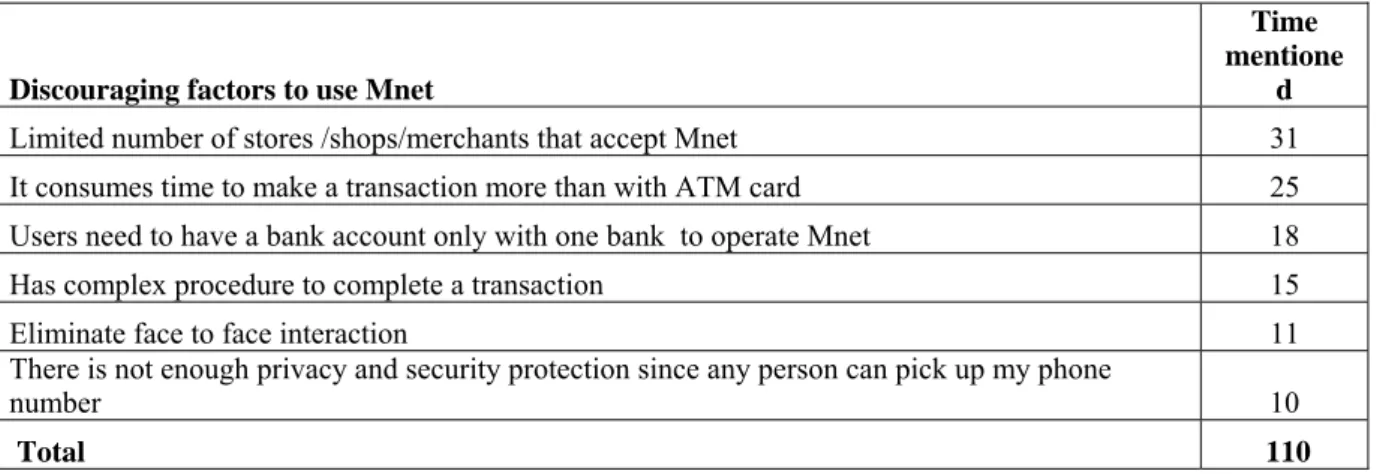
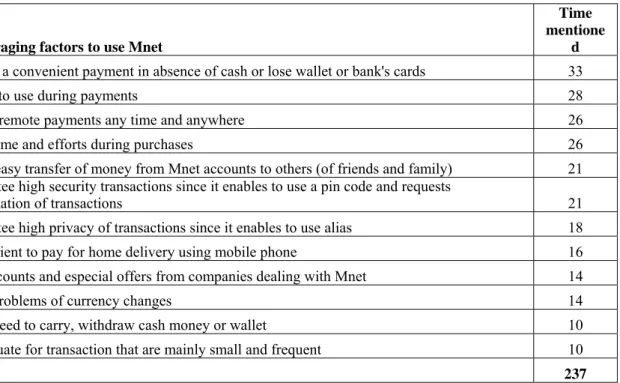
In order to shed more light on motives to use Mnet Table 1 and Table 2 provide a summary list of discouraging and encouraging factors respectively. It could be seen that respondents are more inclined to list encouraging factors by 215%.
Among the negative factors that scored more than 10 times by respondents, results revealed the following six, which are similar to Mallat (2006): There is a limited number of stores, shops and merchants that accept Mnet, which limit the use of Mnet technology. Mnet consumes time to complete a transaction, and therefore users perceived it as more complex than bank cards (credit and ATM cards). In order to operate Mnet, users need to have a bank account only with one bank "the national bank of Kuwait", which limits the usability of this new technology. When a user wishes to complete a transaction, he needs to follow complex procedure. Moreover, the Mnet technology eliminates face to face interaction, which is an important characteristic of the Arab culture. Finally, users perceive that Mnet does not enough guarantee the user's privacy and security transactions since any person could pick up his/her phone number.
These six factors are related to perceived critical mass, Mnet complexity, culture and privacy. Therefore, establishing a critical mass of sellers and buyers is an important feature of m-payment in Kuwait. Multiple merchants and users must jointly adopt the Mnet in order for it to succeed in Kuwait. Customers would use the Mnet because many consumers and most sellers will use it. Therefore, the growth of m-payment market is not possible without high participation of merchants.
Discouraging factors to use Mnet
Time mentione
d
Limited number of stores /shops/merchants that accept Mnet 31 It consumes time to make a transaction more than with ATM card 25 Users need to have a bank account only with one bank to operate Mnet 18
Has complex procedure to complete a transaction 15
Eliminate face to face interaction 11
There is not enough privacy and security protection since any person can pick up my phone
number 10
Total 110
Table 1: Discouraging factors for the acceptance of Mnet in Kuwait
Among the negative factors that scored more than 10 times by respondents, results revealed the twelve factors that we regrouped in three: PU, PEOU, and privacy & security. Encouraging factors related to PU are: Mnet is a convenient payment when I don't have cash, lose my wallet or bank cards. Mnet enables remote payments any time and anywhere, thus users can request items while they are driving their cars and ask delivery at home. Mnet allows easy transfer of money from Mnet account to another of friends and family members. Mnet is a convenient way to pay for home delivery using mobile phone since most people carry their mobile phones. Mnet users may get discounts and especial offers from companies dealing with Mnet Company. Mnet solves problems of currency changes. Mnet is adequate for transactions that are mainly small and frequent (e.g. coffee, soft drink at starbucks, or a movie ticket) in order to avoid standing in a long line at Cinema. Finally, users don’t need to carry their wallet, or withdraw cash money. Most ranked encouraging factors related to PEOU are: Mnet is easy to use during transactions, and Mnet saves time and efforts during purchases. Most ranked encouraging factors related to perceived privacy & security are: Mnet guarantees high security transactions since it enables to use a pin code and requests confirmation after completing transactions. Mnet also guarantees high privacy of transactions since it enables a potential user to select an alias instead of his/her real mobile phone number when completing transactions.
Encouraging factors to use Mnet
Time mentione
d
Mnet is a convenient payment in absence of cash or lose wallet or bank's cards 33
Is easy to use during payments 28
Enable remote payments any time and anywhere 26
Saves time and efforts during purchases 26
Allow easy transfer of money from Mnet accounts to others (of friends and family) 21 Guarantee high security transactions since it enables to use a pin code and requests
confirmation of transactions 21
Guarantee high privacy of transactions since it enables to use alias 18 Convenient to pay for home delivery using mobile phone 16 Get discounts and especial offers from companies dealing with Mnet 14
Solve problems of currency changes 14
Don’t need to carry, withdraw cash money or wallet 10
Is adequate for transaction that are mainly small and frequent 10
Total 237
Table 2: Encouraging factors for the acceptance of Mnet in Kuwait
Conclusion
The study explores the intention to use Mnet as a new m-payment technology recently introduced in Kuwait. Thus, the study makes several contributions in the field of IS/IT. The major contributions stem from (a) shedding light on factors that affect intention to use Mnet in Kuwait using a mix approach of quantitative and qualitative data collection methods and; (b) the moderation role of experience and gender on the intention to use Mnet. The most important result is that gender and experience are two important factors in ICT acceptance in Kuwait. The study reveals that intention to use Mnet is perceived usefulness and enjoyment driven for experienced and inexperienced male users, while it is enjoyment driven for female users. The role played by perceived enjoyment as the most determinant on intention to use Mnet, is not unique for m-payment technology since previous studies conducted in Kuwait have also shown same for instant messaging usage (Rouibah and Ould-Ali 2005), and camera mobile phone adoption (Rouibah and Hasan 2006).
Moreover, the current study results extend previous findings of Gefen et al., (2003) about online shopping and Dahlberg and Öörni (2007) about m-payment. Our results reveal that perceived trust seems to affect intention to use Mnet of potential users regardless of their experience. With regard to gender, perceived trust affects intention to use Mnet only of female users. In addition, social norm and privacy play the weakest effect on intention to use Mnet, which are in line with the effect of these two variables on camera mobile phone usage in Kuwait (Rouibah and Hasan 2006).
The study also shows a major characteristic of female users in Kuwait. Social norm affects both their perceived ease of use and perceived usefulness, while their perceived enjoyment affects perceived trust too.
Findings of the paper extend the traditional TAM model, and previous studies in the Arab world in several ways. First it provides an external validity of the TAM to m-payment technology and to another culture (Arab culture) that has been seldom investigated before. Second, the extension included mainly three constructs: privacy and perceived enjoyment, and perceived trust. A third contribution is that the paper emphasizes that new technology intention to use in Kuwait is largely affected by individual characteristics in term of gender and experience. Fourth, the study has shown that perceived enjoyment exerts more influence on Mnet intention to use than does PEOU, perceived trust and subjective norm.
The above findings should be interpreted in light of the following: (a) The focus of the paper is concentrated on the intention to use one m-payment technology; (b) the used technology is an ICT that has a hedonic, i.e. enjoyment component instead of IT/ICT in the workplace, and (c) the respondents are students.
The findings of this study contribute to a better theoretical understanding of the factors that promote ICT in Kuwait and the Arab world. In addition, the study has several implications for theory and practice. From a
practical perspective, results of the study could be used to promote Mnet as a complementary e-payment in Kuwait, and therefore, results could be used to design specific advertisement campaigns based on different categories of potential adopters (experienced vs. inexperienced) and gender (male vs. female). For example, in marketing Mnet among female users, advertisers should target the current social norms by portraying females enjoying m-payment while not promoting the usefulness of mobile methods of payment. In Kuwait, female are getting more personal financial responsibilities, financial autonomy and more rights in Kuwait, compare to other Gulf cooperative countries. In line with this trend and in order to promote m-payment and other e-payment female social norms in Kuwait need to be changed over time by greater education/awareness about the usefulness of Mnet and why technology usefulness should matter to them. From a research perspective there is a need to extend the external validity of the model to other Gulf Arabic countries which share the same values, and culture. More data is always desirable. It would be useful to increase the sampling, both in terms of number, but also with a more diverse sample profile (young vs. adults), which would contribute to extend the study's knowledge on m-payment intention to use in the Arab region.
The variance extracted from experienced users is 35% and 45% from inexperienced users. The variance extracted from female users is 34% and 67% from male users. Similar values were reported by previous studies: Venkatesh and Morris (2000) and Nysveen et al., (2005b). The amount of variance explained by the predicting factors for each of the outcome variables is acceptable, but still a large percentage of intention to use Mnet remains unknown, and call for additional studies.
References
Al Qabas 2007, 'Electronic card adoption in Kuwait', Al Qabas 16th September 2007.
Alshawaf A.R., Ahikari A., & Zhang H., 2002, 'Information ethics: an investigation of different subcultures in a society', Review of Accounting and Finance, vol. 1, no. 3, pp. 54-73.
Au Y. A. & Kauffman R. J. 2007, 'The economics of mobile payments: Understanding stakeholder issues for an emerging financial technology application', Electronic Commerce Research and Applications, Forthcoming.
Carat G., 2002, 'ePayment systems database - trends and analysis. Electronic Payment Systems Observatory (ePSO)', <ftp://ftp.jrc.es/pub/EURdoc/eur20264en.pdf>
Chou Y., Lee, C., & Chung, J., 2004, 'Understanding m-commerce payment systems through the analytic hierarchy process' Journal of Business Research, vol. 57, no. 12, pp. 1423-1430.
Coursaris, C., & Hassanein, K., 2002, 'Understanding m-commerce - a Consumer Centric Model', Quarterly Journal of Electronic Commerce, vol. 3, no. 3, pp. 247-271.
Dahlberg T, Mallat N, and Oeoerni A., 2003b, 'Trust Enhanced Technology Acceptance Model – Consumer Acceptance of Mobile Payment Solutions: Tentative evidence', Paper presented at the Stockholm Mobility Roundtable, 22–23 May 2003, Stockholm, Sweden.
Dahlberg T., and Öörni A., 2007, 'Understanding Changes in Consumer Payment Habits - Do Mobile Payments and Electronic Invoices Attract Consumers?' Paper presented to the 40th Hawaii International Conference on System Sciences, 3-6 January 2007, Waikoloa, Big Island, Hawaii.
Dahlberg T., Mallat N., Ondrus J., & Zmijewska A., 2007, 'Past, present and future of mobile payments research: A literature review' Electronic Commerce Research and Applications, forthcoming.
Davis F.D., Bagozzi R. P., & Warshaw P. R., 1989, 'User Acceptance of Computer Technology: A Comparison of Two Theoretical Models', Management Science, no. 35, pp. 982-1003.
Davis, F. D., R. P. Bagozzi, & Warshaw P. R., 1992, 'Extrinsic and intrinsic motivation to use computers in the workplace' Journal of Applied Social Psychology, no. 22, pp. 1111-1132.
Dewan, S. G., & Chen, L.-d., 2005, 'Mobile Payment Adoption in the USA: A Cross-industry, Cross-platform Solution'. Journal of Information Privacy & Security, vol. 1, no. 2, pp. 4-28.
Gefen, D., E. Karahanna & Straub D.W., 2003, ‘Inexperience and experience with online stores: The importance of TAM and trust', IEEE Transactions on Engineering Management, vol. 50, no. 3, p. 307.
Hwang Y., 2005, 'Investigating enterprise systems adoption: uncertainty avoidance, intrinsic motivation, and the technology acceptance model, European Journal of Information Systems, no. 14, pp. 150–161.
Juniper Research 2006, 'Mobile payment on the rise', viewed 09th May 2006,
Juniper Research 2007, 'M-Commerce Hot Spots, Part 1: Beyond Ringtones and Wallpaper', viewed 9th of May
2007 <http://www.ecommercetimes.com/story/ebiz/57109.html>
Khodawandi D., Pousttchi K., & Wiedemann D.G., (2003) 'Akzeptanz mobiler bezahlverfahren in Deutschland (acceptance of mobile payments in Germany)', in: K. Pousttchi, K. Turowski (Eds.), Mobile commerce-anwendungen und perspektiven, Proceedings zum 3, Workshop on Mobile Commerce, Augsburg, Germany, 2003.
Loch K. D., Straub D. W., & Kamel S., 2003, 'Diffusing the Internet in the Arab World: The Role of Social Norms and Technological Culturation', IEEE Transactions on Engineering Management vol. 50, no 1, pp. 45-63.
Luo X., & Lee C., 2004, 'Micropayments in Wireless M-Commerce: Issues, Security, and Trend' Journal of Internet Banking and Commerce, vol. 9, no.2, <http://www.arraydev.com/commerce/JIBC/0402-10.htm>
Mallat N., 2006,: 'Exploring Consumer Adoption of Mobile Payments - A Qualitative Study', Proceedings of the Helsinki Mobility Roundtable, Helsinki, Finland,.1-2 June 2006.
Mallat N., Rossi M., & Tuunainen V.P., 2004, 'Mobile banking services, Communications of the ACM, vol. 47, no. 5, pp. 42–46.
McCoy S., Galletta D.F., & King W.R., 2007, 'Applying TAM across cultures: the need for caution', European Journal of Information Systems, no. 16, pp. 81-90.
Nysveen H. Pedersen Per E., & Thorbjørnsen H., 2005b, 'Intention to use mobile services. Antecedents and Cross-Service comparisons',Journal of the Academy of Marketing Science, vol. 33, no 3, pp. 330-346. Nysveen H., Pedersen P.E. & Thorbornsen H., 2005a, 'Explaining intention to use mobile chat services:
moderating effects of gender, Journal of consumer Marketing, vol. 22, no. 5, pp.247-256.
Peffers K., & Ma W., 2003, 'An agenda for research about the value of payment systems for transactions in electronic commerce', Journal of Information Technology Theory and Application, vol. 4, no. 4, pp. 1-14.
Ramayah T., Ling C.Y., Suki N.M. & Ibrahim A., 2005, 'Determinants of Intention to Use an Online Bill Payment System among MBA Students', E-Business, no. 9, pp. 80–91.
Rouibah & Ould-Ali, S., 2005, 'Investigation of certain factors associated with the chat Technology acceptance and its impact on CBA students', Arab Journal of Administrative Sciences, vol. 12, no. 2, pp. 1-56. Rouibah K. & Hasan A., 2006, 'Modified Technology Acceptance Model for Camera Mobile Phone Adoption:
Development and validation'. Paper presented to the 17th Australian Conference on Information
System, Adelaide, Australia 5th to 7th December 2006.
Rouibah K., 2008, 'Social Usage of Instant Messaging by Employees outside the workplace in Kuwait: A structural Equation Model'. IT and People (Forthcoming).
Sun H., & Zhang P., 2006, 'Causal Relationships between Perceived Enjoyment and Perceived Ease of Use: An Alternative Approach', Journal of the Association for Information Systems, vol. 7, no. 9, pp. 618-645. Szmigin I., & Bourne, H., 1999, 'Electronic cash: a qualitative assessment of its adoption' International Journal
of Bank Marketing, vol. 17, no. 4, pp.192-202.
Taylor S., and Todd P. A., 1995, 'Assessing IT Usage: The Role of Prior Experience', MIS Quarterly, vol. 19, no. 4, pp. 561-570.
Van Hove, L., 2001, 'The New York City Smart Card Trial in Perspective: A Research Note', International Journal of Electronic Commerce, vol. 5, no. 2, pp. 119-131.
Venkatesh V. & Davis F.D., 2000, 'A theoretical extension of the technology acceptance model: Four longitudinal field', Management science, no. 46, pp. 186-204.
Acknowledgements
Copyright
Kamel Rouibah © 2007. The authors assign to ACIS and educational and non-profit institutions a non-exclusive licence to use this document for personal use and in courses of instruction provided that the article is used in full and this copyright statement is reproduced. The authors also grant a non-exclusive licence to ACIS to publish this document in full in the Conference Proceedings. Those documents may be published on the World Wide Web, CD-ROM, in printed form, and on mirror sites on the World Wide Web. Any other usage is prohibited without the express permission of the authors.