S
ONDER
F
ORSCHUNGS
B
EREICH
504
Rationalit¨
atskonzepte,
Entscheidungsverhalten und
¨
okonomische Modellierung
Universit¨at Mannheim L 13,15 68131 Mannheim No. 07-27MIND THE GAP: THE EFFECTIVENESS OF INCENTIVES TO BOOST RETIREMENT
SAVING IN EUROPE Axel B¨orsch-Supan∗
May 2004
Financial support from the Deutsche Forschungsgemeinschaft, SFB 504, at the University of Mannheim, is gratefully acknowledged.
[Draft 25 May 2004]
MIND THE GAP:
THE EFFECTIVENESS OF INCENTIVES
TO BOOST RETIREMENT SAVING
IN EUROPE
Axel Börsch-Supan
*Mannheim Research Institute for the Economics of Aging (MEA), Mannheim, Germany
#
National Bureau of Economic Research (NBER), Cambridge, Massachusetts, USA
ABSTRACT
Pension reforms all across Europe have a common theme: to reduce the generosity of the pay-as-you-go public pension pillar threatened by population aging, and to build up new pillars by private saving through occupational and individual pension plans. The extent of such retirement saving varies a great deal across Europe. This variation reflects, among other factors, the differences in public pension sys-tems, taxation and capital market regulations. The first part of this paper looks at this variation in an attempt to learn about the effectiveness of the various incentives to boost retirement saving. While we find a strong correlation between the generosity of pay-as-you-go pensions and retirement saving, there is no straight correlation between the volume of retirement saving and the extent to which it is tax-favored. The second part of the paper uses the recent reforms in Germany as “experiments” that may shed light on which incentives might work and which might fail. We describe the introduction of the tax-favored “Riester pension plans” in 2001 and the 2004 tax reform, which changes the tax treat-ment of retiretreat-ment savings in Germany from a conventional to a deferred taxation scheme. In spite of a deep subsidy and a generous tax treatment, “Riester pensions” have not found much attraction, while the originally heavily tax-favored whole life insurance is still wide spread. We conclude that boosting retirement saving requires more than simply tax relief.
ADDRESS:
Prof. Axel Börsch-Supan, Ph.D. MEA, L13,17
University of Mannheim 68131 Mannheim Fax: +49-621-181-1863 Email: [email protected]
ACKNOWLEDGEMENTS: This paper was written for the OECD workshop on tax-favored retirement saving plans, 28. May 2004. We are grateful for helpful comments by xxx and the participants of the OECD workshop. Financial support was provided by the National Institute on Aging (NIA) through the NBER, the German Science Foundation (DFG) through the Sonderfo rschungsbereich 504, the State of Baden-Württemberg and the German Insurers Association (GDV). The usual disclaimer applies.
Mind the Gap: The Effectiveness of Incentives
to Boost Retirement Saving in Europe
by Axel Börsch-Supan
1. Introduction
Pension reforms all across Eur ope have a common theme: they reduce the generosity of the pay-as-you-go (PAYG) public pension pillar threatened by population aging, and they attempt to build up new pre-funded pillars that rely on private saving through occupational and indi-vidual pe nsion plans. The extent of such retirement saving in Europe is the topic of this paper. It varies a great deal across Europe. This variation reflects, among other factors, large differ-ences in public policy, notably the generosity of public pension systems, capital taxation and capital market regulations. Can we learn from these differences? Do they tell us about the effectiveness of different policy approaches in order to boost retirement saving?
How to boost retirement saving is an important question. Generating a significant increase in retirement saving is necessary to compensate for the cuts in PAYG pensions which in turn are needed to keep future contribution rates bearable. We will see that the amounts necessary are large. However, saving now cuts into consumption now, so people tend to procrastinate, in particular, because the force of compound interest – and thus the power of saving for retire-ment early on – is hard to intuitively understand. Which incentives are needed to overcome this tendency to procrastinate and behave myopically? This is both a normative and a positive question. The normative aspect deals with the question which retirement income level the state should enforce. Almost all in Europe will agree that society has the obligation to provide a subsistence income. This, however, is not the point here because – even after the current string of pension reforms have taken their bite – most European countries will still provide levels of mandatory PAYG pensions that are well above subsistence levels. Should the state enforce private saving to guarantee retirement incomes substantially above subsistence levels? There are a number of reasons why one might give preferential tax treatment to retirement savings. The first argument applies to savings formation in general. The savings rate is very low in many countries.1 An inadequately low savings rate leads to a high level of individual
1
consumption in the short run, but also leads to a reduction in investments which are required for the high levels of long-term economic growth which pave the way for consumption at a later date. It is difficult to define in practice how high the ideal savings rate should be. As long as the rate of return on capital continues to be higher than the growth in total wage in-come we can be sure, however, that this ideal savings rate has not yet been reached. This is the case in almost all the OECD countries, including in the Federal Republic of Germany (Abel, Mankiw, Summers and Zeckhauser, 1989). Moreover, in order to achieve neutrality between consumption today and later as well as neutrality between consumption of present and future generations, deferred taxation of savings is required.
The second argument is that many people are myopic and only begin to make provision for their old age when it is too late. Even if the paternalism implicit in this view might be unap-pealing for some, there is plenty of empirical evidence corroborating myopia. A more formal argument is that tax relief will mitigate the negative effects of liquidity constraints. An addi-tional factor is that most people have little intuitive grasp of interest and compound interest mechanisms and believe it is possible to compensate for the low contributions made during the first half of their working life by saving twice as much during the second half, which it is not. As it is not possible for the individual citizen to rectify this mistake once it has been made, paternalistic logic suggests that the state must encourage saving.
Third, it also may make sense from a purely fiscal standpoint to deploy tax instruments to ensure adequate old-age provision. If retirement income drops below a defined threshold, the law in most European countries currently requires that inadequate incomes be topped up by social assistance payments. This should only be an emergency measure, however, as othe r-wise the far-sighted will simply end up subsidizing the short-sighted. In federal systems like Germany this would also result in fiscal side effects shifting burden from the federal to the state and local level because social assistance is financed from states and local authority re-sources.
Finally, there is the more subtle argument of adverse selection. It is based on the observation that people who believe they have an above -average life expectancy are more likely to con-vert funded old-age pension provision into life annuities. Others prefer lump-sum payments. This means that private life annuities are too expensive for most people.2 This adverse selec-tion of “poor risks” can be rectified by giving preferential tax treatment to life annuities
tive to lump-sum payments, assuming we wish to avoid the instrument of compulsion and the negative incentive effects associated with it.
In those countries in which pay-as-you-go systems are gradually being supplemented by funded systems, tax allowances for old-age pension provision have also been used to accele r-ate the transition from one system to the other and to spread the transition burden equally across several generations.3 Whether these tax concessions are self-financing is a matter of controversy, see Boskin (2003) versus Auerbach, Gale and Orszag (2003).
This paper focuses on the positive aspects, given that the normative question has been an-swered affirmatively. Are tax-incentives sufficient to boost retirement saving? What are the experiences in Europe with different tax regimes, such as conventional and deferred taxation? Which other instruments have been used, such as mandatory, quasi-mandatory, opt-in and opt-out schemes? Are such instruments necessary at all, or will people adjust their retirement savings automatically to the new environment of lower public pensions? What is the role of information about the pension system in the willingness to accumulate own retirement sav-ings?
This paper thus takes a fairly broad view on incentives to boost retirement saving not re-stricted to tax privileges. The paper is structured as follows. After documenting the savings volume necessary to compensate for the cuts in pay-as-you-go pensions in section 2, the first part of this paper uses the cross-national variation in Europe to address these issues. Section 3 compares the current tax and pension regimes and relates them to the size of the “three pil-lars”, i.e., public, occupational and private pensions. Section 4 looks at the substitution be-tween PAYG pensions and private retirement savings, section 5 at the substitution bebe-tween retirement savings and other savings. Section 6 discusses saving incentives other than taxes. The second part of the paper tries to learn from the recent reforms in Germany. They are a rather incisive change in pension regime from a monolithic PAYG system to a true multipillar system. It will eventually yield a valuable basis for program evaluation. The reform process include d the introduction of private retirement accounts (“Riester pensions”) in 2001 and the 2004 tax reform, which changes the tax treatment of retirement savings in Germany from a conventional to a deferred taxation scheme. Section 7 describes the status of retirement saving before the 2001 reform, section 8 describes the 2001 and 2004 reforms, and section 9 attempts
3
a preliminary assessment of the reforms, obviously at a very early stage. Section 10 summa-rizes the main lessons and concludes the paper.
2. How much retirement saving is needed to stabilize the public
pension systems?
This section briefly sets the stage for parts 1 and 2 of this paper by computing an important benchmark number: How much saving for old age is necessary to stabilize the ailing PAYG systems in Europe? These systems face a common problem. Due to population aging, the sys-tem dependency ratios will sharply increase, often about double. Since solutions within the PAYG systems are limited due to sheer size of the dependency increase, almost all pension reform attempts in Europe make use of the added flexibility gained by pre-funding.4
We use Germany as an example for a numerical calculation of the volume of pre-funding nec-essary to keep the PAYG contribution rate flat during the aging process. Such computations obviously depend on the policy mix between parametric and fundamental reform steps.5 We employ a partial equilibrium analysis using a policy mix proposed by Birg and Börsch-Supan (1999) which comes close to the current reform path in Germany. Within the PAYG system, the effective retirement age will be increased by 3 years until 2035. The PAYG contribution rate will be frozen from 2005 on. This will reduce the replacement rate in the PAYG system by about 20% until 2035. Together with the existing second and third pillar pensions, this will create a mix in Germany similar to what it is now in the Netherlands and Switzerland.
The savings volume necessary to fill this pension gap is depicted in figure 1 and depends on birth cohort. It is based on a financial instrument similar to a group life insurance which cov-ers all three biometric risks (longevity, disability and survivorship) and is paid out on retire-ment as an annuity. For the sake of simplicity our computations are based on a standardized life course, in which gainful employment begins at age twenty and ends at age 60, the latter
4
Privatization and pre-funding are often used to describe the move toward funded systems. However, they are associated with two different aspects: privatization is the creation of funded individual accounts, pre-funding means closing the gap between social security benefits promised to date and the assets on hand to pay for them. One can easily imagine combinations of privatization and pre-funding during the transition to a partially funded system, ands this is exactly what is simulated in the sequel.
5
Parametric reform steps within the PA YG system, in particularly an increase in the retirement age, can go a long way in stabilizing future contribution rates. Unlike to the UK, however, they cannot absorb all the burden in the countries most affected by population ageing. Germany, for example, would need a shift of the average re-tirement age by 9.5 years in order to fully compensate the increase in the dependency ratio, see Börsch-Supan (2000).
gradually increasing to age 63 in the year 2035. We apply the upper variant of the life expec-tancy projections used by the most recent government computations. Hence, this insurance covers the individual risk of longevity as well as this projected aggregate increase of longev-ity. Early disability occurs between age 45 and 60 with an increasing probably averaging 15 percent, the current frequency. Survivor benefits are paid in accordance to the average current probabilities which is likely to be an overestimate because an increasing share of women will have their own pensions.6
Figure 1: Saving rates necessary to fill pension gap
(Percent of gross earnings, by real rate of return)
0,0% 0,5% 1,0% 1,5% 2,0% 2,5% 3,0% 3,5% 4,0% 4,5% 5,0% 1940 1945 1950 1955 1960 1965 1970 1975 1980 1985 1990 Birth Cohort
4.5%
5.5%
3.0%
Source: Birg and Börsch-Supan (1999).
The pension or insurance company is investing the accumulated capital in the market using a broad portfolio of stocks, bonds, direct placement and real estate. We assume that this portfo-lio generates the average gross rate of return that prevailed between 1980 and 1995 in the in-dustry. This was 6.5% in real terms – however, we will also vary this rate in our projections. We subtract administrative costs of 6% of contributions, the average for group insurance poli-cies, 7 resulting in a net rate of return to the customer of 4.5% in real terms. One may find this overly optimistic in these days , hence, we also present a simulation with a slightly higher (5.5%) and a substantially lower real rate of return (3.0%). We also assume that this rate will
6
In this case, Germany has a partial offset rule which reduces total claims.
7
Administrating individual policies is more expensive. This is why we choose group policies that can be bun-dled by employers, as is done in the Netherlands or, in a slightly modified form, through the US 401(k) plans.
decline by 0.5 percentage points in the wake of population ageing. This estimate is based on the growth model by Börsch-Supan, Ludwig and Winter (2003).
Figure 1 shows that the earlier cohorts need to fill a smaller gap, while the later cohorts have longer time to exploit the force of compound interest. The implied saving rate (i.e., contribu-tions to new pension accounts, expressed as a percentage of gross earnings to be compatible to the PAYG contribution rates) is highest for the 1965 cohort and reaches about 3.2% of gross earnings if the past rate of return prevail, but exceed 4.6% of gross earnings if only a 3% real rate of return can be achieved. These two figures bracket the saving rate which the German government is proposing (4% of gross earnings).
We conclude that the volume in household saving to be generated by tax or other incentives is substantial in Germany. Extrapolating this simulation to France and most other European countries will generate slightly smaller gaps to be filled because aging is more pronounced than in the EU average. Aging will, however, be stronger in Italy where an even higher vol-ume of saving needs to be generated in order to fill the pension gap.
Part I: Evidence on Tax-Favored Retirement Saving in Europe
The extent of tax-favored retirement saving varies a great deal across Europe. This variation reflects, among other factors, the differences in public pension systems, taxation and capital market regulations. The first part of this paper looks at this variation in an attempt to learn about the effectiveness of the various incentives to boost retirement saving.
3. Retirement saving and the institutional setting in Europe
This introductory section looks at the crude cross-nationa l correlation between the extent of retirement saving, pension systems and taxation. We begin with the large variation in pe nsion schemes. Table 1 shows the mixture between PAYG and funded old-age provision across seven selected European countries and the United States.
Table 1: Sources of Retirement Income – Size of the “Three Pillars”
Percent a D F I E NL CH GB US
First Pillar b 85% 79% 74% 92% 50% 42% 65% f 45%
Second Pillar c 5% 6% e 1% 4% 40% 32% 25% 13%
Third Pillar d 10% 15% 25% 4% 10% 26% 10% 42% g
Notes: (a) Percent of total income of average two-person household just after retirment. (b) Public retirement in-come (public pensions, social assistance, civil servants‘ pensions, etc.). (c) Private occupational pension inin-come. (d) All other retire ment income (asset income, net transfers received, earnings, etc.). (e) In France, mandatory o c-cupational pensions are pay-as-you-go financed and are included in the first pillar. (f) In Great Britain, first pillar income also includes SERPS. (g) In the US, 25 percentage points of this figure are earnings.
Sources: Disney et al. (1998), Gruber and Wise (1999), Börsch-Supan and Miegel (2001).
In most Continental European countries, notably in the three largest countries France, Ge r-many and Italy, the PAYG mechanism is the most important instrument. There are notable exceptions, however, such as the Netherlands and Switzerland. In spite of these differences, table 2 shows an astounding similarity in the overall replacement rates. Adding up the income from all pillars, we find that households just after retirement receive approximately 80% of the income they enjoyed shortly before retirement. This replacement rate is nearly identical in Germany, France, Italy, the Netherlands and in Switzerland; it is slightly lower in Great Brit-ain.
Table 2: Comprehensive Retirement Income Replacement Rate
D F I E NL CH GB US
Percent of Preretirementa
82% 79% 80% ./. 78% 81% 69% ./.
Notes: All income sources of average two -person retiree household just after retirement as percent of total income of average two-person household just before retirement. Source provides no strictly comparable data for Spain and US.
Source: Disney et al. (1998).
The combination of tables 1 and 2 suggests a strong substitution among the three pillars, that is, a strong adaptation of the private individual and employer-based old-age provision to the public pension system.
Table 3: Assets and Participation in Tax-Favored Retirement Saving Plans
D F I E NL CH GB US Percent of GDP 8.6% 5.7% 5.5% 5.0% 116% 112% 76% 108% Percent of employment 42% 90% 79% 59% 53%
Source: Antolin, de Serres and de la Maisonneuve (2004). Data refers to year 2000. Life -insurance not included.
Tables 3 and 4 tell a similar story from a slightly different point of view. The accumulated assets in tax-favored retirement saving plans (table 3) are much smaller in those countries which have large public pension replacement rates (table 4).
Table 4: After-Tax Replacement Rates (Public Pensions)
D F I E NL CH GB US
Percent 77% 77% 97% 92.5% 46% 57% 40% 48%
Source: Adapted from Casey (2003). Based on the salary of an average production worker at “normal” age of re-tirement. In France, mandatory occupational pensions are pay-as-you-go financed and are included in the above figure. In the Netherlands, mandatory occupational pensions are pre-funded and not included in the above figure.
Relative to the force of public pension replacement rates, taxation does appear to not play a major role in explaining the cross-national variation in the importance of tax-favored saving plans. Table 5 shows tax regimes and effective tax-rates, using the familiar “EET” notation of deferred taxation. Germany and France apply an even more lenient taxation than the five countries with deferred taxation, and Spain has lower tax rates than the two Anglo-Saxon
countries, nevertheless do play tax-favored savings only a minor role in Germany, France and Spain.
Table 5: Tax Treatment of Retirement Savings
D F I E NL CH GB US
Percent EEP EEP EPP EET EET EET EET EET
Effective Tax on Contributions 22.1% 37.1% 16.6% 22.1% 29.0% Effective Tax on Accrued Income 14.5% 12.8% 12.7% 20.1% 22.3% Effective Tax on Benefits 17.1% 32.1% 11.6% 17.1% 24.0%
Source: Yoo and de Serres (2004). E=tax exempt, P=partially exempt/partially taxed, T=taxed. Comparable data for Germany, France and Italy is not available.
We conclude from this introductory section, that while we find a strong correlation between the generosity of pay-as-you-go pensions and retirement saving, there is no straight correla-tion between the volume of retirement saving and the extent to which it is tax-favored. In the following, we give these correlations a closer look.
4. Substitution between PAYG and private pensions
Section 3 suggests that substitution between PAYG pensions (“first pillar”) and private pen-sions (occupational and individual penpen-sions in second and third pillar) is the most important retirement saving mechanism. This is in line with economic theory: models with consumption smoothing will predict substitution between PAYG and funded pensions, while the effect of taxation depends on the dominance of the substitution over the income effect.
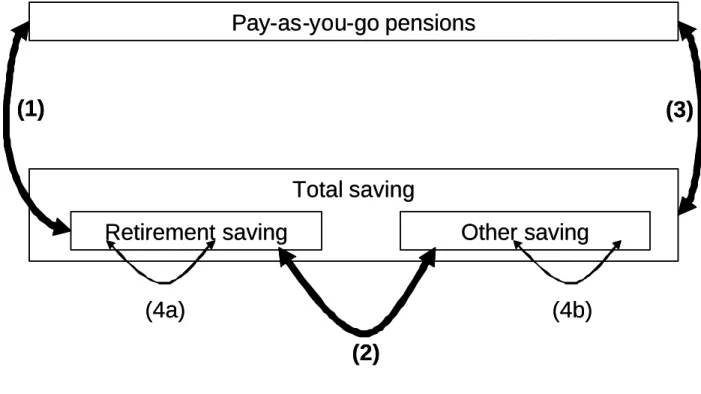
One actually has to carefully distinguish two kinds of substitution or “crowding out”, see the arrows in figure 2: (1) substitution within several types of “retirement wealth”, including mainly notional pension wealth (claims on future PAYG pensions) and real wealth (claims on assets usable only for retirement, such as occupational and individual pensions), and (2) sub-stitution between retirement wealth (defined by liquidity restrictions such as no availability before retirement age) and other wealth that can be liquidized freely.8 Both substitution
8
mechanisms are important in the pension reform discussion. The first substitution mechanism (people accumulate more retirement assets if PAYG pensions are reduced) is well visible in economic models with consumption smoothing, such as the well-known strand of overlapping generation models which include both pay-as-you-go pension schemes and life-cycle motive for retirement saving (Auerbach and Kotlikoff (1987) for the United States; Miles (1999) for Great Britain; Börsch-Supan, Ludwig and Winter (2003) for Germany). The second substitu-tion mechanism (for example, people may buy smaller homes and thus accumulate less assets for a smaller down payment when they have to accumulate more assets for retirement) is not visible in these models since they have only one savings motive (consumption smoothing over the life-cycle) and do not distinguish between high- and low-frequency savings or “men-tal accounts” for different savings purposes.
Figure 2: Substitution among savings types (“Crowding out”)
Pay-as-you-go pensions
Total saving
Retirement saving
Other saving
(1)
(4a)
(2)
(3)
(4b)
Pay-as-you-go pensions
Total saving
Retirement saving
Other saving
(1)
(4a)
(2)
(3)
(4b)
The combination of the two effects – arrow (3) in figure 2 – is the center of the crowding out debate between Feldstein (1974) and Barro (1974). Crowding out is an important policy issue. A central argument put forward in pension reform discussions is the macroeconomic superior-ity of a funded system vis-à-vis a PAYG system.9 This argument is valid only to the extent
9
Welfare superiority including transition costs requires additional effects over and above this capital accumula-tion, strengthening the necessity of new saving. See Fenge (1997), Börsch-Supan (1999) and Sinn (2000) for an e xchange on this point.
that new savings is created which adds to the capital stock and therefore promotes economic growth. In this case, the generation of retirement savings through the first substitution mecha-nism is not offset by an equally large substitution away from other savings through the second mechanism. Moreover, if the contrary is true (“full crowding out”) and pre-funding is in-censed by tax relief, this is wasted because it only shifts existing savings from one form to another.
The cross-national evidence on the first substitution mechanism appears fairly solid as we have seen in tables 2 through 4. Further evidence comes from an inspection of life-cycle sav-ing profiles.
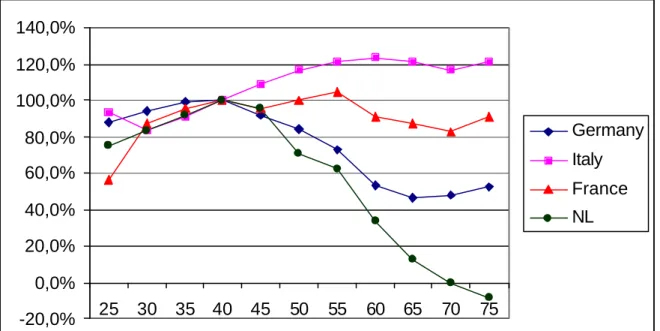
Figure 3: Age-specific saving rates (cohort corrected)
-20,0% 0,0% 20,0% 40,0% 60,0% 80,0% 100,0% 120,0% 140,0% 25 30 35 40 45 50 55 60 65 70 75 Germany Italy France NL
Sources: France: Fall, Loisy, and Talon (2001); Germany: Börsch-Supan, Reil-Held, Rodepeter, Schnabel, and Winter (2001); Italy: Brugiavini and Padula (2001); Netherlands: Alessie and Kapteyn (2001).
Figure 3 shows, by age group, median saving rates in France, Germany, Italy and the Nethe r-lands. They are based on a comparable longitudinal framework, represent life-cycle saving purged from cohort effects, and employ comparable variable definitions and data sources as part of the International Saving Comparisons Project (Börsch-Supan, 2001 and 2003). The saving profiles in France, Germany and Italy are rather flat and show no dissaving in old age. One possible explanation is that the high replacement rates of the public pension systems in these countries have made private retirement income largely unnecessary. If other saving mo-tives, such as precaution and intergenerational transfers, are more important than retirement
saving, age -saving profiles are likely to be much flatter than under the textbook life-cycle hypotheses which predicts saving in young and dissaving in old age. This explanation is in line with the work by Jappelli and Modigliani (1998) who argue that the main mechanism for “retirement saving” in Italy is the PAYG system. While we lack the most appropriate counter-factual – French, German and Italian data from times when these countries had no PAYG systems – figure 3 depicts the case of the Netherlands which have, as opposed to France, Germany and Italy, only a small base pension provided by their PAYG public pe nsion system. All additional retirement income in the Netherlands has to be provided by (mandatory) sav-ings plans, commonly provided through occupational pension plans. Figure 3 shows that the median Dutch household has a much more pronounced hump-shaped life-cycle savings pro-file than the median French, German and Italian households, and it exhibits dissaving among the elderly as they draw down their mandatory saving accounts.
This cross-national evidence suggests that a pension reform towards a multi-pillar system with a substantial portion of funded retirement income will revive the retirement motive for saving in France, Germany and Italy. In fact, as pointed out in section 2, these systems will look very similar to the current Dutch system. Hence, it is likely that saving rates among the young will increase (to accumulate retirement savings), and saving rates among the elderly will decline sharply (because they will dissolve their retirement savings). Combining the re-sults of figures 1 and 3 gives us an order of magnitude for those effects. The net saving rate of the average German household in mid age would increase by about 4 percentage points from 11 to 15 percent, while the saving rate would decrease by about 6 percentage points from 4 to –2 percent in old age, when retirement accounts are drawn down for consumption.
From a policy point, there seems no doubt that people adjust their behavior to the generosity of public pension systems like in a system of communicating pipes. Taxes appear to be uncor-related with these adjustments. The cross-national evidence, however, reflects long-run ad-justments. Hence, this section does not necessarily imply that tax incentives boosting retire-ment savings are superfluous. While the evidence of table 5 – high taxes on retireretire-ment sav-ings in the Netherlands and the United States – seems to be contradictory to the high levels of retirement saving, these tax rates have been established after a multipillar system had been installed.
5. Substitution between retirement saving and other saving
There is also clear evidence on the partial effects of tax incentives (see arrows (3), (4a) and (4b) in figure 2). Several econome tric studies using large micro data sets have been shown the impact of tax relief on dedicated savings in Germany, e.g. whole life insurance policies and savings and loan agreements (Börsch-Supan and Stahl, 1991b; Brunsbach and Lang,1998; Lang, 1998; Walliser and Winter, 1999). These studies show quite clearly that tax relief for specific investment vehicles strengthen the attractiveness of the relevant forms of saving. In-deed, they appear to have markedly shaped the retirement savings landscape in Germany, see section 7.
This is, however, not the central issue. Evidence on the total effect – the generation of new savings, when retirement savings through the first substitution mechanism is not offset by an equally large substitution away from other savings through the second substitution mecha-nism, i.e., arrow (2) in figure 2 – is still controversial, and a European perspective10 brings, rather unfortunately, not much additional light into the old controversy between Venti and Wise (1990) on one side, and Gale and Scholz (1994) and Attanasio and De Leire (1994) on the other side, summarized by Skinner and Hubbard (1996) for the US and by Attanasio and Banks (1998) for a comparison between the US and the UK.
Auerbach and Kotlikoff (1983) pioneered the discussion on the difficulties with the identifica-tion of the substituidentifica-tion parameters both in time series and cross secidentifica-tional studies for the US. The structural instability of the parameters is due to the changes in population structure and to the fluctuations in interest rates as well as in contribution rates during the transition after the introduction of a new pension system.
Additional complications along these lines stem from the fact that a considerable share of elderly households in Continental Europe seem to be “overannuitized”. Evidence by Börsch-Supan and Stahl (1991a) and Börsch-Börsch-Supan (1992, 1994) shows that the annuity income of a majority of pensioners (mostly PAYG income provided through the public system) by far exceeds consumption expenditures. The next ge neration of pensioners appears to be aware of this fact, since saving rates in Germany drop for the now middle aged cohorts. Given this trend, a reduction in public pension wealth may not necessarily be channeled into new sav-ings, or only after a transition period of new costly learning. At the same time, these
10
holds, if left to their own devices, may also shun pe nsion assets because they do not want to lock their wealth into long term saving for retirement. In short: a careful analysis of the link between total saving rates and changes in pension systems needs to be cohort-specific and cannot simply use aggregate time-series.
It may therefore not be a major surprise, if for Europe the empirical evidence is scanty and there exists a wide variety of results, making it particularly hard to reach any conclusion. Kim (1992) links changes in the retirement system to the savings rate and shows that the German pay-as-you-go system has crowded out saving to a significant extent. Cigno and Rosati (1996) confirm these findings but explain the crowding-out effect unconventionally by repercussions on fertility rather than through the familiar channels stressed by Feldstein (1974). Other time series studies include Rossi and Visco (1994) for Italy, who are able to attribute part of the decline occurred during the 1980s in the saving rate to the increased generosity of the social security in the 1970s. In other countries the relationship between pension wealth and private fungible wealth emerging from time series data is poorly determined.11 Cross sectional analy-sis based on Italian micro data (Brugiavini, 1987; Jappelli, 1995) obtain low estimates of the substitution parameter. Recent studies for the Netherlands obtain mixed results. In particular, by using the Dutch Socio Ec onomic Panel (SEP) data on private wealth and on (constructed) data on social security wealth and pension wealth, Alessie, Kapteyn and Klijn (1997) and Kapteyn, Alessie and Lusardi (1999) have investigated the question whether or not there ex-ists displacement between discretionary private wealth on the one hand and soc ial security and pension wealth on the other hand. For pension wealth they do not find any evidence of displacement, while for social security wealth they find full displacement.12
Clear cut “experiments” in which the pension system changes but everything else remains constant, are hard to come by also in Europe. Attanasio and Brugiavini (1997) rely directly on a test of how changes in saving rates are related to changes in pension wealth following the 1992 Reform of the Italian Social Security System in a “quasi-natural-experiment” setting. They find that households whose public pension wealth was substantially curtailed by the reform show a marked increase in their private saving rate. Germany will provide an “experi-ment” with its 2001 and 2004 reforms, but, as we will see in part 2 of this paper, it is too early to draw firm conclusions yet. So far, the German experience with its very small uptake rates
11
See Kohl and O’Brien (1998) for a detailed survey.
12
See also Euwals (2000). The evidence based on cross sectional data for the USA (Hubbard, 1986) and for Canada (King and Dicks-Mireaux, 1982), is also rather mixed.
of the new tax-favored retirement saving instruments shows that short-run effects maybe quite different from the long-run effects shown in the previous section.
Börsch-Supan and Lusardi (2003) attempt a cross-national analysis exploiting the cohort-corrected savings data in the International Savings Comparisons Project. They find that co-hort-corrected saving rates are positively (!) correlated to public pension replacement rates, suggesting crowding in rather than crowding out – this positive correlation, however, changes sign to a significant negative one, once credit restrictions are taken account of.13
In summary, the European evidence so far does not add much to the evidence gathered in the US debate. This is in spite of the large institutional variation in Europe. While we do know that subsidies strongly increase saving in the specific form that is subsidized, possibly to the detriment of other saving forms, we do not really have firm evidence that saving-related tax relief or similar subsidies increase total saving in Europe.
This does not make tax-relief a potentially wasteful instrument. Even if tax relief would only shift other saving to retirement saving, this may be a valuable mechanism if the government wants to make sure that the elderly will have a generous multipillar retirement income. That is, even if the government does not believe in the creation of new saving for macroeconomic purposes, it still may want to repress procrastination not only in form of consumption now, but also in the form of a larger house in the near future, and subsidize retirement consumption in the far future.
6. Other ince ntives: Opting in and out, mandatory savings
The U.S. experience, summarised by Wise (2001), has also taught us two further lessons. First, tax relief is not everything. The great success of individual retirement accounts (so-called “IRAs”) and employer-sponsored retirement saving plans (so-(so-called “401(k) plans”) also seems to be due to information and advertising, and a consistent capital market regulation that reduced the uncertainty of investors. This is in great contrast to the UK experience, sum-marised by Disney (1996), where the lack of regulation and information led to the so-called mis-selling scandals that undermined investment in private accounts. In this scandal, inappro-priate financial products were sold to households, often by door-to-door salespersons, result-ing in huge financial losses to many families. State intervention seems necessary to provide
13
Specified as downpayment restrictions according to Chiuri and Jappelli (2000). The results should be cau-tiously interpreted since they rely on a small panel of six countries and five waves.
for a smooth working of the capital market. The German experience after the 2001 reform, to which we will turn in the second part of this paper, teaches a related lesson: lack of transpa r-ency – ironically created by overregulation – appears to have destroyed all positive incentives created by tax relief.
The second lesson from US experience is that tax relief only works for the upper two third of the income distribution. Neither IRAs nor 401(k) plans will have a noticeable impact on fu-ture retirement income of the lower third of the income distribution. In Germany and in Italy, these observations have sparked an extended discussion on whether to make private provision mandatory. The argument pro mandatory savings is mainly the need to cover all persons in order to avoid pockets of poverty and to prevent moral hazard. The arguments against manda-tory savings rest on the well known economic efficiency arguments against taxation.14 One advantage of private savings for old age as opposed to PAYG contributions is that the latter have mainly tax character (Börsch-Supan and Reil-Held, 2001), therefore create dead weight losses, while private saving does not. Making saving mandatory, however, introduces an ele-ment of force, thus shifts savings understood as voluntary insurance premia towards manda-tory taxes.
The issue is complicated by moral hazard. As long as the government provides pension in-come of last resort, voluntary savings is a waste – from the individual point of view, at least among those in the lowest parts of the earnings distribution – if one can just as well apply for social assistance. People may therefore opt for mandatory savings in order to reduce moral hazard.
While most economists do not like the incentives costs associated with mandating retirement saving, Boeri, Börsch-Supan and Tabellini (2001 and 2002a) actually find that most workers in France, Germany, Italy and Spain prefer a pension reform with mandatory savings over a reform with voluntary savings. Besides the moral hazard argument, there are many other ex-planations for this finding, such as the already mentioned lack of self -control and the fear of procrastination, the expected higher likelihood of government bail-out if a pension fund fails in which mandatory savings were invested, etc. All of these arguments underscore a need for government interve ntion – most strongly, in the imposition of a mandatory saving plan; less strongly, by giving tax relief.
14
Part II: A Case Study of the Recent German Pension Reform
In this second part, we describe and analyze the 2001 and 2004 pension reforms in Germany. They are a good example for a rather incisive change in pension regime from a monolithic pay-as-you-go system to – eventually – a true multipillar system. Section 7 describes the status of retirement saving before the 2001 reform, section 8 describes the 2001 and 2004 reforms, and section 9 attempts a preliminary assessment.
7. Retirement saving before the 2001 pension reform
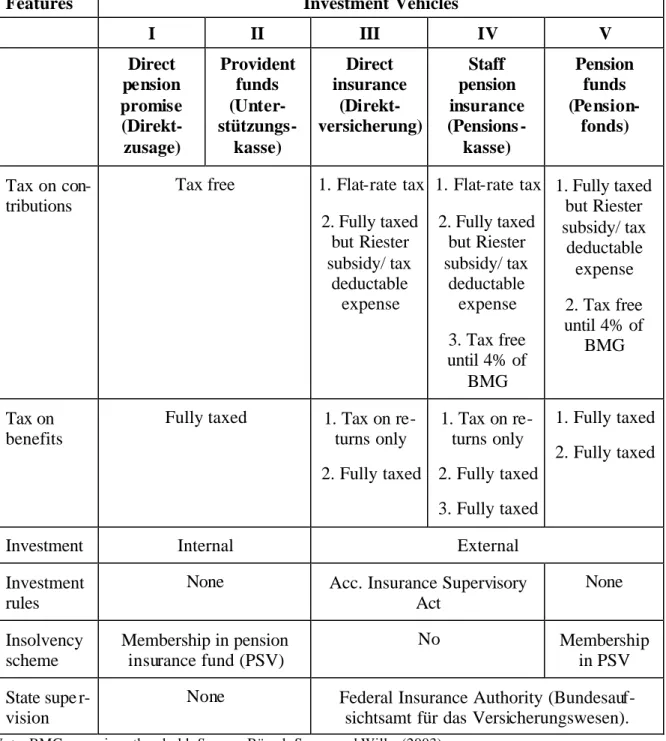
Tax-favored retirement saving in Germany takes several well-defined forms as occupational and individual pension plans. First, there are four types of occupational pensions: (I) direct pension promises based on company book reserves, (II) provident funds, independent organi-zations sponsored by employers, (III) direct insurance, where employers buy whole life insur-ance for their employees, and (IV) staff pension insurinsur-ance, where employers set up their own insurance-like or ganization. All these plans are of the “defined benefit” type. Until 2001, de-fined contribution pension funds – an investment vehicle which is widely used in other coun-tries – were not permitted in Germany. Table 6 gives an overview of their features.
Second, the only individual retirement saving form which was tax-favored before the 2001 pension reform is whole life insurance. Both accrual and benefits are tax exempt; moreover, contributions can be deducted from taxes up to a limit which depends on the tax-payers other dedicated saving instruments. Tax-favored and subsidized individual retirement accounts were introduced in the 2001 reform, see section 8.
Table 6: Types of occupational pension systems
Features Investment Vehicles
I II III IV V Direct pension promise (Direkt-zusage) Provident funds (Unter- stützungs-kasse) Direct insurance (Direkt-versicherung) Staff pension insurance (Pensions -kasse) Pension funds (Pension-fonds) Tax on con-tributions
Tax free 1. Flat-rate tax 2. Fully taxed but Riester subsidy/ tax deductable expense 1. Flat-rate tax 2. Fully taxed but Riester subsidy/ tax deductable expense 3. Tax free until 4% of BMG 1. Fully taxed but Riester subsidy/ tax deductable expense 2. Tax free until 4% of BMG Tax on benefits
Fully taxed 1. Tax on re-turns only 2. Fully taxed 1. Tax on re-turns only 2. Fully taxed 3. Fully taxed 1. Fully taxed 2. Fully taxed
Investment Internal External
Investment rules
None Acc. Insurance Supervisory Act None Insolvency scheme Membership in pension insurance fund (PSV) No Membership in PSV State supe r-vision
None Federal Insurance Authority (Bundesauf-sichtsamt für das Versicherungswesen). Note: BMG = earnings threshold. Source: Börsch-Supan and Wilke (2003).
The institutional breadth of retirement savings and the various forms and levels of taxation imposed on them have significant monetary effects. These are calculated in Table 7 and ex-pressed as after-tax benefits in percent of contributions accumulated over the average length of a work life. For ease of comparison, the calculation assumes an identical rate of return of 3% (including the pay-as-you-go scheme).
Table 7: Effects of different taxation rules on retirement saving Public retirement insurance Civil ser-vant pe n-sion Occupational pension I/II (pension promise/ provident fund) Occupational pension III/IV (direct insurance/ staff pension insurance ) Whole life insurance Investment fund
Tax Regime EEP EET EET TET PEE TTE Benefits as
percent of contributions
173.3% 143.7% 159.9% 142.8% 143.7% 124.8%
Note: The figures reflect a savings period of 37 years and an annual contribution of EUR 500, a real rate of interest of 3%, a retirement age of 65 and an average tax rate of 22%. Deductions are calculated on the basis of statutory percentage rates; no account is taken of maximum tax allowance amounts. E=tax exempt, P=partially exempt/partially taxed, T=taxed.
Source: Computed from Börsch-Supan and Lührmann (2000)
Table 7 shows that the current situation does not resemble a “level playing field”. Public re-tirement insurance receives the most preferential tax treatment; investment funds (including pension funds) come off worst. The difference in the net benefit payments from the public retirement insurance scheme and an investment fund is almost 50% of contributions. The net benefit payments of pension forms which are subject to deferred taxation – public retirement insurance, civil servants pensions, and occupational pensions – tend to be higher than net benefit payments subject to the other tax principles. Public retirement and occupational pe n-sions generate the highest net benefit payments as only a very minor share of the pension benefits (a hypothetical interest portion) is taxed and in many cases, thanks to generous ex-emptions, no tax is levied at all.
The unequal tax treatment of different forms of old-age pension provision cast occupational pensions and investments in investment funds in a highly unattractive light. While the unequal tax treatment of a pure capital investment in equities might be justified because this form of saving does not cover biometric risks, the other two investment vehicles do in fact cover these risks.
The asymmetric taxation of state and private old-age pension provision is not only reflected in different levels of net be nefit payments but also exercises incentive effects and triggers substi-tution effects. These are apparent from the spread of different forms of private old-age pe n-sion provin-sion in Germany. Of those investing in private forms of penn-sion provin-sion, 71.2%
have a life insurance policy but only 15.1% an equity or other investment fund. Occupational pensions are the weakest pillar of pension provision in Germany. The volume of such schemes is less than half of that of life insurance policies and less than 10 percent of public retirement insurance expenditure.15 Among them, the lion share of more than two thirds goes to type-I defined benefit pe nsion plans (direct pension promise backed by book reserves) which also provide the highest tax advantage, see table 7.
The composition of fina ncial wealth of German households excluding occupational pension wealth is displayed in Table 8. The most important component is whole life insurance, about a third of gross financial wealth. This is in line with the econometric studies by Brunsbach and Lang (1998) and Walliser and Winter (1999) who exploit cross-sectional variation in tax rates and find a significant influence of the favorable tax treatment on the portfolio share of whole life insurance in German households. Bonds make up the lions’ share in this category, while stocks are less than 10 percent of the average household portfolio. This fact is also significant for financial markets, as life-insurance companies have not been allowed to invest signifi-cantly in stocks in the past, which in turn is one of the main reasons for thin capital markets in Germany. Stocks and bonds are tax privileged in so far as capital gains are tax exempt if the underlying asset has been held for longer than one year.16
Table 8: Composition of household wealth, Germany, 1978–1998
1978 1983 1988 1993 1998
Savings accounts 33,8% 26,7% 25,2% 17.5% 22,2%
Building societies 13,6% 13,0% 9,5% 7.5% 7,5%
Stocks and bonds 16,2% 19,6% 19,7% 31.4% 24,3%
Life insurance (cash value) 36,4% 36,7% 42,4% 33.3% 30,7%
Other financial wealth 0,0% 4,0% 3,4% 10.4% 15,3%
Total gross financial wealth 100.0% 100.0% 100.0% 100.0% 100.0%
Note: Household data from the Einkommens- and Verbrauchsstichprobe (EVS).
Source: Börsch-Supan, Reil-Held, Rodepeter, Schnabel and Winter (1999) and own computations.
15
DIA (1999).
16
8. The German reforms in 2001 and 2004
17The core of the recent reforms includes two elements. The first core element are significant benefit cuts in the PAYG pillar. The replacement rate is successively reduced, implying bene-fit cuts of about 20% by the year 2040, the projected peak of population aging in Germany. This is achieved by a change in the benefits indexation formula in two stages, 2001 with the introduction of the “Riester steps” and 2004 with the introduction of the “sustainability fac-tor”, see Börsch-Supan and Wilke (2003).
The second core element of the Riester reform is the introduction and significant pr omotion of supplementary funded private pensions on the basis of individual retirement accounts (“Ri-ester pensions”) to fill the pension gap created by the benefit cuts. The objective is to offer incentives for people to take out supplementary private pension cover which, in the long term, should compensate for the future cuts in public pensions. These pensions are voluntary: there will be no legal mandate for people to invest in these additional private schemes. The Riester pensions resemble IRAs in the U.S.
The tax-relief and/or subsidies for Riester pensions can also be used for several types of occu-pationa l pensions (direct insurance, staff pension insurance and pension funds , see table 6), which merges elements of the existing German DB plans with elements of US-style 401(k) plans.
8.1 Individual retirement accounts (“Riester pensions”)
The Riester pensions are heavily regulated and many restrictions apply. The most incisive restriction is on payment plans. Since additional private pension schemes are intended to sup-plement or replace benefits from the public pension scheme, the government decided that in-centives will only be available for investment vehicles which guarantee payment of a life an-nuity payable from the date of retirement. Investment vehicles which provide for lump-sum disbursements are not subject to state subsidies.18 This restriction has already met with con-siderable criticism in the public debate as it excludes other forms of provision for old age (such as investments in old-age or nursing homes).
17
This and the following section draw on Börsch-Supan and Wilke (2003) who provide further details.
18
The incentives provided by the state can take two forms: direct savings subsidies or tax-deductible special allowances. The tax authorities automatically compute which of the two forms versions is most advantageous.
Direct savings subsidy. All dependently employed and certain self employed workers who pay personal contributions to a certified retirement pension policy are entitled to receive a direct retirement savings subsidy. The subsidy is paid directly into the beneficiary’s saving account. A basic subsidy and a child subsidy for each child for which child benefits were re-ceived during the previous year is paid. Child subsidies are payable to the mother. In the case of married couples, both partners receive a basic subsidy if they have each taken out their own supplementary private pension policy. In addition, non-entitled partners (such as mothers not in paid employment) are also entitled to receive the full subsidy for their own retirement pe n-sion policy provided that the respective married partner subject to compulsory insurance con-tributions has paid his or her minimum personal contribution to their supplementary retire-ment pension policy (see below).
Table 9: Direct savings subsidies
From … on Savings rate Basic subsidy [Euro p.a.] Child subsidy [Euro p.a.] 2002 1 percent 38 46 2004 2 percent 76 92 2006 3 percent 114 138 2008 4 percent 154 185
Source: Börsch-Supan and Wilke (2003).
Table 9 shows the maximum incentive subsidies available as of 2002. In order to qualify for the maximum subsidy the beneficiary must invest a specified percentage of his or her gross earnings (denoted as “saving rate”). This percentage increases until 2008 in four steps. The percentage is applied to the actual earnings level, capped at the same cap as the PAYG contri-butions are (about 2 times average earnings). If less money is invested, the state subsidy is reduced accordingly. The scheme is complicated by the fact, that the subsidy is included in the savings amount. Hence, the actual saving rate necessary for the maximum subsidy is lower than the percentages indicated in the second column of table 9. In turn, certain mini-mum amounts are necessary, see table 10.
Table 10: Minimum Savings
Year No child One child Two or more children
2002 – 2004 45 38 30
As of 2005 90 75 60
Source: Börsch-Supan and Wilke (2003).
Tax deductible special expenses. Alternatively, qualifying retirement savings can be de-ducted as “special allowances” from income taxes. This is usually more advantageous for workers with higher than average earnings. Saving rates, caps etc. are the same as in the sub-sidy case. Table 11 shows the maximum tax-deductible contributions to private retirement savings accounts.
Table 11: Maximum Savings
From … on Tax deductible special expenses in Euro/Year
2002 525
2004 1.050
2006 1.575
2008 2.100
Source: Börsch-Supan and Wilke (2003).
Criteria for individual pension plans eligible for subsidies/tax relief. Individual retirement accounts only qualify for state promotion if they meet criteria laid down in the new Certifica-tion of Retirement Pension Contracts Act (“AltZertG”). It contains a long list of rules which make the system complex for customers and potential insurers alike. Qualifying pension plans require certification by the Federal Financial Markets Authority (“Bundesanstalt für Finanzdi-enstleistungs- und Finanzmarktaufsicht”) which will be granted automatically if they fulfill the following preconditions:
1. The investor must be committed to making regular, voluntary pension contributions.
2. Pension benefits may only be paid out when the beneficiary reaches the age of 60 at the earli-est or upon reaching retirement age.
3. At the beginning of the disbursement phase, the accrued pension contributions (inclusive of subsidies) must be guaranteed (i.e., the nominal rate of return must be nonnegative).
4. Pension payments must guarantee lifelong benefits which retain or increase their nominal value, i.e. in the form of a life annuity or disbursement plan linked to lifelong annual install-ments.
5. The disbursement plan must continue to provide benefits until the beneficiary reaches the age of 85 and subsequently provide a life annuity guaranteed by the capital available at the begin-ning of the disbursement phase.
6. Supplementary survivor’s coverage must not have features which offset the original plan. 7. Initial commission and administrative charges must be spread equally over a period of at least
10 years.
8. The investor must be informed about the following issues before taking out the policy: The level and distribution over time of commission and administrative costs, the cost of switching to a different policy, the costs of financial management, the costs involved in changing to a different insurer.
9. The investor must be informed once a year during the term of the policy about how his or her contributions are being used, capital formation, costs and yields, and also about whether and to what extent the insurer takes account of ethical, social and ecological investment criteria. 10. The investor must have the right to suspend contributions during the saving phase, to allow the
policy to continue running without making additional contributions, or to terminate the policy by serving three months notice to the end of the quarter.
11. Policy rights may not be assigned or transferred to third parties. Claims to pension benefits cannot, as a result, be bequeathed.
Products eligible for subsidy support and into which old-age pension contributions and the proceeds on such contributions may be invested include pension insurance and capitalization products, bank accounts with accumulated interest and shares in growth and distributing vestment funds. These products are offered by life insurance companies, banks, capital in-vestment companies, financial services institutions and secur ities services companies.
8.2 State promotion of occupational pension schemes
The Riester reform remained largely undecided on the role of occupational pensions versus individual accounts. Traditionally, occupational pensions have played a minor role in Ge r-many, particularly in comparison with other countries. Demand for participation in occupa-tional pension schemes has also been falling in recent years.19 On the other hand, occupa-tional pensions may provide a psychological substitute for mandated private pensions. In or-der to strengthen occupational pensions, additional (implicit and explicit) subsidies were in-troduced with the Riester reform.
19 See Ruppert (2000).
The Riester reform introduced pension funds as a vehicle for occupational pensions – an in-vestment vehicle which is widely used in other countries, but was not permitted in Germany. There are now five different investment vehicles in German occupational pension schemes, but only three are eligible for Riester incentives: direct insurance, staff pension insurance and pension funds (see table 6). As the employer has to provide the employee with the possibility to benefit from the Riester incentives, this means – especially for smaller companies – that some companies now have to restructure their pension schemes.
The most important change is the general right to convert part of the salary directly into con-tributions to pension plans. This applies regardless of whether the concon-tributions are paid by the employer or the employee. Arrangements may be based both on gross or net pay. If they are based on net pay, there is a large implicit subsidy since the so-converted salary may not only be subject to deferred taxation but can also be exempt from social security contributions, at least until 2008. If they are based on gross pay, contributions may enjoy the same direct subsidies or tax relief as contributions to individual accounts, as long as the occupational pe n-sions meet certain criteria which are less restrictive than the criteria for individual pension plans. Which contribution rules apply depends on the chosen investment vehicle and the in-centives they attract (see table 6). Collective barga ining agreements, however, have prece-dence over the right to convert salary. This means that an employee covered by a binding col-lective agreement is only entitled to convert his or her pay into pension if this is explicitly provided for in the terms of the collective agreement. This rule makes sure that employers and unions can impose their own rules on occupational pension plans.
8.3 Deferred taxation
Contributions to the Riester pensions introduced in 2001 will be tax exempt during the saving phase, pension payments during the benefit phase will be taxed in full as normal income. This applies to all benefits regardless of whether these accrue from contributions, subsidies or capi-tal gains. One may regard this as another form of subsidy, since taxes occur later in life (hence, an implicit tax credit) and us ually at a lower rate due to progressivity.20
The 2004 tax reform has introduced tax-deferred taxation to all other retirement saving vehi-cles as well, including public pensions. This requires a complex transition process. Currently, public pensions are taxed “EEP”, see table 5, 6 and 7. Only a part of the hypothetically
20
Börsch-Supan and Lührmann (2000). The “tax credit” feature depends on the an income or consumption tax point of view.
crued interest is taxed after retirement (this part is assumed to be 27% of benefits if retirement takes place at the “normal” age of 65; 32% at early retirement with age 60). In 2005, this tax-able fraction will jump to 50%, and successively increase to 80% in 2020 and 100% in 2040. During a substantially shorter time span, contributions to all retirement schemes (public, oc-cupational and individual) will become tax deductible, see figure 4. It begins with 60% of contributions in 2005 and successively increases to 100% in 2025. This scheme avoids double taxation (with a few exceptions), but incurs substantial revenue losses (about 1 billion Euro per year until 2006).
Figure 4: Transition to deferred taxation in Germany
2005 2025 2040 60% 100% 100% Deductible contributions 2005 2020 2040 50% 80% 100% 27%
Tax rate on benefits
2005 2025 2040 60% 100% 100% Deductible contributions 2005 2025 2040 60% 100% 100% Deductible contributions 2005 2020 2040 50% 80% 100% 27%
Tax rate on benefits
2005 2020 2040
50%
80% 100%
27%
Tax rate on benefits
9. An assessment of the Riester pension plans
The introduction of the Riester pensions in 2001 offers a fascinating case study in the poten-tial success and failure of tax-favored but voluntary retirement saving. Will workers overcome the temptations to procrastinate? How many will build up supplementary pe nsions? How much will they save?
At this point, only three years since their introduction, it is too early to tell. It took about about a decade to popularize a general subsidized dedicated savings program in Germany (“Vermögenswirksame Leistungen”, directly deducted from payroll) which now enjoys almost universal participation. In the US, IRAs needed equally long to be accepted by a large share
of households, and participation is still biased towards the well-to-do. In this section, we look at the design and the incentives in order to understand who is likely to take up the newly cre-ated Riester pe nsions.
9.1 Depth of subs idies versus administrative restrictions
The first aspect is the depth of Riester incentives. As described in the preceding section, there are two kinds of incentives: the subsidies and tax exemptions during the contribution phase and tax-related advantages or disadvantages during the disbursement phase. The direct subs i-dies during the contribution phase are very deep for those who have relatively low income and those who have children. The reverse is the case for the tax-deductible special allowances, due to the progressive tax system. Here, households with higher incomes benefit more. This results in a U-shaped relation between subsidies and income, visible in figure 5 which shows the subsidy as a percentage of savings in form of the new supplementary pe nsions.21
Figure 5: Depth of subsidies to Riester pensions
0 10 20 30 40 50 60 70 80 90 100 10.000 15.000 20.000 25.000 30.000 35.000 40.000 45.000 50.000 55.000 60.000 65.000 70.000 75.000 Annual earnings (Euro)
%
Single, no children Single, one child
Married, one income, two children
Note: Direct subsidy/the tax advantage as a percentage of savings in form of the new supplementary pensions. Source: Deutsche Bundesbank (2002).
For lowest income households, the subsidy is almost as large as the contribution itself. Even for the well-to-do, subsidy rates are high around 40-50 percent. Given these deep subsidies, uptake is likely to be high. Figure 3, however, is only one part of the picture. The U-shaped
21
We use the word “subsidy” for both the direct subsidy and the tax-deductible special allowance.
curve will eventually be flattened out during the disbursement phase when pension benefits will be taxed. This flattening effect is due to the impact of progressive taxation. Taxation will not affect pensioners in the lower half of the income distribution because their pension in-come is below the still generous exemption for retired households. It will, however, consid-erably reduce the effective lifetime subsidy to households with incomes above average. The tax relief for Riester pensions, therefore, are heavily tilted towards those households who are less likely to invest in old-age provision, given the experience in other countries (notably the United Kingdom and the United States).
While the depth of the incentives makes Riester pensions rather attractive, and especially so for the less well-to-do, they are less flexible than other retirement investment products. One of the main complaints is that most of the capital has to be annuitized and can therefore not be used as collateral (e.g., for a mortgage) or be bequeathed. The argument lacks a certain logic since the very objective of the Riester pensions is to provide annuity income in order to fill the pension gap emerging from the reduced PAYG pillar. Nonetheless, the widely voiced ar-gument is a clear indication that most workers have not yet realized that they will depend on Riester pensions for a reasonable retirement income.
The extensive certification requirements severely restrict private providers’ scope to develop new private insurance products and lead to higher costs. Certain cost items can result in total costs of up to 20 percent, compared with around 10 percent for a normal capital sum life in-surance policy.22 What is more, the certification rules merely serve to create a formal product standard without creating the trans parency needed in order to compare different investment vehicles and the relative rates of return they offer. As a result, customers are often not in a position to make truly informed private investment decisions. The guarantee of the nominal value of contributions does ensure that, on retirement, at the very least the nominal capital saved is available as pension capital. However, there are set ways to provide indexation which is needed in order to ensure that the value of pension benefits paid out from the saved capital can be maintained over the long term. Riester benefits that are defined in nominal Euros will lose their value even at very modest rates of inflation given the long terms involved.
22
9.2 Preliminary evidence on take-up rates
First survey results show that demand for Riester products is sluggish: only around 9 percent had actually taken out a policy by mid 2002; a further 16 percent planned to conclude a policy by the end of 2002. By the end of 2003, however, the take-up rate has increased to about 35 percent of all eligible workers.
This comes during a growing trend for workers to enroll in supplementary pension plans. Only around half of those planning to enroll in such plans are considering doing so in the framework of a Riester pension. The other half prefer other savings and insurance products, and/or occupational pensions.23 Moreover, many households, especially in the higher income brackets, merely may restructure their existing pension plans in order to reap Riester subs i-dies. Börsch-Supan, Heiss und Winter (2004) provide evidence for such substitution. Slightly more than 50 percent in a representative sample of German workers who invested in Riester pensions claimed that they simply pushed funds from unsubsidized retirement savings into Riester pe nsions, while 37 percent answered that they created new savings.
Finally, there is consistent evidence that take-up rates of private retirement saving are much higher among those who are well informed about the pension system (know the contribution rate, know the pay-as-you-go mechanism, know that aging will put additional pressure on public pension systems), see Boeri, Börsch-Supan and Tabellini (2001, 2002a and b) and Börsch-Supan, Heiss und Winter (2004). Information and knowledge creation, therefore, seems to be an important incentive to boost retirement saving.
10. Summary and Conclusions
This paper provides a mixed bag of insights. First, the amount of retirement saving needed to fill the pension gaps created by pension reform all over Europe is substantial. Increasing the household saving rate by 4%, the benchmark in Germany, is a major feat.
Second, there is clear evidence tax relief shifts saving into those channels which enjoy the highest tax relief. Third, equally clear is the evidence on substitution between PAYG pensions and private retirement savings in the long run, as seen in the cross-national evidence. People eventually adjust their behavior to the generosity of public pension systems like in a system of communicating pipes. The current level of taxes appears to be uncorrelated with these
23
justments. This does not necessarily imply that tax incentives boosting retirement savings are superfluous, since in the short-run, they might help in a transition to a new regime. The strong substitution effect suggests that information about the future level of PAYG benefits seems to be an important policy tool in order to instigate private retirement saving.
Fourths, the paper unfortunately adds little to the core question, whether tax relief creates ad-ditional new savings. This is in spite of the large institutional variation in Europe. While we do know that subsidies strongly increase saving in the specific form that is subsidized, possi-bly to the detriment of other saving forms, we do not really have firm evidence that saving-related tax relief or similar subsidies increase total saving in Europe.
This does not make tax-relief a potentially wasteful instrument. Even if tax relief would only shift other saving to retirement saving, this may be a valuable mechanism if the government wants to make sure that the elderly will have a generous multipillar retirement income. That is, even if the government does not believe in the creation of new saving for macroeconomic purposes, it still may want to repress procrastination not only in form of consumption now, but also in the form of a larger house in the near future, and subsidize retirement consumption in the far future.
Finally, the German reforms in 2001 and 2004 have successfully installed a political process that will stabilize contribution rates to the PAYG public pension system, avoiding further harm to labor markets and economic growth. However, the jury is still out whether the result-ing pension gap will be closed by tax-favored and subsidized retirement savresult-ing. Shiftresult-ing to deferred taxation will cost the German government 6 billion Euros in lost revenues. So far, uptake rates are small. The German experience certainly teaches that tax relief can be made fruitless if it is combined with intransparent regulations restricting investment possibilities and withdrawal plans. In addition, information was poor. The German government tried to convince wor kers that the cuts in the PAYG pillar are relatively small – this certainly did not help the drive to start building up unprecedented second and third pillars.
To sum up, my reading of the evidence in Germany and Europe at large is that the best policy in order to boost retirement saving is a transparent description of the level of future PAYG pensions. Tax relief may serve well as an instrument to dampen liquidity problems especially among young families who have children and need to invest in homeownership. The crucial mechanism, however, is simply the substitution between declining PAYG pensions and re-tirement savings: Mind the pension gap!
References
Abel, A.B., N.G. Mankiw, L.H. Summers, and R.J. Zeckhauser (1989), Assessing Dynamic Efficiency: Theory and Evidence, Review of Economic Studies, 56, 1-20.
Alessie, R., and A. Kapteyn (2001): Household savings in the Netherlands. Research in Eco-nomics, 55, 61–82.
Alessie, R., A. Kapteyn and F. Klijn (1997), Mandatory pensions and personal savings in the Netherlands, De Economist, 145, no. 3, pp. 291-324