Ministry of Tourism, Govt of India C-1 Hutments, Dalhousie Road New Delhi-110011
Evaluation Study- Plan
Scheme of
Computerization &
Information Technology
March 2009
Mott MacDonald A-20 Sector -2ACKNOWLEDGEMENT
The present study is a culmination of sincere efforts by many stakeholders, without whose active and timely support, it would have been impossible to bring out the study in its present form.
Mott MacDonald Team would like to thank key officials of Ministry of Tourism for inputs and valuable suggestions for carrying out the assignment and in finalising the study report.
We wish to acknowledge, with thanks, the constant guidance and valuable inputs provided by Shri.Sujit Banerjee(Secretary),Dr.R.N.Pandey (Addl D.G),Shri.Devesh Chaturvedi(Director), Shri.Ajay Gupta(Jt DG), Shri.K.K.Nath (Dy.Director,MR) and Shri.S.K.Mohanta DPA Gd.âBâ (MR). We gratefully acknowledge the support of the various state Tourism Departments and concerned officials, Consultants, India Tourism offices and concerned officials and the tourists for providing us necessary information which enabled us to successfully complete the report in time.
List of Contents
PageSummary
S1. Detailed Study of Central Financial Assistance Scheme i
S2. Efficiency Analysis of India Tourism Office (ITO) viii
S3. Benchmarking for Promotion of E-Governance x
S4. Benchmarking against International Websites xii
1
Introduction
1
1.1 The Project 1
1.2 Scope of Work 1
1.3 Approach and Methodology 1
1.4 Report Format and Chapterisation 2
2
Evaluation of Central Financial Assistance Scheme
3
2.1 Aims and Objectives of the CFA Scheme 3
2.2 Sampling Plan for Primary survey for the study 6
2.3 Mapping of CFA Scheme Process of Ministry of Tourism, Government of India 9
2.3.1 Key Process 1: Promoting CFA Scheme to the States 9
2.3.2 Key Process 2: Advising to States during DPR preparation 9
2.3.3 Key Process 3: Assessing DPRs submitted by States 9
2.3.4 Key Process 4: Announcing successful and unsuccessful States 9
2.3.5 Key Process 5: Monitoring the CFA Scheme Implementation 10
2.3.6 Key Process 6: Concluding the CFA Scheme for a State for a year 10
2.4 CFA Scheme Implementation - Sampled States 10
3
Region Based Analysis of CFA Scheme
12
3.1 Northern Region 12
3.1.1 Uttarakhand 12
3.1.2 Jammu and Kashmir 15
3.2 Southern Region 16 3.2.1 Andhra Pradesh 17 3.2.2 Kerala 22 3.3 Eastern Region 25 3.3.1 Jharkhand 25 3.4 North-Eastern Region 28 3.4.1 Assam 28 3.4.2 Arunachal Pradesh 33 3.5 Western Region 35 3.5.1 Maharashtra 35 3.5.2 Gujarat 39
3.8 Log Frame Analysis 48
3.9 Suggestions / Recommendations 52
4
Efficiency Analysis of India Tourism Office
55
4.1 India Tourism Office-An Introduction 55
4.2 Aims and Objectives for setting up India Tourism Offices 55
4.3 Present Organizational Structure 55
4.4 Regional India Tourism Office â Assam 56
4.4.1 Present Administrative Setup 56
4.4.2 Infrastructure 56
4.5 Regional India Tourism Office -Maharashtra 57
4.5.1 Present Administrative Setup 57
4.5.2 Infrastructure 57
4.6 State India Tourism Office - Andhra Pradesh 59
4.6.1 Present Administrative Setup 59
4.6.2 Infrastructure 59
4.7 State India Tourism Office-Karnataka 61
4.7.1 Present Administrative Setup 61
4.7.2 Infrastructure 61
4.8 State India Tourism Office-Kerala 63
4.8.1 Present Administrative Setup 63
4.8.2 Present Infrastructure 63
4.9 State India Tourism Office-Arunachal Pradesh 65
4.10 Response of emails to other Domestic India Tourism Offices 65
4.11 Response to Emailing International ITO Offices 67
4.11.1 Netherlands ITO 67
4.11.2 Singapore ITO 68
4.11.3 Toronto ITO in Canada 69
4.11.4 Sydney ITO in Australia 69
4.11.5 Dubai 71
4.12 Suggestions and Recommendations for Improving the Efficiency of ITO 71
5
Benchmarking of Website
75
5.1 Benchmarking For E-Governance 75
5.1.1 Profile of Ministries / Departments selected for Benchmarking 75
5.1.2 E-Readiness in Ministries 81
5.1.3 Readiness and Usage 82
5.1.4 Suggestions/Recommendations 83
5.2 Benchmarking against International Websites 84
5.2.2 Approaches towards Benchmarking 85
5.3 Suggestions / Recommendations 91
5.3.1 Multiple Stakeholder Recommendations 91
Table 2.1: Details of Hardware and Software allowed under the CFA Scheme 5
Table 2.2: Year wise Beneficiary States under the CFA Scheme 6
Table 2.3: Region-wise selected states for Primary Survey 7
Table 2.4: Respondent wise contacts for the Primary Survey 8
Table 2.5: Scheme Implementation in Sampled States ( Rs in Lakhs) 10
Table 3.1: Components and Costs proposed by Government of Assam under CFA scheme 30
Table 3.2: Responses to Email Questionnaires sent to 17 State Tourism offices 45
Table 3.3: Responses from the State Tourism offices to email sent To a Tourist 47
Table 3.4: Log frame for the CFA Sampled States 49
Table 3.5: Parameters for Classification of States 53
Table 4.1: Assam India Tourism Office- Present IT Infrastructure 56
Table 4.2: Assam India Tourism office -Means of Communication 57
Table 4.3: Andhra Pradesh-Means of Communication of India Tourism Office 60
Table 4.4: Karnataka--Means of Communication of ITO 62
Table 4.5: Kerala-Means of Communication of ITO 64
Table 4.6: Domestic ITOs- Response to emails sent on 26th May 2008 65
Table 5.1: Selected Parameters of Regulatory Environment in Ministries/ Departments 81
Table 5.2: Load Time by Connection Speed 89
Table 5.3: HTML Check and repair Test across Selected Sites 89
Table 5.4:Browser Compatibility Test across Selected Sites 89
Table 5.5: Link Check Test across Selected Sites 90
Table 5.6: Spell Check Test across Selected Sites for first test 90
Summary
S1. Detailed Study of Central Financial Assistance Scheme
The following is an understanding of the processes that are being carried out by the Ministry of Tourism as part of the fund disbursal under the CFA Scheme. The Planning Division is the key division that handles the CFA Scheme. The State Governments apply to the Planning Division of MoT with Detailed Project Report (DPR). These are evaluated by the MoT and clarifications, if any, are sought from the State Tourism Departments. The following section details the processes followed by the MoT.
Key Process 1: Promoting CFA Scheme to the States
MoT does not have an annual promotion of the schemes among the States / UTâs. The circular announcing the scheme and the guidelines is sent to the concerned Secretary (Tourism) of the State Government which is then sent by the Secretary to the concerned implementing agencies of the State Government.
Key Process 2: Advising States during DPR preparation
A prioritisation meeting is held with the State Governments wherein the discussion focuses on the themes and the activities selected for the year. The outcome of this meeting is the selection of themes for the various projects to be developed by the State Government under various schemes. These are developed in details as a Detailed Project Report (DPR) by the various implementing agencies.
Key Process 3: Assessing DPRs submitted by States
There are mandatory requirements for each application from the States like Detailed Project Report, completed Form C along with checklist, Form (D) for equipment and Detailed Cost Estimates (DCE). If some of these documents are not attached or the documents are not explanatory, then MoT writes to the states for clarifying and resending the same.
Key Process 4: Announcing successful and unsuccessful States
Usually all the states that apply under various heads of the CFA scheme have availed the benefit of the scheme. But there maybe clarifications which are asked for when states submit DPRs as explained above, which may lead to delays in sanctioning and releasing the amount.
Key Process 5: Monitoring the CFA Scheme Implementation
The States send in the Utilisation Certificate and the Completion Certificate and these are considered as the indicators for the physical and financial progress of the projects sanctioned under the Scheme. In addition, the India Tourism Offices at each state are also supposed to do routine monitoring of the multiple schemes.
Key Process 6: Concluding the CFA Scheme for a State for a year
When the MoT receives the Completion Certificate and Utilization Certificate for a sanctioned project from the concerned State Governments, the particular project is considered to be closed. While a particular project has been sanctioned and is being implemented, MoT can sanction another project for succeeding year under the scheme.
CFA Scheme Implementation - Sampled States
The table below summarises the year-wise activities undertaken, funds sanctioned and released by both the GOI and State Government under the scheme.
Central Share State Share Total ( In Rs Lakhs)
Year State Particulars
Sanctioned Released Sanctioned Released Sanctioned Released 2002-03 Chhattisgarh Procurement of IT equipment 30 28.09 30 28.09 Vista Software 22.05 22.05 22.05 22.05 44.1 44.1 Andhra Pradesh Development of CD's and VCDâs 11.75 11.75 11.75 11.75 Kerala CD's and VCD's 23.5 23.5 23.5 23.5 47 47 2003-04 Maharashtra IT Scheme Uttarakhand Internet 50 40 50 48.8 100 88.8
Jammu and Kashmir Photo CD 14.25 12.82 14.25 19.76 28.5 32.58
Kerala IT Schemes 29 29 29 29 58 58
Chhattisgarh IT Scheme 31.68 15.84 31.68 15.84
2004-05
Maharashtra Up gradation
Uttarakhand IT Equipment 45 45 49.725 49.45 94.725 94.45 Andhra Pradesh E-Commerce
Portal 75 67.5 75.36 6.62 150.36 74.12 Translation of websites, audio CD,interactive tool on mktg 14 12.6 14 14 28 26.6 Kerala IT Scheme 21 18.9 21 21 42 39.9 Assam 47.8 43.6 47.8 43.6 Chhattisgarh IT Scheme 75 67.5 75 67.5 2005-06 Arunachal Pradesh 50 45 50 45
Jammu and Kashmir IT Scheme 50 44.82 50 44.82
Arunachal Pradesh CD ROM's 50 25 50 25
2006-07
Maharashtra IT Project 54.81 49.33 54.81 46.37 109.62 95.7
Jharkhand 49.1 44.19 49.1 44.19
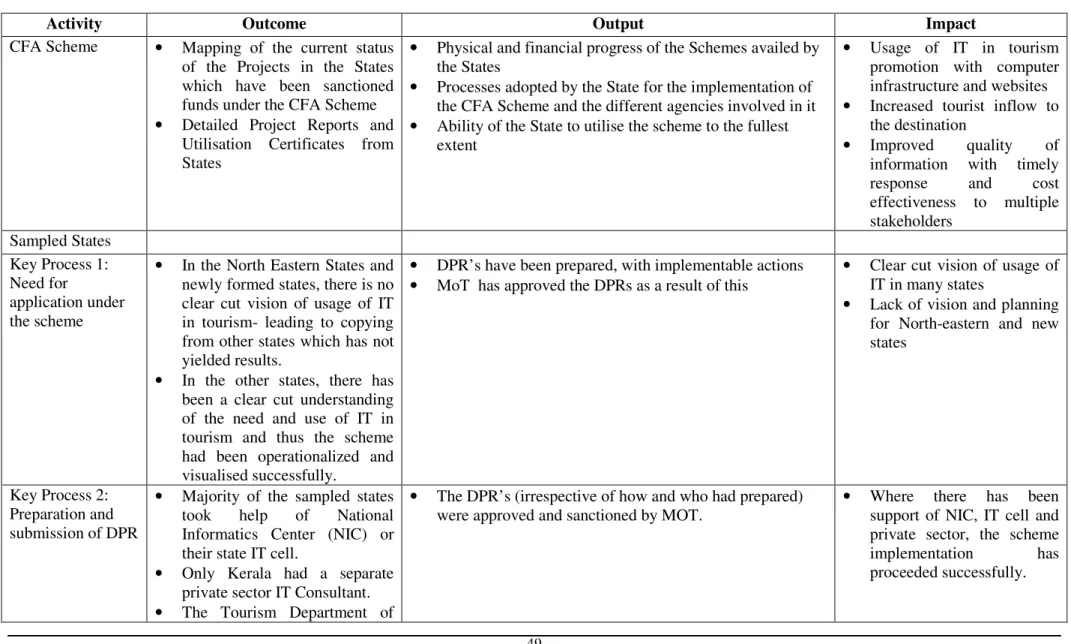
Log Frame Analysis
The following is the log frame of the CFA scheme for the sampled 10 states, which reflects the outcome of the scheme as collected from primary and secondary survey.
Activity Outcome Output Impact
CFA Scheme ⢠Mapping of the current status of the Projects in the States which have been sanctioned funds under the CFA Scheme
⢠Detailed Project Reports and
Utilisation Certificates from States
⢠Physical and financial progress of the Schemes availed by the States
⢠Processes adopted by the State for the
implementation of the CFA Scheme and the different agencies involved in it
⢠Ability of the State to utilise the scheme to the
fullest extent
⢠Usage of IT in tourism promotion with computer infrastructure and websites
⢠Increased tourist inflow to the
destination
⢠Improved quality of information
with timely response and cost effectiveness to multiple stakeholders Sampled States Key Process 1: Need for application under the scheme
⢠In the North Eastern States and
newly formed states, there is no clear cut vision of usage of IT in tourism- leading to copying from other states which has not yielded results.
⢠In the other states, there has
been a clear cut understanding of the need and use of IT in tourism and thus the scheme had been operationalized and visualised successfully.
⢠DPRâs have been prepared, with implementable
actions
⢠MoT has approved the DPRs as a result of this
⢠Clear cut vision of usage of IT in
many states
⢠Lack of vision and planning for
North eastern and new states
Key Process 2: Preparation and
⢠Majority of the sampled states
took help of National
⢠The DPRâs (irrespective of how and who had
prepared) were approved and sanctioned by
⢠Where there has been support of
Activity Outcome Output Impact
their state IT cell.
⢠Only Kerala had a separate
private sector IT Consultant.
⢠The Tourism Department of
North Eastern and newly formed states had prepared the DPR, thus, not been able to visualisation of needs
proceeded successfully.
Key Process 3: Grant Management for the fiscal year
⢠Usually, the projects were
sanctioned in a particular year; funds released in the subsequent year and were completed over the next 2 years.
⢠If it a computer infrastructure project, the grant
management is being completed within a year while for others like website and walkthroughs, the project extends between 2-3 years.
⢠Immediate impact is not felt, will
take time.
Key Process 4: Implementing the DPR
⢠For each state, the State Tourism Department is the disbursing agency while there are other implementing agencies
⢠The action points in the DPRâs are being implemented
⢠Lack of training has been cited as one of the major reasons for partial functioning of the implemented project.
Key Process 5: Monitoring
⢠There is no monitoring from the MoT. The NIC and the IT cell usually are overworked and is usually not a part of monitoring.
⢠The State tourism depts lack
the required qualified manpower and capacities to do the monitoring
⢠Lack of monitoring is leading to time overrun ( thus cost overrun), technology obsolescence
⢠If monitoring were done periodically, it would have resulted in better utilisation of funds and resources- e.g. the photo CD of J&K need not have been produced since the technology has changed between the project approval and implementation phase
Activity Outcome Output Impact Key Process 7: Involvement of MoT ⢠This is limited to DPR sanctioning phase.
⢠There is usually said to be monitoring by the
India Tourism offices. But effective monitoring is not there.
Overall analysis of the Scheme
⢠The scheme has been beneficial
to the State tourism for implementing IT is tourism. Since the amount is small and is less than Rs 50 lakhs, usually there is also no delay from the State govt for the release of the State share.
⢠But the gaps arise in
visualisation of IT in tourism, translating this into DPRâs and implementing it. In case of a clear cut vision, the scheme also has been completed successfully.
⢠The South, West and Central region has
implemented the scheme successfully while North East and in J&K still has not been able to frame the vision of usage of IT in tourism, thus the projects are getting delayed and are
incomplete.
⢠There has been an increased
awareness and setting up of IT infrastructure and services across India. This status needs to be reflected in the next plan period with flexibility for inclusion of new technology.
Questionnaire to the remaining 17 states
An email was sent to understand the usage of IT posing as a tourist.
There was no response from any of the states regarding the status of the scheme.
No information about the details of the scheme was received by the Study team.
In a Government setup, it becomes very difficult to respond to issues like scheme financials etc through emails. But there could have been a query on the nature of the email and this could have been taken further. This may also be because, these emails are going to the web administrators who are not key functionaries of the Tourism Department in the respective states
From the above log frame, we can see that there has been an impact of the CFA scheme on the usage of IT in tourism. In the new states like Chhattisgarh and Jharkhand, infrastructure has been built up but in states of the North East, there are still problems in the implementation because they have not been able to conceptualise the project components in the proper way. Training has not been imparted to the personnel, thus forcing the departments to rely on external agencies for DPR preparation.
In the Southern States, there has been effective and efficient utilization of money under the CFA Scheme. The Kerala Tourism Department has taken an IT consultant who is a leader in the creative arena, thus treating the web as another medium of communication. They have been able to find the correct message for the website developed. The Kerala Tourism website has got international recognition. There is weekly and daily server analytics generated which are sent at the end of the week to the concerned heads. This helps in constant monitoring enabling the website to stay on top of search engine optimization by coming in within the first 5 hits displayed. The website is never allowed to dip more than this in the SEOâs.
In Andhra Pradesh, the two projects have been completed while funds are awaited from the State govt for hardware purchase which is expected to be completed at the earliest. In addition, the states in Southern India have imparted training to their personnel and have monitored the quality of the product and process.
In Western states like Maharashtra and Gujarat, CFA has been utilised to a great extent. The authorization required from ASI has delayed the project in Gujarat while Maharashtra has completed the projects. They have also trained their personnel.
In Northern India, Jammu and Kashmir has delayed in the production of photo CDâs. The present project of networking is also being delayed because of lack of clarity about the requirements. In Uttarakhand, the projects have been completed successfully. Since the implementation agencies were commercial bodies, there has been constant monitoring in the quality of the product.
It can be seen that encouragement in the form of awards and recognition for the best performing states would also ensure that there is a healthy spirit of competition. This would also be an enabler for states to innovate, which would encourage dissemination of learning that can be gained from each such success story.
Suggestions / Recommendations
⢠In the case of IT, there is regular up gradation of technology. There should be space for the
emerging new technologies. The technologies to be included can be decided by an expert technical panel, advertising and communication agencies. This would help in meeting the requirements of the industry and be effective for every major stakeholder.
⢠In the CFA guideline, the paragraph concerning production of CD-ROMs can be reworded as
follows
- âWhich is good for carrying interactive contents like interactive Multimedia,
- âMovies on DVD format: DVDs can be used for distributing content like
advertisement movies, promotional movies, documentaries, documentation of cultural programme etc.â
⢠Sponsored title is not defined in CFA. This has been successfully implemented by the Kerala
tourism department and can go towards accelerating the production of quality communication materials. Sponsored means product developed by a third party and partially funded or sponsored by the state department of tourism. The copyright holder of the product will sell it in the market to recover his/her cost and profit. Normally the tourism department gives only less than half of the cost. The producer supplies copies to sponsoring agency at concessional prices in addition to predetermined number of voucher copies. (Normally 50 or 100 copies).
⢠In addition, there can be a tier system for the States who have implemented CFA scheme. The
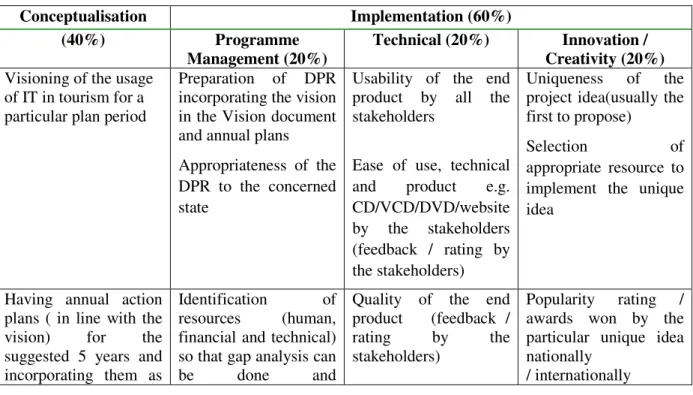
states can be classified on the basis of the performance as Tier 1, Tier 2 and Tier 3. The following are the components for the classification of states. The parameters for conceptualisation would have a rating of 40% while that for implementation could have 60%
weightage. In Implementation, Programme Management, Technical aspects and
Innovation/creativity would also be assessed. The parameters are given below.
Conceptualisation Implementation (60%)
(40%) Programme
Management (20%)
Technical (20%) Innovation / Creativity (20%)
Visioning of the usage of IT in tourism for a particular plan period
â¢Preparation of DPR
incorporating the vision in the Vision document and annual plans
â¢Appropriateness of the DPR to the concerned state
⢠Usability of the end product
by all the stakeholders
⢠Ease of use, technical and
product for ex
CD/VCD/DVD/website by the stakeholders(feedback / rating by the stakeholders)
⢠Uniqueness of the
project idea(usually the first to propose)
⢠Selection of
appropriate resource to implement the unique idea
Breaking down this
Vision document into
annual plans for the suggested 5 years and incorporating them as DPR so that continuation
of the vision is
ensured.(This would help in ensuring that the technology also does not become outdated)
⢠Identification of
resources (human,
financial and technical) so that gap analysis can be done and appropriate remedial actions taken
⢠Preparation of project
schedule with the
finalised resources
Quality of the end product (feedback / rating by the stakeholders)
Popularity rating / awards won by the particular unique idea nationally
/internationally
Programme
implementation within
the specified time period and budget
Appropriateness of the end product to the stateâs IT in tourism
Financial Management of
the project with
Completion certificate
and utilisation certificate released by the concerned state department
Cost effectiveness of the end product ( how many years can that product be used, how many technological changes can it survive etc when used among the diff stake holders)
For the above, MoT should also ensure timely sanction of the DPR and the timely release of the sanctioned amount under CFA.
Thus the states which is ranked by MoT and gets within a range of 75-100% should come in the Tier 1 category. Tier 2 states would have 50-75 % rating while Tier 3 would have a rating of 25-50% respectively.
⢠Many states have not availed the CFA scheme for IT properly because there is a lack of vision
about the themes to be considered, thus, leading to copying from other states. For example, Assam had copied elements of Kerala but was not successful in implementation of the DPR effectively. There should be awareness about the best practices and adoption of the same.
⢠Information displayed on the state websites should be updated. There should be correct email
addresses and contact numbers provided for the same. These should also be monitored by the MoT.
⢠To encourage the states to adopt the best IT practices, a scheme of presenting awards to
outstanding States may be started.
⢠In many cases, lack of training on computer usage has been a bottleneck in effective outcome
of the scheme. Thus basic hardware and software training on the selected packages should be provided by the State Government as part of CFA Scheme grant proposal. Thus, the CFA scheme proposal by the State Government should also contain the training budget.
⢠In addition, all the promotional material developed under the CFA Scheme should also carry
the incredible India logo. This would help in popularizing the website without additional expenditure.
⢠The CFA infrastructure built up and the service provided to the key target group i.e. Tourists
need to be strengthened- there also needs to be training on email etiquette and writing to different target groups.
S2. Efficiency Analysis of India Tourism Office (ITO)
Visits were done to select India Tourism Offices in India. For the others, contact details of the International and domestic India Tourism offices were downloaded from the Incredible India website. An email was sent to the international and domestic ITOâs explaining the purpose of the particular project, for which the following process was used.
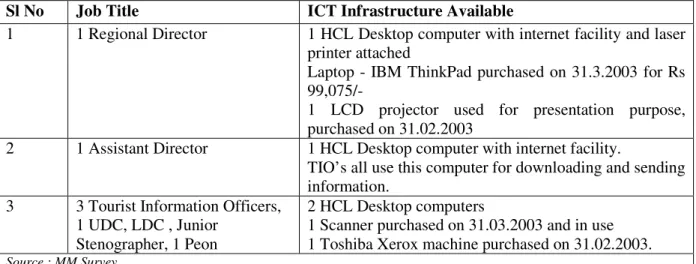
The present administrative setup and the computer infrastructure of the office was mapped vis-Ã -vis the roles and responsibilities of the office and the individual officers. The gap analysis was thus done and suggestions were formulated for remedying the same.
The following matrix was used to identify how computers were used for communication with the different stake holders. This gap analysis was thus done and suggestions were formulated for remedying the same.
Suggestions and Recommendations for Improving the Efficiency of ITO
⢠It can be seen that the ITOs are equipped with computers and other infrastructure. But there
needs to be a clear cut plan on how to take these forward for provision of services to various stakeholders using IT.
⢠The different stakeholders identified were MoT, Regional Directorâs office, State Tourism
departments, Travel and Tour operators, hotel chains and tourists. Majority of the communication is by using letters, faxes/phone calls and after that comes use of computers in the form of IT. Thus the ITOâs are still in the emerging stage of usage of IT.
⢠Port Blair ITO had requested for sending the postal address so that they could send the
brochure. But standardized marketing materials with appropriate images and of appropriate memory could be developed for each state. As and when such enquiries over email come, these can be send as attachments as the response.
⢠In addition, email etiquette and email management should also be inculcated in all the ITOs.
There should be periodic deletion/archiving of old messages so that the mailbox does not display over quota and bounce back the emails. These emails should also be used for incorporation into a database which can be used for sending promotional materials time to time.
⢠There are bottlenecks in top down dissemination of information. For example, MoT sends the
projects selected in each state, grants disbursed etc to the Regional Directorâs Office which ideally should get passed on to the State ITOs. But many a times, information about the projects is not available to the State ITOs. In such a situation, when they are asked to monitor a project, then they can only take the project status from the State Tourism departments. Thus the entire monitoring efforts are not as effective as envisaged. In order to avoid the delay / absence of information, an Intranet can be developed for access by all the employees of MoT. An intranet would help to solve all these problems effectively and efficiently.
⢠Digital signatures provide legal status to emails. Thus the correspondence and communication
of MoT for the authorization of various projects, documents etc can be done through email if digital signatures are there.
Communication with Stakeholders Percentage
Email usage with Ministry of Tourism
Email usage with State Tourism Dept
Email usage with industry
Email usage with tourists
Total 100%
⢠An e-services portal can be developed for the travel and tour operators and the hoteliers. Thus
they would be able to upload documents, pay fees online, check status online, access notifications and newsletter over email etc. One caveat of this is that physical verification of the travel and tour operators should also be done manually. When the travel and tour operators apply for renewing their status, they can send the financial status and other details over email/mail along with the fees. There should be random checking of travel and tour operators to see if they conform to the norms, office in central commercial location, working during prime office hours through out the year etc.
⢠There is no data backup taken at present. These should be incorporated in the Annual
Maintenance Contract and backups taken in each week/month.
⢠There should be a basic minimum infrastructure that should be decided for each kind of ITO.
Thus state level ITOâs may be provided with digital camera for taking photos for uploading along with the documents.
⢠There should be clear cut plan of phasing out the computer systems that are old. The legacy
systems that are in use reduce the efficiency by increasing the time required for completion of a task. Thus an annual technology evaluation and maintenance plan should be in place.
⢠At present, there is a small IT cell in the MoT Headquarters which needs to be built up. This
can provide the adequate technical support to the states/ITO along with the National Informatics Centre.
⢠A State wise IT plan for each ITO can be made for the next plan period which will help to
prioritise the immediate, medium and long term goals.
⢠There is no clear cut training plan on IT for the employees. Majority of the ITOâs talked of
training given during 2001-02 and not afterwards. Thus the annual budget and plan of MoT should have training plans in place.
⢠There needs to be a grievance / redressal cell for the different stakeholders of the MoT.
S3. Benchmarking for Promotion of E-Governance
Benchmarking is about identifying and measuring best practice processes that work elsewhere and then emulating them. The aim is to reduce duplication by learning from others who have already found the solution. It is about understanding oneâs own websites weaknesses and ccomparison with peers to understand the evolving best practices.
The Ministries/Departments selected by secondary research for a benchmarking evaluation are:
⢠Ministry of Corporate Affairs (MCA)
⢠Ministry of External Affairs (MEA)
⢠Directorate General of Foreign Trade, Ministry of Commerce and Industry (DGFT)
⢠Directorate General of Supply Division, Department of Commerce, Ministry of Commerce
and Industry (DGSD)
⢠Department of Pension & Pensioners Welfare, Ministry of Personnel, Public Grievance &
Pensions (DPPW)
⢠e-Committee, Department of Law and Justice, Ministry of Law and Justice (DLJ)
The criteria of selection of these Ministry / Department were that certain levels of IT application were common to all. These included the use of ICT (Information Communication Technology) for internal communications and administration as well as having a website that displays the principal purpose of the ministry/department.
The E-Readiness in Ministries was classified into Environment and Readiness and Usage. Here, readiness includes two components âinfrastructure readiness and human resource readiness - within the Ministry/ Department.
When doing the efficiency mapping of the ITOs and benchmarking them for e-governance, we can see that the gaps identified in the efficiency analysis of ITOs can be solved by using the e-governance infrastructure.
The following are some of the suggestions/recommendations to achieve comparable e-governance standards:
⢠There needs to be a clear cut vision on how the MoT visualises the usage of IT to transform its
operations, both internally and to the external world.
⢠These vision statements need to be articulated in an readiness plan and setting up of an
e-readiness cell which would be instrumental in taking this vision forward.
⢠Infrastructure readiness like intranet, video conferencing facilities etc needs to be initiated at
the earliest and can be taken forward in the next plan period.
⢠Human resource readiness is one of the most important parameters which will ensure
achieving greater impact and sustaining the e-governance efforts. These needs to be taken forward in a systematic way ensuring that as a Government organisation, there is equity and equality for the personnel and its different stakeholders. Thus, for the human readiness, there should be an annual training plan, not restricted to grades.
S4. Benchmarking against International Websites
The following are the websites which have been selected for benchmarking against the Ministry of Tourism, Government of Indiaâs site www.incredibleindia.org. They are Uniquely Singapore (http://www.visitsingapore.com) of the Singapore Tourism Board (STB), Tourism Malaysia (http://travel.tourism.gov.my/en/) of the Malaysia Tourism Promotion Board (MTPB), Dubai Tourism (http://www.dubaitourism.ae) of the Dubai Government's Department of Tourism & Commerce Marketing (DTCM).
They have been selected on the basis of the feedback of the tourists who have considered them to be very good sites. The criteria of selection were that these websites were also created by comparable Government agencies of South East Asia having similar culture and have a very successful track record of using websites in increasing tourist inflow.
There two major approaches of benchmarking are as follows:
⢠Manual Benchmarking which uses manual techniques such as questionnaires, usability studies, etc.
Manual benchmarking used open ended questionnaires to collect data from the various stake holders like hotels, travel and tour operators, associations and tourists to capture the responses. The database of the hotels, travel and tour operators etc were downloaded from the Incredible India website.
⢠Automated Benchmarking uses software tools available on the net to support benchmarking. This
follows the approach of using online tools from the Internet to assess the web pages of each of the above mentioned websites.
These online tools were selected from the website of UKOLN, a research organization based in University of Bath in United Kingdom (http://www.ukoln.ac.uk/) that aims to inform practice and influence policy in the areas of: digital libraries, information systems, bibliographic management, and web technologies.
The tool NetMechanic: (http://www.netmechanic.com) was used to analyse and compare the above websites. NetMechanic is a web-based service for checking web sites where various functions are available for free and additional functions such as more comprehensive testing are licensed.
The following are the outcome of the above approaches.
Multiple Stakeholder Recommendations
⢠The Incredible India website is not known to majority of the domestic tourists. Majority of the
foreign tourists had referred to the Lonely Planet Guides and other commercial websites to get an understanding of India as a destination.
⢠Respondents said that even though the pictures were attractive, there was no correlation
between the images and the text. In addition, the themes were cluttered, scattered and confusing. The following is some of the few suggestions to bring about coherence.
⢠Respondents said that even though the pictures were attractive, there was no correlation
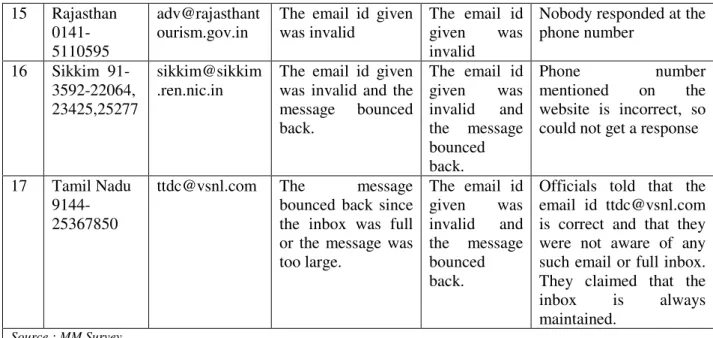
⢠The emails sent to the State Tourism offices of Sikkim, Rajasthan, Karnataka, Andhra
Pradesh, Madhya Pradesh, Maharashtra and Meghalaya failed since the email id was wrong. These email ids were taken from the State tourism websites as provided in the Incredible India website. (The email responses are attached as Annexure 1). In addition, the contact details of the travel and tour operators given in the Incredible India website had also changed. These were the information that are of primary importance to tourists and which need to be updated and monitored regularly.
⢠Opinion of independent consultants was that Incredible India is a very powerful website with
links of more than a lakh people. They opined that the number of links in the Incredible India website makes it so powerful that even if search engine optimization is not done, the website would rank first in the results of many search engines like Google, yahoo etc. This inherent strength needs to be tapped effectively and efficiently.
⢠Themes in the home page need to be arranged more coherently. Within India, all the states
have websites which have been developed independently. These website offers can be put on the Incredible India website as showcase of the month.
⢠For foreign tourists, weather is a major consideration- this could be included in the website.
⢠The website also does not feature a calendar of events in the major cities of India. This can be
helpful in promoting State Tourism efforts along with promotion of destinations attractions.
⢠There contact details of the domestic India Tourism offices can be displayed prominently in
the website as a banner. This would help the tourists get further information.
⢠In addition, contests can be held for best photos, best write ups, best video etc shot by the
tourists while on holiday. This would help in popularising the website further.
⢠There can be a feedback section wherein the tourists can write in to share their experiences of
India.
⢠There can also be a dedicated TV channel showcasing the videos developed by the different
states under the CFA scheme.
⢠A seasonal calendar of festivals can be developed which will help to showcase each state with
that festival. These help to generate and keep up an interest in the websites.
⢠There needs to be a cross cutting across departments. For e.g. sale of various handloom
articles from different states can be showcased in the website, which would lead to associational branding.
⢠A link to the important related information such as hotels, travel agents etc may be considered
on the Incredible India website.
⢠Incredible India campaign as a website needs to vision on the brand, positioning and the
multiple channels of communication like print, web etc. The web should be seen as a creative communication medium rather than as purely technical.
⢠Since the Incredible India website was given to an external consultant for redesigning the
website, the Incredible India website was static and had not changed its look for the past 3 months. At present, after the redesigning, there should be adequate and timely monitoring of the look of the website which will enable it to be dynamic.
⢠In addition, many of the States have designed their websites innovatively. MoT can also draw
upon the best practices of the States concentrating on the creative aspect. Technical Suggestions
⢠The web page should not be more than 2 screenfuls in length. If it exceeds these criteria, it
should be broken down. Since many of the present images are heavy, they need to be broken down into several smaller pages.
⢠The detailed report contained the name of the images and was marked in red. These indicated
that they were very large. They can be checked to see if the file sizes can be reduced.
⢠Some of the images can be reduced to get highest rating.
⢠To get a 5 star score in the Automated Benchmarking online tool, it is mandatory to keep the
size of the web page and its entire graphics below 40K bytes, connecting to only one Web server, and keeping the web page free of HTML errors. The home page had 17 images with a total size of 128K bytes.
⢠It is also required that the server analytics be gathered to see from which of the states and the
international countries is the most hits being generated. These should be monitored continuously and appropriate tools developed for increasing the tourism inflow.
1
Introduction
1.1 The Project
The Ministry of Tourism (MoT) is the nodal agency for the development and promotion of tourism in India. It formulates national policies and programmes and co-ordinates activities of various Central Government Agencies, State Governments/UTs and the Private Sector.
Ministry of Tourism has been involved in implementing the Scheme of Central Financial Assistance (CFA) for Information Technology (IT) Projects for the various states during the 10th Five year plan. The Market Research (MR) Division of Ministry of Tourism, Government of India had assigned
Mott MacDonald to conduct the Evaluation study of the plan scheme assistance for modification / improvement of the CFA scheme during the 11th Five year plan.
1.2 Scope of Work
The scope of work for the study was as follows:
⢠To evaluate the extent to which the CFA scheme has contributed in improving the efficiency of
Ministry of Tourism headquarters office and overseas and domestic offices of India Tourism
⢠To evaluate the extent of Central Financial Assistance availed by States/UTâs under the scheme and
the impact of resultant IT facilities / infrastructure in promoting tourism in respective states / UTs. In this connection, the States of Andhra Pradesh, Arunachal Pradesh, Uttarakhand and Maharashtra were visited. The India Tourism Offices located in these States were to be visited.
⢠To make recommendations, based on the findings of the evaluation for bringing about
improvements / modifications in the scheme, inter-alia for â
o Further increasing the efficiency of Ministryâs Offices
o Promoting e-governance, particularly in comparison with other leading Ministries /
Departments of Government of India in this respect
o Encouraging States, UTs to use IT for promoting tourism and enhancing their tourism
potential
1.3 Approach and Methodology
Our overall approach for the entire project was as follows:
⢠Understood the project and needs of the client thoroughly
⢠Mobilised and used a multi-disciplinary team of appropriate personnel with adequate qualification
and experience in the field
⢠Designed a framework for the evaluation of the various aspects of the scheme and conducted field
surveys to collect information required for the Evaluation framework and prepared an evaluation report
⢠Established and maintained close contact with the client and other stakeholders during the project
period and took their inputs and constant feedbacks in achieving the project objectives
During the 10th Five year plan (from 2002-03 to 2006-07), 27 states have availed of the benefits under the CFA Scheme with a total disbursal from MoT of Rs 1349.54 Lakhs,The sample for the study covered 10 states in the 5 regions of North, South, East, West and Central region. The selection of the 4 states of Maharashtra, Arunachal Pradesh, Andhra Pradesh and Uttarakhand was mandatory (as mentioned in the ToR). In addition, the 6 states of Assam, Chattisgarh, Gujarat, Jammu and Kashmir, Jharkhand and Kerala were also selected. The criteria for selection of the remaining 6 states were that these states had availed of the CFA scheme in 2005-06 and/or 2006-07 and a substantial amount of assistance under this scheme was disbursed to them.
1.4 Report Format and Chapterisation
The Report has been compiled in the following format so as to bring about a logical flow in data presentation followed by comprehensive analysis and conclusions drawn from the same. The Main Report consists of 4 chapters as follows.
Chapter Contents
Chapter 1 Introduction
Chapter 2 Evaluation of Central Financial Assistance Scheme
Chapter 3 Region Based Analysis of CFA Scheme
Chapter 4 Efficiency Analysis of India Tourism Office
2
Evaluation of Central Financial Assistance Scheme
2.1 Aims and Objectives of the CFA Scheme
The Ministry of Tourism, Government of India has undertaken major initiatives in the field of Information Technology with a view to benefit the tourists with the following aims:
a) To bring improvement and efficiency of Government of India Tourist Offices and the Ministry Headquarters;
b) To provide improved & quality information to tourists; and
c) To provide improved tourist facilitation.
To encourage the State Tourism Departments to take major IT initiatives for improved tourist information and facilitation as well as marketing and publicizing their tourist products, Central Financial Assistance for IT was formulated. It aimed to extend assistance to the State/UT Governments to enable them to adopt widespread use of Information Technology in their tourism products and services comprising publicity, promotion and marketing etc. Under this scheme, assistance of upto 50% of the IT project has been given to the State/UT Governments subject to the following conditions:
⢠The CFA on IT projects is on a 50:50 basis. The CFA was restricted to an annual ceiling of
Rs.75 lakhs (later changed to Rs 50 lakhs) for each state/UT irrespective of number of projects. 90% of the central component will be released as 1st installment.
⢠The State/UT Governments have to submit their IT proposals for Central Financial Assistance
by 30th of October for consideration during the financial year.
⢠State/UT Governments have to give a write up on the scope and benefits of the project duly
supported by a project/feasibility report preferably prepared by a professional agency/organization. An officer not below the rank of Director Tourism should certify the project report.
⢠The project should be supported in revised Form âPâ with full details of the Hardware/Software
to be procured/developed and terms and conditions of the procurement and how itâs going to benefit the state. The State/UT Government should clearly mention the cost of the project with state share, schedule of implementation, implementing agency, date of completion and method of funding.
⢠The State/UT Government shall bear all expenses for the operation and maintenance including
recurring charges of the project and a prescribed undertaking to this effect should be sent along with the proposal.
⢠The State/UT Governments should ensure that the details of the hardware/software
components submitted with the project should remain the same at the time of actual procurement. If there are any changes in the procurement prior approval of Ministry of Tourism has to be obtained before procurement of hardware/software.
⢠Central Financial Assistance, up to 90% of the share of the Ministry of Tourism, GOI, will be
released to the State/UT Government as an advance subject to the production of a proof for placement of order for procurement/development of Hardware/Software. The balance amount of the Central Financial Assistance in full will be released to the State/UT Governments on production of proof of formalities followed, copy of placement order, completion certificate and production of proof of utilization of funds for the purpose for which it was released.
⢠Special assistance (100%) to new states and north eastern states on case to case basis with
approval of Secretary (Tourism).
The following ceiling has been proposed under the CFA for different items
i) Production of CD/VCD/DVD : Rs.10 Lakhs
Maximum number of topics/themes allowed : Five
No. of copies of CD/VCD/DVD : 5000
Additional copies for participation in Intâl tourism fairs : 5000 ii) Preparation of CDs/VCDâs on culture, traditional art forms : Rs. 7 Lakhs
No of themes allowed during a financial year : Five
No of copies of CDs/VCDâs : 5000
Additional copies for participation in Intâl tourism fairs : 5000 iii) Sponsored CD/VCD/DVD on culture, traditional art forms : Rs. 5 Lakhs
No of themes allowed during a financial year : Five
No of copies for CD/VCD/DVD : 5000
Additional copies for participation in Intâl tourism fairs : 5000
iv) Web-Sites
Launching of Tourism Portals : Rs.10 Lakhs
Revamping of existing sites/translation in foreign languages : Rs. 10 Lakhs (v) Remote Sensing Facility, HARK etc.
Remote Sensing equipment at each monument : Rs.15Lakhs
HARK system for each monument : Rs. 15Lakhs
(vi) IVRS
IVRS facility for each connection : Rs. 5 Lakhs
Information Kiosk for each site (5 at one site) : Rs. 10 Lakhs
17. State/UT wise ceiling: Rs. 75 lakhs during a financial year as central component relaxable for deserving cases with the approval of the competent authority and subject to availability of funds.
18. Year Wise ceiling for each States/UTs : Rs. 75 Lakhs
19. Special assistance to New and North East States would be 100% on case-to-case basis.
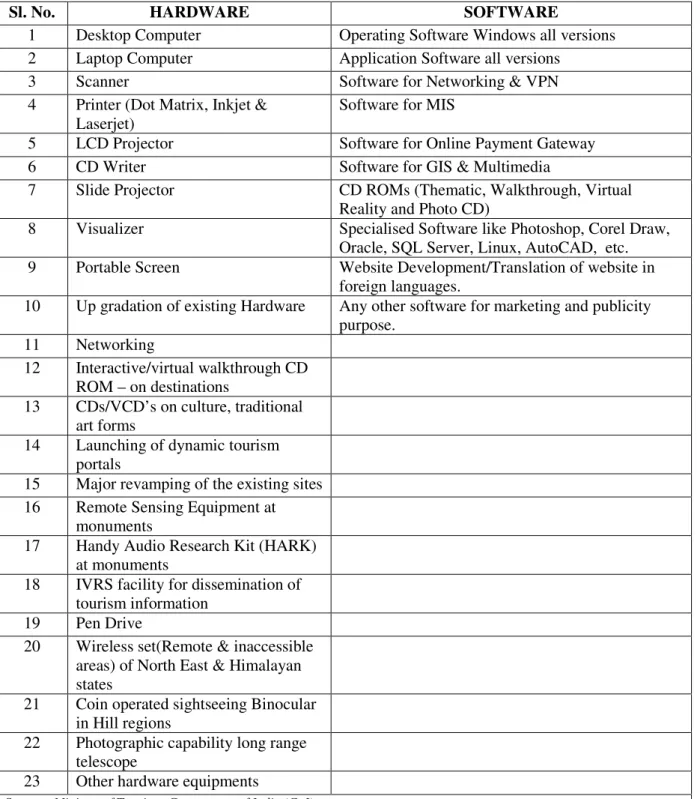
The details of Hardware and Software to be considered for Central Financial Assistance under this scheme are detailed in Table 2.1.
Table 2.1: Details of Hardware and Software allowed under the CFA Scheme
Sl. No. HARDWARE SOFTWARE
1 Desktop Computer Operating Software Windows all versions
2 Laptop Computer Application Software all versions
3 Scanner Software for Networking & VPN
4 Printer (Dot Matrix, Inkjet & Laserjet)
Software for MIS
5 LCD Projector Software for Online Payment Gateway
6 CD Writer Software for GIS & Multimedia
7 Slide Projector CD ROMs (Thematic, Walkthrough, Virtual
Reality and Photo CD)
8 Visualizer Specialised Software like Photoshop, Corel Draw,
Oracle, SQL Server, Linux, AutoCAD, etc.
9 Portable Screen Website Development/Translation of website in
foreign languages.
10 Up gradation of existing Hardware Any other software for marketing and publicity purpose. 11 Networking 12 Interactive/virtual walkthrough CD ROM â on destinations 13 CDs/VCDâs on culture, traditional art forms
14 Launching of dynamic tourism
portals
15 Major revamping of the existing sites
16 Remote Sensing Equipment at
monuments
17 Handy Audio Research Kit (HARK)
at monuments
18 IVRS facility for dissemination of tourism information
19 Pen Drive
20 Wireless set(Remote & inaccessible areas) of North East & Himalayan states
21 Coin operated sightseeing Binocular in Hill regions
22 Photographic capability long range telescope
23 Other hardware equipments
2.2 Sampling Plan for Primary survey for the study
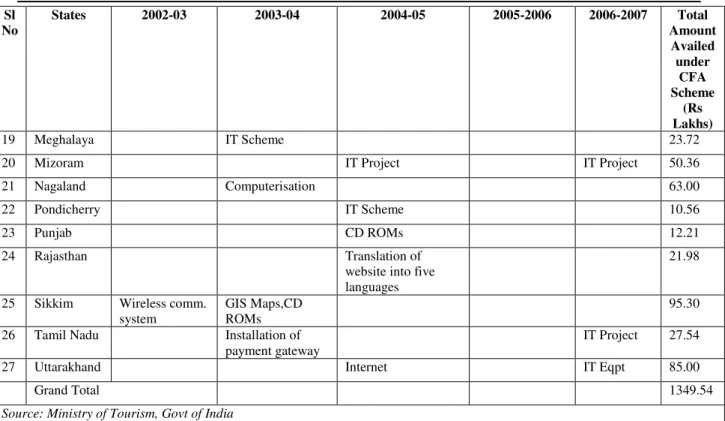
Table 2.2 lists the states that have availed of the benefits under the CFA Scheme. Between 2002-03 to 2006-07, 27 states had availed of the benefits under the CFA Scheme with a total disbursal of Rs 1349.54 Lakhs. (Source: Ministry of Tourism, Govt of India)
Table 2.2: Year wise Beneficiary States under the CFA Scheme Sl No States 2002-03 2003-04 2004-05 2005-2006 2006-2007 Total Amount Availed under CFA Scheme (Rs Lakhs) 1 Andhra Pradesh Vista Software, CD's E-Commerce Portal 111.71 2 Arunachal Pradesh Computerisation IT Scheme 70.00 3 Assam IT Project 43.00 4 Bihar Computers, Printers, LCD,UPS Purchases 13.38 5 Chhattisgarh IT Eqpts Procurement IT Schemes Digital Walkthrough 111.43 6 Dadar & Nagar Haveli IT Scheme 18.64 7 Daman and Diu CDROM,Multimedia Information Kiosk 4.05 8 Delhi Computerisation of DTTDC Revision of existing website 56.18 9 Gujarat IT Project 41.33 10 Haryana Installation of Multimedia Kiosk, CD/VCD,CDROM 15.00 11 Himachal Pradesh Up gradation on website Prodn CD,VCD 20.00 12 Jammu and Kashmir
Photo and CD IT Scheme 57.64
13 Jharkhand CD,Website,
Info Kiosks
44.19 14 Karnataka IT Infrastructure,
handy reach audio kit, IT Eqpt for jungle resorts and lodge
32.00
15 Kerala CD's and VCD's IT Schemes, IT Project Translation of websites, audio CD and interactive tool on mktg,VCDS 92.30
Sl No States 2002-03 2003-04 2004-05 2005-2006 2006-2007 Total Amount Availed under CFA Scheme (Rs Lakhs) 19 Meghalaya IT Scheme 23.72
20 Mizoram IT Project IT Project 50.36
21 Nagaland Computerisation 63.00
22 Pondicherry IT Scheme 10.56
23 Punjab CD ROMs 12.21
24 Rajasthan Translation of
website into five languages
21.98 25 Sikkim Wireless comm.
system
GIS Maps,CD ROMs
95.30 26 Tamil Nadu Installation of
payment gateway
IT Project 27.54
27 Uttarakhand Internet IT Eqpt 85.00
Grand Total 1349.54
Source: Ministry of Tourism, Govt of India
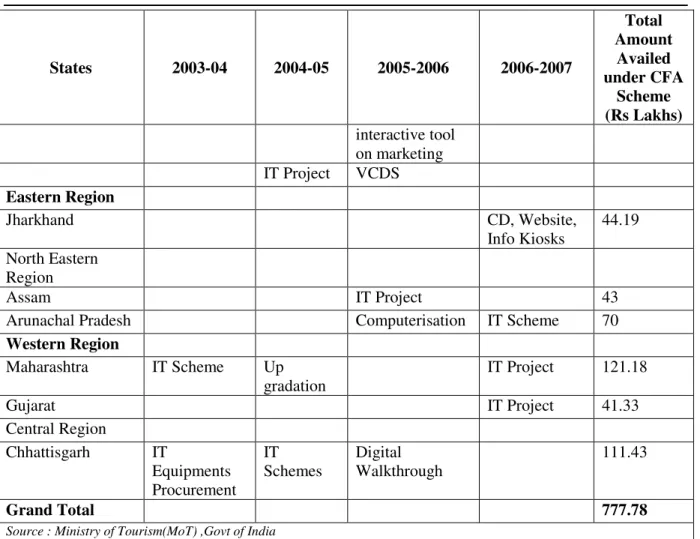
For the primary survey, our study team covered 10 states in the 5 regions of North, South, East, West and Central India. The selection of the 4 states of Maharashtra, Arunachal Pradesh, Andhra Pradesh and Uttarakhand was mandatory (as mentioned in the ToR at the proposal stage).The criterion for selection of the remaining 6 states was that these states have availed the CFA scheme in 2005-06 and/or 2006-07 and a substantial amount of assistance has been provided. Thus, the remaining 6 states selected were Assam, Chhattisgarh, Gujarat, Jammu and Kashmir, Jharkhand and Kerala. The state-wise sample with the break-up of products and services procured in various years by these select states is as is detailed in Table 2.3.
Table 2.3: Region-wise selected states for Primary Survey
States 2003-04 2004-05 2005-2006 2006-2007 Total Amount Availed under CFA Scheme (Rs Lakhs) Northern Region Jammu and Kashmir Photo and CD IT Scheme 57.64
Uttarakhand Internet IT Equipment 85
Southern Region
Andhra Pradesh Vista
Software E-Commerce Portal 111.71 CD's Kerala CD's and VCD's IT Schemes Translation of websites, audio 92.3
States 2003-04 2004-05 2005-2006 2006-2007 Total Amount Availed under CFA Scheme (Rs Lakhs) interactive tool on marketing IT Project VCDS Eastern Region Jharkhand CD, Website, Info Kiosks 44.19 North Eastern Region Assam IT Project 43
Arunachal Pradesh Computerisation IT Scheme 70
Western Region Maharashtra IT Scheme Up gradation IT Project 121.18 Gujarat IT Project 41.33 Central Region Chhattisgarh IT Equipments Procurement IT Schemes Digital Walkthrough 111.43 Grand Total 777.78
Source : Ministry of Tourism(MoT) ,Govt of India
It can be seen that the selected states have availed the schemes and have gone beyond the basic infrastructural up gradation into procurement of multiple services and products. The other 17 states which have not been included in the sample were contacted electronically by email followed by telephonic interaction. The respondent list for the study is given in Table 2.4.
Table 2.4: Respondent wise contacts for the Primary Survey
Sl No Details No of
Contacts
1 Ministry of Tourism, GoI
IT Cell
Planning Division MR Division International Offices
6
2 State level Department of Tourism ( 2 persons in 10 states) 20
3 5 India Tourism Offices ( Assam, Arunachal Pradesh, Andhra Pradesh,
Kerala and Maharashtra) ( 2 persons in 5 offices)
10
4 Email questionnaires to the 20 domestic India Tourism Offices and 14
International India Tourism Offices
34
7 Tourists-Domestic and Foreign and by purpose (Business & Trade, Leisure & Holiday, Religious & Pilgrimage, Social and Others).
70
8 Related Bodies (All India Resort Development Association, Hotel
Association of India, Federation of Hotel and Restaurant Associations of India, The Travel Agents Association of India (TAAI),Indian Association of Tour Operators (IATO),The International Air Transport Association (IATA),TAFI - Travel Agents Federation of India),Airlines
connectivity(www.makemytrip.com,),Cruise(1)
9
9 Website developers 1
10 Email Questionnaires to the remaining 17 states who had availed the CFA
Scheme
17
Total 237
2.3 Mapping of CFA Scheme Process of Ministry of Tourism, Government of India The following is an understanding of the processes that are being carried out by the Ministry of Tourism as part of the fund disbursal under the CFA Scheme. The Planning Division of the MoT is the key division that handles the CFA Scheme. The State Governments apply to the Planning Division with Detailed Project Report (DPR). These are evaluated by the MoT and clarifications, if any, are sought from the State Tourism Departments. The following section details the processes followed by the MoT.
2.3.1 Key Process 1: Promoting CFA Scheme to the States
MoT does not carry out any annual promotion of the schemes among the States / UTâs. The circular announcing the scheme and the guidelines is sent to the concerned Secretary (Tourism) of the State government which is then sent by the Secretary to the concerned implementing agencies of the State Government.
2.3.2 Key Process 2: Advising to States during DPR preparation
A prioritisation meeting is held with the State governments wherein the discussion focuses on the themes and the activities selected for the year. The outcome of this meeting is the selection of themes for the various projects to be developed by the State Govt under various schemes. These would be developed in details as the Detailed Project Report (DPR) by the various implementing agencies. 2.3.3 Key Process 3: Assessing DPRs submitted by States
There are mandatory requirements for each application from the States like Detailed Project Report, completed Form C along with checklist, Form (D) for equipment and Detailed Cost Estimates (DCE). If some of these documents are not attached or the documents are not explanatory, then MoT writes to the states for clarifying and resending the same.
2.3.4 Key Process 4: Announcing successful and unsuccessful States
Usually all the states that apply under various heads of the CFA scheme, have availed the benefit of the scheme. But there maybe clarifications which are asked for when states submit DPRs as explained above, which may lead to delays in sanctioning and releasing the amount.
2.3.5 Key Process 5: Monitoring the CFA Scheme Implementation
On receipt of the fund from MoT, the States send in the Utilisation Certificate and the Completion Certificate and these are considered as the indicators for the physical and financial progress of the projects sanctioned under the Scheme. In addition, the India Tourism Offices at each state also do routine monitoring of the multiple schemes.
2.3.6 Key Process 6: Concluding the CFA Scheme for a State for a year
When the MoT receives the Completion Certificate and Utilization Certificate for a sanctioned project from the concerned State Governments, the particular project is considered to be closed. While a particular project has been sanctioned and is being implemented, MoT can sanction another project for succeeding year under the scheme.
2.4 CFA Scheme Implementation - Sampled States
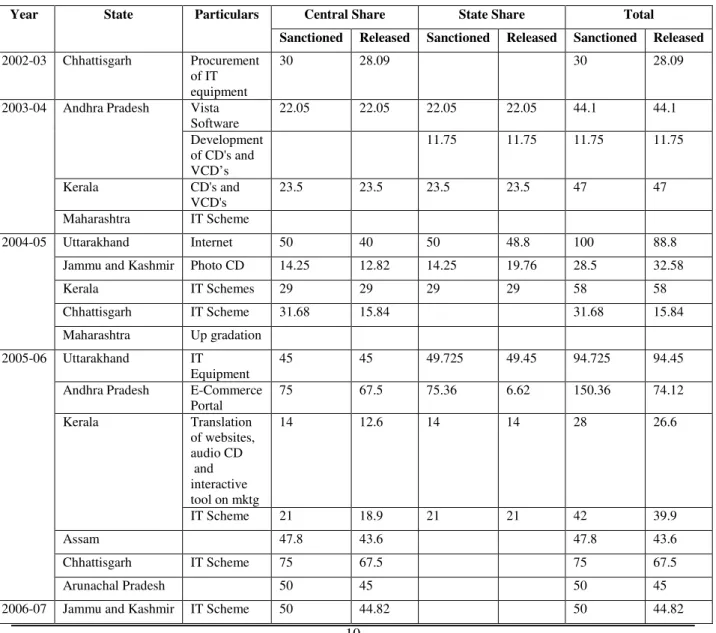
Table 2.5 summarises the activities undertaken, funds sanctioned and released by both the GOI and State Governments under the scheme.
Table 2.5: Scheme Implementation in Sampled States (Rs in Lakhs)
Central Share State Share Total
Year State Particulars
Sanctioned Released Sanctioned Released Sanctioned Released 2002-03 Chhattisgarh Procurement of IT equipment 30 28.09 30 28.09 Vista Software 22.05 22.05 22.05 22.05 44.1 44.1 Andhra Pradesh Development of CD's and VCDâs 11.75 11.75 11.75 11.75 Kerala CD's and VCD's 23.5 23.5 23.5 23.5 47 47 2003-04 Maharashtra IT Scheme Uttarakhand Internet 50 40 50 48.8 100 88.8
Jammu and Kashmir Photo CD 14.25 12.82 14.25 19.76 28.5 32.58
Kerala IT Schemes 29 29 29 29 58 58 Chhattisgarh IT Scheme 31.68 15.84 31.68 15.84 2004-05 Maharashtra Up gradation Uttarakhand IT Equipment 45 45 49.725 49.45 94.725 94.45
Andhra Pradesh E-Commerce Portal 75 67.5 75.36 6.62 150.36 74.12 Translation of websites, audio CD and interactive tool on mktg 14 12.6 14 14 28 26.6 Kerala IT Scheme 21 18.9 21 21 42 39.9 2005-06
Arunachal Pradesh CD ROM's 50 25 50 25 Maharashtra IT Project 54.81 49.33 54.81 46.37 109.62 95.7
Jharkhand 49.1 44.19 49.1 44.19
Gujarat 45.92 41.33 45.92 45 91.84 86.33
3
Region Based Analysis of CFA Scheme
3.1 Northern Region
In the Northern Region, the following states were visited by the study team
⢠Uttarakhand
⢠Jammu and Kashmir
3.1.1 Uttarakhand
(i) Key Process 1: Need for Application under the Scheme
Uttarakhand is a new state which was carved out from Uttar Pradesh in November 2001. For tourist facilitation, Uttarakhand Government has been maintaining a chain of tourist rest houses through Garhwal Mandal Vikas Nigam (GMVN) and Kumaon Mandal Vikas Nigam (KMVN) Limited. In order to facilitate services for tourists, it was proposed to create online reservation system for selected guest houses of GMVN & KMVN. Uttarakhand Tourism Development Board is also operating nationwide Public Relation Offices of Uttarakhand under the CFA Scheme. Online booking of accommodation using payment gateways through Credit and Debit cards and provision of customized and packaged tours was planned through the system.
Thus, the objectives of the online reservation system of Guest Houses in Uttarakhand were articulated by the State Government as follows:
⢠To help tourists with travel plans in an organized way ⢠Developing the thinking of Book Now and Save Big ⢠Assimilation of data for administration and governance
⢠Encouraging travelling and promote national integration and international peace ⢠Awareness and acquaintance of the staff with modern information technology tools ⢠A platform for open expression and exchange of ideas for tourism related activities ⢠Achieving professionalism in tourism
⢠Reinforcing confidence of tourists towards Uttarakhand and India as a preferred holiday
destination
⢠To improve the internal efficiency and performance of the system
⢠Generating public attention towards tourism in the state and its developmental efforts ⢠To identify/locate potential revenue generating tourist spots in the state
(ii) Key Process 2: Preparation and submission of DPR
The tourism activities are co-ordinated by UTDB (Uttarakhand Tourism Development Board) which is the state Govt body while there were two implementing agencies- Garhwal Mandal Vikas Nigam Ltd
The UTDB (Uttarakhand Tourism Development Board) along with present GMVN and KMVN discussed the priority areas for the state for the CFA Scheme. The DPRs were framed by these two entities only with the objective of availing CFA to cover their entire network of offices and guest house facilities.
In case of Garhwal Mandal Vikas Nigam (GMVN) the DPR was prepared by National Informatics Centre (NIC), while for Kumaon Mandal Vikas Nigam (KMVN) the DPR was prepared by independent consultants, NIC officials and key resource persons from the Nigams. KMVN had also hired a local survey agency to find out the tourism potential in and around Kumaon region and the slated benefits.
(iii) Key Process 3: Grant Management for the fiscal year
Uttarakhand has availed a total amount of Rs.85 Lakhs under the CFA scheme in the years 2004-05 and 2006-07.
In case of Kumaon Mandal Vikas Nigam Ltd (KMVN), the project has been completed and the utilization and completion certificates have been sent to Ministry of Tourism (MoT) .The detailed central and state components are as follows:
The Central component for KMVN project covers the procurement of the following:
⢠Desktop Computer
⢠Laptop (6 nos) ⢠Hp Laser Printer ⢠Laser Colour Printer ⢠Scanners
⢠UPS 1 KVA
⢠Internet connectivity of VSNL ⢠Cost of software & front office
The State Component for KMVN project accounts for:
⢠Mail Server
⢠Desktop Computer
⢠Printers â 2 nos
⢠UPS 1 KVA
⢠Colour Laser Printer â 1 No
⢠5 KVA UPS â 2 nos
⢠Furniture - Computer Table
⢠Furnishing of Computer rooms at TRC
⢠Cost of software
⢠Internet bandwidth charges
In case of GMVN, although the grant was given to GMVN but the project for networking and computerization was for UTDB, KMVN & GMVN.
The State Component for Networking under GMVN project is as follows:
⢠46 Transit Rest Houses of GMVN & KMVN
⢠13 Offices Of UTDB
⢠19 Public Relation Offices of GMVN & KMVN ⢠2 Central Reservation Offices GMVN & KMVN
The units so computerized are functioning and the online reservation is functioning successfully.
(iv) Key Process 4: Implementing the DPR
After the approval of project and release of fund by MoT and State Govt, tendering and finalization of panel of vendors and rates for computers, communication systems, and application development was undertaken by both the Nigams. Subsequently, vendors were selected through an open tendering process, orders were placed and computers and other communication infrastructure were installed at the proposed sites. Separate agency was also selected for development of application software.
The key phases of the project involved setting up of computers and other equipments at proposed sites (Hardware components), Development of Application Software, Implementation, making them Operational and Managing them. While Info drive E-Solution, Dehradun developed the online booking software; Silicon Media Infocom (a company from Ghaziabad) developed the websites of the GMVN and KMVN.
(v) Key Process 5: Monitoring
Monitoring of work done by the consultants/agencies was overseen by the IT cell in both the Nigams. The website for online booking has shown increased tourist bookings with a simultaneous increase in revenue, thus achieving the objectives set for the project.
Besides, as per KMVN, responsibilities and periodic targets (direct revenue, increase in tourist inflow, etc) are given to the General Selling Agents and other key persons. Their work is directly monitored by the Managing Director who heads the IT cell.
(vi) Key Process 6: Concluding the Scheme for a year/ Present Status
In case of both GMVN and KMVN, the tourists can directly make the booking. As a result the functioning of Central Reservation Centre has reduced considerably. There has been an increase in tourist inflow due to availability of online information leading to revenue generation for the state. Information and facilities for availing packaged and customized tours have also helped tourists to plan their trips in advance. The internal efficiency of the department has also increased with installation of essential hardware like desktop computer, Laptops, Laser colour printers and Scanners.
(vii) Key Process 7: Involvement of MoT
Involvement of MoT has been restricted to sanction of funds for the scheme. There has been no assistance in terms of project planning, preparation or training of staff.
(viii) Overall Analysis of the Scheme
KMVN has effectively utilized the entire fund and completed the project with all its components benefiting the state of Uttarakhand. Besides, tourists have also benefited tremendously. Training to the manpower is given by Uttarakhand Administrative Training Institute. There is computerization in most of the offices, proper billing system, tally package and proper use of server thereby adding on to
In case of KMVN, the tourist arrival increased by 20-25% (from 1 Lakh in 2006-07 to 1.25 lakh in 2007-08). In the financial year 2007-08, Rs 1, 83, 48,000 was earned as tourist revenue. Besi