WORKING PAPERS
L
Debt and International Financeinternationa. Economics Department The World Bank
November 1990 WPS 530
The Menu Approach
to Developing
Country
External
Debt
An Analysis
of Commercial
Banks'
Choice Behavior
Asli Demirguc-Kunt
and
Ishac Diwan
Suppose that each creditor bank to a particular debtor country is
confronted with a choice: each dollar of country debt held can
be either rescheduled or sold at a given price. What choice will
they make? Relatively strong banks will take advantage of a debt
workout to exit from the debt. Relatively weak banks will relend.
The Policy, Research, and Extemal Affairs Complex distributes PRE Working Papers to disseminate the findings of work in progress and to encourage the exchange of ideas among Bank staff and al others interested in development issues. These papers carry the names of the authors, reflect only their views, and should be used and cited accordingly. The findings, interpreations, and conclusions are the authors' own. They should not be attributed to the World Bank, its Board of Directors, its management, or any of its member countries.
Public Disclosure Authorized
Public Disclosure Authorized
Public Disclosure Authorized
Debt and International Flnance
WPS 530
This paper - a product of the Debt and International Finance Division, Intemational Economics Department - is part of a larger effort in PRE to understand bank choices in debt restructurings. Copies
are available free from the World Bank, 1818 H Street NW, Washington, DC 20433. Please contact Sheilah King-Watson, room S8-025, extension 31047 (35 pages).
Demirguc-Kunt and Diwan explore what deter- Brazil rescheduling deal, the first package mines tne choice banks will make when con- specifically based on the menu approach to debt fronted with a "menu" of exit instruments and workouts. Their empirical results statistically new-money options, as is now typical in debt link commercial banks' characteristics to their workouts for developing countries. portfolio choices - with 83 percent
predictabil-ity in this sample. In particular, they examine how deposit
insurance and rules on capital adequacy affect a Among the implications for the new debt commercial bank's exit decision - arguing that reduction strategy:
these exit decisions arc influenced rnainly by the
structure of the banks' balance sheets and by the * Larger debt reductions negotiated on a
regulatory systems within which they operate. market basis are more costly, per unit of debt reduced. To increase debt reduction, weaker The FDIC insurance subsidy is more valu- banks must be persuaded to exit, increasing the able to weak institutions, they argue, so a bank's needed exit price.
valuation of the debt claims it holds is inverseiy
related to the bank's financial strength. For a * The exit price depends on the strength of the given menu, the relatively weak banks choose to banking industry. So the effectiveness (and cost)
relend. of the present debt strategy is affected by
changes in the world economy. In boom periods, The banks that choose to exit are those that banks are stronger and exit prices reduced. are financially "strong" and have relatively high
exposure to the country whose debt is being * Regulators can affect the cost of debt recontracted. Contrary to common belief, bank reduction by altering the regulatory framework size alone does not significantly affect exit within which the banks operate.
behavior.
* )cbt reduction in the developing countries Demirguc-Kunt and Diwan test their results is beneficial to the deposit insurance agencies of using individual banks' choices in the 1988 the major creditor nations.
The PRE Working Paper SPries disseminates the findings of work under way in the Bank's Policy, Research, and Extemal Affairs Complex. An object.ve of the series is togeltthesefindings out quickly, even if presentations are less than fully polished. The findings, interpretations, and conclusions in these papers do not necessarily represent of ficial Bank policy.
by Asli Demirguc-Kunt and Ishac Diwan* Table of Contents 1. Introduction 1
2. The Commercial Banks' Decision-Making Framework 4
2.1 A Simple Model 4
2.2 Banks Choice from a Menu of Options 7
2.3 Characteristics of Exiting Banks 9
3. The B-azil 1988 Refinancing Package 11
4. The Empirical Model 13
4.1 Choice of Proxy Variables 15
4.2 A Parenthesis on Provisioning Policy 17
4.3 Estimation Technique and the Data Set 19
4.4 Estimation Results 22
5. Conclusions 24
Appendix of Proofs 27
Tables 29
References 33
* We would like to thank Izak Atiyas, Stijn Claessen', James Thomson, and Haluk Unal for helpful discussions and Dan Kobb for excellent research assistance.
of the strategy to bring the debt crisis to an end. Recognizing that reduced cohesion between the banks would not allow the concerted lending strategy to go forward, the new approach seeks financing for debt reduction from the
International Financial Institutions while emphasizing the need for voluntary choices among banks between a variety of financial options. Accordingly, recent financing packages (Brazil 1988, Mexico 1989, Philippines 1990, Costa-Rica 1990, Venezuela 1990) have offered a menu of financial
instruments-including exit and relending options- from which individual tanks could
freely choose according to their best interest. 1 Financing packages prepared
following this approach are based on a recognition of the diversity of comnercial banks' incentives and constraints.
An important issue that arises in this context is the determination of banks' characteristics that can explain their choice when presented with a menu of options. In this paper, we address this issue using both
theoretical arguments and an empirical assessment of the Brazil 1988
rescheduling deal--the first package specifically based on the menu approach to debt workouts. Our empirical results link statistically commercial banks' characteristics to their choice of elements of a financing menu.
Absent regulatory and tax considerations and with risk neutrality, the banks' decision rule would be simple. Each bank would choose from the manu the option that is perceived to have the greatest present value. This is
the case made by Williamson (1988) and Cline (1989) who clai. that
differences in expectations between optimist and pessimist banks represent the major distinction between banks that exit and banks that relend. This view however fails to explain why the optimists do not directly buy out the
1
However, the relative pricing of the menu items has remained a concerted exercise.
pessimists.
In this paper, we argue that the exit decision of commercial banks is
mainly influenced by the structure of their balance sheet and by the
regulatory system within which they operate. It is well known that mispriced
deposit insurance (and the safety net in general) subsidizes risk-taking
behavior by banks--especially once a bank's financial position deteriorates
(for example, see Merton [1977], Sharpe [1978], and Kane [1985]). Bank can
increase their value by taking on more risk. They can achieve this by
increasing either asset risk or leverage. We focus on the latter. While leverage is limited by capital adequacy requirements, the book value
application of those requirements creates extra value for claims whose real
value has fallen below book value. In effect, the ownership of such claims
allows banks to over-represent their own capital, thus increasing their
(real) leverage. As a result, banks that sell inherited debt that is treated
at par by regulators lose valuable rights to excess leverage. In our view,
real leverage is determined by history, with random shocks imposing losses on
certain assets and providing at the same time their holders with rights to
"excess leverage", a non tradable asset. Since the FDIC insurance subsidy
(and thus excess leverage) is more valuable to weak institutions, a bank's
valuation of these "excess leverage" rights is inversely related to the
bank's financial strength. This allows us to show that a given menu separates
banks into two groups, with the relatively strong banks exiting, and the
relatively weak banks relending.
Other studies have focused on the effect of the regulatory framework
on the incentives of banks to increase asset risk rather than leverage. The
important distinction between those analyses and ours lies in the assumptions
about the characteristics of assets other than country debt that can be
incentives of small and large banks. He argues that since that large
institutions are subject to preferential treatment by regulators which leads
them to take additional risks (see Kane [1985, 1989] and Kaufman [1985]),
they pr4ier relending over exit relative to smaller banks. Huizinga and Ozler (1990) distinguish between small and large debtor countries. They argue that
insured banks bid up the price of assets that significantly affect their
probability of failure. As a result, the secondary market price of a lar&e
country' debt is larger than that of an otherwise similar, but smaller:
country.
These arguments rely on the assumption that the riskiness of dabt
claims cannot be duplicated by other assets in the market-place. When banks
can also increase risk by acquiring substitute assets rather than by
increasing their country debt exposure, banks' size cannot explain menu choices. Moreover, for the actions of particular banks to have an effect on
the price of particular risk dimensions, monopoly power over certain risk dimensions has to be assumed. Given the small overall size of regulated banks
in the global financial markets, this is however not a particularly appealing
hypothesis. This view would also imply that each bank should specialize in a
certain risk dimension, which we do not observe. Finally, our empirical
investigation rejects the hypotheses according to which exposure (and bank size) are negatively correlated to exit.
In contrast, our analysis neutralizes banks' incentives to increase
asset risk (by assuming that all the securities that can be held in banks'
portfolios are part of the same risk-class) and focuses instead on changes in
real leverage.2 Our main argument is close to those of Sachs and Huizinga
2Another reason for neutralizing the intensity of risk per unit of asset in
the analysis is that the issue about whether asset risk and leverage a;-substitutes or complementary for banks (i.e, whether the marginal valu. of
leverage increases or decreases with asset risk) is unresolved in the banking literature (for both sides of the debate, see Keeley and Furlong [1988] and
(1987) and Bouchet and Hay (1989) who discuss the consequences of book value accounting on exit incentives. They argue that the large money center banks resist exit because debt reduction requires book losses that are costly given their large exposure and weak financial position. We make those statements precise by building a model that characterizes these exit costs.
The rest of the paper is organized as follows: in section 2, we build a model of bank choice behavior that incorporazes deposit insurance and
capital adequacy considerations, and we derive our main results. We describe the Brazil 1988 agreement in section 3 and test our hypotheses about the determinants of bank choices in section 4. The important implications of our results are discussed in section 5.
2. The Commercial Banks' Decision-Making Framework
Suppose that each creditor bank to a particular debtor country is confronted with two options: each dollar of country debt held can be either rescheduled, or sold at a given price. Our goal in this section is to explore the determinants of this choice. To do so, we develop a simple model of
banks' optimal behavior under risk neutrality, focusing on the interaction between mispriced deposit insurance and the book value application of capital adequacy requirements. The model shows that banks with weaker balance sheets and small country exposures tend to prefer relending over exit compared to stronger and to more exposed banks.
2.1 A Simple Model
Consider a simple two periods model of risk neutral banks. Banks differ in the composition of their portfolio of assets. There are N assets
(types of loans) indexed by i. The random return at the end of period t=2 on a dollar (at book value) of loan i is represented by 6'AR. We take the
nominal loan obligation R as given in the analysis. In period tl1, sle[O,l] is known, but A Ae[0,1] is uncertain. However, all participants know A's density and distribution functions f(A) and F(A). This parametrization is
meant to capture the notion that the actual return on each loan depends on a
market factor A as well as a specific factor 6%. 6' can be interpreted as the outcome of the realization of a past shock. We normalize the total book value
of the assets of a representative bank to one, i.e Lo EL' = 1. We denote
by p1 the "fair" value of market risk, i.e p1 = E(AR)/R, and by pii - bip, for
all i, the fair value of loan i, where E(.) represents the expectation
operator and R one plus the risk free interest rate. On the liability side,
banks hold deposits, D. We assume that deposits are insured at a fixed cost,
and that depositors earn the risk free interest rate, R.
The value of a representative bank can be written as a function of L
and D:
Vl(.) - (I/R)Jf [Li6iRA - DR] f(A)dA ; with ELS; - DR (1)
A1
where Al is the state of nature in which the bank fails. When A < A1, the
deposit insurance agency repays the part of deposits the bank defaults on.
It would be helpful in the sequel to rewrite the bank's value
function in terms of the fair value of its assets A, - [EL1p']. Let C1 =
[EL'pl] - D - A1 - D. The variable C1 is often called enterprise-contributed
equity to differentiate it from federally-contributed equity (see Kane (1989)
for a thorough discussion). It is then possible to show that (see appendix 1
3Issues relating to optimal bank size arise with the existence of monopoly
profits in some markets; see Atiyas (1990) for an excellent treatment. For
our purposes however, we abstract from such issues and analyze only the asset
choice per unit of total book value of assets.
4With no loss of generality,
for a derivation): V1 - C1 + I1 ; with (2) - (1/R) } [DR - ELY6RA] f ()dA (3) 0 - (A1/R) |
((1
-kl)R
- (AR/pj)] f(A)dA (3') 0 (1 -kl)
- D / Al (4) A1 - (1 - kj)p 1R/K (5)Eq. (2) expresses the value of a bank as a sum of the net fair value of its
assets, C., plus the value of the deposit insurance subsidy, Il. Il is defined in equation (3) as the difference between the bank's obligation to deposit-holders, DR, and expected available resources ELY6iAR, integrated
over all states in which the bank fails. Further, we have expressed in eq.
(3') I. in terms of the bank's real leverage 1/k1 defined in eq. (4) (note
that (1/kl)- Al/Cl). Eq. (5) redefines the failure state A1 in terms of the
bank's leverage.
Deposit insurance at fixed cost creates a subsidized source ot funds.
Given their portfolio of assets (Li), banks would gain by financing their assets by as much deposits, and as little own capital as possible. It can
indeed be checked in eq. (2) and (3) that the bank's value increafas with
leverage. Without an established minimum deposit to assets ratio, the
leverage of risk neutral banks would be unbounded, as would be the sLbsidy
from the taxpayers.
However, capital adequacy requirements (CAR) restrict banks deposits to remain below some multiple (l-k) of the book value oL assets. The CAP. can be written as:
D 5- Lo
(1
) (6)Under risk neutrality, banks would choose to increase re.-l leverage as much as possible. Therefore, the bank's optimal leverage is initially given by:
(I - k1) - (I - A)LD,/A,.(7
Real leverage (1/k,) exceeds (l/k) whenever the value assets has fallen below book value (i.e, A1 < Lo). The larger the discrepancy between real and book value of assets, the higher is (1/kl). Because leverage increases the deposit insurance subsidy, Il, and thus the bank's value, V1, assets that depreciated
after they were booked therefore acquire a special value due to the "excess leverage" rights they confer. The important implication is that no bank would be willing to sell sach assets at their fair valtue.5 It is also important to realize that those "excess leverage" rigrits are not transferable, since an
asset must be entered in the books at the price at which it is purchased.
Thus, a bank with a positive probability of failure values the Brazilian debt
it holds on its books at more than its fair value, yet it has no incentives
to purchase Brazilian debt from anothex bank at the fair price. However, this
bank would accept to sell its Brazilian debt if the sale price is large
enough to compensate not only for the lost future income, but also for the
lost "excess leverage" rights. What concerns us here is to analyze the
determinants of that exit price.
2.2 Banks Choice from a Menu of Options
5Regulations which require that the bank "mark to market" t.ie remaining debt
if it takes a loss on part of a similar debt, which are a feature of the U.S.
banking environment, merely magnify the importance of capitalization
Consider that each of the creditor banks is now confronted with two
options at the end of t-l: each dollar of country debt held can be either
rescheduled, requiring (forced) new lending in the amount p. or it can be sold at a price of A > pl.6,7 When a unit of debt is sold, the proceeds are
used to buy risky assets of equivalent value, but the bank must write down
its own capital by (1 - p). To maintain capital adequacy, the bank is then required to raise additional capital (1 - p), or to reduce deposits by (1
-- p). In our model, the former policy is preferred (however, our results
apply in a stronger form to the case where the bank m;ist shrink).
Assume for simplicity that additional capital must be raised in the
form of equity.8 If e dollars of country debt are sold (e < Li), the value of
the bank for the initial shareholders, V(.), becomes:
V2(e, p, p) Cl + I2(.) + (p - pl)e - (U - e)M(l - p1), (8)
where:
I2(.) = [A2
/R]
2 [(l-k2(.))R - (AR/pj)] f(A)dA (9)0
A,(.) A1 + e(p - p1) - (L1 - e)p(l - p1) + e(l - p) (10)
where A2(e) and (1 - k2(.)) are defined as in eqs. (4) and (5) respectively, but with k1 replaced by k2(.), and
Al
by A2(.). Eq. (8) says that thevalue--to old shareholders--of a bank that owns L units of debt and exits on e
6In a pure buyback, p is set to zero. Also, note thaL in general, the
announcement of a debt reduction will increase debt prices. With no loss of
generality, it is possible to interpret p as the ex-post debt price. For an
analysis of the equilibrium debt price foilowing a menu driven debt deal, see
Diwan and Kletzer (1990).
7New lending requires the bank to sell other assets of value p, or to raise
new equity and deposits. In the first case, the bank would choose to dispose
of the assets that can be sold at book value. We do not pursue the second
case in order to keep size (in terms of book values) constant in our
analys is.
Alternatively, additional capital can be raised by issuing subordinated
debt. The Modigliani-Miller theorem applies here and the subordinated debt to
units is given by the sum of: the value of its net own capital C1; the new
value of deposit insurance I2(.); the subsidy it receives on exited delt, (p
- pl)e; minus the losses iaLcurred from relending a fraction p of its
remaining exposure, (L1 - e)p(l - p1). Eq. (10) defines the new value of
assets as the sum of: the value of old assets; the exit subsidy; minus the
loss from relending; plus the assets purchased with the newly raised equity
e(1-p). Note that this last term is not part of V2(.), because the value of
the new assets is equal to the new shareholders' equity.
Given a menu of options (p,,s), each bank must decide how to allocate
its country debt Li between the two options so as to maxim,ze its value V(.). Differentiating (8), the marginal effect of exit is given by:
8v 2/ae ° aI 2/8e +
(P
- P1) + A(l - p1J (11)Exit at p reduces the bank value on account of a reO%zction in the insurance
subsidy I2 due to the required reduction in leverage (LLat is, 012/ae S 0).
However, the bank's value increases proportionally to the exit subsidy (p
-p1). Moreover, p(l - pl) of relending costs are saved. As apparent, the
marginal benefits are linear in the amount of exit e. The marginal cost of
exit, aI2/ae, however depends on the amount of exit. It is possible to show
that a2I2/ae2 > 0 (see appendix). The intuition is simple: as a bank sells a
unit of debt, the probability of failure is reduced, making further exit less
costly. As a result, the optimal response to a menu (p ,p) is a corner
solution: either a bank exits completely, or it only relends.
2.3 Characteristics of Exiting Banks
We are now In a position to analyze the characteristics of banks that
bank when it only relen, (e 0) and exits (e - L1) respectively. We can compute p(y, k1, LI), the smallest price at which a bank with "financial strength" k1 and exposure Li is willing to exit. Formally, p(.) solves:
VR - V(O, p) V(L , p, A) V
(12)
which reduces after some manipulations to:
(IR - IE) L' [t(l - p1) + (p -p1 )] (13)
where I and IE are the values of deposit insurance at e - 0 and e - LI
respectively. Equation (13) s.ates that p is the exit price at which the
total loss from exit (AI) is equal to the total benefit of exit.
(i) Effect of financial strength: From (13), it is easy to verify that banks with a stronger financial position given exposure, i.e larger losses on their
balance sheet for a given exposure would exit at a lower price than weaker
banks. We show in appendix 3
that-dp/dA1I L1 • 0. (14)
This result is due to the fact that in the model the marginal value of real
leverage increases with the probability of failure. The stronger a bank, the less it values excess leverage.
(ii) Effect of Exposure From (13), it is also possible to show that banks
with a larger exposure to the country would accept to exit at a lower price
than banks with a low exposure, given financial strength, that is (see appendix 3):
ap/aL' I Al < O. (15)
The intuition now is the following. Take two banks with equal. strength, but
with bank A more exposed to Brazil than bank B. Both require an equal price to sell their fist unit of Brazilian debt, and lower prices for subsequent units (because they are now stronger). But because A is more exposed, it continues to sell Brazil debt at lower prices when B is already completely
out. As a result, A would be willing to exit completely at a lower average price than B.
3. The Brazil 1988 Refinancing Pactage
The deal reached between Brazil and its Bank advisory committee in June 1988 formally terminated the moratorium declared by Brazil in February
1987. The package had three main components:9
o The restructuring of $62 billion of outstanding debt into a single
deposit (MYDFA) facility in Brazil's central bank and the renewal of trade and interbank credit lines;
o four new money packages totalling $5.2 billion;'0
a and an exit option that can be substituted for new money.
The deal presented the banks with a two-step decision. (a) First, each bank had to determine the extent to which it desired to exit. By converting (all
or part of) its exposure to the exit bond, the bank would escape the new money requirement on that part of its exposure. (b) Second, each bank had to
reschedule its remaining exposure and provide new money loans in proportion to its remaining exposure. The total new money contribution of each bank had to be allocated to one of the four available new money facilities.
The size of the required new money contribution was computed by
For details, see Lamdany 1989.
taking 11.4 percent of each individual bank's remaining Brazil exposure, which was determined by its 1987 exposure minus the size of its holding of
the new exit bond. In case a bank decided instead to exit cn a certain
portion of its outstanding loans, it had to convert its old loans into a new exit bond.
More than 90% of the new money was committed by August 5, the
deadline to receive an early participation fee. In September, the agreement was signed by Brazil's creditors, and in November, the first tranche of $4
billion of the new-money loans were disbursed.
Predictions of the Model
The exit bond offers a below market interest (of 6 percent) and the
conversion took place at par. It was also agreed that the exit bond could be
exchanged on competitive terms for a new financial instrument to be issued in the future--the OTN--that would be indexed on the value oi the dollar. iThe
institutions that chose to exit and retain the exit bond in their portfolio
did not liave to write-off their capital directly, but the lower interest
earned will result in future losses in their income statements, lowering
their book capital through the retained earnings account. Banks that expected
to swap their exit bonds for OTNs would however have to write-off the
difference between the values of the two instruments.
Our model predicts that the relatively stronger and more exposed
banks would be more interested by the exit bond than the relatively weaker
and less exposed institutions.
Our model also predicts that each bank would choose only one option
(corner solution). However, this last prediction cannot be tested directly
using the Brazil 1988 deal. The supply of the exit bond was restricted to a
maximum of $5 billion but only $1.2 billion was issued. This was not however
a reflexion of a lack of demand for exit bonds, but was rather an unfortunate
consequence of the distribution mechanism in place. The allocation of the
options was achieved in two rounds. In the first round, banks indicated two dollar figures for each option: a bid (restricted by some ceilings), and a
reallocation. Banks received the options they bid for, and the uncommitted
portion of each facility was then reoffered to banks that acquired this
option during the first round and elected to reallocate all or part of their
commitment to that option. Each bank's share of the remaining amounts of each option was then determined in a second round by pro-rating their reallocation
bids. However, the reallocation bid most banks choose turned out to be the
new money trade facility (which indeed ended up oversubscribed), because it was rightly expected that this option was more valuable than any other. As a
result, we expect that the weaker and more exposed banks chose to only relend
while the stronger and more exposed banks exited at least partially.
4. The Empirical Model
In this section, we attempt to assess empirically the characteristics
of exiting banks using data from the Brazil financing package. Table 3
describes banks' choices based on their asset size and nationality (since
breakdown based on exposure is similar to that based on asset size, it is not
reported). Bank choices based on nationality do not seem to differ
significantly. Approximately 40 to 50 percent of the banks in each group
exited or partially exited, while the rest chose to only relend. Differences
are not blurred, however, when banks are grouped based on their asset sizes. Clearly, smaller banks preferred to exit whereas largest banks chose to only relend. Nevertheless, the choice behavior indicated by table 3 may be
misleading. Banks may be affected by other factors while making their
interested in evaluating the importance of such factors as exposure,
nationality, and long-term business interest. Numbers in table 3 may not give us an accurate picture since we do not control for these additional factors. Our aim is to study all relevant effects simultaneously to be able control and separate individual effects.
To test the implications of the theoretical model, we need an empirical model of bank choice behavior. Because banks' decision cannot be predicted with certainty, we model the choice probabilities. The empirical model describes the choices among a limited number of alternatives by relating the conditional probability of a particular choice being made to bank characteristics identified by our theoretical model.
Consider modelling the choice behavior of banks when two alternatives
are available (exit partially vs. relend only) and one must be chosen1 2. The
decision by the ith bank can be conveniently represented by a random variable Di that takes the value one if the bank chooses to only relend and the value zero if the bank partially exits. Let Pi represents the probability that Di takes the value one. It is of interest to estimate the probabilities Pi as well as how various explanatory variables affect Pi.
As in the case of the theoretical formulation, the individual bank makes the decision that maximizes the expected value of its equity. Assume the expected equity value of the institution (Vi) differs under each choice due to banks' individual characteristics and a random disturbance. Then, assuming linearity,
Vio = ai0Ci + eio, and (16)
Vil 8 ai1C, + eilX
12
Note that this analysis can be easily extended to j>2 alternatives in a financing package. See Judge et al., 1985, ch. 18.
where Ci is the vector of characteristics of the ith bank, and eio and eil are random disturbances. Thus Di - 1 if Vil > VLO and Di 0 O otherwise. Then,
P(Di - 1) - P (Vil > Vi0) (17)
- P [(eio - eil) < [ailCi - aiOCi1 - F(xi),
where xi - (ail - ai0)Ci and F is the cumulative distribution function of (eio
- eil). Therefore, Pi3, the probability that the ith bank will make the jth
choice will be a function of Ci.
Following equation (17), the empirical model is:
P(Di-l) - f(MV/A, BV/A, PCLLR, LLR/BV, EX/BV, DUS, DEUROPE) + e (18)
The model estimated relates the conditional probability of making a choice to
bank characteristic proxies explained below and listed in table 4.
4.1 Choice of Proxy Variables
The theoretical model explained in section 2 identifies the financial
strength--more precisely, real leverage k, - (Cl/Al)--of the institution as a crucial determinant of its choice. However it is not easy to capture this
variable. We use two direct proxies for real leverage, the book value (BV)
and the market value (MV) of the institutions' capital, deflated by the total
book value of their assets (A). Neither variable is an accurate estimate of real leverage: entreprise-contributed equity of bank are not known; BV of
equity is likely to have a positive bias since managers of weak financial
institutions have incentives to overstate their capital; NV of equity, as
given by the value of outstanding stock of the institution, has a negative
addition to the fair value of the institutions' own capital. 13
We use two indirect measures of financial strength to correct for
biases introduced by the use of market and book values of assets. The loan
loss reserves (LLR) to BV ratio is used as a measure of how deceptive the
book value of assets for institutions that are allowed to include loan loss
reserves in their capital, since including anticipated losses in
institutions' book value overestimates their equity. The percentage change in
LLR is used to measure how deceptive market values are. Market values can be
relatively high for weak institutions because they partly capture
federal-contributed equity. As discussed in the next section, the percentage change in LLR can be taken as a direct signal of a bank's portfolio quality in the
U.S and in Japan. However (se below), due to national differences surrounding
the costs and benefits of provisioning decisions, we do not expect those
variables to affect banks' menu choices in the other OECD countries.
Exposure is another factor identified by our model as a determinant
of bank choices. Holding financial strength constant, our model predicts that more exposed banks exit more. On the other hand, other models, as well as
intuitive statements often predict the opposite, i.e, that more exposed banks
are more likely to relend. Thus, the institutions' exposure to Brazil (EX),
and to other developing countries (TEX) are included to test the direction
and significance of this effect.
The decision of two banks with identical strengths and exposures may
also differ due to differences in the regulatory, fiscal and accounting
system in the countries in which they operate (see 4.2). To study national
differences in general, dummy variables are used (DUS, DEUROPE and others).
Finally, we want to test the widely held hypotheses that large
13The variable C1 used in our model (often called enterprise-contributed
equity)is the market value of an institution's equity net of its federal
institutions, and institutions with long-term business interests in the
country prefer to relend rather than exit. The empirical model also includes
proxies to capture these effects. As size proxies, total assets (A) and total
liabilities (L) are used. To proxy long term business interests of
institutions, dummy variables indicating banks' number of branches in the
country are included.
4.2 A Parenthesis on Provisioning Policy
In the model developed above, we considered that it is when an asset
is sold for less than its book value that regulatory costs are imposed.
Moreover, we ignored the existence of tax benefits associated with losses. Thus, we did not analyze banks' incentives to recognize losses without actually disposing of assets. But in reality, banks can recognize losses
through provisioning rather than solely through market sales. In some countries (the U.K, Switzerland, Canada, France and Germany), tax benefits accrue when losses are recognized through provisioning. But in the US and
Japan, tax benefits only accrue as a result of exchanges and buybacks, and
there are no tax benefits to provisioning. On the cost side, provisioning is
devoid of regulatory costs in some of the creditors countries: the US, France
and Japan allow commercial banks to include loan-loss provisions (LLR) in capital. However, most other OECD countries do not consider LLR to be part of the bank's capital, making provisioning costly in regulatory terms. The Basle
agreement--which will take full force in 1992--calls however for the
exclusion of LLR from capital in all OECD countries.
Let us now compare exit against provisioning.
(1) In France, provisioning offers tax advantages but no regulatory costs.
Thus, all banks should provision as much as allowed with timing depending on tax shelter considerations only. Once provisions are in place, exit offers no
tax advantage, but it is costly in regulatory terms.
(2) In Canada, Switzerland, Germany and the U.K, provisioning and exiting offer the same .ax advantages and regulatory costs. As a result, provisioning
allows banks to exit partially and at their preferred speed. Once provisions
are built, exit may allow for additional tax benefit and regulatory cost,
depending on the size of the provisions.14
(3) In the US and Japan, provisioning was devoid of any important regulatory
costs and tax benefits at the time the deal was finalized. 5 However, the
Basle agreements reached in 1987 specify that starting in 1992, provisions
will be excluded from capital. As a rasult, existing provisions will become
costly in 1992. By then, banks that have built LLR will have to raise capital
or reduce assets. Thus, starting in 1987, reserving must have been perceived
as costly, especially as no tax benefits were available. However, increases in provisions became a popular bank strategy since May 1987, when Citicorp increased its provisions by $ 3 billion. The market reacted with an 8 percent
rise in its stock price. More generally, event studies show that banks that
increased their LLR experienced a rise in stock prices, while those that did
not lost value [Grammatikos and Sanders (1988), Musumeci and Sinkey (1990)].
It is then tempting to interpret provisioning policy as a tool banks have
been using to signal the true quality of their assets (that is, C,) to the
market-place. Since raising capital will be less costly to banks that will be
perceived as strong in 1992, building provisions must be perceived as less costly by the insiders of those banks. The signalling hypothesis is that
stronger banks (from the U.S and Japan, but not from other OECD countries
1 4However,
in case of over-provisioning, the bank may have to pay taxes on
the gains that arise from the sale, and this discourages exit. This seems to
be the case for several German banks.
15For Japanese banks capital inclusion of reserves is allowed up to 14
percent and tax deductibility for only one percent. U.S. and Japanese banks
where provisioning policy is driven by tax considerations) have used
provisioning policy as a means to signal the true value of their current
portfolio and reduce their current cost of funds.1 6
Another aspect of commercial bank regulations that affects the choice
between new money and exit instruments is the mandated provisioning rules for
bad loans. When such provisions are required, relending becomes taxed
relative to exiting and therefore becomes less attractive. This is especially
true in Canada, Switzerland and in the U.K.
4.3 Estimation Technique and the Data Set
Estimation of this model is possible using a qualitative response
model. The type of the model obtained depends on the choice of F in equation
(13). Most common choices in economic applications are linear, normal, and logistic functions which lead respectively to linear, probit, and logit
17 probability models. Here, Logit Maximum Likelihood Method is used
To analyze banks' choice behavior, the partizipants in the Brazil
financing package are categ -ized into two classes based on their choices:
1. no exit, 2. exit (partial or complete). Dependent variable is assigned the value zero for exit and value one for no exit choices.
Before the estimations, candidate proxy variables are checked for
possible multicollinearity, using Belsley, Kuh, and Welsch (1980) two step
procedure. This procedure combines two diagnostic tools to dete~t which
coefficients are most likely to be affected by the collinearity. The first
statistic is the condition number of the X matrix (regressor matrix) which is
16However, the argument above does not imply that banks that increased their
LLR to signal strength have ended up with a larger ratio of LLR relative to
assets. In fact, in our sample, those banks' LLR to assets ratios have
remained relatively constant, indicating that banks that have increased
provisions have also tended to raise new equity.
The alternative models and their underlying assumptions are discussed in
defined as the ratio of the square roots of the minimum and maximum
eigenvalues of X'X matrix. The condition number is unity when the columns of X are orthogonal and rises above unity with collinearity between columns. The
second diagnostic tool is the regression coefficient variance decompositior.,
which is used to compute the proportions of coefficient variances associated
with each eigenvalue. In the first step the eigenvalues that signal
multicollinearity are identified. The second step inspects the proportions of
the sampling variance of each coefficient associated with those eigenvalues
and detects the regressors that are causing the X'X matrix to be
ill-conditioned. 18
The multicollinearity test indicates that only two variables are
dangerously correlated: Market and book values of equity. Therefore, they are
used alternatively in regressions. Different specifications are compared
based on three criteria recommended by Amemiya (1981). These are model
chi-square, Akaike's information criterion (AIC), and in-sample classification accuracy. (i) Model chi-square is the outcome of a likelihood-ratio test of
the joint significance of all variables in the model. It is measured as twice
the difference in log likelihood of the current model from the likelihood
only based on the intercept. The null hypothesis that all the explanatory
variables in the model are zero is rejected if the calculated chi-square
statistic is grater than a critical value. (ii) Akaike's (1973) information
criterion (AIC) is desirable in comparing models with different degrees of
freedom since it makes an adjustment to penalize for the number of parameters
estimated. It is given by the negative log likelihood of the model plus the
number of estimated parameters. We seek the model for which AIC is the
smallest. (iii) In-sample prediction accuracy indicates the overall
classification accuracy of the model. It is given by the total percentage of
correctly classified observations and is a determinant of statistical fit (Maddala, 1986).
Final model specifications, determined based on the above criteria,
are further tested using Davidson and MacKinnon (1984) specification test for logit and probit models. This is a general specification test that is capable of detecting various forms of model inadequacy such as omitted variables,
structural shifts in coefficients, and heteroskedasticity. The Lagrange
multiplier test statistic is given by the explained sum of squares from an
artificial linear regression in which a vector of ones is regressed on a
constructed vector of variables19
Data
The banks that participated in the 1988 Brazilian financing package
are classified into three groups: U.S., Japanese, and European (including
Australia and Canada) banks. All banks refer to the consolidated banks, i.e.,
bank holding companies. Bank data are obtained from Moody's Bank Manual,
Nihon Keizai Shimbun Bank Annual Tapes, and IBCA for U.S., Japanese, and
European banks respectively. Stock price information is obtained from Wall Street Journal for U.S. banks, from Nihon Keizai Shimbun for Japanese banks, and from Financial Times for European banks. When explanatory variables are
not in terms of percentages, they are converted to US$ using exchange rate
information obtained from Financial Times. Definitions are given in table 4. For each institution, where possible, two-year (1986, 1987) year-end
annual time series data are collected. Each bank's Brazilian exposure and
participation in the financing package are given in Gazeta Mercantil, March
26, 1989. In the resulting data set approximately 70 percent of the deal is
represented. The Japanese and US bank data sets are more complete and
19The equations used to construct the artificial variables and description
representative than that of the European banks.
4.4 Istimtion Results
The results are reported in table 5. The two samples used are the
U.S. and Japanese banks and all banks. The U.S. and Japanese banks are first
analyzed separately since their data set is more complete and homogeneous.
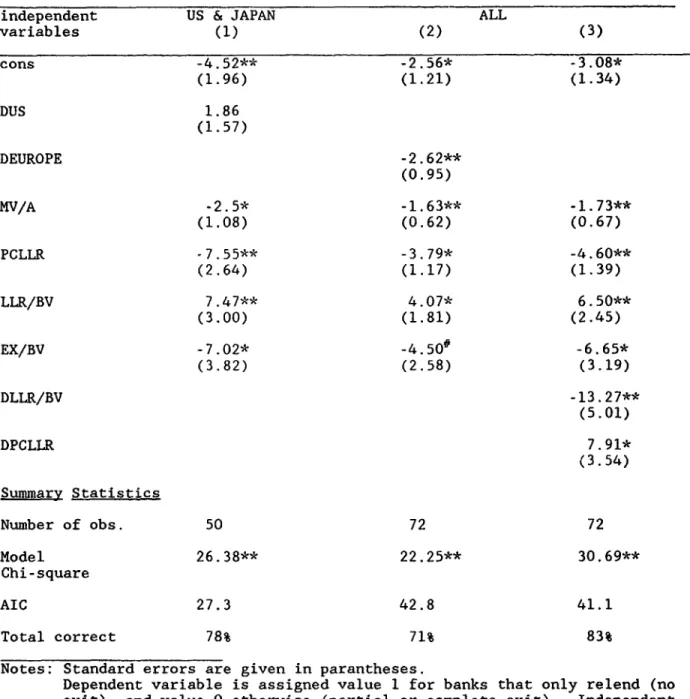
The first column in table 5 reports results for U.S. and Japanese banks.
These two groups of banks do not significantly differ in their choice
behavior. This is evidenced by the insignificant coefficient of the
nationality dummy variable, DUS. Although not reported, dummy variables for slope coefficients do not prove significant either.
All the proxies for financial strength develop significant
coefficients with the expected sign, indicating that the weaker institutions
are less likely to exit. In particular, we find that banks with higher MV to
assets ratios and with higher increases in LLR tend to exit more, and that
banks with higher LLR to asset ratios tend to exit less.20 These results
strongly confirms the main prediction of the theoretical model.
The exposure to Brazil debt to book value ratio produces a negative
and significant coefficient, thus confirming another result of our model. Controlling for financial strength, the greater the exposure of the
institution, the less likely it is to only relend. 2 1
The affiliate and branch dummy variables and asset size variable all
produce positive yet insignificant coefficients. The positive sign for
affiliate and branch dummy variables are expected since they are included to capture, at least partially, the value of banking assets of the institutions
20Both
KV and BV coefficients capture this effect, however the specification
including BV is not reported since it is significantly inferior based on our criteria.
21Due to incomplete information, the variable TEX turns out to be
in Brazil. When this value is larger, banks are expected to relend rather than exit. The positive signs are consistent with this argument, yet their insignificance indicdtes that the dummy variables do not capture all the
information, and we lack better proxies.
Asset size coefficient's positive sign indicates that larger
institutions are more likely to relend. However since it is insignificant, we can conclude that controlling for other characteristics, size is not an
important determinant. As indicated by table 3, large institutions appear to
relend rather than exit. Yet this effect is not statistically significant in
the Brazil deal, once we control for other characteristics. The widely held
belief that it is the large--rather than the weak--institutions that relend
may be simply due to the fact that in the U.S, large banks tend to be weak.
However, the inclusion of other types of banks in the sample--and in
particular of many small and weak banks--indicate that size per se has not
been an important determinant of exit behavior.
The last two columns of table 5 report results for all banks. The
most important difference is indicated by the European bank dummy variable,
DEUROPE. Its negative and significant sign underlines the differences in choice behavior of European banks. As argued above (section 5.2), European
banks (excluding the French) are expected to be willing to exit at lower
prices since they tend to have higher provisions already in place.
Decomposing the dummy variable to investigate whether any of the regressors affect European banks differently leads to interesting results. As reported in the last column, dummy variables for percentage increase in loan
loss reserves and loan loss reserve to book value ratio (DPCLLR, DLLR/BV)
prove significant but have the opposite signs of the benchmark coefficients.
Thus, as expected, PCLLR and LLR/BV variables affect the decisionmaking of US
still have the same effects.
The overall statistical fit of the model is given by the criteria
reported at the foot of table 5. The joint insignificance of independant
variables is rejected at the one percent significance level for alternative
spec7fications and the model classifies up to 83 percent of bank choices
correctly. The null hypothesis of no misspecification cannot be rejected at
the five percent significance level for any of the reported specifications.
5. Conclusions
This study provides evidence that bank characteristics are
significant determinants of commercial-bank choice behavior when confronted with a menu of options. We develop a theoretical model of bank choice
behavior and empirically test its implications using data from the 1988
Brazilian financing package. Our empirical results show that bank
characteristics are capable of explaining over 80 percent of this choice.
One of the main implications of the theoretical model is that under
risk-neutrality assl-mption, financially stronger and more exposed banks
prefer to exit. These results are also supported empirically. Farthermore,
contrary to common belief, we find that bank size per se does not
significantly affect exit behavior.
Our finding have several important implications for the new debt reduction strategy. (i) First, larger debt reductions operated on a market
basis are more costly, per unit of debt reduced. In order to increase debt
reduction, weaker banks must be convinced to exit, increasing the needed exit
price. (ii) Second, the exit price depends on the strength of the banking
industry, and thus, the effectiveness (and cost) of the present debt strategy is affected by changes in the world economy. In perods of booms, banks become
stronger and exit prices are reduced. (iii) Third, regulators can affect the
banks operate. (iv) Forth, LDC debt reductions is beneficial to the deposit insurance agencies of the major creditor nations.
Our results have important implications for the analysis of the secondary market for LDC debt. One implication of our model is that due to differences in valuations between (insured) buyers and sellers of debt, the volume of debt in "circulation" must be small. Indeed, traded volumes in LDC
debt have been extremely low--especially after correcting for demand by the debtor country-but increasing overtime. At the same time, LDC debt prices have declined overtime and especially after 1986, with the magnitude of
decline unexplainable by increasing debt or worsening fundamentals alone. The model developed above can explain those stylized facts. Due principally to subsidized debt to equity swap programs, buyers have been willing to pay more
than the fair price to acquire country debt. 22 Given their reservation price
all banks above a certain strength sold their exposure, while weaker banks held onto their claims.23 Thus, the observed market price must be interpreted as the value of debt to the marginal bank. Furthermore, the supply of debt--and thus trade volumes--must have gone up, debt--and debt price down, as the
banking industry regained strength after the big slump of 1982. Finally, it
should be recognized that the debt of similar countries cani trade at very
different prices if one of the countries engaged in subsidized debt reduction programs while the other did not.
Finally, our results shed new light on the present debt strategy. Under the old strategy, the IFIs required the commercial banks to share in the cost of attempting to reform the debtor countries economies by sharing in the supply of new loans. However, as banks' financial situations started to
22
Indeed, there is evidence showing that the existence of debt/equity swap
.rograms increase debt prices (Salomon:20 percent, Acharya Diwan:16 percent)
3James (1990) finds direct empirical evidence that LDC loans held by the core lenders exceeds their secondary market prices.
diverge in the mid-eighties, the concerted new money approach broke down. Strong banks now resisted large new money calls. By 1988, after the
completion of the Brazil deal, new commercial credits litteraly dried up. The
Brady initiative should then be seen as an attempt to reduce the tensions
within the creditor grc.up by tailoring financial instruments to the specific
needs of banks, in particular, to allow strong banks to exit and weaker
institutions to relend. By negotiating on a menu ex ante and allowing banks
to choose ex post the options that they value most, a better burden sharing
between the IFIs and the commercial banks can be achieved without
unsurmountable coordination problems.
Important tasks for future reseach are to extend the analysis of menu choices to an equilibrium framework, to study the role of more complex
options such as exit and par bonds, and to empirically examine banks' choices
Appendix of Proofs 1. The value of the insured bank is given by:
VI- J [(LRA)/R - D] f(A)dA ; with LRAI = DR (Al)
A
The uninsured bank must borrow from depositors at a rate Ru given by: Au
DR - [DRU [l-F(AU)] + J [LRA ]f(A)dA, with LRAU = DRU. (A2)
0 Its value is given by:
1 1
V- J[(LA)/R - (DRU/R)] f(A)dA
e
[(LRA)/R]
f(A)dA - tDRU/R)[l-F(Au)]Au Au
1 Au
I [(LIA)/R]f(A)dA + E [(LRA)/R]f(A)dA - D using (A2) (A3)
AUf 0
- L E(AR/R) - D Lp0 - D (A3')
where we define p0 = E(AK/R), with E the expectation operator, po the "fair"
price of the loan L, and Lpo, the initial "fair" value of loans L. Subtracting VU from VI using (Al) and (A3'), we get the value of the
insurance subsidy I:
1 1
I 8 VI - Vu e J[(LRA/R)- D]f(A)dA - 5 [(LRA/R) -D]f(A)dA
Aif 0
f A' - (LRA/R)]f(A)dA
0
2. Differentiating equation (9) with respect to e, we have:
OI(.)/ae
= (aA2/ae)(I/A2) + A2(a(1-k2/ae)F2, where F2 = F(A2), (A4)Furthermore, using eqs. (10), (4), (5) and (6), we can compute:
a (l-k 2)/ae -(1 - k2)(BA2/8e)/A2 < 0 (A6)
0A2/ae - (R/R)(a(l-k2)/ae) < 0 (A7)
8A2/8(l-k2) = R/R > 0 (A8)
Feeding (A5) to (A8) into (A4) and reducing, we get:
aI(.)/ae G - (8A2/Ae)
J
[RA/R]f(A)dAs
0 (A9)0
differentiating (A9), and using (A7) and (A8), we get:
a2I(.)/el
-e (aA2/ae)(aX 2/8e)A2R > oa2I(.)/8ea(l-k
2) = - (aA2/ae)(A2/a(l-k2)A2R < 0 (Al0) 3. Rewrite eq. (13) as:G(p, Al' L1) _ (IN -IE) - L' [14(l - pl) + (p - pl)] = Using the implicit function theorem, we get:
ap/laA
1 Ll = - [aG(.)/aA I/I[G a( .) /ap)I
ap/aL' I A1 = - [aG(.)/8Ll]/[8G(.)/ap)] Computing the needed partial derivatives:
aG(.)/aE
° - < 0,aG(.)/aA 1 = [aIN/aAl - aIE/aAl] < 0 using (AlO)
8G(.)/aL' = - (p(l - pl) + (R - p1)] < 0,
Table 2
Characteristics of the various menu items
Item Tocal Rate Tenure Grace Debt to Relending Bearer
amount (years) (years) Equity
Rescheduling
MYDFA 62,000 13/16 20 7 auction X
Interbank 4,600 5.8 up to 1 na to trade na
Trade 10,200 5.8 up to 1 na to interbank na
New money 5,200
New money bonds1 674 13/16 12 5 auction X
Cofinancing 750 13/16 12 5 auction
New trade2 600 13/16 9 9
Parallel 3,176 13/16 12 5 at par X
Exit 1,200
Exit bonds 1,200 6 fixed 25 10 auction3 X
Notes: 1. also exempt from Brazilian taxes 2. bullet maturity
3. can also be converted into a dollar indexed bond that would be traded in the Brazilian capital market.
-Table 3
Bank Choices Based on Nationalitv and Size
I. Nationality
only exit exit and relend only relend
US 7% 40% 53%
JAP 17% 21% 61%
EUROPE 16% 19% 65%
II. Asset Size
only exit exit and relend only relend
top 10 0/10 3/10 7/10
top 20 1/20 10/20 9/20
smallest 20 13/20 0/20 7/20
smallest 10 7/10 0/10 3/10
Source: Complete data on the 1988 Brazilian Financing package from the newspaper Gazeta Mercantil.
Table 4
Variable Definitions and Sources
MV: market value of the institution's equity. MV is the price per share multiplied by the number of shares outstanding.
BV: book value of the institution's equity. BV is the book value of assets minus the book value of liabilities and is given by the sum of capital stock, surplus, undivided profits and reserves.
A: total asset size of the institution.
L: total liability size of the institution.
LLR: loan loss reserves of the institution. PCLLR:percentage change in loan loss reserves.
EX: 1987 Brazilian exposure of the institutions. It is calculated from: EX- (ol+o2+o3+o4)/.114 +oe
where ol-o4 are the new money options and oe is the exit option as given in Gazeta Mercantil (Economia), March 26,1989.
TEX: institution's total exposure to all LDCs.
DA, DB: dummy variables for the institution's affiliates or branches in Brazil. They take the value zero or the number of existing branches or affiliates.
Other Dummy Variables: country or region dummy variables (e.g., DUS, DJAP, DEUROPE, denoting U.S., Japanese, and European banks), and above
variables multiplied by country dummies are also included.
Notes: US bank data are obtained from Moody's Bank Manual. Japanese bank data are from Nihon Keizai Shimbun Bank Annual Tapes. Data for the rest of the banks came from IBCA.
Table 5-j Logit Analysis of Bank Choice Behavior Dependent variable: bank choice
independent US & JAPAN ALL
variables (1) (2) (3) cons -4.52** -2.56* -3.08* (1.96) (1.21) (1.34) DUS 1.86 (1.57) DEUROPE -2.62** (0.95) MV/A -2.5* -1.63** -1.73** (1.08) (0.62) (0.67) PCLLR -7.55** -3.79* -4.60** (2.64) (1.17) (1.39) LLR/BV 7.47** 4.07* 6.50** (3.00) (1.81) (2.45) EX/BV -7.02* -4.50Q -6.65* (3.82) (2.58) (3.19) DLLR/BV -13.27** (5.01) DPCLLR 7.91* (3.54) Summary Statistics Number of obs. 50 72 72 Model 26.38** 22.25** 30.69** Chi-square AIC 27.3 42.8 41.1 Total correct 78% 71% 83%
Notes: Standard errors are given in parantheses.
Dependent variable is assigned value 1 for banks that only relend (no exit), and value 0 otherwise (partial or complete exit). Independent variable definitions and sources are given in table 4.
**, *, # indicate coefficient estimates that differ significantly from zero at 1, 5, and 10 percents respectively.
References
Acharya, Shankarshan and Ishac Diwan (1989)."Sovereign Debt Buybacks as a Signal of Creditworthiness." PPR Working Paper 318. World Bank, Washington. Amemiya, T. (1981). "Qualitative Response Models: A Survey." Journal of Economic Literature, 1483-1536.
Atiyas, I. (1990). "The Effect of Implicit Deposit Insurance on Banks' Response to Financial Distress." Processed, the World Bank, Industry and Energy Department.
Akaike, H. (1973). "Information Theory and an Extension of the Maximum Likelihood Principle." In Second International Symposium on Information Theory. Edited by B. N. Petrov and F. Csaski, Budapest: Akademiai Kiado. Belsley, D. A., E. Kuh, and R. E. Welsch (1980). Regression Diagnostics, Identifying Influential Data and Sources of Collinearity, Wiley, New York, chapter 3.
Bouchet M. and J. Hay (1989). "The Rise of The Market Based Menu Approach and its Limitations." In Husain and Diwan eds, Dealing with the Debt Crisis, The World Bank.
Claessens, S. and I. Diwan (1989). "Market-Based Debt Reduction."In Husain and Diwan eds, Dealing with the Debt Crisis, The World Bank.
Cline, W. (1989). "The Baker Plan and Brady Reformulation: An Evaluation." In Husain and Diwan eds, Dealing with the Debt Crisis, The World Bank.
Davidson, R. and J. C. MacKinnon (1984). "Convenient Specification Tests for Logit and Probit Models." Journal of Econometrics, 241-62.
Diwan Ishac, and Kenineth Kletzer. 1990. "Concerted Deals with Voluntary
Choices: the Mechanics and Attributes of the Menu Approach to LDC Debt." PRE working paper, the World Bank, Washington.
Grammatikos, T. and T. Saunders (1988). "Addition to Bank-Loss Reserves: Good News or Bad News?" Mimeo, New York University.
Hay J. and M. Bouchet (1989). "Tax, Accounting and Regulatory Treatment of Sovereign Debt." Debt Management and Financial Advisory Services Department Staff Working Paper, World Bank.
Huizinga, H. (1989). "The Commercial Bank Debt on Developing Countries: How Have Banks Been Affected?" In Husain and Diwan eds, Dealing with the Debt Crisis, The World Bank.
Huizinga, H. and S. Ozler (1989). "Secondary Market Prices for Developing Country Debt: The Role of Creditor Country Factors." Processed.
James, Christopher (1990). "Heterogeneous Creditors and the Market Value of Banks LDC Loan Portfolio." mimeo, University of Florida, Gainsville.
Judge, G., W. Griffiths, C. Hill, H. Lutkepohl, and T. Lee (1985). The Theory and Practice of Econometrics, John Wiley & Sons, Inc.
Kane, E. J. (1985). The Gathering Crisis in Federal Deposit Insurance, Cambridge, MA, MIT Press.
Kane, E. J. (1989). The S&L Insurance Ness: How Did It Happen? Cambridge, MA, MIT Press.
Karaken, J. (1986). "Federal Bank Regulatory Policy: A Description and Some Observations." Journal of Business, 59, 3-48.
Karaken, J. and N. Wallace (1978). "Deposit Insurance and Bank Regulation: A Partial Equilibrium Exposition." Journal of Business, 51, 413-438.
Kaufman, G. (1985). `Impli.ations of Large Bank Problems and Insolvencies for the Banking System and Economic Policy." Occasional papers prepared by
Research Department members for review and comment SM-85-3, Federal Reserve Bank of Chicago.
Lamdany, R. (1989). "The Menu Approach in Action: the 1988 Brazil Financing Agreement." In Husain and Diwan eds, Dealing with the Debt Crisis, The World
Bank.
Lessard, D. (1989). "Beyond the Debt Crisis: Alternative Forms of Financing Growth." In Husain and Diwan eds, Dealing with the Debt Crisis, The World
Bank.
Maddala, G. (1986). "Econometric Issues in Empirical Analysis of Thrift
Institutions' Insolvency and Failure." Invited Research Working Paper No. 56, Federal Home Loan Bank Board.
Merton, R. C. (1977). "An Analytical Derivation of the Cost of Deposit Insurance and Loan Guarantees." Journal of Banking and Finance, 3-11.
Musumeci, James and Joseph Sinkey (1990). "The International Debt Crisis and Bank Loan-Loss-Reserve Decision: The Signalling Content of Partially
Anticipated Events." Journal of Money, Credit and Banking; 22; 3; (370-87). Penati, A. and Proptopapadakis, (1988). "The Effect of Deposit Insurance on Banks' Portfolio Choice With an Application to International Overexposure." Journal of Monetary Economics, 21, 107-126.
Sachs, J. and H. Huizinga, (1987). "U.S Commercial Banks and the Developing Country Debt Crisis." Brookings Papers on Economic Activity.
Sachs, J. (1989), "Efficient Debt Reductions" in Husain and Diwan eds, Dealing with the Debt Crisis, The World Bank.
Sharpe, W. F. (1978). "Bank Capital Adequacy, Deposit Insurance and Security Values.: Journal of Financial and Quantitative Analysis, 701-08.
Williamson, J. (1988). Voluntary Approaches to Debt Relief. Paper 25, Institute for International Economics.
World Bank, (1988). Market Based Menu Approach. Debt Management and Financial Advisory Services Department.
192 Author
WPS510 Public Expenditure Reviews for Antoine Schwartz October 1990 C. Cristobal
Education: The Bank's Experience Gail Stevenson 33640
WPS51 1 The Macroeconomic Underpinnings Fred Jaspersen October 1990 A. Oropesa
of Adjustment Lending Karim Shariff 39075
WPS512 Social Security Reform: The Capital Patricio Arrau October 1990 S. King-Watson
Accumulation and Intergenerational 31047
Distribution Effect
WPS513 The Business Cycle Associated with Miguel A. Kiguel October 1990 E. Khine
Exchange-Rate-Based Stabilization Nissan Liviatan 39361
WPS514 Restrictive Labor Practices in Alan S. Harding October 1990 A. Joseph
Seaports 33743
WPS515 Stock Markets in Developing Mansoor Dailami October 1990 M. Raggambi
Countries: Key Issues and a Michael Atkin 37657
Research Agenda
WPS516 International Capital Mobility and the Jaime de Melo October 1990 S. Fallon
Costs of U.S. Import Restraints David Roland-Holst 37947
WPS517 Do Wage Distortions Justify Jaime de Melo October 1990 S. Fallon
Protection in the U.S. Auto and David Tarr 37947
Steel Industries9
WPS518 Industrial Organization and Trade Jaimede Melo October 1990 S. Fallcn
Liberalization: Evidence from Korea David Roland-Hoist 37947
WPS519 Taxes, Outward Orientation, and Irene Trela October 1990 A. Bhalla
Growth Performance in Korea John Wha!ley 37699
WPS520 Trade Reform, Policy Uncertainty, Sweder van Wijnbergen October 1990 M. Stioude
and the Current Account 38831
WPS521 World Bank Treatment of the Social Helena Ribe October 1990 M. Abiera
Impact of Adjustment Programs Soniya Carvalho 31262
WPS522 A Survey of the Costs of World Brent Borrell October 1990 A. Kitson-Walters
Sugar Policies Ronald C. Duncan 33712
WPS523 EC Bananarama 1992 Brent Borrell October 1990 S. Lipscomb
Maw-Cheng Yang 33718
WPS524 The Kuwaiti NOOs: Their Role in Aid Nural Abdulhadi October 1990 R. Grimm
F ows to Developing Countries S12-018
WPS525 School Effects on Achievement in Marlaine E. Lockheed October 1990 C. Cristobal
Secondary Mathematics and Barbara Bruns 33640
Contact
Autho r for paper
WPS526 Rural Poverty in India, 1973-86 Nanak Kakwani October 1990 B. Rosa
Kalinidhi Subbarao 33751
WPS527 Voluntary Choices in Concerted Ishac Diwan October 1990 S. King-Watson
Deals: Mechanics and Attributes Ken Kletzer 31047
of the Menu Approach
WPS528 Monetary Policy Instruments for Gerard Caprio, Jr. October 1990 W.
Pitayatona-Developing Countries Patrick Honohan karn
37666
WPS529 The Sectoral Structure of Poverty Monika Huppi October 1990 C. Spooner
During An Adjustment Period: Martin Ravallion 30464
Evidence for Indonesia in the Mid-1980s
WPS530 The Menu Approach to Developing Asli Demirguc-Kunt November 1990 S. King-Watson
Country External Debt: An Analysis Ishac Diwan 31047
of Commercial Banks' Choice Behavior
WPS531 The World Bank's Role in Shaping Fred T. Sai November 1990 L. Bruce-Diggs