Systematic Liquidity and Leverage
*
Bige Kahraman Heather Tookes
September 2017
ABSTRACT
Does trader leverage exacerbate the liquidity comovement that we observe during crises? Using a regression discontinuity design, we exploit threshold rules governing margin eligibility in India to analyze the impact of trader leverage on systematic liquidity. We find that trader leverage causes sharp increases in comovement during severe market downturns, explaining about one third of the increase in liquidity commonality during these periods. Consistent with downward price pressure due to deleveraging, we also find that trader leverage causes stocks to exhibit large increases in return comovement during these periods of market stress.
* We would like to thank seminar participants at the University of Miami, Georgia State University, the Federal Reserve Board, Cornell University, 2017 University of Oregon Summer Finance Conference, 2016 HEC-McGill Winter Finance Conference, 2017 European Finance Association, and the 5th Luxembourg Asset Management Summit for their comments. We would also like to thank Nirmal Mohanty, Ravi Narain, R. Sundararaman, C. N. Upadhyay, and staff at the NSE for providing us with institutional information. Minhua Wan provided excellent research assistance. A portion of this project received financial support from the 2013-2014 NSE - NYU Stern Initiative on the Study of Indian Capital Markets. The views expressed in this paper are those of the authors and do not necessarily represent those of NSE or NYU. Author contact information: Bige Kahraman, Said Business School, Park End Street, Oxford OX1 1HP, UK, [email protected]. Heather Tookes, Yale School of Management, PO Box 208200, New Haven, CT 06520,
1. Introduction
Does trader leverage exacerbate the liquidity comovement that we observe during crises? Commonality in liquidity, the tendency of the liquidity of individual stocks to move together, has been well-documented. Recent papers in the literature (e.g., Karolyi, Lee, and Van Dijk (2012) and Hameed, Kang, and Viswanathan (2010)) also report large increases in commonality during crises, both in U.S. markets and in markets around the world. The fact that the systematic component of liquidity increases during crises is alarming because these are precisely the times during which traders need liquidity the most. Therefore, it is important to understand the causes of the heightened comovement. There are competing explanations for the increased commonality in liquidity that we observe during crisis periods. Liquidity comovement might increase when there is market-wide panic selling due to economy-wide changes in fundamentals or increased aggregate uncertainty. Alternatively, it could be due to frictions related to traders’ ability to maintain levered positions when market prices decline. While both of these explanations of increased commonality in liquidity during crises are plausible, disentangling them poses substantial empirical challenges. To assess the extent to which traders’ leverage (a form of funding) matters, one would first need to observe variation in trader leverage. Second, and more importantly, one would have to separate the effects of deleveraging from other portfolio demands. This is particularly challenging because, during downturns, investors may liquidate their positions due to negative sentiment or increased uncertainty, which can also affect liquidity comovement.
Although the funding-based explanation for heightened liquidity comovement in bad times has received substantial attention in the theoretical literature (e.g., Kyle and Xiong (2001), Gromb and
Vayanos (2002), Morris and Shin (2004), Weill (2007), and Gromb and Vayanos (2009), Brunnermeier and Pederson (2009)), we still have a paucity of empirical evidence of its importance. In this paper, we aim to fill this gap by examining the impact of trader leverage on liquidity comovement using the margin trading regulations in India.
There are a number of reasons why margin trading in India provides a useful lens through which we can examine frictions due to leverage. First, margin traders might face difficulties in meeting their margin requirements and maintaining their positions when the values of their portfolios decline. Second, brokers may become less willing to provide margin debt during periods of market stress. Both of these can lead to trader deleveraging, which can consume liquidity. The additional advantage of the Indian context is that the regulatory setting helps us overcome the empirical challenges discussed above. In India, only some exchange-traded stocks are eligible for margin trading. Importantly, eligibility is based on a well-defined cutoff. The discreteness of the margin trading rules provides a discontinuity (see Lee and Lemieux (2010)) in the ability of traders to use leverage and therefore provides us an opportunity to perform a regression discontinuity design (RDD) to identify the causal effect of trader leverage on commonality in liquidity.
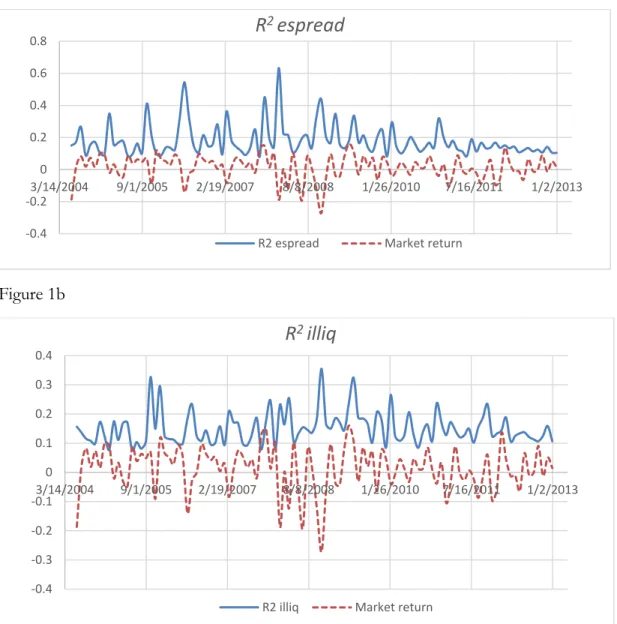
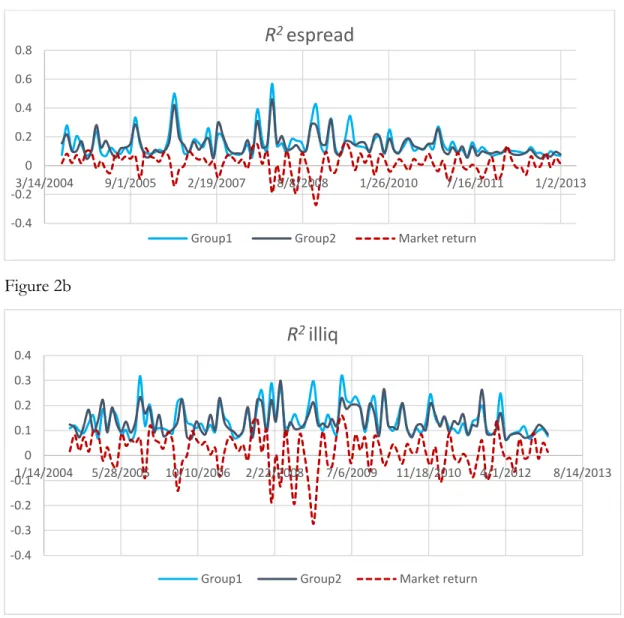
Like other stock markets throughout the world, Indian equity markets are characterized by liquidity commonality that tends to increase during downturns. This pattern is obvious in Figure 1, which shows the time series of commonality along with Indian stock market returns. It is clear from the figure that there is a dramatic increase in commonality (nearly doubles) when there are large drops in market returns. Figure 2 shows the same time series of commonality, but this time for the subsample of stocks that are very close to the margin trading eligibility threshold. The patterns in Figure 2 are
even more revealing than those in Figure 1. During almost all market downturns, the liquidity commonality in margin eligible stocks is much higher than that of margin ineligible stocks. During other periods, there are small (if any) differences between the two groups. The figures provide simple, yet striking, evidence consistent with the Brunnermeier and Pedersen (2009) hypothesis that funding constraints in bad times drive commonality.
In the formal regression analysis, we use regression discontinuity design (RDD) to identify the causal effect of trader leverage. Consistent with the theoretical literature, we find that trader leverage
exacerbates commonality in stock liquidity. Moreover, this effect is solely driven by crisis periods. The
magnitudes of our findings are economically large. For instance, when we examine commonality of
effective spreads, we find that margin-eligible stocks experience an additional 30% increase in liquidity
comovement during crisis periods. During non-crisis periods, the impact of trader leverage is insignificant. Our results are robust to a battery of tests in which we control for various stock-level characteristics. Importantly, we also conduct placebo tests in which we repeat our analysis around false eligibility cutoffs as well as market rallies and we find no significant effects.
We start our analysis by examining commonality in liquidity because we still do not have a full understanding of the main causes of liquidity crises. However, it is also important to point out that trader leverage can simultaneously drive both commonality in liquidity and commonality in returns (e.g., Gromb and Vayanos (2002), Brunnermeier and Pedersen (2009), Geanakoplos (2010)). Therefore, we extend our analysis to examine the impact of margin trading on return comovement. Consistent with downward price pressure due to the deleveraging of traders who rely on borrowing, we find that trader leverage amplifies increases in return comovement during crisis periods. Similar to
the findings on commonality in liquidity, we find that the economic effect of trader leverage on return comovement is substantial (in crisis periods, there is an additional 28% increase in return comovement due to leverage) and that trader leverage affects return comovement only during periods of market stress.
After establishing the causal impact of trader leverage on commonality in liquidity and commonality in returns, we conduct a number of mechanism tests. In addition to helping us understand the drivers of the patterns that we observe in the data, these tests also allow us to assess the extent to which the same economic forces drive commonality in liquidity and returns. If the main findings are due to frictions related to binding collateral constraints and deleveraging, we would expect the increases in comovement during crises to be strongest between the stocks in which traders tend to use leverage. That is, we would expect pairwise correlations in stocks’ liquidity as well as returns to be higher within the set of margin-eligible stocks. This is precisely what we find. These findings are consistent with margin traders, as a group, simultaneously unwinding their positions in multiple stocks when the value of their collateral falls.
Our data allow us to zoom in further to understand potential cross-stock linkages. We can
observe, on a daily basis, the entire portfolio of stocks that each trader has financed with margin debt.
These data include unique trader and broker identification numbers, thus allow us to identify margin trader and broker linkages across stocks. Using this information, we examine the importance of common traders and common brokers on heightened commonality in liquidity and returns during crises. Both the broker and trader channels are of interest. At the trader level, leverage-induced funding constraints might force a trader to liquidate positions in multiple stocks in her portfolio. At the broker
level, a negative shock to the overall market might make the broker less willing to provide capital to its customers. We find that margin-eligible stocks that are more connected, through either common margin traders or common brokers, experience much larger increases in pairwise comovement in both liquidity and returns during severe market downturns. The estimated economic effects of common brokers are larger than the economic effects of common traders. In addition to revealing the underlying forces behind the main results, this finding indicates that policies which aim to recapitalize or subsidize lenders (instead of borrowers) might be more effective in mitigating systematic liquidity crises.
Our findings contribute to the growing literature on commonality in liquidity. This line of research initially focused on documenting pervasive commonality (Chordia, Roll Subrahmanyam (2000), Hasbrouck and Seppi (2001), Huberman and Kalka (2001)). Subsequent work focused on
distinguishing its cause. One strand of theoretical literature points to funding constraints of traders.1
These studies predict that funding constraints, which include constraints due to margin requirements, drive commonality in liquidity during market downturns. Hameed, Kang, and Vishwanathan (2010) and Coughenour and Saad (2004) support this view. Specifically, Hameed, Kang, and Viswanathan (2010) report that commonality increases following large market declines. Coughenour and Saad (2004) focus on New York Stock Exchange specialists, who provide liquidity in all of the stocks in which they make markets, and show that liquidity commonality is higher when stocks share specialists, especially when specialists are capital constrained.
1 These include works by Kyle and Xiong (2001), Gromb and Vayanos (2002), Morris and Shin (2004), Weill
While the findings in the papers described above are consistent with the idea that funding constraints drive commonality, the overall evidence to date is mixed. Another line of work emphasizes the importance of correlated trading demands that arise from similarities in investors’ styles, tastes, or
sentiments.2 Karolyi, Lee, and Van Dijk (2012) find that intuitive proxies for funding constraints
(variables such as local interest rates) are not strongly associated with heightened commonality in liquidity in bad times, while turnover commonality (which can be interpreted as a proxy for correlated taste) and foreign flows have considerable explanatory power. Although not paying specific attention to crisis periods, Kamara, Lou, and Sadka (2008) and Koch, Ruenzi, and Starks (2016) find that commonality is higher when institutional ownership is higher.
One important distinction between these two views is the asymmetry in their predictions. Different from correlated trading due to common investor styles or tastes, which can be important in any market environment, the commonality that arises from funding constraints is expected to be concentrated in times of market downturns, when funding constraints are binding. This asymmetry helps with the interpretation of any empirical findings.
Unlike the previous studies, we use a regression discontinuity design that allows us to isolate the impact of the leverage channel from confounding effects – an empirical challenge faced by previous studies. This makes it possible to make causal statements about the impact of leverage on comovement. Our main finding is that trader leverage dramatically increases commonality, but only during crisis periods. This is not driven by index stocks or differences in ownership structure (such
as institutional and foreign ownership), which indicates that leverage channel is distinct from prior findings in the literature. To the best of our knowledge, our paper is the first to provide evidence on the impact of trader leverage on commonality in liquidity.
Our paper is also related to recent work by Kahraman and Tookes (2016), who use the same sample of stocks that we use in this paper, but they examine the impact of trader leverage on stock
liquidity levels. They find that, on average, margin-eligible stocks have higher liquidity. In extended
analysis, they also find that this effect reverses during times of crisis. Different from Kahraman and
Tookes (2016), this paper focuses on comovement. Liquidity levels and comovement are fundamentally
different and can be driven by different forces. While Kahraman and Tookes (2016) report that trader leverage has an impact on liquidity levels during all time periods, in this paper, we find that it affects liquidity comovement only during periods of market stress. We introduce new data at the margin trader and broker level, which helps us uncover the mechanism behind these findings. Another important difference from Kahraman and Tookes (2016) is that we also analyze returns. A new finding that emerges from our analysis is that, while commonality in stock returns and commonality in liquidity are not strongly correlated in normal times, due to leverage, they become highly linked during times of market stress.
Finally, our findings on return comovement add to the literature on financial contagion. Examples include Bekaert, Harvey, and Ng (2005) and Jotikasthira, Lundblad, and Ramadorai (2012), who document heightened return comovement during crisis periods in international markets. Boyson, Stahel, Stulz (2010) and Billio, Getmansky, Lo, and Pelizzon (2012) provide evidence consistent with contagion among hedge funds. While the theory of contagion is well-studied, empirical evidence on
its underlying causes is not conclusive. In this paper, we find that trader leverage is one driver that serves to exacerbate the excess return comovement that we observe during crisis periods.
The paper proceeds as follows: Section 2 discusses the regulations that determine margin eligibility in India. Section 3 describes the data and the regression discontinuity approach. The main results are in Section 4. Section 5 presents mechanism analyses. Section 6 concludes.
2. Margin trading in India
Margin trading allows traders to borrow in order to purchase shares. In India, the margin trading system is regulated by the Securities and Exchange Board of India (SEBI). The current system, in which margin trading is allowed in stocks that meet certain eligibility requirements, has been in
place since April 2004.3 Under current SEBI guidelines, two criteria must be met for a stock to be
eligible. The first is that the stock must have traded on at least 80% of the trading days over the past six months. The second requirement provides the identification that we need for the empirical analysis. The stock’s average impact cost, defined as the absolute value of the percentage change in price from the bid-offer midpoint that would be caused by an order size of 100,000 rupees (approximately $2,000 during our sample period), must be less than or equal to 1%. The impact cost used to determine eligibility is based on the average of estimated impact costs over the past six months. These are calculated at random ten-minute intervals four times per day.
3Prior to the current system, the primary borrowing mechanism for traders in India was a system called Badla. Under
Stocks that meet the impact cost and trading frequency requirements are categorized as Group 1 stocks and are eligible for margin trading. Stocks that fail to meet the impact cost requirement, but meet the trading frequency requirement, are categorized as Group 2 stocks. All remaining stocks are classified into Group 3. Group 2 and Group 3 stocks are ineligible for margin trading (i.e., no new
margin trades are allowed as of the effective date).4 Impact costs and the resulting group assignments
are calculated on the 15th day of each month. The new groups are announced and become effective
on the 1st day of the subsequent month. For example, when determining eligibility for the month of
December, regulators use data from May 15 through November 15 to determine each stock’s eligibility. The resulting group assignments are announced on December 1 and are effective for the entire month of December. For stocks that meet the 80% trading frequency requirement, the probability of eligibility shifts unequivocally from 0 to 1 at the 1% impact cost cutoff. This feature of the system allows us to employ a sharp regression discontinuity design (i.e., the probability of assignment jumps from 0% to 1% at the threshold).
There are alternative ways that traders can obtain leverage in India outside of the formal margin trading system, but these channels tend to be costly or available for only a small subset of stocks. For example, for a stock to be eligible for futures and options (F&O) trading, there are additional market capitalization, free float, trading activity, and impact cost requirements. As of December 2012, we find only 140 stocks that are eligible for F&O trading (whereas 620 stocks are eligible for margin trading in the same month). Investors can also borrow from nonbanking finance
4 When a stock moves from Group 1 to Group 2 or 3, no new margin trades are allowed as the effective date. However,
companies (NBFCs), which are regulated by RBI (the central bank), to finance the purchase of any security. However, NBFC loans typically carry higher interest rates and other terms that are less favorable to investors. It is important to note that, even if these alternative channels are used, their existence would create bias against finding significant effects of margin eligibility.
For eligible stocks, the most important requirements for margin trading in India are similar to those in the United States. Minimum initial margins are set at 50% (i.e., a margin trader may borrow up to 50% of the purchase price), and minimum maintenance margins are set at 40% (i.e., prices may fall without a margin call as long as the loan is less than 60% of the value of the collateral in the margin account). Unlike in the United States, stock-level margin position data are made publicly available on a next-day basis. We exploit this information in our analysis of the impact of margin trading intensity
later in the paper.5 Margin trading rules are distinct from the other trading rules in India.6 This is
important because it allows us to interpret any findings in terms of a trader leverage channel, rather than something else.
2. Data and Methodology 3.1. Data
5 For a more detailed discussion of the margin trading system in India, see the Securities and Exchange Board of India
(2012). See also the referenced SEBI circular dated March 11, 2003: http://www.sebi.gov.in/legal/circulars/mar-2003/circular-for-risk-management-for-t-2-rolling-settlement_15836.html.
6 Group 1 membership in India has one additional regulatory advantage in the very short run. For non-institutional traders,
trade settlement with the broker occurs at day t+1. Collateral to cover potential losses prior to full payment at settlement is collected at the time of trade (this is called a VAR margin). VAR margin requirements are lower for Group 1 stocks than for Group 2 and Group 3 stocks. Thus, Group 1 stocks require less short-term capital. The existence of an additional source of leverage does not change our overall interpretation of Group 1 membership because the margin financing
The initial sample consists of all equities trading on the National Stock Exchange of India (NSE) from April 2004 through December 2012. The master list of stocks is from the NSE. These are monthly files that contain the International Securities Identification Number (ISIN), stock symbol, impact cost measure, and the NSE group assignment for each stock. The daily data are also from the NSE and include symbol, security code, closing price (in Indian Rs), high price, low price, total shares traded, and the value of shares traded. We obtain intraday transactions and quote data for all Group 1 and Group 2 NSE stocks from Thomson Reuters Tick History. These data include inside quotes
and all transactions during our sample period.7 We merge the Thomson Reuters Tick data with the
other datasets using a map of RIC codes (Thomson unique identifier) to ISINs that was provided to us by Thomson. To ensure reliability of the matching, we remove all matches for which the absolute difference between the closing price on the NSE daily files and the last transaction price in the Thomson Tick data is more than 10%. We also remove cancelled trades and entries with bid or ask prices equal to zero. We require non-missing price and volume information for at least 12 trading days in a given month.
We obtain two datasets with information on daily outstanding margin positions. Both are from the NSE. The first dataset reports the stock-level total outstanding margin trading positions at the end of each trading day. These data are available throughout our sample period. The second dataset contains trader-level data with outstanding margin positions for each stock and trader. These data include unique trader and broker identification numbers and allow us to identify margin trader and
7Fong, Holden, and Trzcinka (2014) Thomson Reuters Tick compare prices to those in Datastream and confirm that
broker linkages across stocks. The trader-level data are available only for the 2007 to 2010 subperiod. We complement the NSE data with company information from Prowess, a database of Indian firms, which covers approximately 80% of the NSE stocks. Prowess provides information on shares outstanding, index membership, ownership structure (at the quarterly frequency), and trade suspensions. Prowess data are available throughout our sample period.
Following the related studies in the literature, we impose sample restrictions to ensure data quality. First, we exclude stocks with extreme price levels (we use the 1% tails of the distribution). This restriction is similar to the restriction imposed in studies using U.S. data, which commonly focus only on stock prices above $5 and less than $999. Second, we exclude the stocks that have been suspended from trade, since trading irregularities in suspended stocks are likely to contaminate our liquidity measures. Finally, although we do not observe corporate actions such as stock splits, bankruptcy, or mergers, we aim to remove these events from the analysis. To do so, we omit stocks with percentage changes in shares outstanding that are greater than 50% (in absolute value) and exclude stocks with temporary ISIN identifiers, as this appears to be an indication of a corporate action.
Throughout the analysis, we focus on Group 1 and Group 2 stocks (as noted above, Group 3 stocks are not frequently traded). There are 1,842 unique ISINs in Groups 1 and 2 during our sample period. Of these, 1,500 are in Group 1 at some point during our sample period, and 1,347 are in Group 2. Of the 1,842 stocks in the sample, the majority appear in the local samples at some point. For
instance, in the local sample used in the R2espread (the commonality measure using effective spreads)
sample at least once. This observation is important to the overall interpretation because it shows that, although our RDD approach focuses only on stocks close to the threshold during a given month, the analysis is not constrained to only a small subset of stocks.
For every stock and month in our sample, we begin the analysis by calculating two widely-used measures of liquidity: average percentage effective bid-ask spread and the Amihud (2002)
illiquidity ratio. Effective spread (espread) is defined as 100* .5 * ( ) * 2.
.5 * ( )
transaction price bid ask bid ask
The
bid and ask prices reflect the prevailing quotes at the time of the trade. The effective spread captures the difference between the transaction price and the fundamental value for the average trade. The effective spreads that we calculate reflect the average daily effective spreads, based on all transactions that occur during the month.
The Amihud illiquidity variable (illiq) is defined as 1000000* ret ,
* p vol where ( ) ( 1) ret ; ( 1) p t p t p t
p is closing price on day t; and vol is the (rupee) trading volume on day t. Illiq
captures the change in price generated by daily trading activity of 1 million rupees. This measure is widely used in the literature because it requires only daily data and does well capturing intraday measures of the price impact of trades (Hasbrouck (2009) and Goyenko, Holden, and Trzcinka (2009)). Following Amihud (2002), we winsorize the measure at the 1% and 99% levels (based on the full sample distribution), and we also remove observations in which daily trading volume is less than 100 shares. The latter restriction impacts only 1% of the full sample of daily data. Because our focus
illiquidity measure using international data, and we impose price filters to remove potentially erroneous data from the returns calculations. In particular, whenever the closing price is +/- 50% of the previous closing price, we set that day’s price and the previous price equal to missing. As in Karolyi, Lee, and Van Dijk (2012) we take logs to reduce the impact of outliers.
If margin traders tend to delever during downturns, the resulting order imbalances are likely
to cause increases in both bid-ask spreads and the price impact of trading.8
3.2. Commonality Measure
We use the daily liquidity measures for all Group 1 and Group 2 stocks to construct the commonality in liquidity measure for each stock and month. We define commonality in liquidity as
the R2 statistic from a regression of stock i’s daily liquidity innovations on market liquidity innovations.
We choose to focus on R2 rather than liquidity betas, which are also used in the commonality in
liquidity literature, because liquidity betas estimated at the stock-month level (a frequency crucial to our identification strategy) would introduce excessive noise in the analysis. The papers that use liquidity betas estimate them using data over a full year or more (e.g., Kamara et. al (2008), Hameed et. al (2010), Koch et. al (2016)). Similar to our paper, Karolyi, Lee, and Van Dijk (2012) are interested
in commonality at the monthly horizon, and they define commonality based on the R2 statistic.
Because, in principle, a high R2 can result from either a strong positive or a strong negative correlation
with the market, later in the paper, we also examine liquidity correlations (an alternative commonality
measure) both with the overall market as well as within Groups 1 and 2. Doing so allows us to clarify both the direction and source of any observed commonality.
Along the lines of the approach in Karolyi, Lee, and Van Dijk (2012), we first calculate liquidity innovations based on a first-stage stock-level regression of daily liquidity on variables known to affect
liquidity. Using data for each stock i on day d during month t, we estimate:
, , , , 1 , , , , .
i t d i i t d i i t d i t d
Liquidity Liquidity X (1)
Xtis a vector of indicator variable to indicate day-of-week, month, and whether the trading day falls
near a holiday. It also includes a time trend. The daily regression residuals, denoted i t d, , ., are the
liquidity innovations that we examine. This method is also used to pre-whiten the liquidity data in Chordia, Sarkar, and Subrahmanyam (2005) and Hameed, Kang, and Viswanathan (2010). Market
liquidity innovations (m t d, , .) are defined as the equally weighted average innovations for all Group 1
and Group 2 stocks in the market. We choose to equally weight the liquidity innovations in this paper in order to avoid potential bias that might result from the fact that Group 1 stocks tend to be larger than Group 2 stocks and would therefore receive more weight in the market liquidity innovation calculation.
In the second step, for each stock and calendar month, we use daily data to generate a time
series of monthly R2 statistics from the following regression:
, , 1 , , , , .
i t d i m t d i t d
This R2 measure
is also used in Karolyi, Lee, and Van Dijk (2012) and captures the extent to which the liquidity of a
and R2illiq for the regressions using effective spread and the Amihud (2002) ratio as liquidity measures,
respectively. A high R2 is indicative of high commonality in liquidity. As we emphasize in the
introduction, our analysis mostly focuses on the Group 1 and Group 2 stocks that lie near the impact cost cutoff of 1%.
We also calculate R2return, a measure of commonality in returns. R2return is defined as the R2
from a regression ofthe daily returns of stock i on (equal-weighted) market returns during month t.
After establishing the basic results for commonality in liquidity, we extend our analysis to returns since trader leverage can also play an important role in returns comovement.
It is useful to start by summarizing a couple of important patterns that we observe in the margin position data. First, we observe a significant decline in outstanding margin positions during the global financial crisis, consistent with the intense deleveraging commonly reported in the press. For example, from the first quarter of 2008 to the last quarter of that year, we find that outstanding margin debt declined by approximately 70%. Second, we find that, while margin traders are contrarian traders who provide liquidity during normal times, they become momentum traders who consume liquidity during severe downturns. For instance, there are 38% more contrarian trades than momentum trades in the overall sample. In stark contrast, during crises, momentum trades are 85%
more likely than contrarian trades.9 Motivated by these findings, we aim to understand whether margin
trading and deleveraging cause liquidity and return comovement, particularly during market downturns.
3.3. Descriptive Statistics
Table 1 provides basic summary statistics. We report market- and stock-level information for the full sample, as well as subsamples that are defined according to whether a given month corresponds to a severe market downturn. “Severe downturns” refers to months in which Indian
market returns (i.e., CNX 500 returns) are below the 10th decile returns, which corresponds to a
one-month market return of -9% or less.10 Panel A of Table 1 reports that the median monthly market
return during these periods is -13.2%, with an interquartile range of -18.9% to -10.5%. “Outside of downturns” refers to all months outside of severe downturn periods. Panel A of Table 1 reports median monthly market return of 2.9%, with an interquartile range of -1.2% to 7.4%, outside of severe downturns.
Panel A of Table 1 also reports monthly market liquidity levels, defined as the equal-weighted
average daily effective spread (espread) or Amihud (2002) illiquidity ratio (illiq) of all Group 1 and
Group 2 stocks during month t. From the table, it is clear that market liquidity is lower during severe
downturns. For instance, consistent with previous work by Hameed, Kang and Viswanathan (2010),
we observe a 40% increase in espread and a 35% increase in illiq when there are large market declines.
Panels B, C and D of Table 1 show statistics of the commonality measures for the local samples of Group 1 and Group 2 stocks. Consistent with the literature, Panel B reveals that all stocks
exhibit commonality, although the average R2measures are slightly higher for Group 1 stocks than for
Group 2 stocks. The average R2espread is 0.146 for Group 1 stocks and 0.138 for Group 2 stocks. For
10 In addition to capturing the recent financial crisis of 2008, this definition also captures severe market downturns that
R2illiq, these values are 0.139 and 0.136, respectively. The more interesting variation appears when one
examines extreme downturns. During these periods, commonality in all stocks increases. However,
the effect is much larger for Group 1 stocks, for which commonality using the R2espread measure
almost doubles and commonality based on R2illiq increases by 50%. These changes are 28%–40%
lower for Group 2 stocks than they are for Group 1 stocks. Not surprisingly, the statistics in Panel B are consistent with Figure 2, which shows the time series of commonality for the local samples. The average differences in commonality between Group 1 and Group 2 stocks are driven almost entirely by crisis periods.
Table 1, Panel C describes commonality in liquidity, as captured by liquidity correlations, rather
than the R2 measure. Corr_espread is defined as the month t correlation of stock i’s daily effective
spreads with the average daily market effective spread. Corr_illiq is the correlation of stock i’s daily
Amihud illiquidity measure with average market illiquidity. These measures complement R2 since they
can capture the direction of commonality. Panel C reveals that the correlation between stock liquidity
and average market liquidity is positive – even the 25th percentile of liquidity correlations is positive
under each market condition. Importantly, the patterns based on the R2 measures that we discuss
above are very similar to the patterns that we observe using liquidity correlations. There is an increase in liquidity correlations for all stocks during severe downturns, and these increases are much more pronounced for Group 1 stocks. For instance, we observe about a 70% increase in effective spread correlations for Group 1 stocks, while this change is only 48% for Group 2 stocks. The same pattern holds when correlations are based on the Amihud (2002) illiquidity ratio. Combined with the evidence
in Panel A that market liquidity falls during severe downturns, these basic descriptive statistics reveal
that the crisis-period increases in R2 capture increased correlation as stock liquidities fall.
Panel D of Table 1 summarizes return comovement during the different market return regimes. The commonality in returns patterns are very similar to what we observe when we examine commonality in liquidity in Panels B and C. Panel D shows that the local sample of Group 1 stocks experience a 70% increase in return comovement during downturns, while that increase is only 52% for local Group 2 stocks. This suggests a potential role for trader leverage in stock return dynamics, which we will explore in extended analysis.
Overall, the summary statistics in Table 1 reveal important variation in commonality across margin eligibility regimes. This motivates a formal examination of trader leverage as a potential driver of commonality.
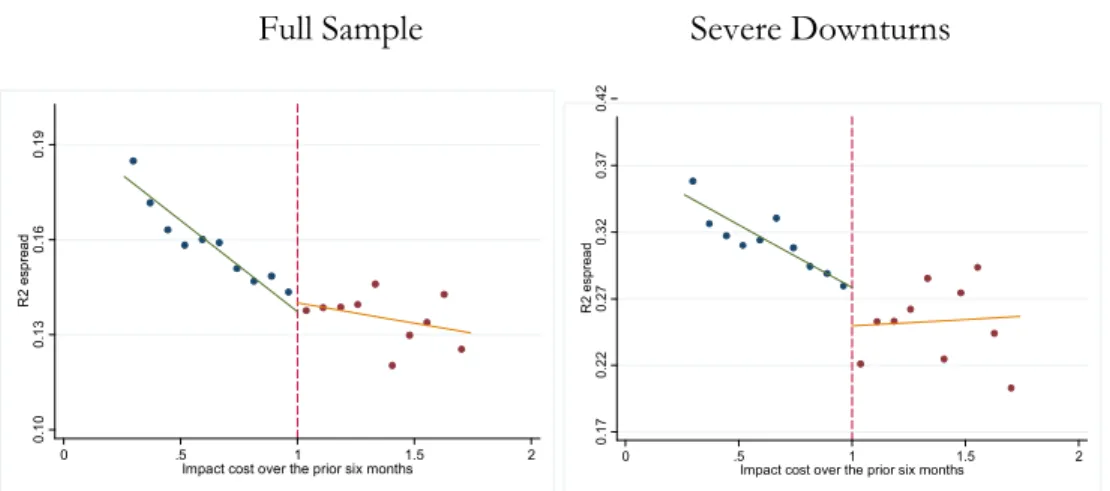
We use regression analysis to test formally the hypothesis that trader leverage impacts commonality in liquidity; however, as Lee and Lemieux (2010) suggest, it is instructive to begin with plots of the data near the impact cost threshold. As noted in Section 2, the impact costs that determine
eligibility in month t are calculated over the six months prior to month t. In Figures 3a and 3b, we
examine all stocks in the sample with impact costs between 0.25% and 1.75%. To do so, we form ten impact cost bins of equal width on each side of the eligibility cutoff. We choose the number of bins
based on the F-tests suggested in Lee and Lemieux (2010).11 We compute average commonality within
each bin. We then run separate regressions of average commonality on average impact cost for the
11 We fail to reject the hypothesis of over smoothing when we move to ten bins from either 20 or 30 bins. We reject the null of over smoothing when we move from ten bins to five.
observations on each side of 1%. We do this for all periods (left side Figures 3a and 3b), as well as for periods of severe market downturns (right side of the figures). If there is a treatment effect of margin trading eligibility, we would expect an increase in commonality at the cutoff, particularly during crisis periods. Consistent with this, the regression lines in Figures 3a and 3b show discontinuous drops in
commonality measures based on espread and illiq, respectively, during severe downturns. By contrast,
we do not observe discontinuities in the non-crisis period data. The figures provide further (suggestive) evidence of the role of trader leverage in driving commonality.
3.4. Local Regressions: Methodology
Using the time series and cross-sectional variation in the commonality in local Group 1 and Group 2 stocks, we estimate local discontinuity regressions in which we test whether traders’ leverage via margin trading impacts liquidity commonality. We also examine how any effects that we observe vary with prevailing market conditions. To do this, we first need to define the local sample of stocks. The objective is to choose a bandwidth that is small enough to capture the effect of the treatment (margin eligibility), but with a sufficiently large sample to provide statistical power. To make these tradeoffs, we rely on the optimal bandwidth selection techniques in Calonico, Cattaneo, and Titiunik (CCT, 2014). The CCT bandwidths are based on the data-dependent bandwidths designed for RDD applications in Imbens and Kalyanaraman (IK, 2012), but improve on them by selecting the initial bandwidth optimally. This results in more conservative (smaller) bandwidths than those suggested by
IK. For the R2espread variable, the CCT bandwidth is 0.18, and for the R2illiq variable, it is 0.20. These
Group 1 and Group 2 stocks. In robustness analysis (later in the paper), we also examine how sensitive our main findings are to the bandwidth choice.
In the final step, we estimate regressions in which the dependent variable is the monthly R2
for all stocks in the local discontinuity sample. The basic specification is as follows:
2 * 1 .
it it it
R Group (2)
Group 1 is an indicator variable equal to 1 if the stock is eligible for margin trading during month t. The baseline regression includes a vector of year-month fixed effects. Because the dependent variable
is estimated, we bootstrap all standard errors.12 Our objective is to understand whether shocks
(variations in margin eligibility) to the ability of traders to obtain leverage channel (margin financing)
have a causal impact on liquidity comovement. The estimated coefficient on β captures the difference
in commonality for stocks that lie just above and just below the threshold and identifies the average treatment effect as long as error terms (and potentially omitted variables) are continuous at the cutoff. The identification comes from the fact that the eligibility is discontinuous at impact cost equal to 1%, but variation in the other relevant variables is continuous (see, e.g., Lee and Lemieux (2010)).
Because we are primarily interested in the question of what drives the increases in liquidity comovement that we observe during crises, we remove the year-month fixed effects and add an
interaction variable that captures the impact of trader leverage during crises. Severedownturn is a dummy
12 We use Stata’s bssize command to determine the optimal number of replications. We require that our bootstrapped standard errors do not deviate from the ideal bootstrapped value (i.e., the value obtained with infinitely many replications) by more than 10% with probability 0.99. This results in 331 replications.
variable equal to 1 if monthly market returns are in the bottom decile of the monthly returns during our sample period. The main specification is as follows:
2
1* 1 2* 1 *
* .
it it it t
t it
R Group Group severedownturn
severedownturn
(3)
The primary coefficients of interest are on the Group 1 indicator variable and the Group 1*severedownturn
interaction variable. If margin calls create financing frictions for margin traders, then we would expect Group 1 stocks to exhibit more commonality in liquidity during times in which deleveraging affects many stocks in the market. We also estimate a model in which we replace the direct effect of
severedownturn in Equation (3) with month-year fixed effects. We do this to check whether any findings from the main specification are due to unmodeled time-series variation in commonality.
3. Results
4.1. Commonality in Liquidity
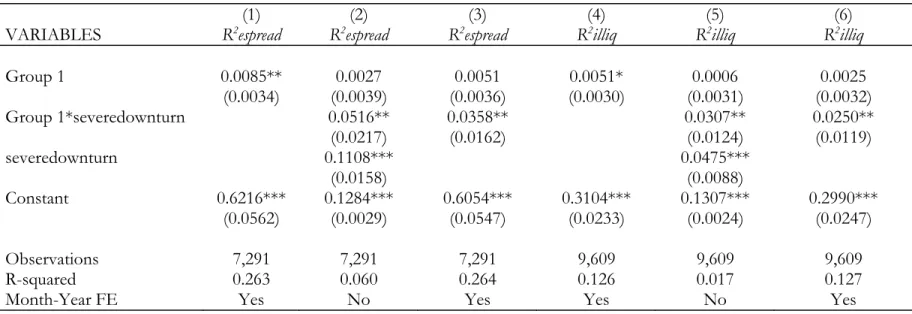
The results of the local regressions are in Table 2. In Columns 1 through 3, the dependent variable is
R2espread, and in Columns 4 through 6, it is R2illiq. In the case of R2espread, we observe a small, positive
coefficient on the Group 1 dummy variable when we constrain the impact of trader leverage to be the
same in all market environments (Column 1). The estimated coefficient of 0.0085 suggests that eligibility increases commonality by 8.5 basis points, which is 6.1% higher than the mean of 139 basis points for the local sample of Group 2 stocks. In Column 2, when we allow the effect of eligibility to vary when the overall market is in a severe downturn, the patterns are much more striking. In fact, we
find that the results in Column 1 are driven entirely by severe downturn periods. The estimated coefficient on the Group 1 dummy is insignificant. Consistent with earlier work, we find that all stocks
exhibit more commonality during downturns. The estimated coefficient of 0.1108 on the severedownturn
dummy suggests a 111 basis point increase in crisis-period commonality, representing 79.9% and 75.8% increases relative to the sample averages of 139 basis points and 146 basis points for Group 1 and Group 2 stocks, respectively. Importantly, the positive and significant coefficient of 0.052 on the
Group1*severedownturn interaction implies that those stocks eligible for margin trading display an additional 52 basis points increase in commonality. These estimates imply that trader leverage accounts for approximately one third of the total crisis-period increase in commonality for Group 1 stocks and maps to a 35.3% increase in commonality relative to the Group 1 sample mean. Column 3 shows
results from the specification in which we replace the direct effect of severedownturn with month-year
fixed effects. The estimated coefficient on the Group1*severedownturn interaction is 0.0358 and remains
highly significant. While we use the specification in Column 2 throughout the paper because it allows us to make statements about the impact of margin trading during crises relative to the average increase in commonality across all stocks during crisis periods, the results in Column 3 provide a useful specification check.
When we examine the impact of trader leverage on R2illiq, we find patterns that are similar to
what we find for R2espread. In Column 4 of Table 2, in which we restrict the effect of leverage on
commonality to be the same across market conditions, we find that the estimated coefficient on Group
1 is positive, but the t-statistic is only 1.59. When we allow the effect of margin trading eligibility to
substantially increases during severe downturns. More importantly, similar to the R2espread regressions,
we find that there is an additional increase in commonality for margin-eligible stocks. Specifically, in the case of the Amihud (2002) illiquidity ratio, trader leverage explains nearly 40% of the total crisis-period increase in commonality in Group 1 stocks. Similar to Column 3, the results in Column 6 show
that the main findings are robust to replacing the direct effect of severedownturn with month-year fixed
effects. Overall, the evidence in Table 2 strongly supports the hypothesis that trader leverage drives
commonality in crises.
4.1.1. Robustness
In Table 2, the only covariates are time fixed effects and the market conditions variable. As Lee and Lemieux (2010) explain, adding covariates can help reduce the sampling variability in the regression discontinuity estimates. Therefore, we add a vector of firm-level control variables to control for factors that are known to be correlated with measures of commonality in liquidity (see, e.g., Chordia et al. (2000), Kamara et al. (2008), Karolyi et al. (2012), and Koch et al. (2016)). The additional controls are lagged: volatility (defined as the standard deviation of daily level returns), stock-level returns, log rupee volume, market capitalization, and lagged dependent variable. While including these covariates imposes a linearity assumption, Lee and Lemieux (2010) point out that doing so does not affect the consistency of the RD estimator. Before estimating the regressions, we check the extent to which covariates exhibit discontinuities at the eligibility cutoff during severe downturns. As shown in Appendix Figure A.1, we do not observe discontinuous changes in these variables.
The results of regressions with the control variables are presented in Table 3. Overall, as in Table 2, we find that crisis periods are associated with higher commonality and that margin trading
substantially increases this effect. The magnitudes of the estimated effects of margin trading during downturns are similar to, although slightly larger than, the baseline results from Columns 2 and 5 of Table 2. Not surprisingly, we also find significant relationships between commonality and the covariates. We find that commonality is higher when stock volatility and trading volume are higher
and when market capitalization is smaller.13 We also find that commonality is positively autocorrelated.
The relationship between commonality and lagged stock returns depends on the specification. When we control for month fixed effects, the relationship is negative and marginally significant, suggesting that commonality decreases when stock returns increase. When we instead explicitly control for extreme market downturns, the relationship between commonality and the continuous returns variable becomes positive, which might capture some common liquidity improvements as stock market conditions improve. Although they don’t really affect the estimates, to remain conservative, we keep the control variables in all subsequent analyses.
Having established that the basic results are robust to the inclusion of control variables, we now turn to the question of bandwidth selection (i.e., defining the local “neighborhood” around the impact cost cutoff of 1%). As noted earlier, we rely on CCT bandwidths because of their optimality properties; however, it is still useful to check to see whether the results are robust to a plausible set of
13 One might be concerned that the margin trading effect on commonality in liquidity is really a contemporaneous volume effect (assuming margin trading leads to increased volume and commonality in volume which, in turn, might impact commonality in liquidity). In Appendix Table A.1, we repeat the Table 2 and Table 3 regressions, but replace the dependent variables with R2volume, the R2 from a regression of daily volume innovations on market volume innovations during month t. We find no significant relationship between margin trading eligibility and commonality in trading volume. This is true in both normal times, and in times of crisis. Moreover, in the data, we do not observe a differential impact on volume levels of Group 1 stocks during bad times. These finding strongly support the idea that margin trading captures trader leverage, distinct from volume.
alternative bandwidths. The CCT bandwidth for R2espread is 0.18 and it is 0.20 for R2illiq. In Appendix
Table A.2, we increase and decrease these bandwidths in increments of 0.02 (to values that are 30% to 33% greater than and less than the CCT values). As can be seen from Appendix Table A.2, the main results are robust to bandwidth choice.
Finally, we confirm our main findings using local polynomial regressions. We follow Lee and Lemieux (2010) and use the Akaike information criterion (AIC) to determine the appropriate polynomial orders for a given bandwidth. This approach helps avoid the overfitting problem that can result from estimating polynomial regressions over very narrow bandwidths. We begin with the CCT bandwidth used in main regressions, and we expand it by factors of 1.25 to 1.75. The AIC suggests polynomial orders ranging from 1 to 3 for these bandwidths. Results are reported in Appendix Table A.3. Results show that impact cost polynomials are not significant, and importantly, the inclusion of these polynomials does not have an impact on our findings.
While it is commonly used in the literature, one potential question with the overall
interpretation of the R2 measures is that high R2 can, in theory, capture important positive or negative
liquidity comovement. The descriptive statistics presented in Table 1 reveal that the documented patterns in liquidity comovement are due to increases in positive comovement. To test formally
whether our results are dependent on the choice of R2-based commonality measures, we repeat the
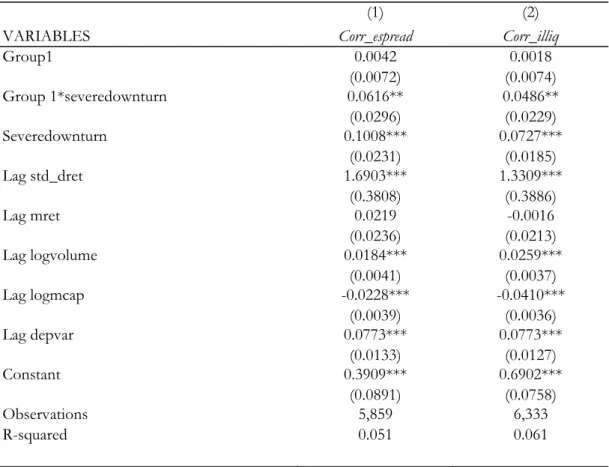
Table 3 analysis using alternative commonality measures (Corr_espread and Corr_illiq), which measure
the correlation between a stock’s daily liquidity with market liquidity. Results are in Table 4. The results
in Table 4 are remarkably similar to results using R2espread and R2illiq. For example, the estimated
increase in commonality for all stocks and the coefficient of 0.0616 on Group1*severedownturn in Table 4 implies an additional 26% increase in spread commonality for margin-eligible stocks during crises. That is, trader leverage accounts for more than one third of the total increase in commonality for margin-eligible stocks. These findings show that the effects we document in Tables 2 and 3 are driven by increases in positive liquidity comovement.
4.1.2. Placebo tests
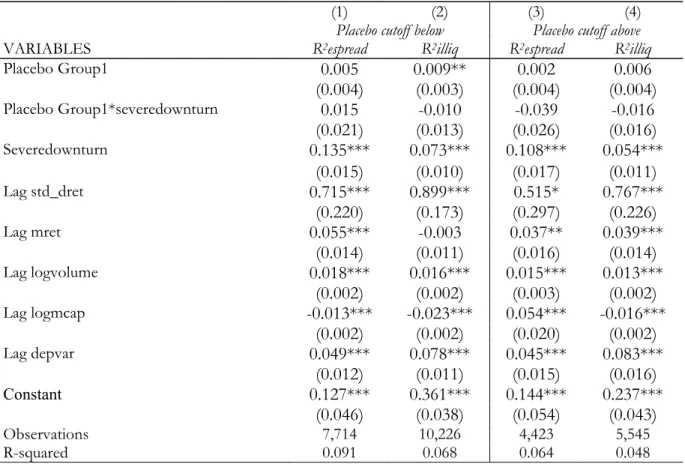
Tables 2 through 4 reveal a causal effect of trader leverage on commonality in liquidity during crises. In particular, we observe a discontinuous increase in commonality at the margin trading eligibility cutoff, which lends empirical support for the hypothesis that trader leverage causes commonality, especially during downturns. The identifying assumption in this interpretation is that there is a sharp discontinuity in the ability of traders to borrow at the impact cost value of 1%. One potential alternative interpretation of the main results (in Tables 2 and 3) is that the measured impact costs predict future commonality in liquidity rather than variation in trader leverage and that the regressions capture this relationship. To ensure that our results are not driven by variation in impact cost, we repeat the analysis around false eligibility cutoffs. We examine two false cutoffs: the first at one bandwidth above, and the second at one bandwidth below, the true cutoff of 1%.
The results of the placebo analysis are in Panel A of Table 5. Unlike the liquidity patterns at the true cutoff shown in Tables 2 through 4, we find no evidence of discontinuous jumps in commonality around the false eligibility thresholds. This is true both on average and during crises, and it lends strong support to the causal interpretation of our findings.
What happens during other periods of high market volatility, specifically when there are large rises in the market? If the main findings are due to margin traders whose portfolio constraints cause deleveraging when market conditions deteriorate, we would not expect to observe symmetric effects during extreme up- and down- market conditions. Examining market rallies, rather than severe downturns, can serve as a placebo check for the mechanism driving our results. In Panel B of Table
5, we repeat the Table 3 regression analyses, but we replace severedownturn with market_rally, a dummy
variable equal to 1 if market returns are higher than 90th percentile returns. There are two important
observations from the table. First, on average, commonality in liquidity is lower during extreme market increases. Second and most importantly, there is no differential impact of margin eligibility on
commonality during market rallies, that is, the coefficient on the market_rally*Group 1 interaction is
statistically insignificant. These findings support the leverage-induced funding constraints interpretation of our main results.
4.1.3. Alternative explanations
Karolyi, Lee and Van Dijk (2012) find that commonality is higher when stocks are owned by more foreign owners. Kamara, Lou, and Sadka (2008) find that institutional ownership and index membership are associated with higher commonality. Unlike the trader leverage channel (an effect related to funding constraints), these variables capture effects due to similarity in institutional investment styles or tastes. In interpreting the results in this paper, one might be concerned that Group 1 status is capturing variation in institutional (or foreign) ownership rather than trader leverage. In this section, we analyze this, as well as other potential alternative explanations.
It is useful to start by noting that our main finding arises only during severe downturns. We do not observe significant differences in commonality in liquidity between Groups 1 and 2 stocks outside of downturns. Alternative explanations based on correlated trading channels are unlikely to drive the main results because, if margin traders engage in correlated trading strategies due to similarity in investment style or taste, we would expect margin eligibility to drive correlations in liquidity during normal market conditions and stock market rallies, as well as downturns. To complement this reasoning, we conduct extended robustness tests to assess directly the impact of previously documented channels on our findings.
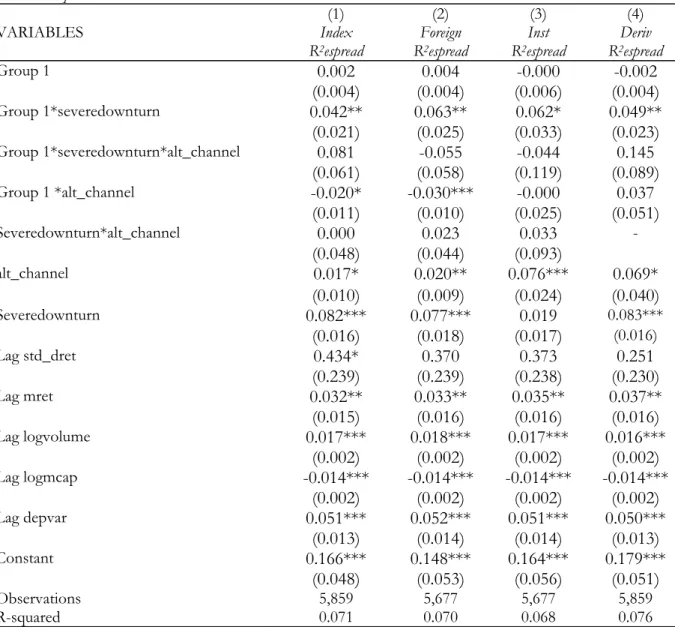
To examine whether our results are driven by index membership, we introduce a dummy equal to 1 if the stock is in the CNX500 index (Standard and Poor’s broad-based index of the Indian Stock market). To investigate the role of investor type, we use quarterly ownership data from Prowess and
introduce variables foreign and inst, which are equal to percentage foreign and institutional ownership,
respectively. We repeat the analysis shown in Table 3, but we include all of these direct effects. We
also interact them with Group 1 dummy, as well as the Group 1*severedownturn interaction variable, to
see whether our trader leverage interpretation is actually coming from an alternative mechanism. In addition, we examine whether Group 1 status is proxying for the ability to trade derivatives on the
stock. To do so, we introduce deriv, a dummy variable equal to 1 if the stock is eligible for futures and
options trading.14
14 Note that all stocks eligible for futures and options trading are in Group 1; however, it is only a subset of margin-eligible stocks (there are approximately 150 of these stocks). This means that the group1*deriv and deriv are collinear. Thus, the former are dropped from the analysis.
Results are in Table 6. The estimated coefficients on the direct effects are overall in line with earlier findings. For instance, consistent with Kamara, Lou, and Sadka (2008), we find that, on average, index stocks exhibit more commonality and institutional ownership exacerbates commonality in liquidity. Similar to Karolyi, Lee and Van Dijk (2012), we also find higher commonality in stocks with more foreign ownership. Interestingly, the estimated coefficients on the Group 1 interactions with foreign ownership and index membership are both negative, suggesting that margin eligibility mitigates their effects. While these alternative interpretations are significant on average, they don’t have a differential impact on commonality in liquidity during severe downturns. Most importantly, the estimated crisis-period impact of Group 1 status on commonality in liquidity remains very close to the main results in Table 3, even after accounting for these alternative channels.
Finally, using the quarterly ownership data from Prowess, we check for changes in ownership composition during severe downturns. For each stock, we calculate the percentage shares held by
foreign investors, institutional investors, individual investors, and blockholders/insiders (foreign perc,
inst perc, indiv perc, and promoter perc, respectively). We also investigate whether the information structure
of trading, which might cause changes in commonality, changes during severe downturn periods.15 We
then regress these stockholdings on the Group 1 dummy as well as its interaction with severedownturn.
Appendix Table A.4 reports the results. Group 1*severedownturn is insignificant in all regressions,
indicating that there is no significant change in ownership composition or informed trading during
severe downturns. 16
4.2. Return Commonality
The analysis thus far tests the hypothesis that leverage can drive substantial increases in liquidity comovement during crises. We focus most of the initial analysis on commonality in liquidity because it is pervasive and not well-understood; however, it is important to point out that, in theory (e.g., Gromb and Vayanos (2002), Brunnermeier and Pedersen (2009), Geanakoplos (2010)), trader leverage will drive both commonality in liquidity and commonality in returns. In this section, we use our research design to test the hypothesis that trader leverage causes return comovement. Our set-up allows us to estimate the portion of return comovement that stems from frictions related to trader leverage.
Before describing the specifics of the empirical analysis, it is important to emphasize that commonality in liquidity does not necessarily imply commonality in returns. As Karolyi, Lee and Van Dijk (2012) note, commonality in liquidity can arise when stocks are facing very different liquidity demands. If one group of stocks experiences intense buying pressure, while the other experiences intense selling pressure, we would see increased correlation in liquidity but not an increase in return correlation. However, in the case of the deleveraging that occur during crises, selling pressure that are
16 As the results in Appendix Table A.4 indicate that investor composition does not change with Group 1 membership, we populate the quarterly ownership data at the monthly frequency for the purpose of Table 6. This allows us to compare the results with the ones from the baseline analysis.
likely to be similar across stocks might cause returns to comove in ways that are similar to the liquidity patterns that we observe.
To test for evidence of the hypothesized relationship between leverage and returns comovement, we repeat the main Table 2 and Table 3 regressions, but we replace the dependent
variable with commonality in returns. Similar to before, we use the R2 from a regression of stock i’s
returns on the market index to capture return commonality. The results are in Table 7. Columns 1 and 2 are analogous to the Table 2 regressions. They show results of regressions without the stock-level control variables. In Columns 3 and 4, we add the same additional controls that we include in Table 3. Consistent with the descriptive statistics in Panel D of Table 1, the estimates in Table 7 provide causal evidence of the impact of trader leverage on return comovement during severe downturns.
Columns 1 and 3 show that, on average, there is a significant difference in return comovement between Group 1 and Group 2 stocks, however this difference is quite small. For example, in Column
1, the estimated coefficient on Group1 dummy implies a 10 basis point increase in return comovement
for stocks that are eligible for margin trading, which is a 3.9% increase relative to the average return
comovement in the local sample of Group 2 stocks. When we include severedownturn dummy as well as
its interaction with Group1 dummy variable in Columns 2 and 4, we see that this difference is entirely
driven by crisis periods (as in the case of commonality in liquidity). The coefficient of 0.056 on the
Group 1*severedownturn interaction in Column 2 of Table 7 implies that trader leverage accounts for a 56 basis point increase in crisis-period return comovement. This represents approximately 28% of the total crisis-period increase in return comovement, which is remarkably similar in magnitude to the
results we document for commonality in liquidity. Overall, these findings show that leverage is a key
driver of the increase in stock return comovement that we observe during downturns. 17
Given the results in Tables 2, 3 and 7, and the theoretical linkages between commonality in returns and liquidity, it is natural to ask whether the Group 1 stocks with higher return commonality during downturns also have higher liquidity commonality. The data reveal that this is, indeed, the case. While the correlation between commonality in liquidity and commonality in returns measures for local Group 1 stocks is only 0.2 outside severe downturns, this correlation more than doubles during severe downturns. In Panel B of Table 7, we further examine this by looking at stocks’ liquidity and return comovement rankings. In each period, we independently sort Group 1 stocks into 5 groups (in ascending order) based on stock’s commonality in liquidity and commonality in returns. Panel B reports the mean commonality in returns rank for each of the 5 groups of stocks ranked on
commonality in liquidity.18 Outside of severe downturns, there is only a mild association between
commonality in liquidity and commonality in returns; however, the relationship becomes much stronger during severe downturns. Stocks that have the highest and the lowest commonality in liquidity
during severe downturns have an average rank of 4.38 and 2.04, respectively, in R2returns. The
crisis-period increase in average R2returns ranks is also strongly monotonic as we move from stocks with the
lowest-ranked commonality in liquidity to the ones with the highest rank.
17 Appendix Table A.5 contains results of robustness analyses in which we test whether the commonality in returns findings in Table 7 are sensitive to bandwidth choice or to the inclusion of polynomials of impact cost – the RDD checklist robustness tests. These regressions are analogous to those in Appendix Tables A.2 and A.3. As in Tables A.2 and A.3, we find that return commonality results are robust.
18 For this exercise, we use R2espread as our measure of commonality in liquidity. Results are similar when
4.3. Mechanism
In this section, we examine margin trading activity and leveraged-based linkages across stocks to shed additional light on the mechanisms driving our main findings. All of the tests include examinations of commonality in both liquidity and returns. This helps us understand whether commonality in
liquidity is caused by some of the same forces that drive commonality in returns.
4.3.1. Correlated Margin Trading Activity
The results presented so far show that the ability of traders to borrow increases commonality in liquidity and returns. If traders’ use of leverage (rather than simply the ability to lever up, captured by the Group 1 dummy variable) is really driving the results, we would also expect the findings to be strongest in stocks in which there is more correlated margin trading activity. We do not have trade-level data on margin trading activity; however, the daily stock-trade-level margin positions data available in India allow us to examine this question (and are a substantial improvement over the monthly market aggregate data available in the U.S.). We use this information to calculate a proxy for correlated margin
trading activity: margin corr is equal to the correlation between daily changes in a Group 1 stock’s
outstanding margin positions and the average daily changes in outstanding margin positions in the entire market during each month. Even though we do not observe intraday margin trades, our proxy
is likely to be correlated with total margin trading activity.19
19margin corr captures daily correlations in changes in outstanding margin positions and is defined over the entire sample period. As reported in Section 3, there is a substantial decline in margin debt for Group 1 stocks during severe downturns, indicating that margin corr in such time periods mostly captures correlated
We repeat the Table 3 and Table 7 regressions, but we include margin corr, and interact it with
Group1 and Group1* Sevredownturn.20 If the increase in commonality in liquidity and returns that we
observe is due to trader leverage, we expect that the coefficients on the triple interaction term will be positive and significant.
The findings in Table 8 show that this is indeed the case. Results reveal an economically
important role for margin corr for both commonality in liquidity and commonality in returns. For
instance, the results in Column 1 imply that a one standard deviation increase in correlated margin
activity during severe downturns results in a 0.035 (equal to 0.15 * 0.23) increase in R2espread, which is
about 50% of the average effect of the increase in R2espread during severe downturns. Note that, unlike
the triple interaction term, coefficients on margin corr*Group1 are not positive and significant, revealing
that trader leverage does not increase commonality outside the crises periods. The findings for
commonality in liquidity based on R2illiq and commonality in returns are similar (Columns 2 and 3 of
Table 8, respectively).
4.3.2. Within-Group Commonality
If the increased commonality of liquidity and returns that we observe in Group 1 stocks during severe downturns is due to binding capital constraints and deleveraging, then one would expect commonality to be higher within the universe of Group 1 stocks. In this section, we analyze commonality within and across Group 1 and Group 2 stocks. To do so, we calculate the pairwise
20 Since margin corr is available only for Group 1 stocks (it is set to zero for Group 2 stocks),regressions include only Group1* Severedownturn. The interaction severedownturn * margin corr and margin corr are dropped due to multicollinearity.
correlations in stocks’ liquidity and return measures, and then we test whether within- or across-group commonality is stronger.
For each local stock, we calculate the monthly pairwise correlations of the stock’s daily liquidity with the daily stock liquidity of all other stocks in the market (including nonlocal stocks). We also do
the same for returns. Corr_espread is the monthly pairwise correlation in espread. Corr_illiq is the monthly
pairwise correlation in illiq. Corr_return is the monthly pairwise correlation in stock returns. We analyze
the differences in pairwise correlations for different types of stock pairs. G1G1 is a dummy variable
equal to 1 if both stocks in a given pair are Group 1 members; G2G2 is a dummy variable equal to 1
if both stocks in a given pair are Group 2 members. The baseline pair is a pair that consists of one
Group 1 and one Group 2 stock. We interact both G1G1 and G2G2 with severedownturn dummy to
assess the change in within-group pairwise correlations during downturns. The results are in Table 9. Consistent with our previous findings, all stocks exhibit commonality, especially during downturns. Group 1 stocks, whose margin traders are more likely to face collateral calls that may cause them to liquidate several stocks in their portfolios, have higher pairwise correlations with both Group 1 and Group 2 stocks during downturns. Most importantly, in those crisis periods, Group 1 stocks have higher pairwise liquidity and return correlations with other Group 1 stocks than they do with Group
2 stocks (G1G1 and G1G1 * severedownturn are both positive and significant). Thus, the findings in
Tables 2, 3 and 7 not only reflect Group 1 stocks’ increased comovement with the market, but that some of this stems from increased comovement with other Group 1 stocks. Group 2 stocks, which are ineligible for margin trading and less likely to have traders facing margin calls, see less pairwise liquidity and return comovement with other Group 2 stocks in both normal times and during crises.