Transferring User Interests Across Websites with Unstructured Text for
Cold-Start Recommendation
Yu-Yang Huang and Shou-De Lin
Department of Computer Science and Information Engineering, National Taiwan University, Taipei, Taiwan
{r02922050,sdlin}@csie.ntu.edu.tw
Abstract
In this work, we investigate the possibility of cross-website transfer learning for tackling the start problem. To address the cold-start issues commonly present in a collabora-tive ltering (CF) system, most existing cross-domain CF models require auxiliary rating data from another domain; nevertheless, un-der the cross-website scenario, such data is of-ten unobtainable. Therefore, we propose the nearest-neighbor transfer matrix factorization (NT-MF) model, where a topic model is ap-plied to the unstructured user-generated con-tent in the source domain, and the similarity between users in the latent topic space is uti-lized to guide the target-domain CF model. Specically, the latent factors of the nearest-neighbors are regarded as a set of pseudo ob-servations, which can be used to estimate the unknown parameters in the model. Improve-ment over previous methods, especially for the cold-start users, is demonstrated with experi-ments on a real-world cross-website dataset.
1 Introduction
While collaborative ltering (CF) approaches are one of the most successful methods for building rec-ommender systems, their performance deteriorates dramatically under cold-start situations. That is, low prediction accuracy is observed for users/items with very few ratings. Content-based recommender sys-tems may also suffer from the cold-start problem. For instance, content-based nearest-neighbor mod-els (Pazzani and Billsus, 2007) might not be as ef-fective if some users contain too few information to generate a meaningful set of neighbors.
Two types of solutions have been proposed to ad-dress the cold-start problem. The rst is to cre-ate hybrid recommendation models that impose a content-based model on a CF model to enrich the information for users/items with sparse rating pro-les (Burke, 2002; Burke, 2007). The second is to transfer the information from auxiliary domains as a remedy to the cold-start individuals (Deng et al., 2015). This paper aims at bringing a marriage be-tween these two types of strategies.
Although transfer learning gradually gains pop-ularity in handling the cold-start issue (Roy et al., 2012), most of them assume a homogeneous model where observations in both domains are of the same type. That is, to transfer knowledge to a rating-based/text-based recommender system, the source system must also be rating-based/text-based. Some earlier works even require the ratings from both do-mains to be in the same format (Li et al., 2009), or assume specic structured text, such as user-provided tags (Shi et al., 2011; Deng et al., 2015). In this work, by contrast, no source-domain ratings are available and unstructured user-generated content is treated as the auxiliary data. We propose a hetero-geneous transfer learning framework to utilize un-structured auxiliary text for a better target-domain CF model.
As there is no single service satisfying all so-cial needs, users nowadays hold multiple accounts across many websites. Furthermore, the account linking mechanism is often available on these web-sites. This allows a precise mapping between the accounts of the same user to be built. One major ap-plication of our approach is to improve the
mendation quality in the target service using auxil-iary data obtained from another seemingly irrelevant service.
For instance, consider a new user on YouTube. The initial recommended videos for this user is likely to be irrelevant as there is very few infor-mation available. However, with the account link-ing mechanism, YouTube accounts can be linked to Twitter accounts with a simple click. Our goal is to utilize the content generated by this user on Twitter, despite the possibility that the content is irrelevant to their preference on video browsing, to produce a better video recommendation list on YouTube.
Seemingly intuitive, there exist some difculties in such cross-website transfer learning approach. The biggest challenge lies in the fact that most users do not use multiple services (e.g. social media sites) for the same purpose. Usually a user registers for multiple services because each of them serves its own purpose. As a result, we cannot assume the ex-istence of direct mentions about target-domain items in the source-domain text data. For example, a regu-lar YouTube viewer does not necessarily tweet about the videos he/she has viewed. Thus simple meth-ods such as keyword matching are likely to fail. The same reasoning also implies that, when transfer-ring knowledge across websites or services, the as-sumption of a shared rating format or structured text is overly optimistic. Even websites aiming for the same purpose often violate this assumption, let alone websites of different types. Therefore, we expect that the source and target services contain heteroge-neous information (e.g. content vs. rating). In our model, we make a less strong assumption: regard-less of the type of information available in each do-main, the users that are similar in one domain should have similar taste in the other domain. Thus, instead of directly transfer the content material from source to target domain, we transfer the similarity between users, and use it as a guide to improve the CF model in the target domain.
2 LDA-MF Model
We rst introduce an intuitive model to realize the above-mentioned idea, and point out several in-trinsic weaknesses making it unsuitable for cross-website transfer learning.
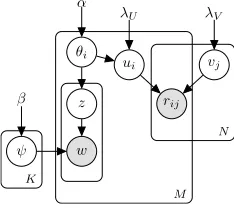
Here we rely on the probabilistic matrix factoriza-tion (PMF) model as our target-domain CF model. In the PMF model, each user latent factor is mod-eled (a priori) by a zero-mean Gaussian. To incor-porate source-domain information into the target-domain PMF model, for each useri, a topic vector θi is extracted from source-domain text content and assigned as the prior mean of this user's PMF latent factor, that is,
ui ∼ N(θi, λ−U1I), (1)
where λU is the precision parameter and I is the identity matrix. Different from the original PMF model, prior distributions of different user latent fac-tors are no longer identical. For users having simi-lar source-domain topic vectors, their latent factors are expected to be close in the target-domain latent space. Such property allows the similarity between users to be transferred from source domain to the target domain.
With the latent Dirichlet allocation (LDA) (Blei et al., 2003) topic model being used, the graphical model is depicted in Figure 1. This model is sim-ilar in structure to the recently proposed collabora-tive topic regression (CTR) (Wang and Blei, 2011) model. The main difference is that, instead of mod-eling description about items, now user-generated content from the source domain is modeled in our problem. We call this model the LDA-MF model.
rij
ui vj
λU λV
z
w θi
α
ψ β
N
[image:2.612.368.485.468.575.2]M K
Figure 1: The LDA-MF model.
of the user-generated content, and the other is gen-erated from the rating data in the target domain to model the latent interests of users. It is an overly strong assumption to assume the optimal dimension-alities for LDA and PMF are equal. In practice, if we choose the dimensionality to optimize the pre-dictive power of PMF (e.g. by cross-validation on the rating data), the LDA model is likely to yield sub-optimal results and vice versa. The experiments that will be shown later conrm this concern. Fur-thermore, since the two variables are modeling dif-ferent types of observations coming from difdif-ferent websites, the underlying meanings of the latent di-mensions are unlikely to be identical. By treating the LDA topic vector as the prior mean of the PMF user latent factor, the latent dimensions are forced to be one-to-one aligned, which is again a strong as-sumption. Finally, the topic vectors are drawn from the Dirichlet distribution which has a bounded (and positive) supportS, while the latent factors in PMF
are unbounded Gaussian random vectors. If the op-timal solution ofui is far from S, the performance of the model could be affected, particularly in the cold-start situation where data is sparse and the prior plays an important role.
3 Nearest-Neighbor Transfer MF Model
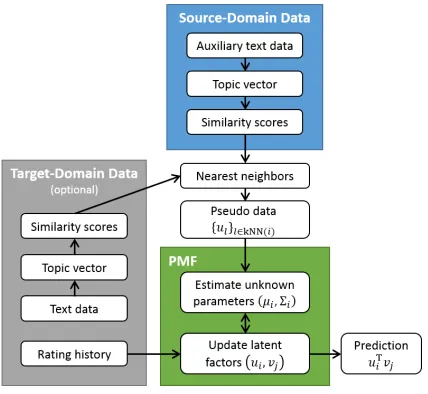
To alleviate the drawbacks of the LDA-MF model, here we propose nearest-neighbor transfer matrix factorization (NT-MF) model to transfer user inter-ests across websites. The entire framework is de-picted in Figure 2.
[image:3.612.321.535.56.253.2]We begin by describing the scenario in which our model operates. First, there is a rating-based rec-ommender system (i.e. PMF) in the target domain, which suffers from the cold-start problem. The tar-get domain might or might not contain content in-formation. For example, in the video recommenda-tion task, we can use the titles of all rated videos of a user to generate content information in the target domain. Such information is not available for the cold-start users since they have not rated any videos. However, in the source domain there are some con-tent information available for these users. This can be, say, the content of a user's tweets. As previously mentioned, this type of auxiliary text data is imme-diately available when a user connects the accounts
Figure 2: The entire system.
from two domains. Therefore, we assume this aux-iliary text data is available for all users.
3.1 Model Outline
Next, we describe the high level concept of our model. As described previously, we have observed that the hypotheses encoded by the LDA-MF model is too strong as the PMF latent factor is enforced to inherit certain mathematical properties from the LDA topic vector. Here we loosen the constraint to only enforce that users should have similar distri-butions over the target-domain PMF latent factors if there is a high similarity between their source-domain topic vectors.
It is a reasonable hypothesis since our objective is to make the target-domain rating matrix factorize in a way that is consistent with the knowledge ex-tracted from source-domain text. After all, the fac-torization of incomplete matrix is not unique, and there is no reason that the latent factor should match the topic factor of the user. In fact, our hypothesis implies a different distribution over the PMF latent factor for each user, i.e. ui ∼ N(µi,Σi), where
(µi,Σi)are unknown parameters, and are (possibly) different for each user.
To estimate the unknown parameters in a dis-tribution, normally we need a set of observations,
(u(1)i , u(2)i , . . .). However, the parameters now
over the parameter space is obviously intractable. Even if we treat the entire model as a hierarchical model and learn the parameters indirectly from rat-ing data, the cold-start problem immediately comes in and forbids us from learning a representative dis-tribution for users.
We propose the idea of using the latent factors of the nearest-neighbors to estimate the unknown pa-rameters in the distribution for a user. That is, the latent factors of the nearest-neighbors,{ul}l∈kNN(i),
are regarded as a set of pseudo observations to re-place the unavailable data, (u(1)i , u(2)i , . . .).
How-ever, the denition of closeness is not based on target-domain rating data, but computed by the topic vectors obtained from the content in the source do-main (and the target dodo-main, if available). Our model is thus not hampered by the cold-start prob-lem.
Note that, in addition to the set of k
-nearest-neighborskNN(i), we also have the corresponding
similarity scores sim(i, l) between each neighbor
l and user i. The similarity scores along with the
list of nearest-neighbors are transferred to the tar-get domain to form a set of weighted samples, D,
which can be used to estimate the unknown parame-ters(µi,Σi), i.e.,
D ≡ {
{ul}l∈kNN(i)
wl=sim(i, l).
(2)
The main purpose of assigning a sample weight
wl to each of the pseudo observationsul is that by doing so, users with a higher source-domain simi-larity to useriwill have a larger impact on the
esti-mation of the target-domain parameters(µi,Σi). In other words, with this model specication, the simi-larity between users is transferred across domains.
3.2 Inference in NT-MF Model
To perform inference in our model, we adopt the maximum a posteriori (MAP) strategy and alter-nately update the user and item latent factors (i.e. by block coordinate ascent), similar to some previ-ous solutions (Salakhutdinov and Mnih, 2007; Wang and Blei, 2011).
To solve for the optimal user latent factor ui,
we need to rst estimate the unknown parameters
(µi,Σi). Therefore, in our coordinate ascent algo-rithm, different from the original PMF model, we update the user latent factors one by one. That is, all user latent factors are regarded as xed constants except for the one,ui, to be updated. By doing so,
for each useri, a set of pseudo observations about ui (Eq. 2) is available. Using these pseudo obser-vations, the unknown parameters(µi,Σi) can then be estimated with standard techniques such as maxi-mum likelihood estimation (MLE). After an estima-tor of(µi,Σi)is obtained, we can analytically solve for the MAP solution of the user latent factor ui.
Then, we move on to the next user, and the coor-dinate ascent procedure continues. These two steps, namely the estimation of unknown parameters and the updating of the latent factors, are repeated until convergence.
One advantage of this procedure is that the list of nearest-neighbors and the similarities in Eq. 2 need not be recomputed during inference, avoiding expensive recomputation of pairwise similarities. It is also noticeable that, different from other transfer-based approaches, rating information and structured text from the source domain are not required in this procedure of model optimization. This further adds a level of exibility to our framework for transfer-ring user interests across websites.
3.3 Case Study: Inferring Unknown Mean To clarify the previous discussions, we present a simple but detailed case-study on how an NT-MF model and its optimization procedure can be de-rived. The latent factorui for each user is assumed to be generated from a multivariate normal distribu-tion with unknown meanµi and a known precision parameterλU, which is shared among the users.
The generative process proceeds as follows:
1. For each useri, draw user latent factor ui ∼
N(µi, λ−U1I).
2. For each itemj, draw item latent factor vj ∼
N(0, λ−V1I).
3. For each observed user-to-item pair(i, j), draw
the ratingrij ∼ N(uTivj, λ−01),
where λ0 is the precision parameter of the
users and items, respectively. We use the notation
N(x|µ,Σ)to denote the Gaussian pdf with meanµ
and covarianceΣ.
The model is optimized by maximizing the pos-terior likelihood of the latent variables (an additive term is omitted),
L=−λ0
2
M
∑
i=1
N
∑
j=1
γij(rij−uTi vj)2
−λU
2
M
∑
i=1
(ui−µi)T (ui−µi)−
λV
2
N
∑
j=1
vjTvj,
(3)
whereγij is an indicator variable which is equal to 1 if itemjis rated by useri, and 0 otherwise.
To solve the MAP problem, we need to rst es-timate the unknown parameters in the distribution, which in this case is the mean vector µi. The
likelihood function over the pseudo observations,
{ul}l∈kNN(i), is dened as,
p(D|µi, λU) =
∏
l∈kNN(i)
N(ul|µi, λ−U1I). (4)
By taking derivative of Eq. 4 with respect toµi and set it to zero, we obtain,
∑
l∈kNN(i)
(ul−µi) = 0, (5)
which implies that the MLE of µi is the sample mean. However, since we are dealing with a set of weighted samples, the sample mean is replaced by the weighted average (the weights wl are assumed to add up to one):
µi =
∑
l∈kNN(i)
wlul. (6)
Our model yields an intuitive result: to estimate the mean vector µi of ui, we can simply take the weighted average of the latent factors ul from the nearest-neighbors as an estimator, where the weights are the similarity scores between the textual proles of useriand its neighbors.
Given µi, we can now maximize Eq. 3 with
re-spect to ui andvj. By taking derivative of Eq. 3
with respect touiandvjand set it to zero, we obtain the update equations,
N
∑
j=1
γijvjvTj +
λU
λ0
I
ui=
N
∑
j=1
γijrijvj+
λU
λ0
µi
(7)
(M
∑
i=1
γijuiuTi +
λV
λ0
I
)
vj = M
∑
i=1
γijrijui. (8)
Now with Eq. 6 to Eq. 8 at hand, we can itera-tively solve forµi,uiandvj for all users and items until the model converges.
It can be seen from this case-study that NT-MF eliminates the three major drawbacks of the previ-ously mentioned LDA-MF model. First, the topic vectors and the user latent factors are not required to have equal dimensionalities, which allows for the optimal dimensionality to be chosen in both models. Second, the mean vector, that is, thekNN weighted
average in Eq. 6, is a linear combination of a set of user latent factors; as a result, the latent dimensions ofui andµi are naturally aligned. Third, the mean vectorµihas the same support as the user latent fac-torui, avoiding the risk of prior misspecication in
cold-start situations.
4 Experiment
We use YouTube video recommendation to test the usefulness of NT-MF under the cold-start scenario. The NT-MF model used in this section follows the optimization procedure derived in Section 3.3.
4.1 Dataset and Statistics
topic vectors can be obtained (Hong and Davison, 2010). We refer to this text data as the Twitter cor-pus.
Videos in a user's liked or favorite playlists are considered to have a rating rij = 1. Other videos are assigned rij = 0. In other words, we are dealing with a one-class collaborative ltering (OCCF) problem (Pan et al., 2008). We adopt the same strategy as in (Wang and Blei, 2011) to deal with OCCF. First, all ratings are assumed to be ob-served, i.e. γij = 1for all user-item pairs. Next, a condence parameter cij is introduced to reduce the inuence of the huge number of zeroes during model optimization. The condence parameter takes place of the original rating precision parameter λ0
and is dened in (Wang and Blei, 2011) as cij =
aifrij = 1andcij =botherwise (a > b >0). All the derivations in the previous sections follow intu-itively.
The titles of the liked videos are concatenated and treated as the text data in the target domain (which we refer to as the YouTube corpus). As for the vo-cabulary, stopwords are rst removed, and then 5000 words are selected from the YouTube corpus based on their TF-IDF scores (Blei and Lafferty, 2009). On average, each user's Twitter text data contains 5149 words and 1193 distinct terms, and each user's YouTube text data contains 158 words and 116 dis-tinct terms. These statistics are in accordance with our assumption that text data in the source domain is abundant comparing to that in the target domain.
To validate the prediction result, each user has at least 10 liked videos. Videos with less than 5 likes are removed from the dataset. After data cleansing, there are 7328 users and 18691 videos in the dataset. The maximum number of likes received by a video is 98, and the average is 19.1. Among all videos, 92% of them are liked by less than 40 users. The max-imum number of likes given by a user is 908, and the average is 48.8. Among all users, 89% of them have liked less than 100 videos. The sparsity (ratio of zeroes to the total number of entries) of the rating matrix is 99.74%, which illustrates the difculty of this recommendation task.
4.2 Evaluation and Scenario
We choose the area under ROC curve (AUC) as the evaluation metric. AUC is often used to compare
models when there is severe class imbalance, which is the case in our OCCF problem since we regard all zeroes as observed. All reported results are the average of 5 random data splits.
Similar to the experiments performed in (Wang and Blei, 2011), we test the performance of each model under two different scenarios. The rst one is the task of in-matrix prediction. In this task, the likes received by each video are partitioned into three sets, namely the training, validation and testing sets. The ratio of data partition is 3:1:1. There are no cold-start users for the in-matrix prediction.
The second task is the out-of-matrix prediction, where the users are partitioned into three sets with the same 3:1:1 ratio. To make the two tasks compa-rable, we randomly split the data until the number of observations in each of the three sets is closed to that of the in-matrix task. Users in the testing set are all cold-start users. The only data we have when mak-ing prediction on the cold-start users is the auxiliary text data.
4.3 Baseline Methods
• LDA: We run linear regression on the LDA
fea-tures to predict the ratings. This model serves as a content-based baseline.
• UKNN: The user-kNN algorithm (Herlocker
et al., 1999) based on LDA features is imple-mented. This model serves as a neighborhood-based baseline.
• PMF: PMF (Salakhutdinov and Mnih, 2007) is
a classic and widely-used CF model. It uses only the rating information, and thus is not ca-pable of performing the out-of-matrix task.
• LDA-MF: This model is implemented as has
been described in Section 2. It is similar to CTR (Wang and Blei, 2011) in structure. Since the optimization of the full model converges badly, we pre-train the LDA part of the model, and x the topic vector when optimizing the PMF part.
All hyperparameters are tuned on the validation set. Due to efciency and storage considerations, for UKNN and NT-MF, thek-nearest-neighbors are
50 200 0.80
0.81 0.82 0.83 0.84 0.85
(0.769) (0.762)
K
A
UC
LDA UKNN PMF LDA-MF NT-MF
50 200
0.80 0.81 0.82 0.83 0.84 0.85
(0.749) (0.716) (0.757) (0.718)
K
A
UC
LDA UKNN PMF LDA-MF NT-MF
50 200
0.80 0.81 0.82 0.83 0.84 0.85
(0.759) (0.791) (0.776) (0.791)
K
A
UC
LDA UKNN PMF LDA-MF NT-MF
[image:7.612.88.536.56.188.2](a) YouTube corpus (b) Twitter corpus (c) YouTube + Twitter corpus
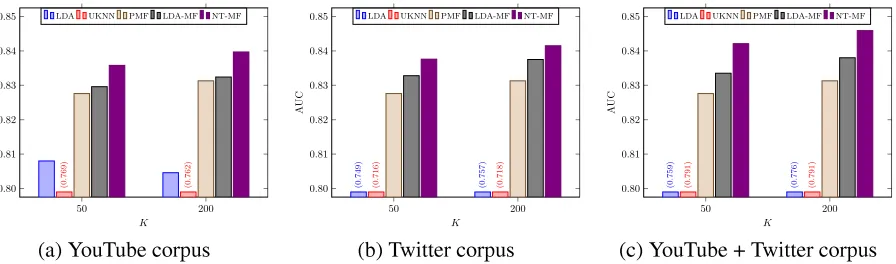
Figure 3: In-matrix AUC using different corpus. For methods signicantly worse than others, we cut off the plot and put the AUC values on top of the bars. NT-MF is signicantly better than the baselines in all plots, according to a paired t-test(p <0.05).
(Muja and Lowe, 2014). The symmetric Kullback-Leibler divergence is chosen to be the distance met-ric between topic vectors. For all baseline methods, we useKto denote the dimensionality of the latent
variables. However, when discussing about NT-MF, since the number of topics can be different from the number of user latent factors, we useT to denote the
former andKto denote the latter to avoid confusion.
4.4 In-Matrix Prediction
In this section, the in-matrix prediction is discussed. First, we test the model's general performance on different corpora. Normally, the optimal number of topics will not be the same for different cor-pora. Since the LDA model performs the best with
K = 50on the YouTube corpus and K = 200 on
the Twitter corpus, we report the results whenK is
set to these two numbers.
Figure 3(a) shows the results when no source-domain information is available and thus no trans-fer learning is performed. That is, all models are provided only with the YouTube ratings and the YouTube corpus. Because the YouTube corpus is scarce, the LDA model results in lower AUC when more topics are used, signifying overtting. The same reason also leads to limited improvement of LDA-MF over PMF. Using neighborhood informa-tion alone, UKNN performs poorly. On the other hand, as a model bringing neighborhood information into PMF, NT-MF outperforms all baselines signi-cantly. The above analysis shows that, although us-ing either content (LDA) or neighborhood (UKNN) information alone is insufcient to generate good predictions, they can effectively improve the factor-ization of the rating matrix if used correctly.
To demonstrate the advantage of transfer learning, we study the scenario where only source-domain text and target-domain ratings are available. That is, the YouTube corpus in the previous analysis is re-placed with the Twitter corpus. The result is shown in Figure 3(b). Comparing to Figure 3(a), we can see that although the Twitter corpus is larger than the YouTube corpus, it leads to a worse performance for LDA and UKNN. Content information from the noisy Twitter corpus alone is not sufcient to capture the rating behavior of users. However, by integrat-ing the content information and ratintegrat-ing history, both LDA-MF and NT-MF benet from a larger corpus.
In the following analyses, we use data from both websites. For LDA, PMF and LDA-MF, we merge the two corpora by summing up the word counts. For UKNN and NT-MF, however, there is a more elegant way to combine the knowledge from differ-ent websites. First, we compute user similarity sep-arately from the two corpora. Then, the two sets of similarity scores are weighted and averaged. Finally, the nearest-neighbors are computed based on this set of newly generated similarity scores. By applying this strategy to NT-MF, not only canθi andui dif-fer in dimensionality, but also the optimal number of topics can be used for different corpora. Regardless ofK, we useT = 50for YouTube andT = 200for
20 40 60 80 100 120 140 160 180 200 0.76
0.77 0.78 0.79 0.80 0.81 0.82 0.83 0.84 0.85
# of observed ratings
A
UC
LDA UKNN PMF LDA-MF NT-MF
20 40 60 80 100 120 140 160 180 200
0.01 0.02 0.03 0.04 0.05 0.06 0.07
# of observed ratings
A
UC
difference
LDA UKNN
PMF LDA-MF
(a) (b)
Figure 4: (a) Cumulative in-matrix AUC. Each point(x, y)in the gure means that the model gives an averaged AUC ofyamong
all users who have less than or equal toxobserved ratings. (b) Difference in cumulative in-matrix AUC between NT-MF and
baseline methods.
Next, as a preliminary investigation of the perfor-mance on cold-start users, in Figure 4(a), we plot the cumulative AUC with respect to the total num-ber of observed ratings. NT-MF outperforms other methods in terms of cumulative AUC regardless of the number of observed ratings. The advantage of NT-MF over the baseline methods is even greater as the number of observed ratings decreases (except for LDA). To make it clear, we plot the difference in AUC between NT-MF and the baseline methods in Figure 4(b). This phenomenon sheds light on the advantage of NT-MF under cold-start scenario.
4.5 Out-of-Matrix Prediction
In this section, we discuss the out-of-matrix predic-tion. Users in the testing set are all completely cold-start users. That is, we are only provided the Twit-ter corpus when making prediction for these users. Therefore, our previous strategy of averaging the similarities only applies to users in the training set. For this study we adopt the strategy of merging the two corpus instead of averaging the similarities. The number of topicsT = 150is chosen for NT-MF with
respect to the validation AUC.
The result is presented in Figure 5. We plot the AUC against the dimensionality of the latent vari-ablesK. It can be observed that NT-MF beats all
baseline methods regardless of K. Comparing to
Figure 3, the out-of-matrix AUC is much lower, sig-nifying the difculty of cold-start recommendation.
Under the cold-start scenario, the latent factor
10 20 50 100 150 200
0.67 0.68 0.69 0.70 0.71 0.72 0.73 0.74 0.75 0.76 0.77
K
A
UC
LDA UKNN LDA-MF
[image:8.612.102.517.53.221.2]NT-MF
Figure 5: Out-of-matrix AUC. NT-MF is signicantly better than the baselines, according to a paired t-test(p <0.05).
used in the prediction phase is taken to be the prior mean for the MF-based models. For LDA-MF the prior mean is the topic vectorθi, while for NT-MF it
is the weighted averageµigiven by Eq. 6.
Since θi is used in place of ui in the LDA-MF model when generating predictions, the curves of LDA and LDA-MF look very similar. A paired t-test (p <0.05) shows no statistically signicant
difference between these two methods whenK = 10 (p= 0.48)andK = 20 (p= 0.09). Despite the
fact thatui = θi is xed for the cold-start users in the LDA-MF model, asK becomes larger, the item
[image:8.612.326.533.279.424.2]make a better use of the available data, the compu-tational efciency must be sacriced.
On the other hand, note that NT-MF achieves the highest AUC whenK = 50. In fact, not only does
NT-MF beat all baseline methods under differentK
values, it also outperforms the best LDA-MF model
(K = 200)with fewer latent factors(K = 20).
Un-like LDA-MF, the latent factors of the cold-start users are not xed in NT-MF. Therefore, NT-MF can represent the information in a more concise way. In this case, NT-MF is better than LDA-MF in terms of both execution speed and predictive power.
10 20 50 100 150 200
0.72 0.73 0.74 0.75 0.76
K
A
UC
T= 10 T= 20 T= 50 T= 100
[image:9.612.86.292.231.376.2]T= 150 T= 200
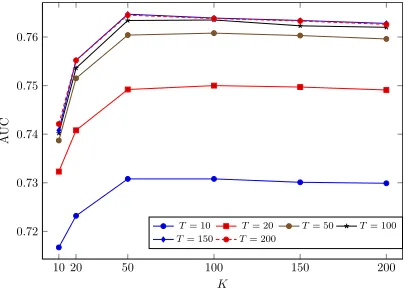
Figure 6: Performance of NT-MF based on out-of-matrix AUC for different values ofKandT.
In Figure 6 we investigate the effect of different values ofKandT. For each curve, we can see that
the performance is about the same forK≥50. This
is in accordance with the observation that NT-MF does not need as many latent factors as LDA-MF to achieve the same level of performance. Also, while increasing the number of topicsT improves the
per-formance in general, increasingT from 150 to 200
gives no signicant improvement. The most impor-tant observation is that the highest AUC is achieved whenK = 50andT = 150. In other words, the
op-timal number of topics is different from that of user latent factors. This further justies the advantage of NT-MF against previous methods.
5 Related Work
Although not directly aiming to solve the problem we have proposed, there exists some models of sim-ilar structure or adopt simsim-ilar ideas.
As previously mentioned, LDA-MF is similar in structure to CTR. Collaborative topic Poisson
fac-torization (CTPF) (Gopalan et al., 2014) combines the ideas of CTR and Poisson factorization (Gopalan et al., 2013) for a better performance. We have also tried CTPF on our dataset; nevertheless, there is no signicant improvement over LDA-MF.
Recently, the neighborhood-aware probabilistic matrix factorization (NHPMF) model is proposed (Wu et al., 2012) as a method to combinekNN and
PMF. It is originally proposed to leverage tagging data for improving PMF. This model can also be applied to our problem if we use the Twitter cor-pus in place of the unavailable tagging data. How-ever, in the NHPMF model, the mean parameters are not treated as constants when the user latent factors are updated. As a result, an extra term appears in the gradient formula, which leads to an O(k2)time
complexity, with k being the number of
nearest-neighbors considered. On the other hand, the com-putation of the weighted average (i.e. Eq. 6) takes O(k) time complexity. We have implemented
NH-PMF for comparison. As we increase k, NHPMF
becomes signicantly slower than NT-MF, while its performance is no better than NT-MF on our dataset.
6 Conclusion
In this work, we propose NT-MF, a cross-website transfer learning model which integrates content, neighborhood and rating information to alleviate the cold-start problem. A signicant improvement over previous methods is demonstrated on a real-world cross-website dataset. The improvement is even more signicant under the cold-start scenario.
So far we use the LDA topic vector to represent a user. As future work, different aspects of text can be taken into account to generate a more comprehen-sive user model. For example, writing styles or opin-ion mining may provide different insights on user behavior. Another possible extension is to apply our idea to more realistic settings such as large-scale and online recommender systems.
Acknowledgments
References
David M. Blei and John D. Lafferty. 2009. Topic models. In Text Mining: Theory and Applications. Taylor and Francis.
David M. Blei, Andrew Y. Ng, and Michael I. Jordan. 2003. Latent dirichlet allocation. J. Mach. Learn. Res., 3:9931022, March.
Robin Burke. 2002. Hybrid recommender systems: Survey and experiments. User Modeling and User-Adapted Interaction, 12(4):331370, November. Robin Burke. 2007. The adaptive web. chapter
Hy-brid Web Recommender Systems, pages 377408. Springer-Verlag, Berlin, Heidelberg.
Zhengyu Deng, Ming Yan, Jitao Sang, and Changsheng Xu. 2015. Twitter is faster: Personalized time-aware video recommendation from twitter to youtube. ACM Trans. Multimedia Comput. Commun. Appl., 11(2):31:131:23, January.
Prem Gopalan, Jake M. Hofman, and David M. Blei. 2013. Scalable recommendation with poisson factor-ization. CoRR, abs/1311.1704.
Prem Gopalan, Laurent Charlin, and David M. Blei. 2014. Content-based recommendations with pois-son factorization. In Z. Ghahramani, M. Welling, C. Cortes, N. D. Lawrence, and K. Q. Weinberger, ed-itors, Advances in Neural Information Processing Sys-tems 27, pages 31763184. Curran Associates, Inc. Jonathan L. Herlocker, Joseph A. Konstan, Al Borchers,
and John Riedl. 1999. An algorithmic framework for performing collaborative ltering. In Proceedings of the 22Nd Annual International ACM SIGIR Con-ference on Research and Development in Information Retrieval, SIGIR '99, pages 230237, New York, NY, USA. ACM.
Liangjie Hong and Brian D. Davison. 2010. Empirical study of topic modeling in twitter. In Proceedings of the First Workshop on Social Media Analytics, SOMA '10, pages 8088, New York, NY, USA. ACM. Bin Li, Qiang Yang, and Xiangyang Xue. 2009. Can
movies and books collaborate?: Cross-domain collab-orative ltering for sparsity reduction. In Proceedings of the 21st International Joint Conference on Artical Intelligence, IJCAI'09, pages 20522057, San Fran-cisco, CA, USA. Morgan Kaufmann Publishers Inc. Marius Muja and David G. Lowe. 2014. Scalable nearest
neighbor algorithms for high dimensional data. Pat-tern Analysis and Machine Intelligence, IEEE Trans-actions on, 36.
Rong Pan, Yunhong Zhou, Bin Cao, Nathan Nan Liu, Ra-jan M. Lukose, Martin Scholz, and Qiang Yang. 2008. One-class collaborative ltering. In Proceedings of the 8th IEEE International Conference on Data Min-ing (ICDM 2008), December 15-19, 2008, Pisa, Italy, pages 502511.
Michael J. Pazzani and Daniel Billsus. 2007. The adaptive web. chapter Content-based Recommenda-tion Systems, pages 325341. Springer-Verlag, Berlin, Heidelberg.
Suman Deb Roy, Tao Mei, Wenjun Zeng, and Shipeng Li. 2012. Socialtransfer: Cross-domain transfer learning from social streams for media applications. In Pro-ceedings of the 20th ACM International Conference on Multimedia, MM '12, pages 649658, New York, NY, USA. ACM.
Ruslan Salakhutdinov and Andriy Mnih. 2007. Proba-bilistic matrix factorization. In Advances in Neural In-formation Processing Systems 20, Proceedings of the Twenty-First Annual Conference on Neural Informa-tion Processing Systems, Vancouver, British Columbia, Canada, December 3-6, 2007, pages 12571264. Yue Shi, Martha Larson, and Alan Hanjalic. 2011. Tags
as bridges between domains: Improving recommenda-tion with tag-induced cross-domain collaborative l-tering. In Proceedings of the 19th International Con-ference on User Modeling, Adaption, and Personaliza-tion, UMAP'11, pages 305316, Berlin, Heidelberg. Springer-Verlag.
Chong Wang and David M. Blei. 2011. Collaborative topic modeling for recommending scientic articles. In Proceedings of the 17th ACM SIGKDD Interna-tional Conference on Knowledge Discovery and Data Mining, KDD '11, pages 448456, New York, NY, USA. ACM.